


 Скачать презентацию Overview of Process Safety Green Engineering and Inherently
dbb4fd4ec9143a0bffb6202f04c87c6e.ppt
- Количество слайдов: 64
 Overview of Process Safety, Green Engineering, and Inherently Safer Design Harry J. Toups LSU Department of Chemical Engineering with significant material from SACHE 2003 Workshop presentation entitled: Inherently Safer Design, by Dennis Hendershot Rohm and Haas Company 1
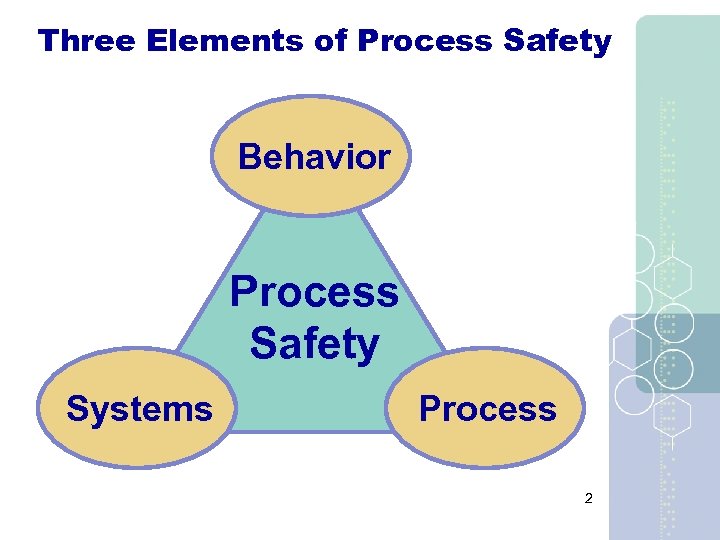 Three Elements of Process Safety Behavior Process Safety Systems Process 2
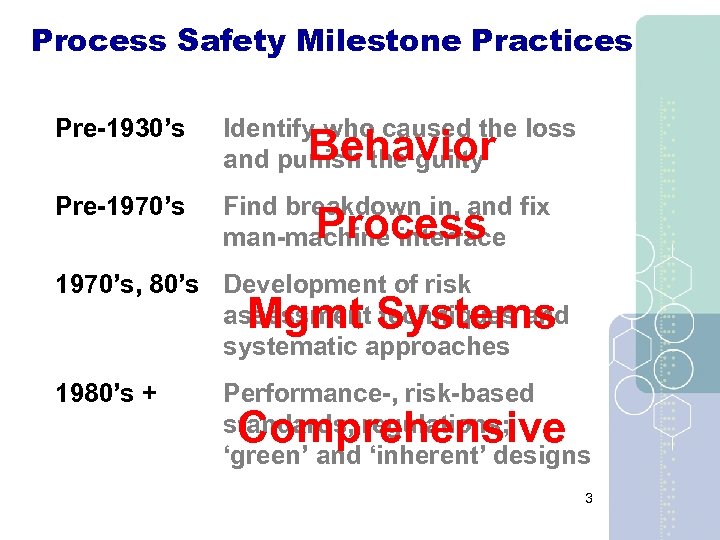 Process Safety Milestone Practices Pre-1930’s Identify who caused the loss and punish the guilty Pre-1970’s Find breakdown in, and fix man-machine interface Behavior Process 1970’s, 80’s Development of risk assessment techniques and systematic approaches Mgmt Systems 1980’s + Performance-, risk-based standards, regulations; ‘green’ and ‘inherent’ designs Comprehensive 3
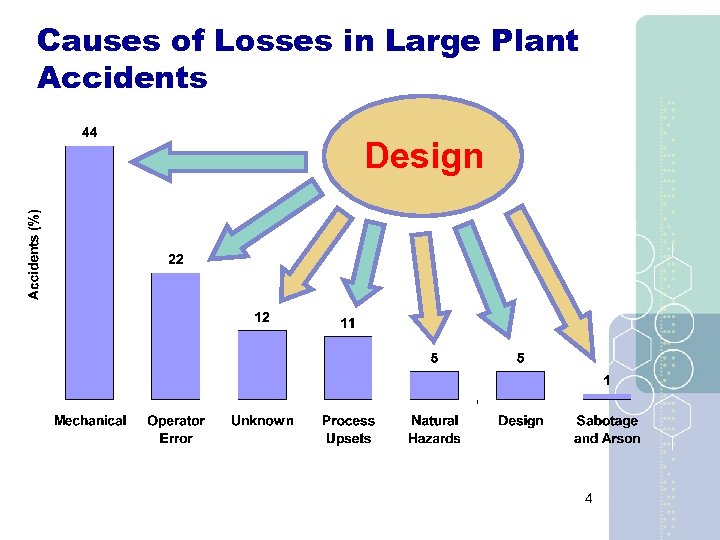 Causes of Losses in Large Plant Accidents Process Design 4
 Green chemistry and engineering – A Definition The design, commercialization, and use of chemical processes and products, which are feasible and economical while minimizing: 1) generation of pollution at the source, and 2) risk to human health and the environment. 5
 New paradigm for the environment • Traditional environmental approach – “End of pipe” waste treatment – “Waste minimization” – an advance, but we can go further • Green chemistry and engineering – Eliminate or dramatically reduce hazards to the environment 6
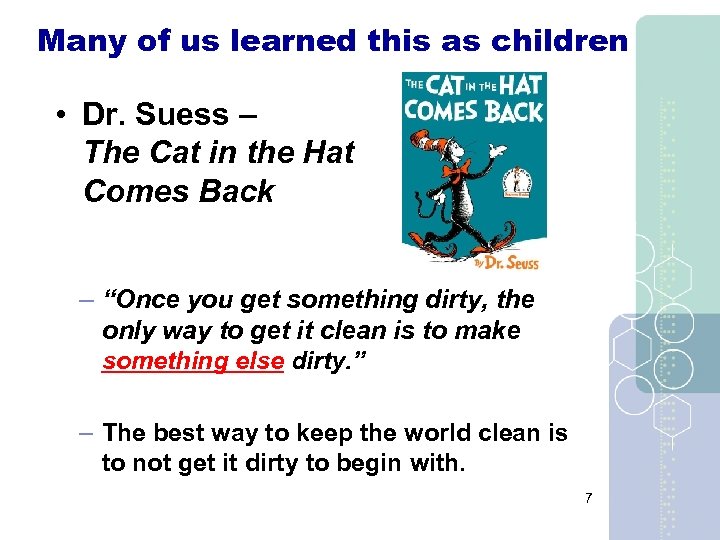 Many of us learned this as children • Dr. Suess – The Cat in the Hat Comes Back – “Once you get something dirty, the only way to get it clean is to make something else dirty. ” – The best way to keep the world clean is to not get it dirty to begin with. 7
 Inherently Safer Design – A Definition The design of chemical processes and products with specific attention to eliminating hazards from the manufacturing process rather than relying on the control of these hazards Notice the common philosophy to Green Engineering? 8
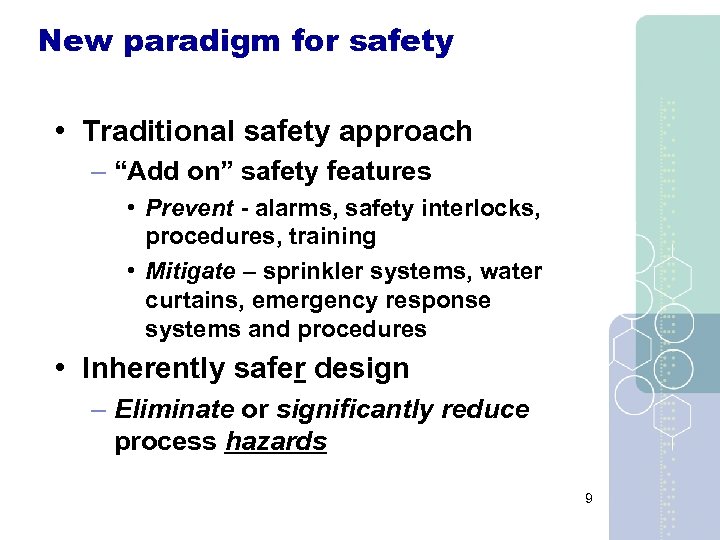 New paradigm for safety • Traditional safety approach – “Add on” safety features • Prevent - alarms, safety interlocks, procedures, training • Mitigate – sprinkler systems, water curtains, emergency response systems and procedures • Inherently safer design – Eliminate or significantly reduce process hazards 9
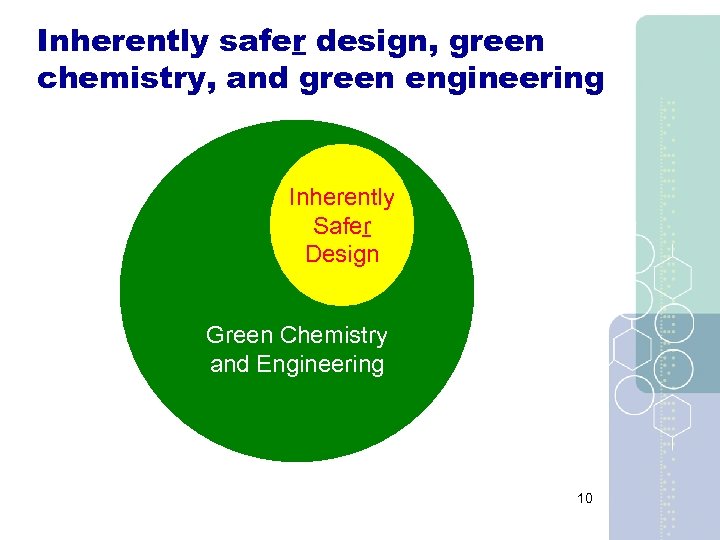 Inherently safer design, green chemistry, and green engineering Inherently Safer Design Green Chemistry and Engineering 10
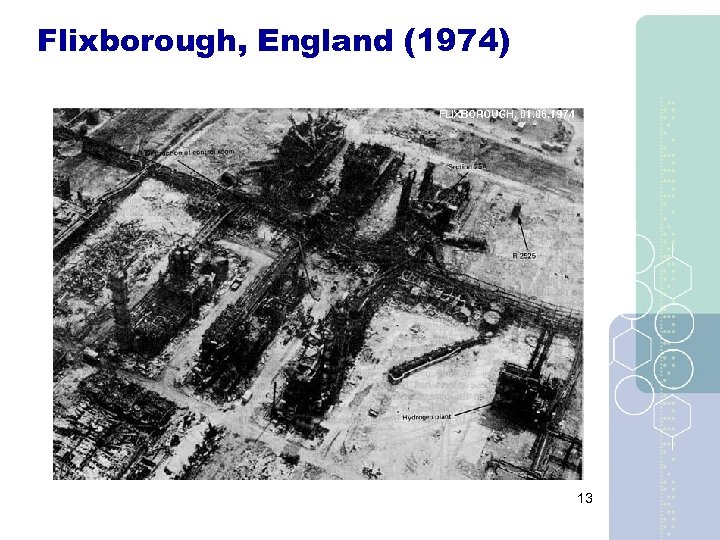
 Why are we interested in inherently safer design? 11
 Flixborough, England (1974) 12
 Flixborough, England (1974) 13
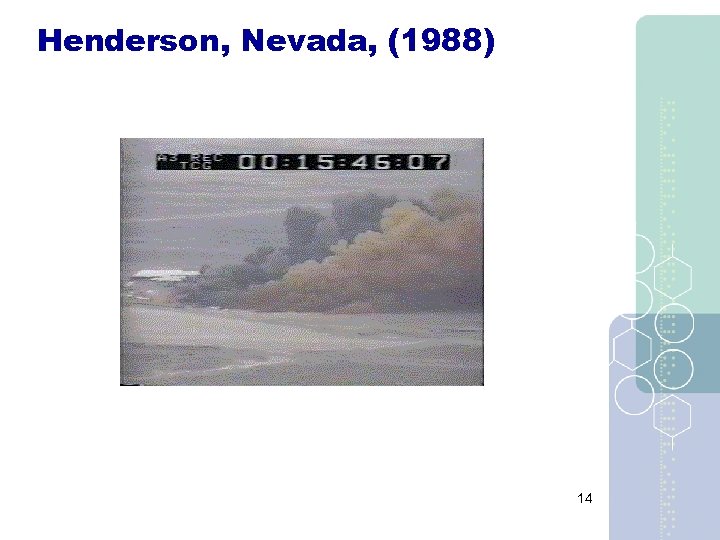 Henderson, Nevada, (1988) 14
 What is inherently safer design? • Inherent - “existing in something as a permanent and inseparable element. . . ” – safety “built in”, not “added on” • Eliminate or minimize hazards rather than control hazards • More a philosophy and way of thinking than a specific set of tools and methods – Applicable at all levels of design and operation from conceptual design to plant operations • “Safer, ” not “Safe” 15
 Hazard • An inherent physical or chemical characteristic that has the potential for causing harm to people, the environment, or property (CCPS, 1992). • Hazards are intrinsic to a material, or its conditions of use. • Examples – Phosgene - toxic by inhalation – Acetone - flammable – High pressure steam - potential energy due to pressure, high temperature 16
 To eliminate hazards: • Eliminate the material • Change the conditions of use 17
 Chemical Process Safety Strategies 18
 Inherent • Eliminate or reduce the hazard by changing to a process or materials which are non-hazardous or less hazardous • Integral to the product, process, or plant cannot be easily defeated or changed without fundamentally altering the process or plant design • EXAMPLE – Substituting water for a flammable solvent (latex paints compared to oil base paints) 19
 Passive • Minimize hazard using process or equipment design features which reduce frequency or consequence without the active functioning of any device • EXAMPLE – Containment dike around a hazardous material storage tank 20
 Active • Controls, safety interlocks, automatic shut down systems • Multiple active elements – Sensor - detect hazardous condition – Logic device - decide what to do – Control element - implement action • Prevent incidents, or mitigate the consequences of incidents • EXAMPLE – High level alarm in a tank shuts automatic feed valve • Caution: Even protective systems can cause incidents! (See Hendershot et al handouts) 21
 Procedural • Standard operating procedures, safety rules and standard procedures, emergency response procedures, training • EXAMPLE – Confined space entry procedures 22
 Batch Chemical Reactor Example Hazard of concern • Runaway reaction causing high temperature and pressure and potential reactor rupture 23
 Passive • Maximum adiabatic pressure for reaction determined to be 150 psig • Run reaction in a 250 psig design reactor • Hazard (pressure) still exists, but passively contained by the pressure vessel 24
 Active • Maximum adiabatic pressure for 100% reaction is 150 psig, reactor design pressure is 50 psig • Gradually add limiting reactant with temperature control to limit potential energy from reaction • Use high temperature and pressure interlocks to stop feed and apply emergency cooling • Provide emergency relief system 25
 Procedural • Maximum adiabatic pressure for 100% reaction is 150 psig, reactor design pressure is 50 psig • Gradually add limiting reactant with temperature control to limit potential energy from reaction • Train operator to observe temperature, stop feeds and apply cooling if temperature exceeds critical operating limit 26
 Inherent • Develop chemistry which is not exothermic, or mildly exothermic – Maximum adiabatic exotherm temperature < boiling point of all ingredients and onset temperature of any decomposition or other reactions 27
 Which strategy should we use? • Generally, in order of robustness and reliability: – Inherent – Passive – Active – Procedural • But - there is a place and need for ALL of these strategies in a complete safety program 28
 Inherently Safer Design Strategies 29
 Inherently Safer Design Strategies • • Minimize Moderate Substitute Simplify 30
 Minimize • Use small quantities of hazardous substances or energy – Storage – Intermediate storage – Piping – Process equipment • “Process Intensification” 31
 Benefits • Reduced consequence of incident (explosion, fire, toxic material release) • Improved effectiveness and feasibility of other protective systems – for example: – Secondary containment – Reactor dump or quench systems 32
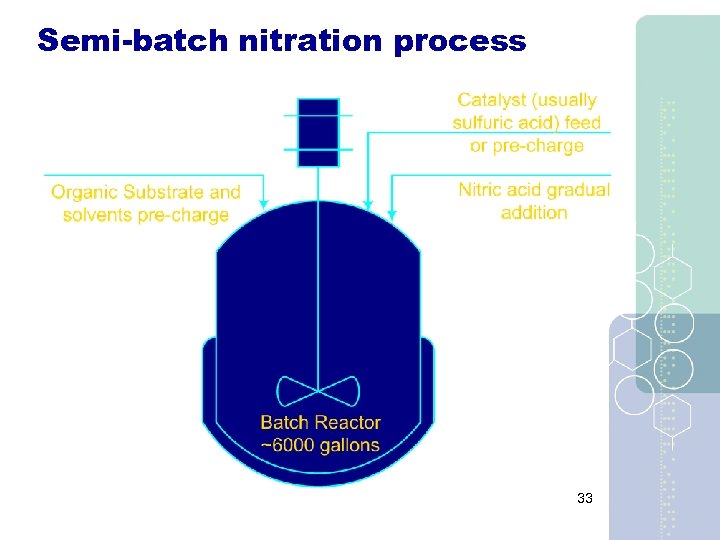 Semi-batch nitration process 33
 How can Process Intensification be used in this reaction? • Mixing – bringing reactants into contact with each other • Mass transfer – from aqueous phase (nitric acid) to organic phase (organic substrate) • Heat removal 34
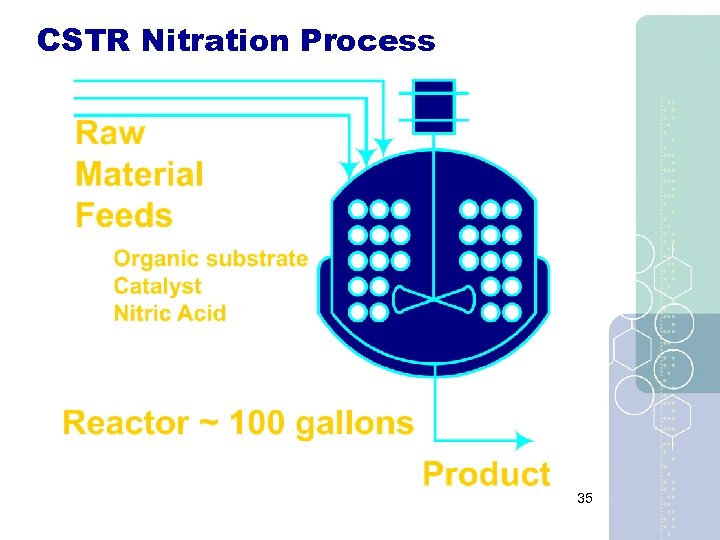 CSTR Nitration Process 35
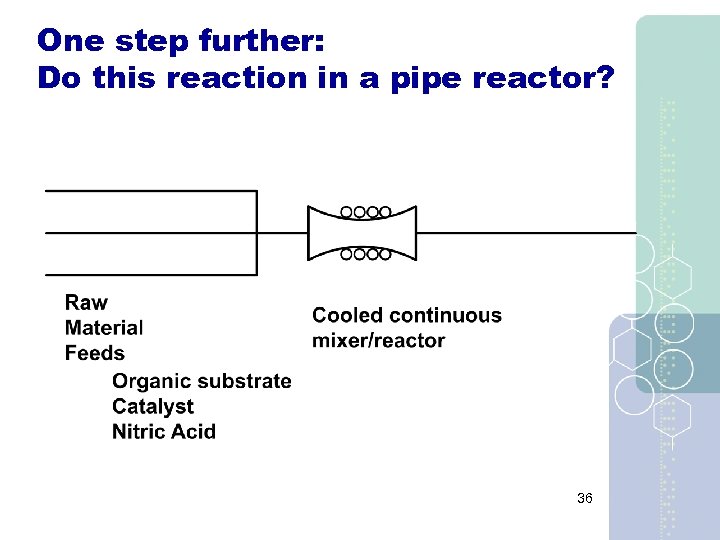 One step further: Do this reaction in a pipe reactor? 36
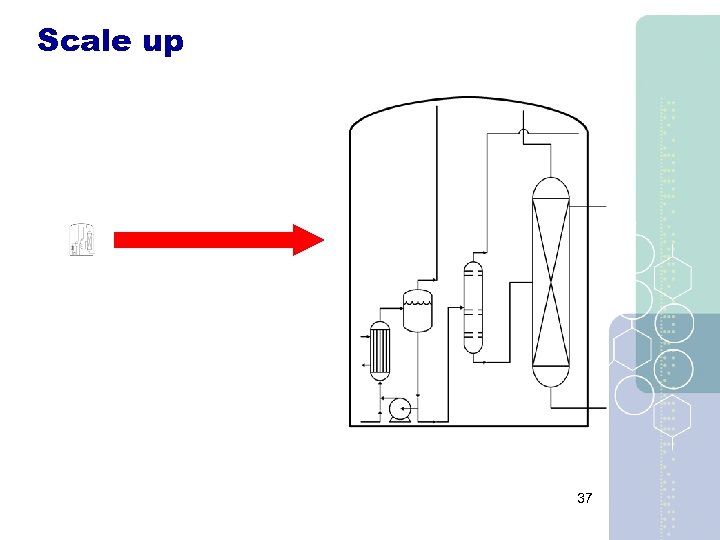 Scale up 37
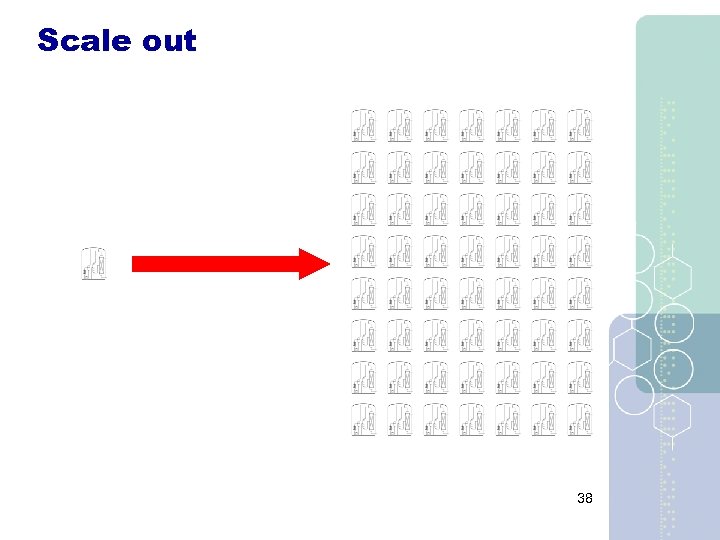 Scale out 38
 On-demand phosgeneration • • Continuous process to produce phosgene Phosgene consumers are batch processes No phosgene storage Engineering challenges – Rapid startup and shutdown – Quality control – Instrumentation and dynamic process control – Disposal of “tail gas” and inerts 39
 Moderate • • • Dilution Refrigeration Less severe processing conditions Physical characteristics Containment – Better described as “passive” rather than “inherent” 40
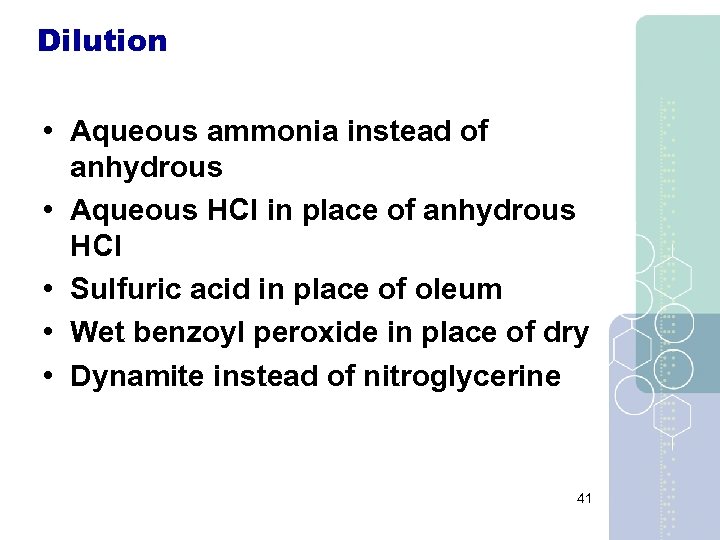 Dilution • Aqueous ammonia instead of anhydrous • Aqueous HCl in place of anhydrous HCl • Sulfuric acid in place of oleum • Wet benzoyl peroxide in place of dry • Dynamite instead of nitroglycerine 41
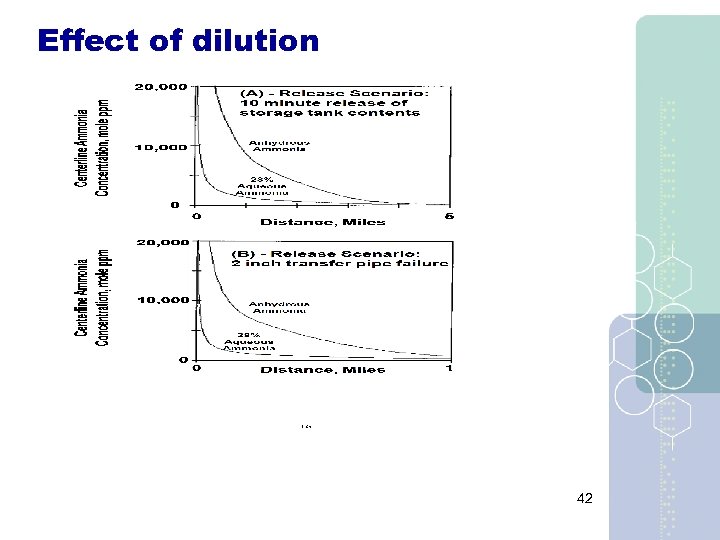 Effect of dilution 42
 Less severe processing conditions • Ammonia manufacture – 1930 s - pressures up to 600 bar – 1950 s - typically 300 -350 bar – 1980 s - plants operating at pressures of 100 -150 bar were being built • Result of understanding and improving the process • Lower pressure plants are cheaper, more efficient, as well as safer 43
 Substitute • Substitute a less hazardous reaction chemistry • Replace a hazardous material with a less hazardous alternative 44
 Substitute materials • Water based coatings and paints in place of solvent based alternatives – Reduce fire hazard – Less toxic – Less odor – More environmentally friendly – Reduce hazards for end user and also for the manufacturer 45
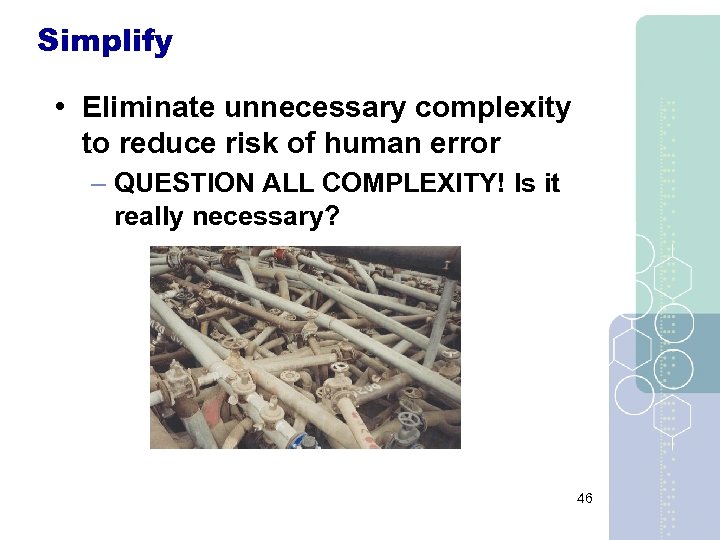 Simplify • Eliminate unnecessary complexity to reduce risk of human error – QUESTION ALL COMPLEXITY! Is it really necessary? 46
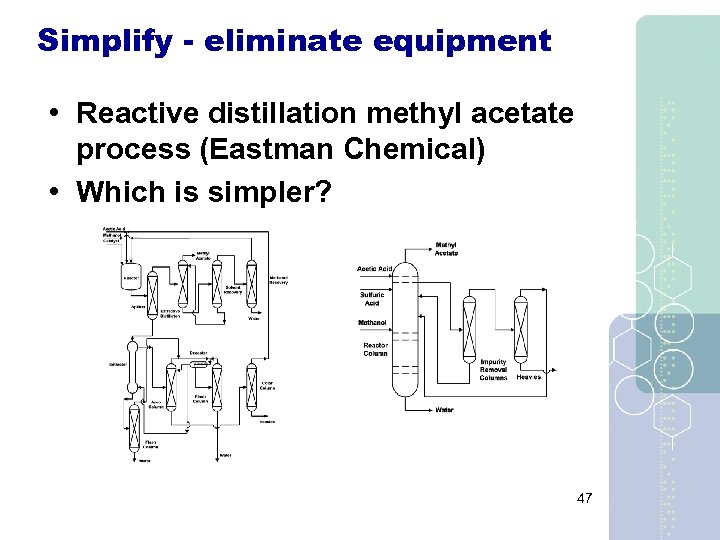 Simplify - eliminate equipment • Reactive distillation methyl acetate process (Eastman Chemical) • Which is simpler? 47
 Modified methyl acetate process • • Fewer vessels Fewer pumps Fewer flanges Fewer instruments Fewer valves Less piping. . . 48
 But, it isn’t simpler in every way • Reactive distillation column itself is more complex • Multiple unit operations occur within one vessel • More complex to design • More difficult to control and operate 49
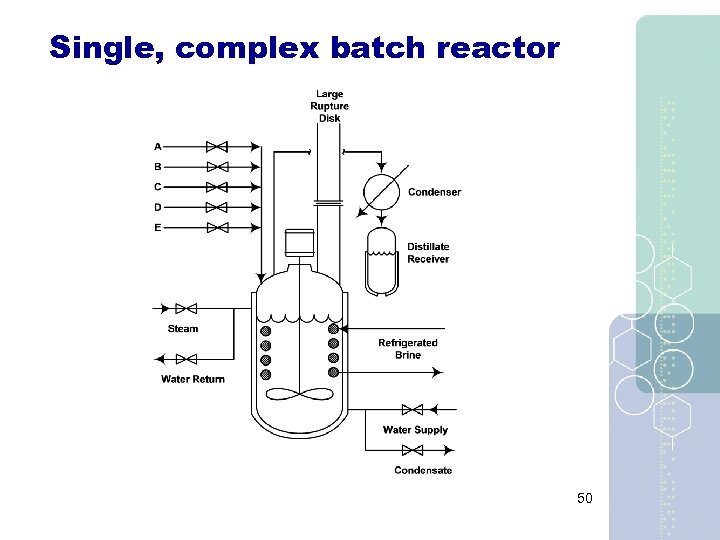 Single, complex batch reactor 50
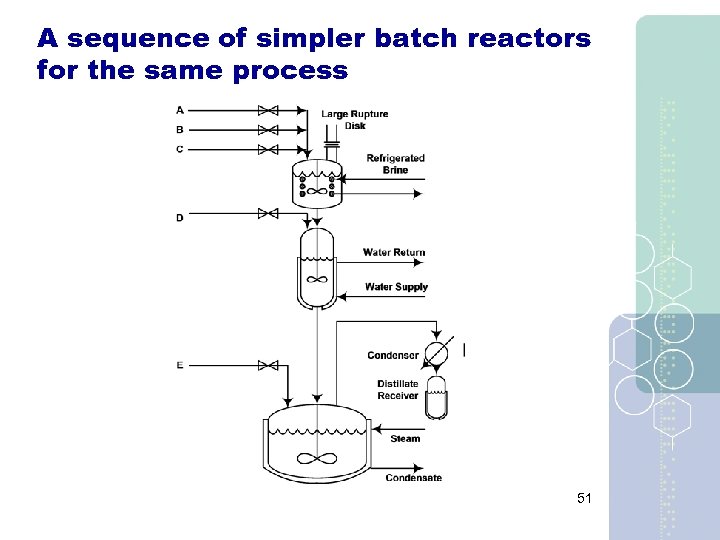 A sequence of simpler batch reactors for the same process 51
 Inherent safety conflicts • In the previous example – Each vessel is simpler • But – There are now three vessels, the overall plant is more complex in some ways – Compare to methyl acetate example • Need to understand specific hazards for each situation to decide what is best 52
 Conflicts and Tradeoffs 53
 Some problems • The properties of a technology which make it hazardous may be the same as the properties which make it useful: – Airplanes travel at 600 mph – Gasoline is flammable • Any replacement must have the ability to store a large quantity of energy in a compact form – Chlorine is toxic • Control of the hazard is the critical issue in safely getting the benefits of the technology 54
 Multiple hazards • Everything has multiple hazards – Automobile travel • velocity (energy), flammable fuel, exhaust gas toxicity, hot surfaces, pressurized cooling system, electricity. . . – Chemical process or product • acute toxicity, flammability, corrosiveness, chronic toxicity, various environmental impacts, reactivity. . . . 55
 What does inherently safer mean? • Inherently safer is in the context of one or more of the multiple hazards • There may be conflicts – Example - CFC refrigerants • low acute toxicity, not flammable • potential for environmental damage, long term health impacts • Are they inherently safer than alternatives such as propane (flammable) or ammonia (flammable and toxic)? 56
 Inherently safer hydrocarbon based refrigerators? • Can we redesign the refrigeration machine to minimize the quantity of refrigerant sufficiently that we could still regard it as inherently safer? – Home refrigerators – perhaps (<120 grams) – Industrial scale applications – probably not, need to rely on passive, active, procedural risk management strategies 57
 Multiple impacts • Different populations may perceive the inherent safety of different technology options differently • Example - chlorine handling - 1 ton cylinders vs. a 90 ton rail car – A neighbor two miles away? – An operator who has to connect and disconnect cylinders 90 times instead of a rail car once? • Who is right? 58
 Inherently safer = safer • Air travel – several hundred people – 5 miles up – control in 3 dimensions – 600 mph – thousands of gallons of fuel – passengers in a pressure vessel –. . l l l • Automobile travel – a few people – on the ground – control in 2 dimensions – 60 mph – a few gallons of fuel – might even be a convertible –. . Automobile travel is inherently safer But, what is the safest way to travel from Washington to Los Angeles? Why? 59
 At what level of design should engineers consider inherently safer design? • Selecting Technology? Plant Design? Equipment Details? Operations? • Best answer? – All levels! • Inherently safer design is not a meeting. • Inherently safer design is a way of thinking, a way of approaching technology design at every level of detail – part of the daily thought process. 60
 Questions a designer should ask when he has identified a hazard In this order 1. Can I eliminate this hazard? 2. If not, can I reduce the magnitude of the hazard? 3. Do the alternatives identified in questions 1 and 2 increase the magnitude of any other hazards, or create new hazards? 4. At this point, what technical and management systems are required to manage the hazards which inevitably will remain? 61
 The Future: Inherently safer design • Some hazardous materials and processes can be eliminated or the hazards dramatically reduced. • The useful characteristics of other materials or processes make their continued use essential to society for the foreseeable future … we will continue to manage the risks. • E. g. , Air travel 62
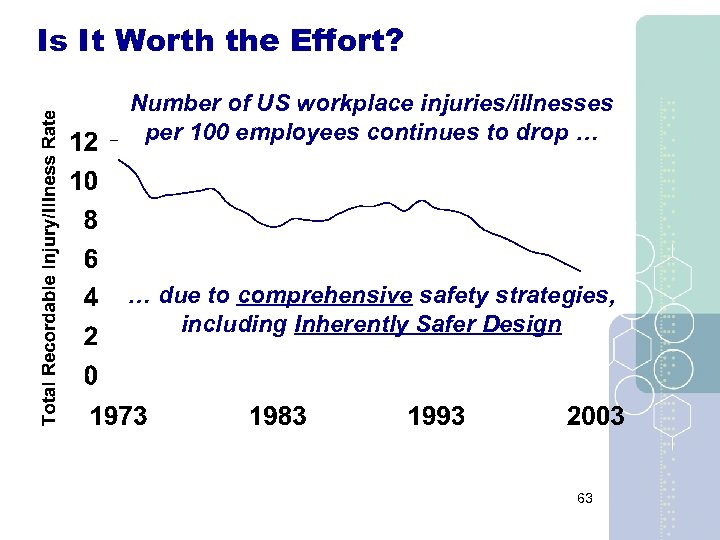 Is It Worth the Effort? Number of US workplace injuries/illnesses per 100 employees continues to drop … … due to comprehensive safety strategies, including Inherently Safer Design 63
 END OF PRESENTATION 64