


 Скачать презентацию Overview of Office of Analysis and Epidemiology Diane
ce93cdfe762a4b00ad86123fff1be3f9.ppt
- Количество слайдов: 36
 Overview of Office of Analysis and Epidemiology Diane Makuc, Dr. P. H. January 23, 2004 U. S. DEPARTMENT OF HEALTH AND HUMAN SERVICES Centers for Disease Control and Prevention National Center for Health Statistics
 Office of Analysis and Epidemiology (OAE) History • Office started by former NCHS Director Dorothy Rice in mid-1970’s. • Jack Feldman was Office Director for more than 20 years. Role • Cross-cutting analytic program • Collaborative projects with others in NCHS, CDC, HHS, and beyond
 OAE Organization Interdisciplinary staff organized into units that focus on: • Health, United States • Healthy People 2010 • Aging and chronic disease • Infant, child, and women’s health • Injury and disability • File linkage
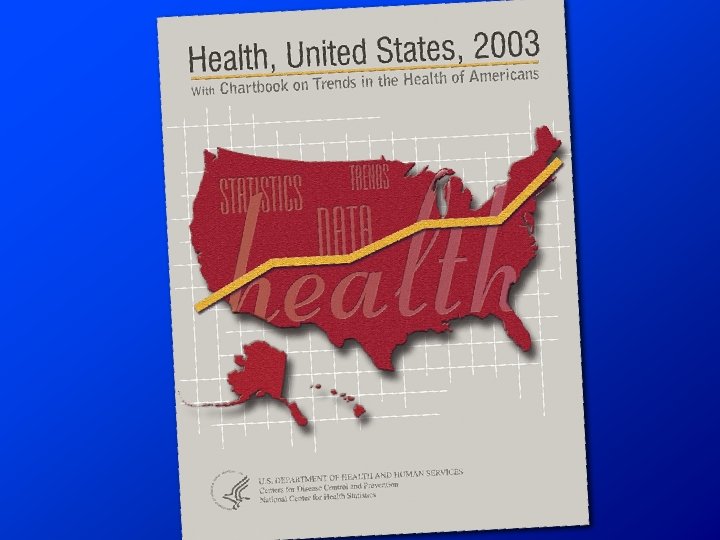
 OAE Activities • Monitoring the health of the Nation • Assessing and developing health data • Interagency/international collaborations to improve data • Research on significant health issues and methods • Training • Disseminating data electronically
 Monitoring the Health of the Nation
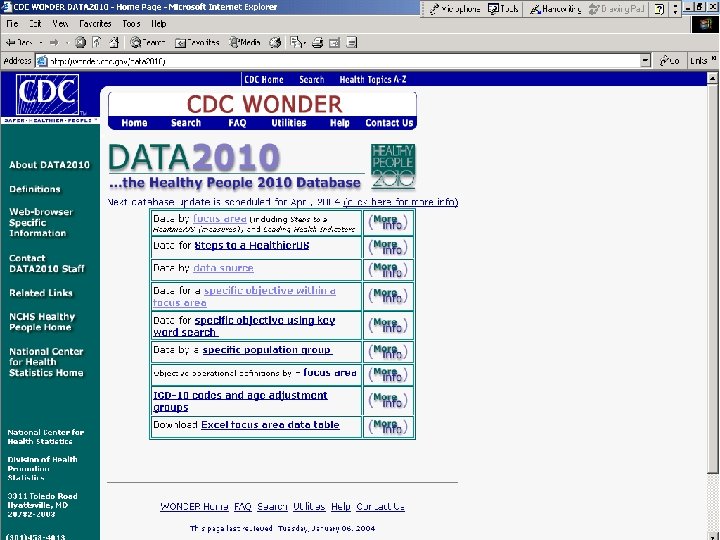
 Healthy People 2010 • HHS health promotion and disease prevention agenda for the nation • 2 overarching national goals: • Increase quality and years of healthy life • Eliminate disparities in health • 467 specific objectives • NCHS provides expertise and data for tracking progress
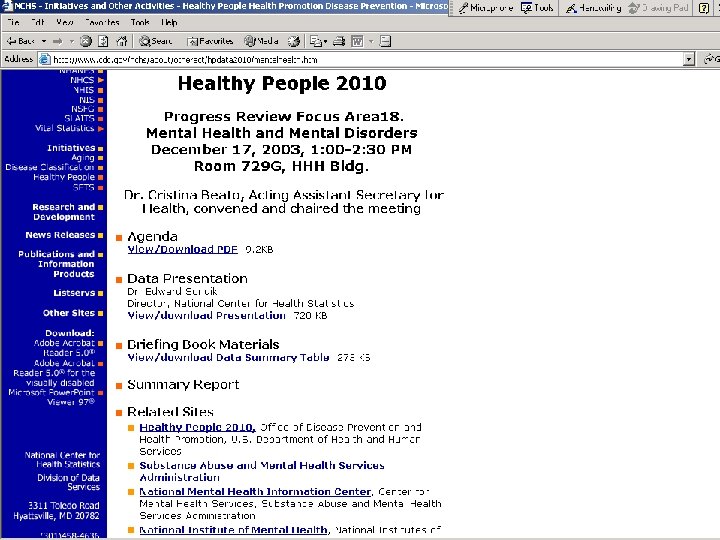
 Healthy People 2010 Progress Reviews • Monthly meeting chaired by Assistant Secretary for Health • Covers one of 28 focus areas each month (e. g. heart disease and stroke, tobacco use, mental health, etc. ) • NCHS presents data tracking progress towards objectives • Data presentations available on web
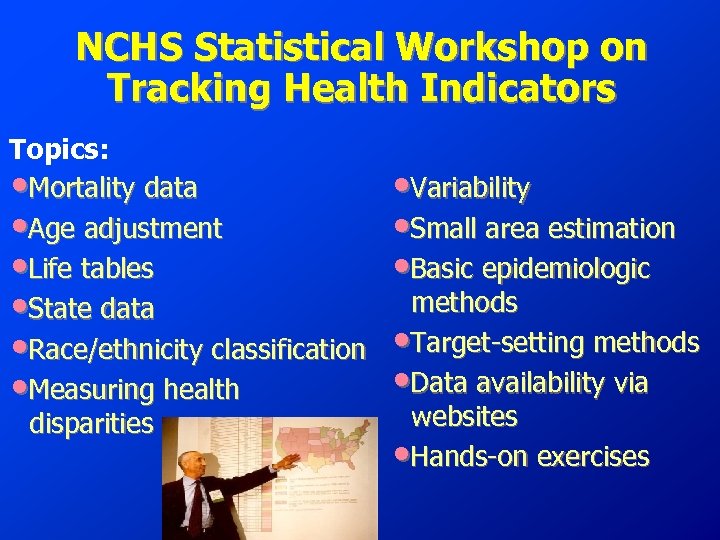 NCHS Statistical Workshop on Tracking Health Indicators Topics: • Mortality data • Age adjustment • Life tables • State data • Race/ethnicity classification • Measuring health disparities • Variability • Small area estimation • Basic epidemiologic methods • Target-setting methods • Data availability via websites • Hands-on exercises
 Assessing and Developing Health Data
 NCHS Automated Tracking System • Tracks current addresses of NCHS survey participants. • Current addresses facilitate possible recontacts and enhance file linkages. • Uses Post Office mailout and National Change of Address data base.
 File Linkage • NCHS survey data files are being linked to other files to enhance their usefulness for research and policy analysis. • File linkage adds prospective data on morbidity, health care use, and mortality to cross-sectional and longitudinal surveys.
 NCHS Surveys with Current Linkage Activities • National Health Interview Survey (NHIS) • National Health and Nutrition Examination Surveys (NHANES) • Second Longitudinal Study on Aging (LSOA II) • Baseline: 1994 NHIS Supplement on Aging for ages 70+ • Followup: 1997 -98 and 1999 -2000
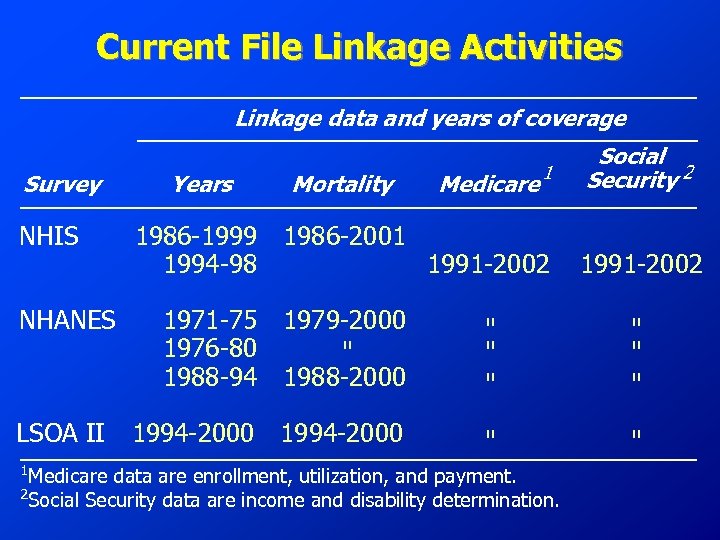 Current File Linkage Activities Linkage data and years of coverage Survey NHIS NHANES LSOA II 1 Years Mortality Medicare 1 1986 -1999 1986 -2001 1994 -98 1991 -2002 Social Security 2 1991 -2002 1971 -75 1979 -2000 1976 -80 " 1988 -94 1988 -2000 " " " 1994 -2000 " " Medicare data are enrollment, utilization, and payment. 2 Social Security data are income and disability determination.
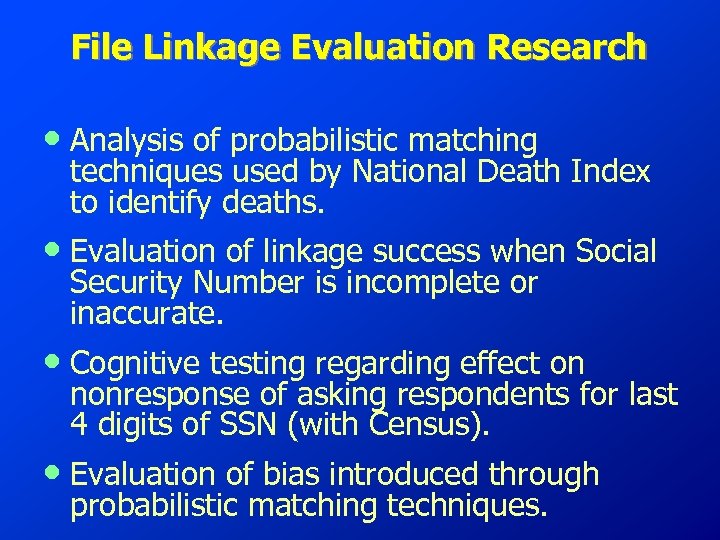 File Linkage Evaluation Research • Analysis of probabilistic matching techniques used by National Death Index to identify deaths. • Evaluation of linkage success when Social Security Number is incomplete or inaccurate. • Cognitive testing regarding effect on nonresponse of asking respondents for last 4 digits of SSN (with Census). • Evaluation of bias introduced through probabilistic matching techniques.
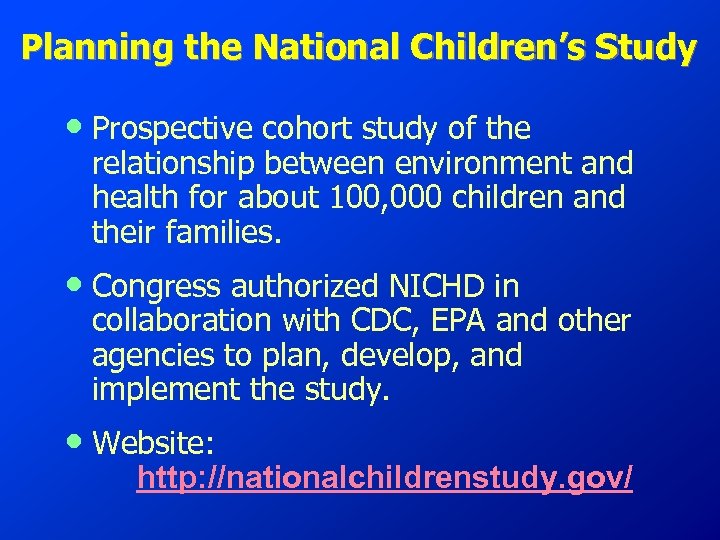 Planning the National Children’s Study • Prospective cohort study of the relationship between environment and health for about 100, 000 children and their families. • Congress authorized NICHD in collaboration with CDC, EPA and other agencies to plan, develop, and implement the study. • Website: http: //nationalchildrenstudy. gov/
 Interagency and International Collaborations to Improve Health Data
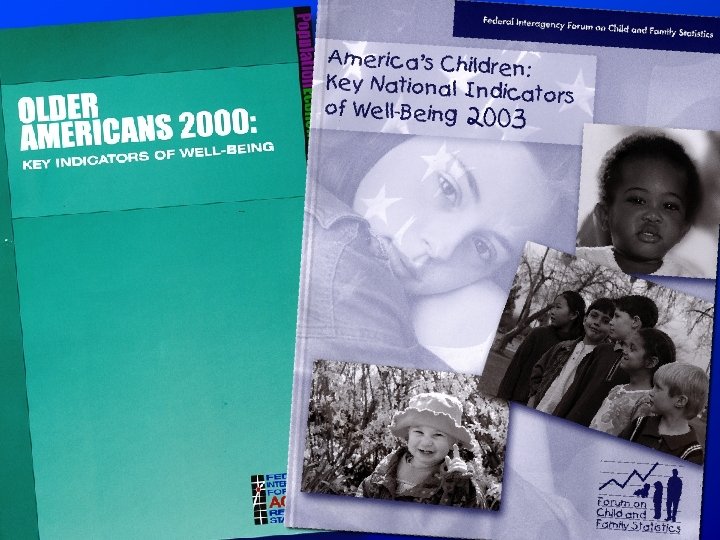
 Federal Interagency Forums • Forum on Child and Family Statistics Website: www. childstats. gov • Forum on Aging-related Statistics Website: www. agingstats. gov • Work to improve collection, reporting, and dissemination of data • Publish reports on Key Indicators of Wellbeing
 International Collaborative Effort (ICE) on Injury Statistics • Participants: 15 countries and organizations • Addresses issues in collecting, coding, and grouping injury data to improve comparability and quality of data. • 10 th year • Major products include: • External cause of injury matrix for mortality • Barell Matrix for morbidity data Website: www. cdc. gov/nchs/advice. htm
 Research on Significant Health Issues and Methods
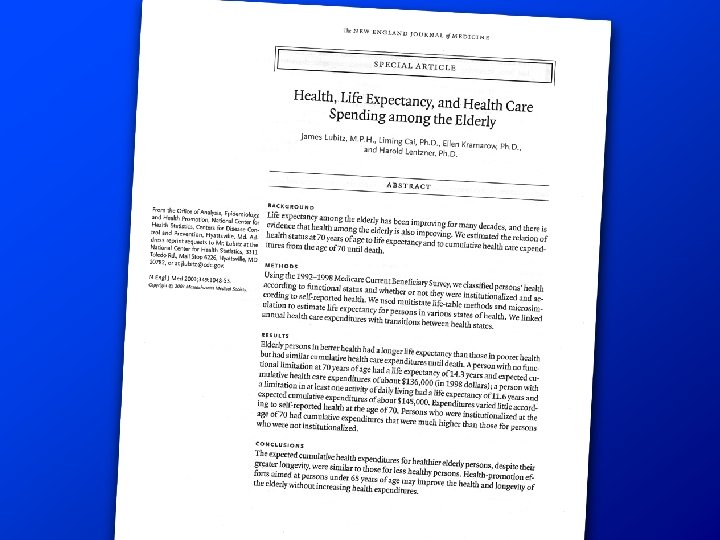
 Selected Research Areas: Aging Trends in summary measures of health • Life expectancy and lifetime health spending by health state • Trends in healthy life expectancy and compression of morbidity Mental health of the elderly • Prevalence of depression and GAD • Trends in the use of mental health services • Relation of disability to depression Prescription drug use among the elderly
 Selected Research Areas: Infant and Child Health • Socioeconomic and racial/ethnic differences in maternal, infant, and child health • Outcomes of multiple pregnancies • Asthma morbidity and mortality • ADHD • Use of psychotropic drugs • Risk of injury
 Selected Research Areas: Injury deaths: 2001 • Collaboration with Mortality Statistics Branch • First of annual series on injury mortality • Detailed data needed for injury prevention • Uses external cause of injury mortality matrix • Mechanism (fall, motor vehicle traffic. . . ) • Intent (unintentional, homicide, suicide…) • Uses multiple cause of death data to identify nature of injury (head, thorax, …)
 Selected Research Areas: Race-bridging • Collaborative project to bridge the transition from single-race to multiple-race Federal data collection standards. • Statistical models developed to assign multiplerace population counts collected from Census 2000 to single-race categories. • Used to create single-race population estimates to estimate birth and death rates. • Evaluation of models and population estimates is ongoing.
 Training (Undergraduate to Post-doctoral) Epidemic Intelligence Service (EIS) (2 years) Fellows (1 -2 years) • ASPH • ATPM Interns (3 months) • ASPH • JPSM • Hispanic Association of Colleges and Universities (HACU)
 Disseminating Data Electronically
 Disseminating data electronically Interactive tables on web and CD using 20/20 software • Trends in Health and Aging • Healthy Women (State data by race) • Asthma-related trends (under development) Data 2010 on web Health, US on web Compressed mortality file – on web and CD (County level mortality and population data)
 Data Warehouse on Trends in Health and Aging • Topics include life expectancy, functional status, healthcare use and costs, chronic conditions, insurance, mortality…. • Aggregated by age, sex, race/ethnicity • Trends from as early as 1900, regular updates • Focus on older adults, also has younger groups
 Data Warehouse on Trends in Health and Aging (cont’d) • Access on web and CD • Tables (charts, maps, explanatory notes) • Website: www. cdc. gov/nchs/agingact. htm
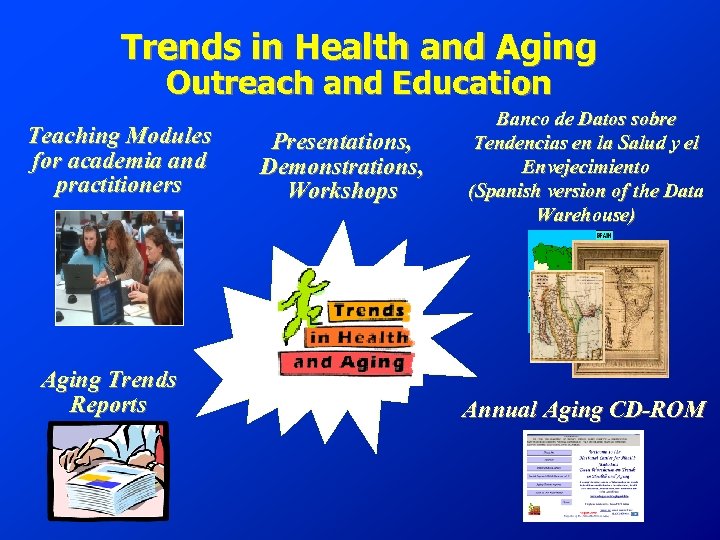 Trends in Health and Aging Outreach and Education Teaching Modules for academia and practitioners Aging Trends Reports Presentations, Demonstrations, Workshops Banco de Datos sobre Tendencias en la Salud y el Envejecimiento (Spanish version of the Data Warehouse) Annual Aging CD-ROM
 OAE Funding Sources • National Institute on Aging (NIA) • National Institute for Child Health and Development (NICHD) • NIH Office of Behavioral and Social Sciences Research (OBSSR) • HHS Office of Assistant Secretary for Planning and Evaluation (ASPE) • Environmental Protection Agency (EPA)