


 Скачать презентацию Overview of NSO and Advanced Design Studies Farrokh
c9a0b3aa0cb64d09771ade4e45c9de19.ppt
- Количество слайдов: 19
 Overview of NSO and Advanced Design Studies Farrokh Najmabadi OFES Budget Meeting April 4 -6, 2000 OFES Headquarters, Germantown Electronic copy: http: //aries. ucsd. edu/najmabadi/TALKS ARIES Web Site: http: //aries. ucsd. edu/ARIES
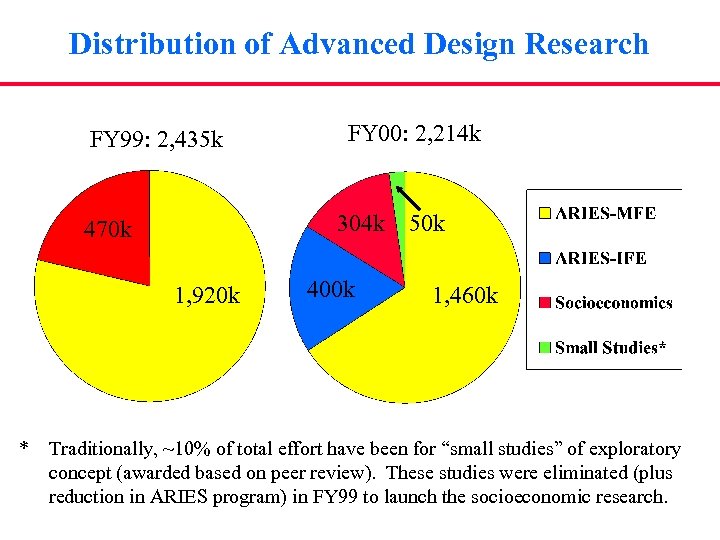 Distribution of Advanced Design Research FY 99: 2, 435 k FY 00: 2, 214 k 304 k 50 k 470 k 1, 920 k 400 k 1, 460 k * Traditionally, ~10% of total effort have been for “small studies” of exploratory concept (awarded based on peer review). These studies were eliminated (plus reduction in ARIES program) in FY 99 to launch the socioeconomic research.
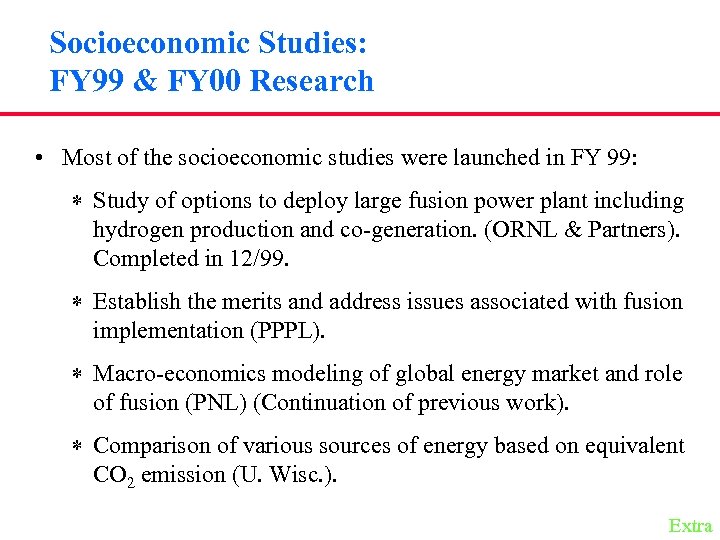 Socioeconomic Studies: FY 99 & FY 00 Research • Most of the socioeconomic studies were launched in FY 99: * Study of options to deploy large fusion power plant including hydrogen production and co-generation. (ORNL & Partners). Completed in 12/99. * Establish the merits and address issues associated with fusion implementation (PPPL). * Macro-economics modeling of global energy market and role of fusion (PNL) (Continuation of previous work). * Comparison of various sources of energy based on equivalent CO 2 emission (U. Wisc. ). Extra
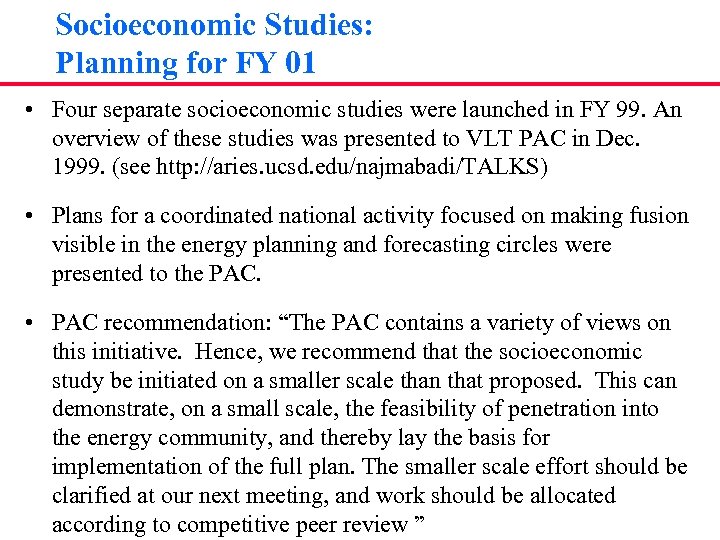 Socioeconomic Studies: Planning for FY 01 • Four separate socioeconomic studies were launched in FY 99. An overview of these studies was presented to VLT PAC in Dec. 1999. (see http: //aries. ucsd. edu/najmabadi/TALKS) • Plans for a coordinated national activity focused on making fusion visible in the energy planning and forecasting circles were presented to the PAC. • PAC recommendation: “The PAC contains a variety of views on this initiative. Hence, we recommend that the socioeconomic study be initiated on a smaller scale than that proposed. This can demonstrate, on a small scale, the feasibility of penetration into the energy community, and thereby lay the basis for implementation of the full plan. The smaller scale effort should be clarified at our next meeting, and work should be allocated according to competitive peer review ”
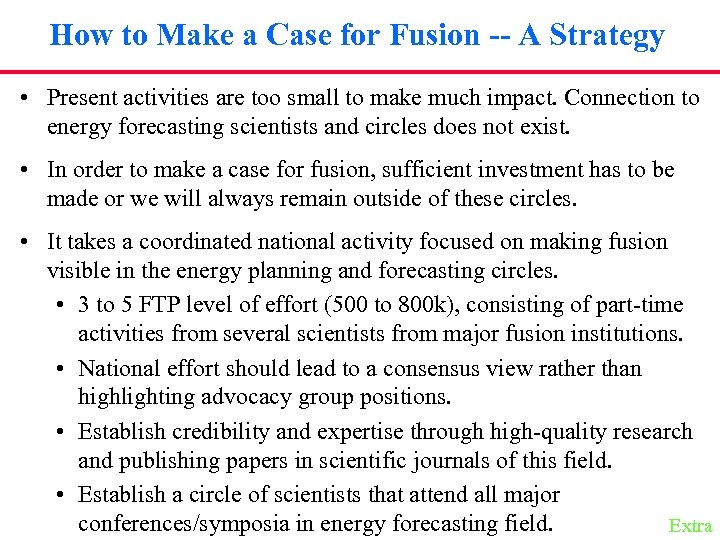 How to Make a Case for Fusion -- A Strategy • Present activities are too small to make much impact. Connection to energy forecasting scientists and circles does not exist. • In order to make a case for fusion, sufficient investment has to be made or we will always remain outside of these circles. • It takes a coordinated national activity focused on making fusion visible in the energy planning and forecasting circles. • 3 to 5 FTP level of effort (500 to 800 k), consisting of part-time activities from several scientists from major fusion institutions. • National effort should lead to a consensus view rather than highlighting advocacy group positions. • Establish credibility and expertise through high-quality research and publishing papers in scientific journals of this field. • Establish a circle of scientists that attend all major conferences/symposia in energy forecasting field. Extra
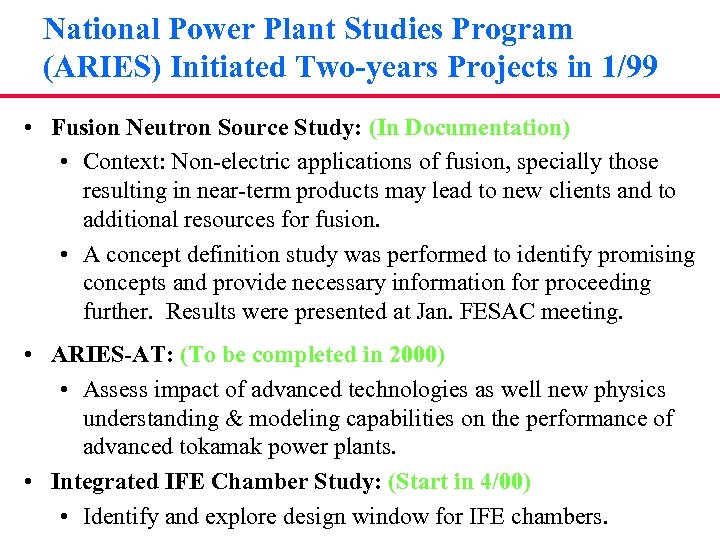 National Power Plant Studies Program (ARIES) Initiated Two-years Projects in 1/99 • Fusion Neutron Source Study: (In Documentation) • Context: Non-electric applications of fusion, specially those resulting in near-term products may lead to new clients and to additional resources for fusion. • A concept definition study was performed to identify promising concepts and provide necessary information for proceeding further. Results were presented at Jan. FESAC meeting. • ARIES-AT: (To be completed in 2000) • Assess impact of advanced technologies as well new physics understanding & modeling capabilities on the performance of advanced tokamak power plants. • Integrated IFE Chamber Study: (Start in 4/00) • Identify and explore design window for IFE chambers.
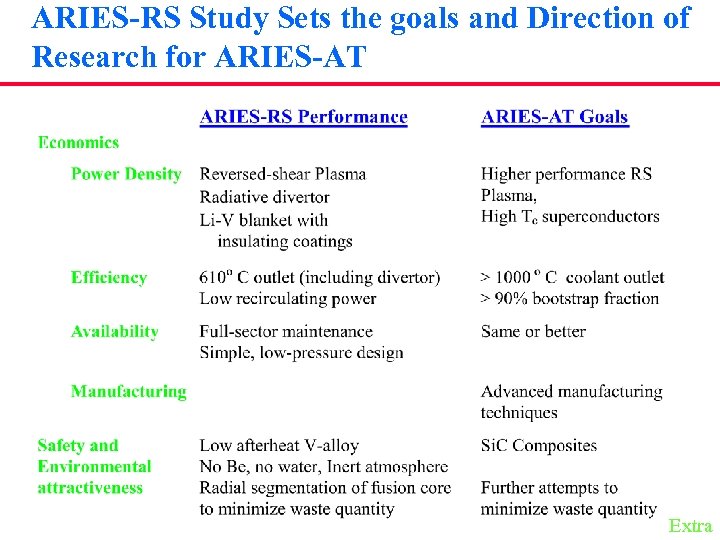 ARIES-RS Study Sets the goals and Direction of Research for ARIES-AT Extra
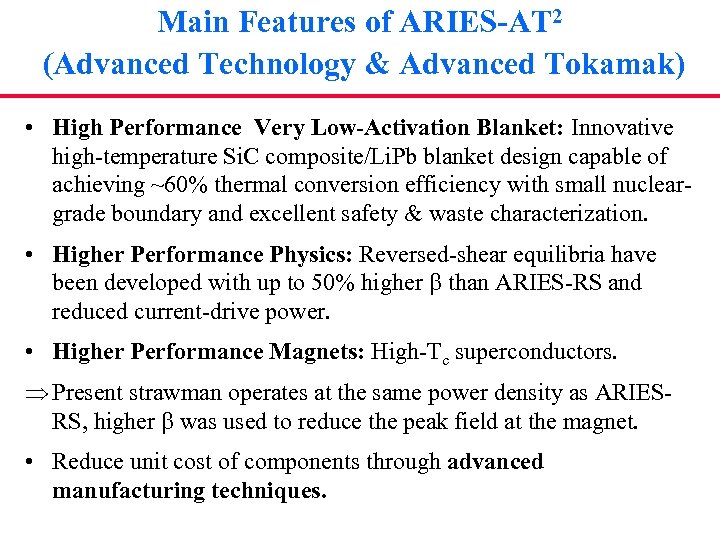 Main Features of ARIES-AT 2 (Advanced Technology & Advanced Tokamak) • High Performance Very Low-Activation Blanket: Innovative high-temperature Si. C composite/Li. Pb blanket design capable of achieving ~60% thermal conversion efficiency with small nucleargrade boundary and excellent safety & waste characterization. • Higher Performance Physics: Reversed-shear equilibria have been developed with up to 50% higher b than ARIES-RS and reduced current-drive power. • Higher Performance Magnets: High-Tc superconductors. Þ Present strawman operates at the same power density as ARIESRS, higher b was used to reduce the peak field at the magnet. • Reduce unit cost of components through advanced manufacturing techniques.
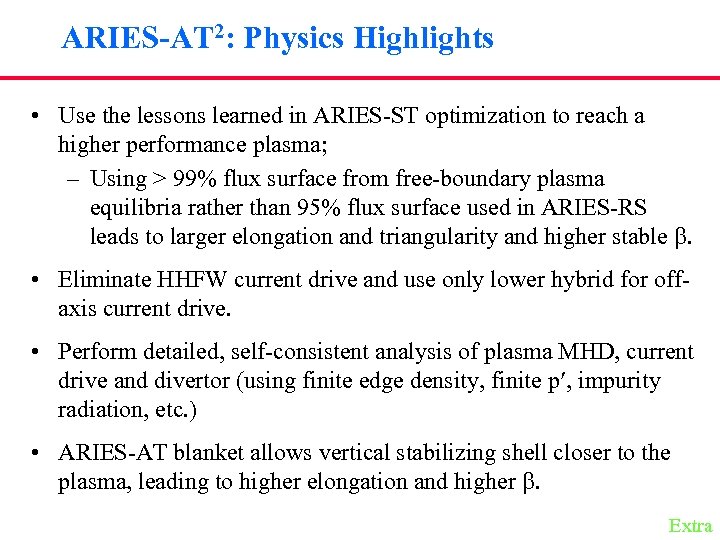 ARIES-AT 2: Physics Highlights • Use the lessons learned in ARIES-ST optimization to reach a higher performance plasma; – Using > 99% flux surface from free-boundary plasma equilibria rather than 95% flux surface used in ARIES-RS leads to larger elongation and triangularity and higher stable b. • Eliminate HHFW current drive and use only lower hybrid for offaxis current drive. • Perform detailed, self-consistent analysis of plasma MHD, current drive and divertor (using finite edge density, finite p , impurity radiation, etc. ) • ARIES-AT blanket allows vertical stabilizing shell closer to the plasma, leading to higher elongation and higher b. Extra
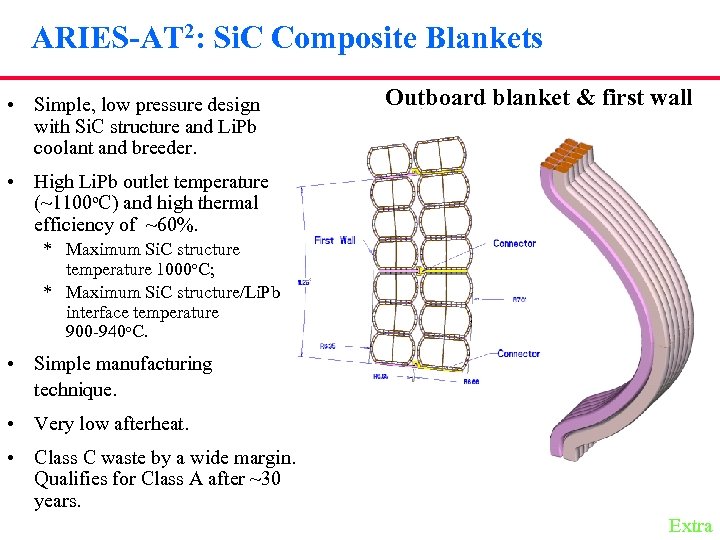 ARIES-AT 2: Si. C Composite Blankets • Simple, low pressure design with Si. C structure and Li. Pb coolant and breeder. Outboard blanket & first wall • High Li. Pb outlet temperature (~1100 o. C) and high thermal efficiency of ~60%. * Maximum Si. C structure temperature 1000 o. C; * Maximum Si. C structure/Li. Pb interface temperature 900 -940 o. C. • Simple manufacturing technique. • Very low afterheat. • Class C waste by a wide margin. Qualifies for Class A after ~30 years. Extra
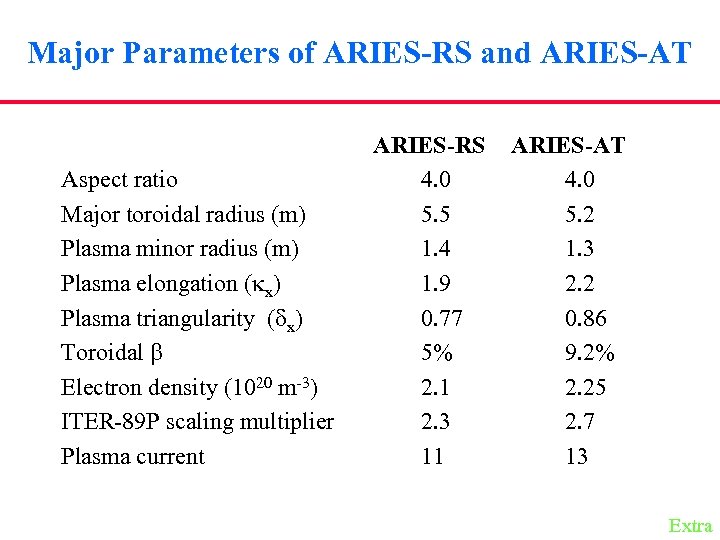 Major Parameters of ARIES-RS and ARIES-AT Aspect ratio Major toroidal radius (m) Plasma minor radius (m) Plasma elongation (kx) Plasma triangularity (dx) Toroidal b Electron density (1020 m-3) ITER-89 P scaling multiplier Plasma current ARIES-RS 4. 0 5. 5 1. 4 1. 9 0. 77 5% 2. 1 2. 3 11 ARIES-AT 4. 0 5. 2 1. 3 2. 2 0. 86 9. 2% 2. 25 2. 7 13 Extra
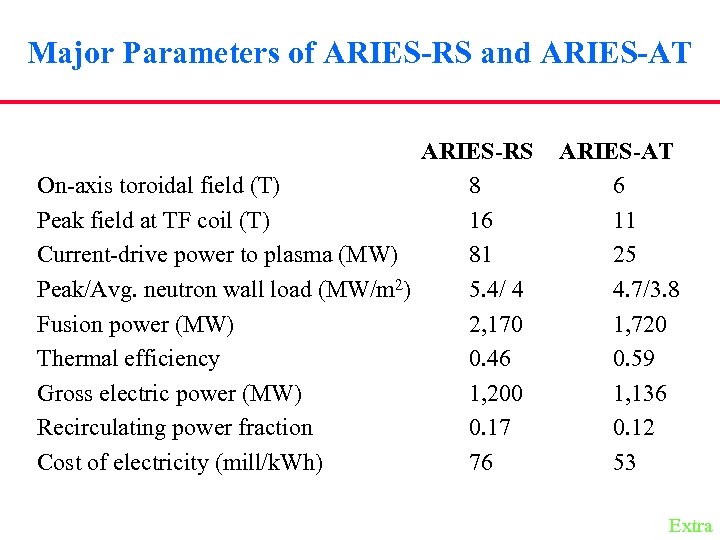 Major Parameters of ARIES-RS and ARIES-AT ARIES-RS On-axis toroidal field (T) 8 Peak field at TF coil (T) 16 Current-drive power to plasma (MW) 81 Peak/Avg. neutron wall load (MW/m 2) 5. 4/ 4 Fusion power (MW) 2, 170 Thermal efficiency 0. 46 Gross electric power (MW) 1, 200 Recirculating power fraction 0. 17 Cost of electricity (mill/k. Wh) 76 ARIES-AT 6 11 25 4. 7/3. 8 1, 720 0. 59 1, 136 0. 12 53 Extra
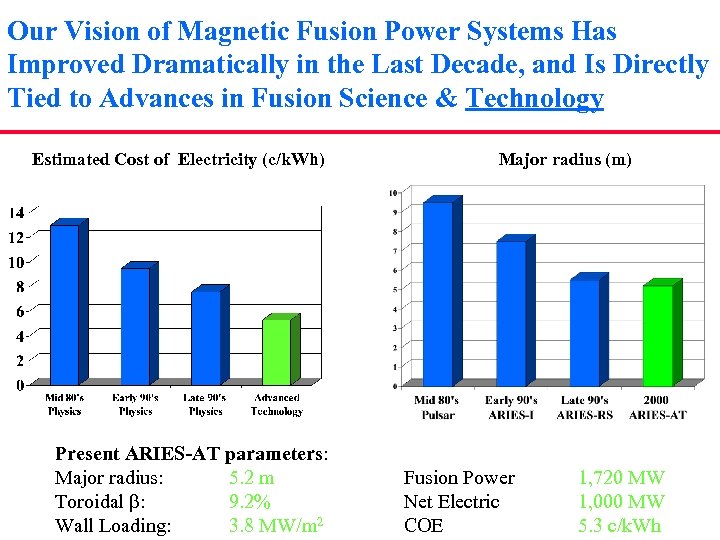 Our Vision of Magnetic Fusion Power Systems Has Improved Dramatically in the Last Decade, and Is Directly Tied to Advances in Fusion Science & Technology Estimated Cost of Electricity (c/k. Wh) Present ARIES-AT parameters: Major radius: 5. 2 m Toroidal b: 9. 2% Wall Loading: 3. 8 MW/m 2 Major radius (m) Fusion Power Net Electric COE 1, 720 MW 1, 000 MW 5. 3 c/k. Wh
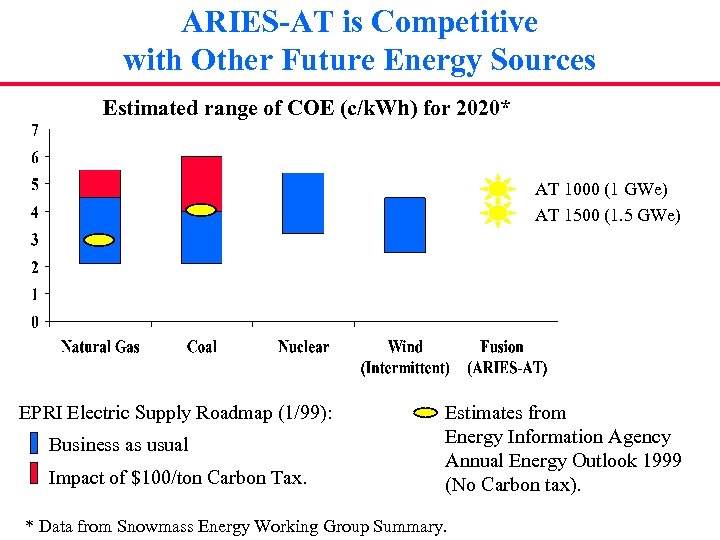 ARIES-AT is Competitive with Other Future Energy Sources Estimated range of COE (c/k. Wh) for 2020* AT 1000 (1 GWe) AT 1500 (1. 5 GWe) EPRI Electric Supply Roadmap (1/99): Business as usual Impact of $100/ton Carbon Tax. Estimates from Energy Information Agency Annual Energy Outlook 1999 (No Carbon tax). * Data from Snowmass Energy Working Group Summary.
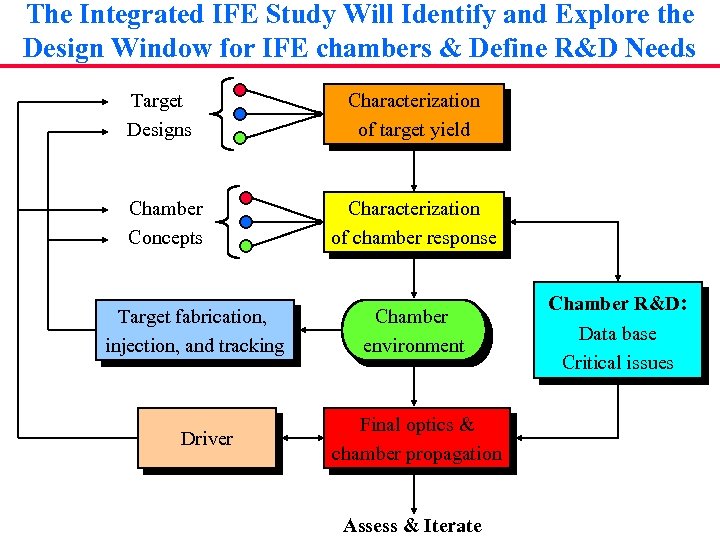 The Integrated IFE Study Will Identify and Explore the Design Window for IFE chambers & Define R&D Needs Target Designs Chamber Concepts Target fabrication, injection, and tracking Driver Characterization of target yield Characterization of chamber response Chamber environment Final optics & chamber propagation Assess & Iterate Chamber R&D: Data base Critical issues
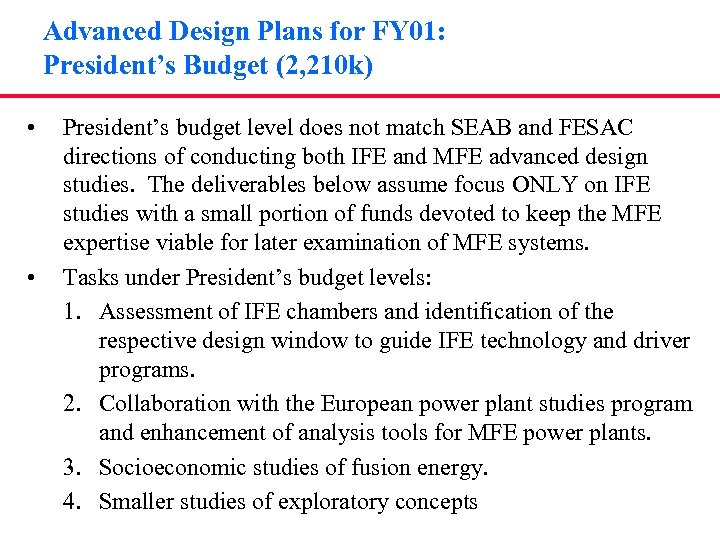 Advanced Design Plans for FY 01: President’s Budget (2, 210 k) • • President’s budget level does not match SEAB and FESAC directions of conducting both IFE and MFE advanced design studies. The deliverables below assume focus ONLY on IFE studies with a small portion of funds devoted to keep the MFE expertise viable for later examination of MFE systems. Tasks under President’s budget levels: 1. Assessment of IFE chambers and identification of the respective design window to guide IFE technology and driver programs. 2. Collaboration with the European power plant studies program and enhancement of analysis tools for MFE power plants. 3. Socioeconomic studies of fusion energy. 4. Smaller studies of exploratory concepts
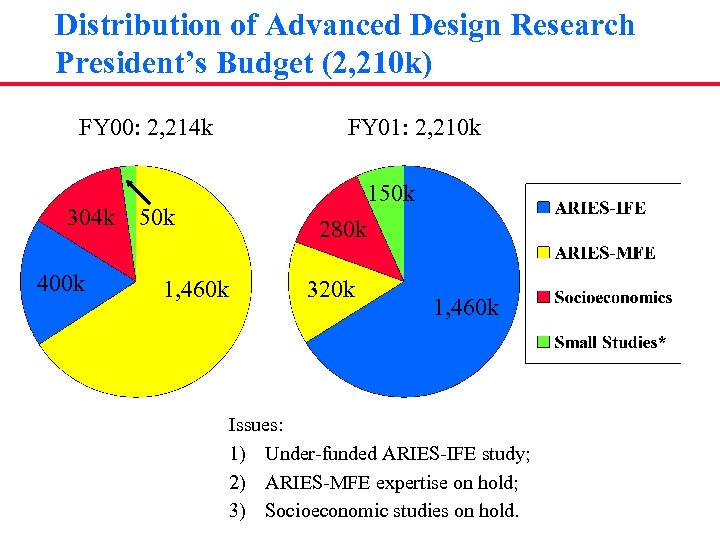 Distribution of Advanced Design Research President’s Budget (2, 210 k) FY 00: 2, 214 k FY 01: 2, 210 k 150 k 304 k 50 k 400 k 280 k 1, 460 k 320 k 1, 460 k Issues: 1) Under-funded ARIES-IFE study; 2) ARIES-MFE expertise on hold; 3) Socioeconomic studies on hold.
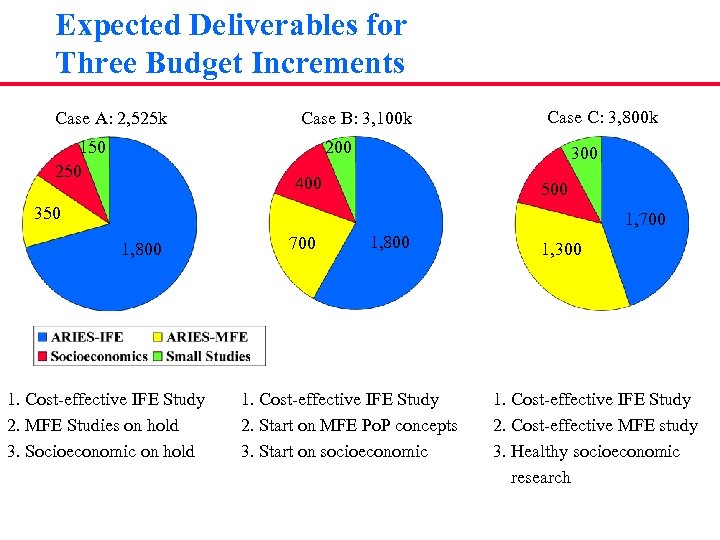 Expected Deliverables for Three Budget Increments Case A: 2, 525 k 150 250 Case B: 3, 100 k Case C: 3, 800 k 200 300 400 500 350 1, 700 1, 800 1. Cost-effective IFE Study 2. MFE Studies on hold 3. Socioeconomic on hold 700 1, 800 1. Cost-effective IFE Study 2. Start on MFE Po. P concepts 3. Start on socioeconomic 1, 300 1. Cost-effective IFE Study 2. Cost-effective MFE study 3. Healthy socioeconomic research
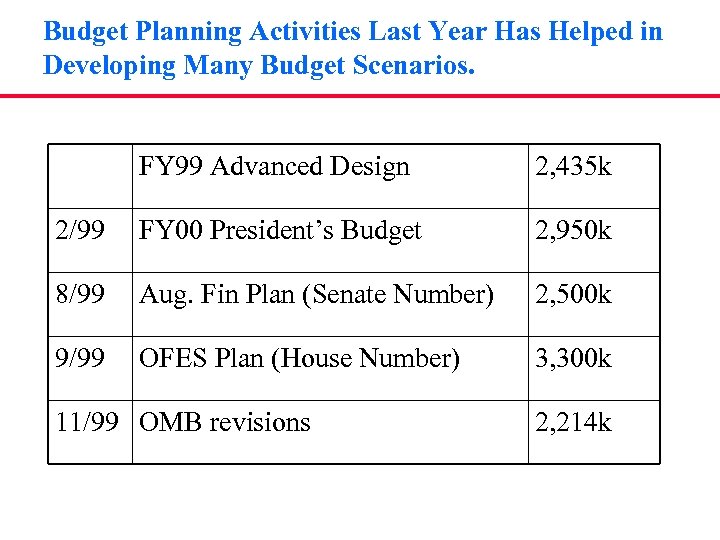 Budget Planning Activities Last Year Has Helped in Developing Many Budget Scenarios. FY 99 Advanced Design 2, 435 k 2/99 FY 00 President’s Budget 2, 950 k 8/99 Aug. Fin Plan (Senate Number) 2, 500 k 9/99 OFES Plan (House Number) 3, 300 k 11/99 OMB revisions 2, 214 k