


 Скачать презентацию Overview of Military Strategy and Operations Agenda
d543bb9e82bf086fc1671a37b023cd62.ppt
- Количество слайдов: 51
 Overview of Military Strategy and Operations
 Agenda • • • Key Theorists Principles of War Facets of the Operational Art Forms of Maneuver Unit Organization Strategy
 Key Theorists • Clausewitz • Jomini • Sun-Tzu
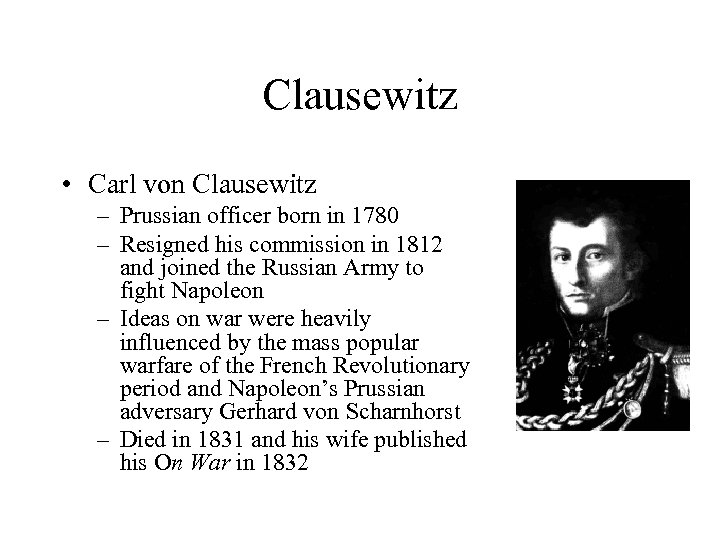 Clausewitz • Carl von Clausewitz – Prussian officer born in 1780 – Resigned his commission in 1812 and joined the Russian Army to fight Napoleon – Ideas on war were heavily influenced by the mass popular warfare of the French Revolutionary period and Napoleon’s Prussian adversary Gerhard von Scharnhorst – Died in 1831 and his wife published his On War in 1832
 Clausewitz • War is neither an art nor a science – It is a continuation of “policy” (or “politics”) by other means. – A form of social intercourse • War is like a wrestling match – It is “an act of force to compel our enemy to do our will. ” – But it is not unilateral. It is a contest between two independent wills.
 Clausewitz • Used a trinitarian analysis consisting of (1) primordial violence, hatred, and enmity; (2) the play of chance and probability; and (3) war’s element of subordination to rational policy – Often loosely expressed as “the people, the military, and the government” • Analyzed “absolute war” or “war in theory, ” but then noted that factors such as poor intelligence, chance, friction, etc make war in practice different than war in the abstract • Argued one should focus his military efforts against the enemy’s “center of gravity” (“Schwerpunkt”) – Very important concept in American military doctrine
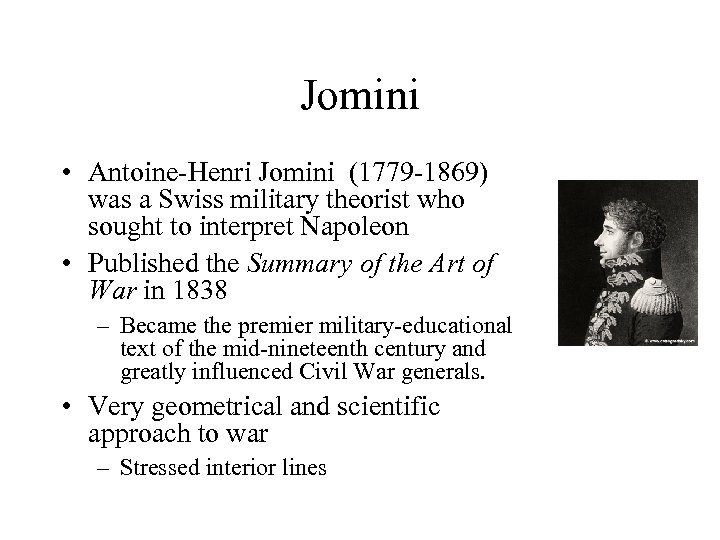 Jomini • Antoine-Henri Jomini (1779 -1869) was a Swiss military theorist who sought to interpret Napoleon • Published the Summary of the Art of War in 1838 – Became the premier military-educational text of the mid-nineteenth century and greatly influenced Civil War generals. • Very geometrical and scientific approach to war – Stressed interior lines
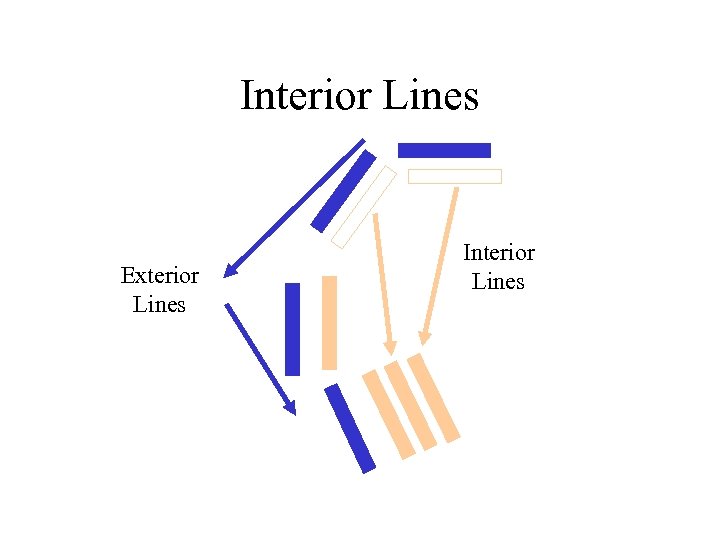 Interior Lines Exterior Lines Interior Lines
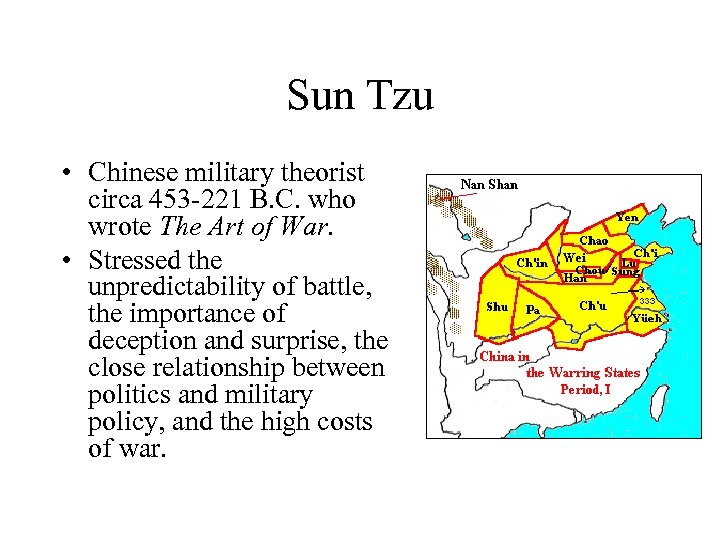 Sun Tzu • Chinese military theorist circa 453 -221 B. C. who wrote The Art of War. • Stressed the unpredictability of battle, the importance of deception and surprise, the close relationship between politics and military policy, and the high costs of war.
 Sun Tzu • “So it is said that if you know your enemies and know yourself, you will not be imperiled in a hundred battles; if you do not know your enemies but do know yourself, you will win one and lose one; if you do not know your enemies nor yourself, you will be imperiled in every single battle. ” • “One hundred victories in one hundred battles is not the most skillful. Seizing the enemy without fighting is the most skillful. ”
 Principles of War • British military officer J. F. C. Fuller developed a list of principles based on the works of Clausewitz and Jomini for use by the British Army in World War I • The US Army modified them and published its first list in 1921 – – – – – Objective Offensive Mass Economy of force Maneuver Unity of command Security Surprise Simplicity
 Objective • When undertaking any mission, commanders should have a clear understanding of the expected outcome and its impact. Commanders need to appreciate political ends and understand how the military conditions they achieve contribute to them. – Ensure that all actions contribute to the goals of the higher headquarters. – Example: In the Yom Kippur War, Egypt was able to transform its limited military success into a major diplomatic victory by forcing the US to exert pressure on Israel to conclude a peace treaty. The Camp David Accords committed Israel to return the entire Sinai Peninsula to Egypt.
 Offensive • Offensive operations are essential to maintain the freedom of action necessary for success, exploit vulnerabilities, and react to rapidly changing situations and unexpected developments. – Offensive actions are those taken to dictate the nature, scope, and tempo of an operation. – Offensive action is key to achieving decisive results; it is the essence of successful operations. – Example: In 1968 84, 000 Viet Cong and North Vietnamese attacked 36 of 43 provincial capitals, 5 of 6 autonomous cities, 34 of 242 district capitals, and at least 50 hamlets in the Tet Offensive
 Mass • Commanders mass the effects of combat power in time and space to overwhelm enemies or gain control of the situation. – Time: applies the elements of combat power against multiple targets simultaneously – Space : concentrates the effects of different elements of combat power against a single target – Example: World War I forces attempted to overcome the stalemate of trench warfare with frontal attacks that relied on mass such as at Verdun
 Economy of Force • Commanders never leave any element without a purpose. When the time comes to execute, all elements should have tasks to perform. – Economy of force requires accepting prudent risk in selected areas to achieve superiority in the decisive operation. – Economy of force involves the discriminating employment and distribution of forces. – Example: Gallipoli was intended to be an economy of force operation for the British, using primarily naval forces. As it turned out, the ground force was too weak to be successful, illustrating how adhering to one principle (economy of force) can violate another (mass).
 Maneuver • As both an element of combat power and a principle of war, maneuver concentrates and disperses combat power to place and keep the enemy at a disadvantage. It includes the dynamic, flexible application of leadership, firepower, information, and protection as well. – Achieves results that would otherwise be more costly – Keeps enemies off balance by making them confront new problems and new dangers faster than they can deal with them. – Example: Napoleon used maneuver at Austerlitz to break the Russo-Austrian center, separating it into two parts
 Unity of Command • Unity of command means that a single commander directs and coordinates the actions of all forces toward a common objective. – Develops the full combat power of a force – Usually requires giving a single commander authority – Example: The pacification efforts in Vietnam were largely uncoordinated until they all eventually came under the control of CORDS (Civil Operations and Rural Development Support)
 Security • Calculated risk is inherent in conflict. Security protects and preserves combat power. – Does not involve excessive caution – Measures taken by a command to protect itself from surprise, interference, sabotage, annoyance, and threat – Grant failed to provide adequate entrenchments and other security measures and was caught offguard the first day at Shiloh
 Surprise • Surprise results from taking actions for which an enemy or adversary is unprepared. – It is only necessary that the enemy become aware too late to react effectively. – Contributions to surprise include speed, information superiority, and asymmetry. – Example: Through a combination of intelligence intercepts, deception measures, bad weather, and a dispersed airborne assault, the Allies gained surprise at Normandy.
 Simplicity • Plans and orders should be simple and direct. Simple plans executed on time are better than detailed plans executed late. – Clear and concise plans cut down on misunderstandings – Example: One of the reasons the Schlieffen Plan ran out of steam after its initial success was that it required too complicated a logistical timetable to sustain it
 Facets of Operational Art • • Synergy Simultaneity and depth Anticipation Balance Leverage Timing and tempo Operational reach and approach
 Facets of Operational Art (cont) • • Forces and functions Arranging operations Centers of gravity Direct versus indirect Decisive points Culmination Termination
 Facets of Operational Art • Synergy – Seek combinations of forces and actions to achieve concentrations in various dimensions, all culminating in attaining the assigned objective(s) in the shortest time possible and with minimum casualties – Example: Combined airborne and amphibious assaults at Normandy • Simultaneity and depth – Place more demands on adversary forces than can be handled both in terms of time and space – Example: Forces simultaneously attacked or secured 27 critical objectives throughout Panama in Operation Just Cause
 Facets of Operational Art • Anticipation – Remain alert for the unexpected and opportunities to exploit the situation – Example: French and British did not anticipate the German’s Blitzkrieg attack through the Ardennes • Balance – Maintain the force, its capabilities, and its operations in such a manner as to contribute to freedom of action and responsiveness – Example: Superior mobility gave the US forces the ability to recover from the initial surprise of Tet and defeat the attack
 Facets of Operational Art • Leverage – Gain, maintain, and exploit advantages in combat power across all dimensions – Example: The US currently tries to leverage its superior technology and firepower. Its adversaries try to leverage their ability to effect US domestic support through inflicting casualties such as in Somalia. • Timing and tempo – Conduct operations at a tempo and point in time that best exploits friendly capabilities and inhibits the adversary – Example: Desert Storm used a deliberate, time-consuming force build-up (Desert Shield). Iraqi Freedom conversely used an extremely rapid “rolling start. ”
 Facets of Operational Art • Operational reach and approach – The distance over which military power can mass effects and be employed decisively – Example: The North Koreans exceeded their operational reach with their attack to Pusan which allowed Mac. Arthur to sever their communications at Seoul. • Forces and functions – Focus on defeating either adversary forces or functions, or a combination of both – Example: The air campaign in Kosovo focused on eliminating or neutralizing Serbian functions such as command control since the inability to conduct a ground attack limited the option of focusing on Serb forces.
 Facets of Operational Art • Arranging operations – Achieve dimensional superiority by a combination of simultaneous and sequential operations – Phases: Deter/engage, Seize initiative, Decisive operations, Transition – Example: Operation Iraqi Freedom has been highly criticized for a failure to properly plan Phase 4. • Centers of gravity – Those characteristics, capabilities, or sources of power from which a military force derives its freedom of action, physical strength, or will to fight – Destroying or neutralizing adversary centers of gravity is the most direct path to victory – Example: The friendly center of gravity in Desert Storm was the coalition so Saddam attempted to destroy it by such measures as launching missiles into Israel.
 Facets of Operational Art • Direct versus indirect – To the extent possible, attack centers of gravity directly, but where direct attack means attacking into an opponent’s strength seek an indirect approach – Example: US enemies like Osama bin Laden know they have no hopes of defeating the US militarily so they attack other targets such as the World Trade Center. • Decisive points – – Usually geographic in nature, but can sometimes be key events or systems Give a marked advantage to whoever controls them Keys to attacking protected centers of gravity Example: The three bridgeheads in Operation Market Garden were each decisive points because their seizure ensured maintenance of the Allied momentum and initiative.
 Facets of Operational Art • Culmination – Point in time and space at which an attacker’s combat power no longer exceeds that of the defender – Example: Even though Meade defeated Lee at Gettysburg, Meade, much to Lincoln’s chagrin, did not feel he was strong enough to prevent Lee’s withdrawal back to Virginia. • Termination – Military operations typically conclude with attainment of the strategic ends for which the military force was committed, which then allows transition to other instruments of national power and agencies as the means to achieve broader goals – Example: This is the current problem in Iraq.
 Forms of Maneuver • The five forms of maneuver are the – envelopment, – turning movement, – infiltration, – penetration, and – frontal attack.
 Envelopment
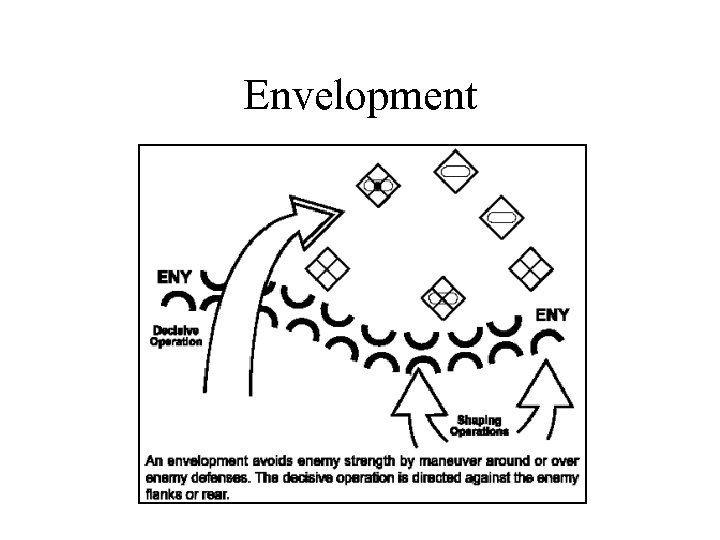
 Envelopment • The envelopment is a form of maneuver in which an attacking force seeks to avoid the principal enemy defenses by seizing objectives to the enemy rear to destroy the enemy in his current positions. • Envelopments avoid the enemy front, where he is protected and can easily concentrate fires. • Single envelopments maneuver against one enemy flank; double envelopments maneuver against both. Either variant can develop into an encirclement. • Example: Lee and Jackson at Chancellorsville
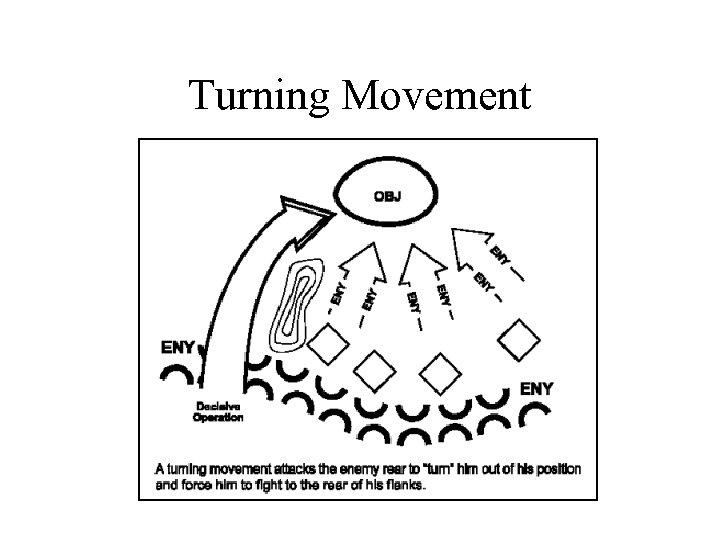 Turning Movement
 Turning Movement • A turning movement is a form of maneuver in which the attacking force seeks to avoid the enemy's principal defensive positions by seizing objectives to the enemy rear and causing the enemy to move out of his current positions or divert major forces to meet the threat. • A major threat to his rear forces the enemy to attack or withdraw rearward, thus "turning" him out of his defensive positions. • Turning movements typically require greater depth than other forms of maneuver. • Example: Mac. Arthur at Inchon
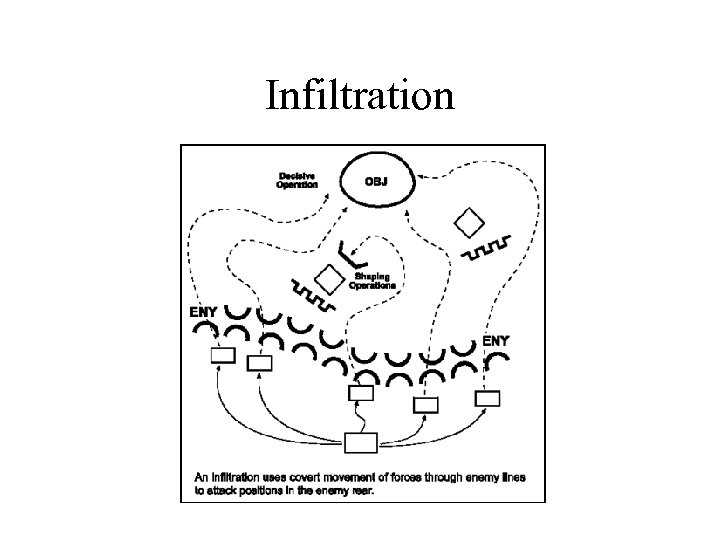 Infiltration
 Infiltration • An infiltration is a form of maneuver in which an attacking force conducts undetected movement through or into an area occupied by enemy forces to occupy a position of advantage in the enemy rear while exposing only small elements to enemy defensive fires • . Typically, forces infiltrate in small groups and reassemble to continue their mission. • Infiltration rarely defeats a defense by itself. Commanders direct infiltrations to attack lightly defended positions or stronger positions from the flank and rear, to secure key terrain to support the decisive operation, or to disrupt enemy sustaining operations. • Example: The Viet Cong at Tet
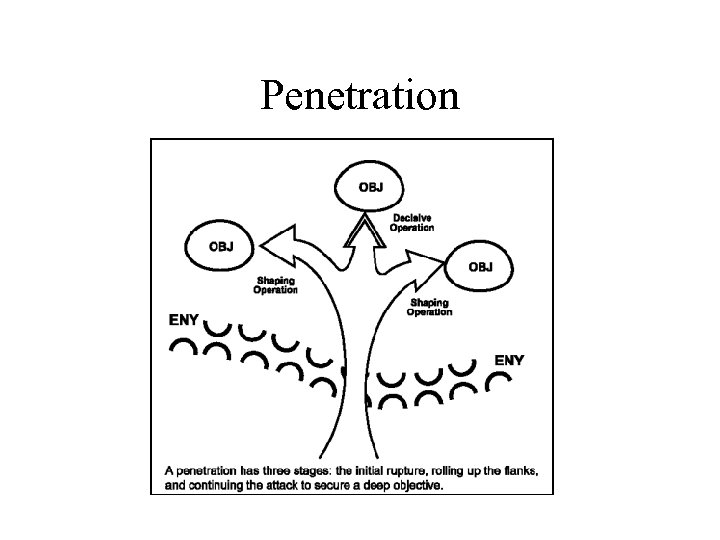 Penetration
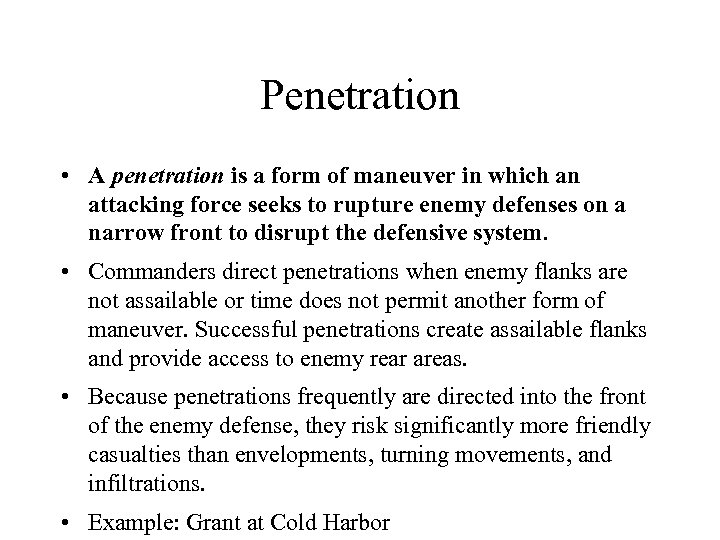 Penetration • A penetration is a form of maneuver in which an attacking force seeks to rupture enemy defenses on a narrow front to disrupt the defensive system. • Commanders direct penetrations when enemy flanks are not assailable or time does not permit another form of maneuver. Successful penetrations create assailable flanks and provide access to enemy rear areas. • Because penetrations frequently are directed into the front of the enemy defense, they risk significantly more friendly casualties than envelopments, turning movements, and infiltrations. • Example: Grant at Cold Harbor
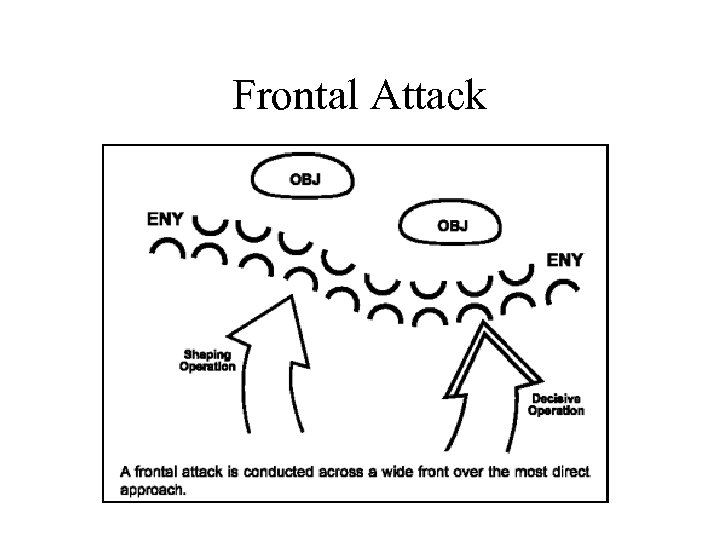 Frontal Attack
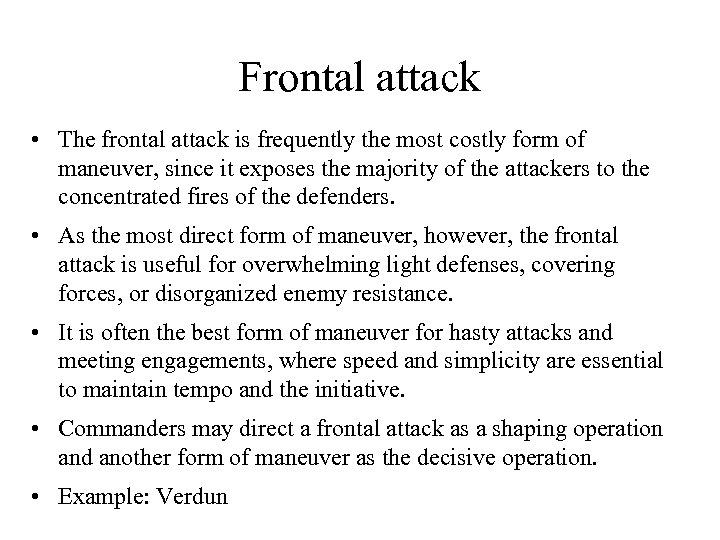 Frontal attack • The frontal attack is frequently the most costly form of maneuver, since it exposes the majority of the attackers to the concentrated fires of the defenders. • As the most direct form of maneuver, however, the frontal attack is useful for overwhelming light defenses, covering forces, or disorganized enemy resistance. • It is often the best form of maneuver for hasty attacks and meeting engagements, where speed and simplicity are essential to maintain tempo and the initiative. • Commanders may direct a frontal attack as a shaping operation and another form of maneuver as the decisive operation. • Example: Verdun
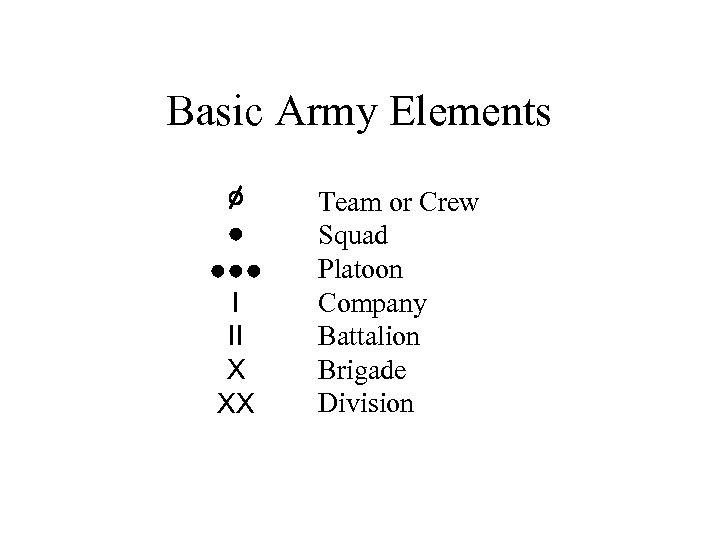 Basic Army Elements I II X XX Team or Crew Squad Platoon Company Battalion Brigade Division
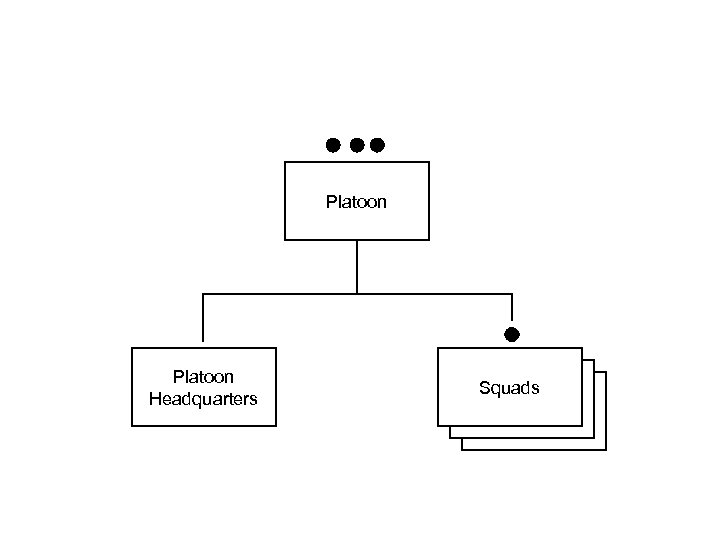 Platoon Headquarters Squads
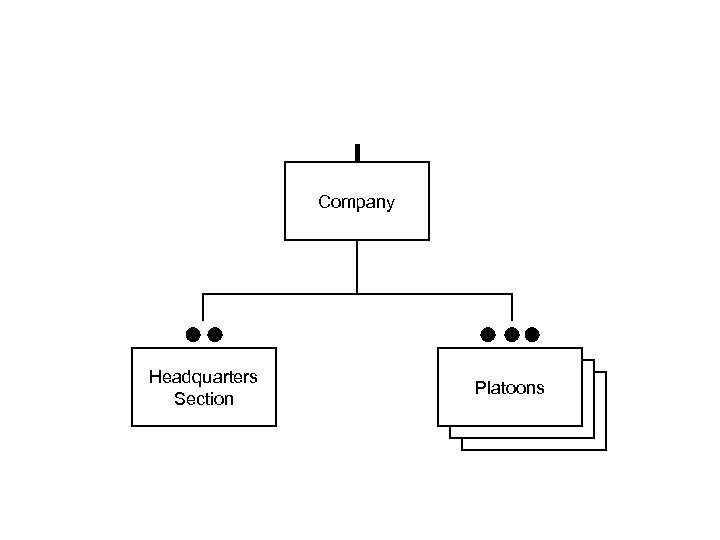 Company Headquarters Section Platoons
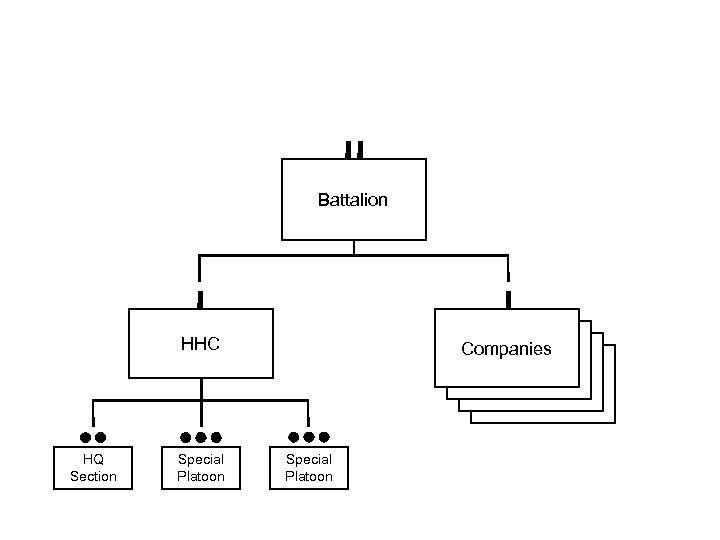 Battalion HHC HQ Section Special Platoon Companies Special Platoon
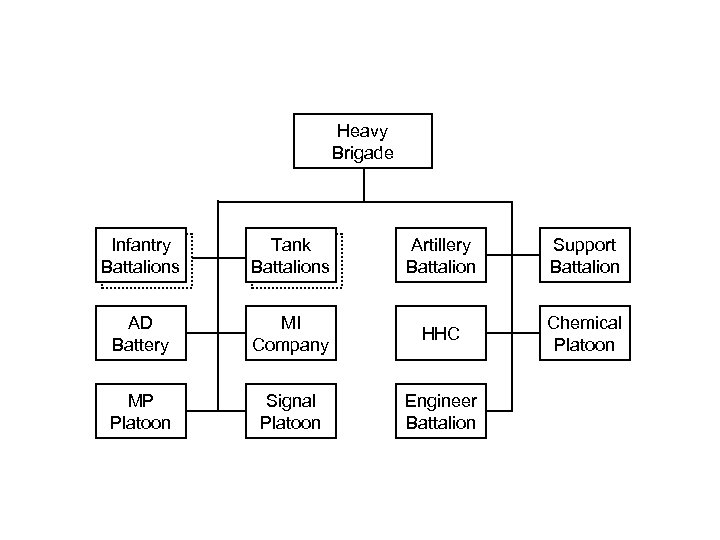 Heavy Brigade Infantry Battalions Tank Battalions Artillery Battalion Support Battalion AD Battery MI Company HHC Chemical Platoon MP Platoon Signal Platoon Engineer Battalion
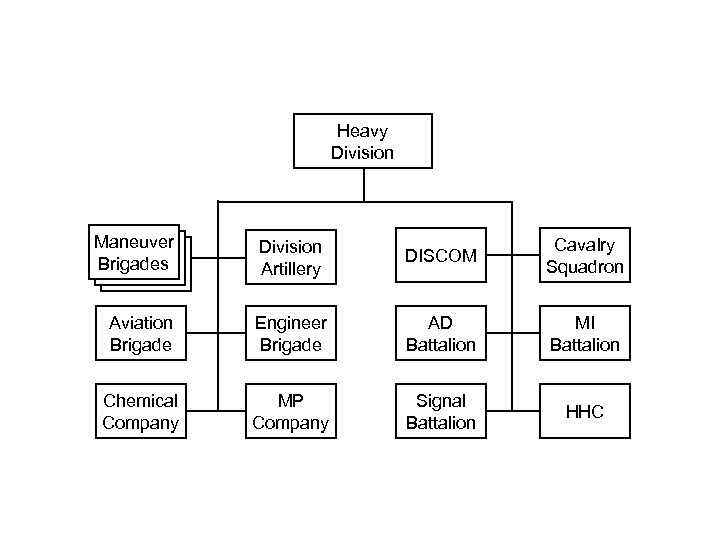 Heavy Division Maneuver Brigades Division Artillery DISCOM Cavalry Squadron Aviation Brigade Engineer Brigade AD Battalion MI Battalion Chemical Company MP Company Signal Battalion HHC
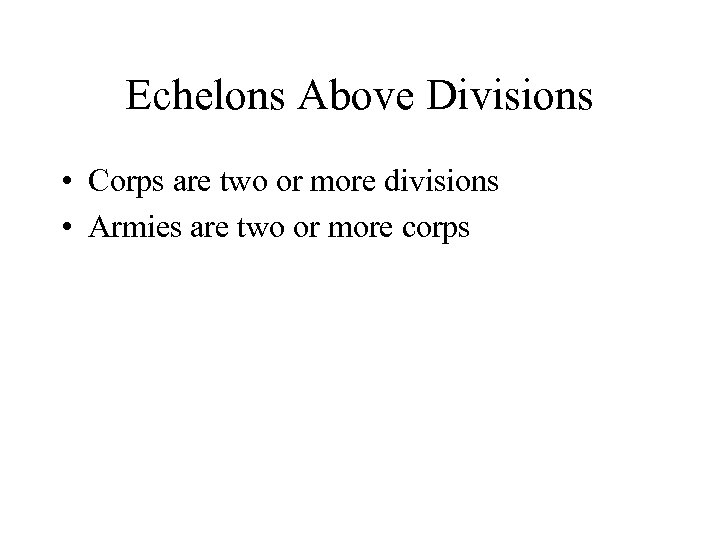 Echelons Above Divisions • Corps are two or more divisions • Armies are two or more corps
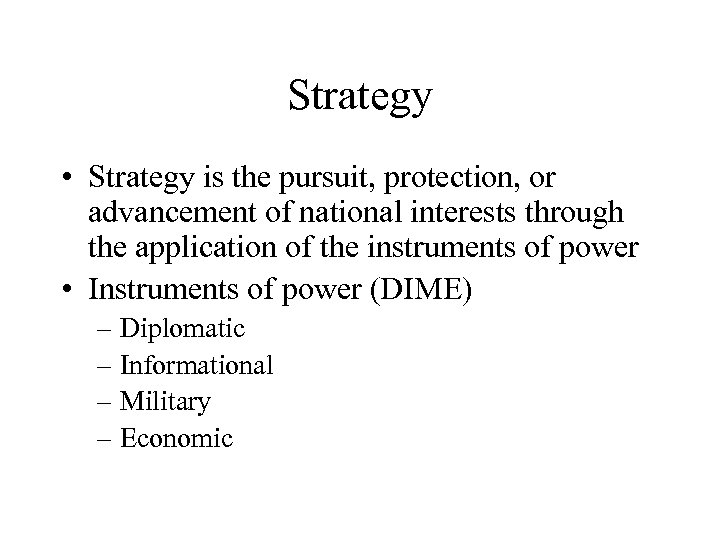 Strategy • Strategy is the pursuit, protection, or advancement of national interests through the application of the instruments of power • Instruments of power (DIME) – Diplomatic – Informational – Military – Economic
 Strategy • Strategy is about how (way or concept) leadership will use the power (means or resources) available to the state to exercise control over sets of circumstances and geographic locations to achieve objectives (ends) that support state interests • Strategy = Ends (objectives) + Ways (course of action) + Means (instruments) – Ways to employ means to achieve ends
 The National Security Strategy of the United States of America (2002) • champion aspirations for human dignity; • strengthen alliances to defeat global terrorism and work to prevent attacks against us and our friends; • work with others to defuse regional conflicts; • prevent our enemies from threatening us, our allies, and our friends, with weapons of mass destruction;
 The National Security Strategy of the United States of America (2002) • ignite a new era of global economic growth through free markets and free trade; • expand the circle of development by opening societies and building the infrastructure of democracy; • develop agendas for cooperative action with other main centers of global power; and • transform America’s national security institutions to meet the challenges and opportunities of the twenty-first century.