


 Скачать презентацию Overview of Marketing Class 23 Tuesday 11 15 11
fda83023c271a30fb5cd2329c7fd3812.ppt
- Количество слайдов: 33
 Overview of Marketing Class 23 Tuesday 11/15/11
 Nature of Marketing • To create value by allowing people and organizations to obtain what they need and want
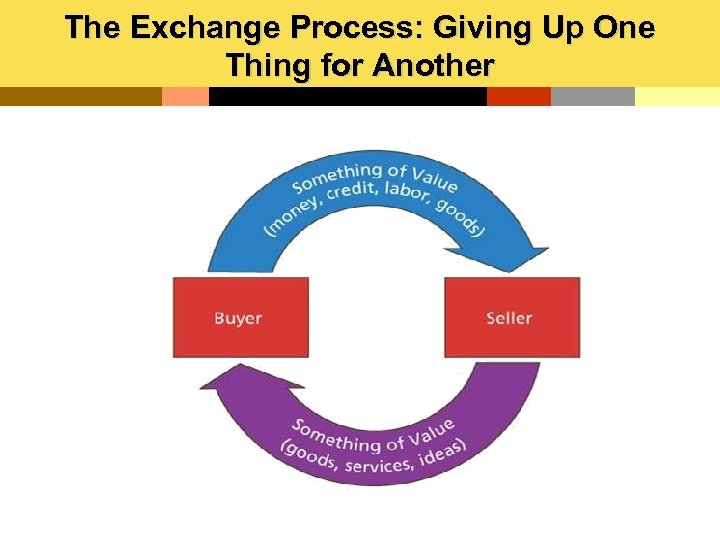 The Exchange Process: Giving Up One Thing for Another
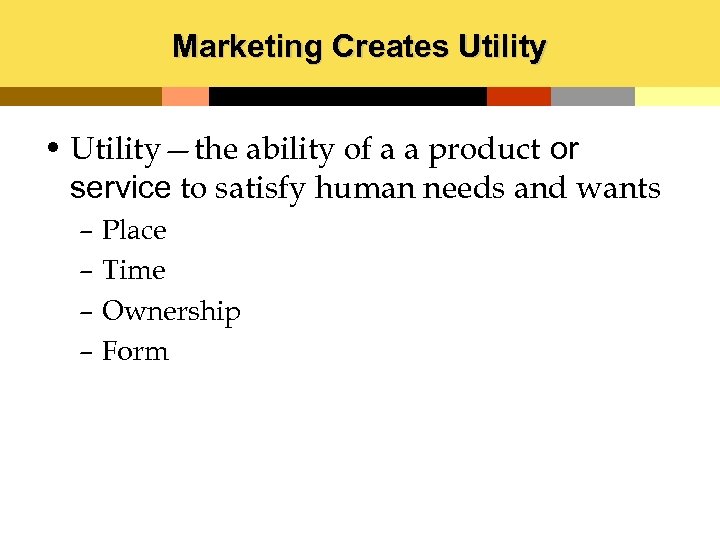 Marketing Creates Utility • Utility—the ability of a a product or service to satisfy human needs and wants – Place – Time – Ownership – Form
 Evolution of the Marketing Concept • The production orientation – During the second half of the 19 th century • The sales orientation – By the early part of the 20 th century • The marketing orientation – By the 1950 s
 Marketing Orientation • Requires organizations to: – Gather information about customer needs – Share that information throughout the entire firm – Use that information to help build long-term relationships with customers
 Developing Marketing Strategy • Marketing strategy: – A plan of action for developing pricing, distributing and promoting products that meet the needs of specific customers • Two major components: – Selecting a target market – Developing the appropriate marketing mix
 Selecting a Target Market • Market – A group of people who have a need, purchasing power, and the desire and authority to spend money on goods, services, and ideas • Target market – A more specific group of consumers on whose needs and wants a company focuses its marketing effort
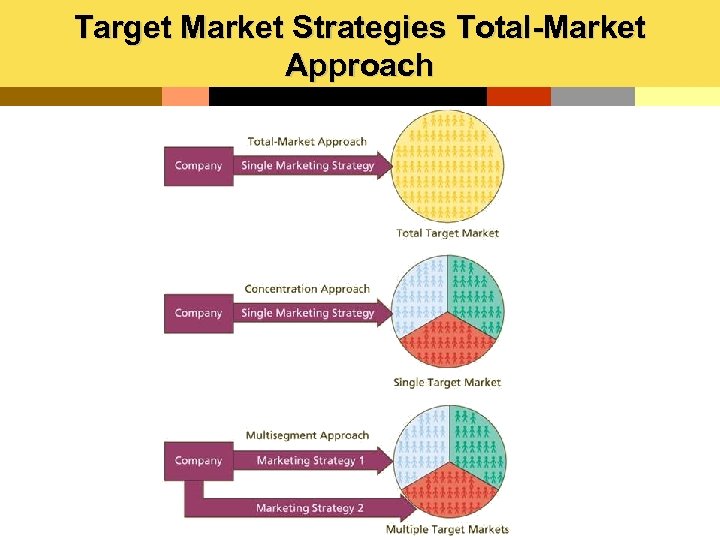 Target Market Strategies Total-Market Approach
 Further Refinement • Market Segment – A collection of individuals, groups, or organizations who share one or more characteristics and have similar product needs and desires • Niche Market – Narrow market segment focus when efforts are on one small, well-defined segment that has a unique, specific set of needs
 The Keys to Successful Market Segmentation 1. 2. 3. 4. 5. Consumers’ product needs must be heterogeneous Segments must be identifiable and divisible The market must be divided so segment sales, cost, and profit can be compared One segment must have enough profit potential to justify a special marketing strategy The chosen segment must be reached by the firm with a particular marketing strategy
 Marketing Research & Information Systems • Marketing research – A systematic, objective process of getting customer information to guide marketing decisions • Marketing information system – A framework for assessing information about customers from internal and external sources
 Collecting Data • Primary data – Marketing information that is observed, recorded, or collected directly from respondents • Secondary data – Information that is compiled inside or outside an organization for some purpose other than changing the current situation
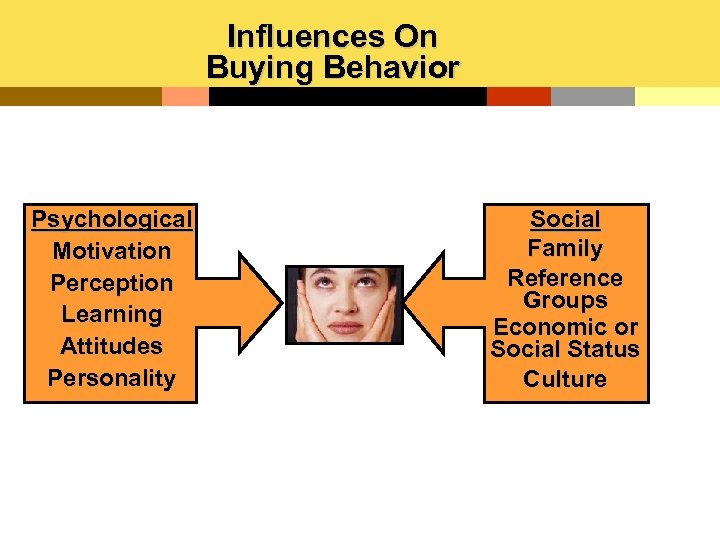 Influences On Buying Behavior Psychological Motivation Perception Learning Attitudes Personality Social Family Reference Groups Economic or Social Status Culture
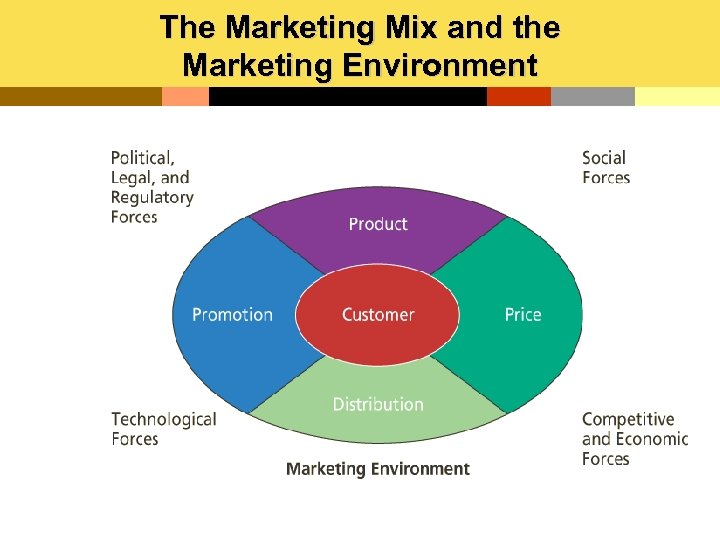 The Marketing Mix and the Marketing Environment
 The 4 P’s • Product: A good, service, or idea that has tangible and intangible attributes that provide satisfaction and benefit to consumers – Products should be sold at a profit • Price: A value placed on a product or service that is exchanged between a buyer and seller • Place (Distribution): Making products available to consumers in the quantities and locations desired • Promotion: A persuasive form of communication that attempts to expedite a marketing exchange by influencing individuals and organizations to accept goods, services, and ideas
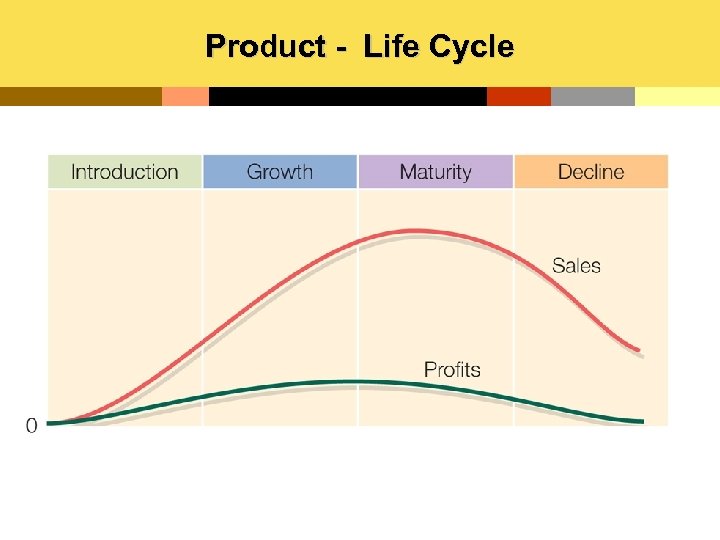 Product - Life Cycle
 Introduction Stage & Marketing Mix EProduct Awareness ELimited Competition ESkim-Pricing Approach EFew Channels
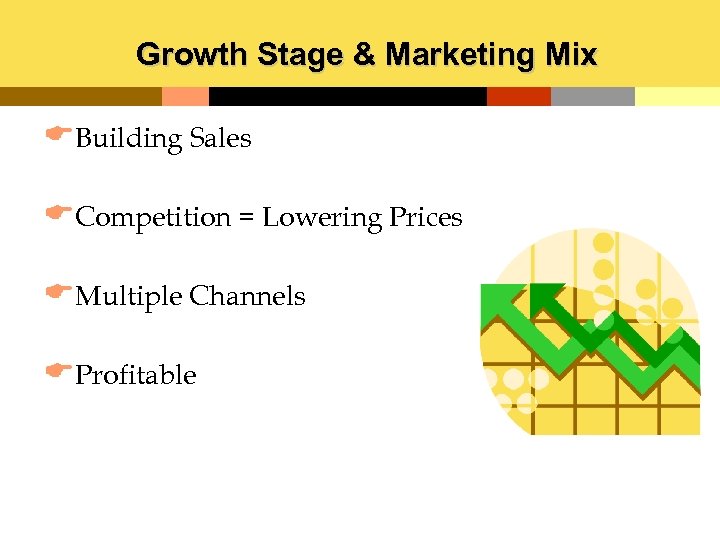 Growth Stage & Marketing Mix EBuilding Sales ECompetition = Lowering Prices EMultiple Channels EProfitable
 Maturity Stage & Marketing Mix ESales Grow At Decreasing Rate EDifferentiate from Competition EPrice Wars EProfits Up With Sales EChanging Consumer Preferences
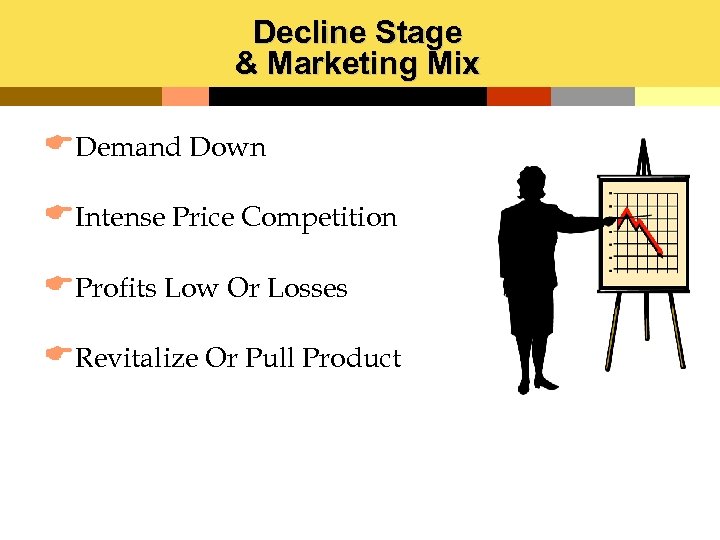 Decline Stage & Marketing Mix EDemand Down EIntense Price Competition EProfits Low Or Losses ERevitalize Or Pull Product
 Pricing - Product Pricing • New $Skimming $Penetration • Other $Cost-Based $Demand-Based $Target Costing $Prestige $Odd-Even
 Place - Distribution • Intermediary – “…a wholesaler or retailer who helps move products from their original source to the end user…” • Each intermediary in the channel of distribution requires a profit margin, thus increasing the cost of the product.
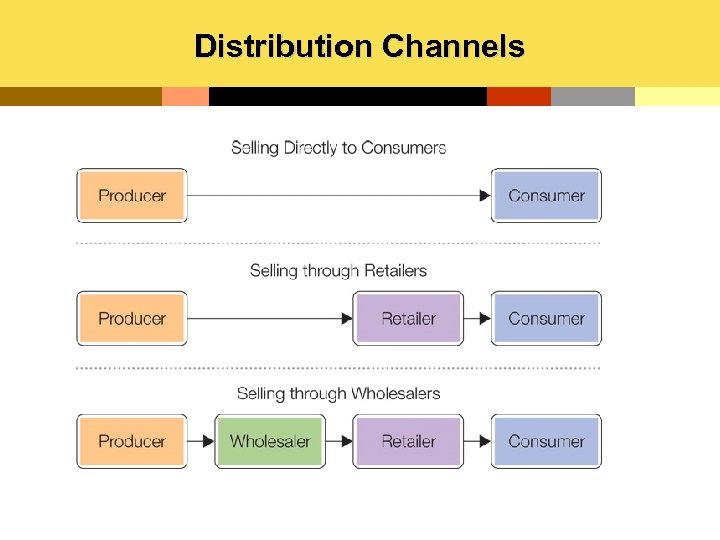 Distribution Channels
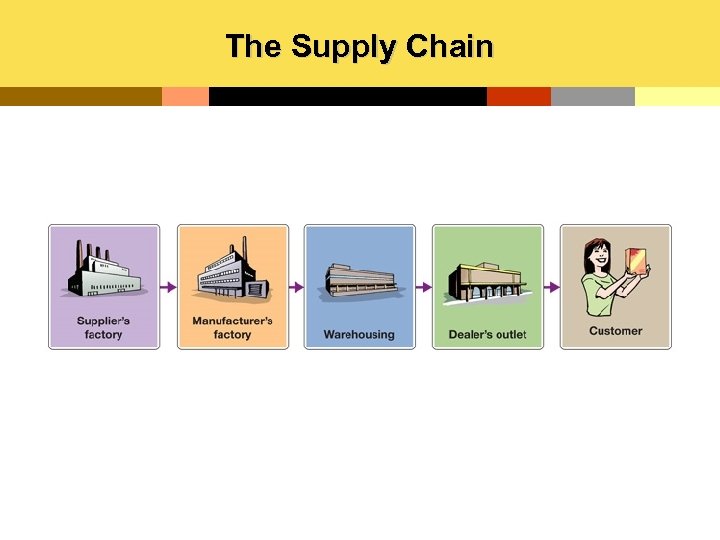 The Supply Chain
 Value Chain • “…the entire range of activities involved in delivering value to customers…”
 Promotion Mix • “…the means by which (companies) communicate with customers…”
![Considerations Before Selecting Promotional Strategy ]Purpose of Promotion? ]Target Market? ]Product Features to Emphasize?](https://present5.com/presentation/fda83023c271a30fb5cd2329c7fd3812/image-28.jpg "Considerations Before Selecting Promotional Strategy ]Purpose of Promotion? ]Target Market? ]Product Features to Emphasize?") Considerations Before Selecting Promotional Strategy ]Purpose of Promotion? ]Target Market? ]Product Features to Emphasize? ]Afford? ]Similar to Competitors?
Considerations Before Selecting Promotional Strategy ]Purpose of Promotion? ]Target Market? ]Product Features to Emphasize? ]Afford? ]Similar to Competitors?
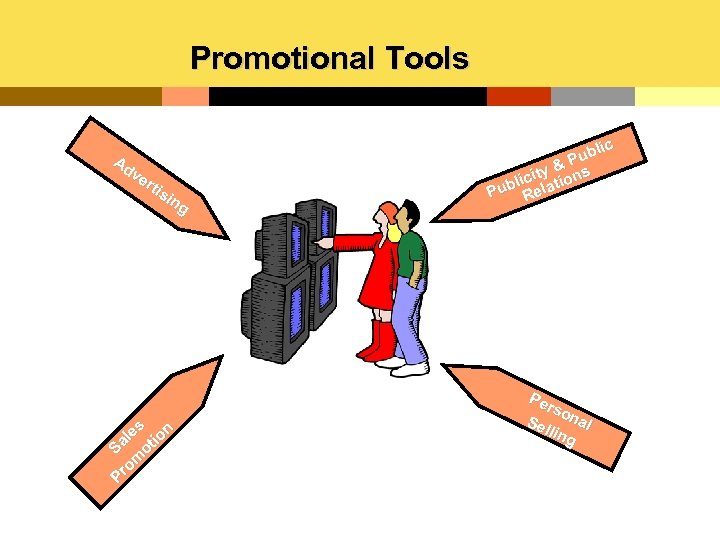 Promotional Tools Ad ve rti sin g s le tion Sa o m ro P ic ubl P ty &ons ici ubl Relati P Pe rso na Se llin l g
 Promotion - Branding • “…word, letter, sound, or symbol that… differentiate(s)… products on the market. ” • Trademark – R “…register(ed) name with the U. S. Patent and Trademark Office. ” • U. S. Patent & Trademark Website
 Branding Strategies ßPrivate Branding ßGeneric Branding ßManufacturer Branding
 Branding Equity & Loyalty • Equity – Value of a brand generated by a favorable consumer experience with a product or service • Loyalty – Consumer preference for a particular product or service that develops over time based on satisfaction with the company’s products or services
 Packaging/Labeling • Packaging - “…container that holds…(the) product. ” • Labeling – “…what… (is said) about the product on… (the) packaging. ”