


 Скачать презентацию Overview of Jewish History When did the
1edc6a852587e313451bf19745d2c9e1.ppt
- Количество слайдов: 92
 Overview of Jewish History
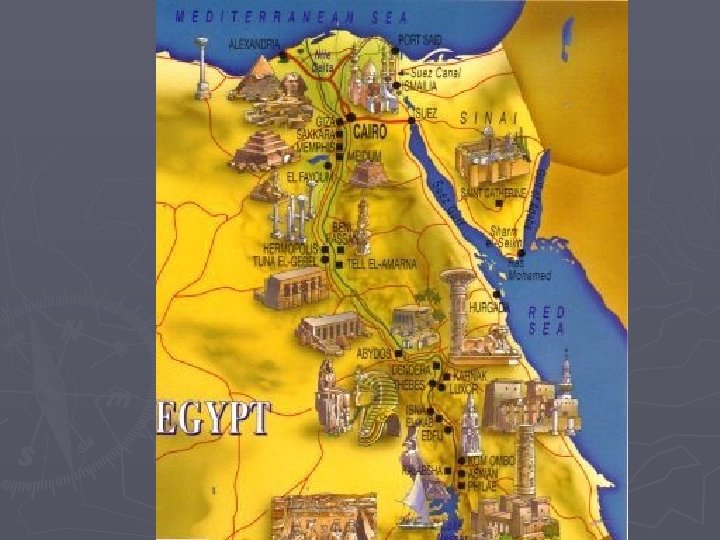
 When did the Exodus happen? 16 th cent. BCE ► 13 th cent BCE ►
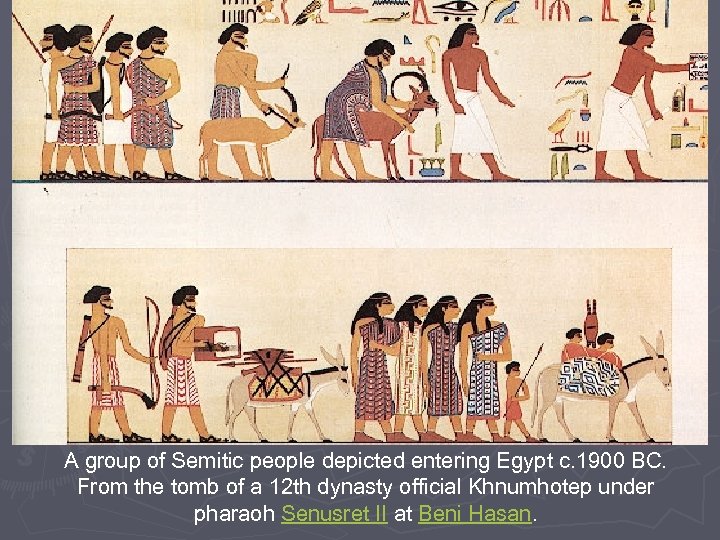 A group of Semitic people depicted entering Egypt c. 1900 BC. From the tomb of a 12 th dynasty official Khnumhotep under pharaoh Senusret II at Beni Hasan.
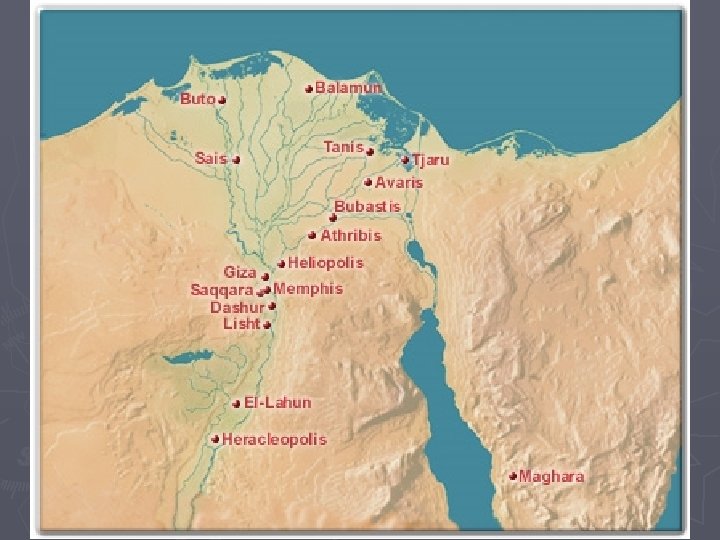
 Hyksos (ruled c. 1700 -1550 BCE) ► The Hyksos were Semites who infiltrated Egypt beginning in the 18 th cent. BCE and set up capital at Avaris ► Hyksos king Salitis occupied Memphis (the Egyptian capital) in 1674 BCE ► Controlled Lower Egypt (first the Delta then the whole North) ► Defeated by Ahmose I in 1550
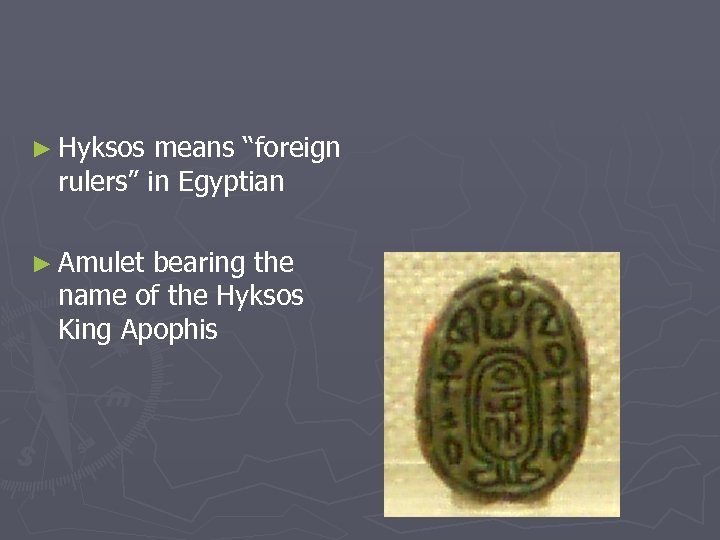 ► Hyksos means “foreign rulers” in Egyptian ► Amulet bearing the name of the Hyksos King Apophis
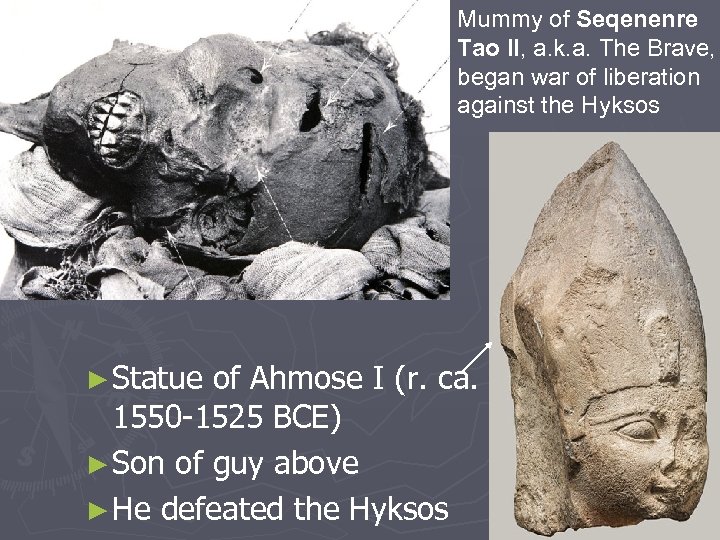 Mummy of Seqenenre Tao II, a. k. a. The Brave, began war of liberation against the Hyksos ► Statue of Ahmose I (r. ca. 1550 -1525 BCE) ► Son of guy above ► He defeated the Hyksos
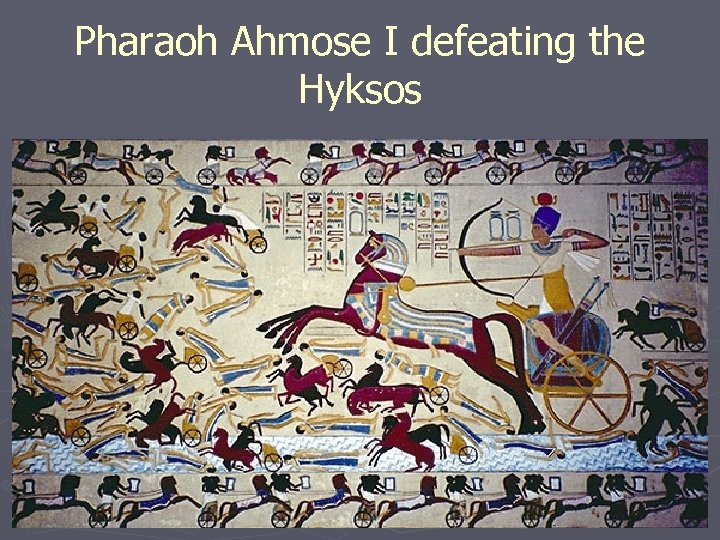 Pharaoh Ahmose I defeating the Hyksos
 Josephus, Contra Apion 1. 73 Manetho, in the second book of his Egyptian History, writes concerning us [the Jews] in the following manner. I will set down his very words, as if I were to bring the very man himself into a court for a witness: ► “…There came, after a surprising manner, men of ignoble birth out of the eastern parts, and had boldness enough to make an expedition into our country and with ease subdued it by force, yet without our hazarding a battle with them. …This whole nation was called Hyksos. …These people…kept possession of Egypt five hundred and eleven years. ” ► After these, he says, "That the kings of Thebais and the other parts of Egypt made an insurrection against the [Hyksos] shepherds, and that there a terrible and long war was made between them. " He says further, "That under a king, whose name was Alisphragmuthosis, the [Hyksos] shepherds were subdued by him, and were indeed driven out of other parts of Egypt… ► “They went away with their whole families and effects, not fewer in number than two hundred and forty thousand, and took their journey from Egypt…. They built a city in that country which is now called Judea, and that large enough to contain this great number of men, and called it Jerusalem…” ► This is Manetho's account. And evident it is from the number of years by him set down belonging to this interval, if they be summed up together, that these shepherds, as they are here called, who were no other than our forefathers, were delivered out of Egypt, and came thence, and inhabited this country. ►
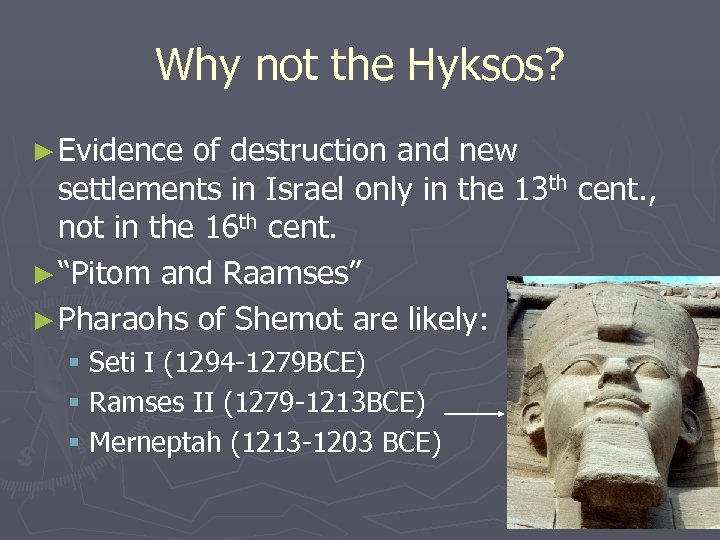 Why not the Hyksos? ► Evidence of destruction and new settlements in Israel only in the 13 th cent. , not in the 16 th cent. ► “Pitom and Raamses” ► Pharaohs of Shemot are likely: § Seti I (1294 -1279 BCE) § Ramses II (1279 -1213 BCE) § Merneptah (1213 -1203 BCE)
 Historical context of the biblical story ► Puts the migration of Jacob’s family to Egypt within the context of a larger movement of Semites moving to Egypt ► Explains how Joseph could rise to great power and marry an Egyptian noblewoman. He was a Semite just as they were. ► Explains why Pharaoh was so paranoid about the Israelite nation increasing and joining enemies to conquer the Egyptians.
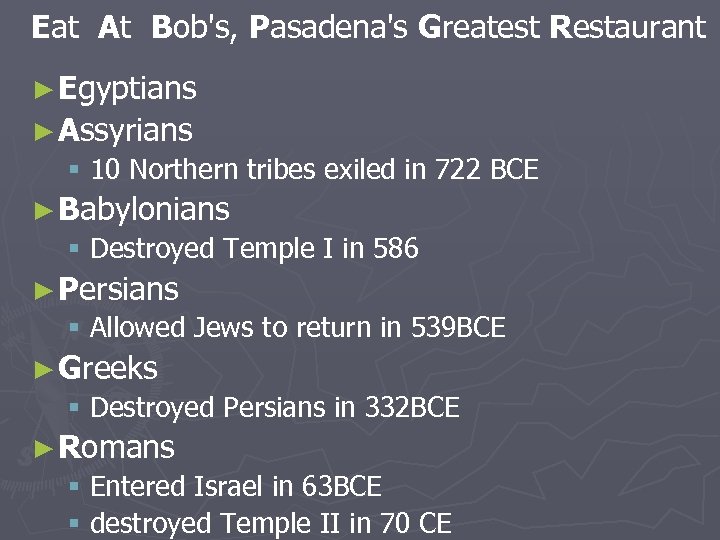 Eat At Bob's, Pasadena's Greatest Restaurant ► Egyptians ► Assyrians § 10 Northern tribes exiled in 722 BCE ► Babylonians § Destroyed Temple I in 586 ► Persians § Allowed Jews to return in 539 BCE ► Greeks § Destroyed Persians in 332 BCE ► Romans § Entered Israel in 63 BCE § destroyed Temple II in 70 CE
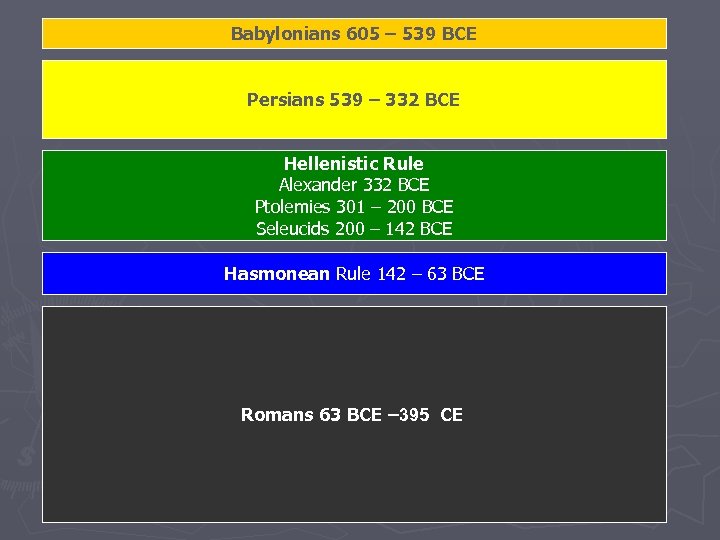 Babylonians 605 – 539 BCE Persians 539 – 332 BCE Hellenistic Rule Alexander 332 BCE Ptolemies 301 – 200 BCE Seleucids 200 – 142 BCE Hasmonean Rule 142 – 63 BCE Romans 63 BCE – 395 CE
 Events of the First and Second Temples
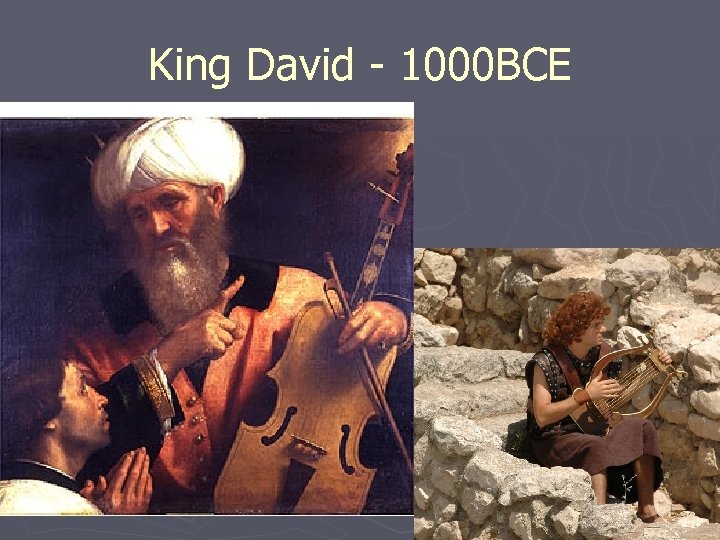 King David - 1000 BCE
 From the Last Kings to the Persian Period: Prophecy and Archaeology The Foundations of Jewish Survival 5 Stages of Galut, 5 Stages of Geulah
 , שבכל דור ודור עומדים עלינו לכלותינו . והקדוש ברוך הוא מצילנו מידם The Egyptian, the Babylonian, and the Persian rose, filled the planet with sound and splendor, then faded to dream-stuff and passed away; the Greek and the Roman followed; and made a vast noise, and they are gone; other people have sprung up and held their torch high for a time, but it burned out, and they sit in twilight now, or have vanished. The Jew saw them all, beat them all, and is now what he always was, exhibiting no decadence, no infirmities of age, no weakening of his parts, no slowing of his energies, no dulling of his alert and aggressive mind. All things are mortal but the Jew; all other forces pass, but he remains. What is the secret of his immortality? ” - Mark Twain “Concerning The Jews, ” Harper’s Magazine, 1899
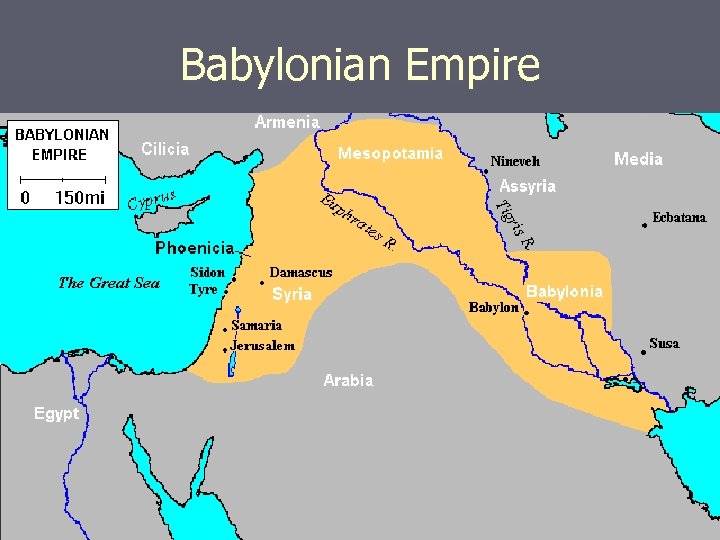 Babylonian Empire
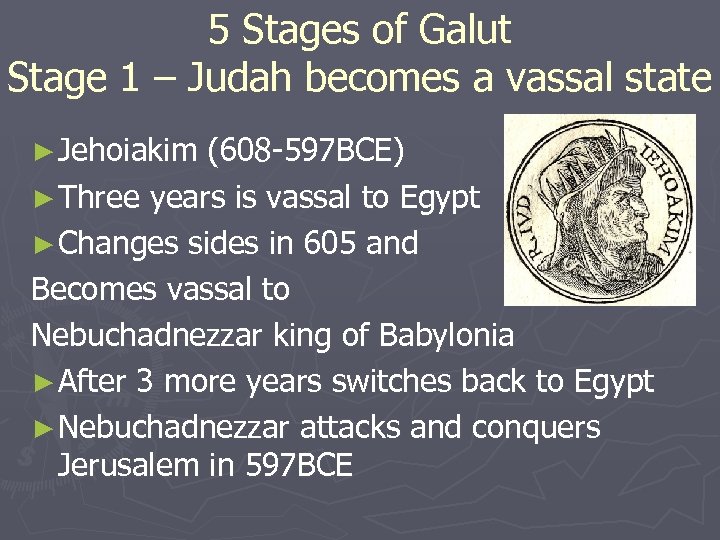 5 Stages of Galut Stage 1 – Judah becomes a vassal state ► Jehoiakim (608 -597 BCE) ► Three years is vassal to Egypt ► Changes sides in 605 and Becomes vassal to Nebuchadnezzar king of Babylonia ► After 3 more years switches back to Egypt ► Nebuchadnezzar attacks and conquers Jerusalem in 597 BCE
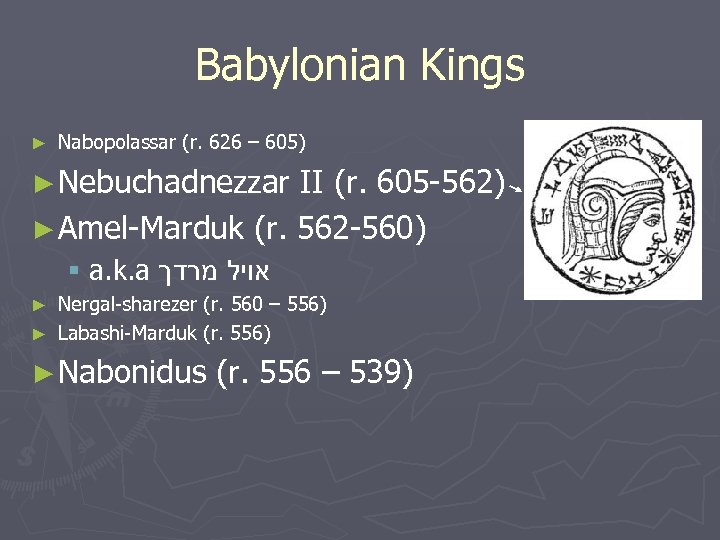 Babylonian Kings ► Nabopolassar (r. 626 – 605) ► Nebuchadnezzar II (r. 605 -562) ► Amel-Marduk (r. 562 -560) § a. k. a אויל מרדך Nergal-sharezer (r. 560 – 556) ► Labashi-Marduk (r. 556) ► ► Nabonidus (r. 556 – 539)
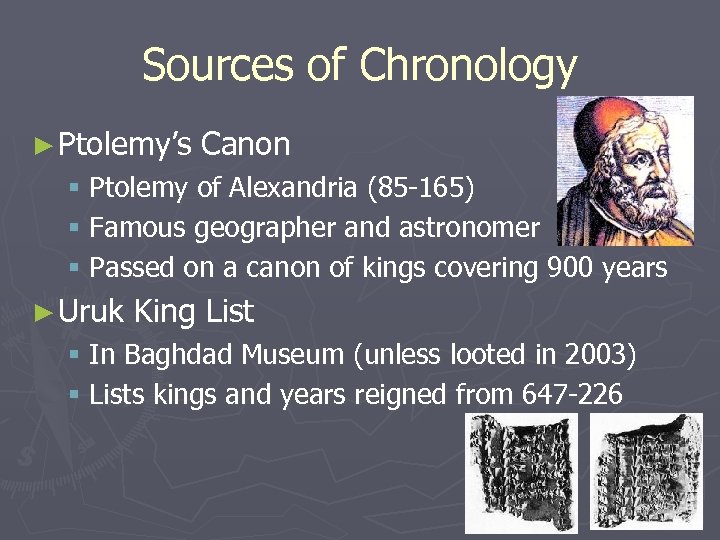 Sources of Chronology ► Ptolemy’s Canon § Ptolemy of Alexandria (85 -165) § Famous geographer and astronomer § Passed on a canon of kings covering 900 years ► Uruk King List § In Baghdad Museum (unless looted in 2003) § Lists kings and years reigned from 647 -226
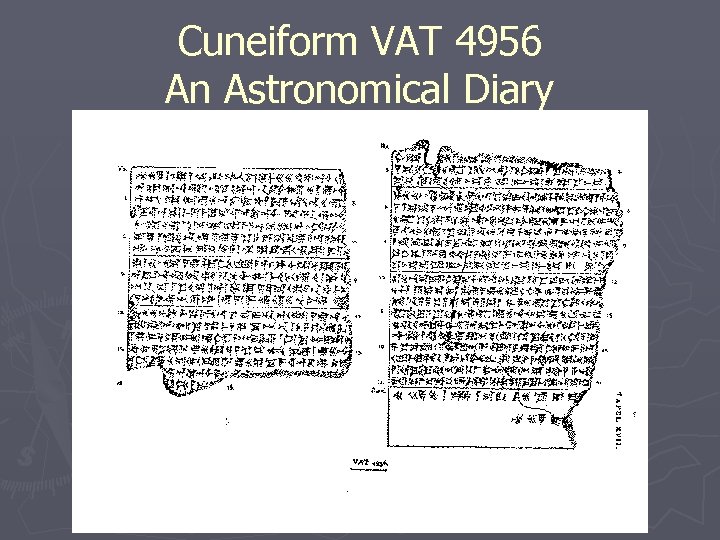 Cuneiform VAT 4956 An Astronomical Diary
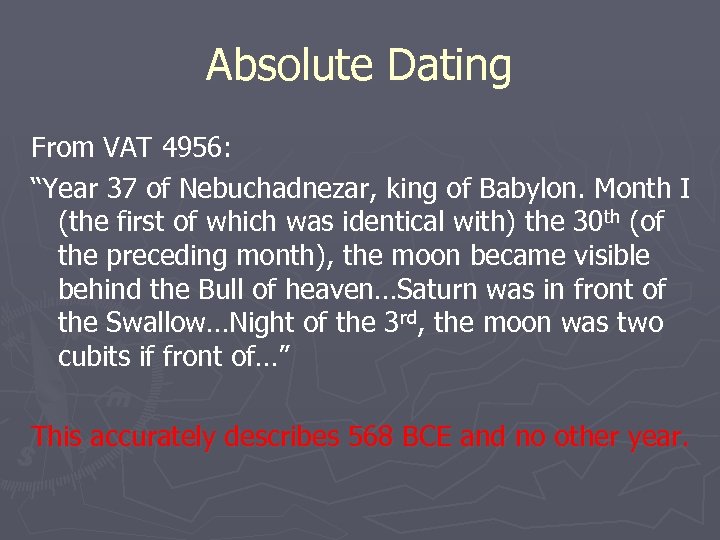 Absolute Dating From VAT 4956: “Year 37 of Nebuchadnezar, king of Babylon. Month I (the first of which was identical with) the 30 th (of the preceding month), the moon became visible behind the Bull of heaven…Saturn was in front of the Swallow…Night of the 3 rd, the moon was two cubits if front of…” This accurately describes 568 BCE and no other year.
 “Chronology Papers” by W. Dolen “But not only did these tablets report on lunar eclipses, and one planet position with specific dates (month and day), these tablets report on many planet positions. By ascertaining through retro-calculation the position of these planets on certain dates, we narrow the dates down to the exact year in the Christian Era system. “For example the 523 -522 BC tablet contains several positions of the planets Jupiter, Venus, Saturn, and Mars during this time period. Jupiter repeats its synodic period every 71 (70. 987) or 83 solar years. Venus repeats itself every eight years. Saturn repeats itself every 59 years. And Mars repeats itself every 47 (46. 979) years. These four planets will all be in the same position in relation to themselves and the stars on the same solar date approximately every 1, 575, 064 years. ” (vol. 5 p. 112)
 Thucydides, History of the Peloponnesian War, Book 2 Ch. 6 “The same summer, at the beginning of a new lunar month, the only time by the way at which it appears possible, the sun was eclipsed after noon. After it had assumed the form of a crescent and some of the stars had come out, it returned to its natural shape. ” This text describes a lunar eclipse in the first year of the Peloponnesian war = 431 BCE
 Stage 2 – Exile of Yehoiachin ► Yehoiachin 597 BCE § Reigns for three months § Captured by Nebuchandezzar in a siege § Imprisoned in Babylonia § Craftsman and elite of Judea is exiled with him § Freed in 562 BCE by Amel-Marduk
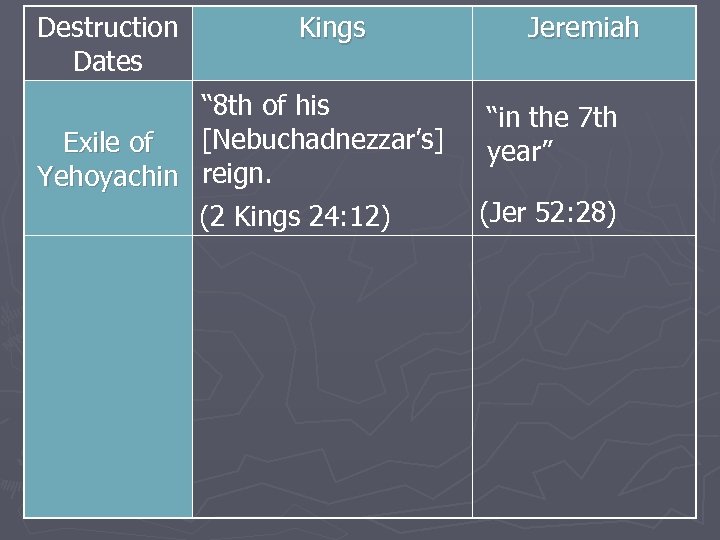 Destruction Dates Kings Jeremiah “ 8 th of his “in the 7 th Exile of [Nebuchadnezzar’s] year” Yehoyachin reign. (Jer 52: 28) (2 Kings 24: 12)
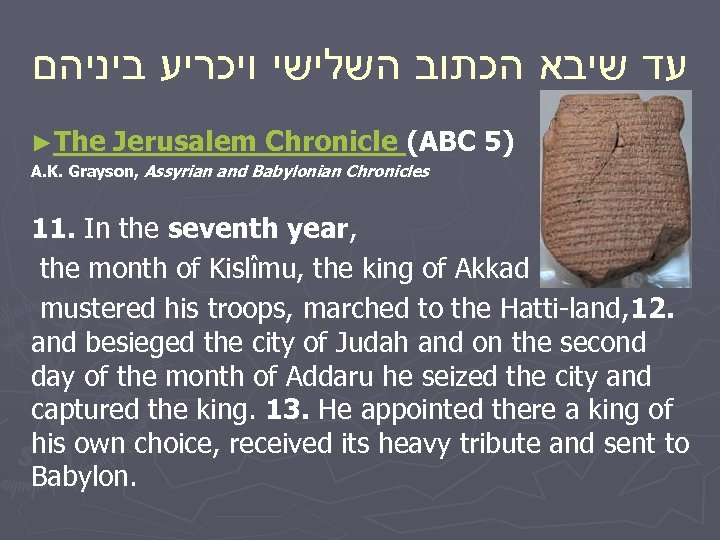 עד שיבא הכתוב השלישי ויכריע ביניהם ►The Jerusalem Chronicle (ABC 5) A. K. Grayson, Assyrian and Babylonian Chronicles 11. In the seventh year, the month of Kislîmu, the king of Akkad mustered his troops, marched to the Hatti-land, 12. and besieged the city of Judah and on the second day of the month of Addaru he seized the city and captured the king. 13. He appointed there a king of his own choice, received its heavy tribute and sent to Babylon.
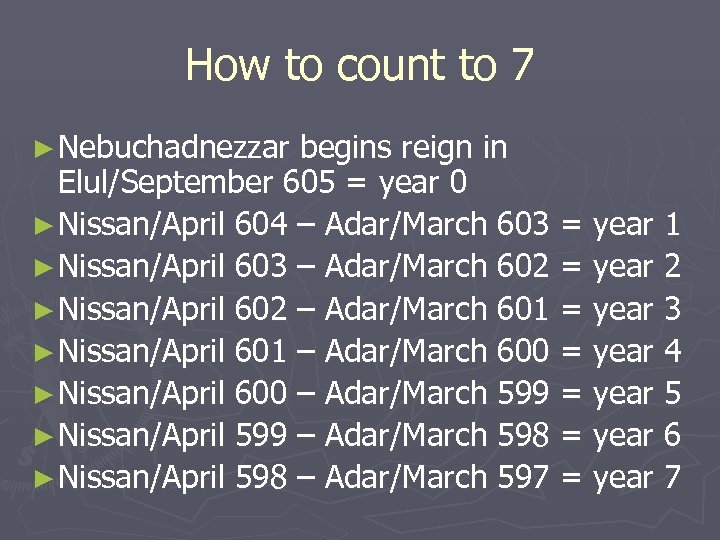 How to count to 7 ► Nebuchadnezzar begins reign in Elul/September 605 = year 0 ► Nissan/April 604 – Adar/March 603 = year 1 ► Nissan/April 603 – Adar/March 602 = year 2 ► Nissan/April 602 – Adar/March 601 = year 3 ► Nissan/April 601 – Adar/March 600 = year 4 ► Nissan/April 600 – Adar/March 599 = year 5 ► Nissan/April 599 – Adar/March 598 = year 6 ► Nissan/April 598 – Adar/March 597 = year 7
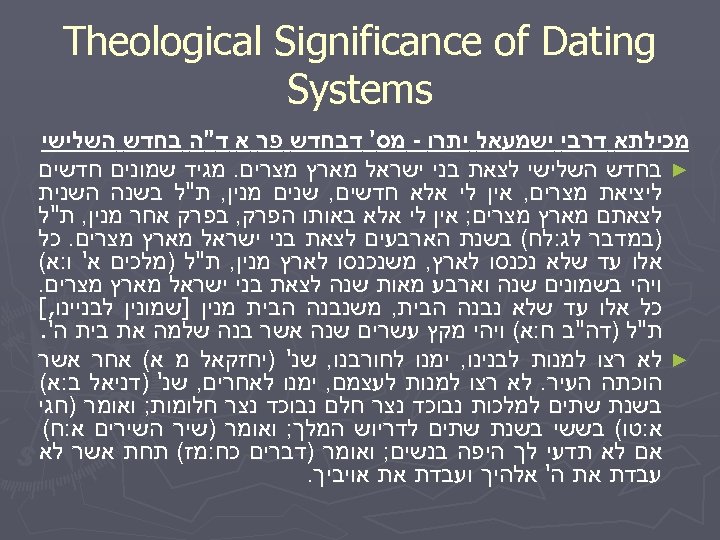 Theological Significance of Dating Systems מכילתא דרבי ישמעאל יתרו - מס' דבחדש פר א ד"ה בחדש השלישי ► בחדש השלישי לצאת בני ישראל מארץ מצרים. מגיד שמונים חדשים ליציאת מצרים, אין לי אלא חדשים, שנים מנין, ת"ל בשנה השנית לצאתם מארץ מצרים; אין לי אלא באותו הפרק, בפרק אחר מנין, ת"ל )במדבר לג: לח( בשנת הארבעים לצאת בני ישראל מארץ מצרים. כל אלו עד שלא נכנסו לארץ, משנכנסו לארץ מנין, ת"ל )מלכים א' ו: א( ויהי בשמונים שנה וארבע מאות שנה לצאת בני ישראל מארץ מצרים. כל אלו עד שלא נבנה הבית, משנבנה הבית מנין ]שמונין לבניינו, [ ת"ל )דה"ב ח: א( ויהי מקץ עשרים שנה אשר בנה שלמה את בית ה'. ► לא רצו למנות לבנינו, ימנו לחורבנו, שנ' )יחזקאל מ א( אחר אשר הוכתה העיר. לא רצו למנות לעצמם, ימנו לאחרים, שנ' )דניאל ב: א( בשנת שתים למלכות נבוכד נצר חלם נבוכד נצר חלומות; ואומר )חגי א: טו( בששי בשנת שתים לדריוש המלך; ואומר )שיר השירים א: ח( אם לא תדעי לך היפה בנשים; ואומר )דברים כח: מז( תחת אשר לא עבדת את ה' אלהיך ועבדת את אויביך.
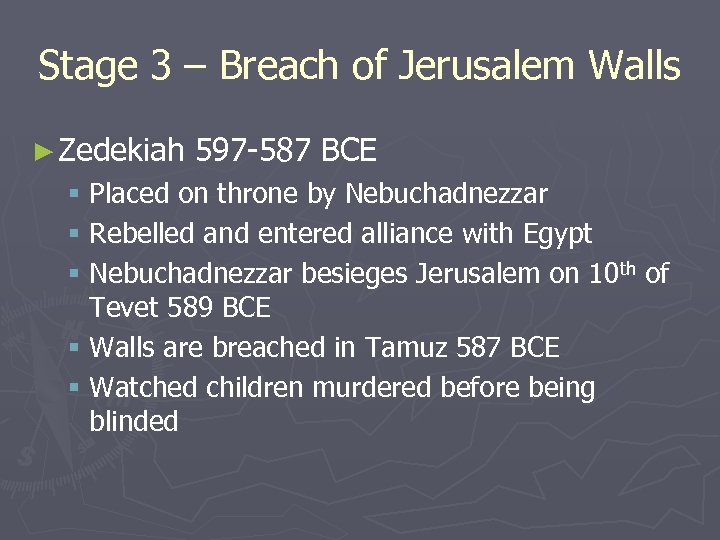 Stage 3 – Breach of Jerusalem Walls ► Zedekiah 597 -587 BCE § Placed on throne by Nebuchadnezzar § Rebelled and entered alliance with Egypt § Nebuchadnezzar besieges Jerusalem on 10 th of Tevet 589 BCE § Walls are breached in Tamuz 587 BCE § Watched children murdered before being blinded
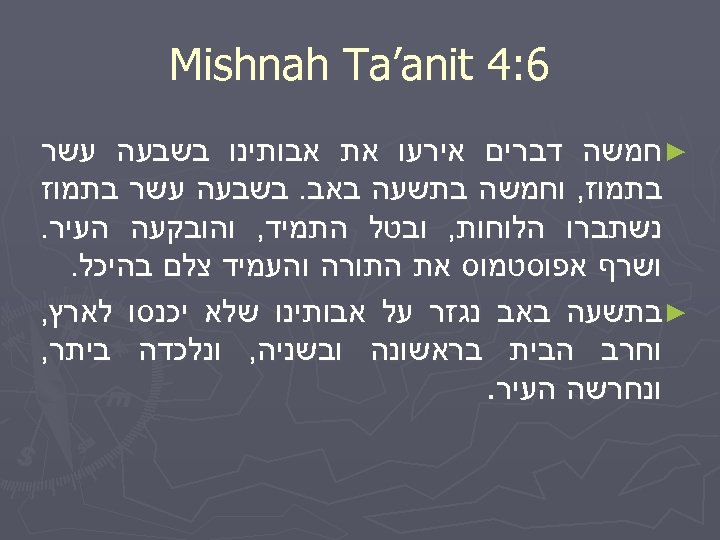 6: 4 Mishnah Ta’anit ► חמשה דברים אירעו את אבותינו בשבעה עשר בתמוז, וחמשה בתשעה באב. בשבעה עשר בתמוז נשתברו הלוחות, ובטל התמיד, והובקעה העיר. ושרף אפוסטמוס את התורה והעמיד צלם בהיכל. ► בתשעה באב נגזר על אבותינו שלא יכנסו לארץ, וחרב הבית בראשונה ובשניה, ונלכדה ביתר, ונחרשה העיר.
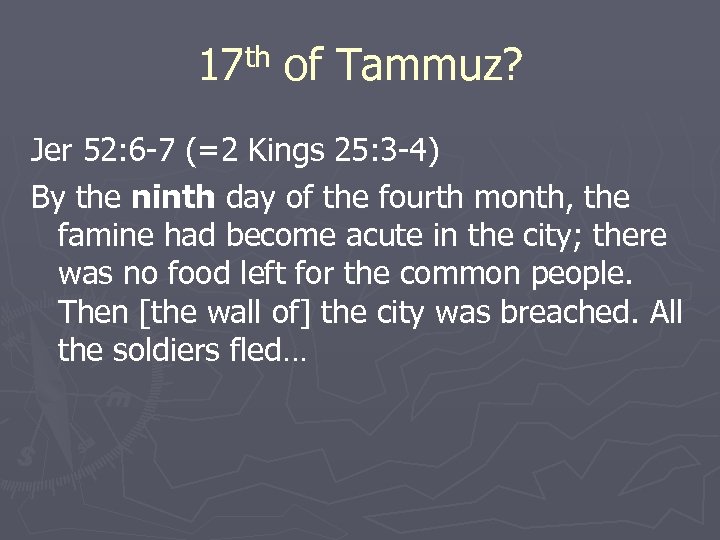 th of Tammuz? 17 Jer 52: 6 -7 (=2 Kings 25: 3 -4) By the ninth day of the fourth month, the famine had become acute in the city; there was no food left for the common people. Then [the wall of] the city was breached. All the soldiers fled…
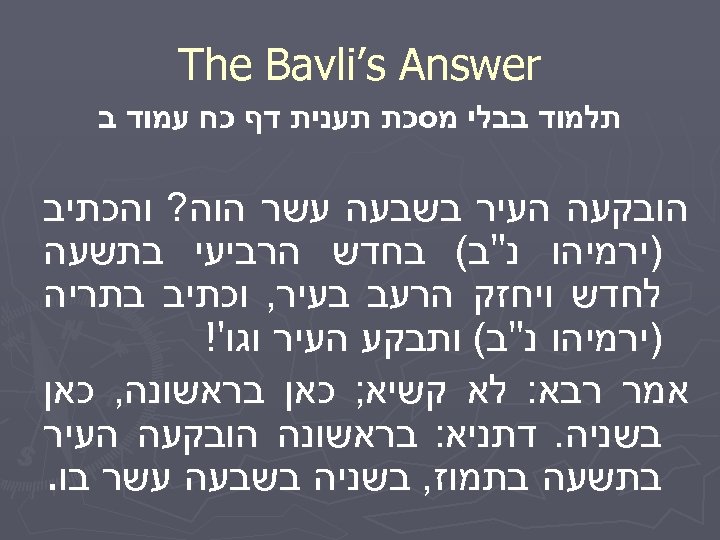 The Bavli’s Answer תלמוד בבלי מסכת תענית דף כח עמוד ב הובקעה העיר בשבעה עשר הוה? והכתיב )ירמיהו נ"ב( בחדש הרביעי בתשעה לחדש ויחזק הרעב בעיר, וכתיב בתריה )ירמיהו נ"ב( ותבקע העיר וגו'! אמר רבא: לא קשיא; כאן בראשונה, כאן בשניה. דתניא: בראשונה הובקעה העיר בתשעה בתמוז, בשניה בשבעה עשר בו.
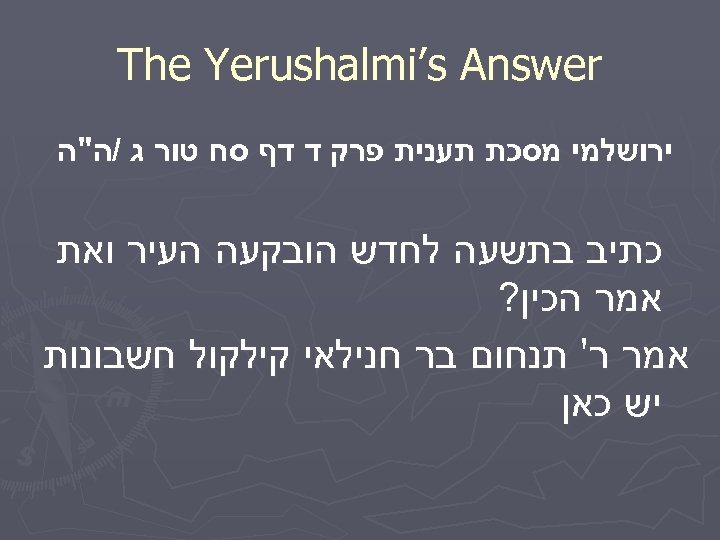 The Yerushalmi’s Answer ירושלמי מסכת תענית פרק ד דף סח טור ג /ה"ה כתיב בתשעה לחדש הובקעה העיר ואת אמר הכין? אמר ר' תנחום בר חנילאי קילקול חשבונות יש כאן
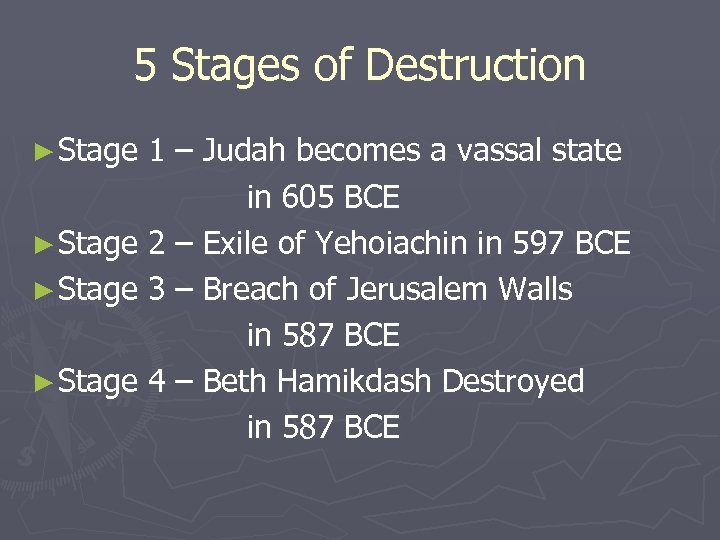 5 Stages of Destruction ► Stage 1 – Judah becomes a vassal state in 605 BCE ► Stage 2 – Exile of Yehoiachin in 597 BCE ► Stage 3 – Breach of Jerusalem Walls in 587 BCE ► Stage 4 – Beth Hamikdash Destroyed in 587 BCE
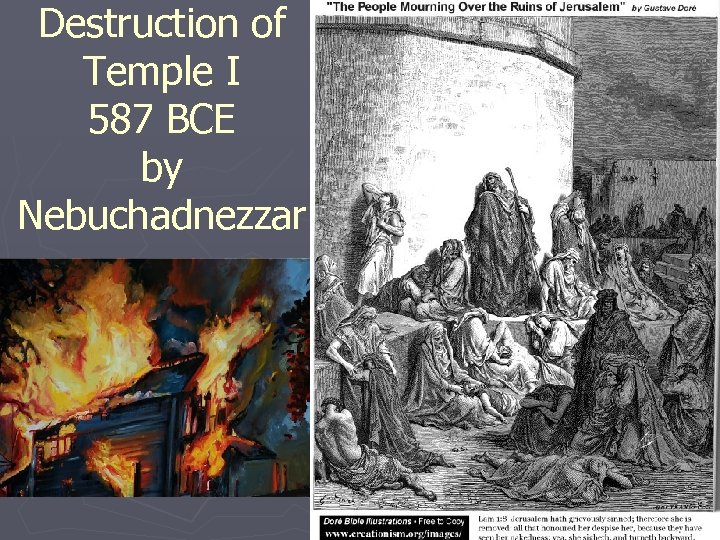 Destruction of Temple I 587 BCE by Nebuchadnezzar
![Destruction Dates Kings “ 8 th of his Exile of [Nebuchadnezzar’s] Yehoyachin reign. (2](https://present5.com/presentation/1edc6a852587e313451bf19745d2c9e1/image-39.jpg "Destruction Dates Kings “ 8 th of his Exile of [Nebuchadnezzar’s] Yehoyachin reign. (2") Destruction Dates Kings “ 8 th of his Exile of [Nebuchadnezzar’s] Yehoyachin reign. (2 Kings 24: 12) Jeremiah “in the 7 th year” (Jer 52: 28) “On the 10 th “On the 7 th day of the 5 th month in the Destruction 19 th year of King 19 th year…” of the Nebuchadnezzar…” (Jer 52: 12) Temple (2 Kings 25: 8) “ 18 th year” (Jer 52: 29)
Destruction Dates Kings “ 8 th of his Exile of [Nebuchadnezzar’s] Yehoyachin reign. (2 Kings 24: 12) Jeremiah “in the 7 th year” (Jer 52: 28) “On the 10 th “On the 7 th day of the 5 th month in the Destruction 19 th year of King 19 th year…” of the Nebuchadnezzar…” (Jer 52: 12) Temple (2 Kings 25: 8) “ 18 th year” (Jer 52: 29)
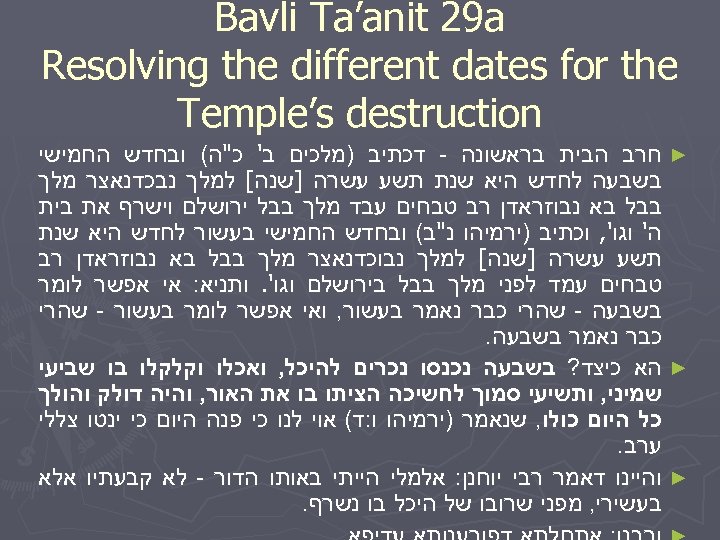 Bavli Ta’anit 29 a Resolving the different dates for the Temple’s destruction ► חרב הבית בראשונה - דכתיב )מלכים ב' כ"ה( ובחדש החמישי בשבעה לחדש היא שנת תשע עשרה ]שנה[ למלך נבכדנאצר מלך בבל בא נבוזראדן רב טבחים עבד מלך בבל ירושלם וישרף את בית ה' וגו', וכתיב )ירמיהו נ"ב( ובחדש החמישי בעשור לחדש היא שנת תשע עשרה ]שנה[ למלך נבוכדנאצר מלך בבל בא נבוזראדן רב טבחים עמד לפני מלך בבל בירושלם וגו'. ותניא: אי אפשר לומר בשבעה - שהרי כבר נאמר בעשור, ואי אפשר לומר בעשור - שהרי כבר נאמר בשבעה. ► הא כיצד? בשבעה נכנסו נכרים להיכל, ואכלו וקלקלו בו שביעי שמיני, ותשיעי סמוך לחשיכה הציתו בו את האור, והיה דולק והולך כל היום כולו, שנאמר )ירמיהו ו: ד( אוי לנו כי פנה היום כי ינטו צללי ערב. ► והיינו דאמר רבי יוחנן: אלמלי הייתי באותו הדור - לא קבעתיו אלא בעשירי, מפני שרובו של היכל בו נשרף.
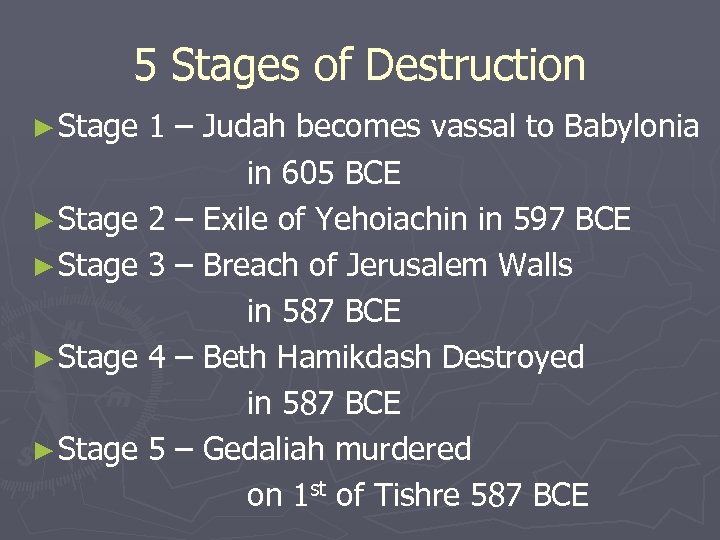 5 Stages of Destruction ► Stage 1 – Judah becomes vassal to Babylonia in 605 BCE ► Stage 2 – Exile of Yehoiachin in 597 BCE ► Stage 3 – Breach of Jerusalem Walls in 587 BCE ► Stage 4 – Beth Hamikdash Destroyed in 587 BCE ► Stage 5 – Gedaliah murdered on 1 st of Tishre 587 BCE
 Stage 1 of Redemption Yehoyachin Freed and Given Daily Allowance And in the thirty-seventh year of the exile of Jehoiachin (562 BCE) king of Judah, in the twelfth month, on the twenty-seventh day of the month, Evil-merodach king of Babylon, in the year that he began to reign, graciously freed Jehoiachin king of Judah from prison; and he spoke kindly jto him, and gave him a seat above the seats of the kings who were with him in Babylon. So Jehoiachin put off his prison garments. And every day of his life he dined regularly at the king's table; and for his allowance, a regular allowance was given him by the king, every day a portion, as long as he lived. (2 Kings 25: 27 -30)
 ANET 308 – Lists of Food Deliveries to Important People 1. . . to Ia-'-u-kin, king. . . to the qîpûtu-house of. . . for Shalamiamu, the. . . for 126 men from Tyre. . . for Zabiruam the Ly[dian]. . . ► 2 10 sila of oil to. . . [Ia]-'-kin, king of Ia-[a-hu-du] 2½ sila of oil to the [five so]ns of the king of Ia-a-hu-du 4 sila to eight men from Ia-a-hu-da-a-a. . . ► 3 1½ sila for three carpenters from Arvad, ½ sila each 11½ sila for eight ditto from Byblus, 1 sila each. . . 3½ sila for seven ditto, ½ sila each ½ sila for Nabû-êtir the carpenter 10 sila to Ia-ku-ú-ki-nu, the son of the king of Ia-ku-du (Yehudah) 2½ sila for the five sons of the king of Ia-ku-du through Qana'a ►
 – Stage 2 of Redeption Cyrus Grants Permission to Return and Rebuild in 539 BCE דברי הימים ב פרק לו )כ( ויגל השארית מן החרב אל בבל ויהיו לו ולבניו לעבדים עד מלך מלכות פרס: )כא( למלאות דבר יקוק בפי ירמיהו עד רצתה הארץ את שבתותיה כל ימי השמה שבתה למלאות שבעים שנה: פ )כב( ובשנת אחת לכורש מלך פרס לכלות דבר יקוק בפי ירמיהו העיר יקוק את רוח כורש מלך פרס ויעבר קול בכל מלכותו וגם במכתב לאמר: ס )כג( כה אמר כורש מלך פרס כל ממלכות הארץ נתן לי יקוק אלהי השמים והוא פקד עלי לבנות לו בית בירושלם אשר ביהודה מי בכם מכל עמו יקוק אלהיו
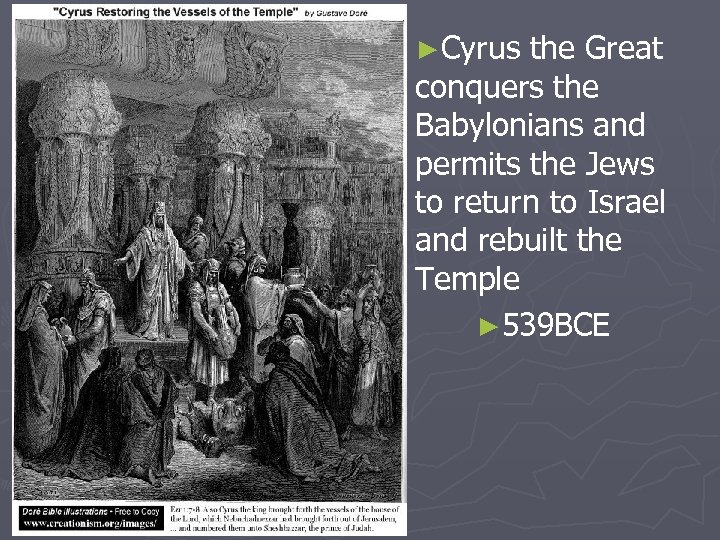 ►Cyrus the Great conquers the Babylonians and permits the Jews to return to Israel and rebuilt the Temple ► 539 BCE
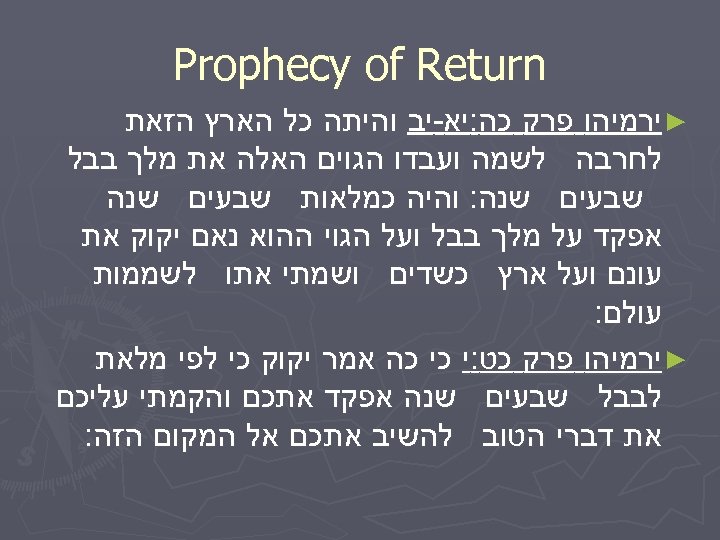 Prophecy of Return ► ירמיהו פרק כה: יא-יב והיתה כל הארץ הזאת לחרבה לשמה ועבדו הגוים האלה את מלך בבל שבעים שנה: והיה כמלאות שבעים שנה אפקד על מלך בבל ועל הגוי ההוא נאם יקוק את עונם ועל ארץ כשדים ושמתי אתו לשממות עולם: ► ירמיהו פרק כט: י כי כה אמר יקוק כי לפי מלאת לבבל שבעים שנה אפקד אתכם והקמתי עליכם את דברי הטוב להשיב אתכם אל המקום הזה:
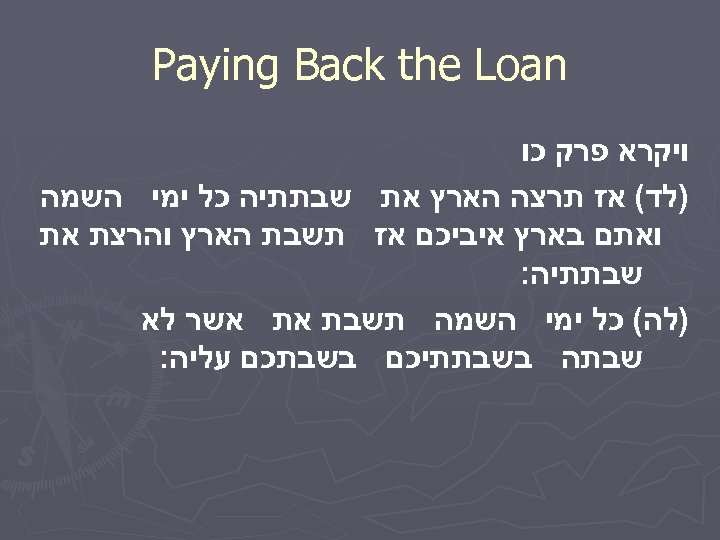 Paying Back the Loan ויקרא פרק כו )לד( אז תרצה הארץ את שבתתיה כל ימי השמה ואתם בארץ איביכם אז תשבת הארץ והרצת את שבתתיה: )לה( כל ימי השמה תשבת את אשר לא שבתה בשבתתיכם בשבתכם עליה:
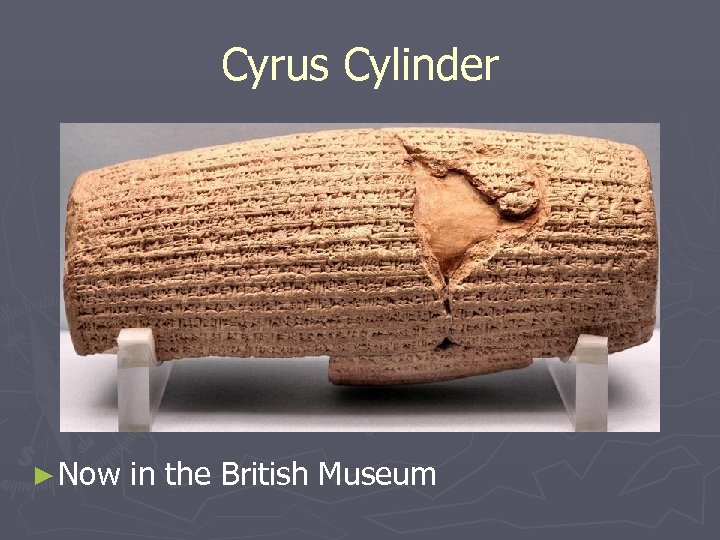 Cyrus Cylinder ► Now in the British Museum
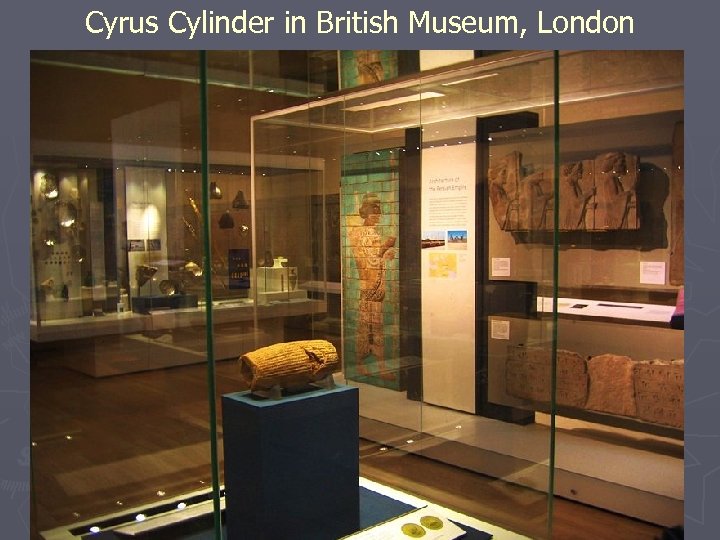 Cyrus Cylinder in British Museum, London
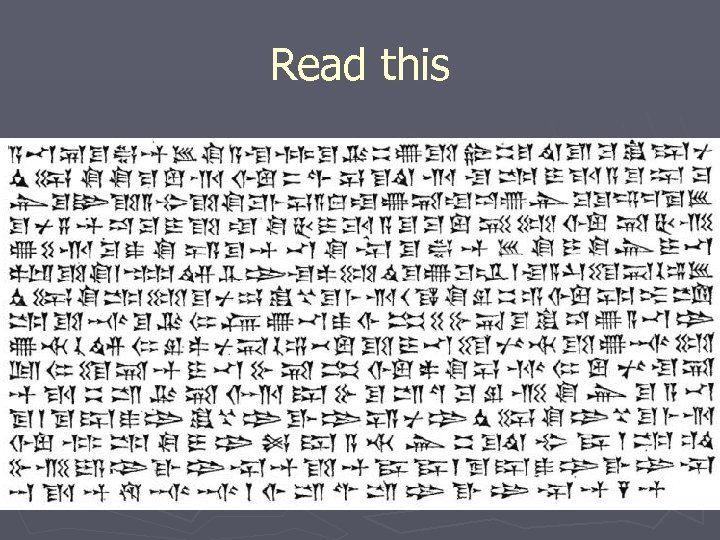 Read this
![Cyrus Cylinder [28 -33] By his exalted word, all the kings who sit upon](https://present5.com/presentation/1edc6a852587e313451bf19745d2c9e1/image-51.jpg "Cyrus Cylinder [28 -33] By his exalted word, all the kings who sit upon") Cyrus Cylinder [28 -33] By his exalted word, all the kings who sit upon thrones throughout the world, from the Upper Sea to the Lower Sea [ i. e. , from the Mediterranean Sea to the Persian Gulf], who live in the districts faroff, the kings of the West, who dwell in tents, all of them, brought their heavy tribute before me and in Babylon they kissed my feet. From Babylon to Aššur and from Susa, Agade, Ešnunna, Zamban, Me-Turnu, Der, as far as the region of Gutium, the sacred centers on the other side of the Tigris, whose sanctuaries had been abandoned for a long time, I returned the images of the gods, who had resided there [i. e. , in Babylon], to their places and I let them dwell in eternal abodes. I gathered all their inhabitants and returned to them their dwellings. In addition, at the command of Marduk, the great lord, I settled in their habitations, in pleasing abodes, the gods of Sumer and Akkad, whom Nabonidus, to the anger of the lord of the gods, had brought into Babylon. ► [34 -36] May all the gods whom I settled in their sacred centers ask daily of Bêl and Nâbu that my days be long and may they intercede for my welfare. May they say to Marduk, my lord: "As for Cyrus, the king who reveres you, and Cambyses, his son, [lacuna]. " The people of Babylon blessed my kingship, and I settled all the lands in peaceful abodes. ►
Cyrus Cylinder [28 -33] By his exalted word, all the kings who sit upon thrones throughout the world, from the Upper Sea to the Lower Sea [ i. e. , from the Mediterranean Sea to the Persian Gulf], who live in the districts faroff, the kings of the West, who dwell in tents, all of them, brought their heavy tribute before me and in Babylon they kissed my feet. From Babylon to Aššur and from Susa, Agade, Ešnunna, Zamban, Me-Turnu, Der, as far as the region of Gutium, the sacred centers on the other side of the Tigris, whose sanctuaries had been abandoned for a long time, I returned the images of the gods, who had resided there [i. e. , in Babylon], to their places and I let them dwell in eternal abodes. I gathered all their inhabitants and returned to them their dwellings. In addition, at the command of Marduk, the great lord, I settled in their habitations, in pleasing abodes, the gods of Sumer and Akkad, whom Nabonidus, to the anger of the lord of the gods, had brought into Babylon. ► [34 -36] May all the gods whom I settled in their sacred centers ask daily of Bêl and Nâbu that my days be long and may they intercede for my welfare. May they say to Marduk, my lord: "As for Cyrus, the king who reveres you, and Cambyses, his son, [lacuna]. " The people of Babylon blessed my kingship, and I settled all the lands in peaceful abodes. ►
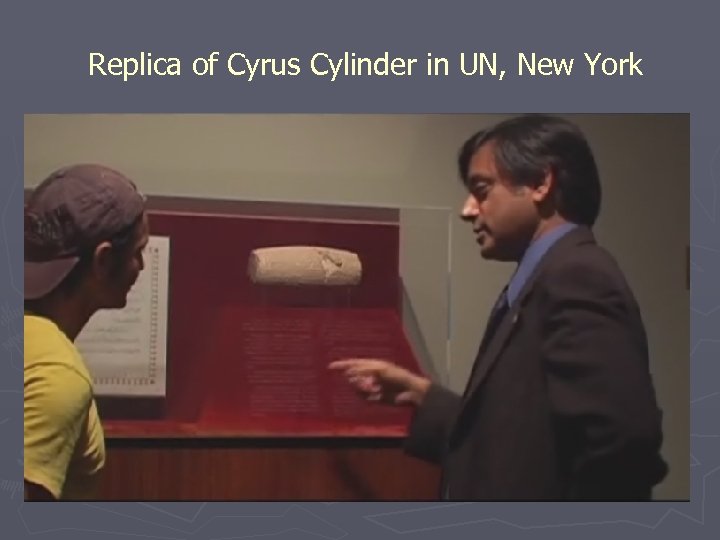 Replica of Cyrus Cylinder in UN, New York
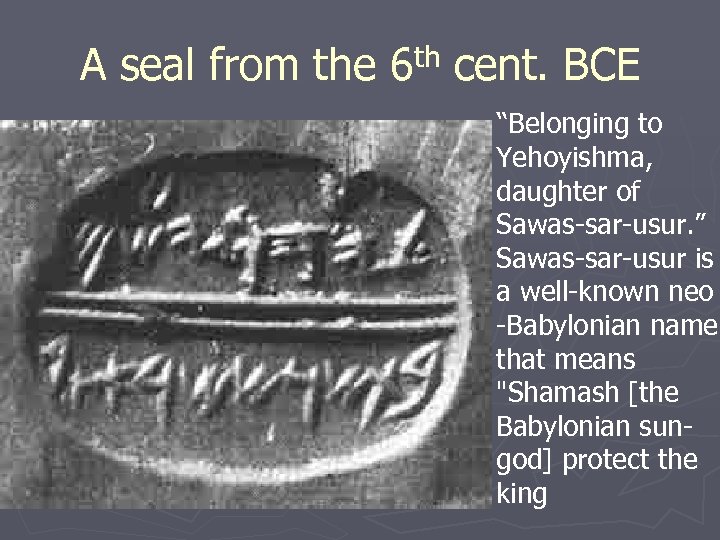 th cent. BCE A seal from the 6 “Belonging to Yehoyishma, daughter of Sawas-sar-usur. ” Sawas-sar-usur is a well-known neo -Babylonian name that means "Shamash [the Babylonian sungod] protect the king
 Stage 3 Rebuilding of Second Bet Hamikdash in 520 -516 BCE ► Texts: Ezra 1 -6, Haggai 1 ► People Involved § Sheshbazzar – Yehoyachin’s son § Zerubabel – Yehoyachin’s grandson § Haggai § Zechariah ► Dates § Commences in Darius I’s 2 nd year = 520 § Finished on Adar 3 of Darius’ 6 th year = March 516
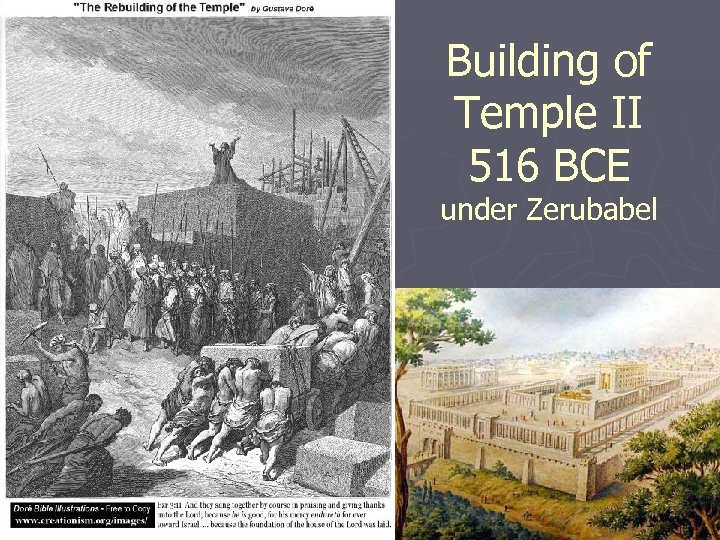 Building of Temple II 516 BCE under Zerubabel
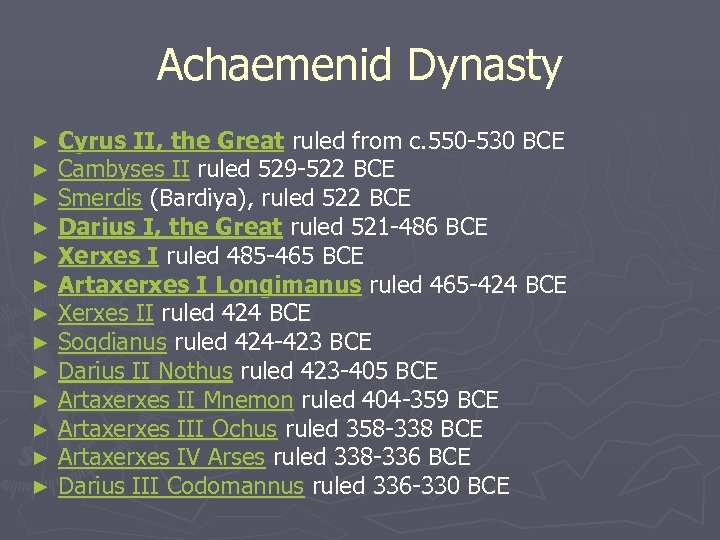 Achaemenid Dynasty ► ► ► ► Cyrus II, the Great ruled from c. 550 -530 BCE Cambyses II ruled 529 -522 BCE Smerdis (Bardiya), ruled 522 BCE Darius I, the Great ruled 521 -486 BCE Xerxes I ruled 485 -465 BCE Artaxerxes I Longimanus ruled 465 -424 BCE Xerxes II ruled 424 BCE Sogdianus ruled 424 -423 BCE Darius II Nothus ruled 423 -405 BCE Artaxerxes II Mnemon ruled 404 -359 BCE Artaxerxes III Ochus ruled 358 -338 BCE Artaxerxes IV Arses ruled 338 -336 BCE Darius III Codomannus ruled 336 -330 BCE
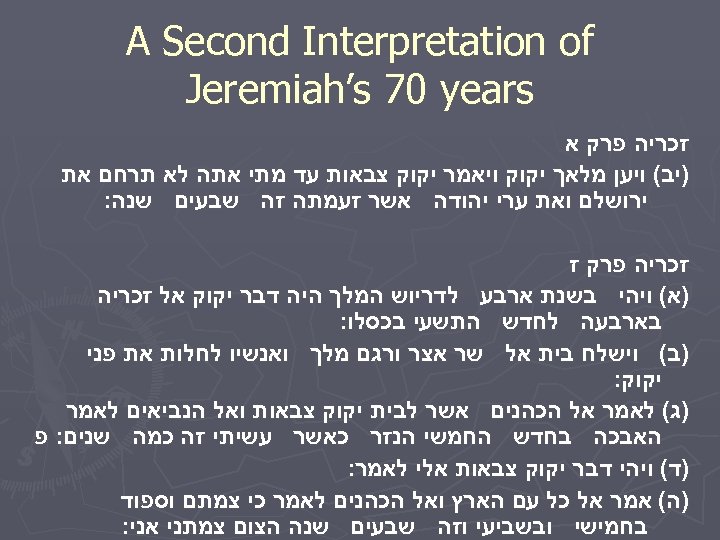 A Second Interpretation of Jeremiah’s 70 years זכריה פרק א )יב( ויען מלאך יקוק ויאמר יקוק צבאות עד מתי אתה לא תרחם את ירושלם ואת ערי יהודה אשר זעמתה זה שבעים שנה: זכריה פרק ז )א( ויהי בשנת ארבע לדריוש המלך היה דבר יקוק אל זכריה בארבעה לחדש התשעי בכסלו: )ב( וישלח בית אל שר אצר ורגם מלך ואנשיו לחלות את פני יקוק: )ג( לאמר אל הכהנים אשר לבית יקוק צבאות ואל הנביאים לאמר האבכה בחדש החמשי הנזר כאשר עשיתי זה כמה שנים: פ )ד( ויהי דבר יקוק צבאות אלי לאמר: )ה( אמר אל כל עם הארץ ואל הכהנים לאמר כי צמתם וספוד בחמישי ובשביעי וזה שבעים שנה הצום צמתני אני:
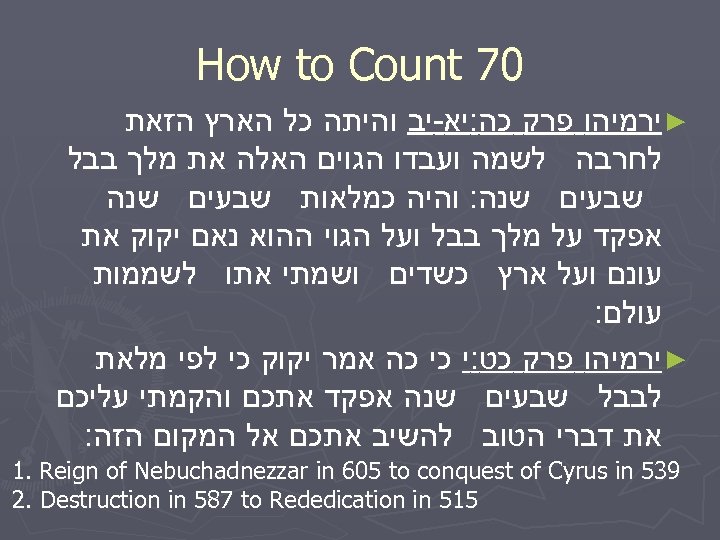 07 How to Count ► ירמיהו פרק כה: יא-יב והיתה כל הארץ הזאת לחרבה לשמה ועבדו הגוים האלה את מלך בבל שבעים שנה: והיה כמלאות שבעים שנה אפקד על מלך בבל ועל הגוי ההוא נאם יקוק את עונם ועל ארץ כשדים ושמתי אתו לשממות עולם: ► ירמיהו פרק כט: י כי כה אמר יקוק כי לפי מלאת לבבל שבעים שנה אפקד אתכם והקמתי עליכם את דברי הטוב להשיב אתכם אל המקום הזה: 935 1. Reign of Nebuchadnezzar in 605 to conquest of Cyrus in 515 2. Destruction in 587 to Rededication in
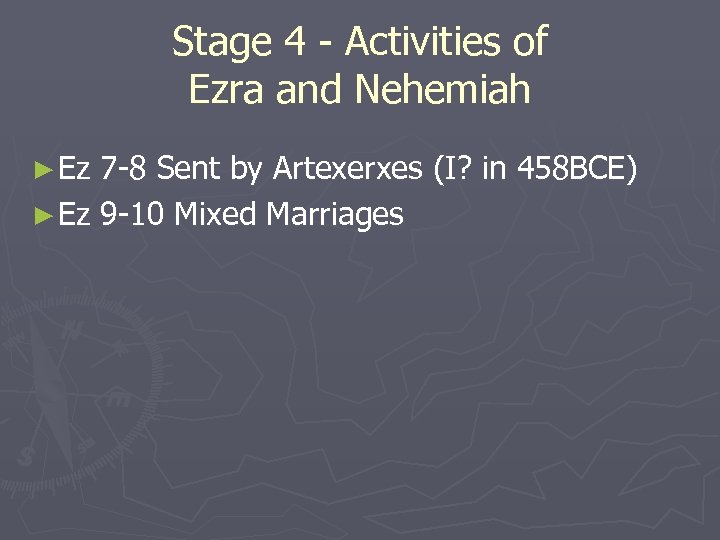 Stage 4 - Activities of Ezra and Nehemiah ► Ez 7 -8 Sent by Artexerxes (I? in 458 BCE) ► Ez 9 -10 Mixed Marriages
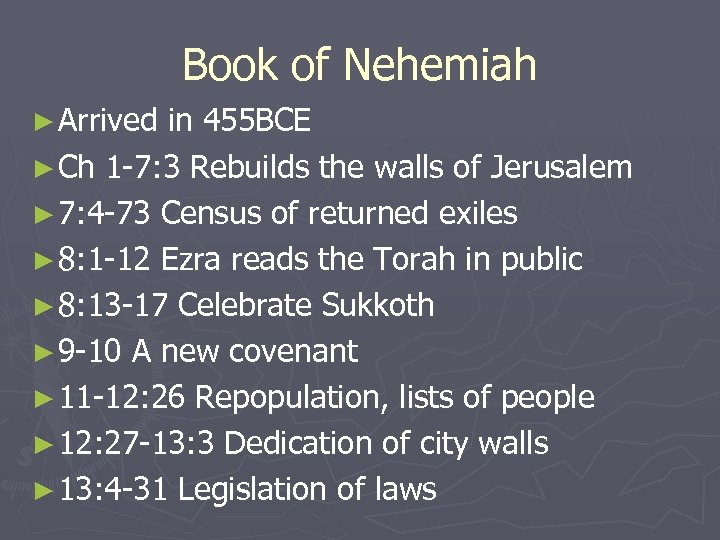 Book of Nehemiah ► Arrived in 455 BCE ► Ch 1 -7: 3 Rebuilds the walls of Jerusalem ► 7: 4 -73 Census of returned exiles ► 8: 1 -12 Ezra reads the Torah in public ► 8: 13 -17 Celebrate Sukkoth ► 9 -10 A new covenant ► 11 -12: 26 Repopulation, lists of people ► 12: 27 -13: 3 Dedication of city walls ► 13: 4 -31 Legislation of laws
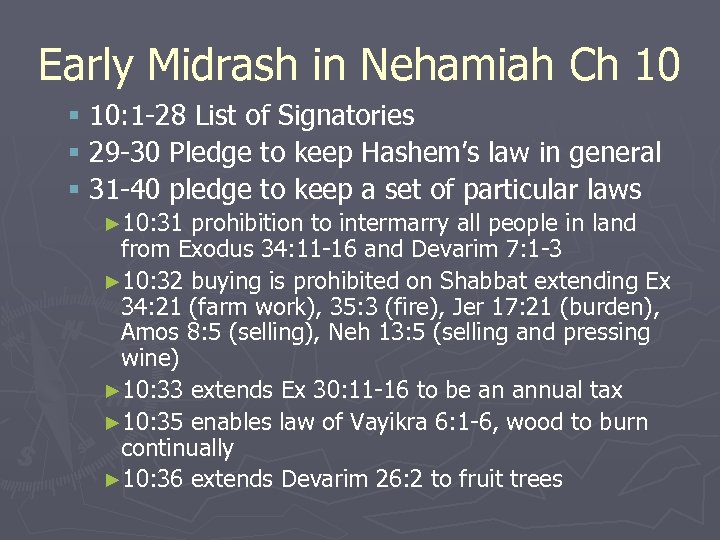 Early Midrash in Nehamiah Ch 10 § 10: 1 -28 List of Signatories § 29 -30 Pledge to keep Hashem’s law in general § 31 -40 pledge to keep a set of particular laws ► 10: 31 prohibition to intermarry all people in land from Exodus 34: 11 -16 and Devarim 7: 1 -3 ► 10: 32 buying is prohibited on Shabbat extending Ex 34: 21 (farm work), 35: 3 (fire), Jer 17: 21 (burden), Amos 8: 5 (selling), Neh 13: 5 (selling and pressing wine) ► 10: 33 extends Ex 30: 11 -16 to be an annual tax ► 10: 35 enables law of Vayikra 6: 1 -6, wood to burn continually ► 10: 36 extends Devarim 26: 2 to fruit trees
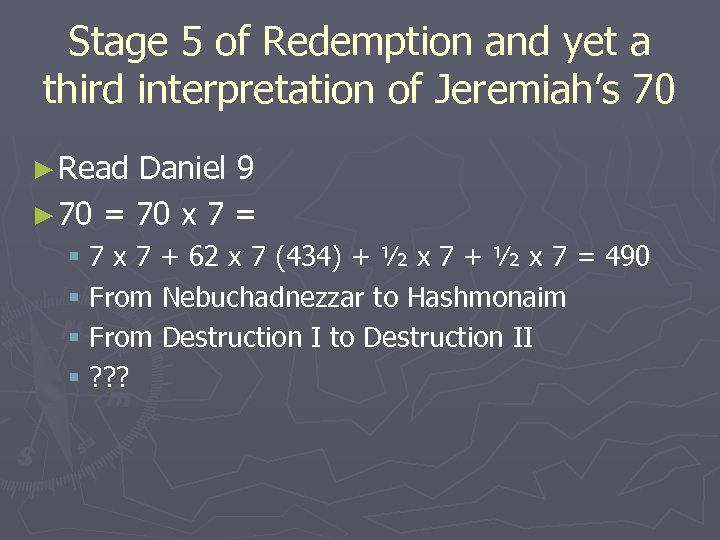 Stage 5 of Redemption and yet a third interpretation of Jeremiah’s 70 ► Read Daniel 9 ► 70 = 70 x 7 = § 7 x 7 + 62 x 7 (434) + ½ x 7 = 490 § From Nebuchadnezzar to Hashmonaim § From Destruction I to Destruction II § ? ? ?
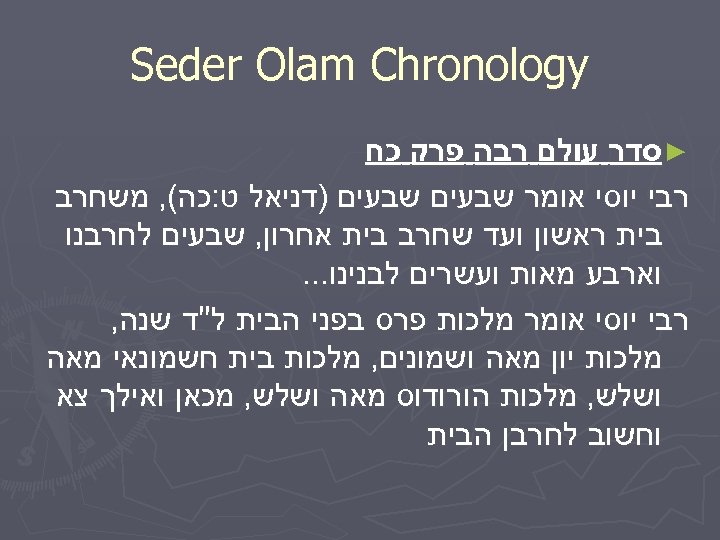 Seder Olam Chronology ► סדר עולם רבה פרק כח רבי יוסי אומר שבעים )דניאל ט: כה(, משחרב בית ראשון ועד שחרב בית אחרון, שבעים לחרבנו וארבע מאות ועשרים לבנינו. . . רבי יוסי אומר מלכות פרס בפני הבית ל"ד שנה, מלכות יון מאה ושמונים, מלכות בית חשמונאי מאה ושלש, מלכות הורודוס מאה ושלש, מכאן ואילך צא וחשוב לחרבן הבית
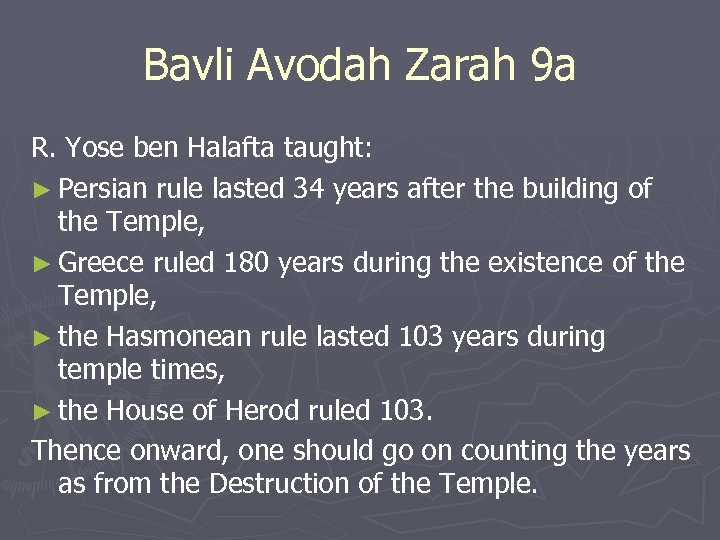 Bavli Avodah Zarah 9 a R. Yose ben Halafta taught: ► Persian rule lasted 34 years after the building of the Temple, ► Greece ruled 180 years during the existence of the Temple, ► the Hasmonean rule lasted 103 years during temple times, ► the House of Herod ruled 103. Thence onward, one should go on counting the years as from the Destruction of the Temple.
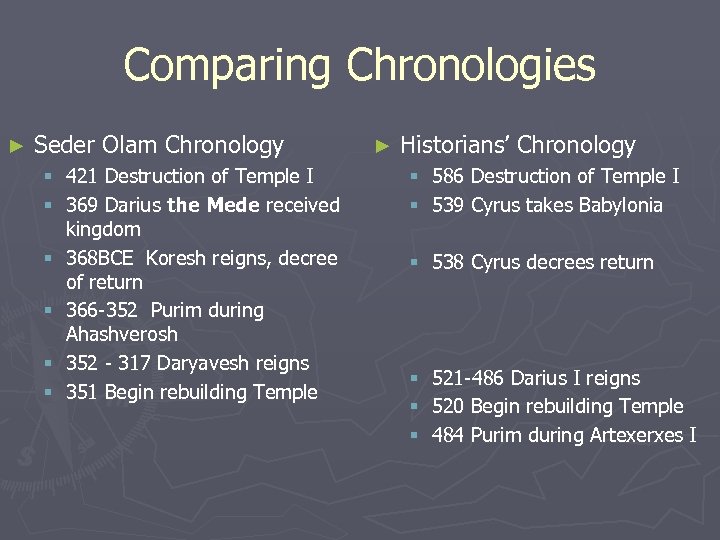 Comparing Chronologies ► Seder Olam Chronology § 421 Destruction of Temple I § 369 Darius the Mede received kingdom § 368 BCE Koresh reigns, decree of return § 366 -352 Purim during Ahashverosh § 352 - 317 Daryavesh reigns § 351 Begin rebuilding Temple ► Historians’ Chronology § 586 Destruction of Temple I § 539 Cyrus takes Babylonia § 538 Cyrus decrees return § 521 -486 Darius I reigns § 520 Begin rebuilding Temple § 484 Purim during Artexerxes I
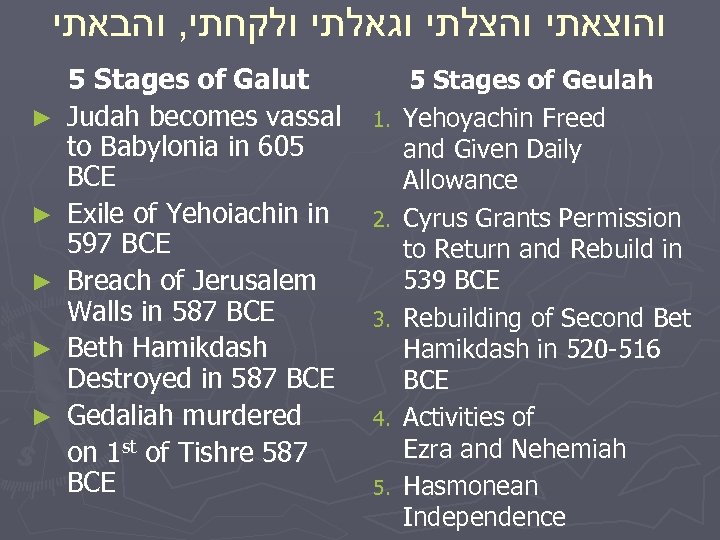 והוצאתי והצלתי וגאלתי ולקחתי, והבאתי ► ► ► 5 Stages of Galut Judah becomes vassal to Babylonia in 605 BCE Exile of Yehoiachin in 597 BCE Breach of Jerusalem Walls in 587 BCE Beth Hamikdash Destroyed in 587 BCE Gedaliah murdered on 1 st of Tishre 587 BCE 1. 2. 3. 4. 5. 5 Stages of Geulah Yehoyachin Freed and Given Daily Allowance Cyrus Grants Permission to Return and Rebuild in 539 BCE Rebuilding of Second Bet Hamikdash in 520 -516 BCE Activities of Ezra and Nehemiah Hasmonean Independence
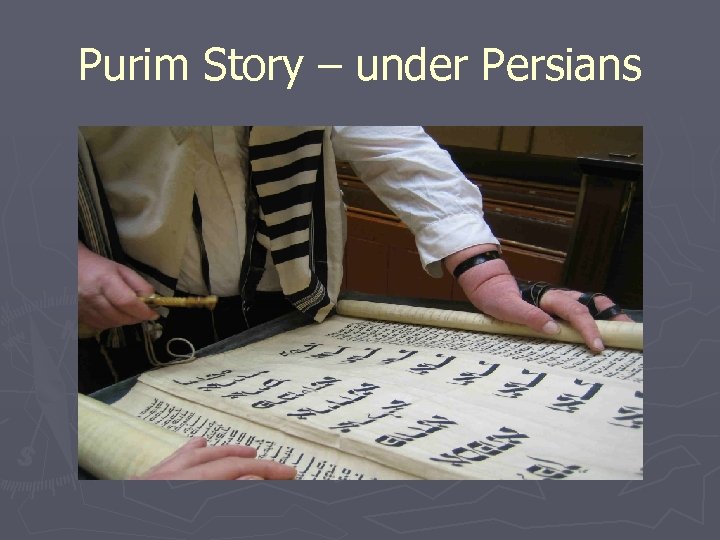 Purim Story – under Persians
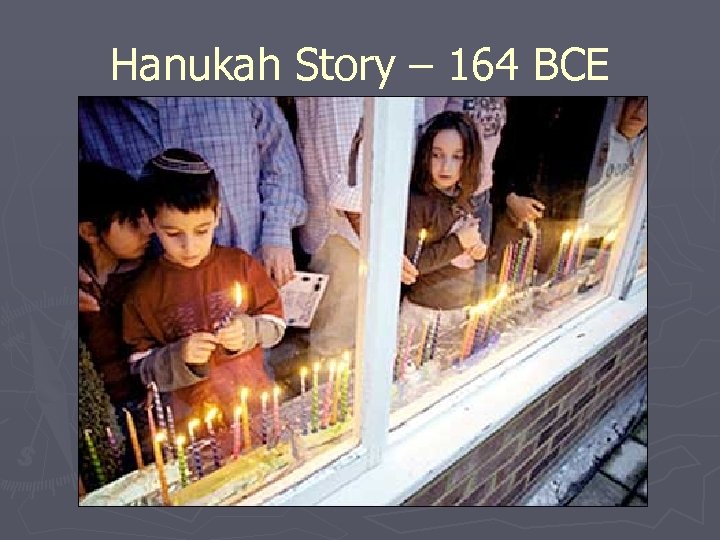 Hanukah Story – 164 BCE
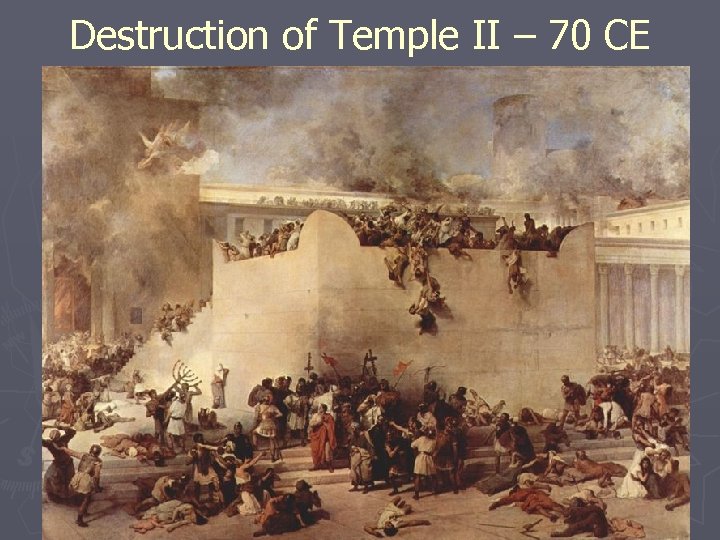 Destruction of Temple II – 70 CE
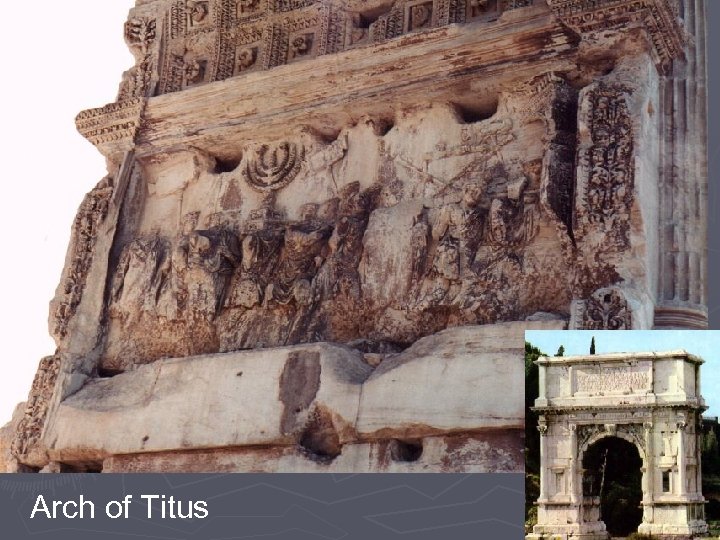 Arch of Titus
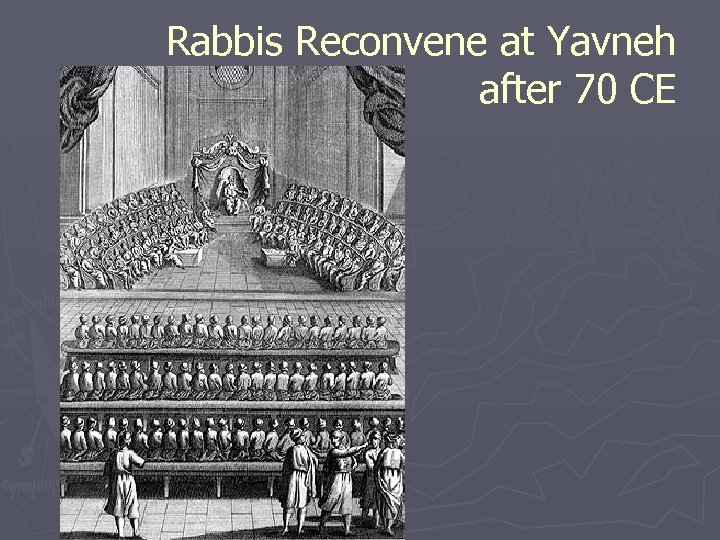 Rabbis Reconvene at Yavneh after 70 CE
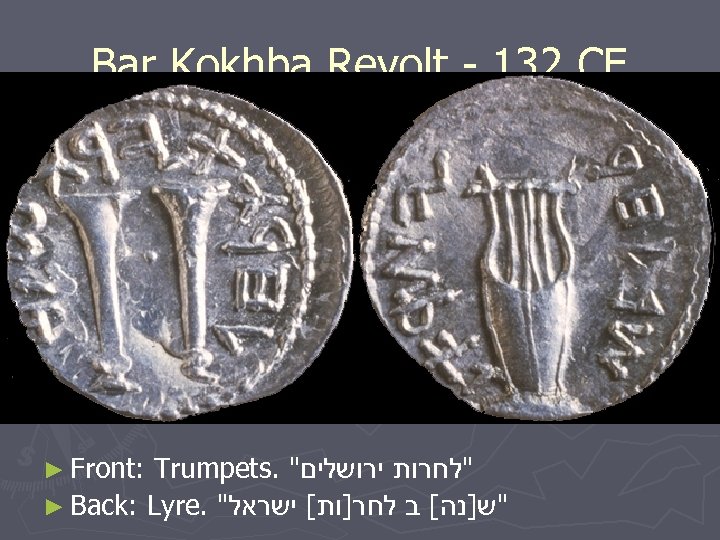 Bar Kokhba Revolt - 132 CE ► Front: Trumpets. " "לחרות ירושלים ► Back: Lyre. " "ש]נה[ ב לחר]ות[ ישראל
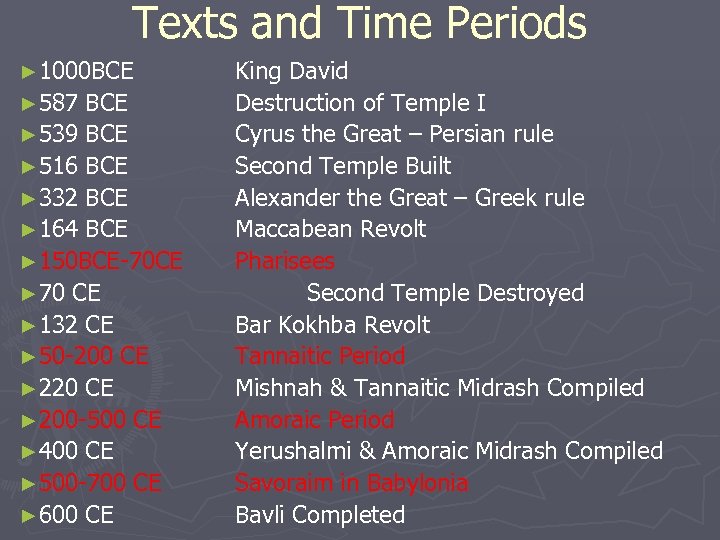 Texts and Time Periods ► 1000 BCE ► 587 BCE ► 539 BCE ► 516 BCE ► 332 BCE ► 164 BCE ► 150 BCE-70 CE ► 70 CE ► 132 CE ► 50 -200 CE ► 220 CE ► 200 -500 CE ► 400 CE ► 500 -700 CE ► 600 CE King David Destruction of Temple I Cyrus the Great – Persian rule Second Temple Built Alexander the Great – Greek rule Maccabean Revolt Pharisees Second Temple Destroyed Bar Kokhba Revolt Tannaitic Period Mishnah & Tannaitic Midrash Compiled Amoraic Period Yerushalmi & Amoraic Midrash Compiled Savoraim in Babylonia Bavli Completed
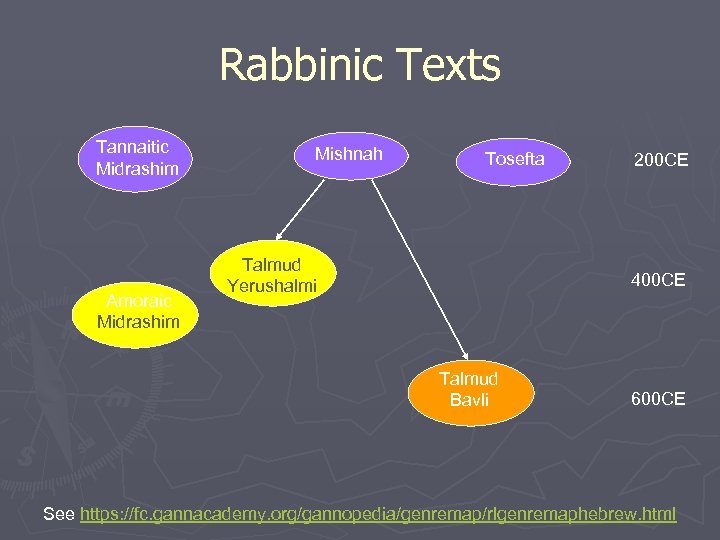 Rabbinic Texts Tannaitic Midrashim Amoraic Midrashim Mishnah Tosefta Talmud Yerushalmi 200 CE 400 CE Talmud Bavli 600 CE See https: //fc. gannacademy. org/gannopedia/genremap/rlgenremaphebrew. html
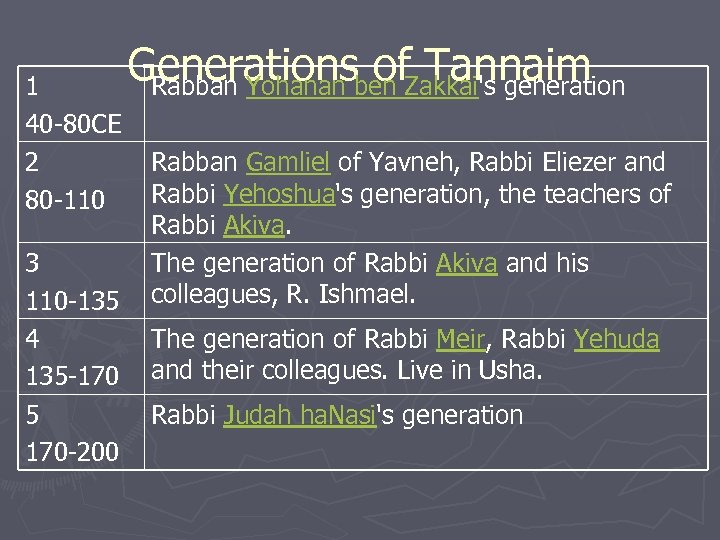 1 40 -80 CE 2 80 -110 3 110 -135 4 135 -170 5 170 -200 Generations of Tannaim Rabban Yohanan ben Zakkai's generation Rabban Gamliel of Yavneh, Rabbi Eliezer and Rabbi Yehoshua's generation, the teachers of Rabbi Akiva. The generation of Rabbi Akiva and his colleagues, R. Ishmael. The generation of Rabbi Meir, Rabbi Yehuda and their colleagues. Live in Usha. Rabbi Judah ha. Nasi's generation
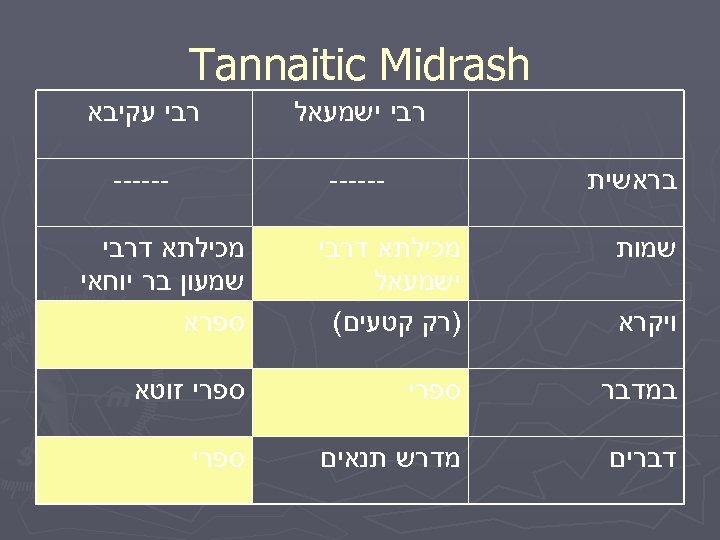 Tannaitic Midrash רבי ישמעאל רבי עקיבא ------ בראשית שמות מכילתא דרבי ישמעאל )רק קטעים( מכילתא דרבי שמעון בר יוחאי ספרא במדבר ספרי זוטא דברים מדרש תנאים ספרי ויקרא
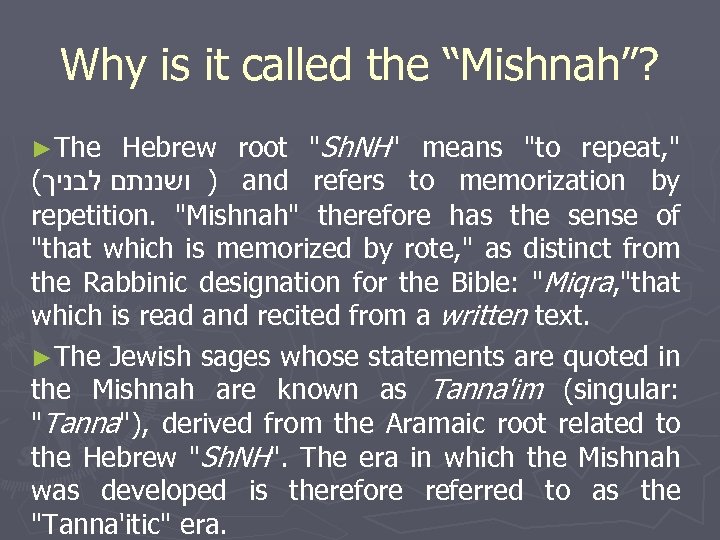 Why is it called the “Mishnah”? Hebrew root "Sh. NH" means "to repeat, " ( ) ושננתם לבניך and refers to memorization by repetition. "Mishnah" therefore has the sense of "that which is memorized by rote, " as distinct from the Rabbinic designation for the Bible: "Miqra, "that which is read and recited from a written text. ►The Jewish sages whose statements are quoted in the Mishnah are known as Tanna'im (singular: "Tanna"), derived from the Aramaic root related to the Hebrew "Sh. NH". The era in which the Mishnah was developed is therefore referred to as the "Tanna'itic" era. ►The
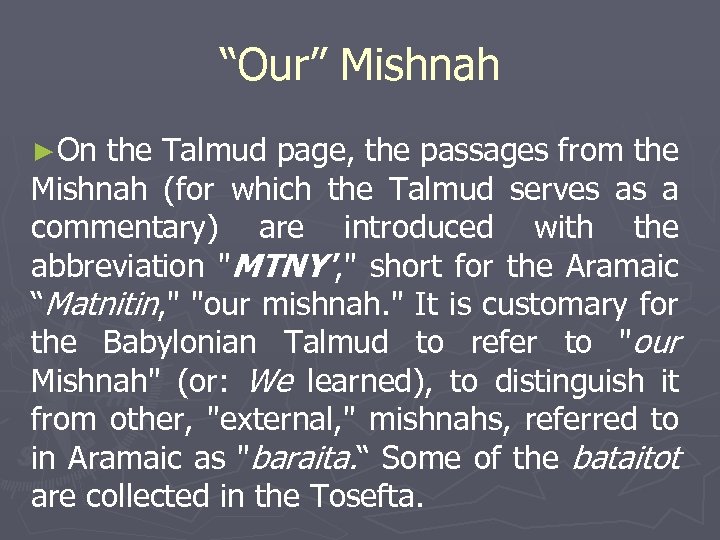 “Our” Mishnah ►On the Talmud page, the passages from the Mishnah (for which the Talmud serves as a commentary) are introduced with the abbreviation "MTNY', " short for the Aramaic “Matnitin, " "our mishnah. " It is customary for the Babylonian Talmud to refer to "our Mishnah" (or: We learned), to distinguish it from other, "external, " mishnahs, referred to in Aramaic as "baraita. “ Some of the bataitot are collected in the Tosefta.
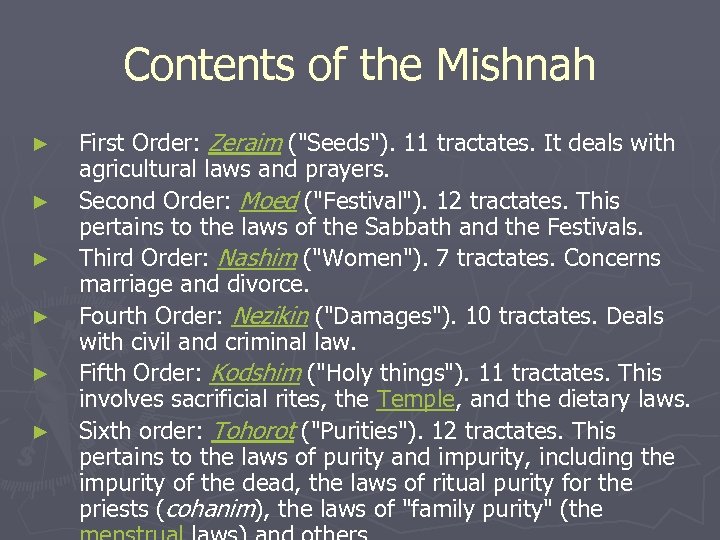 Contents of the Mishnah ► ► ► First Order: Zeraim ("Seeds"). 11 tractates. It deals with agricultural laws and prayers. Second Order: Moed ("Festival"). 12 tractates. This pertains to the laws of the Sabbath and the Festivals. Third Order: Nashim ("Women"). 7 tractates. Concerns marriage and divorce. Fourth Order: Nezikin ("Damages"). 10 tractates. Deals with civil and criminal law. Fifth Order: Kodshim ("Holy things"). 11 tractates. This involves sacrificial rites, the Temple, and the dietary laws. Sixth order: Tohorot ("Purities"). 12 tractates. This pertains to the laws of purity and impurity, including the impurity of the dead, the laws of ritual purity for the priests (cohanim), the laws of "family purity" (the
 Order of Masechtot within a Seder ►Rambam tries to explain order of tractates in the Mishnah based on either chronological or logical progression.
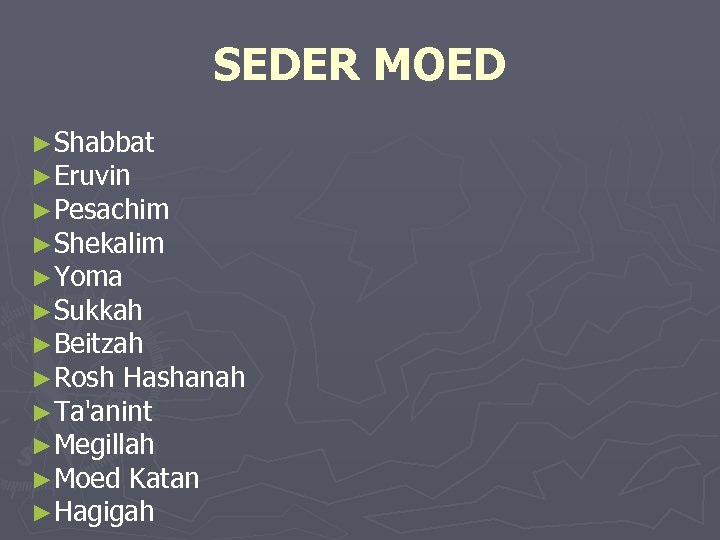 SEDER MOED ►Shabbat ►Eruvin ►Pesachim ►Shekalim ►Yoma ►Sukkah ►Beitzah ►Rosh Hashanah ►Ta'anint ►Megillah ►Moed Katan ►Hagigah
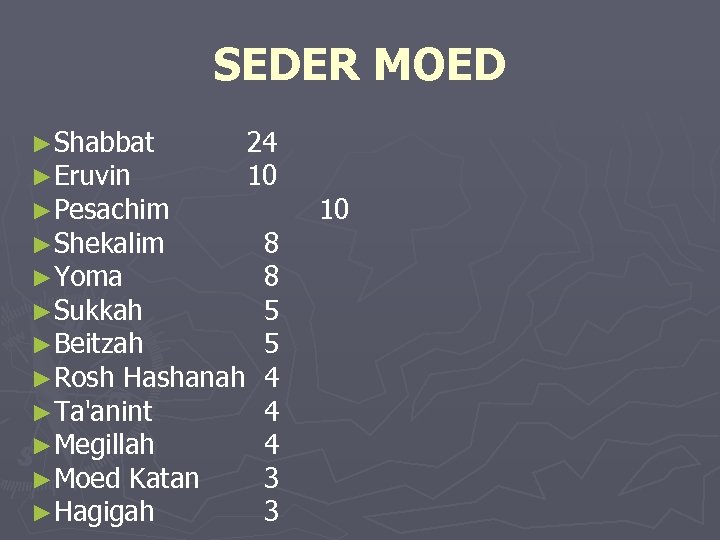 SEDER MOED ►Shabbat 24 ►Eruvin 10 ►Pesachim ►Shekalim 8 ►Yoma 8 ►Sukkah 5 ►Beitzah 5 ►Rosh Hashanah 4 ►Ta'anint 4 ►Megillah 4 ►Moed Katan 3 ►Hagigah 3 10
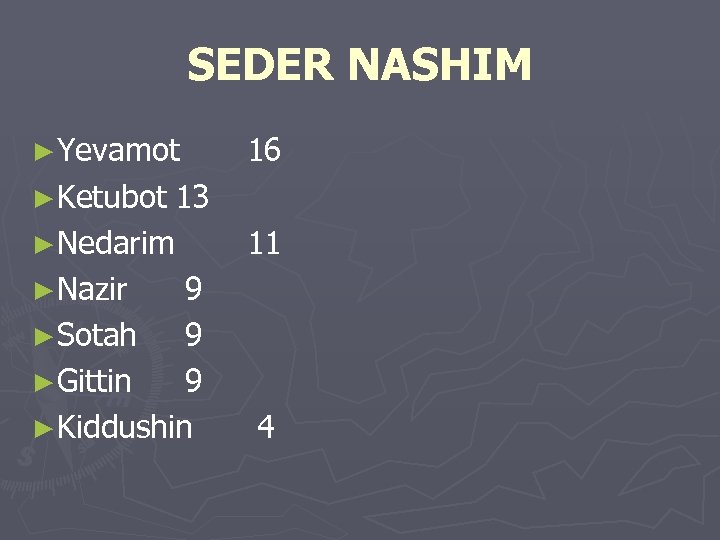 SEDER NASHIM ►Yevamot 13 ►Nedarim ►Nazir 9 ►Sotah 9 ►Gittin 9 ►Kiddushin 16 ►Ketubot 11 4
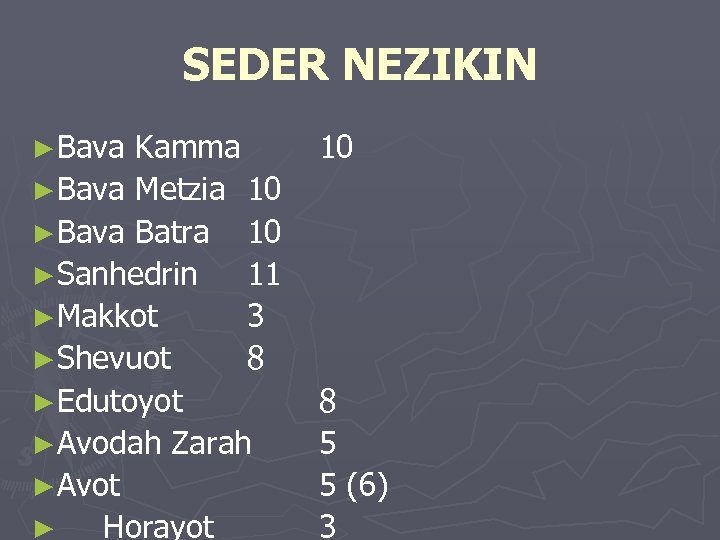 SEDER NEZIKIN ►Bava Kamma ►Bava Metzia ►Bava Batra ►Sanhedrin ►Makkot ►Shevuot 10 10 11 3 8 ►Edutoyot ►Avodah Zarah ►Avot ► Horayot 10 8 5 5 (6) 3
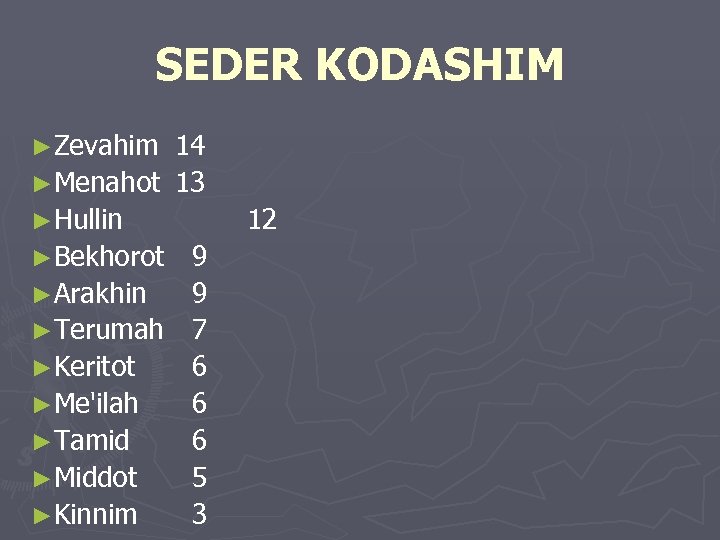 SEDER KODASHIM ►Zevahim 14 ►Menahot 13 ►Hullin ►Bekhorot 9 ►Arakhin 9 ►Terumah 7 ►Keritot 6 ►Me'ilah 6 ►Tamid 6 ►Middot 5 ►Kinnim 3 12
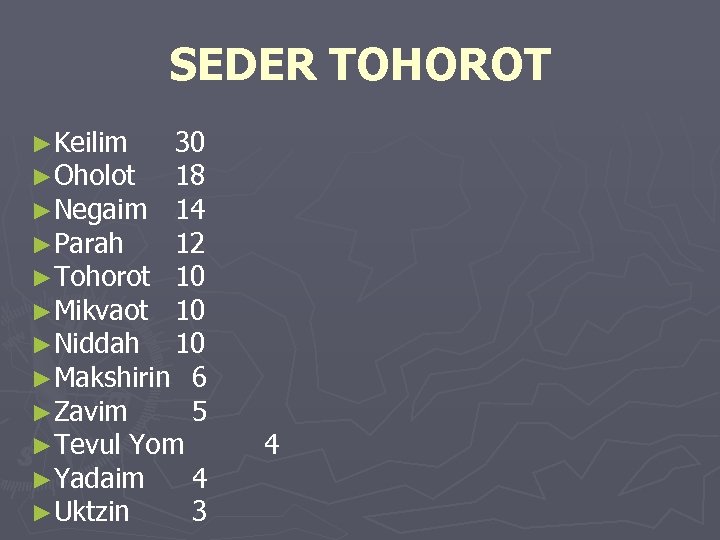 SEDER TOHOROT ►Keilim 30 ►Oholot 18 ►Negaim 14 ►Parah 12 ►Tohorot 10 ►Mikvaot 10 ►Niddah 10 ►Makshirin 6 ►Zavim 5 ►Tevul Yom ►Yadaim 4 ►Uktzin 3 4
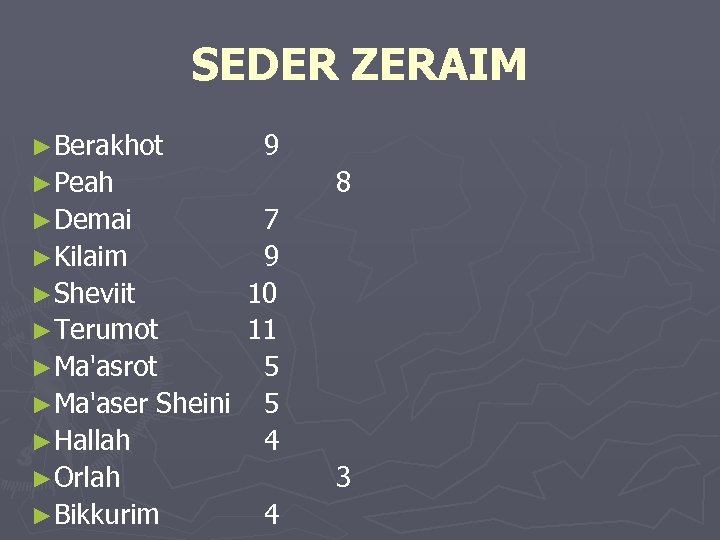 SEDER ZERAIM ►Berakhot 9 ►Peah 7 ►Kilaim 9 ►Sheviit 10 ►Terumot 11 ►Ma'asrot 5 ►Ma'aser Sheini 5 ►Hallah 4 ►Orlah ►Bikkurim 4 8 ►Demai 3
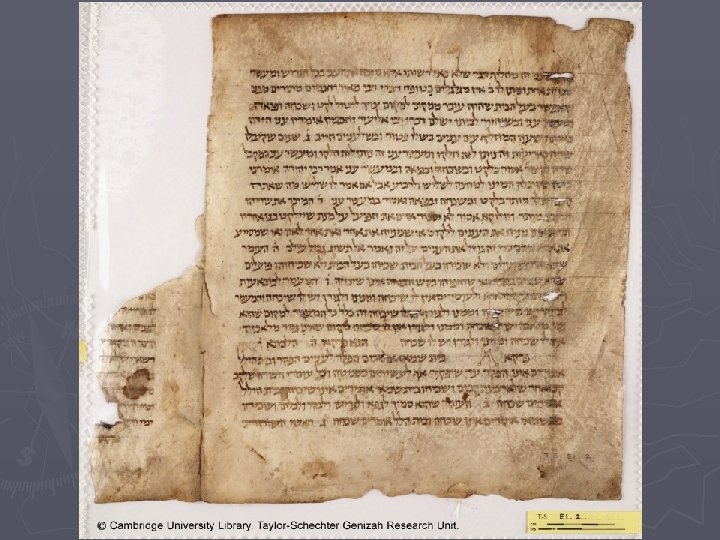
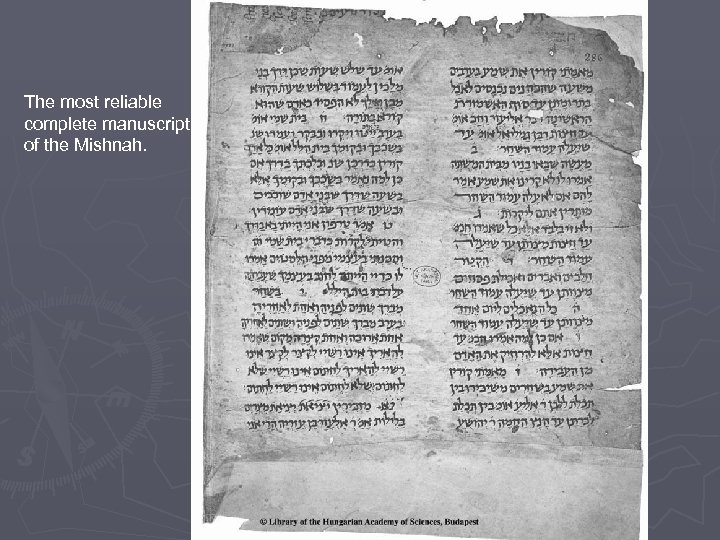 The most reliable complete manuscript of the Mishnah.
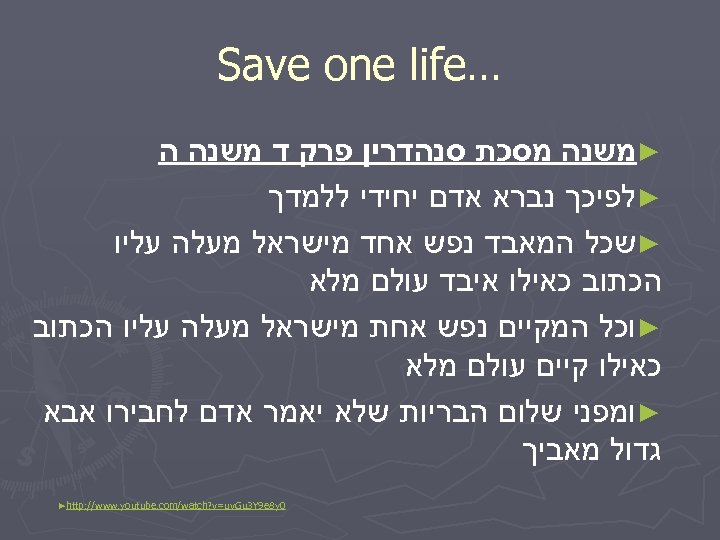 … Save one life ►משנה מסכת סנהדרין פרק ד משנה ה ►לפיכך נברא אדם יחידי ללמדך ►שכל המאבד נפש אחד מישראל מעלה עליו הכתוב כאילו איבד עולם מלא ►וכל המקיים נפש אחת מישראל מעלה עליו הכתוב כאילו קיים עולם מלא ►ומפני שלום הבריות שלא יאמר אדם לחבירו אבא גדול מאביך 0 ►http: //www. youtube. com/watch? v=uv. Gu 3 Y 9 e 8 y
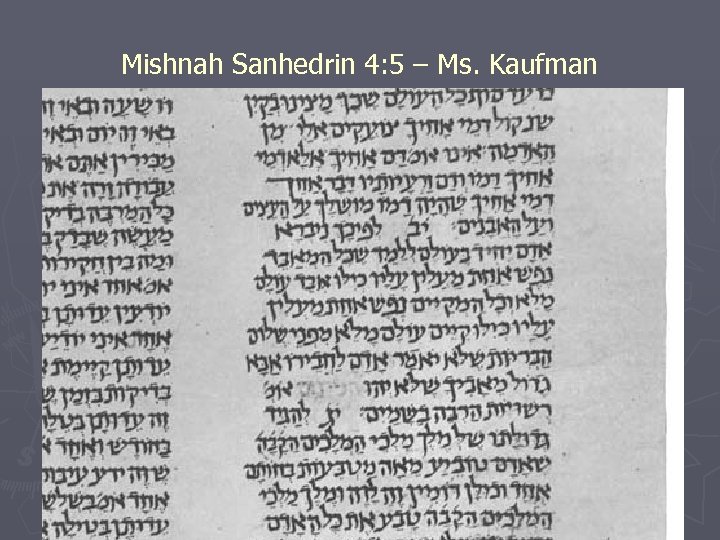 Mishnah Sanhedrin 4: 5 – Ms. Kaufman
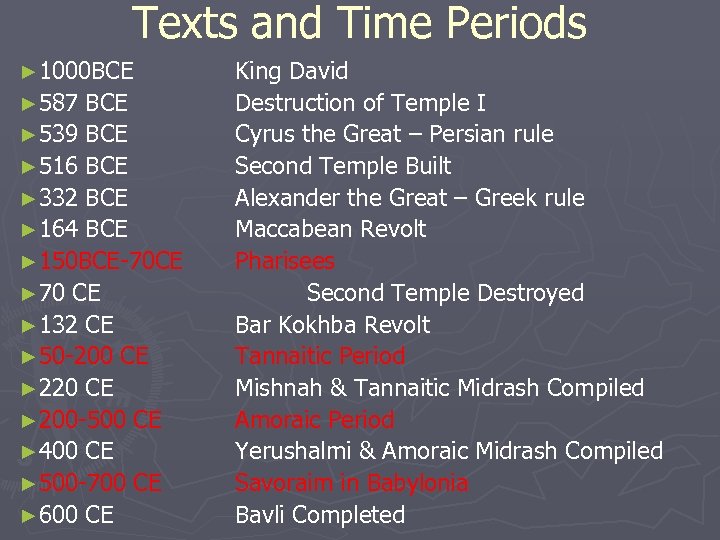 Texts and Time Periods ► 1000 BCE ► 587 BCE ► 539 BCE ► 516 BCE ► 332 BCE ► 164 BCE ► 150 BCE-70 CE ► 70 CE ► 132 CE ► 50 -200 CE ► 220 CE ► 200 -500 CE ► 400 CE ► 500 -700 CE ► 600 CE King David Destruction of Temple I Cyrus the Great – Persian rule Second Temple Built Alexander the Great – Greek rule Maccabean Revolt Pharisees Second Temple Destroyed Bar Kokhba Revolt Tannaitic Period Mishnah & Tannaitic Midrash Compiled Amoraic Period Yerushalmi & Amoraic Midrash Compiled Savoraim in Babylonia Bavli Completed