


 Скачать презентацию Overview of DMTF SMWG and CIM 2004 3
d1dafdd03be1317de5374b2ecfb06c80.ppt
- Количество слайдов: 23
 Overview of DMTF, SMWG and CIM 2004. 3. 30 So Jung Lee DPNM Lab. POSTECH
 DMTF (Distributed Management Task Force)
 DMTF Overview • DMTF is the technology industry organization leading the development of management standards for distributed desktop, network and enterprise environments • Goals - Neutral forum Promote interoperability Move quickly in the new age Raise the bar for management 3 POSTECH DPNM Lab.
 DMTF Organization • Founded in 1992 • Changed the group name in May, 1999 Desktop Management Task Force Distributed Management Task Force • “Not for profit” corporation • Member companies - Board members : 3 com, Cisco, Compaq, Dell, HP, IBM, Intel, Microsoft, NEC, Novell, Sun, Symantec • Customer Advisory Board is formed with 7 customer members 4 POSTECH DPNM Lab.
 DMTF Standards • Common Information Model (CIM) • Web Based Enterprise Management (WBEM) - Common Information Model (CIM) - xml. CIM : XML encodings for CIM - CIM Operations over HTTP • • Directory Enabled Networks (DEN) Desktop Management Interface (DMI) Alert Standard Format (ASF) System Management BIOS (SMIOS) 5 POSTECH DPNM Lab.
 SMWG (Server Management Working Group)
 SMWG Overview • Need of Standard Server Hardware Management Interfaces grows more and more. • Dell, HP, IBM and Intel Corporation has lead the formation of DMTF SMWG. • Include the key vendors such as AMD, Microsoft, Oracle, OSA Technologies and Sun Microsystems. • First face-to-face meeting was on 17 -18 th of December, 2003 • Goal - To develop Industry standard server hardware management architecture by evolving CIM - To develop CLI for managing server hardware - To advance CIM for recent server system technologies 7 POSTECH DPNM Lab.
 Management Problems • There is no uniform way of managing heterogeneous servers independent of machine state, operating system state, server system topology and access mechanism • There is a need to extend the CIM standard to cover various server system (ex. Blades and virtualized server system) • There is a need for lightweight command line interface that can be mapped to CIM 8 POSTECH DPNM Lab.
 WG Charter • The goal of SMWG is to define a platform independent, industry standard management architecture through the following technologies. - Extend CIM schema - Leverage the CIM/XML protocol and identify enhancements if necessary - Define CIM protocol - Define profiles for different server system topologies - Define an architecture model for understanding the semantic behavior of server management components - Demonstrate interoperability 9 POSTECH DPNM Lab.
 WG Charter - cont’d • The scope includes the following: - Wide range of Server profiles (ex. Stand alone, blades, racks. . ) Enumeration of hardware and hardware related software OS present/not present Discovery, proxy, aggregation, redirection Select, control and transfer executable images Power control, system control, configuration and monitoring OS recovery assistance Boot process visibility Basic alerts/events Access to logs View and set status indicators (LED, text LCD, alarms etc) 10 POSTECH DPNM Lab.
 Alliance Partnerships • OASIS - Web services Manageability, Web Services Technologies, Distributed Management Infrastructure • SNIA - Storage Management Initiative • W 3 C - Web Services architecture and technologies • SA Forum - Service Availability Forum 11 POSTECH DPNM Lab.
 Current work – Deliverables & Timeline • Phase 1 deliverable: July 1, 2004 In the CIM v 2. 9 Timeframe the SMWG will deliver - Lightweight command line interface specification - Lightweight CIMOM and supported CIM operations specification - Standard server system topology profiles • Phase 2 deliverable December 31, 2004 - Compliance specification - Test cases for interoperability - Interoperability testing 12 POSTECH DPNM Lab.
 CIM (Common Information Model)
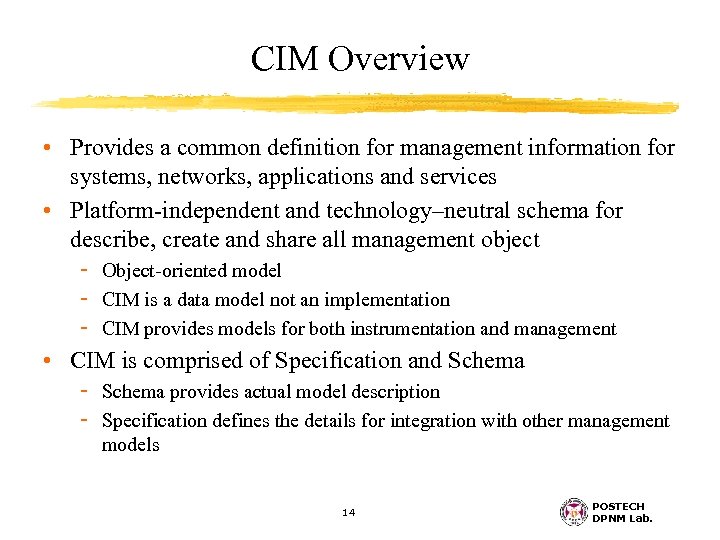 CIM Overview • Provides a common definition for management information for systems, networks, applications and services • Platform-independent and technology–neutral schema for describe, create and share all management object - Object-oriented model - CIM is a data model not an implementation - CIM provides models for both instrumentation and management • CIM is comprised of Specification and Schema - Schema provides actual model description - Specification defines the details for integration with other management models 14 POSTECH DPNM Lab.
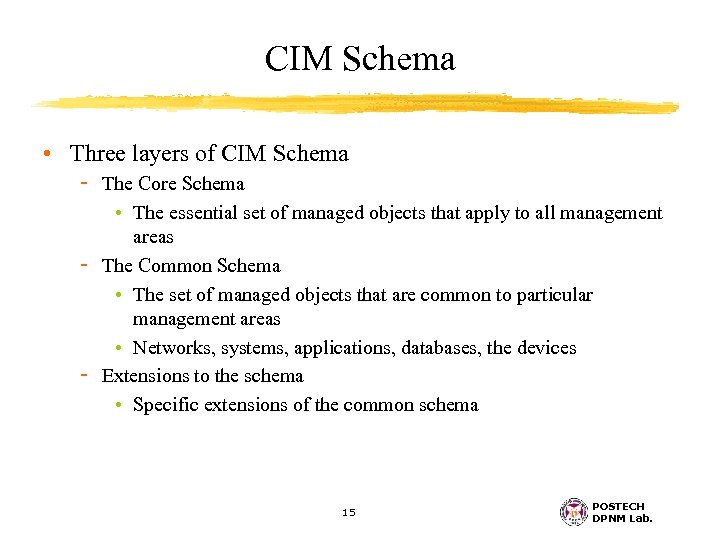 CIM Schema • Three layers of CIM Schema - The Core Schema • The essential set of managed objects that apply to all management areas - The Common Schema • The set of managed objects that are common to particular management areas • Networks, systems, applications, databases, the devices - Extensions to the schema • Specific extensions of the common schema 15 POSTECH DPNM Lab.
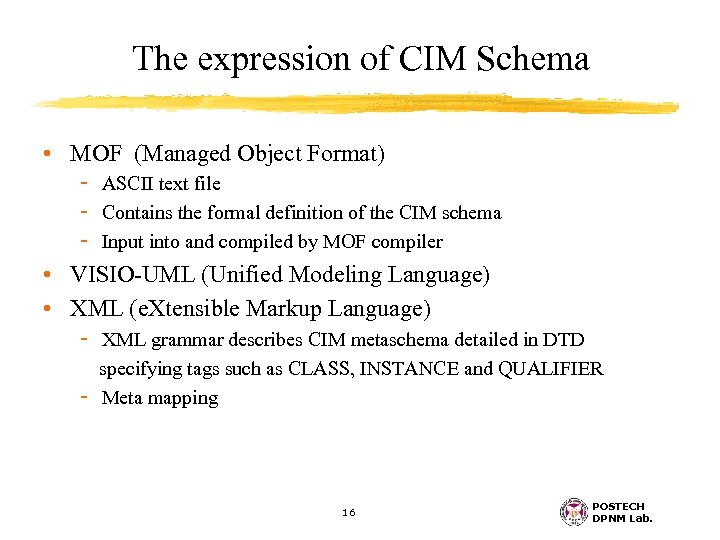 The expression of CIM Schema • MOF (Managed Object Format) - ASCII text file - Contains the formal definition of the CIM schema - Input into and compiled by MOF compiler • VISIO-UML (Unified Modeling Language) • XML (e. Xtensible Markup Language) - XML grammar describes CIM metaschema detailed in DTD specifying tags such as CLASS, INSTANCE and QUALIFIER - Meta mapping 16 POSTECH DPNM Lab.
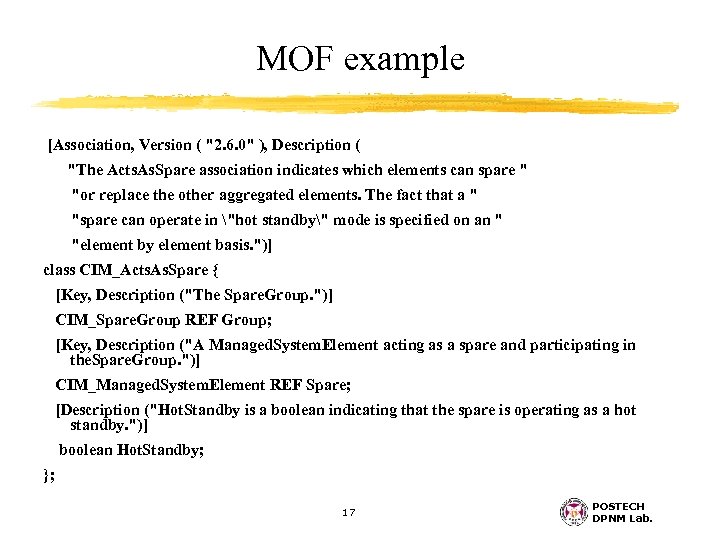 MOF example [Association, Version ( "2. 6. 0" ), Description ( "The Acts. As. Spare association indicates which elements can spare " "or replace the other aggregated elements. The fact that a " "spare can operate in "hot standby" mode is specified on an " "element by element basis. ")] class CIM_Acts. As. Spare { [Key, Description ("The Spare. Group. ")] CIM_Spare. Group REF Group; [Key, Description ("A Managed. System. Element acting as a spare and participating in the. Spare. Group. ")] CIM_Managed. System. Element REF Spare; [Description ("Hot. Standby is a boolean indicating that the spare is operating as a hot standby. ")] boolean Hot. Standby; }; 17 POSTECH DPNM Lab.
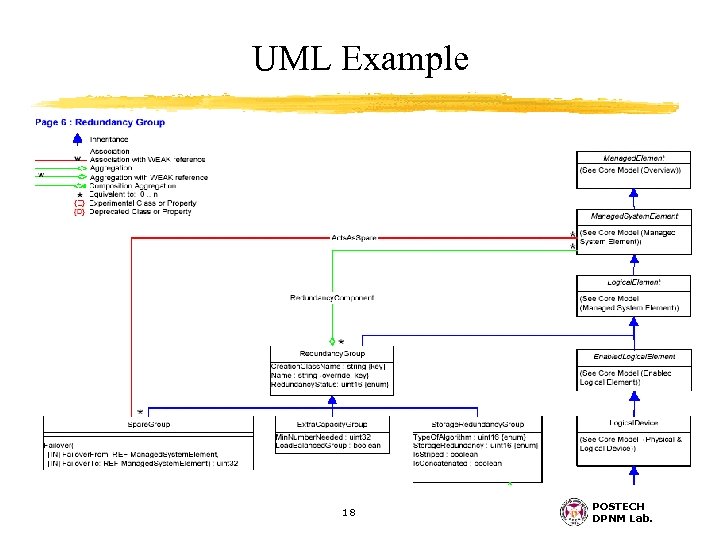 UML Example 18 POSTECH DPNM Lab.
XML example
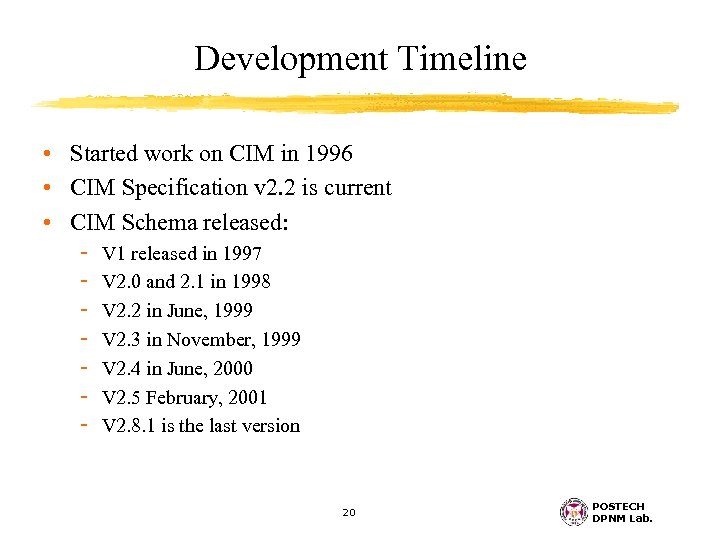 Development Timeline • Started work on CIM in 1996 • CIM Specification v 2. 2 is current • CIM Schema released: - V 1 released in 1997 V 2. 0 and 2. 1 in 1998 V 2. 2 in June, 1999 V 2. 3 in November, 1999 V 2. 4 in June, 2000 V 2. 5 February, 2001 V 2. 8. 1 is the last version 20 POSTECH DPNM Lab.
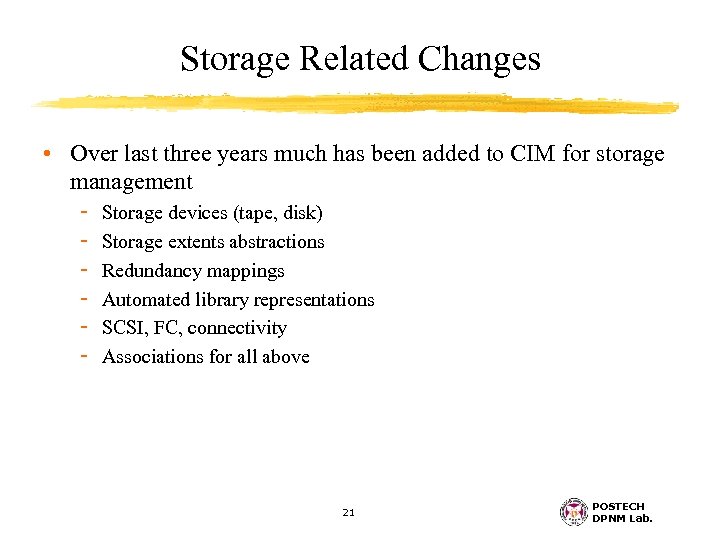 Storage Related Changes • Over last three years much has been added to CIM for storage management - Storage devices (tape, disk) Storage extents abstractions Redundancy mappings Automated library representations SCSI, FC, connectivity Associations for all above 21 POSTECH DPNM Lab.
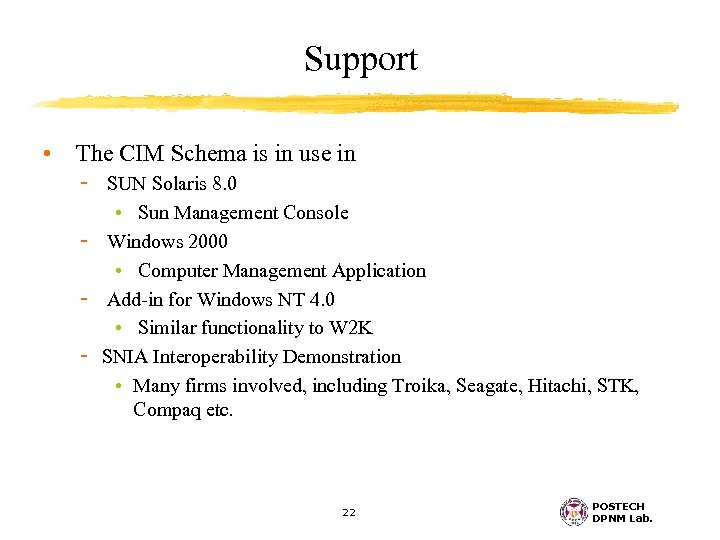 Support • The CIM Schema is in use in - SUN Solaris 8. 0 • Sun Management Console - Windows 2000 • Computer Management Application - Add-in for Windows NT 4. 0 • Similar functionality to W 2 K - SNIA Interoperability Demonstration • Many firms involved, including Troika, Seagate, Hitachi, STK, Compaq etc. 22 POSTECH DPNM Lab.
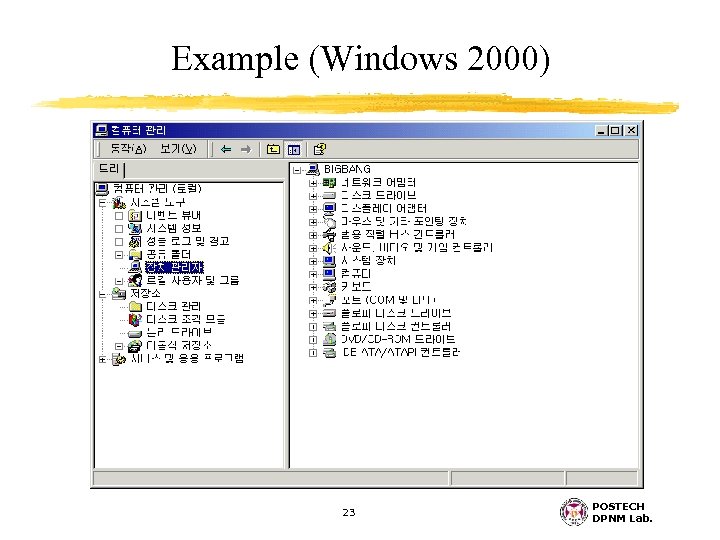 Example (Windows 2000) 23 POSTECH DPNM Lab.