 Скачать презентацию Overview of Constitutions Globally Seminar 1 Outline
legal system seminar 1 constitution.pptx
- Количество слайдов: 31




Overview of Constitutions Globally Seminar 1

Outline • 1) General Concept of a Constitution; • 2) Types of Constitution & Classification Criteria; • 3) Overview of the Russian Constitution of 1993; • 3) Role play
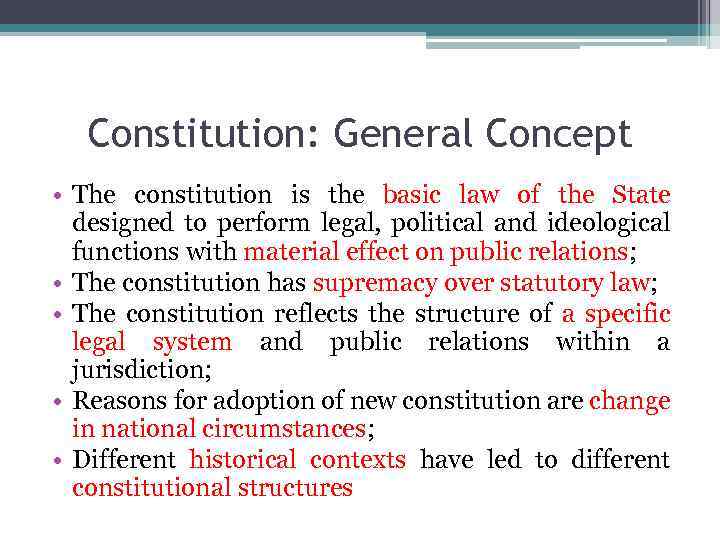
Constitution: General Concept • The constitution is the basic law of the State designed to perform legal, political and ideological functions with material effect on public relations; • The constitution has supremacy over statutory law; • The constitution reflects the structure of a specific legal system and public relations within a jurisdiction; • Reasons for adoption of new constitution are change in national circumstances; • Different historical contexts have led to different constitutional structures
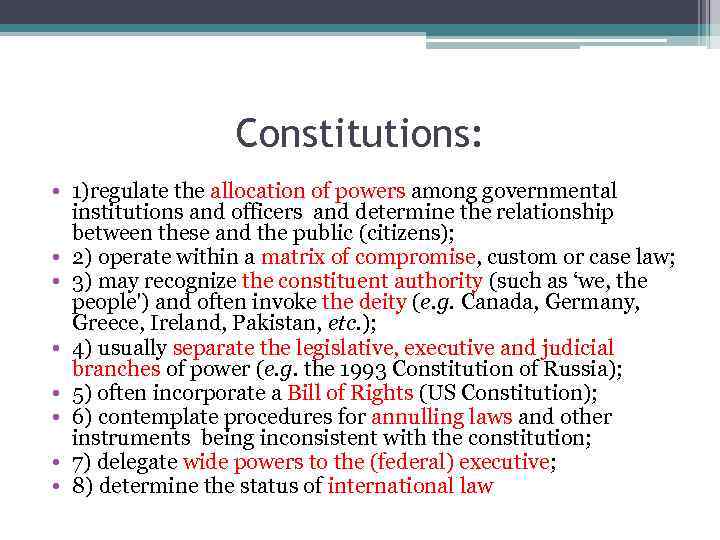
Constitutions: • 1)regulate the allocation of powers among governmental institutions and officers and determine the relationship between these and the public (citizens); • 2) operate within a matrix of compromise, custom or case law; • 3) may recognize the constituent authority (such as ‘we, the people') and often invoke the deity (e. g. Canada, Germany, Greece, Ireland, Pakistan, etc. ); • 4) usually separate the legislative, executive and judicial branches of power (e. g. the 1993 Constitution of Russia); • 5) often incorporate a Bill of Rights (US Constitution); • 6) contemplate procedures for annulling laws and other instruments being inconsistent with the constitution; • 7) delegate wide powers to the (federal) executive; • 8) determine the status of international law
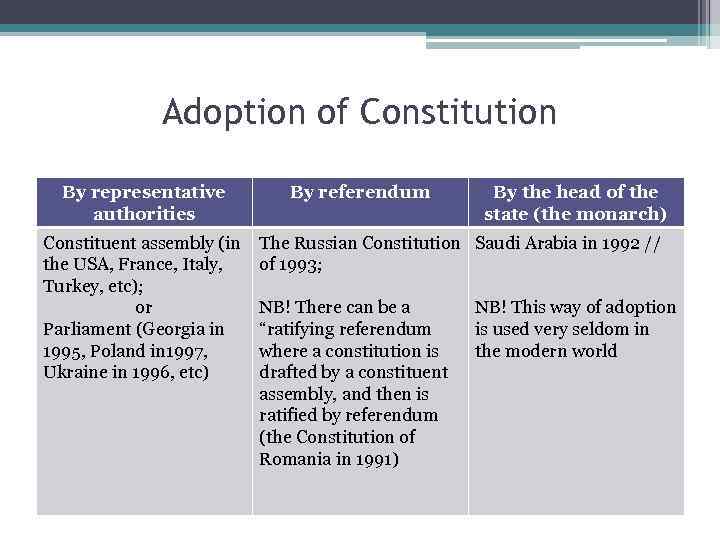
Adoption of Constitution By representative authorities Constituent assembly (in the USA, France, Italy, Turkey, etc); or Parliament (Georgia in 1995, Poland in 1997, Ukraine in 1996, etc) By referendum By the head of the state (the monarch) The Russian Constitution Saudi Arabia in 1992 // of 1993; NB! There can be a “ratifying referendum where a constitution is drafted by a constituent assembly, and then is ratified by referendum (the Constitution of Romania in 1991) NB! This way of adoption is used very seldom in the modern world
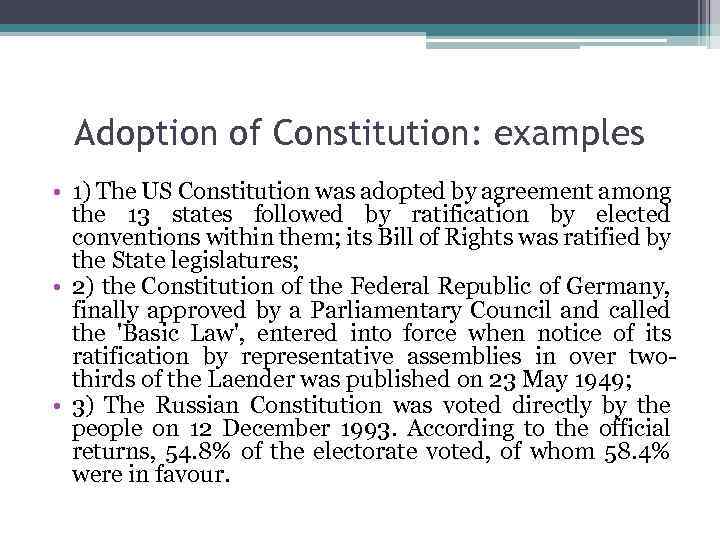
Adoption of Constitution: examples • 1) The US Constitution was adopted by agreement among the 13 states followed by ratification by elected conventions within them; its Bill of Rights was ratified by the State legislatures; • 2) the Constitution of the Federal Republic of Germany, finally approved by a Parliamentary Council and called the 'Basic Law', entered into force when notice of its ratification by representative assemblies in over twothirds of the Laender was published on 23 May 1949; • 3) The Russian Constitution was voted directly by the people on 12 December 1993. According to the official returns, 54. 8% of the electorate voted, of whom 58. 4% were in favour.
Types of Constitution: • 1) Written & unwritten constitutions; • 2) Flexible (elastic) constitutions; • 3) Rigid (inelastic) constitutions; • 4) Evolved constitutions; • 5) Enacted constitutions.
Written Constitution • A written constitution means a constitution written in the form of a book or a series of documents combined in the form of a book. It is a consciously framed and enacted constitution. It is formulated and adopted by a constituent assembly or a council or a legislature. • A written constitution can be amended only in accordance with a settled process of amendment written in the constitution itself. It is a duly passed and enacted Constitution. • (e. g. The Constitutions of India, the USA, Germany, Japan, Canada, France, Switzerland)
Unwritten Constitution: • An unwritten constitution is one which is neither drafted nor enacted by a Constituent Assembly and nor even written in the form of a book. It is found in several historical charters, laws and conventions. It is a product of slow and gradual evolution. • E. g. The UK Constitution
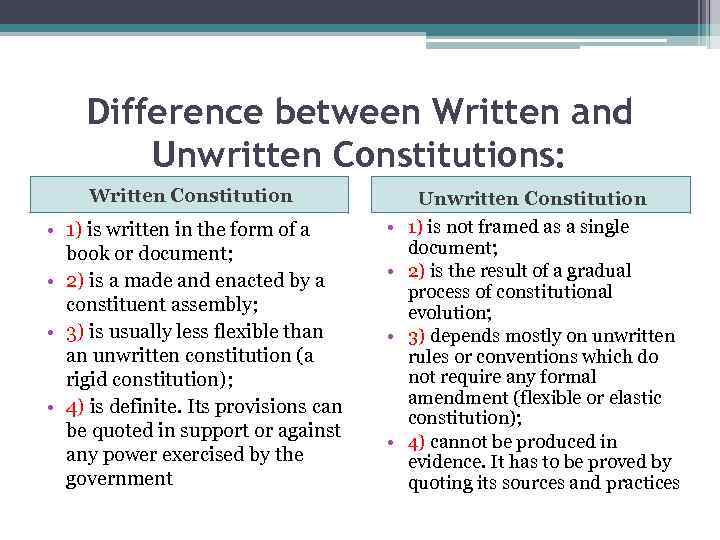
Difference between Written and Unwritten Constitutions: Written Constitution • 1) is written in the form of a book or document; • 2) is a made and enacted by a constituent assembly; • 3) is usually less flexible than an unwritten constitution (a rigid constitution); • 4) is definite. Its provisions can be quoted in support or against any power exercised by the government Unwritten Constitution • 1) is not framed as a single document; • 2) is the result of a gradual process of constitutional evolution; • 3) depends mostly on unwritten rules or conventions which do not require any formal amendment (flexible or elastic constitution); • 4) cannot be produced in evidence. It has to be proved by quoting its sources and practices
Flexible Constitution: • A Flexible Constitution is one which can be easily amended. Constitutional amendments are passed in the same manner by which an ordinary law is passed. • E. g. British Constitution presents a classic example of a most flexible constitution. The British Parliament is a sovereign parliament which can make or amend any law or constitutional law by a simple majority. Laws aiming to affect changes in a constitutional law or in any ordinary law are passed through the same legislative procedure i. e. , by a simple majority of votes in the legislature
Merits of a Flexible Constitution: • (1) its ability to change easily in accordance with the changes in the social and political environment of the society and state. • (2) is very helpful as response to emergencies since it can be easily amended. • (3) has the ability to keep pace with the changing times. The people do not feel the need for revolutionary changes. • (4) always remains up-to-date.
Demerit of a Flexible Constitution: • It is not suitable for a federation. In a federation, a flexible constitution can lead to undesirable changes in the constitution by the federal government or by the governments of federating units.
Rigid Constitution: • The Rigid Constitution cannot be easily amended. For amending it, the legislature has to pass an amendment bill by a specific majority of 2/3 rd or 3/4 th. For passing or amending an ordinary law, the legislature usually passes the law by a simple majority of its members. • A rigid constitution is considered to be the most fundamental law of the land. It is regarded as the basic will of the sovereign people. That is why it can be amended only by a special procedure requiring the passing of the amendment proposal by a big majority of votes which is often followed by ratification by the people in a referendum. • E. g. The Constitution of United States of America
Pros of a Rigid Constitution: • First, a rigid constitution is a source of stability in administration. • Secondly, it maintains continuity in administration. • Thirdly, it cannot become a tool in the hands of the party exercising the power of the state at a particular time. • Fourthly it prevents autocratic exercise of the powers by the government. • Finally a rigid constitution is ideal for a federation.
Cons of a Rigid Constitution • First, it fails to comply with fast changing social environment. • Secondly, being unable to change easily, it hinders the process of social development. • Thirdly, it can be a source of hindrance during emergencies. • Fourthly, its inability to easily change can lead to revolts against the government.
Evolved Constitution: • An evolved constitution is one which is not made at any time by any assembly of persons or an institution. It is the result of slow and gradual process of evolution. Its rules and principles draw binding force from the fact of their being recognised as ancient, historical, time-tested and respected customs and conventions.
Enacted Constitution: • An Enacted Constitution is a man-made constitution. It is made, enacted and adopted by an assembly or council called a Constituent Assembly or Constitutional Council. It is duly passed after a thorough discussion over its objectives, principles and provisions. The Constitutions of India the USA, Japan, China and most of other states are enacted constitutions.
Unitary Constitution • 1) A unitary system is governed constitutionally as one single unit, with one constitutionally created legislature; • 2) All power is top down; • 3) the central government is supreme and any administrative divisions (subnational units) exercise only powers delegated to them by the central government; • 4) The UK is an example of a unitary system
Federal Constitution • 1) there is a Two Tier Government (federal & regional bodies) with well assigned powers and functions; • 2) provides for a federal government in which the powers are divided on the basis of subordination & coordination within federal & regional spheres; • 3) is written & rigid (with lengthy & burdensome procedure for amendments); • 4) proclaims supremacy of judiciary
Overview of the Russian Constitution of 1993
General Information • 1) The Constitution of the Russian Federation was adopted on December 12, 1993 and came into force on December 25, 1993, at the moment of its official publication; • 2) The Constitution forms the country’s legal foundation, proclaims the President of the Russian Federation the head of state and lays upon him the responsibility for defending the Constitution, human rights and civil liberties, safeguarding Russia’s sovereignty, independence and territorial integrity, and ensuring the coordinated functioning and cooperation of the state bodies of power; • 3) The Constitution consists of a preamble and two sections
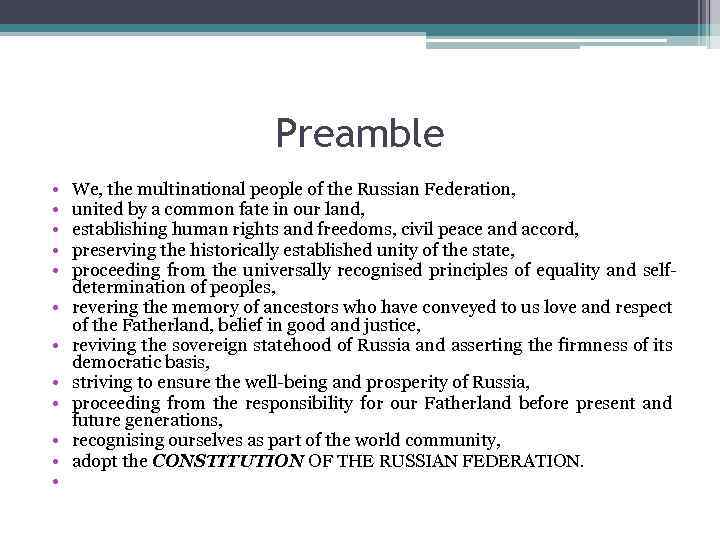
Preamble • • • We, the multinational people of the Russian Federation, united by a common fate in our land, establishing human rights and freedoms, civil peace and accord, preserving the historically established unity of the state, proceeding from the universally recognised principles of equality and selfdetermination of peoples, revering the memory of ancestors who have conveyed to us love and respect of the Fatherland, belief in good and justice, reviving the sovereign statehood of Russia and asserting the firmness of its democratic basis, striving to ensure the well-being and prosperity of Russia, proceeding from the responsibility for our Fatherland before present and future generations, recognising ourselves as part of the world community, adopt the CONSTITUTION OF THE RUSSIAN FEDERATION.
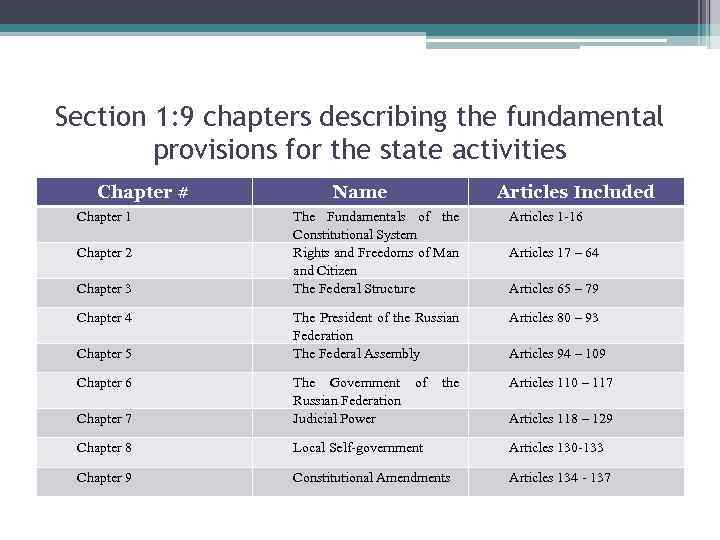
Section 1: 9 chapters describing the fundamental provisions for the state activities Chapter # Chapter 1 Name Articles Included The Fundamentals of the Constitutional System Rights and Freedoms of Man and Citizen The Federal Structure Articles 1 -16 The President of the Russian Federation The Federal Assembly Articles 80 – 93 Articles 110 – 117 Chapter 7 The Government Russian Federation Judicial Power Chapter 8 Local Self-government Articles 130 -133 Chapter 9 Constitutional Amendments Articles 134 - 137 Chapter 2 Chapter 3 Chapter 4 Chapter 5 Chapter 6 of the Articles 17 – 64 Articles 65 – 79 Articles 94 – 109 Articles 118 – 129
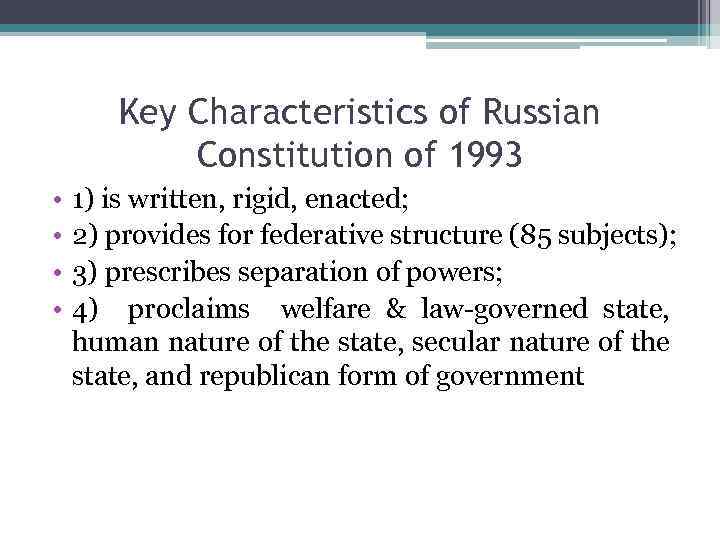
Key Characteristics of Russian Constitution of 1993 • • 1) is written, rigid, enacted; 2) provides for federative structure (85 subjects); 3) prescribes separation of powers; 4) proclaims welfare & law-governed state, human nature of the state, secular nature of the state, and republican form of government
The Constitution Role Play based on Terry Pratchett’ books
Historical Background • The Evil Empire (which is now dissolved) once spanned a bigger part of the World, including the states Uberwald, Borogravia, Mouldavia and Zlobenia and was ruled by a Sourcerer known as the Evil Emperor, who was, well, evil. Under the Evil Empire, all sorts of nasty things were created and used in war. Its symbol is a doubleheaded bat.
Überwald • Überwald is a huge mountainous region of wintry climate populated almost entirely by horror tropes. It was one a part of the Evil Empire (along with smaller states Borogravia, Zlobenia and Mouldavia). The ruling nobility of the land is composed of feudal werewolf and vampire families. Lately, the dwarfs have also come into power. There are many trolls in the distant mountains, warring against the dwarfs, but in cities such as Bonk, trolls are considered semi-sentient slaves. Humans are still mostly in the roles of "townspeople" or "exploited citizens".
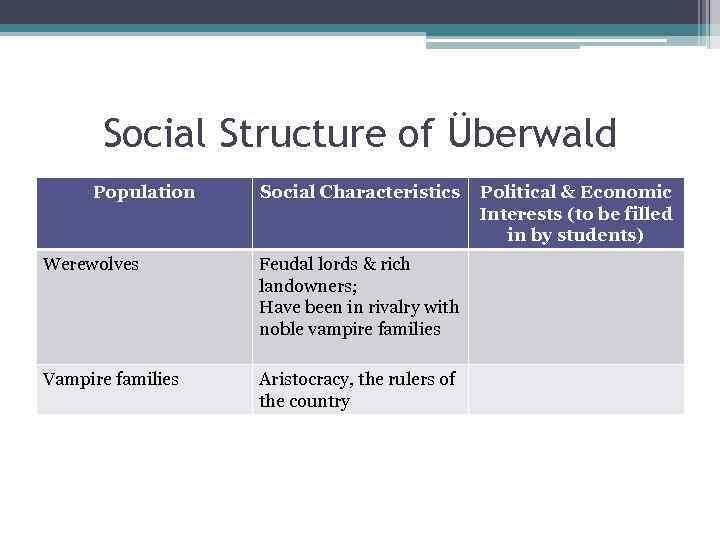
Social Structure of Überwald Population Social Characteristics Werewolves Feudal lords & rich landowners; Have been in rivalry with noble vampire families Vampire families Aristocracy, the rulers of the country Political & Economic Interests (to be filled in by students)
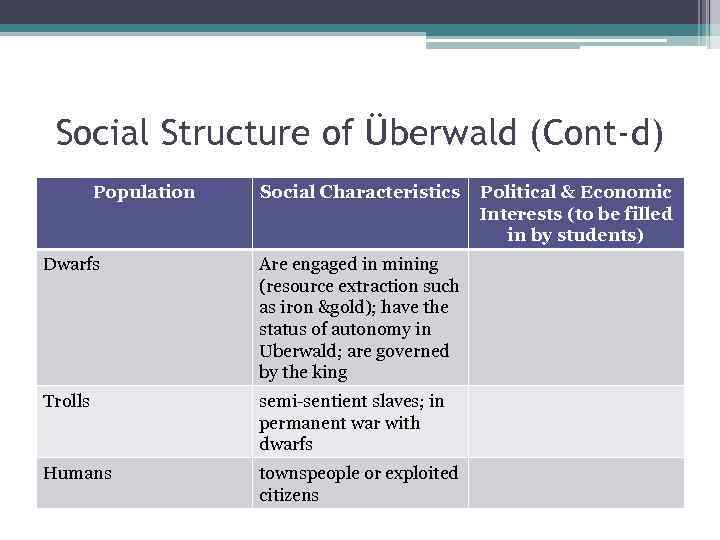
Social Structure of Überwald (Cont-d) Population Social Characteristics Dwarfs Are engaged in mining (resource extraction such as iron &gold); have the status of autonomy in Uberwald; are governed by the king Trolls semi-sentient slaves; in permanent war with dwarfs Humans townspeople or exploited citizens Political & Economic Interests (to be filled in by students)
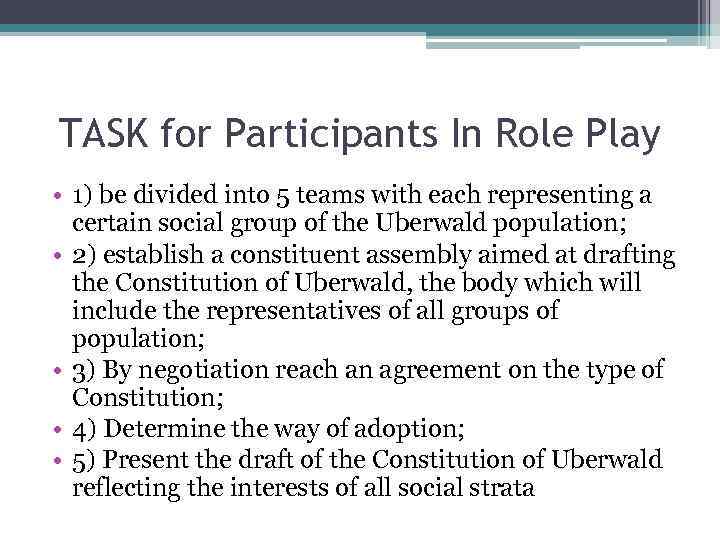
TASK for Participants In Role Play • 1) be divided into 5 teams with each representing a certain social group of the Uberwald population; • 2) establish a constituent assembly aimed at drafting the Constitution of Uberwald, the body which will include the representatives of all groups of population; • 3) By negotiation reach an agreement on the type of Constitution; • 4) Determine the way of adoption; • 5) Present the draft of the Constitution of Uberwald reflecting the interests of all social strata
Скачать презентацию Overview of Constitutions Globally Seminar 1 Outline
legal system seminar 1 constitution.pptx