


 Скачать презентацию Overview of Chinese Taipei Energy Sector — Current
837e38b0c838327ce4313ec4609ca7f9.ppt
- Количество слайдов: 76
 Overview of Chinese Taipei Energy Sector - Current Status and Plans of Future Development Dr. Yophy Huang October 31, 2007 0
 Contents I. Preface II. Energy Supply / Demand III. Major Energy Policy IV. Challenges 1
 2
2
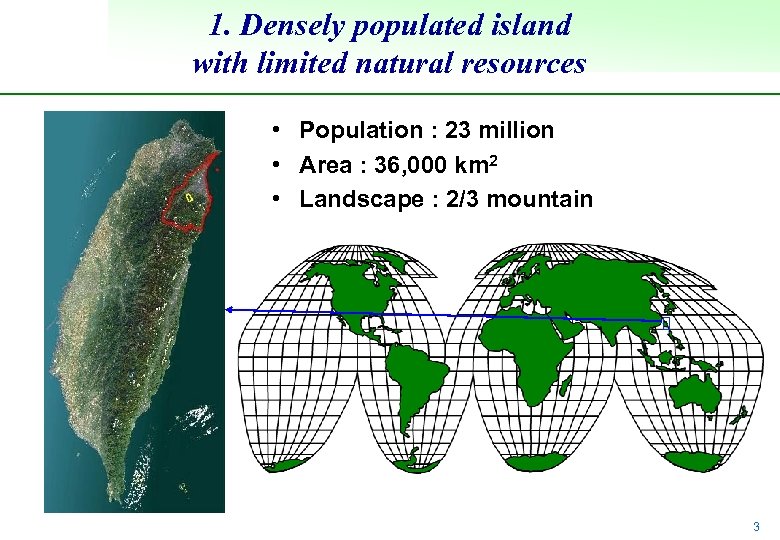 1. Densely populated island with limited natural resources • Population : 23 million • Area : 36, 000 km 2 • Landscape : 2/3 mountain 3
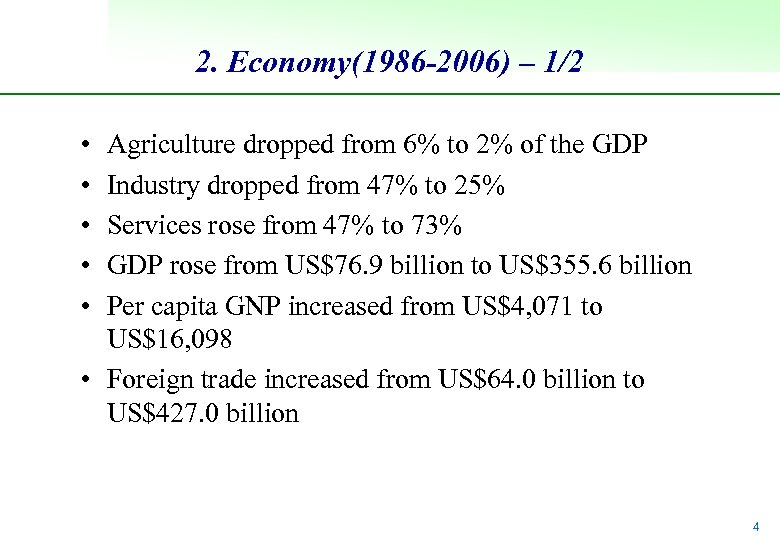 2. Economy(1986 -2006) – 1/2 • • • Agriculture dropped from 6% to 2% of the GDP Industry dropped from 47% to 25% Services rose from 47% to 73% GDP rose from US$76. 9 billion to US$355. 6 billion Per capita GNP increased from US$4, 071 to US$16, 098 • Foreign trade increased from US$64. 0 billion to US$427. 0 billion 4
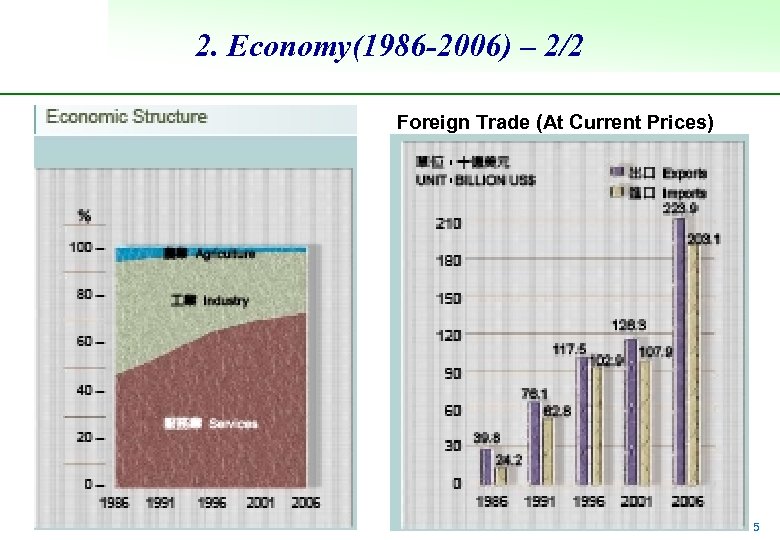 2. Economy(1986 -2006) – 2/2 Foreign Trade (At Current Prices) 5
 6
6
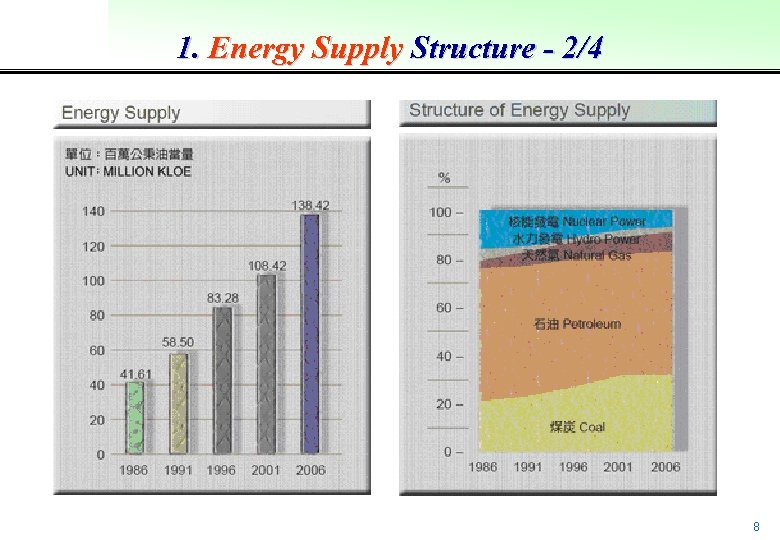
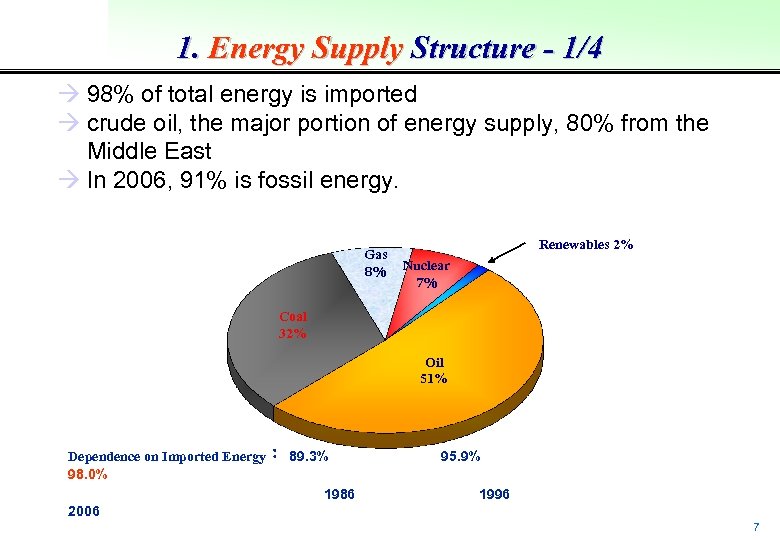 1. Energy Supply Structure - 1/4 à 98% of total energy is imported à crude oil, the major portion of energy supply, 80% from the Middle East à In 2006, 91% is fossil energy. Gas 8% Renewables 2% Nuclear 7% Coal 32% Oil 51% Dependence on Imported Energy: 89. 3% 98. 0% 1986 2006 95. 9% 1996 7
 1. Energy Supply Structure - 2/4 8
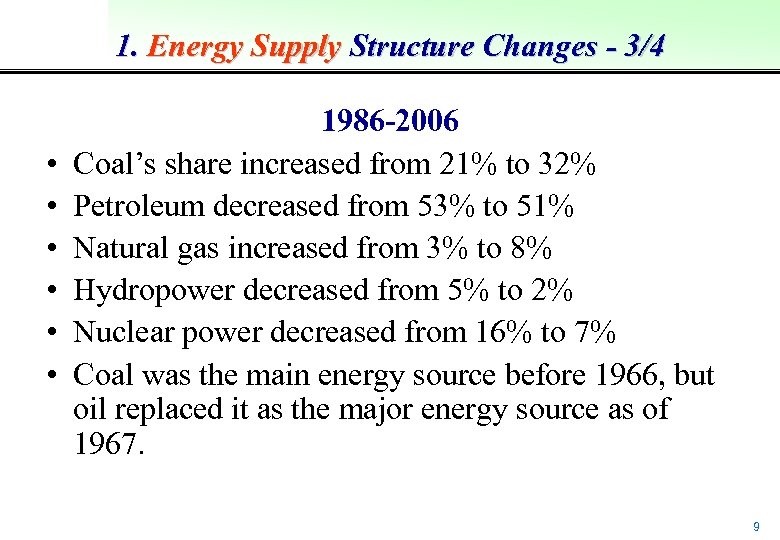 1. Energy Supply Structure Changes - 3/4 • • • 1986 -2006 Coal’s share increased from 21% to 32% Petroleum decreased from 53% to 51% Natural gas increased from 3% to 8% Hydropower decreased from 5% to 2% Nuclear power decreased from 16% to 7% Coal was the main energy source before 1966, but oil replaced it as the major energy source as of 1967. 9
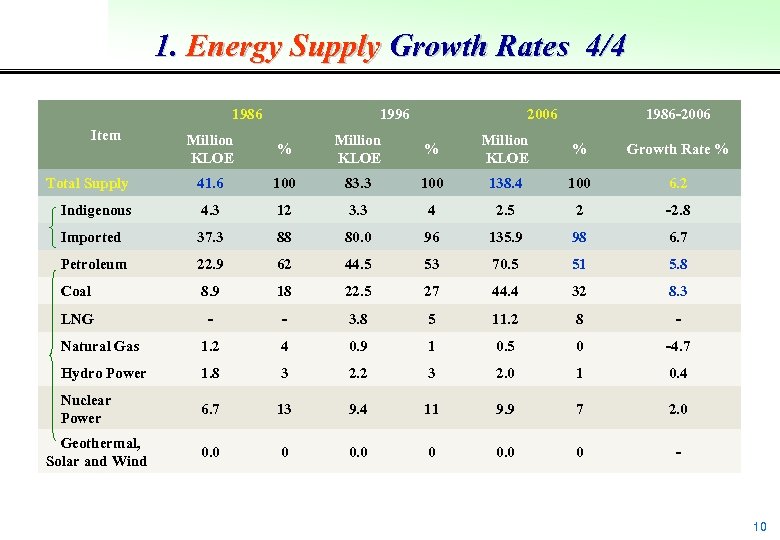 1. Energy Supply Growth Rates 4/4 1986 Item 1996 2006 1986 -2006 Million KLOE % Growth Rate % Total Supply 41. 6 100 83. 3 100 138. 4 100 6. 2 Indigenous 4. 3 12 3. 3 4 2. 5 2 -2. 8 Imported 37. 3 88 80. 0 96 135. 9 98 6. 7 Petroleum 22. 9 62 44. 5 53 70. 5 51 5. 8 Coal 8. 9 18 22. 5 27 44. 4 32 8. 3 LNG - - 3. 8 5 11. 2 8 - Natural Gas 1. 2 4 0. 9 1 0. 5 0 -4. 7 Hydro Power 1. 8 3 2. 2 3 2. 0 1 0. 4 Nuclear Power 6. 7 13 9. 4 11 9. 9 7 2. 0 Geothermal, Solar and Wind 0. 0 0 - 10
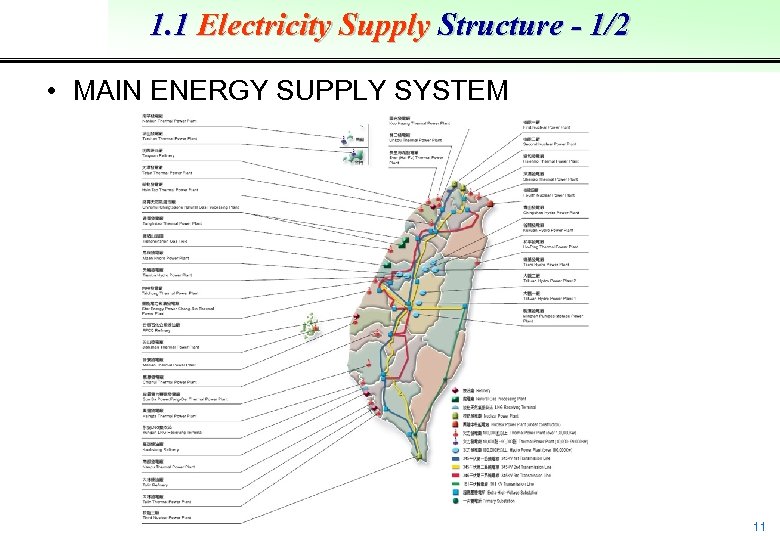 1. 1 Electricity Supply Structure - 1/2 • MAIN ENERGY SUPPLY SYSTEM 11
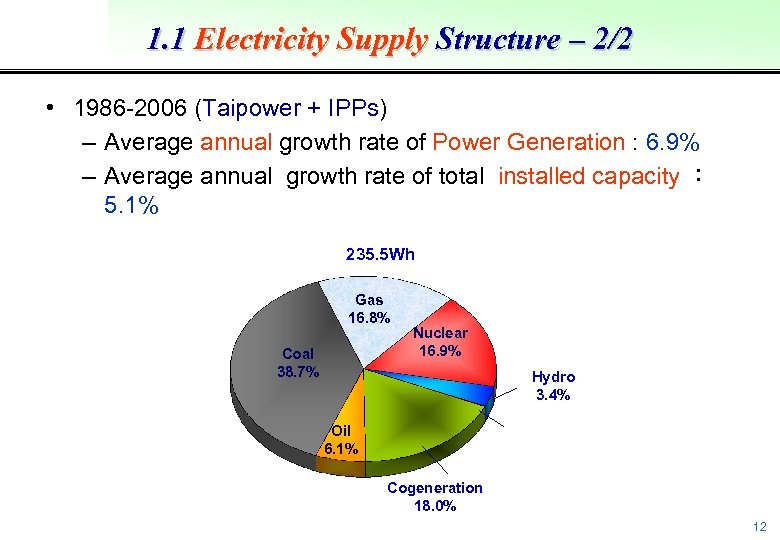 1. 1 Electricity Supply Structure – 2/2 • 1986 -2006 (Taipower + IPPs) – Average annual growth rate of Power Generation : 6. 9% – Average annual growth rate of total installed capacity : 5. 1% 235. 5 Wh Gas 16. 8% Coal 38. 7% Nuclear 16. 9% Hydro 3. 4% Oil 6. 1% Cogeneration 18. 0% 12
 1. 1 Electricity Supply by Taipower – 1/3 1. By the end of 2006, Taipower had a total of 74 power plants. 2. The total installed capacity of Taipower was 30, 045 MW. 3. The peak load was 32, 060 MW. 4. Power generation by Taipower totaled 156. 0 TWh. 5. Total electricity consumption in 2006 amounted to 2, 214 TWh. 13
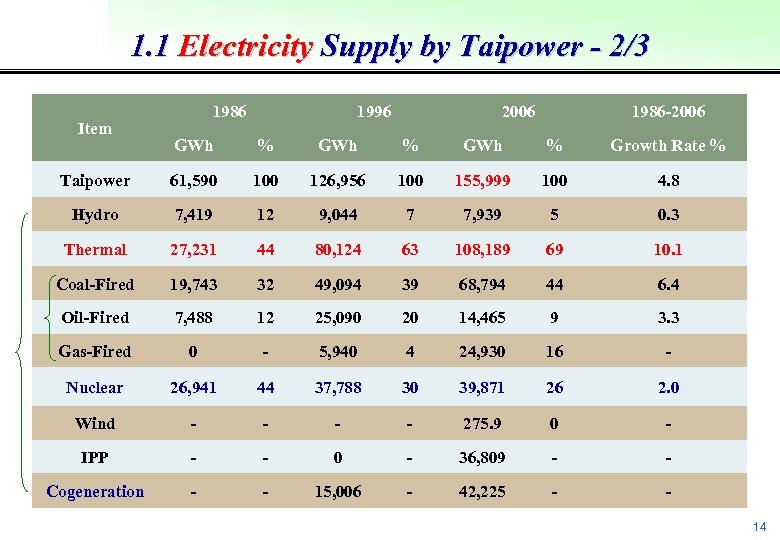 1. 1 Electricity Supply by Taipower - 2/3 Item 1986 1996 2006 1986 -2006 GWh % Growth Rate % Taipower 61, 590 100 126, 956 100 155, 999 100 4. 8 Hydro 7, 419 12 9, 044 7 7, 939 5 0. 3 Thermal 27, 231 44 80, 124 63 108, 189 69 10. 1 Coal-Fired 19, 743 32 49, 094 39 68, 794 44 6. 4 Oil-Fired 7, 488 12 25, 090 20 14, 465 9 3. 3 Gas-Fired 0 - 5, 940 4 24, 930 16 - Nuclear 26, 941 44 37, 788 30 39, 871 26 2. 0 Wind - - 275. 9 0 - IPP - - 0 - 36, 809 - - Cogeneration - - 15, 006 - 42, 225 - 14
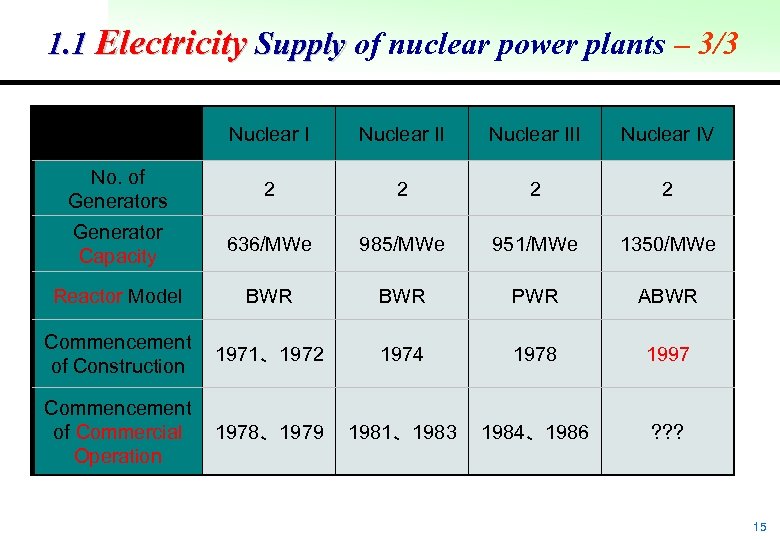 1. 1 Electricity Supply of nuclear power plants – 3/3 Nuclear III Nuclear IV No. of Generators 2 2 Generator Capacity 636/MWe 985/MWe 951/MWe 1350/MWe Reactor Model BWR PWR ABWR Commencement of Construction 1971、1972 1974 1978 1997 Commencement of Commercial Operation 1978、1979 1981、1983 1984、1986 ? ? ? 15
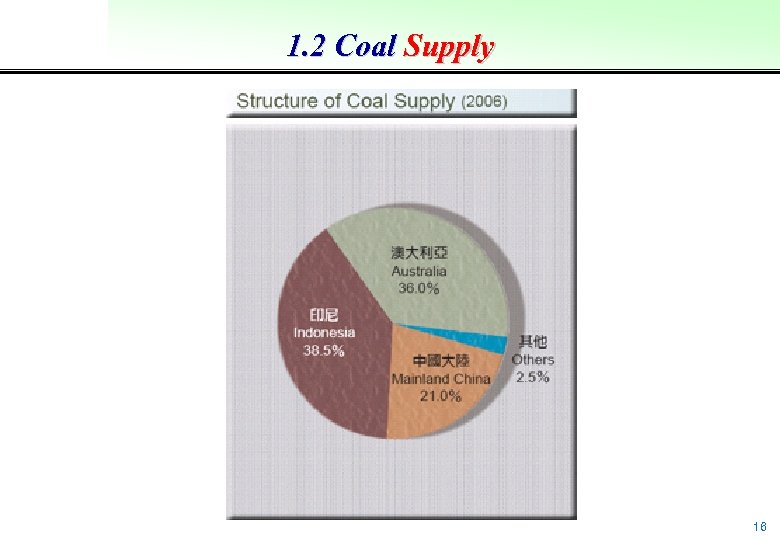 1. 2 Coal Supply 16
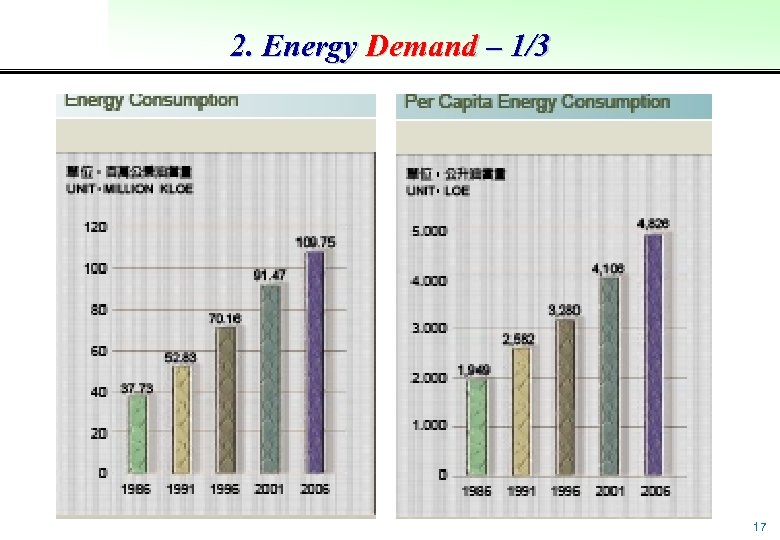 2. Energy Demand – 1/3 17
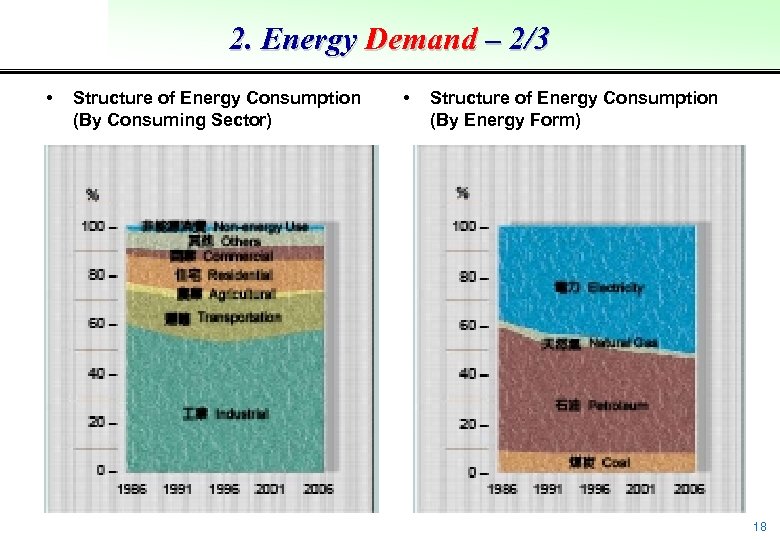 2. Energy Demand – 2/3 • Structure of Energy Consumption (By Consuming Sector) • Structure of Energy Consumption (By Energy Form) 18
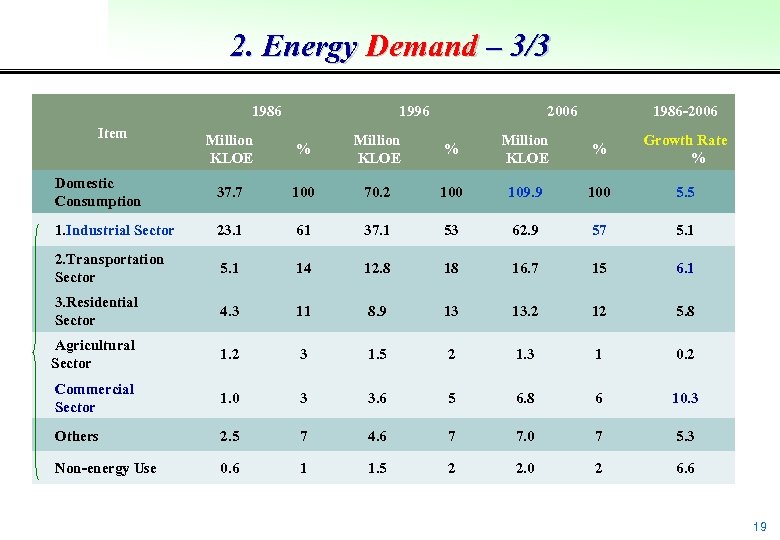 2. Energy Demand – 3/3 1986 Item 1996 2006 1986 -2006 Million KLOE % Growth Rate % 37. 7 100 70. 2 100 109. 9 100 5. 5 1. Industrial Sector 23. 1 61 37. 1 53 62. 9 57 5. 1 2. Transportation Sector 5. 1 14 12. 8 18 16. 7 15 6. 1 3. Residential Sector 4. 3 11 8. 9 13 13. 2 12 5. 8 Agricultural Sector 1. 2 3 1. 5 2 1. 3 1 0. 2 Commercial Sector 1. 0 3 3. 6 5 6. 8 6 10. 3 Others 2. 5 7 4. 6 7 7. 0 7 5. 3 Non-energy Use 0. 6 1 1. 5 2 2. 0 2 6. 6 Domestic Consumption 19
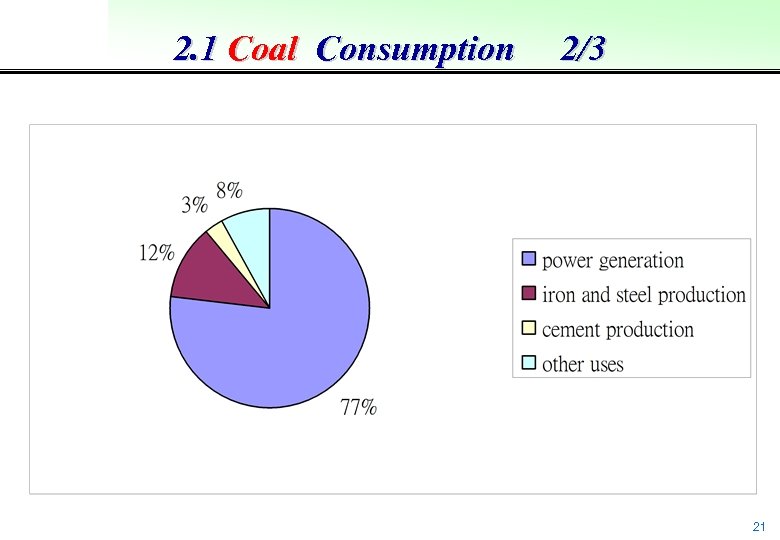
 2. 1 Coal Consumption 1/3 • Coal Consumption by Sector: 1. 77% for power generation 2. 12% for iron and steel production 3. 3% for cement production 4. 8% for other uses • Consumption by Types of Coal Product: 1. Steam coal: 92% 2. Coking coal: 8% 20
 2. 1 Coal Consumption 2/3 21
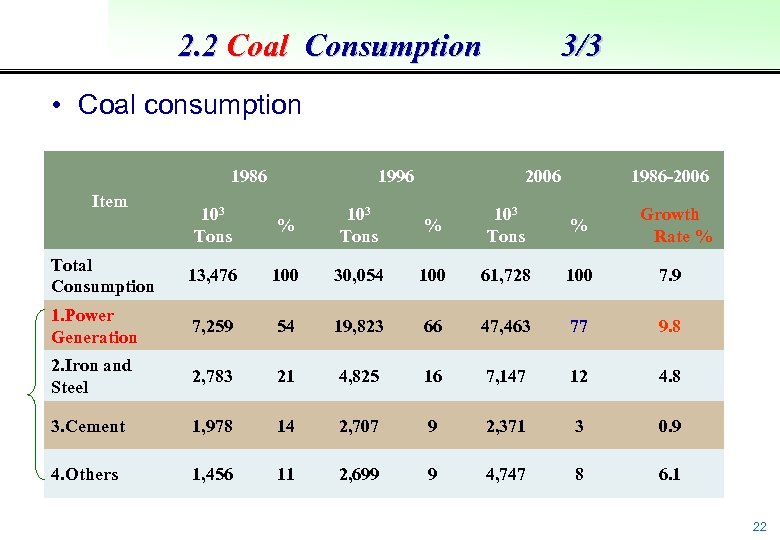 2. 2 Coal Consumption 3/3 • Coal consumption 1986 Item 103 Tons Total Consumption 1996 % 103 Tons 13, 476 100 1. Power Generation 7, 259 2. Iron and Steel 2006 1986 -2006 % 103 Tons % Growth Rate % 30, 054 100 61, 728 100 7. 9 54 19, 823 66 47, 463 77 9. 8 2, 783 21 4, 825 16 7, 147 12 4. 8 3. Cement 1, 978 14 2, 707 9 2, 371 3 0. 9 4. Others 1, 456 11 2, 699 9 4, 747 8 6. 1 22
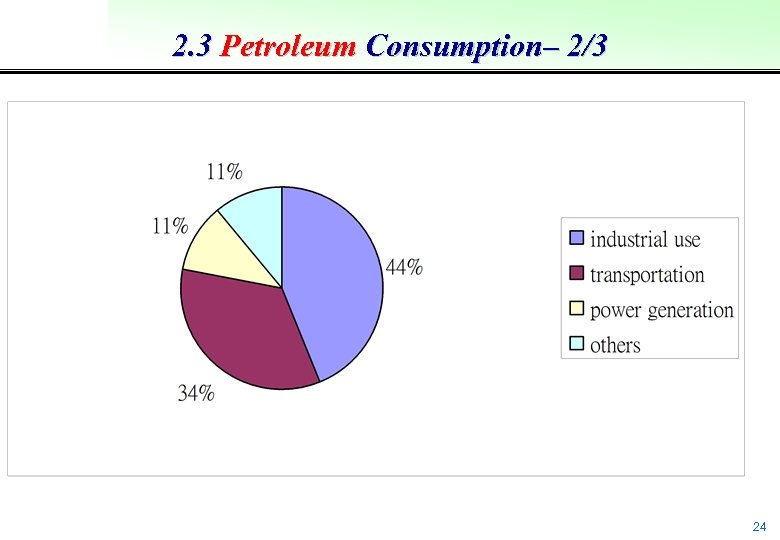
 2. 3 Petroleum Consumption– 1/3 • 1. 2. 3. 3. 4. 5. 6. 7. The consumption in 2006 totaled 47. 26 million KLOE, by sector as follows: 44% for industrial use 34% for transportation 11% for power generation 3% for residential use 1% for agricultural us 1% for commercial use 2% for other uses 4% for non-energy uses 23
 2. 3 Petroleum Consumption– 2/3 24
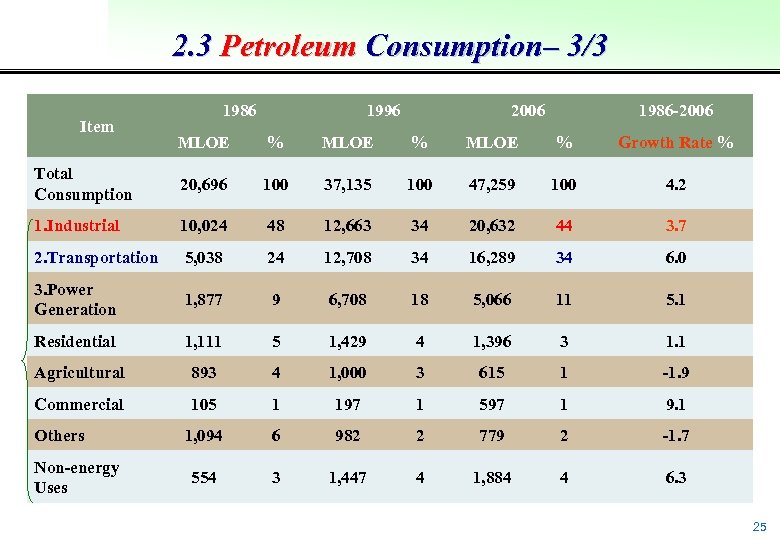 2. 3 Petroleum Consumption– 3/3 Item 1986 1996 2006 1986 -2006 MLOE % Growth Rate % Total Consumption 20, 696 100 37, 135 100 47, 259 100 4. 2 1. Industrial 10, 024 48 12, 663 34 20, 632 44 3. 7 2. Transportation 5, 038 24 12, 708 34 16, 289 34 6. 0 3. Power Generation 1, 877 9 6, 708 18 5, 066 11 5. 1 Residential 1, 111 5 1, 429 4 1, 396 3 1. 1 Agricultural 893 4 1, 000 3 615 1 -1. 9 Commercial 105 1 197 1 597 1 9. 1 1, 094 6 982 2 779 2 -1. 7 554 3 1, 447 4 1, 884 4 6. 3 Others Non-energy Uses 25
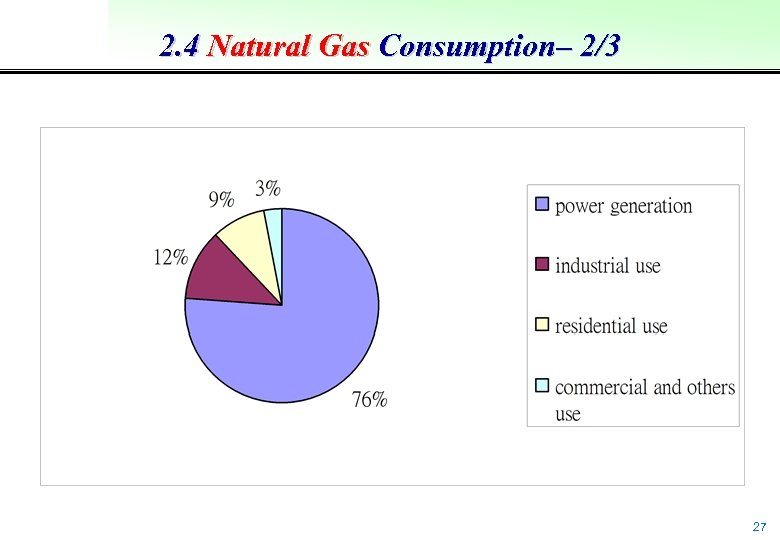
 2. 4 Natural Gas Consumption– 1/3 • Natural gas consumption in 2006 totaled 10. 29 billion cubic meters, breakdown by use as follows: • 76% for power generation • 12% for industrial use • 9% for residential use • 3% for commercial and others use 26
 2. 4 Natural Gas Consumption– 2/3 27
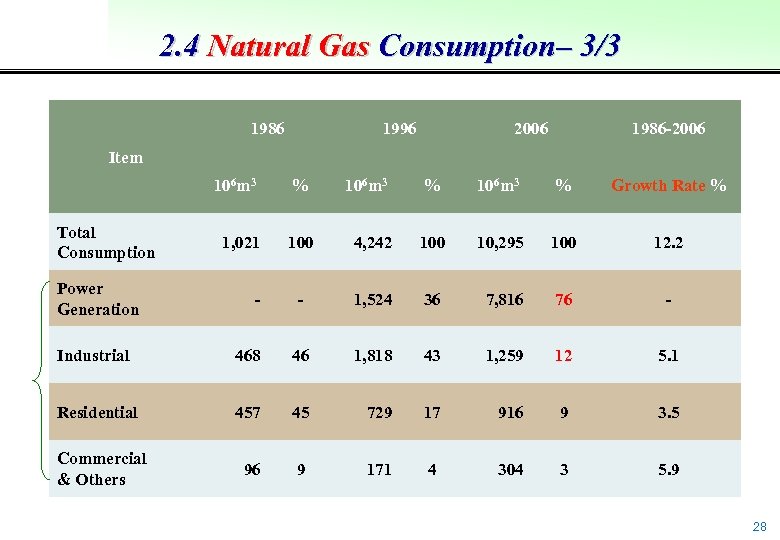 2. 4 Natural Gas Consumption– 3/3 1986 1996 2006 1986 -2006 Item 106 m 3 Total Consumption Power Generation % 106 m 3 % Growth Rate % 1, 021 100 4, 242 100 10, 295 100 12. 2 - 1, 524 36 7, 816 76 - - Industrial 468 46 1, 818 43 1, 259 12 5. 1 Residential 457 45 729 17 916 9 3. 5 Commercial & Others 96 9 171 4 304 3 5. 9 28
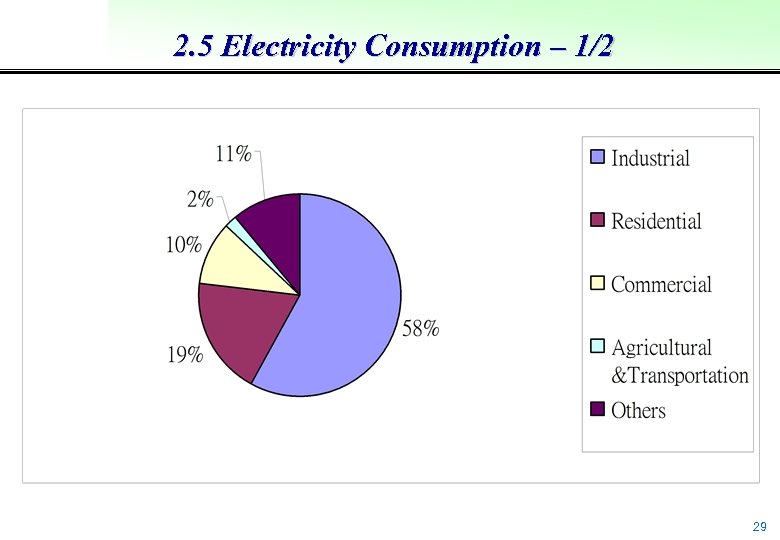 2. 5 Electricity Consumption – 1/2 29
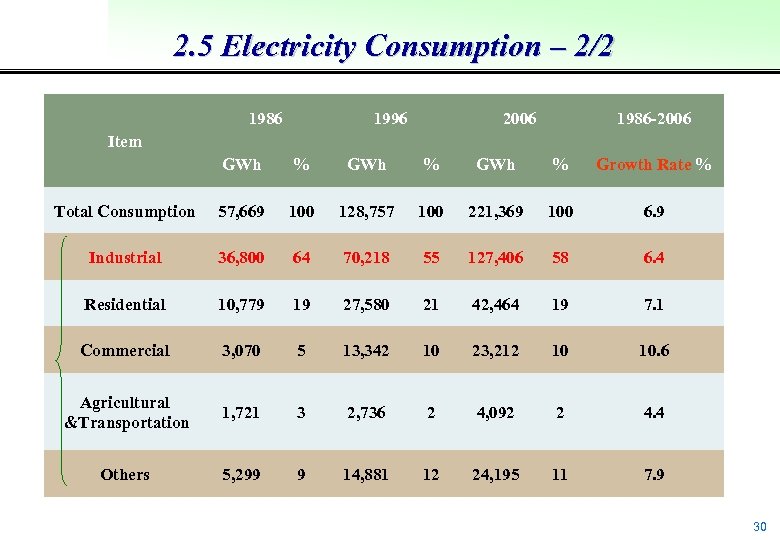 2. 5 Electricity Consumption – 2/2 1986 1996 2006 1986 -2006 Item GWh % Growth Rate % Total Consumption 57, 669 100 128, 757 100 221, 369 100 6. 9 Industrial 36, 800 64 70, 218 55 127, 406 58 6. 4 Residential 10, 779 19 27, 580 21 42, 464 19 7. 1 Commercial 3, 070 5 13, 342 10 23, 212 10 10. 6 Agricultural &Transportation 1, 721 3 2, 736 2 4, 092 2 4. 4 Others 5, 299 9 14, 881 12 24, 195 11 7. 9 30
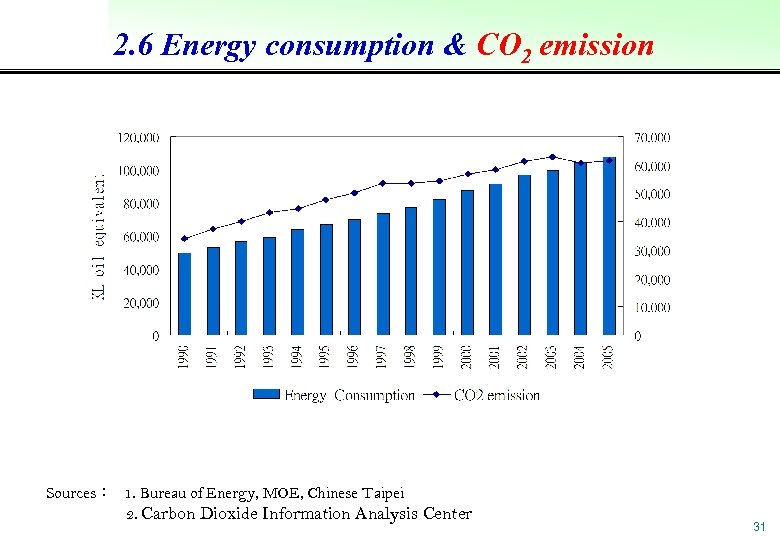 2. 6 Energy consumption & CO 2 emission Sources: 1. Bureau of Energy, MOE, Chinese Taipei 2. Carbon Dioxide Information Analysis Center 31
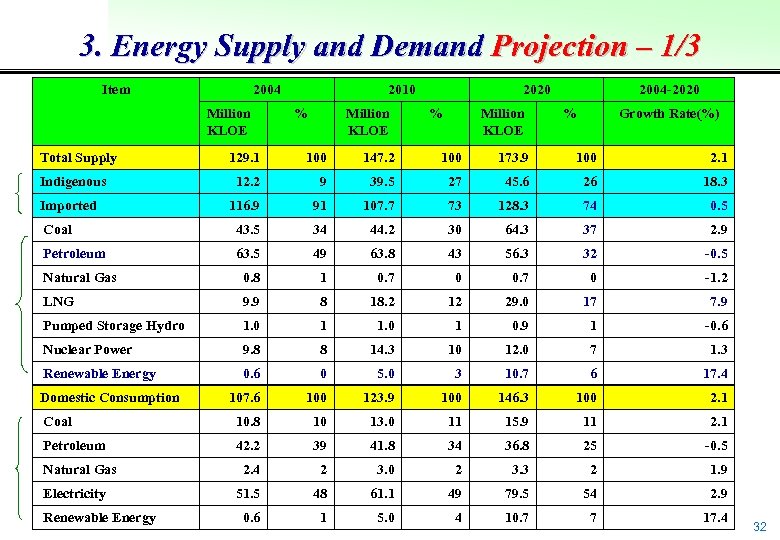 3. Energy Supply and Demand Projection – 1/3 Item 2004 Million KLOE Total Supply 2010 % Million KLOE 2020 % Million KLOE 2004 -2020 % Growth Rate(%) 129. 1 100 147. 2 100 173. 9 100 2. 1 12. 2 9 39. 5 27 45. 6 26 18. 3 116. 9 91 107. 7 73 128. 3 74 0. 5 Coal 43. 5 34 44. 2 30 64. 3 37 2. 9 Petroleum 63. 5 49 63. 8 43 56. 3 32 -0. 5 Natural Gas 0. 8 1 0. 7 0 -1. 2 LNG 9. 9 8 18. 2 12 29. 0 17 7. 9 Pumped Storage Hydro 1. 0 1 0. 9 1 -0. 6 Nuclear Power 9. 8 8 14. 3 10 12. 0 7 1. 3 Renewable Energy 0. 6 0 5. 0 3 10. 7 6 17. 4 107. 6 100 123. 9 100 146. 3 100 2. 1 Coal 10. 8 10 13. 0 11 15. 9 11 2. 1 Petroleum 42. 2 39 41. 8 34 36. 8 25 -0. 5 2. 4 2 3. 0 2 3. 3 2 1. 9 51. 5 48 61. 1 49 79. 5 54 2. 9 0. 6 1 5. 0 4 10. 7 7 17. 4 Indigenous Imported Domestic Consumption Natural Gas Electricity Renewable Energy 32
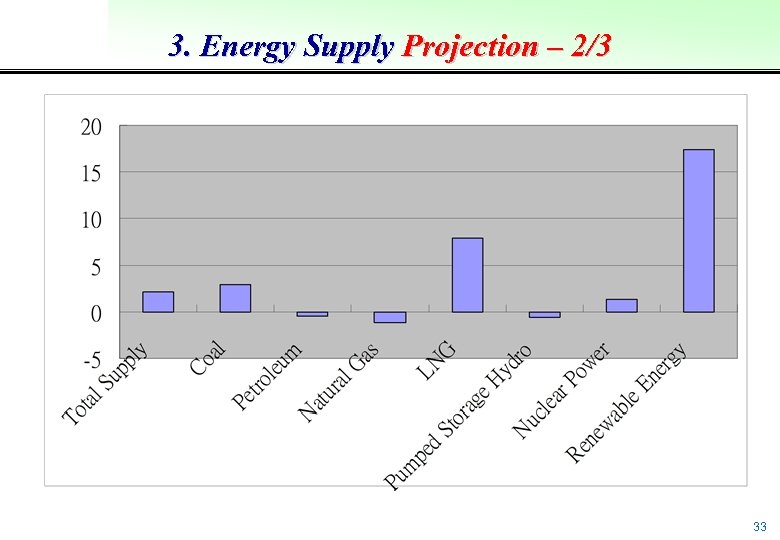 3. Energy Supply Projection – 2/3 33
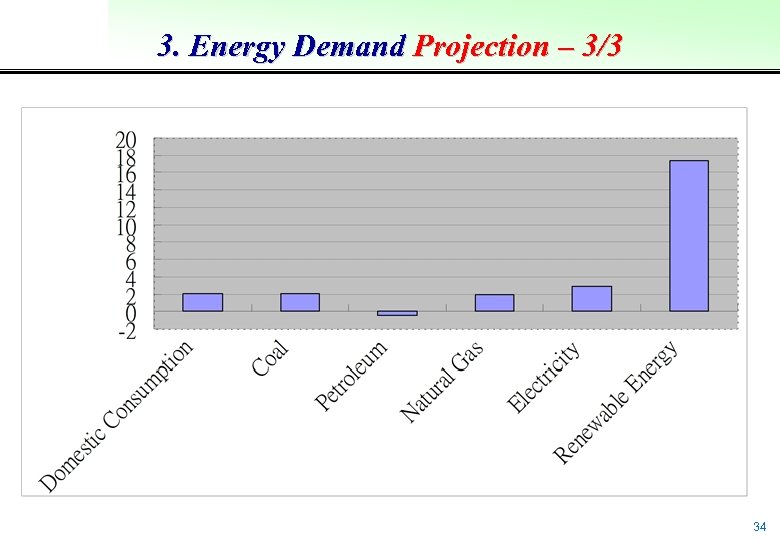 3. Energy Demand Projection – 3/3 34
 35
35
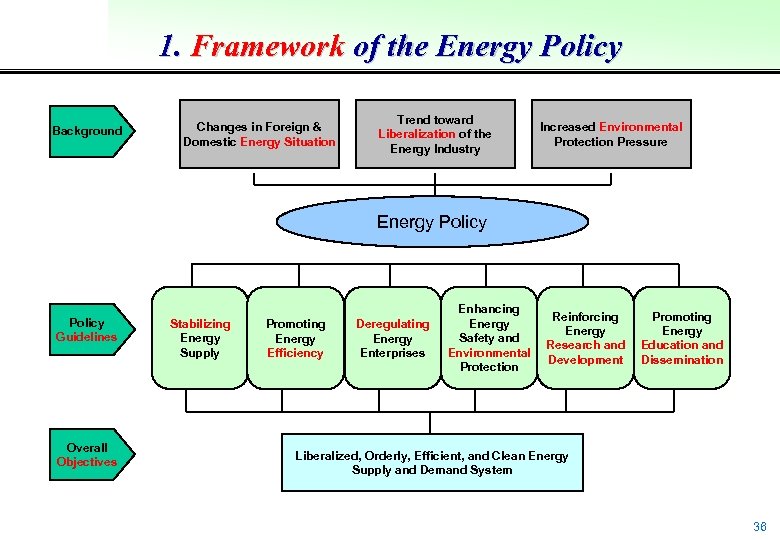 1. Framework of the Energy Policy Background Changes in Foreign & Domestic Energy Situation Trend toward Liberalization of the Energy Industry Increased Environmental Protection Pressure Energy Policy Guidelines Overall Objectives Stabilizing Energy Supply Promoting Energy Efficiency Deregulating Energy Enterprises Enhancing Energy Safety and Environmental Protection Reinforcing Energy Research and Development Promoting Energy Education and Dissemination Liberalized, Orderly, Efficient, and Clean Energy Supply and Demand System 36
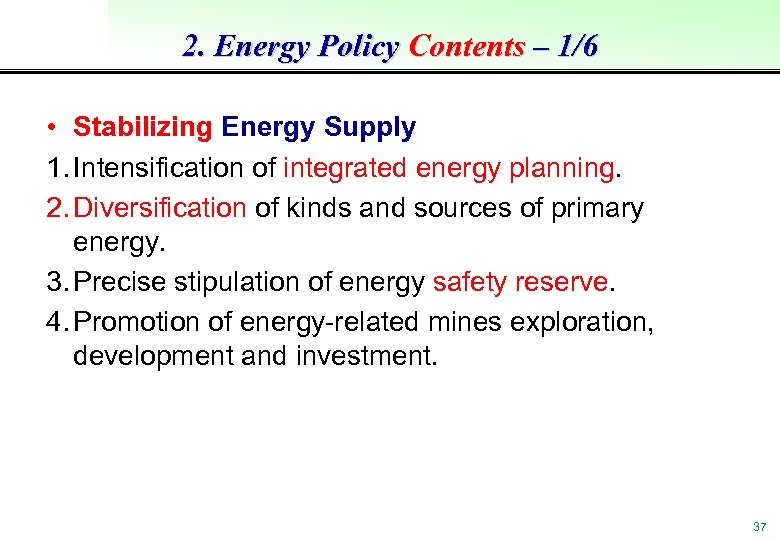 2. Energy Policy Contents – 1/6 • Stabilizing Energy Supply 1. Intensification of integrated energy planning. 2. Diversification of kinds and sources of primary energy. 3. Precise stipulation of energy safety reserve. 4. Promotion of energy-related mines exploration, development and investment. 37
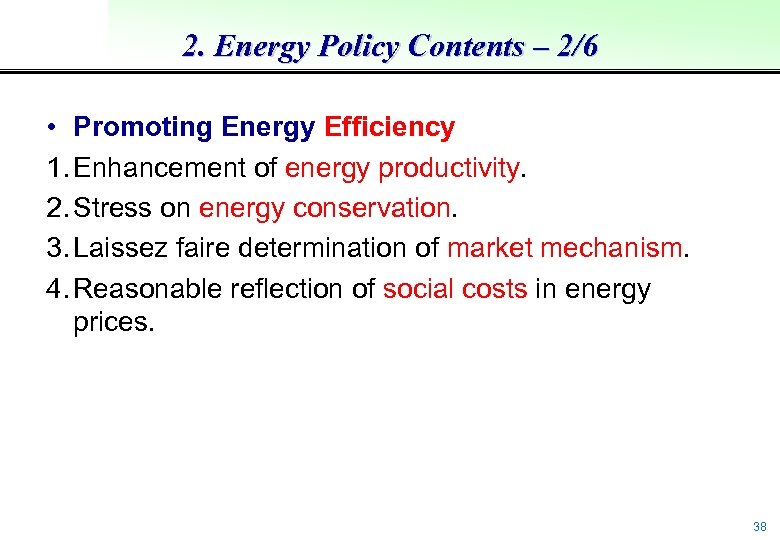 2. Energy Policy Contents – 2/6 • Promoting Energy Efficiency 1. Enhancement of energy productivity. 2. Stress on energy conservation. 3. Laissez faire determination of market mechanism. 4. Reasonable reflection of social costs in energy prices. 38
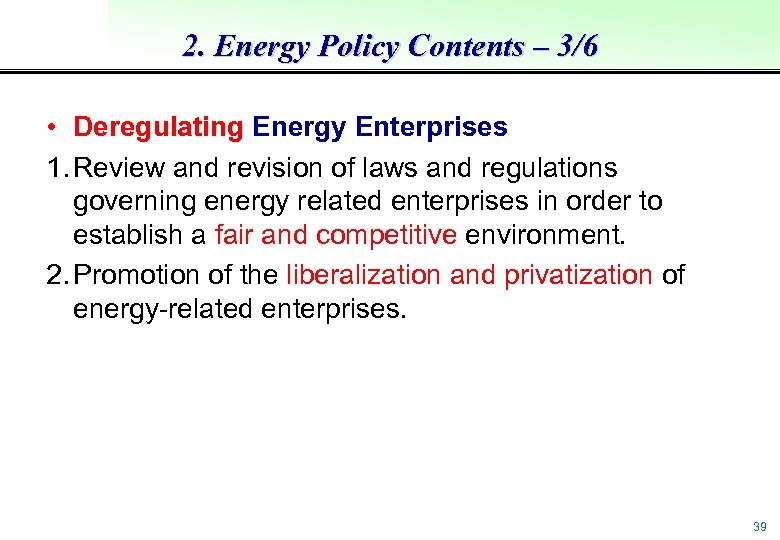 2. Energy Policy Contents – 3/6 • Deregulating Energy Enterprises 1. Review and revision of laws and regulations governing energy related enterprises in order to establish a fair and competitive environment. 2. Promotion of the liberalization and privatization of energy-related enterprises. 39
 2. Energy Policy Contents – 4/6 • Enhancing Environmental protection 1. Active introduction and production of clean energy. 2. Promotion of high efficiency burners and pollution prevention equipment and technology. 3. Mitigating the greenhouse effect to cope with international environmental protection. 40
 2. Energy Policy Contents – 5/6 • Reinforcing Energy Research and Development 1. Promoting R&D on energy conservation technologies. 2. Promoting R&D in renewable energy and utilization on a cost effective basis. 3. Strengthening international cooperation and information interchange. 41
 2. Energy Policy Contents – 6/6 • Promoting Energy Education and Dissemination 1. Fostering correct energy concepts. 2. Promoting energy education. 3. Training energy professionals. 42
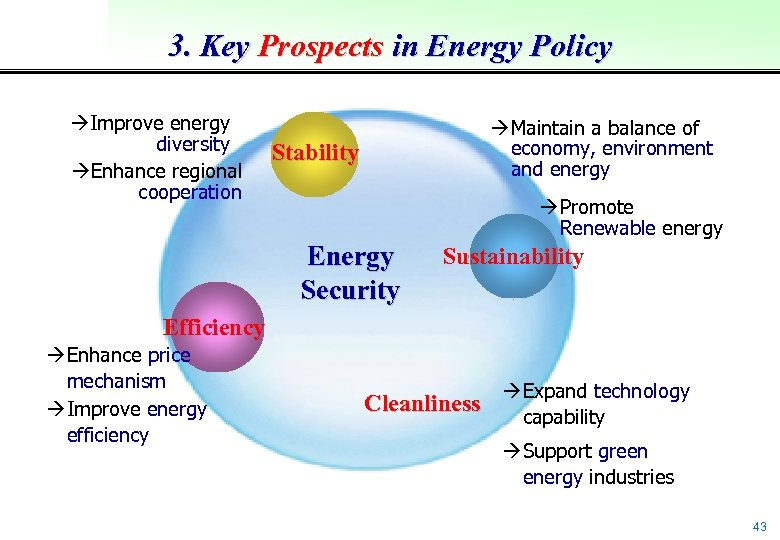 3. Key Prospects in Energy Policy àImprove energy diversity àEnhance regional cooperation à Maintain a balance of economy, environment and energy Stability à Promote Renewable energy Energy Security Sustainability Efficiency à Enhance price mechanism à Improve energy efficiency Cleanliness à Expand technology capability à Support green energy industries 43
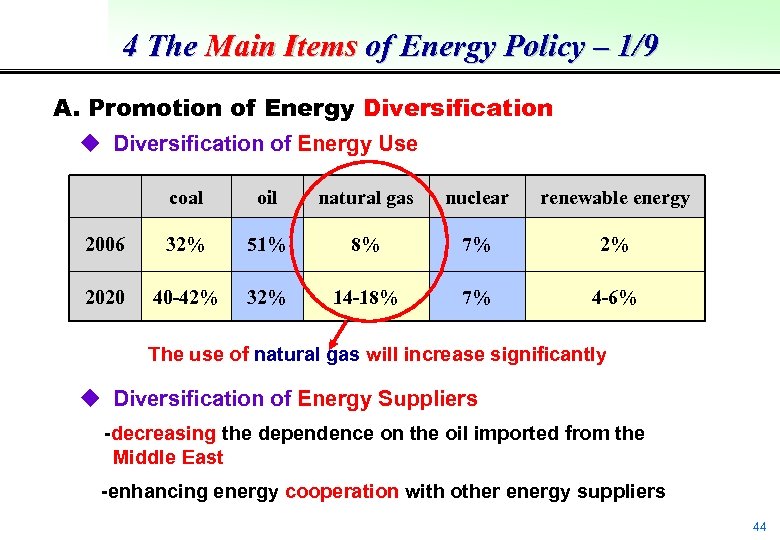 4 The Main Items of Energy Policy – 1/9 A. Promotion of Energy Diversification u Diversification of Energy Use coal oil natural gas nuclear renewable energy 2006 32% 51% 8% 7% 2% 2020 40 -42% 32% 14 -18% 7% 4 -6% The use of natural gas will increase significantly u Diversification of Energy Suppliers -decreasing the dependence on the oil imported from the Middle East -enhancing energy cooperation with other energy suppliers 44
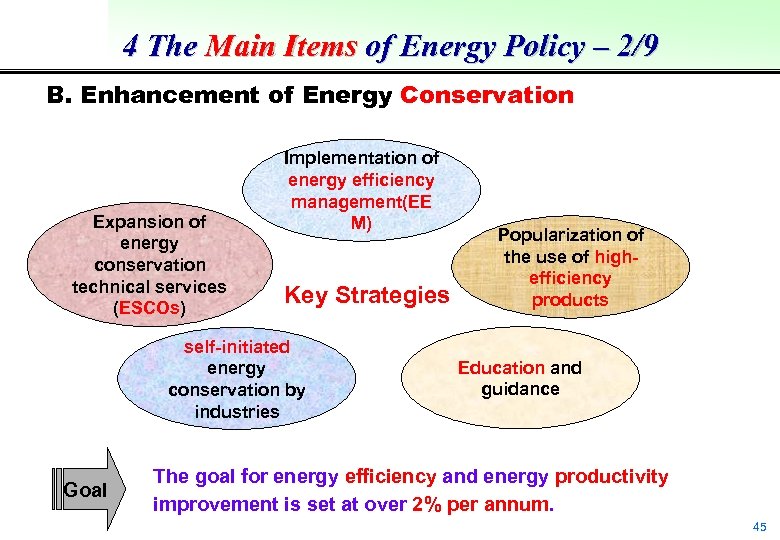 4 The Main Items of Energy Policy – 2/9 B. Enhancement of Energy Conservation Expansion of energy conservation technical services (ESCOs) Implementation of energy efficiency management(EE M) Key Strategies self-initiated energy conservation by industries Goal Popularization of the use of highefficiency products Education and guidance The goal for energy efficiency and energy productivity improvement is set at over 2% per annum. 45
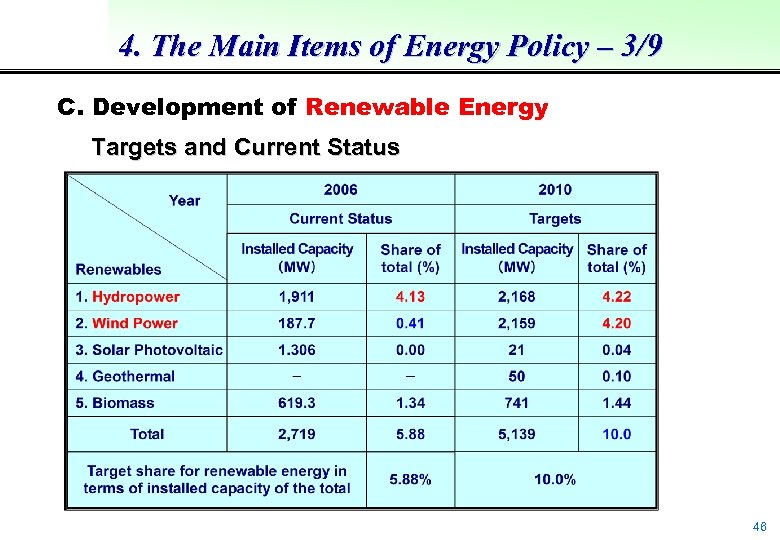 4. The Main Items of Energy Policy – 3/9 C. Development of Renewable Energy Targets and Current Status 46
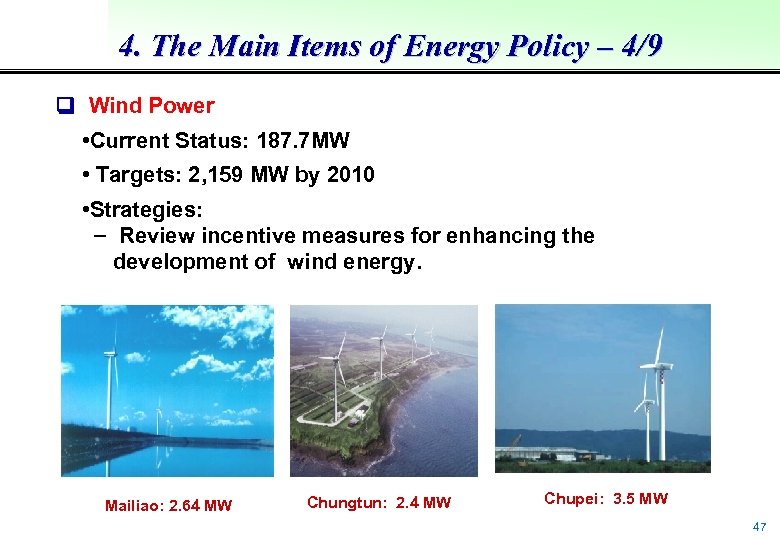 4. The Main Items of Energy Policy – 4/9 Wind Power • Current Status: 187. 7 MW • Targets: 2, 159 MW by 2010 • Strategies: Review incentive measures for enhancing the development of wind energy. Mailiao: 2. 64 MW Chungtun: 2. 4 MW Chupei: 3. 5 MW 47
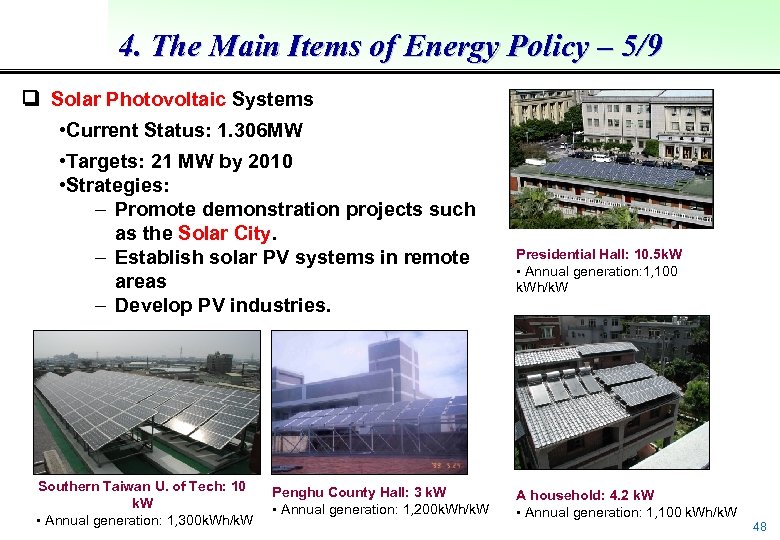 4. The Main Items of Energy Policy – 5/9 Solar Photovoltaic Systems • Current Status: 1. 306 MW • Targets: 21 MW by 2010 • Strategies: Promote demonstration projects such as the Solar City. Establish solar PV systems in remote areas Develop PV industries. Southern Taiwan U. of Tech: 10 k. W • Annual generation: 1, 300 k. Wh/k. W Penghu County Hall: 3 k. W • Annual generation: 1, 200 k. Wh/k. W Presidential Hall: 10. 5 k. W • Annual generation: 1, 100 k. Wh/k. W A household: 4. 2 k. W • Annual generation: 1, 100 k. Wh/k. W 48
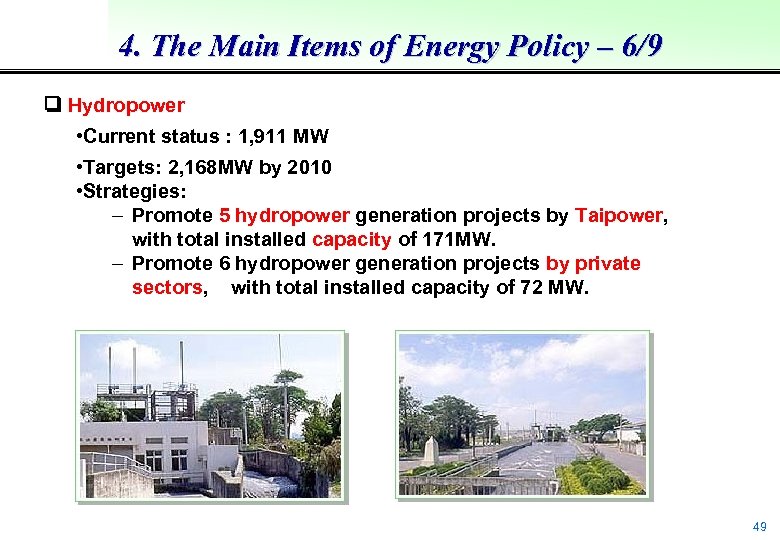 4. The Main Items of Energy Policy – 6/9 Hydropower • Current status : 1, 911 MW • Targets: 2, 168 MW by 2010 • Strategies: Promote 5 hydropower generation projects by Taipower, with total installed capacity of 171 MW. Promote 6 hydropower generation projects by private sectors, with total installed capacity of 72 MW. 49
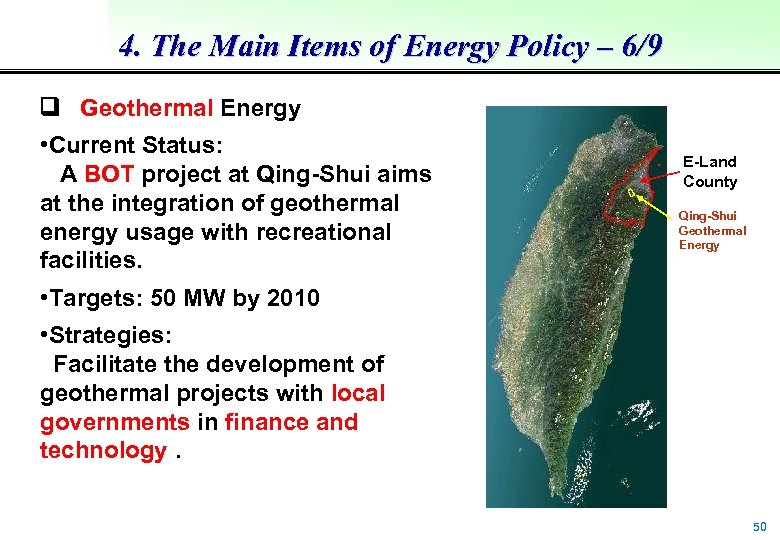 4. The Main Items of Energy Policy – 6/9 Geothermal Energy • Current Status: A BOT project at Qing-Shui aims at the integration of geothermal energy usage with recreational facilities. E-Land County Qing-Shui Geothermal Energy • Targets: 50 MW by 2010 • Strategies: Facilitate the development of geothermal projects with local governments in finance and technology. 50
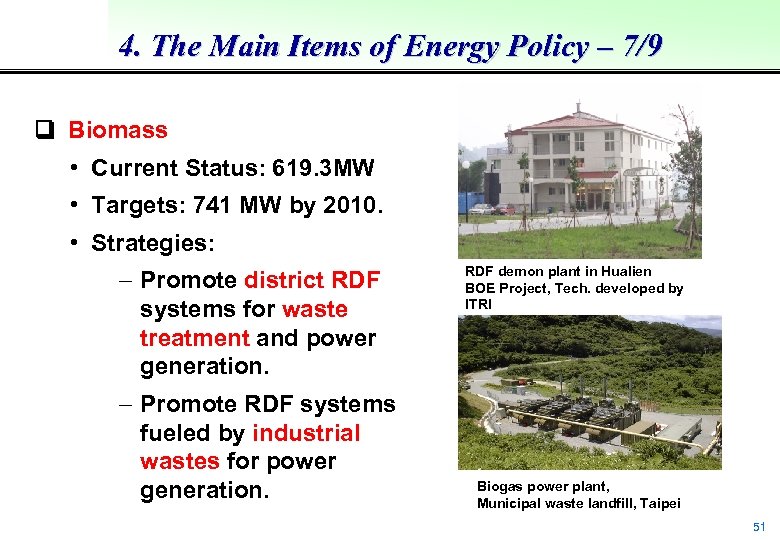 4. The Main Items of Energy Policy – 7/9 Biomass • Current Status: 619. 3 MW • Targets: 741 MW by 2010. • Strategies: Promote district RDF systems for waste treatment and power generation. Promote RDF systems fueled by industrial wastes for power generation. RDF demon plant in Hualien BOE Project, Tech. developed by ITRI Biogas power plant, Municipal waste landfill, Taipei 51
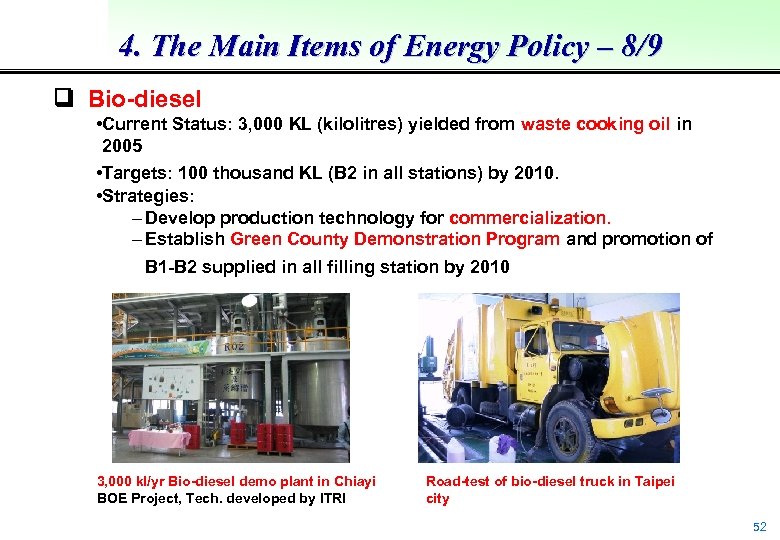 4. The Main Items of Energy Policy – 8/9 Bio-diesel • Current Status: 3, 000 KL (kilolitres) yielded from waste cooking oil in 2005 • Targets: 100 thousand KL (B 2 in all stations) by 2010. • Strategies: Develop production technology for commercialization. Establish Green County Demonstration Program and promotion of B 1 -B 2 supplied in all filling station by 2010 3, 000 kl/yr Bio-diesel demo plant in Chiayi BOE Project, Tech. developed by ITRI Road-test of bio-diesel truck in Taipei city 52
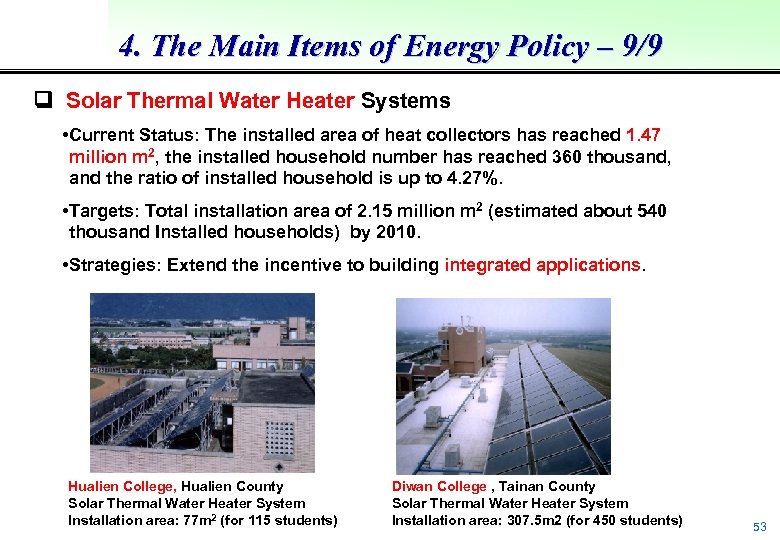 4. The Main Items of Energy Policy – 9/9 Solar Thermal Water Heater Systems • Current Status: The installed area of heat collectors has reached 1. 47 million m 2, the installed household number has reached 360 thousand, and the ratio of installed household is up to 4. 27%. • Targets: Total installation area of 2. 15 million m 2 (estimated about 540 thousand Installed households) by 2010. • Strategies: Extend the incentive to building integrated applications. Hualien College, Hualien County Solar Thermal Water Heater System Installation area: 77 m 2 (for 115 students) Diwan College , Tainan County Solar Thermal Water Heater System Installation area: 307. 5 m 2 (for 450 students) 53
 5. Future Energy Policies and Strategies – 1/9 (1) Stabilize Energy Supply: enhancing energy cooperation and increasing indigenous energy supply A. Enhance security scheme of energy supply as well as international cooperation. B. Increase indigenous energy supply. Aggressively promote non-carbon renewable energy: à 2010 : 5, 130 MW. à 2020 : 7, 000~8, 000 MW. à To accelerate the enactment of “Renewable Energy Development Act”. 54
 5. Future Energy Policies and Strategies – 2/9 C. Promotion Targets of non-carbon renewable energy Waste-to-energy generation: 741 MW by 2010. Biomass Bio-diesel: 100, 000 KLOE by 2010. Wind Power 2, 159 MW by 2010 Photovoltaics 800 MW by 2025. Geothermal, ocean energy, hydrogen and fuel cell are promoted with various programmes. To meet the energy demand & stabilize CO 2 concentrations unprecedented technology changes must occur in this century 55
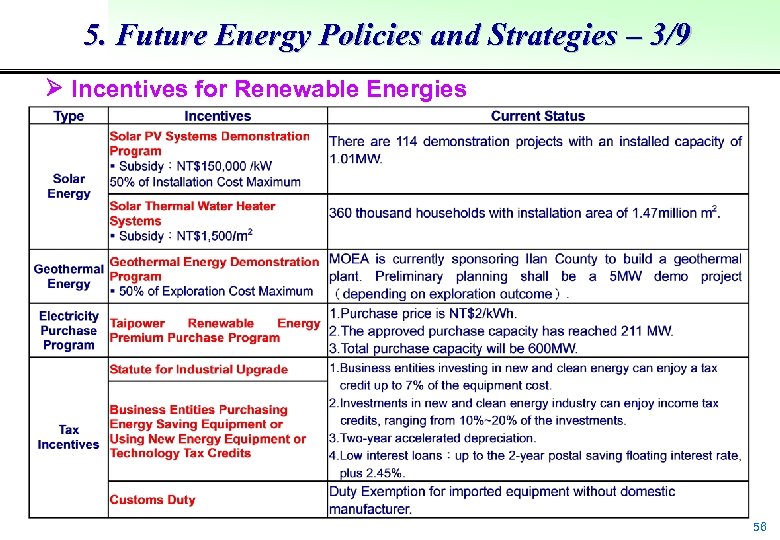 5. Future Energy Policies and Strategies – 3/9 Incentives for Renewable Energies 56
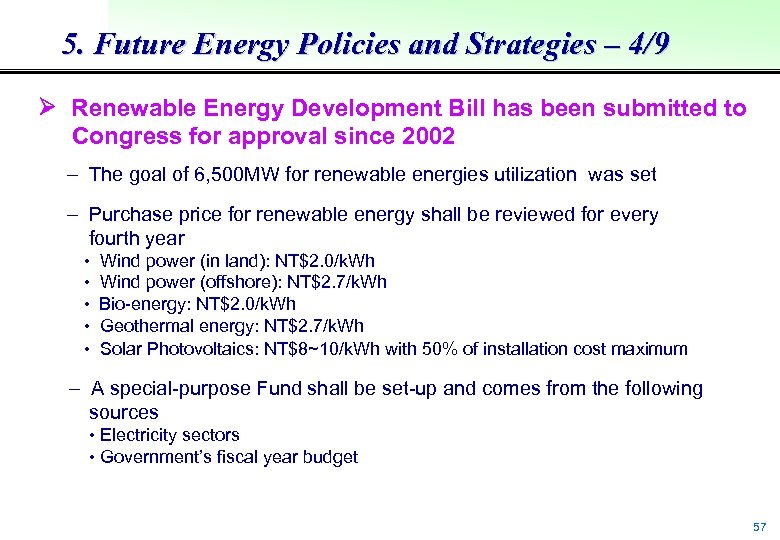 5. Future Energy Policies and Strategies – 4/9 Renewable Energy Development Bill has been submitted to Congress for approval since 2002 The goal of 6, 500 MW for renewable energies utilization was set Purchase price for renewable energy shall be reviewed for every fourth year • • • Wind power (in land): NT$2. 0/k. Wh Wind power (offshore): NT$2. 7/k. Wh Bio-energy: NT$2. 0/k. Wh Geothermal energy: NT$2. 7/k. Wh Solar Photovoltaics: NT$8~10/k. Wh with 50% of installation cost maximum A special-purpose Fund shall be set-up and comes from the following sources • Electricity sectors • Government’s fiscal year budget 57
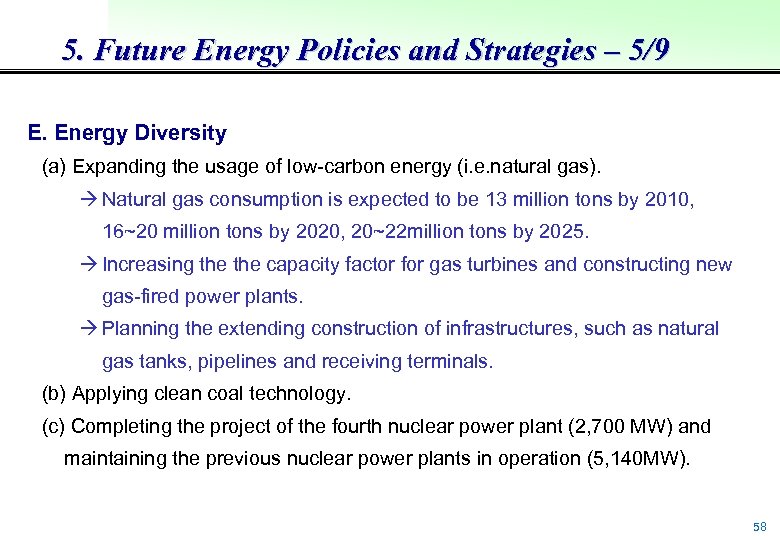 5. Future Energy Policies and Strategies – 5/9 E. Energy Diversity (a) Expanding the usage of low-carbon energy (i. e. natural gas). à Natural gas consumption is expected to be 13 million tons by 2010, 16~20 million tons by 2020, 20~22 million tons by 2025. à Increasing the capacity factor for gas turbines and constructing new gas-fired power plants. à Planning the extending construction of infrastructures, such as natural gas tanks, pipelines and receiving terminals. (b) Applying clean coal technology. (c) Completing the project of the fourth nuclear power plant (2, 700 MW) and maintaining the previous nuclear power plants in operation (5, 140 MW). 58
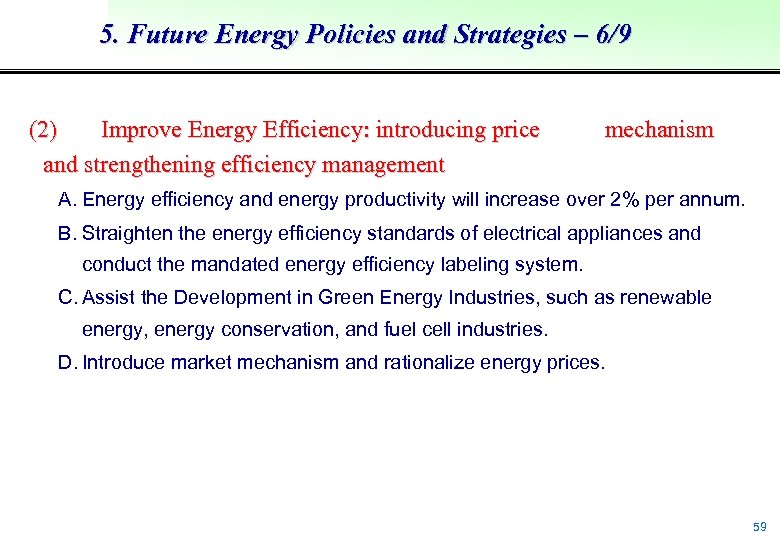 5. Future Energy Policies and Strategies – 6/9 (2) Improve Energy Efficiency: introducing price and strengthening efficiency management mechanism A. Energy efficiency and energy productivity will increase over 2% per annum. B. Straighten the energy efficiency standards of electrical appliances and conduct the mandated energy efficiency labeling system. C. Assist the Development in Green Energy Industries, such as renewable energy, energy conservation, and fuel cell industries. D. Introduce market mechanism and rationalize energy prices. 59
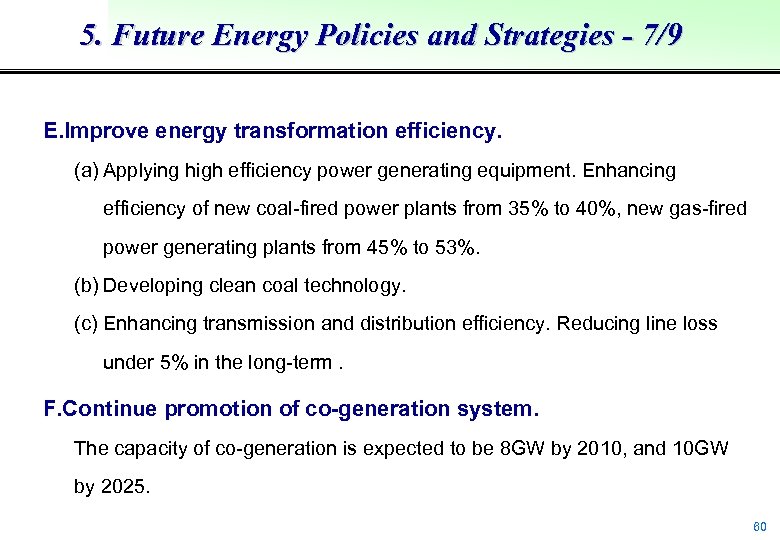 5. Future Energy Policies and Strategies - 7/9 E. Improve energy transformation efficiency. (a) Applying high efficiency power generating equipment. Enhancing efficiency of new coal-fired power plants from 35% to 40%, new gas-fired power generating plants from 45% to 53%. (b) Developing clean coal technology. (c) Enhancing transmission and distribution efficiency. Reducing line loss under 5% in the long-term. F. Continue promotion of co-generation system. The capacity of co-generation is expected to be 8 GW by 2010, and 10 GW by 2025. 60
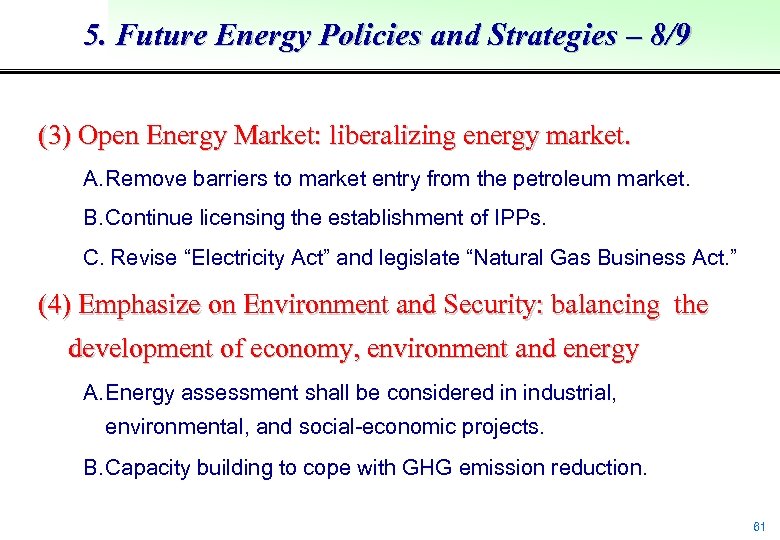 5. Future Energy Policies and Strategies – 8/9 (3) Open Energy Market: liberalizing energy market. A. Remove barriers to market entry from the petroleum market. B. Continue licensing the establishment of IPPs. C. Revise “Electricity Act” and legislate “Natural Gas Business Act. ” (4) Emphasize on Environment and Security: balancing the development of economy, environment and energy A. Energy assessment shall be considered in industrial, environmental, and social-economic projects. B. Capacity building to cope with GHG emission reduction. 61
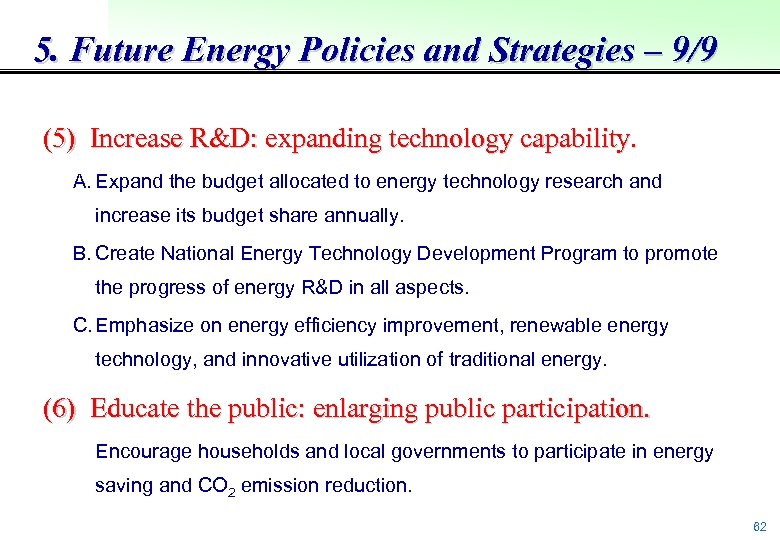 5. Future Energy Policies and Strategies – 9/9 (5) Increase R&D: expanding technology capability. A. Expand the budget allocated to energy technology research and increase its budget share annually. B. Create National Energy Technology Development Program to promote the progress of energy R&D in all aspects. C. Emphasize on energy efficiency improvement, renewable energy technology, and innovative utilization of traditional energy. (6) Educate the public: enlarging public participation. Encourage households and local governments to participate in energy saving and CO 2 emission reduction. 62
 63
63
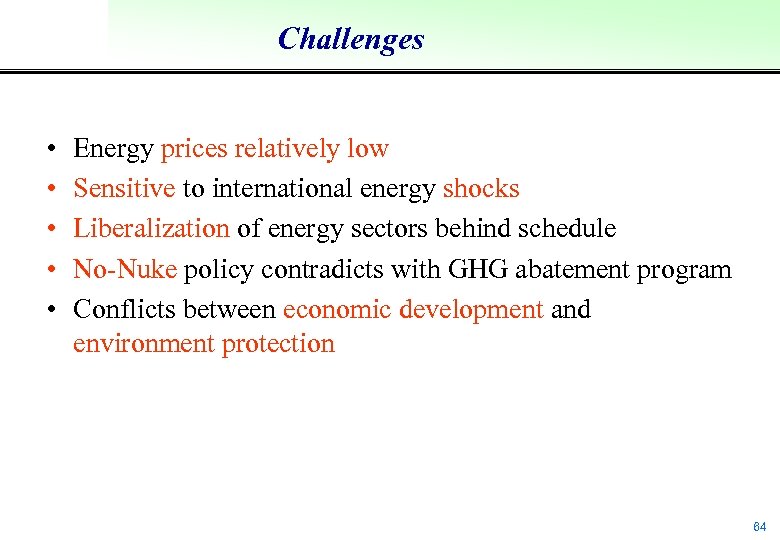 Challenges • • • Energy prices relatively low Sensitive to international energy shocks Liberalization of energy sectors behind schedule No-Nuke policy contradicts with GHG abatement program Conflicts between economic development and environment protection 64
 1. Wrong “signaling” • Subsidies on electricity, water, oil • When international oil prices hike, the government hesitates to let market mechanism function on state-run energy enterprises (such as Taipower, China Petrol) • Sometimes even cut taxes on energy products • Environmental taxes/fees (eg. air pollution fee) only lightly levied → dampens the incentives to save energy →Overall energy efficiency is still relatively low → Hard for the ESCO industry to grow 65
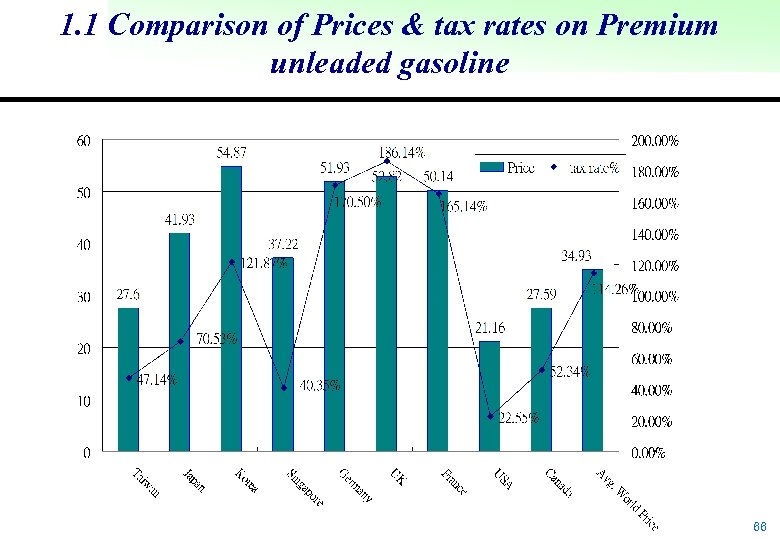 1. 1 Comparison of Prices & tax rates on Premium unleaded gasoline 66
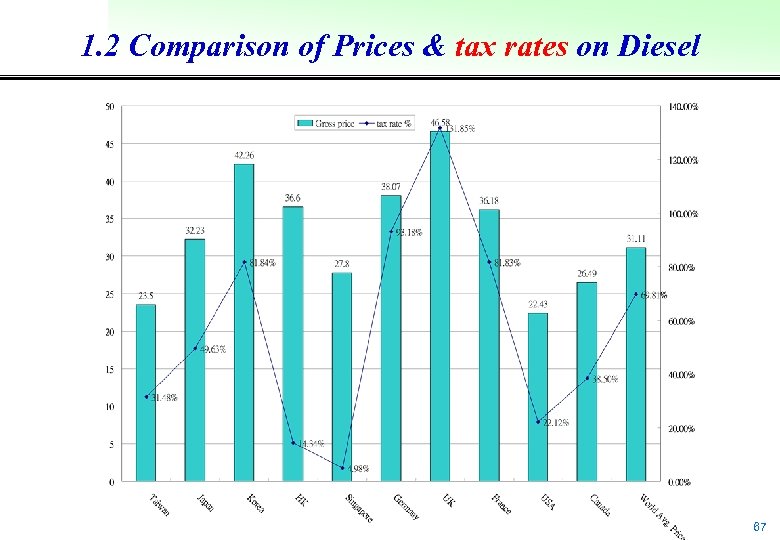 1. 2 Comparison of Prices & tax rates on Diesel 67
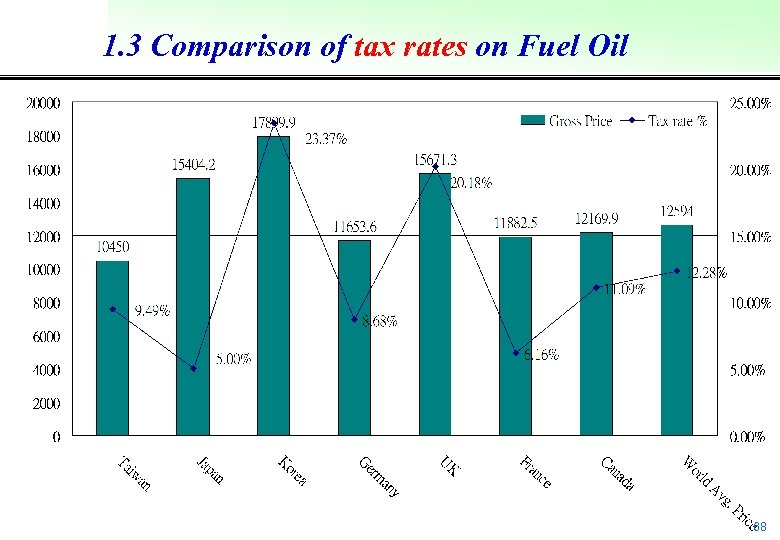 1. 3 Comparison of tax rates on Fuel Oil 68
 2. Sensitive to international energy shocks • Adjustment costs high due to the long run low energy prices • Industry “hollowing out” • Inflationary problems • Energy security • “Energy tax” halted 69
 3. Liberalization behind schedule • Privatization of Taipower far behind schedule • Forcing Taipower to buy electricity from other private IPPs. • Heavily regulated China Petrol on floating prices 70
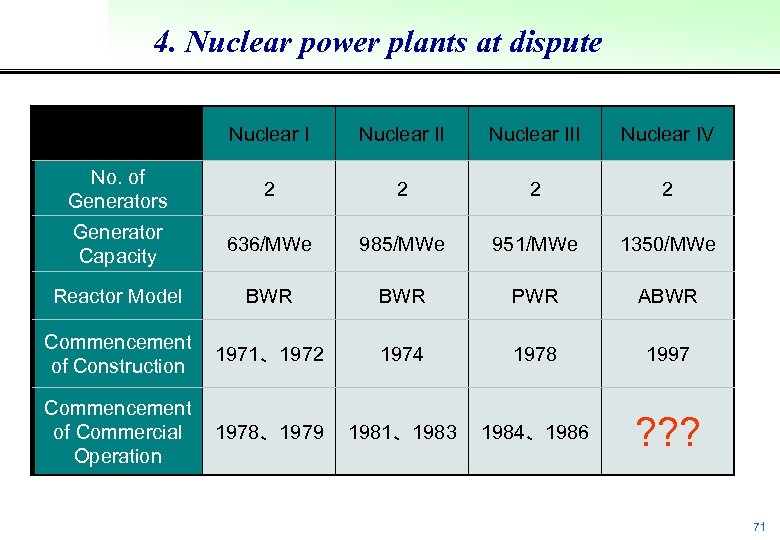 4. Nuclear power plants at dispute Nuclear III Nuclear IV No. of Generators 2 2 Generator Capacity 636/MWe 985/MWe 951/MWe 1350/MWe Reactor Model BWR PWR ABWR Commencement of Construction 1971、1972 1974 1978 1997 Commencement of Commercial Operation 1978、1979 1981、1983 1984、1986 ? ? ? 71
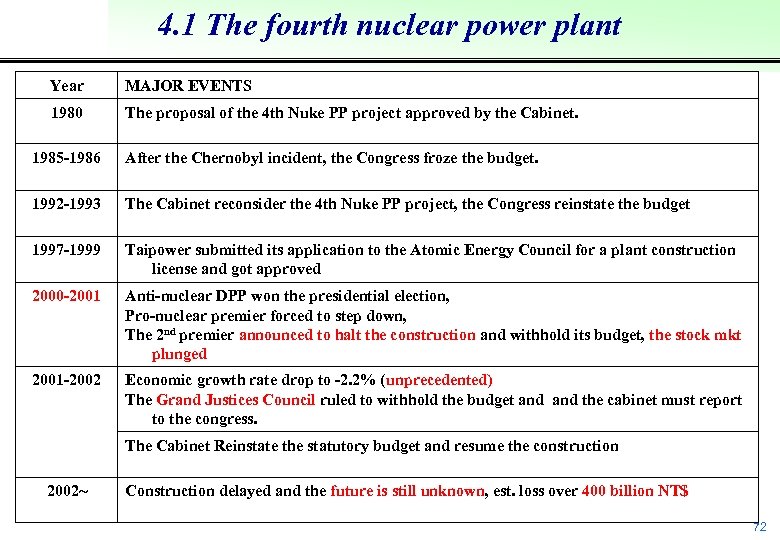 4. 1 The fourth nuclear power plant Year MAJOR EVENTS 1980 The proposal of the 4 th Nuke PP project approved by the Cabinet. 1985 -1986 After the Chernobyl incident, the Congress froze the budget. 1992 -1993 The Cabinet reconsider the 4 th Nuke PP project, the Congress reinstate the budget 1997 -1999 Taipower submitted its application to the Atomic Energy Council for a plant construction license and got approved 2000 -2001 Anti-nuclear DPP won the presidential election, Pro-nuclear premier forced to step down, The 2 nd premier announced to halt the construction and withhold its budget, the stock mkt plunged 2001 -2002 Economic growth rate drop to -2. 2% (unprecedented) The Grand Justices Council ruled to withhold the budget and the cabinet must report to the congress. The Cabinet Reinstate the statutory budget and resume the construction 2002~ Construction delayed and the future is still unknown, est. loss over 400 billion NT$ 72
 4. 2 No-Nuke policy dilemma • • • Ideological disputes: Experts vs. fundamentalists Citizen participation without majority support: 60% people disagree with the ruling party Never legislated Facts: Stock market and the economy plunged in 2001( -2. 2%) Current status: Re-construction still far behind schedule Unanswered question: No-Nuke Program means more “coal” consumption→ contradicting GHG abatement scheme 73
 5. Environment vs. Economy • Energy authority, under the Ministry of Economic Affairs, ranks lower than EPA • Sluggish economy vs. environment protection • “Energy tax” legislation delayed 74
 Thank You For Your Attention 75