


 Скачать презентацию Overview of CERN Activities in 2005 Strategy for
4279bd3b0dbbc4557de1276fbb2713c7.ppt
- Количество слайдов: 75
 Overview of CERN Activities in 2005 Strategy for CERN Future 12 January 2006 R. Aymar 1
 Firstly… • At the beginning of the New Year, I would like • to convey my best wishes to all of you, members of CERN and your families for the full satisfaction of your dreams! • to formulate for CERN and for you all specific wishes and ambitions, led to success by your hard work and commitments 2
 Overview of CERN Activities in 2005 Strategy for CERN future Contents 1. BRAVO and THANKS to each member of CERN staff , collaborative institutions and industrial firms • • • you can be proud of the progress achieved during 2005 Results are visible and help to (re) build confidence for the future Statements about progress in LHC construction 2. Follow up of strategy proposed in 2005: possible scientific plans • CERN Council Strategy Group for European Particle Physics 3. LHC construction overview 4. Linear Colliders ILC/CLIC 5. Human Resources • 5 Yearly Review of CERN employment conditions • Human Resources policy (plan prepared for MTP 2006) • Pension Fund - Strategy of Management – Governance 6. CERN missions besides Research / discoveries • Education / training • Technology transfer • WSIS (World summit of information society) • Open Access 7. Conclusion 3
 2. Why a new structure ? This loss of confidence in CERN management at all levels pushed the MS towards micromanagement but it never drove them away from the proper appreciation of the competence and motivation of the individuals in CERN. We should recover the full confidence of the Member States. The future of CERN depends on this recovery. 13 January 2004 4
 3. How should this structure work? Our cooperation with European Particle Physics Laboratories should be strengthened and deepened – more collaboration towards common goals (accelerator Departments should follow examples of Physics Department) – more active participation of CERN in ECFA At the Council level a new (old) objective has been agreed: to steer the European PP activities (in addition to supervise the CERN Lab) 13 January 2004 5
 4. For which scientific objectives? (1) The following strategic orientations are proposed for CERN activities in 2004 -2010: – 1. to keep the utmost priority for the completion of the LHC project, and strive for a start of operations in the summer of 2007 = machine / detectors / LCG – 2. to fulfil commitments previously made by CERN: CNGS, EGEE – 3. after an in-depth risk analysis review, to mitigate the consequences of failure of old equipment that is necessary for reliable LHC operation. 13 January 2004 6
 5. Conclusions – With improvement in the collective interaction throughout the organization, (not only by new tools, but through voluntary human relationship) – By strengthening individual leadership and the full exercise of individual responsibility to favour the cost-schedule-performance awareness, – With an increase in the voluntary collaboration of CERN with other European PP Laboratories. I am convinced that the challenges ahead of us will be overcome: – the LHC can be ready in time (within cost) and will be another success in the large series of CERN prestigious achievements: scientific discoveries will not be far ahead, – the Members States’ confidence in CERN can be fully restored, around an agreed European scientific strategy, supported by appropriate resources, thus providing CERN with a sure future. Two milestones: end 2006 and 2009 -2010. 13 January 2004 7
 Global views and strategy (2) 2005 is going to be a year without beams (except the Booster and Isolde) but not a "dull year". 2005 (and 2006) are absolutely crucial years to plan, carry out, and improve everything needed to: – Ensure that our priority challenge will be achieved successfully, i. e. first LHC collisions in the summer of 2007 and a rapid and safe start of operations with useful luminosity and associated results. – Prepare opportunities and essentials for the future research programme in HEP in coordinated collaboration with the European Laboratories, and clarify the future role of CERN (CERN Council’s responsibility, EU 7 th Framework Programme) – Promote the recognition of CERN’s other missions: technology transfer, education and training (including fellows) 10 January 2005 8
 Global views and strategy (3) CERN’s resources, human and financial, are scarce to face all these challenges, nevertheless we should pursue a fundamental goal to recover the full confidence of Member States in CERN’s capacities (not competences) as a whole, by completing the LHC in time and, therefore benefiting from this success to obtain appropriate resources to support future scientific objectives, 2005 will also be a crucial year for the 5 -Yearly Review of employment conditions. This is neither the time nor the place to enter into possible details, but in my mind, the results of the 5 -Yearly Review should provide the best support to achieving the previous goals. This will enable the recruitment of the best staff, to maintain high motivation and efficiency, and in return, an appropriate recognition of their contributions, merits and individual responsibilities. 10 January 2005 9
 International Cost and Schedule Review Committee Report of December 2005 When the Committee met one year ago the LHC Project Leader was not able to present the Committee with a revised installation plan that met the February 2007 installation completion date due to: – the underground construction problems at the CMS cavern at point 5 – the installation of the QRL suspended – the design of the Distribution Feedboxes (DFBs) significantly behind schedule Today: – magnet installation is underway in sectors 7 -8, 8 -1, and 4 -5 We, the Committee, are impressed with the degree of recovery from the nearly three year delay in the installation. We applaud the Director General and the Project Leader for their complete commitment to meet the Feb 2007 Milestone and the start of beam commissioning in July 2007, we support the plan. Bravo and heartfelt thanks to all for your actions and your dedication. Afterwards the Council made the following statement: The Council took note of the status report by the Director-General and congratulated the CERN Staff and Management, together with the staff of partner institutions and industrial firms for their achievements in 2005. The Council also expresses appreciation to the Director-General for his 12 January 2006 vision and leadership. 10
 Strategic plans for the future After recognized evidence of the Laboratory’s successful achievements (in 2007), we should be entitled to come back to the MS and request approval of new scientific objectives and to provide coherent resources; Therefore, we have to prepare the future scientific programme, and to show the motivations of the Laboratory and its individuals; Even if we are heavily concentrated on the LHC, we should be engaged in a minimal programme of R&D and design, to reap the benefit of an increased cooperation with European Laboratories (new programmes have been launched independently of CERN); Staff members involved in this R&D programme should feel obliged to deliver more, being privileged and suffering less pressure for procurement and installation of LHC components; LHC completion is an indisputable priority. 10 January 2005 11
 For which scientific objectives? (6) 7. in 2006 -2007, to decide on the implementation of the Linac 4 and any increased R&D programme, depending on new funds made available and on a new HR policy 8. in 2009 -2010, to review and redefine the strategy for CERN activities in the next decade 2011 -2020 in the light of the first results from LHC and of progress and results from the previous actions. The possible choices are at present quite open. The future role of CERN will depend on these choices and their effective funding. 10 January 2005 12
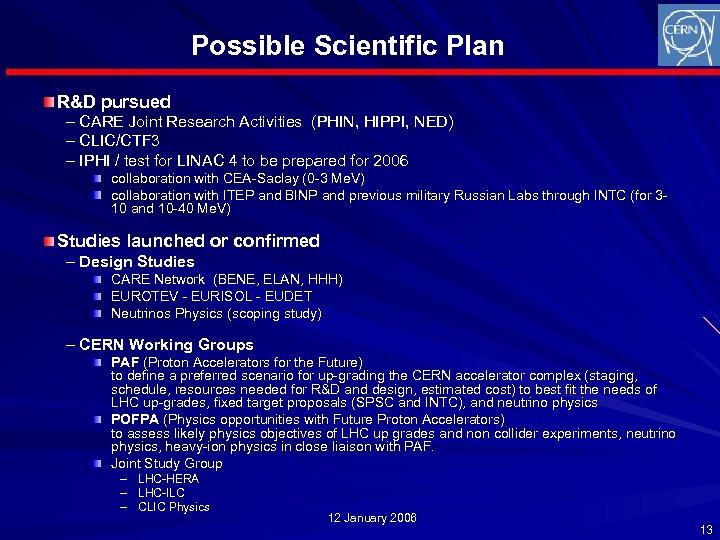 Possible Scientific Plan R&D pursued – CARE Joint Research Activities (PHIN, HIPPI, NED) – CLIC/CTF 3 – IPHI / test for LINAC 4 to be prepared for 2006 collaboration with CEA-Saclay (0 -3 Me. V) collaboration with ITEP and BINP and previous military Russian Labs through INTC (for 310 and 10 -40 Me. V) Studies launched or confirmed – Design Studies CARE Network (BENE, ELAN, HHH) EUROTEV - EURISOL - EUDET Neutrinos Physics (scoping study) – CERN Working Groups PAF (Proton Accelerators for the Future) to define a preferred scenario for up-grading the CERN accelerator complex (staging, schedule, resources needed for R&D and design, estimated cost) to best fit the needs of LHC up-grades, fixed target proposals (SPSC and INTC), and neutrino physics POFPA (Physics opportunities with Future Proton Accelerators) to assess likely physics objectives of LHC up grades and non collider experiments, neutrino physics, heavy-ion physics in close liaison with PAF. Joint Study Group – LHC-HERA – LHC-ILC – CLIC Physics 12 January 2006 13
 CERN Council European Strategy Group for Particle Physics 1 b) New plans for the future scientific programme In June 2005, the CERN Council unanimously decided to take up the task of defining the strategy for European particle physics. In order to achieve that goal, the Council further unanimously decided to set up an ad hoc scientific advisory group with the remit of making a proposal that will enable the Council to produce a strategy document, approved by all Member States. The Group will hold a workshop for one week in Berlin to finalise the strategy document; preparatory work will be led by SPC/ECFA members. 12 January 2006 14
 CERN Council European Strategy Group for Particle Physics To that end, it was agreed that the Strategy Group should comprise: – one scientist proposed by each Delegation; – the Chairman of the SPC and the Chairman ECFA, to act as cochairs of the Strategy Group; – some SPC and ECFA members, who would also act as the steering group; – the CERN Director-General and Chief Scientific Officer, and the Directors of Europe's other main particle physics laboratories, namely DESY, RAL, Orsay, DAPNIA, PSI, Frascati and Gran Sasso. Special meeting of the Council in Lisbon 14 July 2006 to draw conclusions on the European strategy. 12 January 2006 15
 Overview of CERN Activities in 2005 Strategy for CERN future Contents 1. BRAVO and THANKS to each member of CERN staff , collaborative institutions and industrial firms • • • you can be proud of the progress achieved during 2005 Results are visible and help to (re) build confidence for the future Statements about progress in LHC construction 2. Follow up of strategy proposed in 2005: possible scientific plans • CERN Council Strategy Group for European Particle Physics 3. LHC construction overview 4. Linear Colliders ILC/CLIC 5. Human Resources • 5 Yearly Review of CERN employment conditions • Human Resources policy (plan prepared for MTP 2006) • Pension Fund - Strategy of Management – Governance 6. CERN missions besides Research / discoveries • Education / training • Technology transfer • WSIS (World summit of information society) • Open Access 7. Conclusion 16
 Safety is an indispensable frame for working conditions, without compromise Two serious accidents happened last year (25/10 and 16/11 2005), one with fatal consequence Our thoughts are with the victim's family Internal procedures to investigate the cases did not show any failure to observe safety rules and procedures Nevertheless, these events have raised the awareness of risks and the necessity of safety rules, safety training, safety organisation to be a permanent concern. Safety is the duty of everybody An effort has started to review our overall safety rules to see if we can make them shorter and clearer Another large effort, as a crash programme, concerns the preparation of the "Dossier de Sûreté" for the INB (LHC/SPS/CNGS) to be available in Feb 2006 for a review by the Safety Authorities and to get their approval for the start of LHC operation. 17
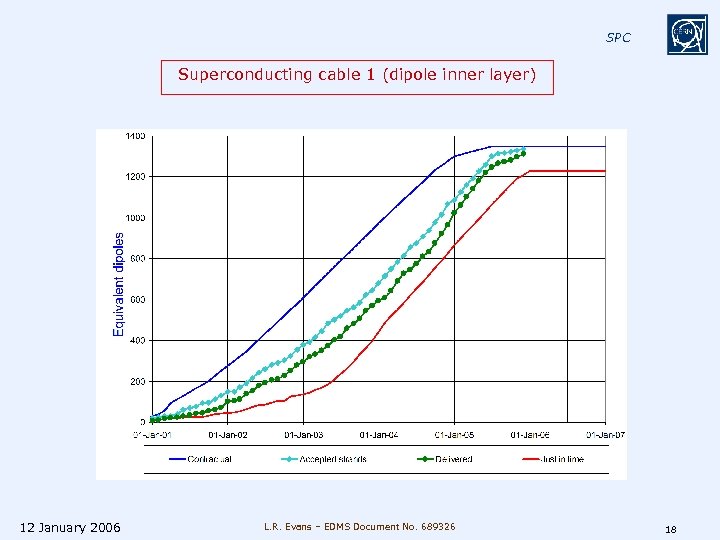 SPC Superconducting cable 1 (dipole inner layer) 12 January 2006 L. R. Evans – EDMS Document No. 689326 18
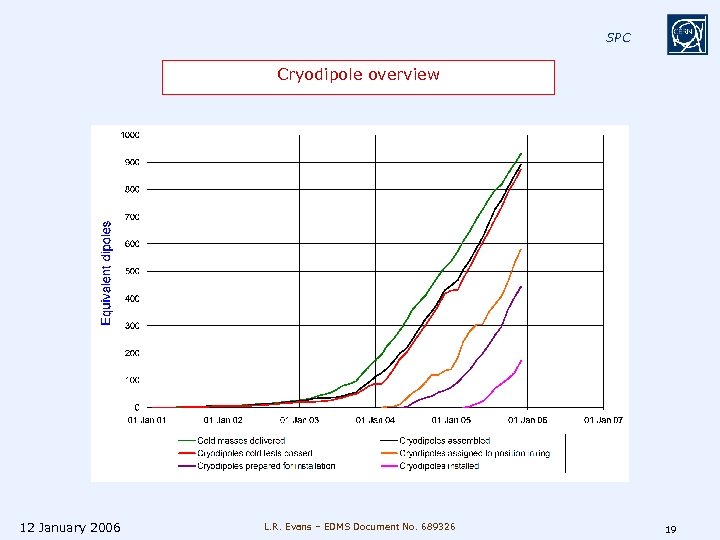 SPC Cryodipole overview 12 January 2006 L. R. Evans – EDMS Document No. 689326 19
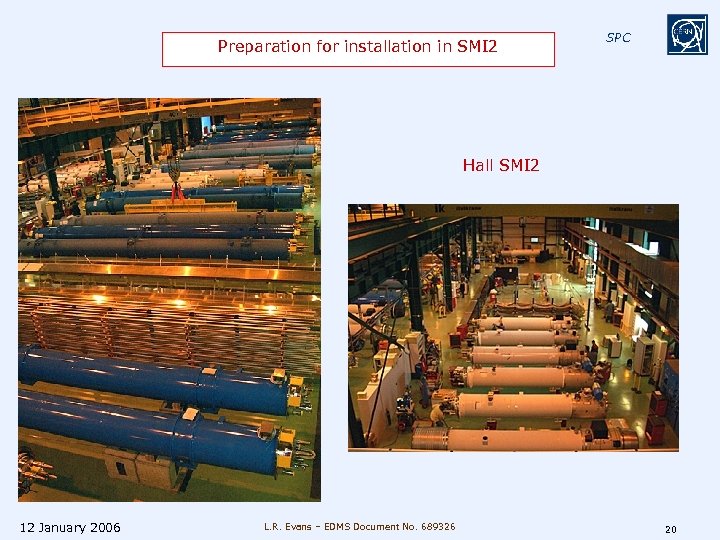 Preparation for installation in SMI 2 SPC Hall SMI 2 12 January 2006 L. R. Evans – EDMS Document No. 689326 20
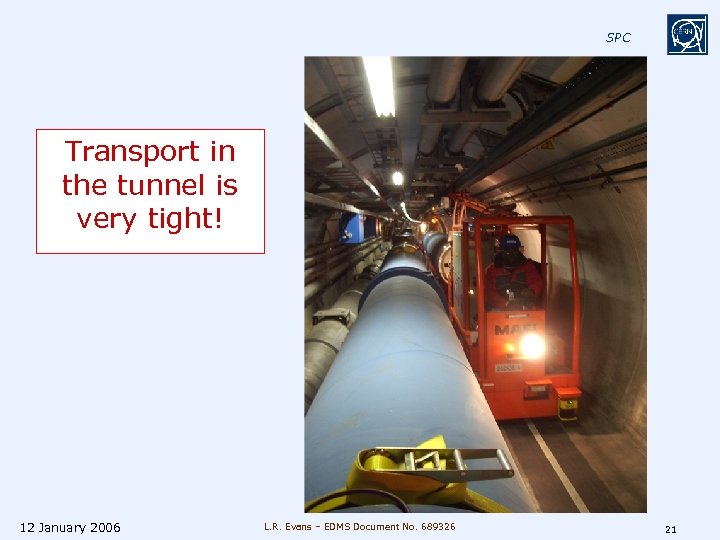 SPC Transport in the tunnel is very tight! 12 January 2006 L. R. Evans – EDMS Document No. 689326 21
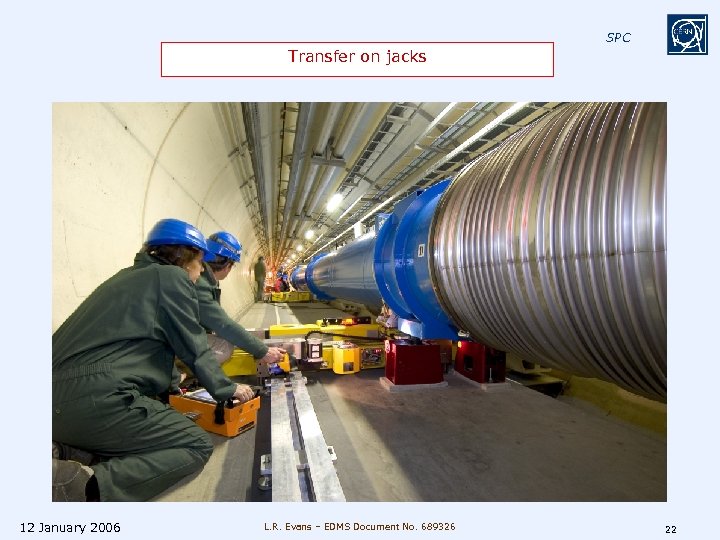 SPC Transfer on jacks 12 January 2006 L. R. Evans – EDMS Document No. 689326 22
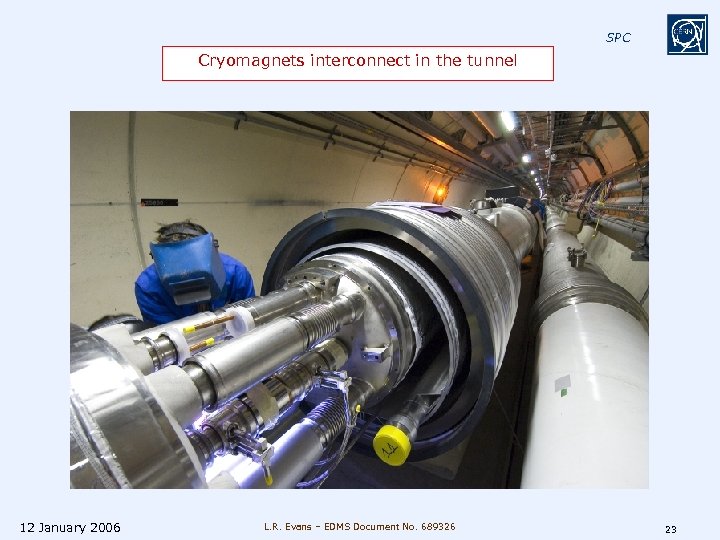 SPC Cryomagnets interconnect in the tunnel 12 January 2006 L. R. Evans – EDMS Document No. 689326 23
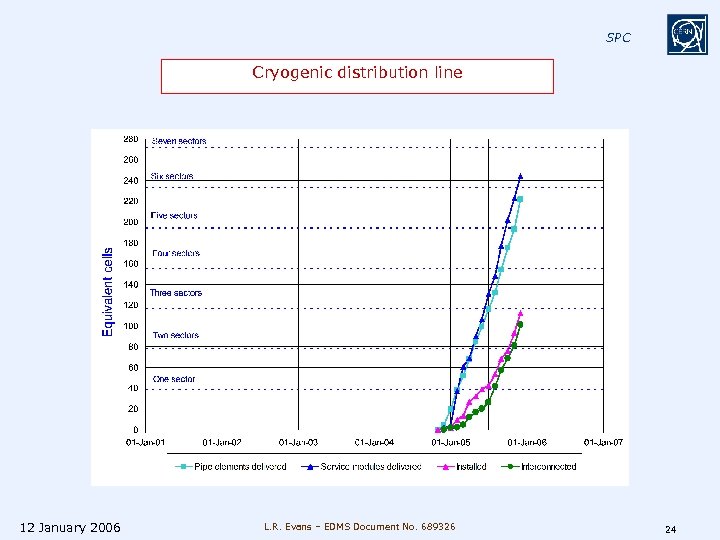 SPC Cryogenic distribution line 12 January 2006 L. R. Evans – EDMS Document No. 689326 24
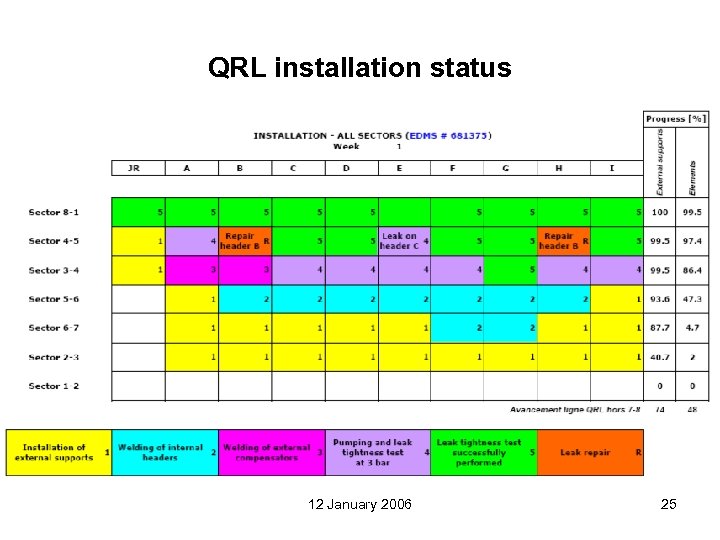 QRL installation status 12 January 2006 25
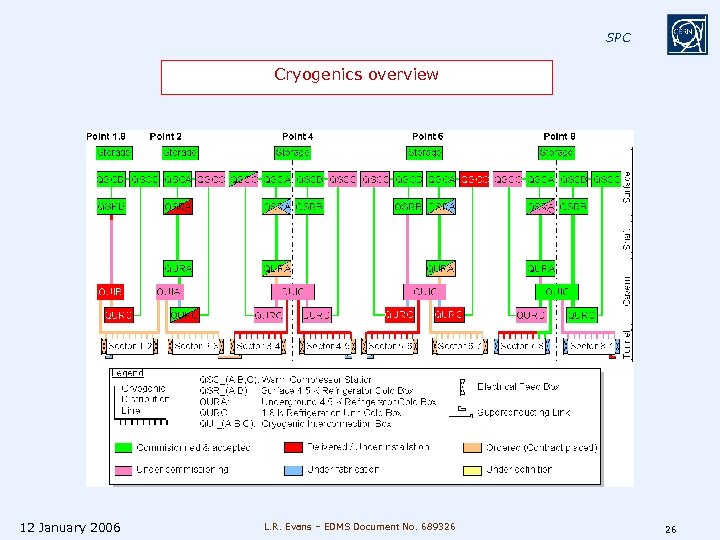 SPC Cryogenics overview 12 January 2006 L. R. Evans – EDMS Document No. 689326 26
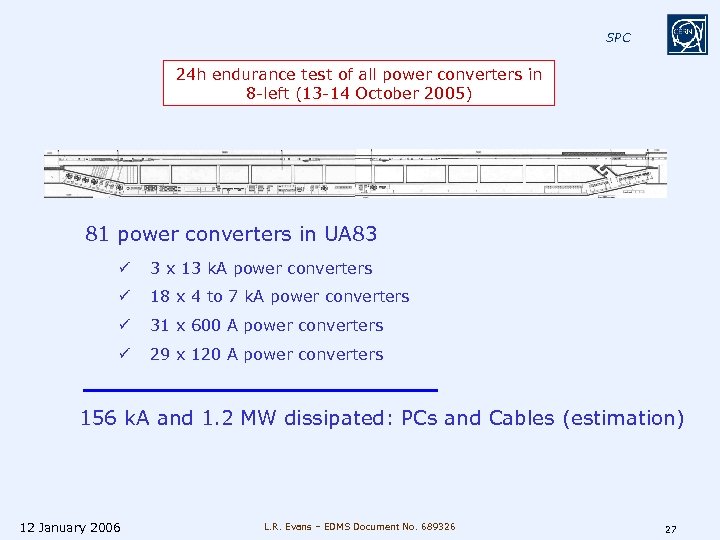 SPC 24 h endurance test of all power converters in 8 -left (13 -14 October 2005) 81 power converters in UA 83 3 x 13 k. A power converters 18 x 4 to 7 k. A power converters 31 x 600 A power converters 29 x 120 A power converters 156 k. A and 1. 2 MW dissipated: PCs and Cables (estimation) 12 January 2006 L. R. Evans – EDMS Document No. 689326 27
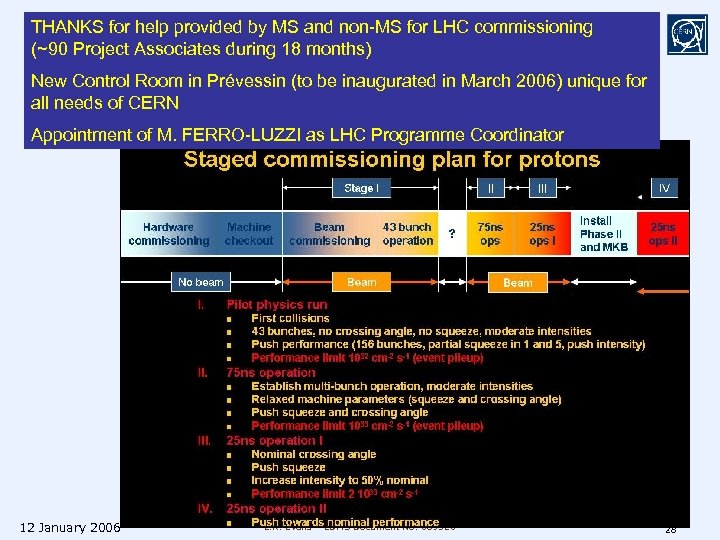 THANKS for help provided by MS and non-MS for LHC commissioning (~90 Project Associates during 18 months) SPC New Control Room in Prévessin (to be inaugurated in March 2006) unique for all needs of CERN Appointment of M. FERRO-LUZZI as LHC Programme Coordinator 12 January 2006 L. R. Evans – EDMS Document No. 689326 28
 SPC Conclusions • All key objectives have been reached for the end of 2005. • End of repair of QRL, reinstallation of sector 7 -8 and cold test of sub-sectors A and B. • Cool-down of full sector 8 -1. • Pressure test of sector 4 -5. • Endurance test of full octant of power converters. • Magnet installation rate is now close to 20/week, with more than 200 installed. This, together with interconnect work, will remain the main bottleneck until the end of installation. 12 January 2006 L. R. Evans – EDMS Document No. 689326 29
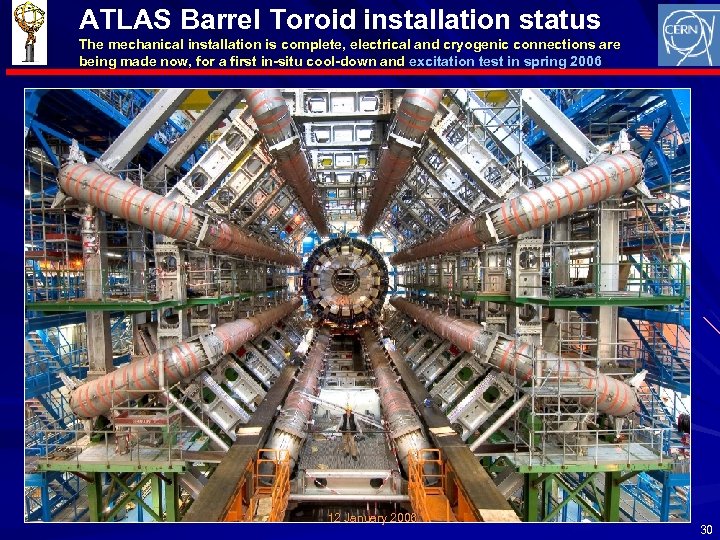 ATLAS Barrel Toroid installation status The mechanical installation is complete, electrical and cryogenic connections are being made now, for a first in-situ cool-down and excitation test in spring 2006 12 January 2006 30
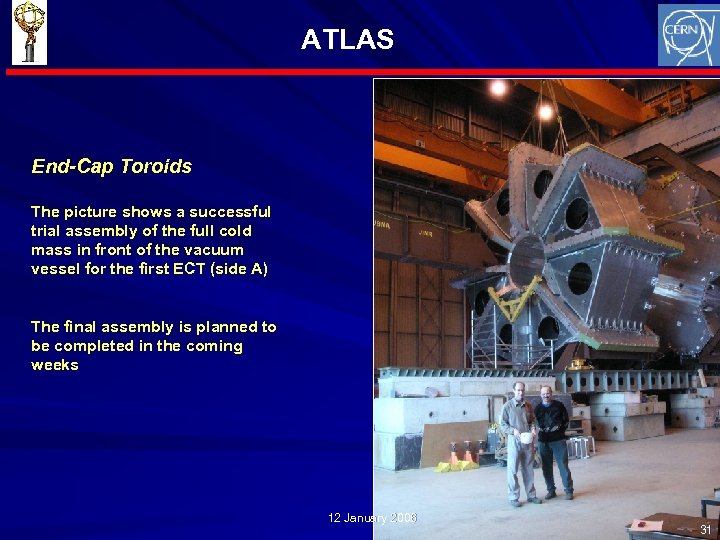 ATLAS End-Cap Toroids The picture shows a successful trial assembly of the full cold mass in front of the vacuum vessel for the first ECT (side A) The final assembly is planned to be completed in the coming weeks 12 January 2006 31
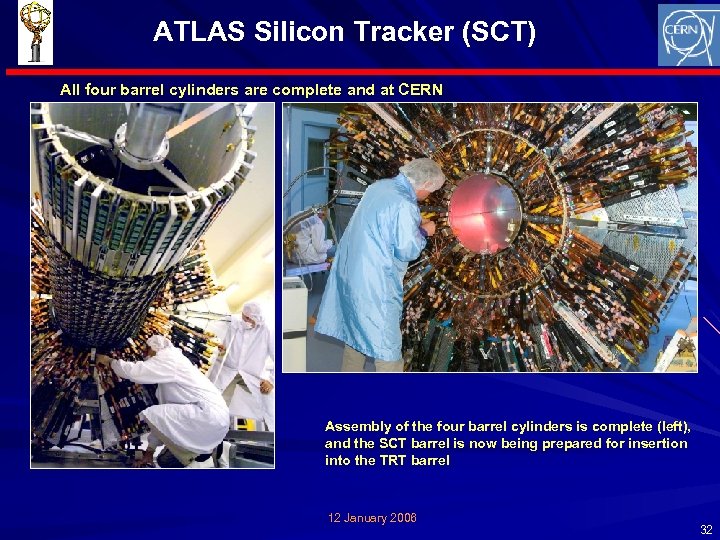 ATLAS Silicon Tracker (SCT) All four barrel cylinders are complete and at CERN Assembly of the four barrel cylinders is complete (left), and the SCT barrel is now being prepared for insertion into the TRT barrel 12 January 2006 32
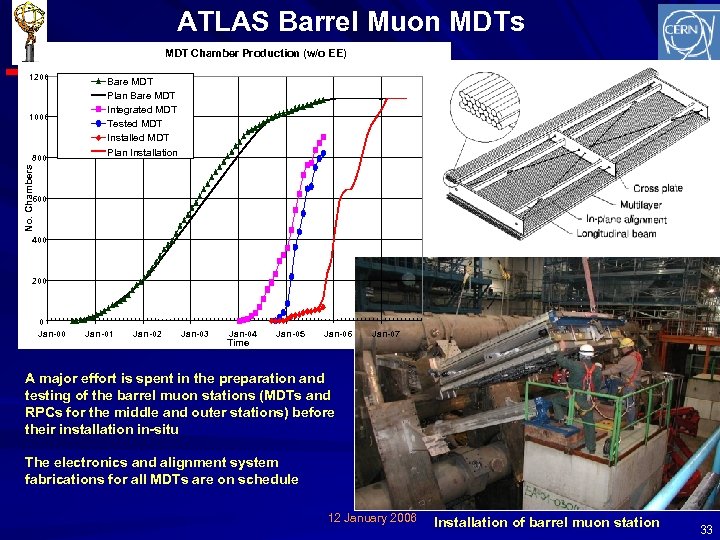 ATLAS Barrel Muon MDTs MDT Chamber Production (w/o EE) 1200 1000 No. Chambers 800 Bare MDT Plan Bare MDT Integrated MDT Tested MDT Installed MDT Plan Installation 600 400 200 0 Jan-01 Jan-02 Jan-03 Jan-04 Time Jan-05 Jan-06 Jan-07 A major effort is spent in the preparation and testing of the barrel muon stations (MDTs and RPCs for the middle and outer stations) before their installation in-situ The electronics and alignment system fabrications for all MDTs are on schedule 12 January 2006 Installation of barrel muon station 33
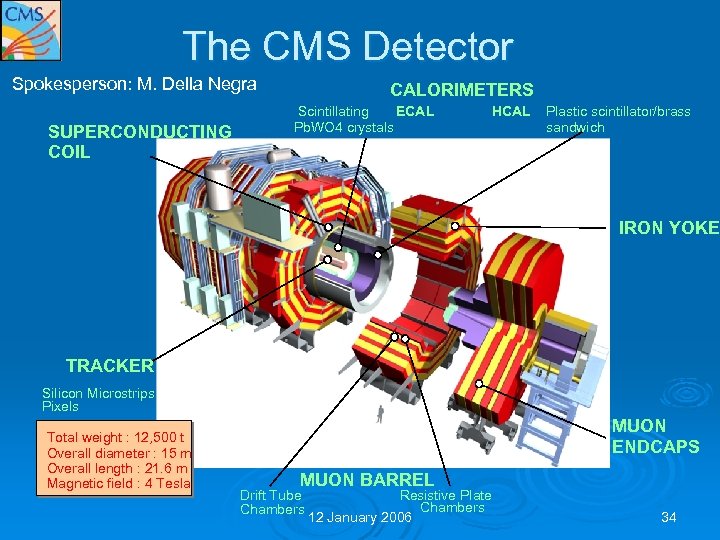 The CMS Detector Spokesperson: M. Della Negra SUPERCONDUCTING COIL CALORIMETERS Scintillating ECAL Pb. WO 4 crystals HCAL Plastic scintillator/brass sandwich IRON YOKE TRACKER Silicon Microstrips Pixels Total weight : 12, 500 t Overall diameter : 15 m Overall length : 21. 6 m Magnetic field : 4 Tesla MUON ENDCAPS MUON BARREL Drift Tube Chambers Resistive Plate Chambers 12 January 2006 34
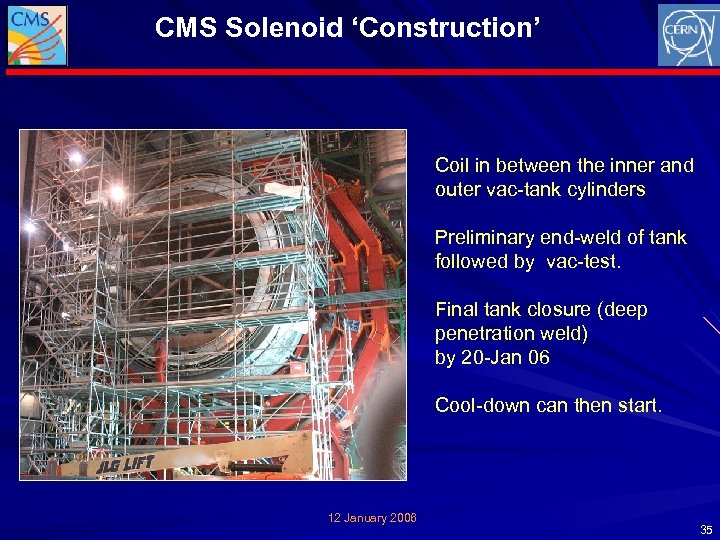 CMS Solenoid ‘Construction’ Coil in between the inner and outer vac-tank cylinders Preliminary end-weld of tank followed by vac-test. Final tank closure (deep penetration weld) by 20 -Jan 06 Cool-down can then start. 12 January 2006 35
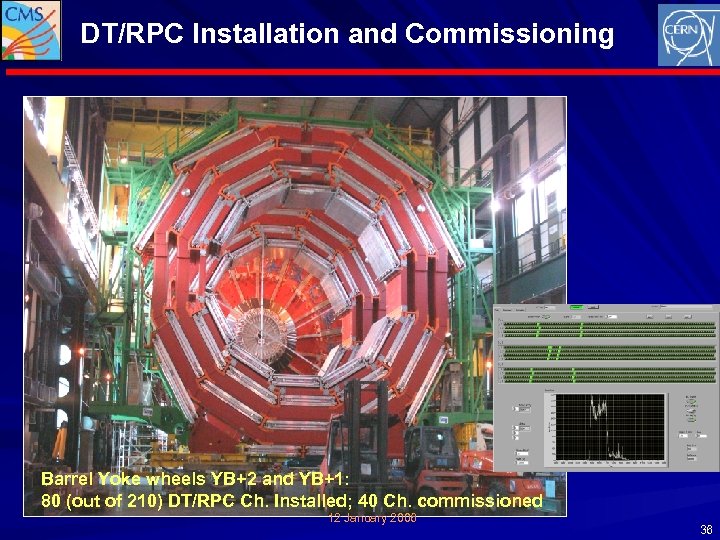 DT/RPC Installation and Commissioning Barrel Yoke wheels YB+2 and YB+1: 80 (out of 210) DT/RPC Ch. Installed; 40 Ch. commissioned 12 January 2006 36
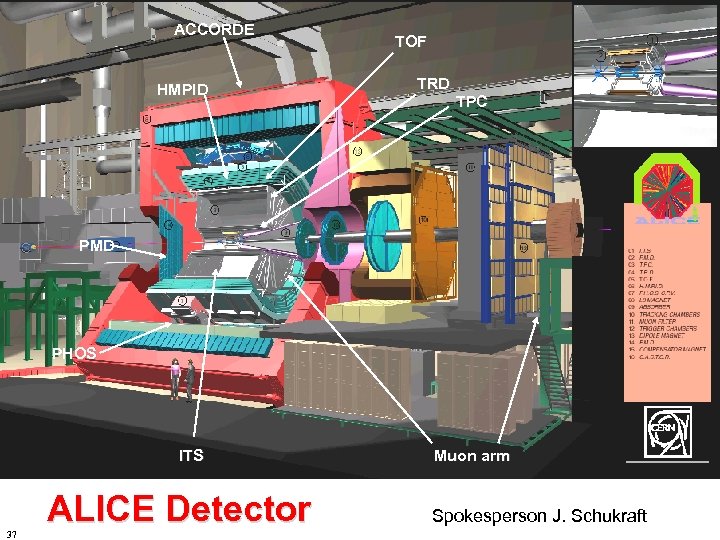 ACCORDE HMPID TOF TRD TPC PMD PHOS ITS 37 ALICE Detector Muon arm Spokesperson J. Schukraft
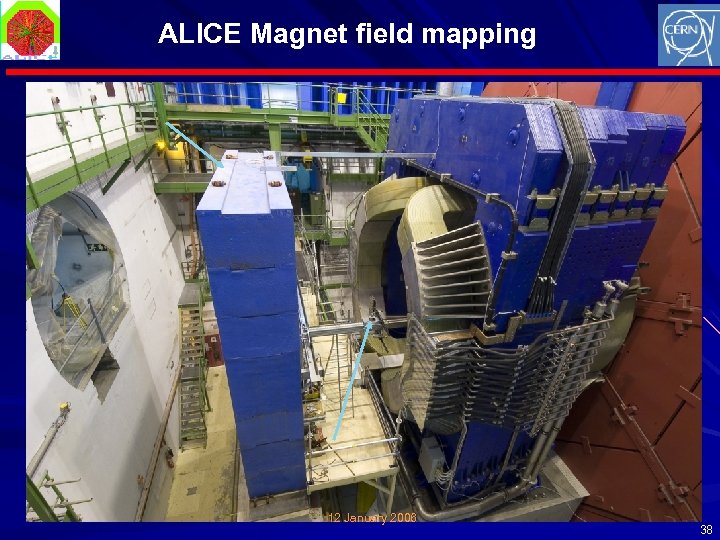 ALICE Magnet field mapping 12 January 2006 38
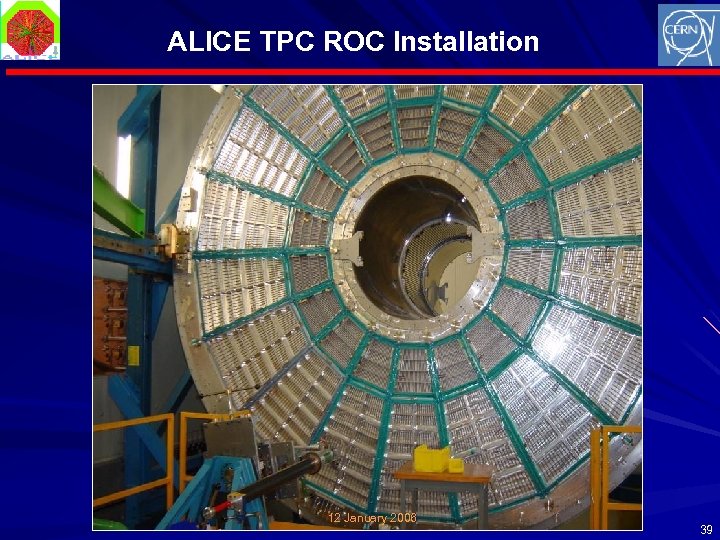 ALICE TPC ROC Installation 12 January 2006 39
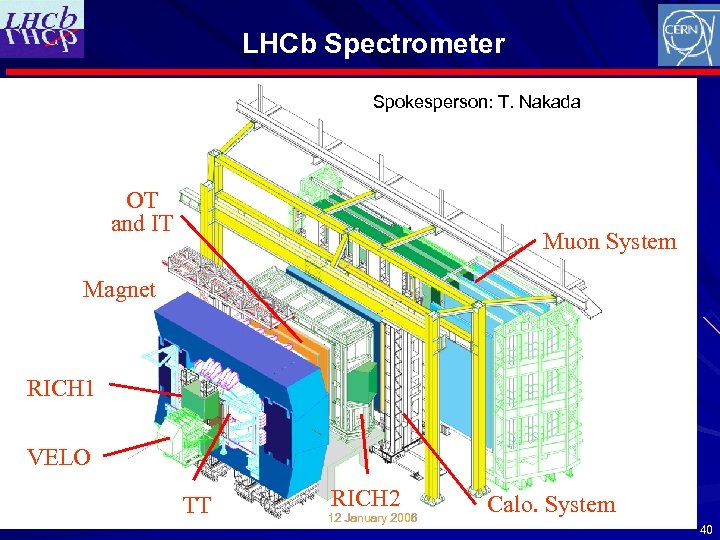 LHCb Spectrometer Spokesperson: T. Nakada OT and IT Muon System Magnet RICH 1 VELO TT RICH 2 12 January 2006 Calo. System 40
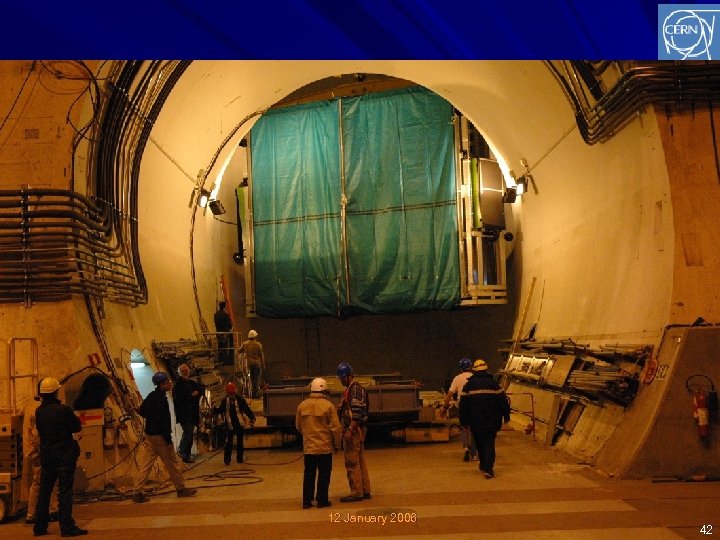
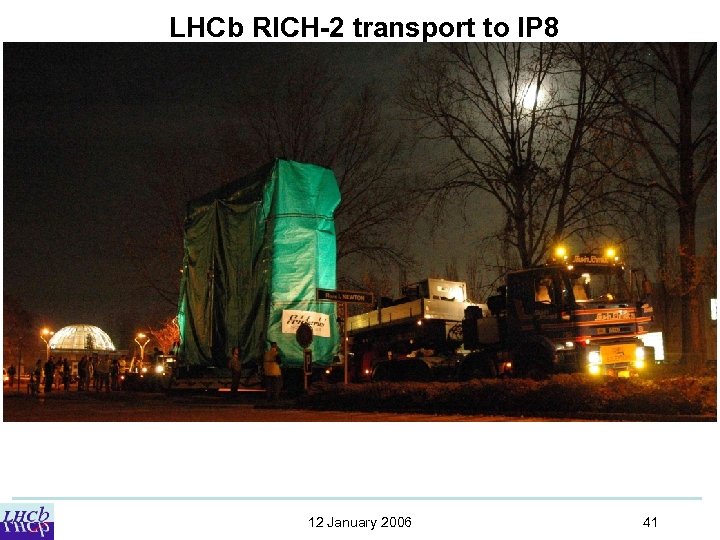 LHCb RICH-2 transport to IP 8 12 January 2006 41
 12 January 2006 42
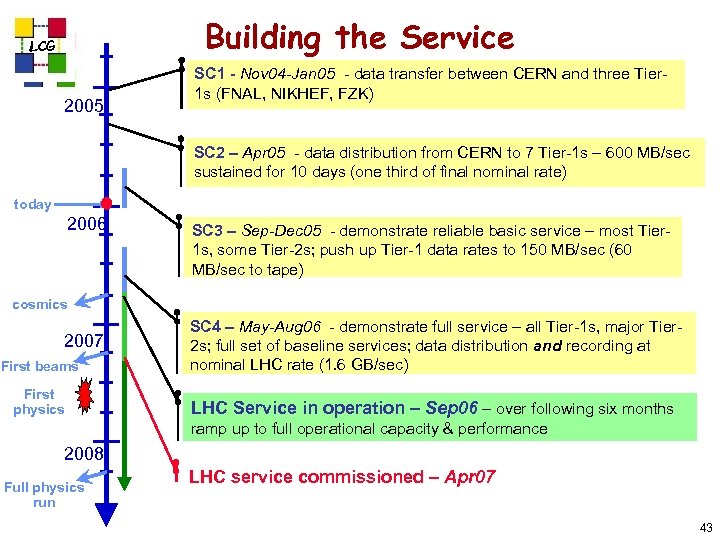 Building the Service LCG 2005 SC 1 - Nov 04 -Jan 05 - data transfer between CERN and three Tier 1 s (FNAL, NIKHEF, FZK) SC 2 – Apr 05 - data distribution from CERN to 7 Tier-1 s – 600 MB/sec sustained for 10 days (one third of final nominal rate) today 2006 SC 3 – Sep-Dec 05 - demonstrate reliable basic service – most Tier 1 s, some Tier-2 s; push up Tier-1 data rates to 150 MB/sec (60 MB/sec to tape) cosmics First beams SC 4 – May-Aug 06 - demonstrate full service – all Tier-1 s, major Tier 2 s; full set of baseline services; data distribution and recording at nominal LHC rate (1. 6 GB/sec) First physics LHC Service in operation – Sep 06 – over following six months 2007 ramp up to full operational capacity & performance 2008 Full physics run LHC service commissioned – Apr 07 43
 EGEE After EU DATA Grid, the EU Commission has recognised the interest of grids for many sciences (later industries) and the leadership of CERN facing the needs of LHC data storage and analysis computing → large EU support to CERN for the Grid development. Support to LCG from EGEE is important, conversely EGEE developed software should be used by LCG to insure prolonged support lst phase of EGEE (April 2004 -2006) is considered a large success 2 nd phase of 2006 -2008 has been approved and more EU support granted Next Step will require an organisation, called "EGO", to insure a permanent, qualified and secure infrastructure to be available to all sciences (services will be paid by users). 12 January 2006 44
 Overview of CERN Activities in 2005 Strategy for CERN future Contents 1. BRAVO and THANKS to each member of CERN staff , collaborative institutions and industrial firms • • • you can be proud of the progress achieved during 2005 Results are visible and help to (re) build confidence for the future Statements about progress in LHC construction 2. Follow up of strategy proposed in 2005: possible scientific plans • CERN Council Strategy Group for European Particle Physics 3. LHC construction overview 4. Linear Colliders ILC/CLIC 5. Human Resources • 5 Yearly Review of CERN employment conditions • Human Resources policy (plan prepared for MTP 2006) • Pension Fund - Strategy of Management – Governance 6. CERN missions besides Research / discoveries • Education / training • Technology transfer • WSIS (World summit of information society) • Open Access 7. Conclusion 12 January 2006 45
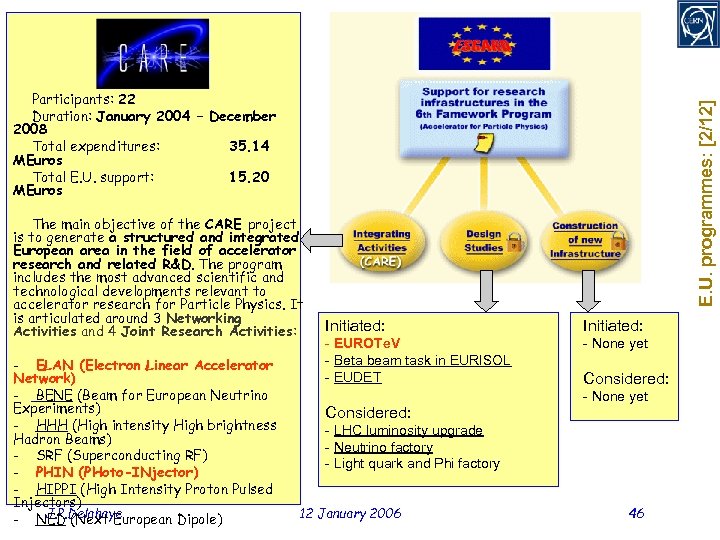 The main objective of the CARE project is to generate a structured and integrated European area in the field of accelerator research and related R&D. The program includes the most advanced scientific and technological developments relevant to accelerator research for Particle Physics. It is articulated around 3 Networking Activities and 4 Joint Research Activities: ELAN (Electron Linear Accelerator Network) - BENE (Beam for European Neutrino Experiments) - HHH (High intensity High brightness Hadron Beams) - SRF (Superconducting RF) - PHIN (PHoto-INjector) - HIPPI (High Intensity Proton Pulsed Injectors) J. P. Delahaye - NED (Next European Dipole) - E. U. programmes: [2/12] Participants: 22 Duration: January 2004 – December 2008 Total expenditures: 35. 14 MEuros Total E. U. support: 15. 20 MEuros Initiated: - EUROTe. V - Beta beam task in EURISOL - EUDET - None yet Considered: - None yet - LHC luminosity upgrade - Neutrino factory - Light quark and Phi factory 12 January 2006 46
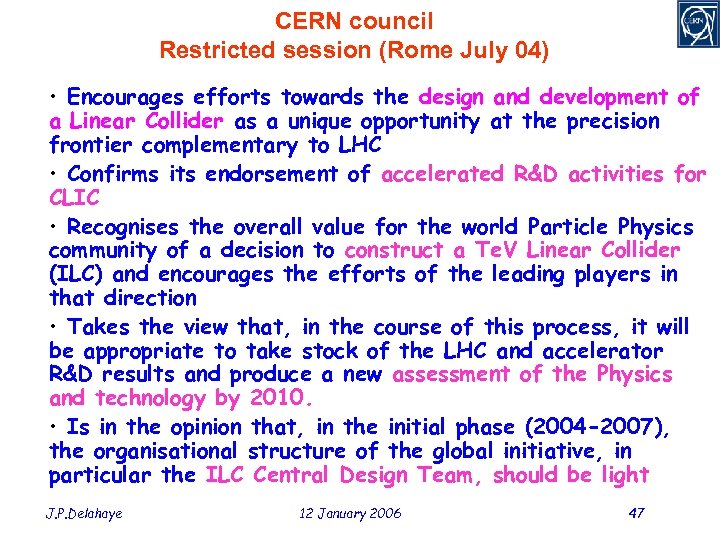 CERN council Restricted session (Rome July 04) • Encourages efforts towards the design and development of a Linear Collider as a unique opportunity at the precision frontier complementary to LHC • Confirms its endorsement of accelerated R&D activities for CLIC • Recognises the overall value for the world Particle Physics community of a decision to construct a Te. V Linear Collider (ILC) and encourages the efforts of the leading players in that direction • Takes the view that, in the course of this process, it will be appropriate to take stock of the LHC and accelerator R&D results and produce a new assessment of the Physics and technology by 2010. • Is in the opinion that, in the initial phase (2004 -2007), the organisational structure of the global initiative, in particular the ILC Central Design Team, should be light J. P. Delahaye 12 January 2006 47
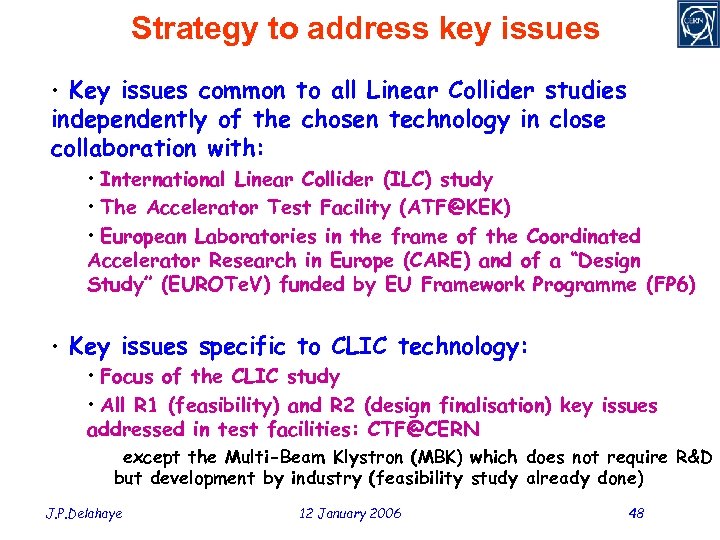 Strategy to address key issues • Key issues common to all Linear Collider studies independently of the chosen technology in close collaboration with: • International Linear Collider (ILC) study • The Accelerator Test Facility (ATF@KEK) • European Laboratories in the frame of the Coordinated Accelerator Research in Europe (CARE) and of a “Design Study” (EUROTe. V) funded by EU Framework Programme (FP 6) • Key issues specific to CLIC technology: • Focus of the CLIC study • All R 1 (feasibility) and R 2 (design finalisation) key issues addressed in test facilities: CTF@CERN except the Multi-Beam Klystron (MBK) which does not require R&D but development by industry (feasibility study already done) J. P. Delahaye 12 January 2006 48
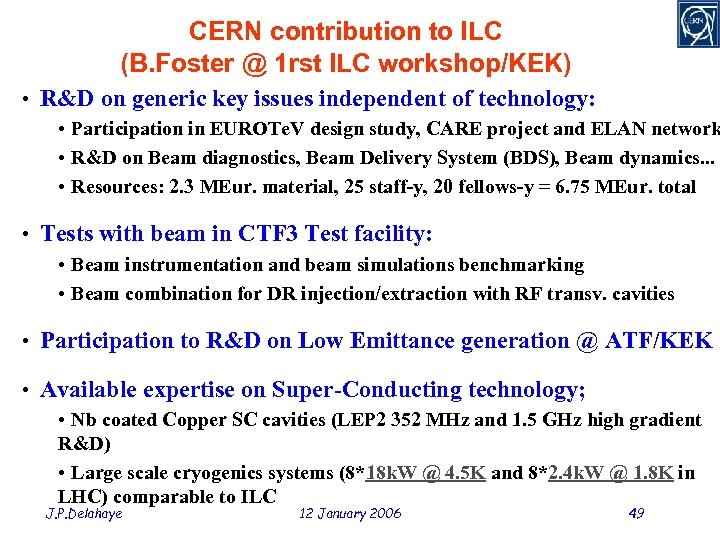 CERN contribution to ILC (B. Foster @ 1 rst ILC workshop/KEK) • R&D on generic key issues independent of technology: • Participation in EUROTe. V design study, CARE project and ELAN network • R&D on Beam diagnostics, Beam Delivery System (BDS), Beam dynamics. . . • Resources: 2. 3 MEur. material, 25 staff-y, 20 fellows-y = 6. 75 MEur. total • Tests with beam in CTF 3 Test facility: • Beam instrumentation and beam simulations benchmarking • Beam combination for DR injection/extraction with RF transv. cavities • Participation to R&D on Low Emittance generation @ ATF/KEK • Available expertise on Super-Conducting technology; • Nb coated Copper SC cavities (LEP 2 352 MHz and 1. 5 GHz high gradient R&D) • Large scale cryogenics systems (8*18 k. W @ 4. 5 K and 8*2. 4 k. W @ 1. 8 K in LHC) comparable to ILC J. P. Delahaye 12 January 2006 49
 CERN additional participation to ILC • CERN proposed as a possible European site for ILC • Participation to the site specific cost of ILC • Civil engineer: J. L. Baldy/CERN • Strong collaboration with DESY (Costing engineer) taking advantage of TESLA cost study and CERN specific technology experts (Cryogenics, civil engineering, infrastructure…. ) • Task force ILC-CLIC cost study (identical methods, identify cost drivers and differences, …. ) • Contribution to ILC workshops: • KEK: Nov 13 -15, 2004 • Snowmass: August 14 -27, 2005 • ILC- Mo. U J. P. Delahaye 12 January 2006 50
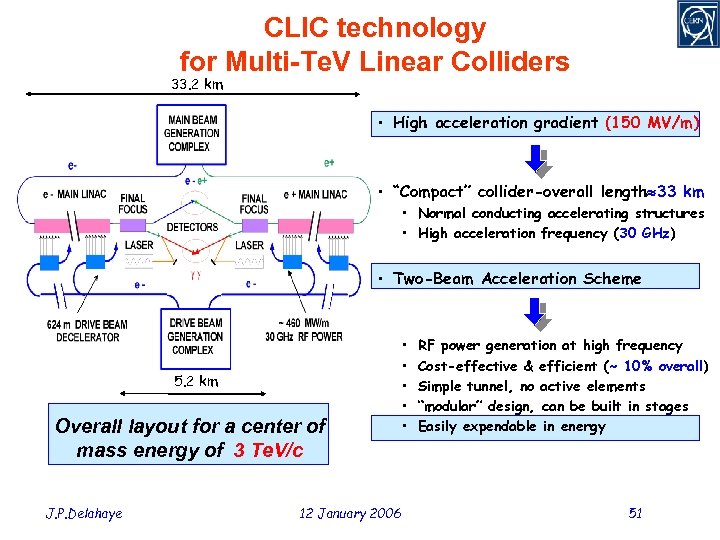 CLIC technology for Multi-Te. V Linear Colliders 33. 2 km • High acceleration gradient (150 MV/m) • “Compact” collider-overall length 33 km • Normal conducting accelerating structures • High acceleration frequency (30 GHz) • Two-Beam Acceleration Scheme 5. 2 km Overall layout for a center of mass energy of 3 Te. V/c J. P. Delahaye 12 January 2006 • • • RF power generation at high frequency Cost-effective & efficient (~ 10% overall) Simple tunnel, no active elements “modular” design, can be built in stages Easily expendable in energy 51
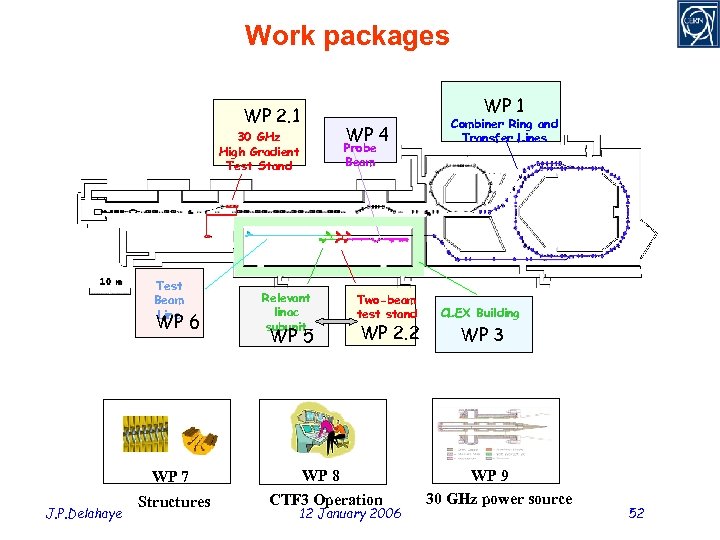 Work packages WP 2. 1 30 GHz High Gradient Test Stand Test Beam Line WP 6 WP 7 J. P. Delahaye Structures WP 1 WP 4 Probe Beam Relevant linac subunit WP 5 Two-beam test stand WP 2. 2 WP 8 CTF 3 Operation 12 January 2006 Combiner Ring and Transfer Lines CLEX Building WP 3 WP 9 30 GHz power source 52
 Mo. U of CTF 3 collaboration • Institutes presently invited to sign the Mo. U • Multi-lateral collaboration between institutions and funding agencies similar to collaboration on physics detectors • Addendum for each institute describing its contribution including resources • CTF 3 project managed by CTF 3 collaboration committee with one representative of each collaborating Institute and a vote weighted to its contribution • Chairman of committee and Collaboration spokesperson elected by members of CTF 3 collaboration committee • CERN similar to other institutes except for duties as host laboratory J. P. Delahaye 12 January 2006 53
 Conclusion • CERN participating to both ILC and CLIC • Strong collaboration with Linear Collider community • Number of synergies and complementary of the two studies • CTF 3 project to demonstrate feasibility of CLIC technology before 2010 presently on schedule • CTF 3 multi-lateral collaboration building-up • Expression of interest from a large number of Institutes • Laboratories and institutes invited to sign the collaboration Mo. U and annex describing contribution • Necessary resources being presently identified • Program of work in 2005 and 2006 well covered J. P. Delahaye 12 January 2006 54
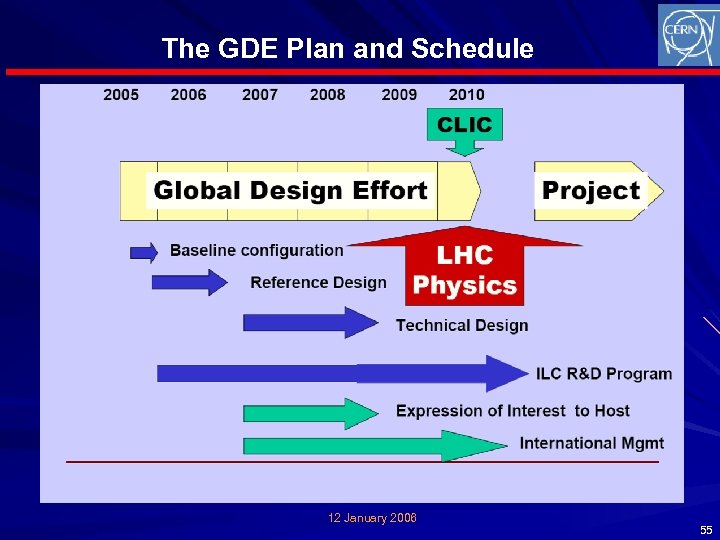 The GDE Plan and Schedule 12 January 2006 55
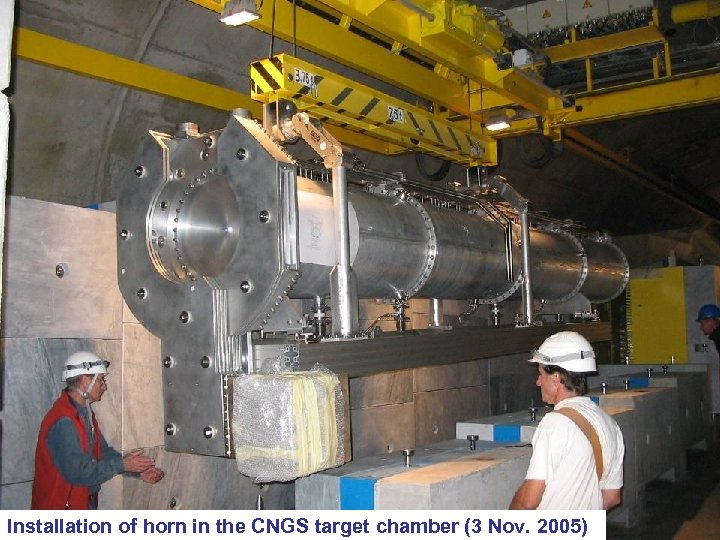 2 December 2005 CNGS status report to J. Engelen Installation of horn in the CNGS target chamber (3 Nov. 2005) 56
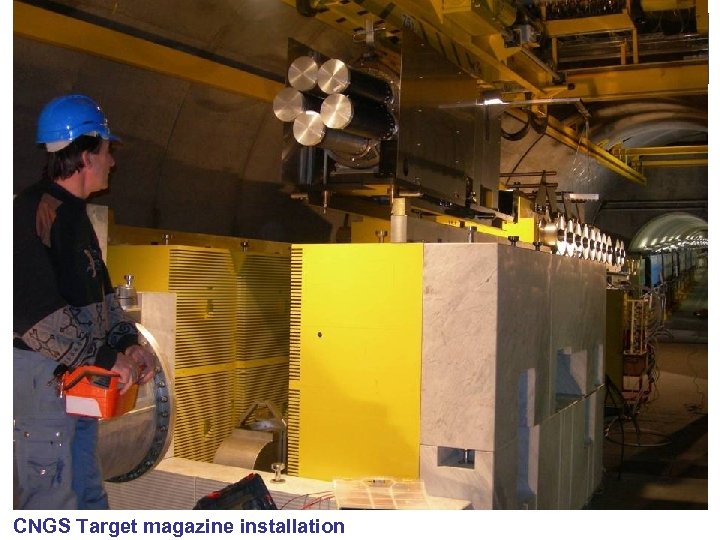 2 December 2005 CNGS status report to J. Engelen CNGS Target magazine installation 57
 Overview of CERN Activities in 2005 Strategy for CERN future Contents 1. BRAVO and THANKS to each member of CERN staff , collaborative institutions and industrial firms • • • you can be proud of the progress achieved during 2005 Results are visible and help to (re) build confidence for the future Statements about progress in LHC construction 2. Follow up of strategy proposed in 2005: possible scientific plans • CERN Council Strategy Group for European Particle Physics 3. LHC construction overview 4. Linear Colliders ILC/CLIC 5. Human Resources • 5 Yearly Review of CERN employment conditions • Human Resources policy (plan prepared for MTP 2006) • Pension Fund - Strategy of Management – Governance 6. CERN missions besides Research / discoveries • Education / training • Technology transfer • WSIS (World summit of information society) • Open Access 7. Conclusion 12 January 2006 58
 5 -Y Review of CERN employment conditions Aim : maintain competitiveness of CERN on the employment market n Provide better long-term career perspectives by increasing salary maxima in most career paths n Optimize possibilities of rewarding performance by increasing the amounts available for merit awards n Enhance family policy, in particular in order to be attractive to young recruits 12 January 2006 59
 Analysis of Data (CERN/FC/4824) Background n “For the analysis and use of the remuneration data collected, the Management proposes to determine the Organization’s main staff recruitment pool and to focus on the conditions in the Member States offering the most competitive employment terms in that area. n Determination of that main source of recruitment will be on the basis of the report drawn up on staff recruitment and retention”. 12 January 2006 60
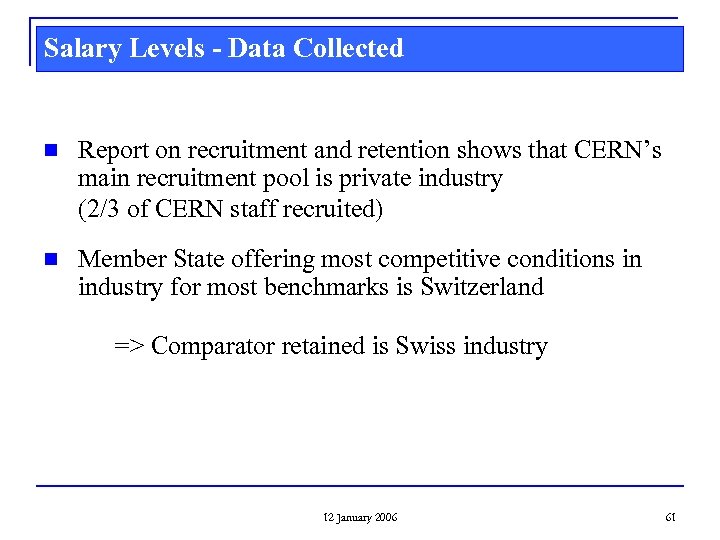 Salary Levels - Data Collected n Report on recruitment and retention shows that CERN’s main recruitment pool is private industry (2/3 of CERN staff recruited) n Member State offering most competitive conditions in industry for most benchmarks is Switzerland => Comparator retained is Swiss industry 12 January 2006 61
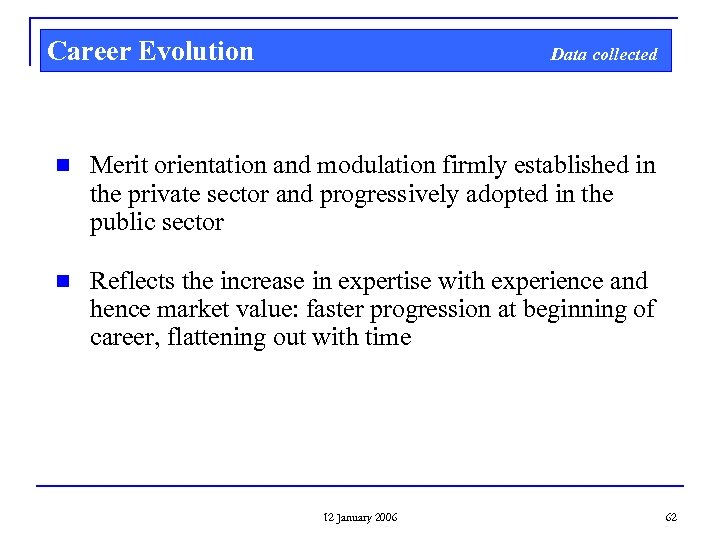 Career Evolution Data collected n Merit orientation and modulation firmly established in the private sector and progressively adopted in the public sector n Reflects the increase in expertise with experience and hence market value: faster progression at beginning of career, flattening out with time 12 January 2006 62
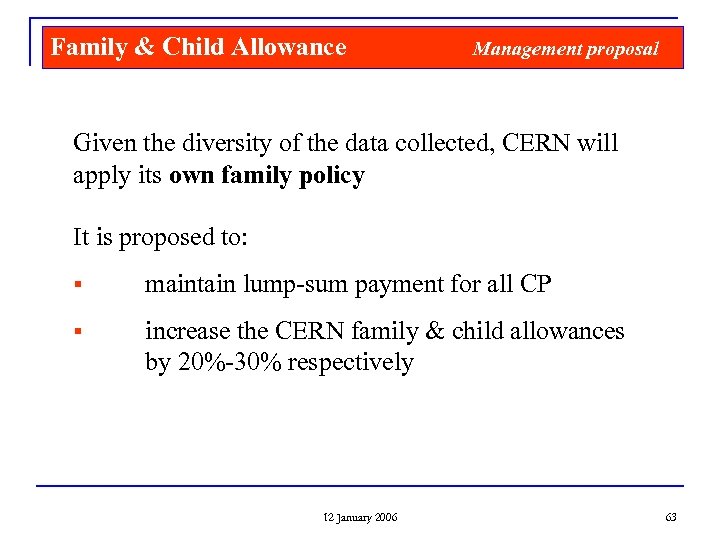 Proposal Family & Child Allowance Management proposal Given the diversity of the data collected, CERN will apply its own family policy It is proposed to: § maintain lump-sum payment for all CP § increase the CERN family & child allowances by 20%-30% respectively 12 January 2006 63
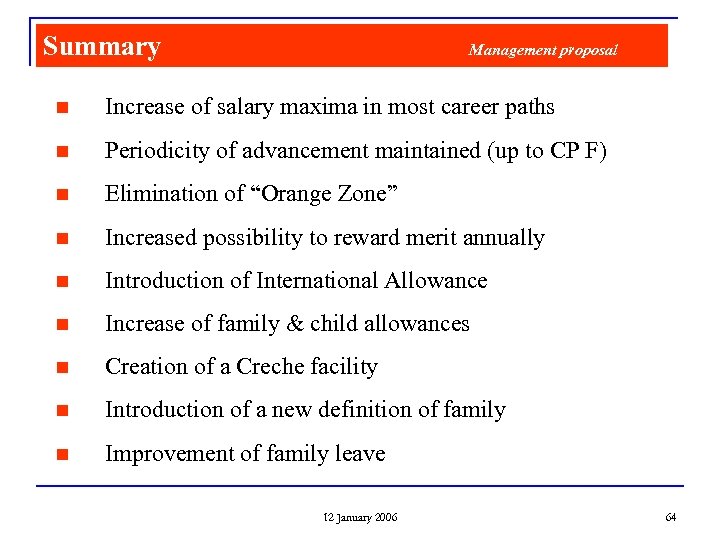 Summary Management proposal n Increase of salary maxima in most career paths n Periodicity of advancement maintained (up to CP F) n Elimination of “Orange Zone” n Increased possibility to reward merit annually n Introduction of International Allowance n Increase of family & child allowances n Creation of a Creche facility n Introduction of a new definition of family n Improvement of family leave 12 January 2006 64
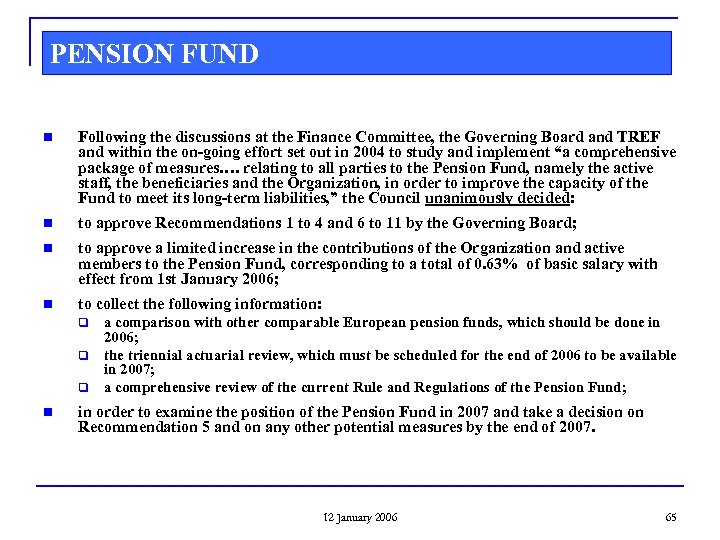 PENSION FUND n Following the discussions at the Finance Committee, the Governing Board and TREF and within the on-going effort set out in 2004 to study and implement “a comprehensive package of measures…. relating to all parties to the Pension Fund, namely the active staff, the beneficiaries and the Organization, in order to improve the capacity of the Fund to meet its long-term liabilities, ” the Council unanimously decided: n to approve Recommendations 1 to 4 and 6 to 11 by the Governing Board; n to approve a limited increase in the contributions of the Organization and active members to the Pension Fund, corresponding to a total of 0. 63% of basic salary with effect from 1 st January 2006; n to collect the following information: a comparison with other comparable European pension funds, which should be done in 2006; q the triennial actuarial review, which must be scheduled for the end of 2006 to be available in 2007; q a comprehensive review of the current Rule and Regulations of the Pension Fund; q n in order to examine the position of the Pension Fund in 2007 and take a decision on Recommendation 5 and on any other potential measures by the end of 2007. 12 January 2006 65
 Overview of CERN Activities in 2005 Strategy for CERN future Contents 1. BRAVO and THANKS to each member of CERN staff , collaborative institutions and industrial firms • • • you can be proud of the progress achieved during 2005 Results are visible and help to (re) build confidence for the future Statements about progress in LHC construction 2. Follow up of strategy proposed in 2005: possible scientific plans • CERN Council Strategy Group for European Particle Physics 3. LHC construction overview 4. Linear Colliders ILC/CLIC 5. Human Resources • 5 Yearly Review of CERN employment conditions • Human Resources policy (plan prepared for MTP 2006) • Pension Fund - Strategy of Management – Governance 6. CERN missions besides Research / discoveries • Education / training • Technology transfer • WSIS (World summit of information society) • Open Access 7. Conclusion 12 January 2006 66
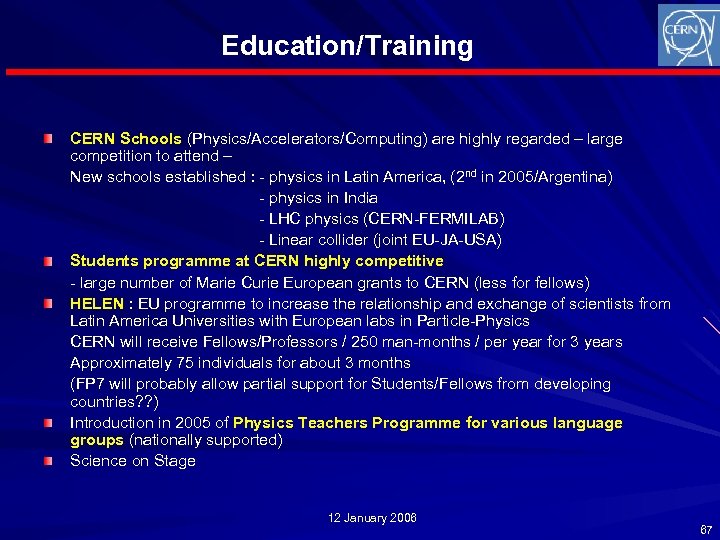 Education/Training CERN Schools (Physics/Accelerators/Computing) are highly regarded – large competition to attend – New schools established : - physics in Latin America, (2 nd in 2005/Argentina) - physics in India - LHC physics (CERN-FERMILAB) - Linear collider (joint EU-JA-USA) Students programme at CERN highly competitive - large number of Marie Curie European grants to CERN (less for fellows) HELEN : EU programme to increase the relationship and exchange of scientists from Latin America Universities with European labs in Particle-Physics CERN will receive Fellows/Professors / 250 man-months / per year for 3 years Approximately 75 individuals for about 3 months (FP 7 will probably allow partial support for Students/Fellows from developing countries? ? ) Introduction in 2005 of Physics Teachers Programme for various language groups (nationally supported) Science on Stage 12 January 2006 67
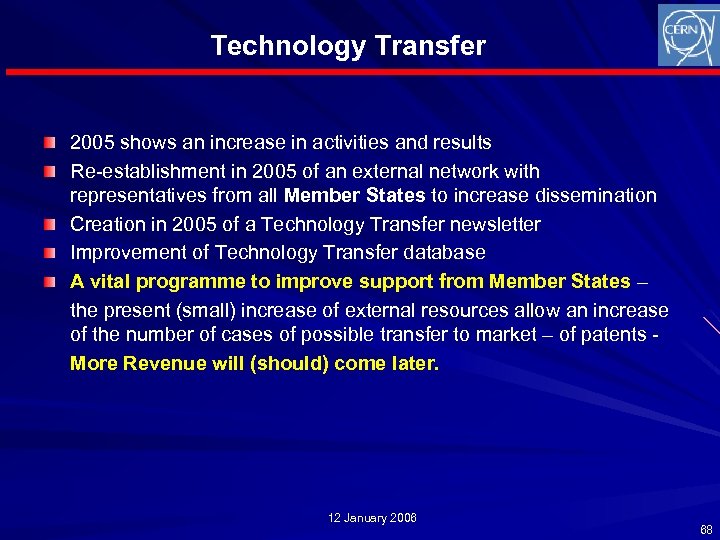 Technology Transfer 2005 shows an increase in activities and results Re-establishment in 2005 of an external network with representatives from all Member States to increase dissemination Creation in 2005 of a Technology Transfer newsletter Improvement of Technology Transfer database A vital programme to improve support from Member States – the present (small) increase of external resources allow an increase of the number of cases of possible transfer to market – of patents More Revenue will (should) come later. 12 January 2006 68
 World Summit on Information Society (WSIS) The World Summit on the Information Society, WSIS, was organised by the International Telecommunications Union under the patronage of United Nations Secretary-General Kofi Annan. The first phase took place in Geneva, Switzerland, in December 2003, and the second phase in Tunis in mid November 2005. In CERN/SPC/840, CERN/2551 the participation of CERN to the first phase of WSIS with the Summit Event named “Role of Science in the Information Society”and possible derived action items for WSIS II in Tunis were described: Ø Participation in the Working Group of Internet-governance (in particular to pay attention to the GRID governance) Ø Organisation (with ITU and UNU Sept 25 -27 2005) of a Workshop on African Research and Education Networking - Extending the reach of GEANT - Africa@home=spreading software BOINC worldwide. ex. = large computing power to investigate Malaria treatment developed by the Swiss Tropical Institute (Basel) - Open Access – e-science infrastructure 12 January 2006 69
 “Science On Stage” Festival at CERN 21 – 25 November The “Science On Stage” festival at CERN took place from 21 -25 November, and had more than 450 participants from 27 European countries, mostly secondary school teachers in physics, chemistry, and biology. Science On Stage is part of the EIROForum programme called “European Science Teacher Initiative (ESTI)”, which is co-funded by EIROForum and the EC (from 2005 -2008) in the framework of the NUCLEUS project within FP 6. The “So. S” participants had been selected by winning their respective national competitions. The So. S festival had three main components: the “science teaching fair”, workshops, and on-stage performances (including new opera “KOSMOS – Opera of the Light”). The next step, in January 2006, will be the launch of the national competitions for “Science On Stage 2”. This 2 nd festival in the ESTI programme will take place in Grenoble (2 -6 April 2007), and will be organised jointly by ESRF and ILL. 12 January 2006 70
 Open Access The future of scientific communication, in particular for particle physics Role of CERN = Convention du CERN server = preprints – “yellow reports” Signature of “Berlin Declaration” CERN Initiative for a tripartite colloquium (7 -8 Dec. 2005) ( Publishers-Funding Agencies-Laboratories) General move to “Open Access” – (move out of “readers pay” towards “authors pay”, as laboratory sponsorship) – interest for science spreading, in particular in developing world. – too large increased cost of publication – how to replace the service given by the present editors (peer review, archiving) – in particular, public accountability and “accreditation” 12 January 2006 71
 Open Access - Next steps for CERN We need a clear way forward – before the end of next year – ready for the LHC CERN should take a lead – for the LHC – for particle physics in Europe and world wide Two stages towards the new scientific communication – establish a working group (3 months) Analysis of the issues with the change Options for the future business model – Table a “position paper” to ICFA Community action 12 January 2006 72
 Conclusions 1. You can be proud of progress achieved during 2005. Big challenges remain ahead of us, which will require hard work and full dedication. 2. CERN Council and Member States (MS) officials have acknowledged our successful efforts. • This is the first step to recover their full confidence in CERN which should remain their flagship in fundamental research and the paradigm for European scientific cooperation (FP 7). In the process of defining a strategy for Particle Physics in Europe, we should encourage the MS to recognize their interest in defining themselves the future role of CERN, this is: 3. • • the logical base for their continuous support and for the benefit of the whole community a better case than always requesting more resources for our programme. Already, the progress in 2005 has led the MS to agree : 4. • • on providing the full indexation in their financial contributions on spending more resources in CERN and providing extra manpower for LHC commissioning to maintain the schedule in 2007 73
 Conclusions Nevertheless, the financial situation of CERN is “incredibly critical” 5. • • • by the end of 2006, all debts on CERN budget are 1. 5 x annual budget. . . a level not acceptable to any Firm or State planned large debt reimbursement between 2008 and 2011 will not allow any new development in CERN to prepare for future programme after 2010. . . . a situation not reasonable in anybody’s eyes full recovery of MS confidence should allow a plea for extra resources … Research Ministers will be personally contacted In matter of scientific strategy, we will have clear views in summer 2006 on our preferred options to prepare for the future 6. • • it will be nice if the Community and the MS just instruct us to work precisely in these directions and the Council provides the needed resources irreversible decisions on new large investments for a future programme should wait for convincing results from LHC operation 74
 Conclusions 7. LHC construction and consolidation remain the undisputable priority technical issues have been resolved logistics will continue to provide everyday challenges preparation of commissioning is ongoing (always a little concern about the reliability of our old equipment!) • No show stopper in principle to prevent the schedule of first beam collisions in summer 2007 • We should make all efforts to maintain this schedule. • After implementation of all planned improvements, we will review the planning and schedule for the summer 2006 • • 8. In 2006, conclusion of the 5 -Yearly Review and the new Human Resources Plan will prepare CERN to be ready for a successful future : LHC operation and a new programme plan In 2006, the Pension Fund issues should be cleared 1. Comparisons with similar Pension Funds should provide examples for solutions of similar structural difficulties 2. New accepted rules should confirm the employer's duty to support social contributions simultaneously with salaries (no more debt) – and give everyone confidence in a realistic future for his/her pension 9. Activities in CERN which complement research are highly valued and praised by MS. We should “sell” them efficiently…more benefits expected … from only a small fraction of our resources. 10. Bon courage! 75