


 Скачать презентацию Overview of Arctic Science Planning ACIA
86912f64ad222d8560f733cf8e2f031e.ppt
- Количество слайдов: 23
 Overview of Arctic Science Planning • • ACIA (Arctic Climate Impact Assessment) International Polar Year Arctic Observing Network SEARCH • Others: ICARP, Cli. C, NEESPI, OASIS, NEON, …
 Arctic Climate Impact Assessment: Identified research needs • • • Coastal vulnerability Extreme events Access -- marine, terrestrial Marine ecosystems Local impacts of changing climate
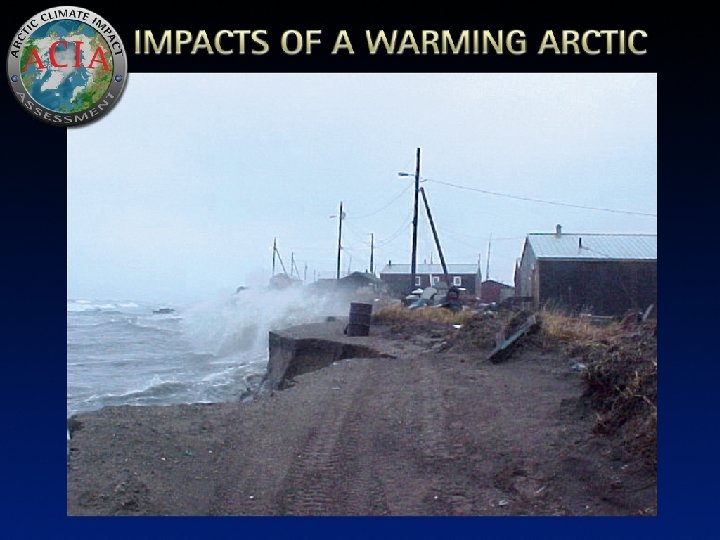
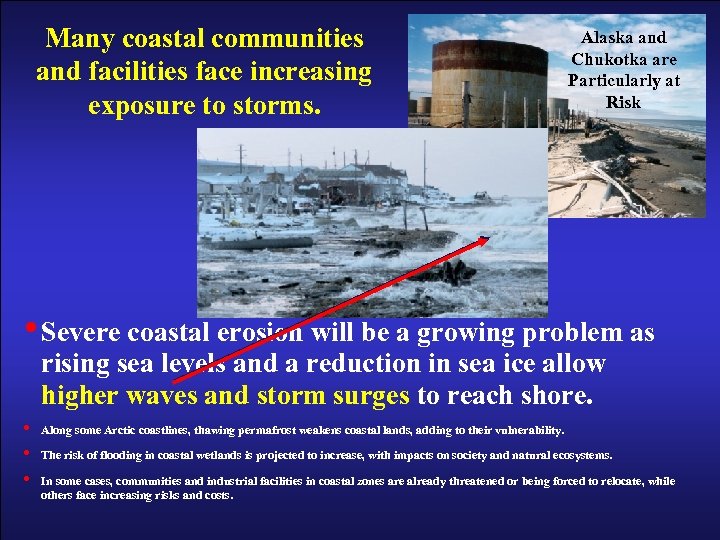 Many coastal communities and facilities face increasing exposure to storms. Alaska and Chukotka are Particularly at Risk • Severe coastal erosion will be a growing problem as rising sea levels and a reduction in sea ice allow higher waves and storm surges to reach shore. • • • Along some Arctic coastlines, thawing permafrost weakens coastal lands, adding to their vulnerability. The risk of flooding in coastal wetlands is projected to increase, with impacts on society and natural ecosystems. In some cases, communities and industrial facilities in coastal zones are already threatened or being forced to relocate, while others face increasing risks and costs.
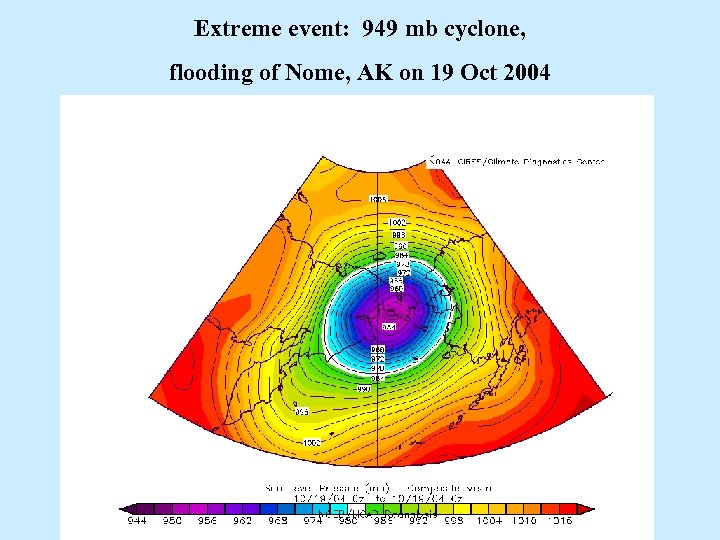 Extreme event: 949 mb cyclone, flooding of Nome, AK on 19 Oct 2004
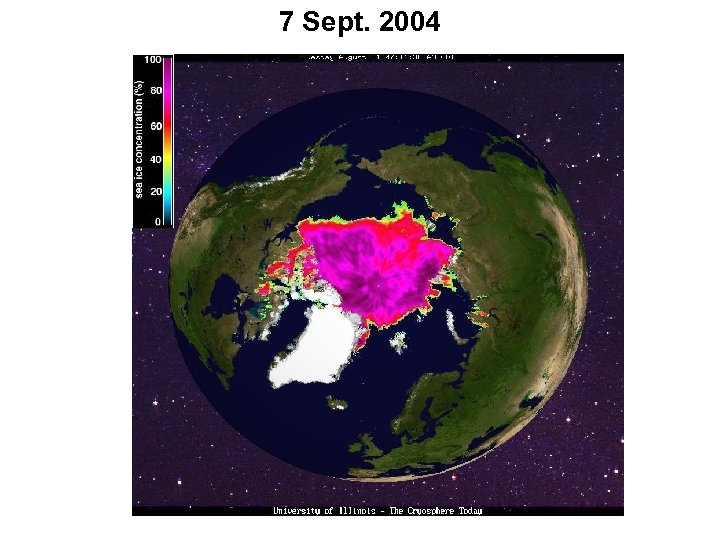 7 Sept. 2004
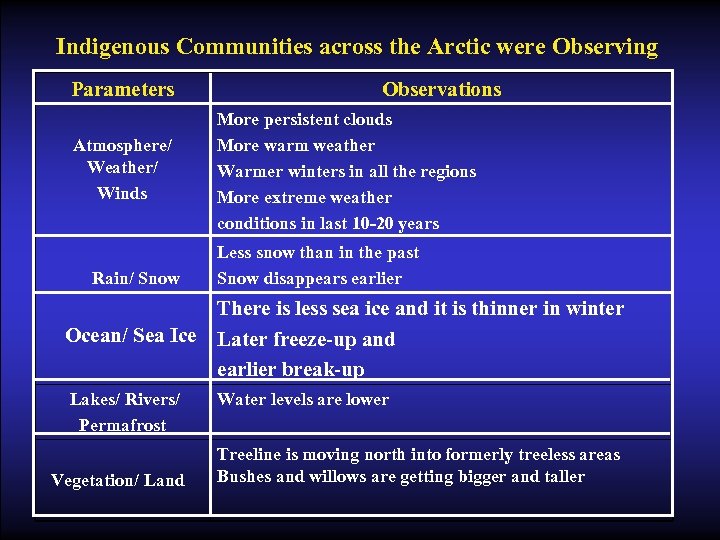 Indigenous Communities across the Arctic were Observing Parameters Atmosphere/ Weather/ Winds Rain/ Snow Observations More persistent clouds More warm weather Warmer winters in all the regions More extreme weather conditions in last 10 -20 years Less snow than in the past Snow disappears earlier There is less sea ice and it is thinner in winter Ocean/ Sea Ice Later freeze-up and earlier break-up Lakes/ Rivers/ Permafrost Vegetation/ Land Water levels are lower Treeline is moving north into formerly treeless areas Bushes and willows are getting bigger and taller
 Arctic Climate Impact Assessment: Identified research needs • • • Coastal vulnerability Extreme events Access – marine, terrestrial Marine ecosystems Local impacts of changing climate
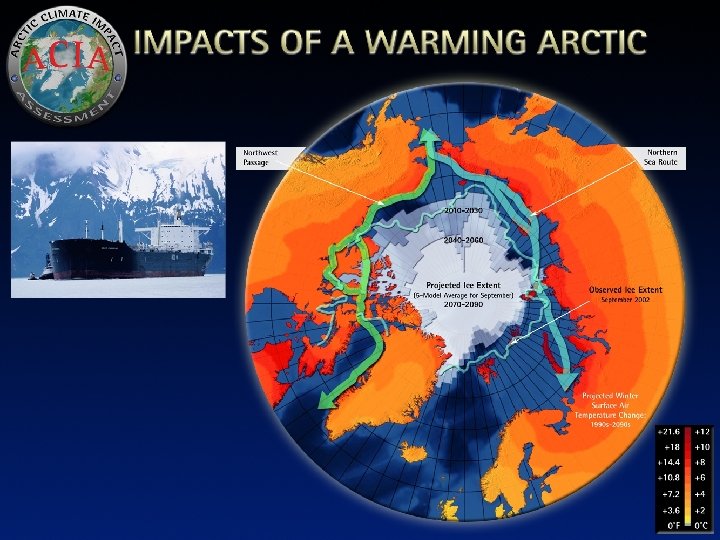
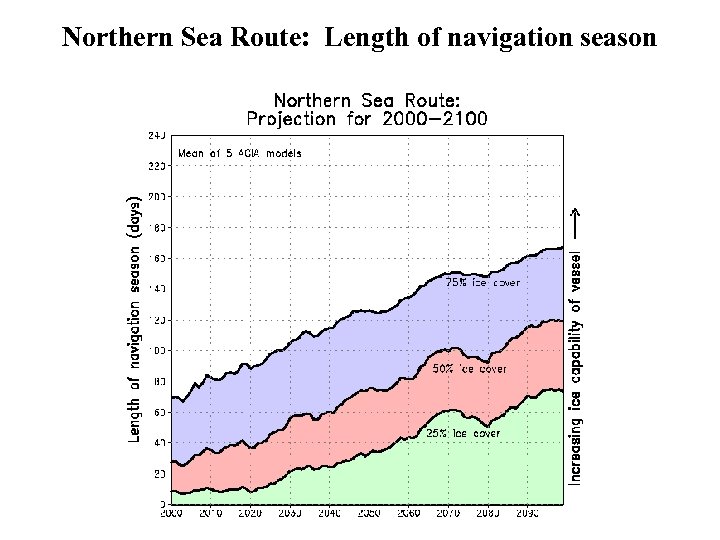 Northern Sea Route: Length of navigation season
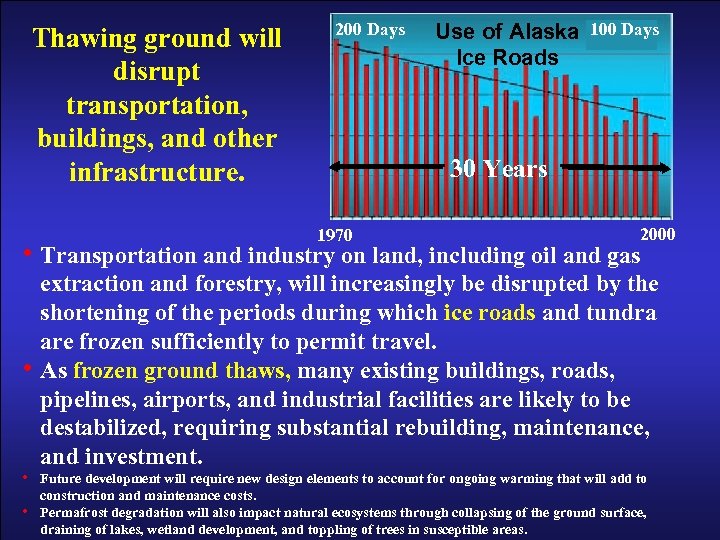 Thawing ground will disrupt transportation, buildings, and other infrastructure. 200 Days Use of Alaska 100 Days Ice Roads 30 Years 1970 2000 • Transportation and industry on land, including oil and gas • • • extraction and forestry, will increasingly be disrupted by the shortening of the periods during which ice roads and tundra are frozen sufficiently to permit travel. As frozen ground thaws, many existing buildings, roads, pipelines, airports, and industrial facilities are likely to be destabilized, requiring substantial rebuilding, maintenance, and investment. Future development will require new design elements to account for ongoing warming that will add to construction and maintenance costs. Permafrost degradation will also impact natural ecosystems through collapsing of the ground surface, draining of lakes, wetland development, and toppling of trees in susceptible areas.
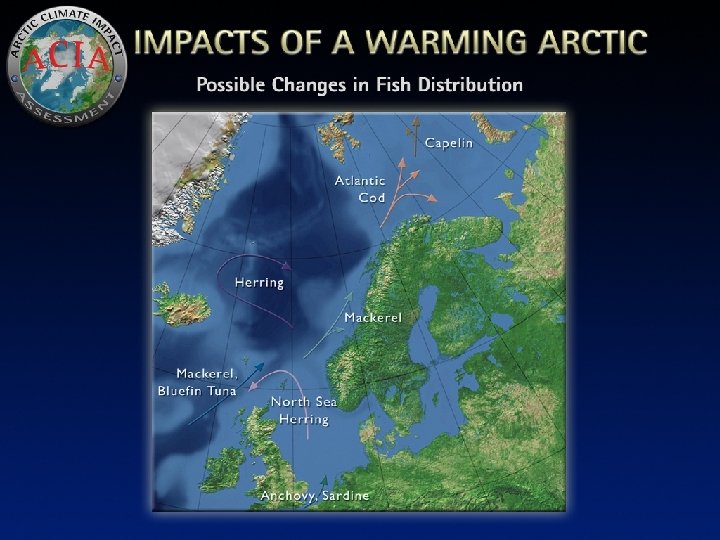
 Arctic Climate Impact Assessment: Identified research needs • • • Coastal vulnerability Extreme events Access – marine, terrestrial Marine ecosystems Local impacts of changing climate
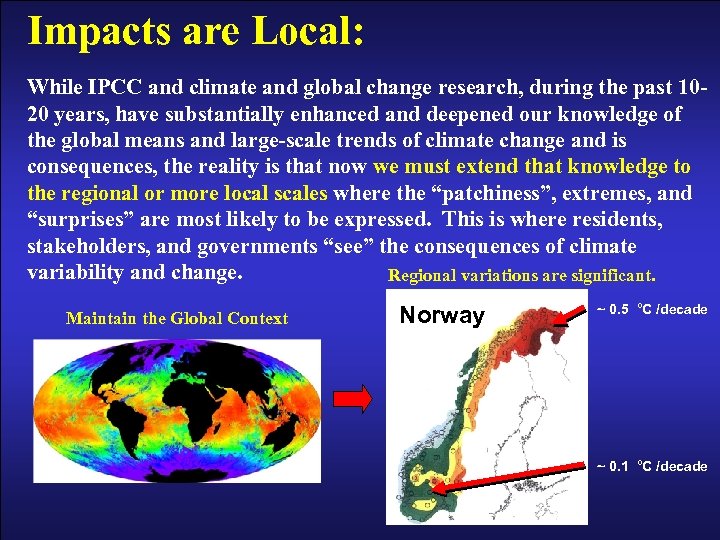 Impacts are Local: While IPCC and climate and global change research, during the past 1020 years, have substantially enhanced and deepened our knowledge of the global means and large-scale trends of climate change and is consequences, the reality is that now we must extend that knowledge to the regional or more local scales where the “patchiness”, extremes, and “surprises” are most likely to be expressed. This is where residents, stakeholders, and governments “see” the consequences of climate variability and change. Regional variations are significant. Maintain the Global Context Norway ~ 0. 5 o. C /decade ~ 0. 1 o. C /decade
 International Polar Year (2007 -09) Drivers include: • Growing need to understand change in the polar regions • Anniversary of past IPYs and IGY provides impetus • New advances in technology and logistics provide ways to address new issues and access new areas
 ICSU IPY Themes 1. Determine environmental status of polar regions by quantifying spatial and temporal variability. 2. Quantify past and present environmental and human change in the polar regions 3. Advance understanding of polar - global teleconnections on all scales and processes controlling these interactions 4. Investigate the unknowns at the frontiers of science in the polar regions. 5. Use the unique vantage point of the polar regions to develop and enhance observations on Earth and beyond (Earth's inner core, magnetic field, the Sun and beyond. 6. Investigate cultural, historical, and social processes that shape the resilience and sustainability of circumpolar human societies and identify their contributions to global cultural diversity and citizenship.
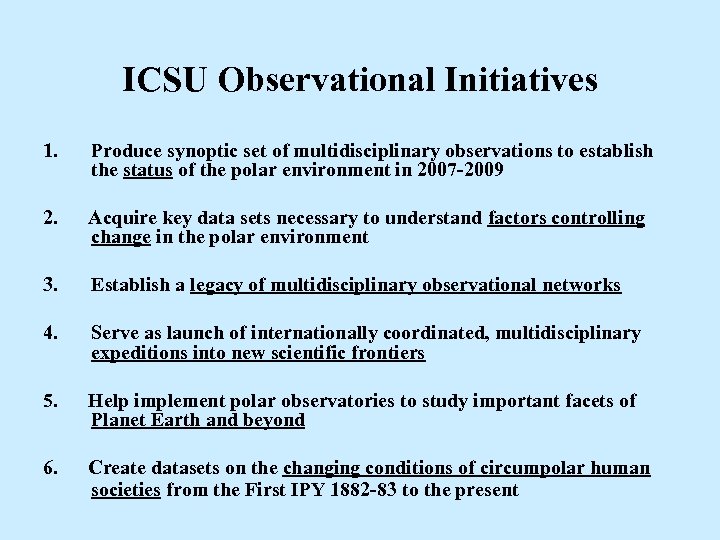 ICSU Observational Initiatives 1. Produce synoptic set of multidisciplinary observations to establish the status of the polar environment in 2007 -2009 2. Acquire key data sets necessary to understand factors controlling change in the polar environment 3. Establish a legacy of multidisciplinary observational networks 4. Serve as launch of internationally coordinated, multidisciplinary expeditions into new scientific frontiers 5. Help implement polar observatories to study important facets of Planet Earth and beyond 6. Create datasets on the changing conditions of circumpolar human societies from the First IPY 1882 -83 to the present
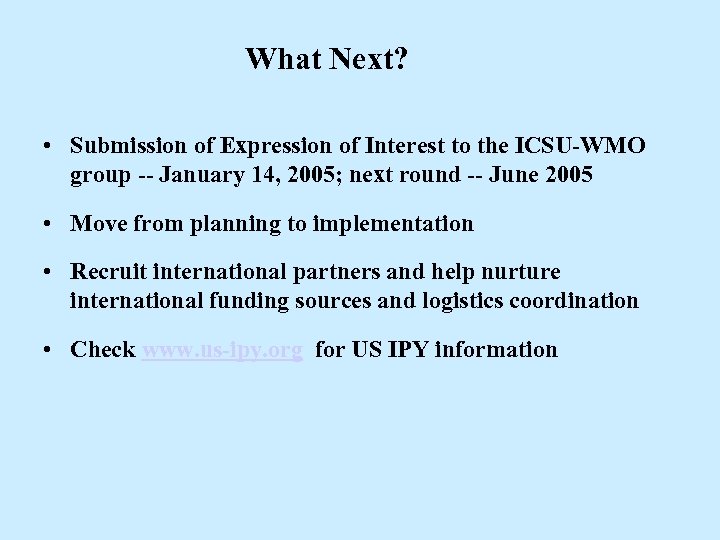 What Next? • Submission of Expression of Interest to the ICSU-WMO group -- January 14, 2005; next round -- June 2005 • Move from planning to implementation • Recruit international partners and help nurture international funding sources and logistics coordination • Check www. us-ipy. org for US IPY information
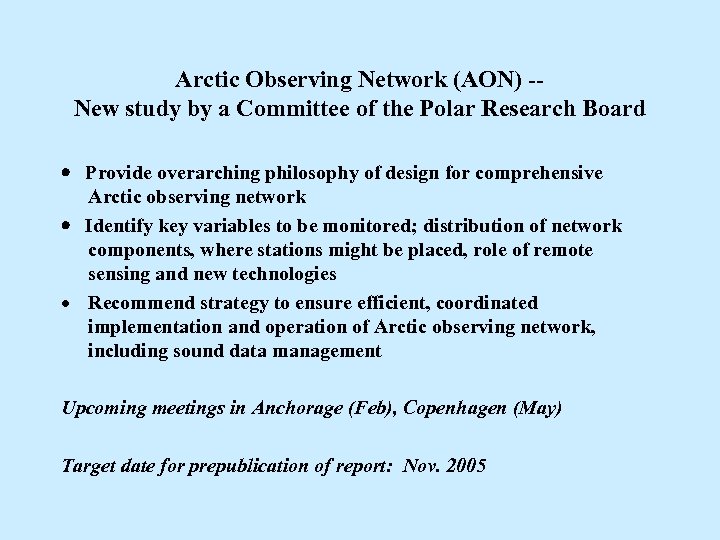 Arctic Observing Network (AON) -New study by a Committee of the Polar Research Board Provide overarching philosophy of design for comprehensive Arctic observing network Identify key variables to be monitored; distribution of network components, where stations might be placed, role of remote sensing and new technologies · Recommend strategy to ensure efficient, coordinated implementation and operation of Arctic observing network, including sound data management Upcoming meetings in Anchorage (Feb), Copenhagen (May) Target date for prepublication of report: Nov. 2005
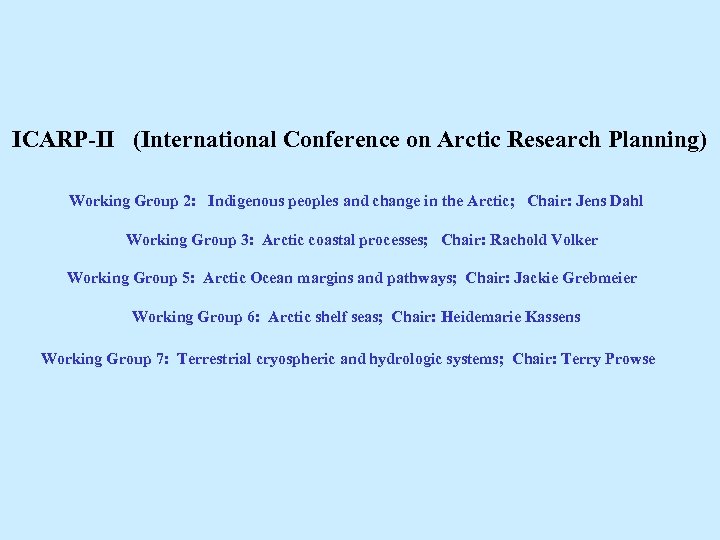 ICARP-II (International Conference on Arctic Research Planning) Working Group 2: Indigenous peoples and change in the Arctic; Chair: Jens Dahl Working Group 3: Arctic coastal processes; Chair: Rachold Volker Working Group 5: Arctic Ocean margins and pathways; Chair: Jackie Grebmeier Working Group 6: Arctic shelf seas; Chair: Heidemarie Kassens Working Group 7: Terrestrial cryospheric and hydrologic systems; Chair: Terry Prowse
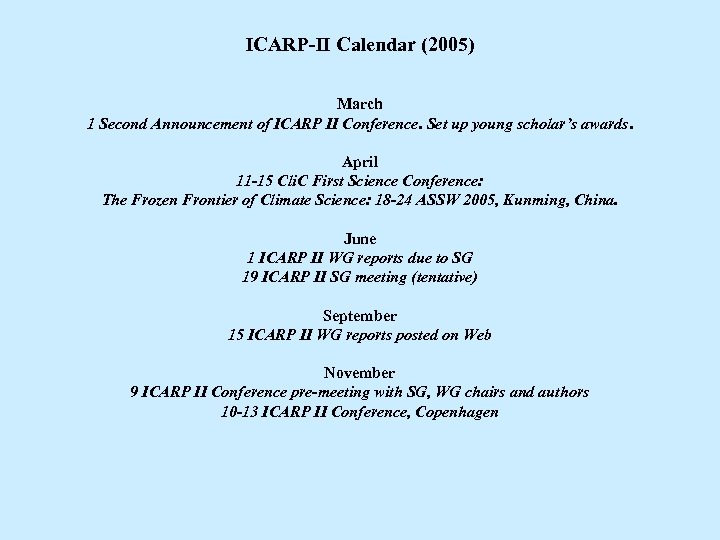 ICARP-II Calendar (2005) March 1 Second Announcement of ICARP II Conference. Set up young scholar’s awards. April 11 -15 Cli. C First Science Conference: The Frozen Frontier of Climate Science: 18 -24 ASSW 2005, Kunming, China. June 1 ICARP II WG reports due to SG 19 ICARP II SG meeting (tentative) September 15 ICARP II WG reports posted on Web November 9 ICARP II Conference pre-meeting with SG, WG chairs and authors 10 -13 ICARP II Conference, Copenhagen
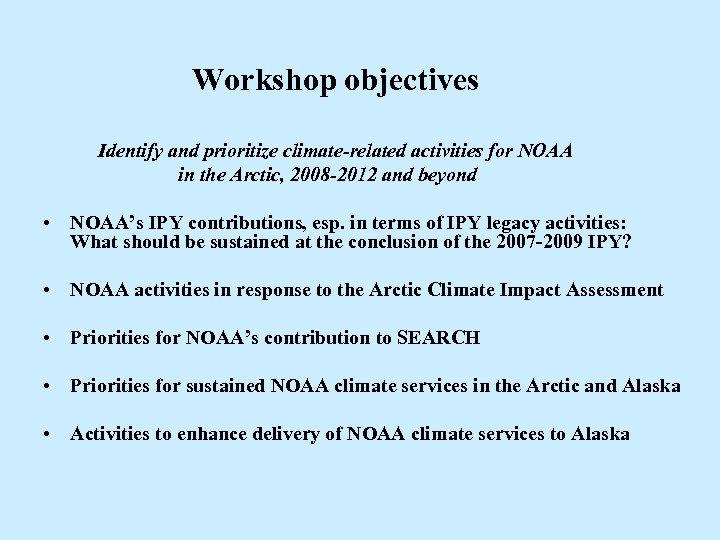 Workshop objectives Identify and prioritize climate-related activities for NOAA in the Arctic, 2008 -2012 and beyond • NOAA’s IPY contributions, esp. in terms of IPY legacy activities: What should be sustained at the conclusion of the 2007 -2009 IPY? • NOAA activities in response to the Arctic Climate Impact Assessment • Priorities for NOAA’s contribution to SEARCH • Priorities for sustained NOAA climate services in the Arctic and Alaska • Activities to enhance delivery of NOAA climate services to Alaska
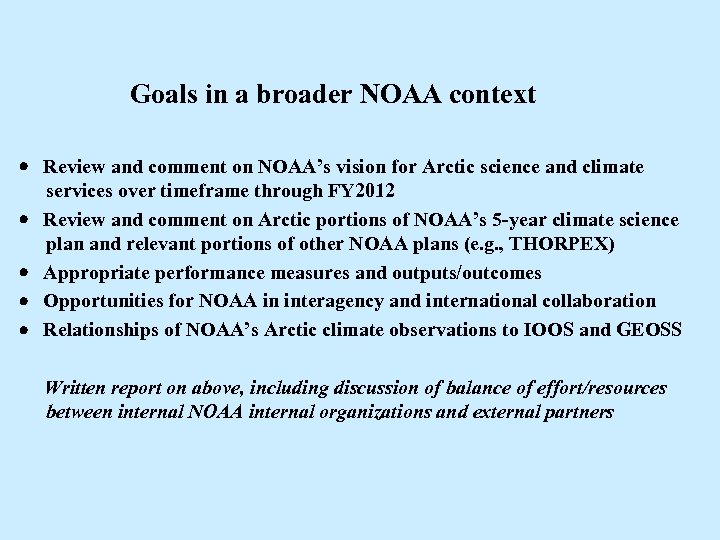 Goals in a broader NOAA context Review and comment on NOAA’s vision for Arctic science and climate services over timeframe through FY 2012 Review and comment on Arctic portions of NOAA’s 5 -year climate science plan and relevant portions of other NOAA plans (e. g. , THORPEX) Appropriate performance measures and outputs/outcomes Opportunities for NOAA in interagency and international collaboration Relationships of NOAA’s Arctic climate observations to IOOS and GEOSS Written report on above, including discussion of balance of effort/resources between internal NOAA internal organizations and external partners