 Скачать презентацию Overview of Application Adapter Technology Kenneth Baik April
b9a9a5854832d860de1db6b9ffd7ae4b.ppt
- Количество слайдов: 21



Overview of Application Adapter Technology Kenneth Baik April 10, 2003 ECE 1770 - Expert Topic
Agenda n Main reasons for EAI n Primary objective of Application Adapter n Typical Issues with Adapter n Basic Functions of Adapter n Adapter Methodology n One of Adapter Technologies n Simple Demo n Summary 2
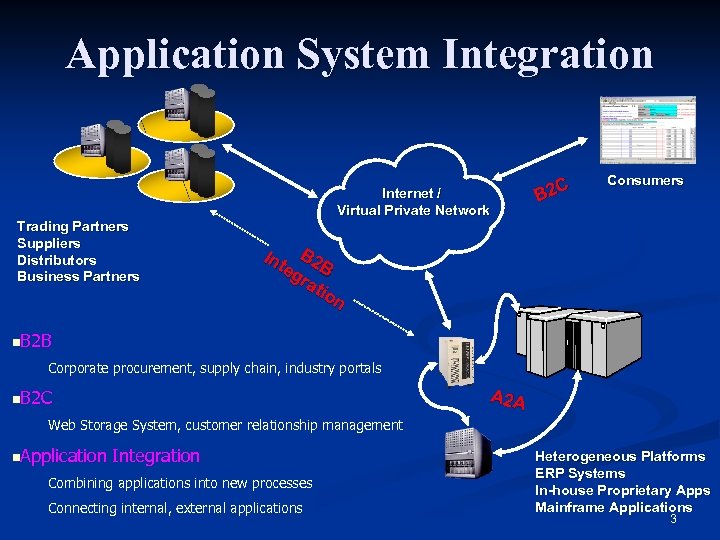
Application System Integration Trading Partners Suppliers Distributors Business Partners Internet / Virtual Private Network B 2 C Consumers Int B 2 eg B ra tio n n. B 2 B Corporate procurement, supply chain, industry portals A 2 A n. B 2 C Web Storage System, customer relationship management n. Application Integration Combining applications into new processes Connecting internal, external applications Heterogeneous Platforms ERP Systems In-house Proprietary Apps Mainframe Applications 3
Two main reasons for Application System Integration n n n To connect between the existing application systems A typical Fortune 1000 company has many Mission Critical Application Systems A typical large enterprise has more than 5000 major application systems These systems are logically interconnected Corporate information is scattered in disparate and heterogeneous application systems. These application systems are called “Legacy” systems. Approximately 70% of corporate data resides on legacy hosts, such as mainframe and AS/400 platform Therefore, the most of enterprises have a mandate to integrate legacy systems to share, exchange, analyze and consolidate the corporate data 4
Two main reasons for Application System Integration n n To connect the existing application systems with new application systems on new platform such as Web application systems As the Internet gets more attention from business sectors, the requirements of connecting the legacy systems to the Web application systems arise to the surface Rewriting a legacy system into Web application system does not make sense financially and technically There are too many risks for mission critical applications To provide a means of exchange for business information flowing between business partners, legacy systems and Web application systems must be integrated. 5
Core component of EAI Products n The requirement for communication between disparate and heterogeneous application systems leads to development of Enterprise Application Integration products n A core component of this is “Adapter” “Application Adapter” is one of the core components of EAI product! 6
Definition of Adapter n n The term “Adapter” could mean different things depending on the context and the application architecture Example 1 a simple servlet is called an adapter Example 2 an entire application, such as EDI gateway, could be called an adapter Regardless of its size and context, an adapter’s primary objective is to facilitate integration of the application for which it has been designed 7
Developing an Adapter n n n Often enterprises end up with multiple homegrown adapters, each exposing a subset of the application functionality Developing an adapter can be very costly and timeconsuming Therefore, for well-known packaged applications such as SAP and Siebel, off-the-shelf adapters are available that integrate the packaged application to the integration backbone with little or no coding effort Custom adapters can also be written for legacy systems for which such ready-made adapters are not available EAI vendors provide adapter SDKs to facilitate this development 8
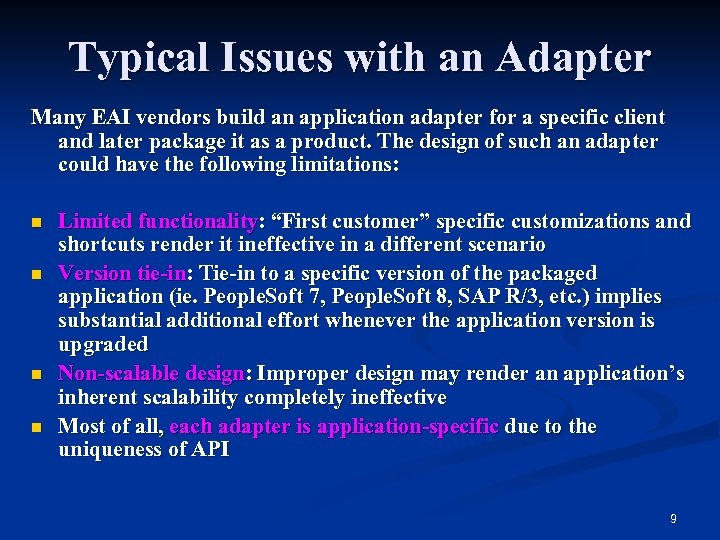
Typical Issues with an Adapter Many EAI vendors build an application adapter for a specific client and later package it as a product. The design of such an adapter could have the following limitations: n n Limited functionality: “First customer” specific customizations and shortcuts render it ineffective in a different scenario Version tie-in: Tie-in to a specific version of the packaged application (ie. People. Soft 7, People. Soft 8, SAP R/3, etc. ) implies substantial additional effort whenever the application version is upgraded Non-scalable design: Improper design may render an application’s inherent scalability completely ineffective Most of all, each adapter is application-specific due to the uniqueness of API 9
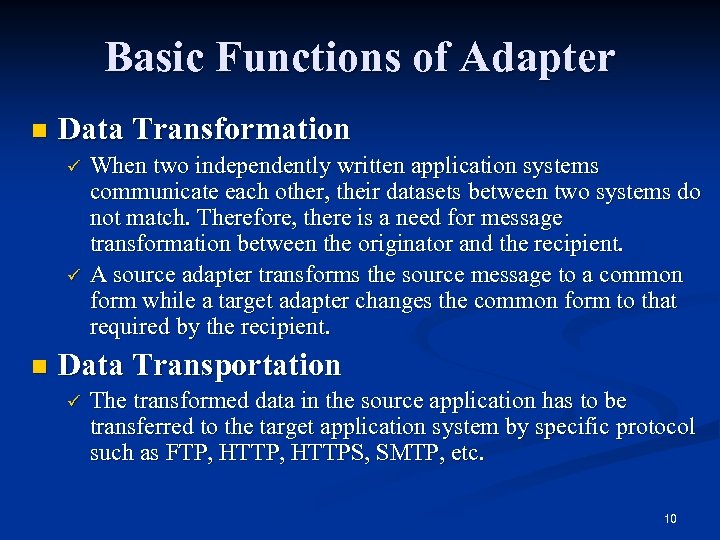
Basic Functions of Adapter n Data Transformation ü ü n When two independently written application systems communicate each other, their datasets between two systems do not match. Therefore, there is a need for message transformation between the originator and the recipient. A source adapter transforms the source message to a common form while a target adapter changes the common form to that required by the recipient. Data Transportation ü The transformed data in the source application has to be transferred to the target application system by specific protocol such as FTP, HTTPS, SMTP, etc. 10
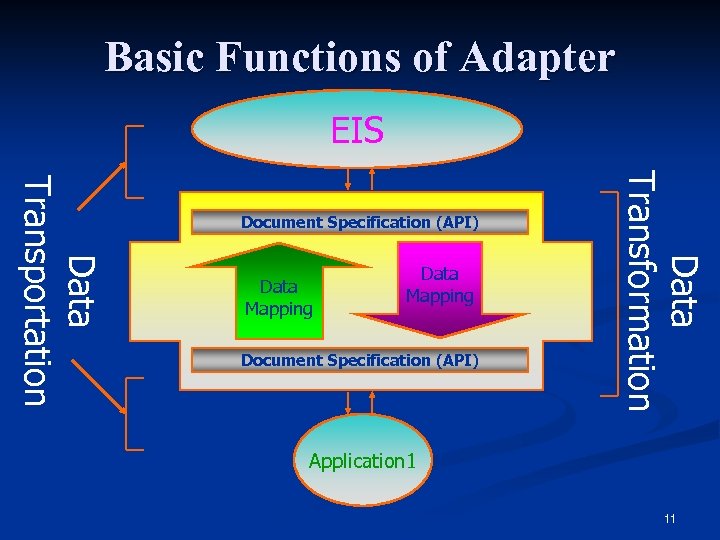
Basic Functions of Adapter EIS Data Mapping Document Specification (API) Data Transformation Data Transportation Document Specification (API) Application 1 11
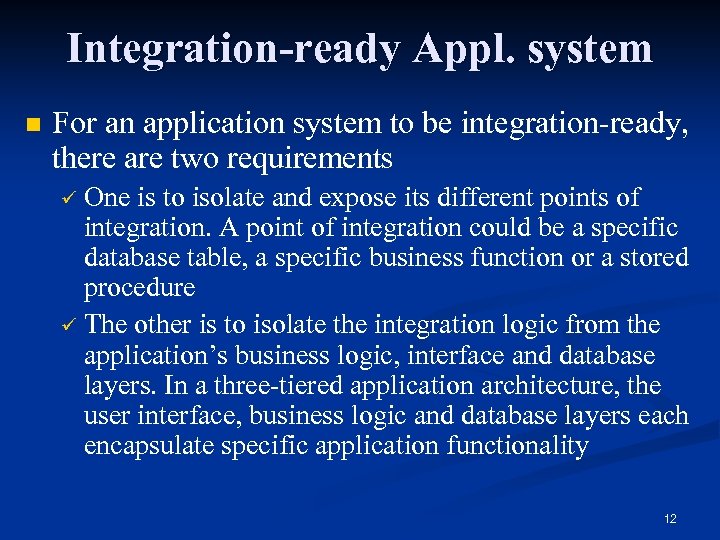
Integration-ready Appl. system n For an application system to be integration-ready, there are two requirements One is to isolate and expose its different points of integration. A point of integration could be a specific database table, a specific business function or a stored procedure ü The other is to isolate the integration logic from the application’s business logic, interface and database layers. In a three-tiered application architecture, the user interface, business logic and database layers each encapsulate specific application functionality ü 12
Adapter Design Methodology n n Adapters are one way for developers to isolate an application’s integration logic. However, application adapters use application-specific APIs and this is not ideal as access mechanisms, since the API will most likely be different for most applications So, platform-neutral standards such as XML, SOAP (Simple Object Access Protocol) and J 2 EE (the Java 2 platform, Enterprise Edition) are ideal building blocks for developers to design adapters 13
One of Adapter Technologies n MS Biz. Talk Server provides the ability to exchange data between two heterogeneous systems through an XML interface n Biz. Talk Messaging Services ü Biz. Talk Server Supports n n ü ü XML, X 12, EDIFACT, and other document formats HTTP, HTTPS, SMTP, MSMQ, File, DCOM, and other protocols Mapping Between Document Formats Programmable Interfaces for Submitting and Receiving Documents and for Administration Content-Based Routing of Documents Data Tracking and Analysis 14
Biz. Talk Server Messaging Tools n Biz. Talk Editor ü n Biz. Talk Mapper ü n Maps one document format to another using document specification Biz. Talk Messaging Manager ü ü ü n Defines input and output document specifications (XML or non-XML) Administers agreements with trading partners and applications Messaging Port – defines Transport Target Location Messaging Channel – defines input/output document specification and a map for data transformation Biz. Talk Administration Tool ü ü Manages queues (receive function/MSMQ) Configures transport integration (HTTP, File, SMTP, etc) 15
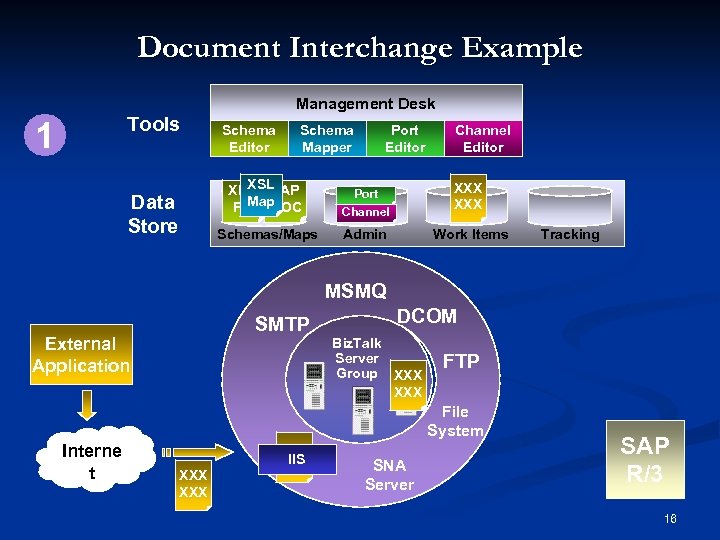
Document Interchange Example Management Desk Tools 1 Schema Biz. Talk Editor Schema Biz. Talk Mapper Port Manager Editor XSL XML SAP Map PO IDOC Schemas/Maps Data Store Port Channel Admin Channel Manager Editor XXX Work Items Tracking MSMQ SMTP External Application DCOM Biz. Talk Server Group XXX FTP File System Interne t EDI IIS XXX HTTP SNA Server SAP R/3 16
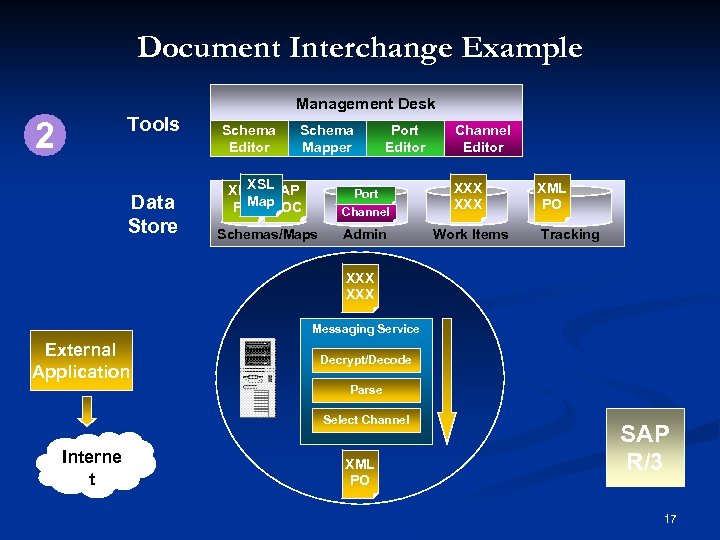
Document Interchange Example Management Desk Tools 2 Data Store Schema Biz. Talk Editor Schema Biz. Talk Mapper Agreement Channel Port Pipeline Manager Editor XSL XML SAP Map PO IDOC Port Channel Schemas/Maps Admin XXX Work Items XML PO Tracking XXX MSMQ DCOM SMTP Messaging Service External Application Biz. Talk Decrypt/Decode Server Group FTP Parse XXX Select Channel Pipeline Interne t HTTP XMLSNA PO Server File System SAP R/3 17
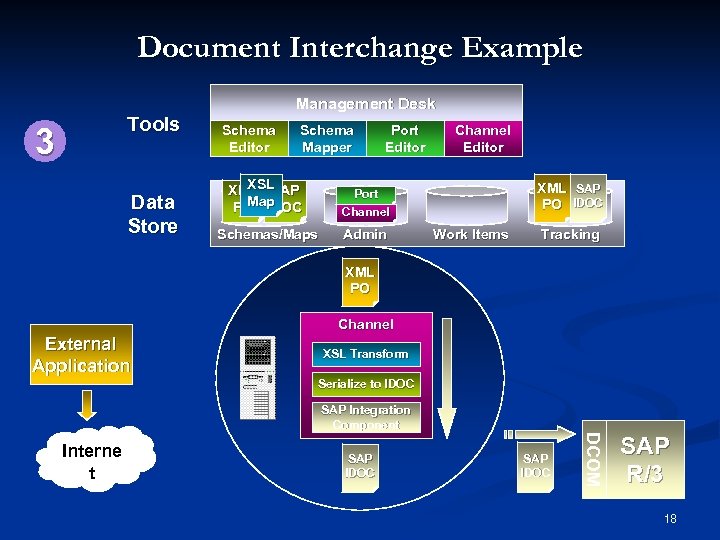
Document Interchange Example Management Desk Tools 3 Data Store Schema Biz. Talk Editor Schema Biz. Talk Mapper Agreement Channel Port Pipeline Manager Editor XSL XML SAP Map PO IDOC Port Channel Schemas/Maps Admin XML SAP PO IDOC Work Items Tracking XML PO Channel External Application XSL Transform Serialize to IDOC Interne t SAP IDOC DCO M SAP Integration Component SAP R/3 18
Simple Demo 19
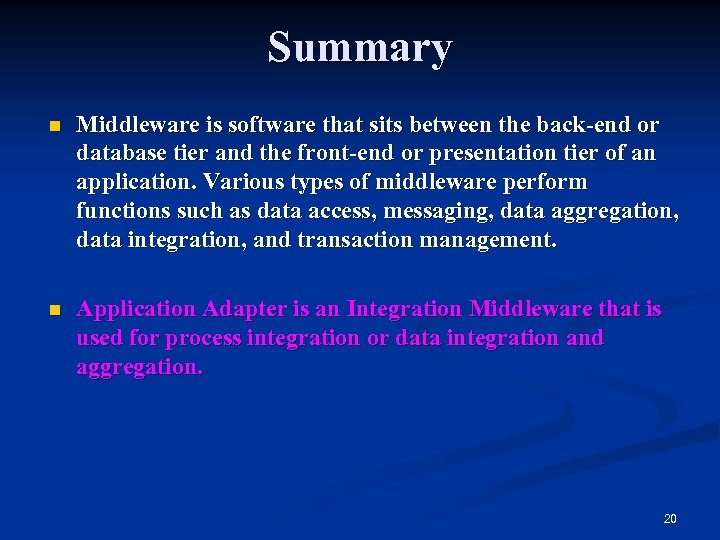
Summary n Middleware is software that sits between the back-end or database tier and the front-end or presentation tier of an application. Various types of middleware perform functions such as data access, messaging, data aggregation, data integration, and transaction management. n Application Adapter is an Integration Middleware that is used for process integration or data integration and aggregation. 20

Questions ? 21
Скачать презентацию Overview of Application Adapter Technology Kenneth Baik April
b9a9a5854832d860de1db6b9ffd7ae4b.ppt