 Скачать презентацию Overview Making Scotland s Rural Environment More Sustainable Steve
c6d103bf8c3ad6a9ede1619db23dc9c4.ppt
- Количество слайдов: 30



Overview Making Scotland’s Rural Environment More Sustainable Steve Albon
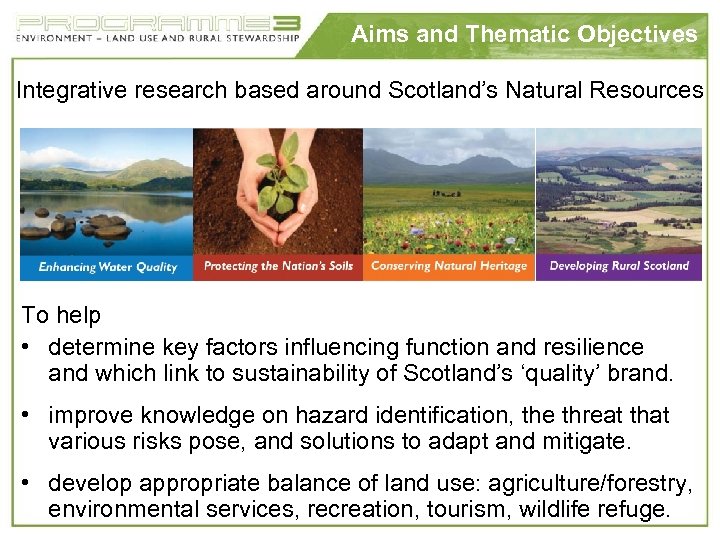
Aims and Thematic Objectives Integrative research based around Scotland’s Natural Resources To help • determine key factors influencing function and resilience and which link to sustainability of Scotland’s ‘quality’ brand. • improve knowledge on hazard identification, the threat that various risks pose, and solutions to adapt and mitigate. • develop appropriate balance of land use: agriculture/forestry, environmental services, recreation, tourism, wildlife refuge.
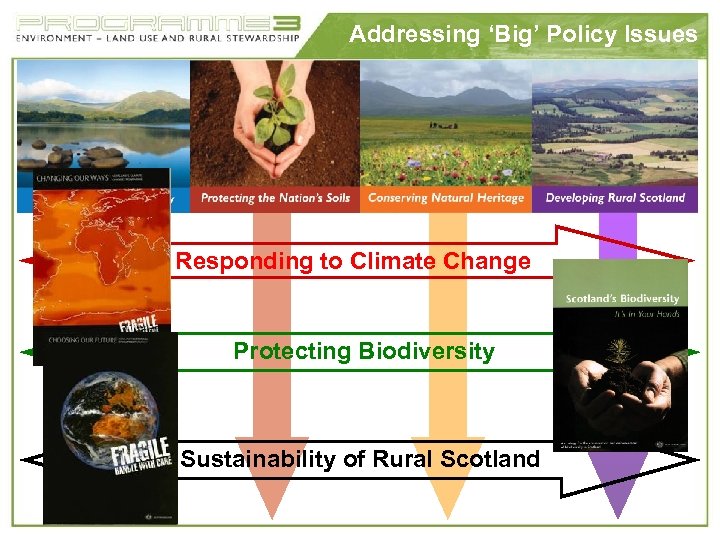
Addressing ‘Big’ Policy Issues Responding to Climate Change Protecting Biodiversity Sustainability of Rural Scotland
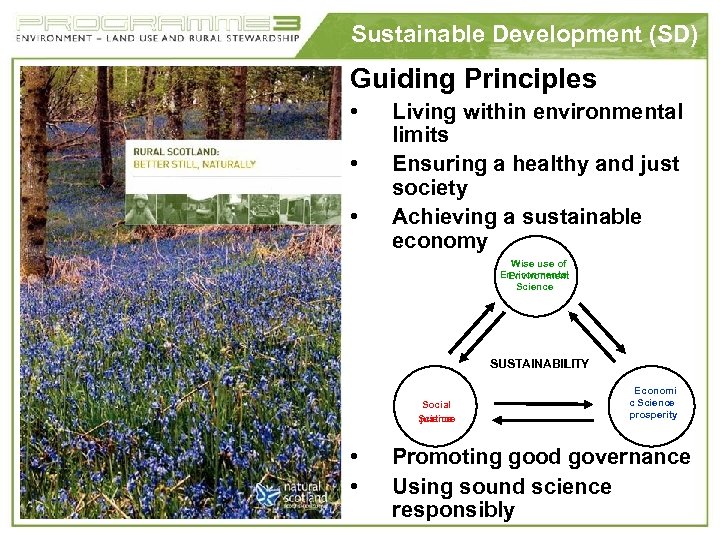
Sustainable Development (SD) Guiding Principles • • • Living within environmental limits Ensuring a healthy and just society Achieving a sustainable economy Wise use of Environmental Environment Science SUSTAINABILITY Social Science justice • • Economi c Science prosperity Promoting good governance Using sound science responsibly
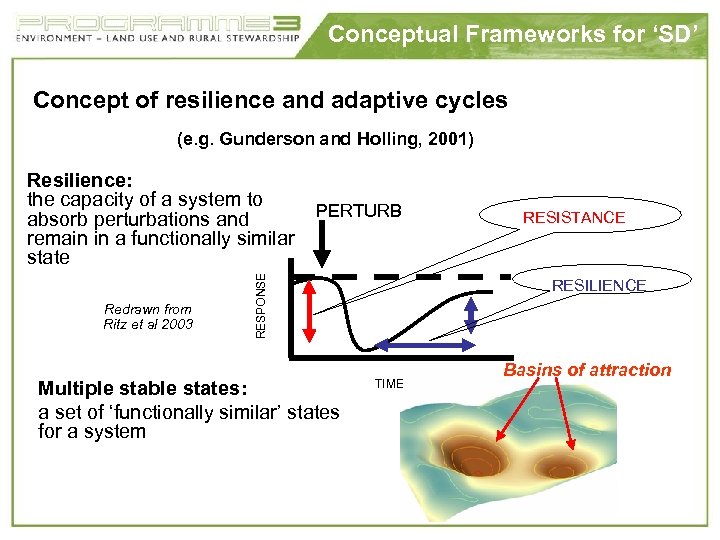
Conceptual Frameworks for ‘SD’ Concept of resilience and adaptive cycles (e. g. Gunderson and Holling, 2001) Redrawn from Ritz et al 2003 PERTURB RESPONSE Resilience: the capacity of a system to absorb perturbations and remain in a functionally similar state Multiple stable states: a set of ‘functionally similar’ states for a system RESISTANCE RESILIENCE TIME Basins of attraction
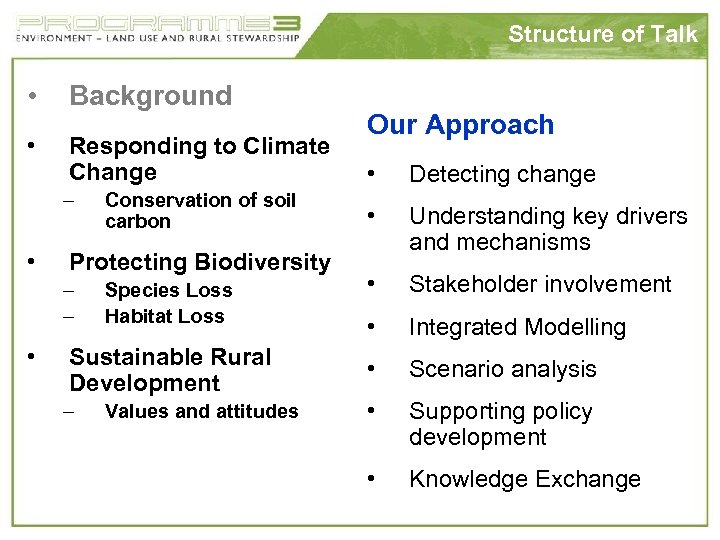
Structure of Talk • Background • Responding to Climate Change • Detecting change • Understanding key drivers and mechanisms • Stakeholder involvement • Integrated Modelling Sustainable Rural Development • Scenario analysis – • Supporting policy development • Knowledge Exchange – • Conservation of soil carbon Protecting Biodiversity – – • Our Approach Species Loss Habitat Loss Values and attitudes
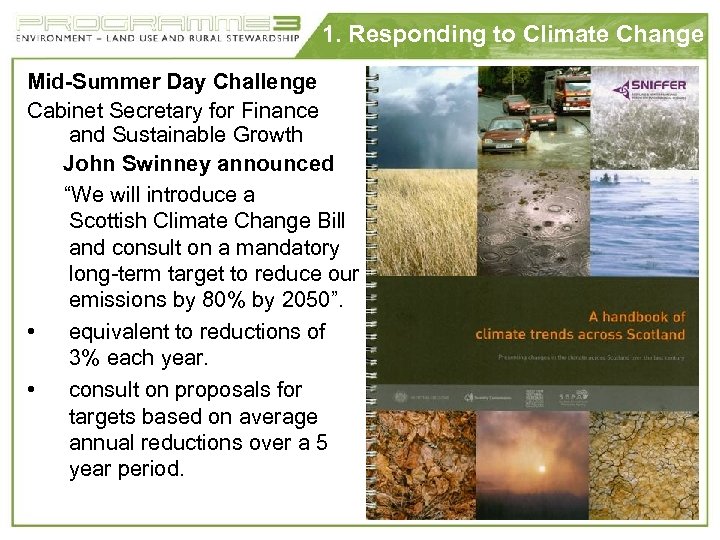
1. Responding to Climate Change Mid-Summer Day Challenge Cabinet Secretary for Finance and Sustainable Growth John Swinney announced “We will introduce a Scottish Climate Change Bill and consult on a mandatory long-term target to reduce our emissions by 80% by 2050”. • equivalent to reductions of 3% each year. • consult on proposals for targets based on average annual reductions over a 5 year period.
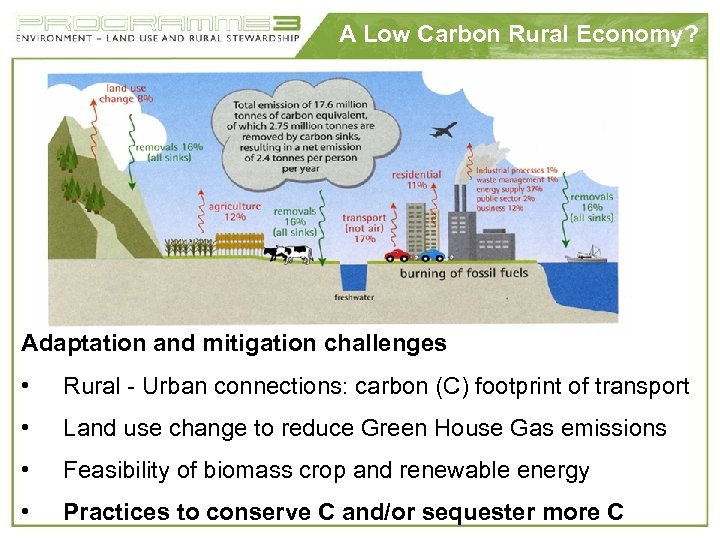
A Low Carbon Rural Economy? Adaptation and mitigation challenges • Rural - Urban connections: carbon (C) footprint of transport • Land use change to reduce Green House Gas emissions • Feasibility of biomass crop and renewable energy • Practices to conserve C and/or sequester more C
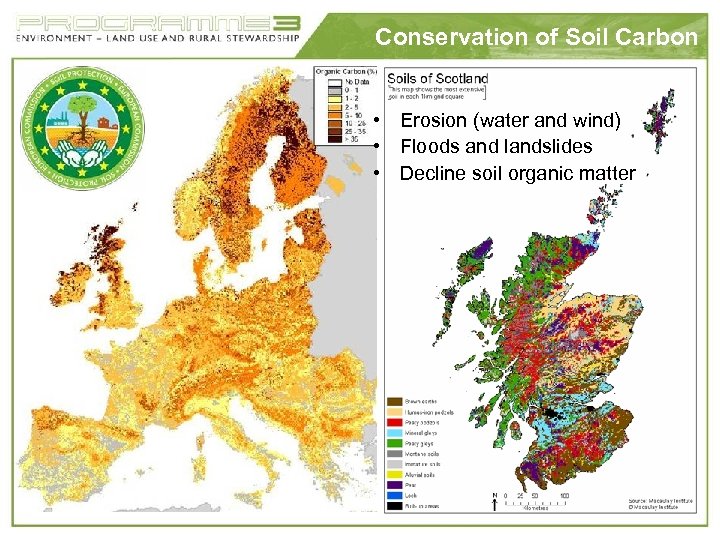
Conservation of Soil Carbon • Erosion (water and wind) • Floods and landslides • Decline soil organic matter
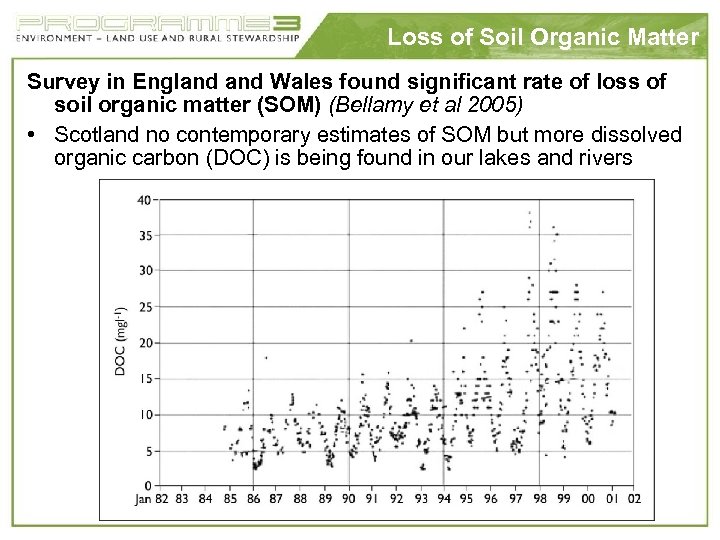
Loss of Soil Organic Matter Survey in England Wales found significant rate of loss of soil organic matter (SOM) (Bellamy et al 2005) • Scotland no contemporary estimates of SOM but more dissolved organic carbon (DOC) is being found in our lakes and rivers
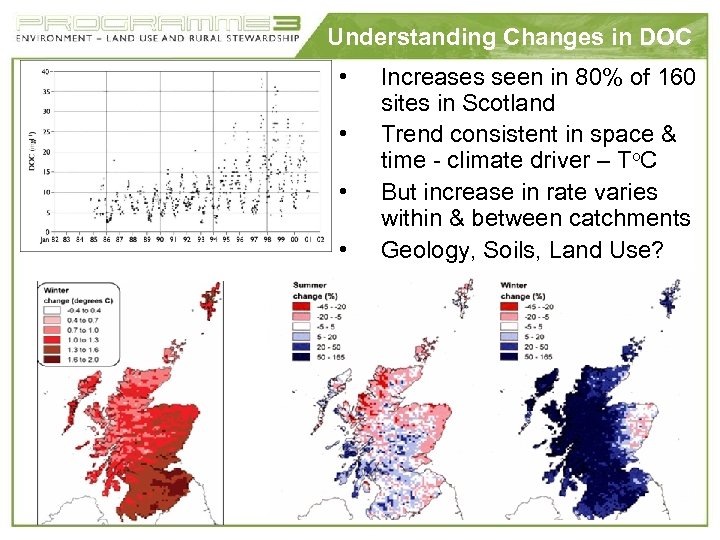
Understanding Changes in DOC • • Increases seen in 80% of 160 sites in Scotland Trend consistent in space & time - climate driver – To. C But increase in rate varies within & between catchments Geology, Soils, Land Use?
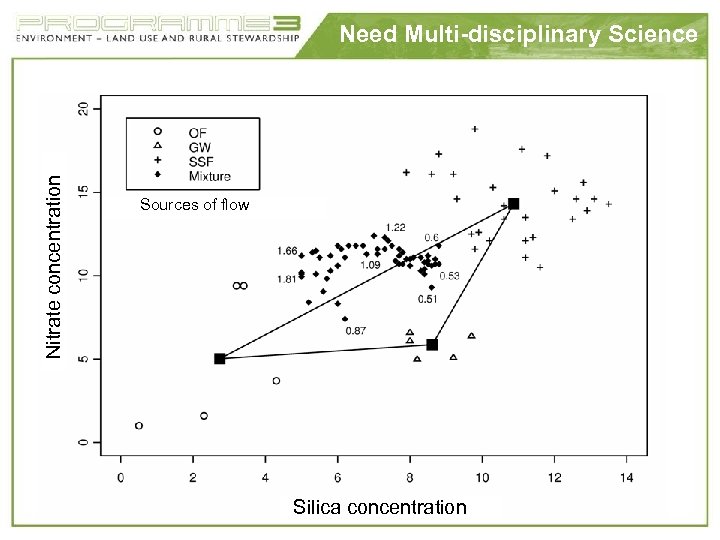
Nitrate concentration Need Multi-disciplinary Science Sources of flow Silica concentration
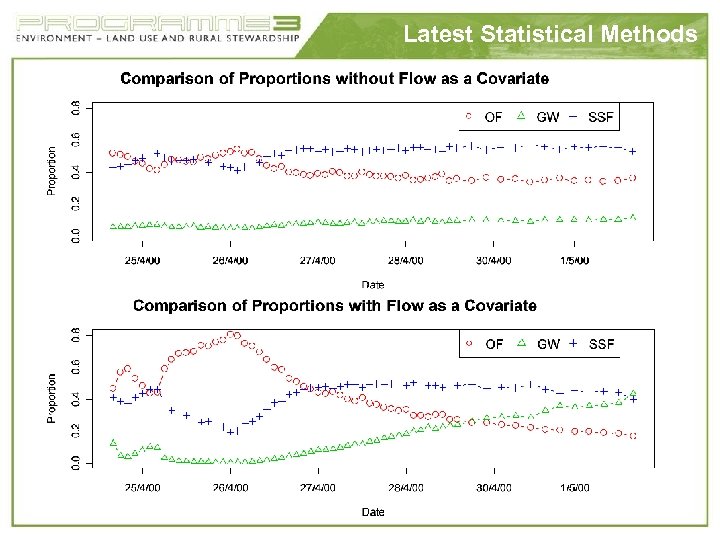
Latest Statistical Methods
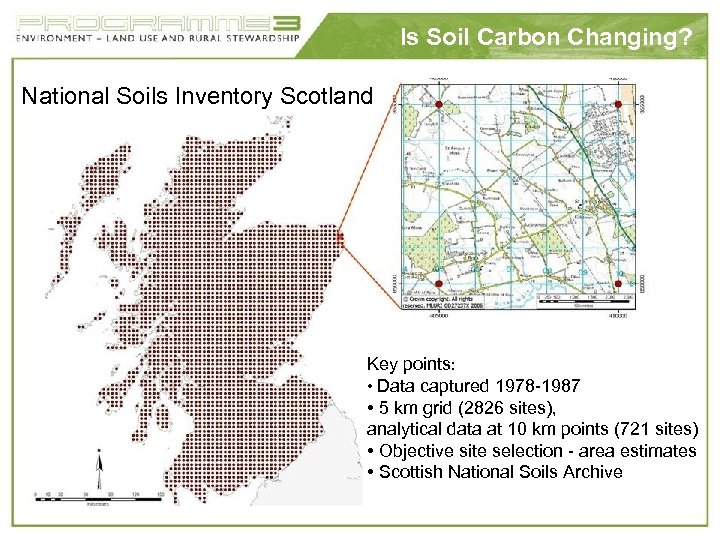
Is Soil Carbon Changing? National Soils Inventory Scotland Key points: • Data captured 1978 -1987 • 5 km grid (2826 sites), analytical data at 10 km points (721 sites) • Objective site selection - area estimates • Scottish National Soils Archive
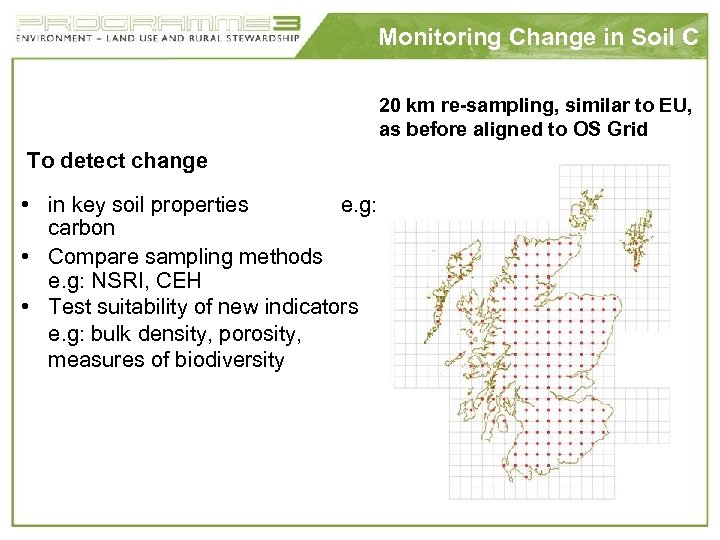
Monitoring Change in Soil C 20 km re-sampling, similar to EU, as before aligned to OS Grid To detect change • in key soil properties e. g: carbon • Compare sampling methods e. g: NSRI, CEH • Test suitability of new indicators e. g: bulk density, porosity, measures of biodiversity
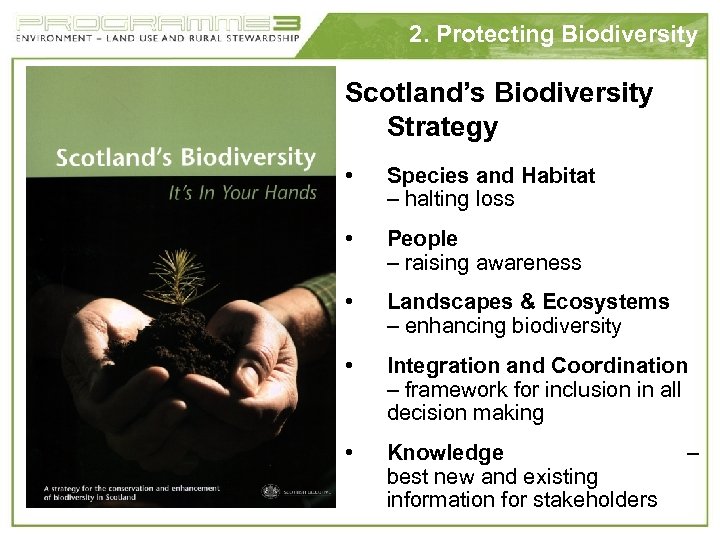
2. Protecting Biodiversity Scotland’s Biodiversity Strategy • Species and Habitat – halting loss • People – raising awareness • Landscapes & Ecosystems – enhancing biodiversity • Integration and Coordination – framework for inclusion in all decision making • Knowledge best new and existing information for stakeholders –
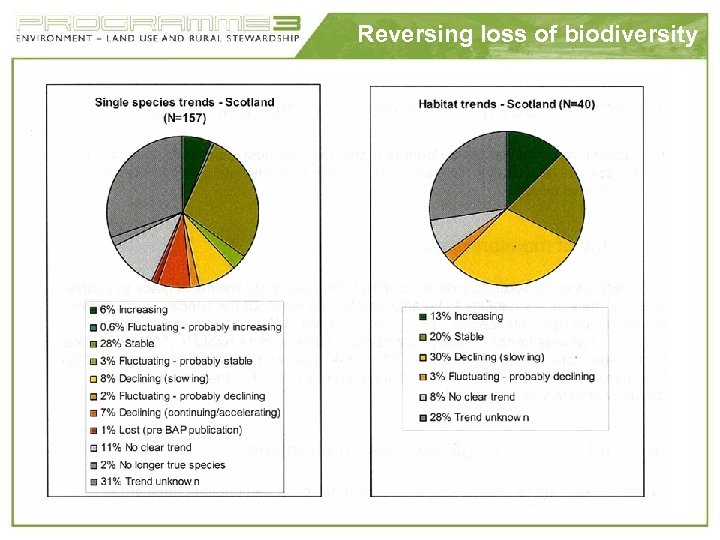
Reversing loss of biodiversity
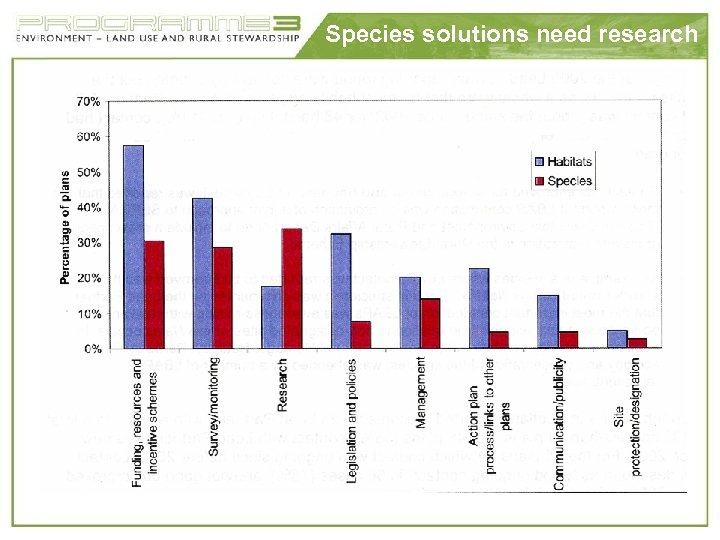
Species solutions need research
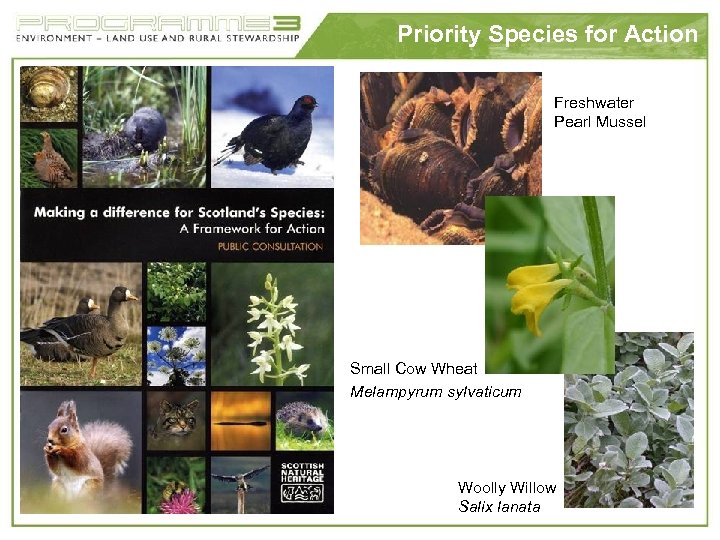
Priority Species for Action Freshwater Pearl Mussel Small Cow Wheat Melampyrum sylvaticum Woolly Willow Salix lanata
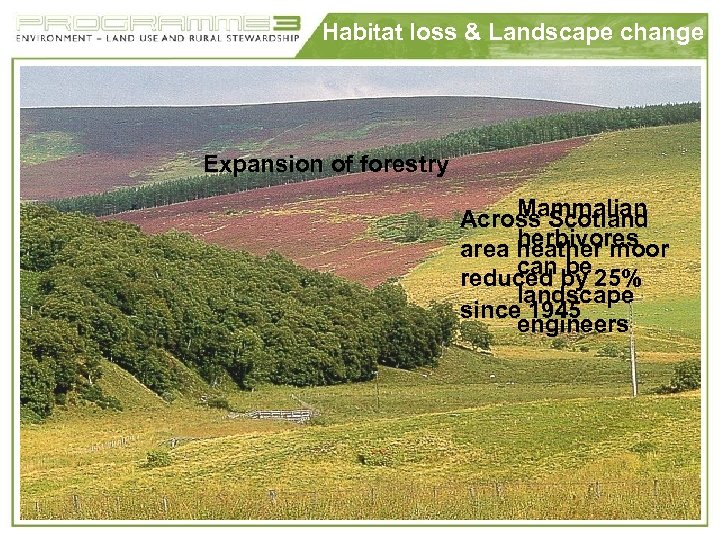
Habitat loss & Landscape change Expansion of forestry Mammalian Across Scotland herbivores area heather moor can be reduced by 25% landscape since 1945 engineers
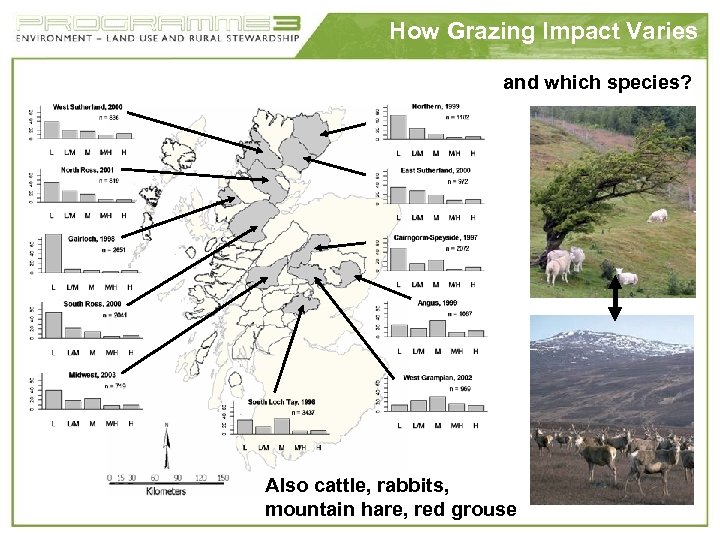
How Grazing Impact Varies and which species? Also cattle, rabbits, mountain hare, red grouse
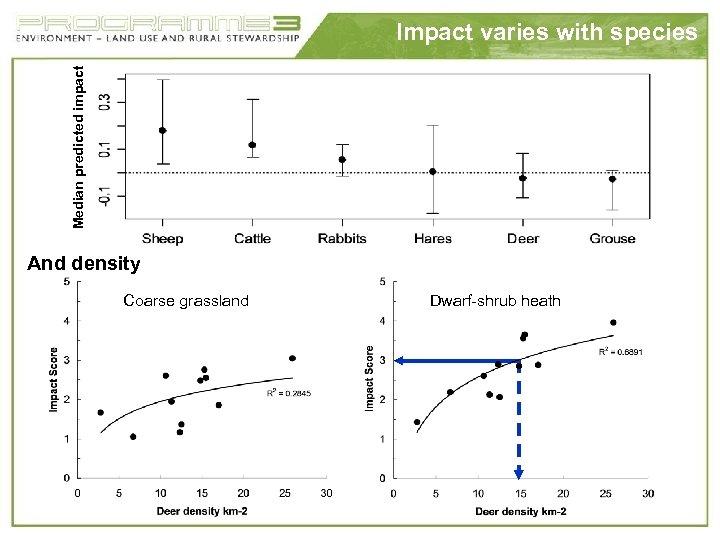
Median predicted impact Impact varies with species And density Coarse grassland Dwarf-shrub heath
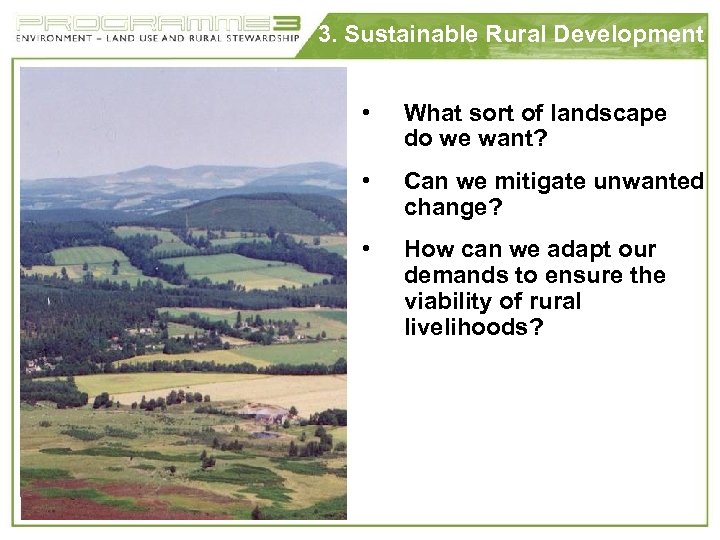
3. Sustainable Rural Development • What sort of landscape do we want? • Can we mitigate unwanted change? • How can we adapt our demands to ensure the viability of rural livelihoods?
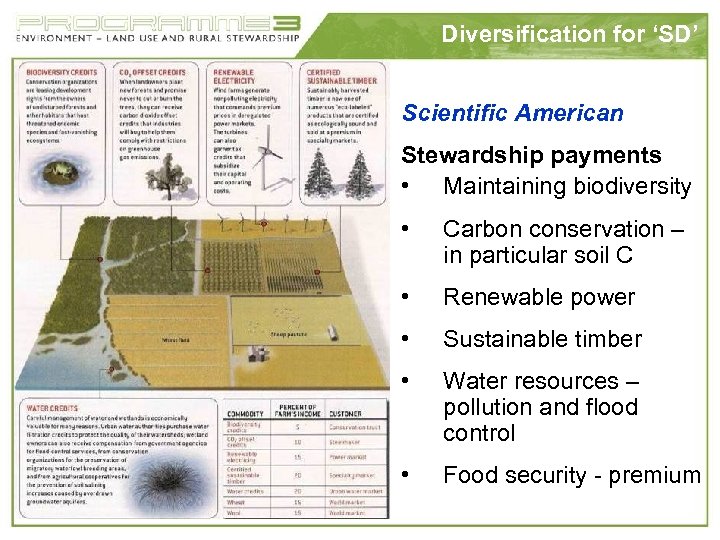
Diversification for ‘SD’ Scientific American Stewardship payments • Maintaining biodiversity • Carbon conservation – in particular soil C • Renewable power • Sustainable timber • Water resources – pollution and flood control • Food security - premium
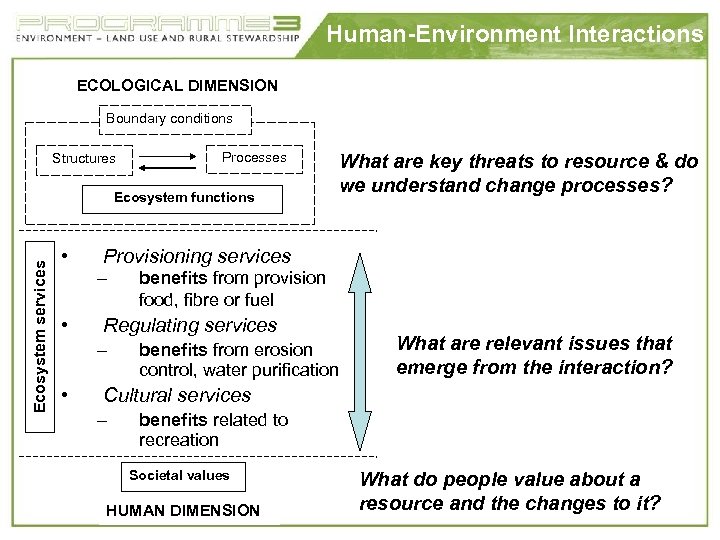
Human-Environment Interactions ECOLOGICAL DIMENSION Boundary conditions Structures Processes Ecosystem services Ecosystem functions • Provisioning services – • benefits from provision food, fibre or fuel Regulating services – • What are key threats to resource & do we understand change processes? benefits from erosion control, water purification What are relevant issues that emerge from the interaction? Cultural services – benefits related to recreation Societal values HUMAN DIMENSION What do people value about a resource and the changes to it?
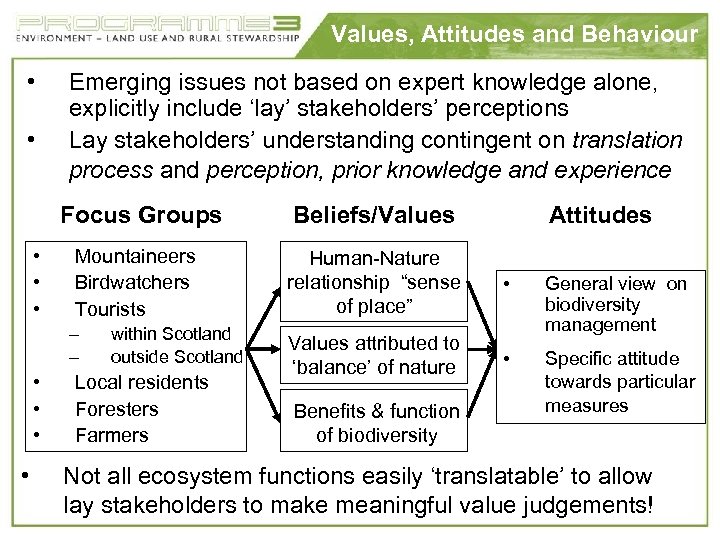
Values, Attitudes and Behaviour • • Emerging issues not based on expert knowledge alone, explicitly include ‘lay’ stakeholders’ perceptions Lay stakeholders’ understanding contingent on translation process and perception, prior knowledge and experience Focus Groups • • • Mountaineers Birdwatchers Tourists – – • • within Scotland outside Scotland Local residents Foresters Farmers Beliefs/Values Attitudes Human-Nature relationship “sense of place” • Values attributed to ‘balance’ of nature General view on biodiversity management • Specific attitude towards particular measures Benefits & function of biodiversity Not all ecosystem functions easily ‘translatable’ to allow lay stakeholders to make meaningful value judgements!
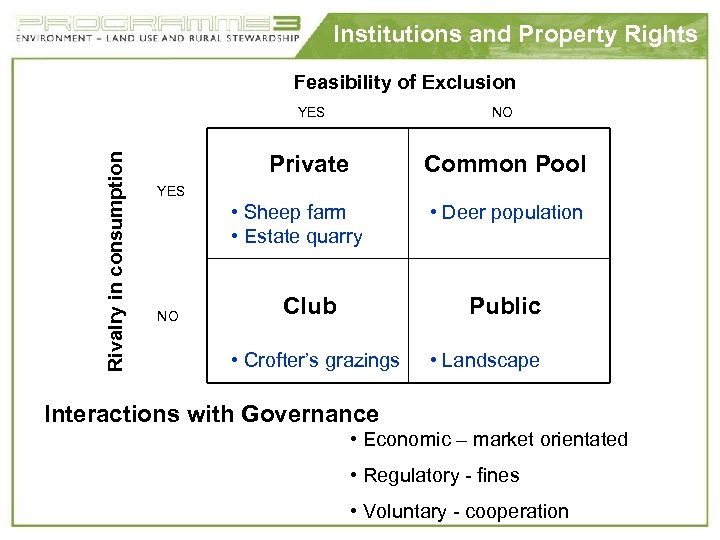
Institutions and Property Rights Feasibility of Exclusion Rivalry in consumption YES NO Private Common Pool YES • Sheep farm • Estate quarry NO Club • Deer population Public • Crofter’s grazings • Landscape Interactions with Governance • Economic – market orientated • Regulatory - fines • Voluntary - cooperation
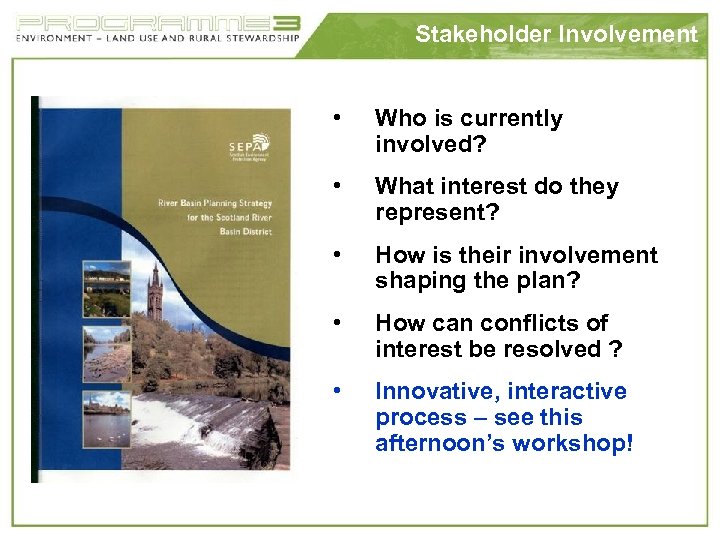
Stakeholder Involvement • Who is currently involved? • What interest do they represent? • How is their involvement shaping the plan? • How can conflicts of interest be resolved ? • Innovative, interactive process – see this afternoon’s workshop!
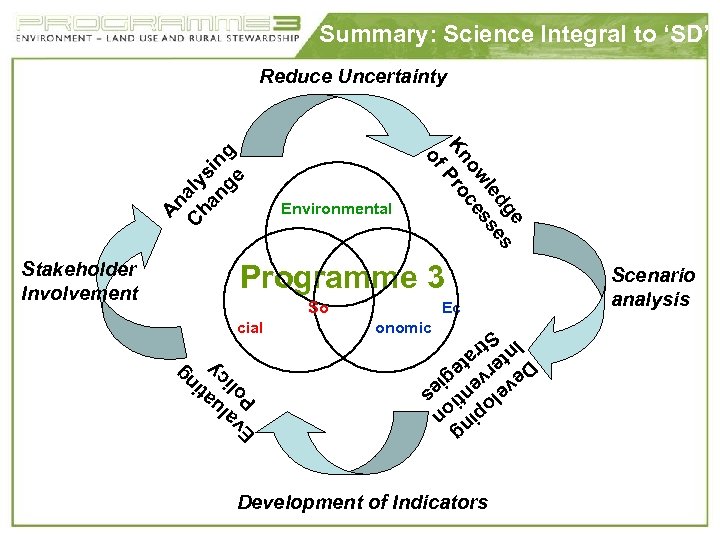
Summary: Science Integral to ‘SD’ Programme 3 So cial Ec onomic ng pi n lo tio s ve en ie De terv teg In tra S E va P lu ol a ic ting y Stakeholder Involvement Environmental e dg s le sse ow ce Kn Pro of A na C ly ha s ng ing e Reduce Uncertainty Development of Indicators Scenario analysis
Acknowledgements Work Package Coordinators Helaina Black Iain Brown Speakers & Workshop Facilitators Alison Hester Kirsty Blackstock Rupert Hough Graphics & Logistics Colin Campbell Simon Langan John Brown Bob Ferrier Keith Matthews Pat Carnegie Alison Hester Robin Pakeman Jane Lund Wendy Kenyon Alan Renwick Lorraine Robertson Alan Renwick Andy Vinten All the Poster authors/presenters Staff of Main Research Providers Programme 3 Advisory Board Michael Usher, Maggie Gill and Ian Bainbridge
Скачать презентацию Overview Making Scotland s Rural Environment More Sustainable Steve
c6d103bf8c3ad6a9ede1619db23dc9c4.ppt