


 Скачать презентацию Overview H Schmickler Why a
d41a043b3d13f1cc9fcf806bffda2422.ppt
- Количество слайдов: 18
 Overview • • • H. Schmickler Why a linear e+e- collider? What is special about CLIC? Technological challenges Project implementation on CERN site Project time scale Outlook to Technical design phase 2011 -2016 1
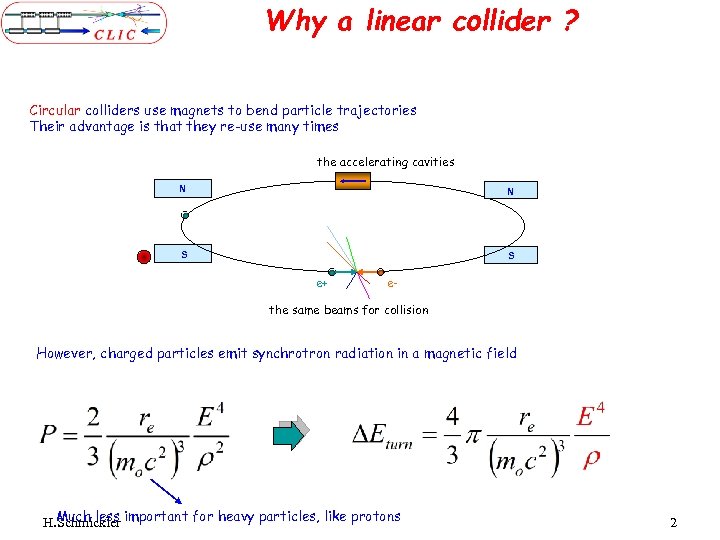 Why a linear collider ? Circular colliders use magnets to bend particle trajectories Their advantage is that they re-use many times the accelerating cavities N N S S e+ e- the same beams for collision However, charged particles emit synchrotron radiation in a magnetic field Much less H. Schmickler important for heavy particles, like protons 2
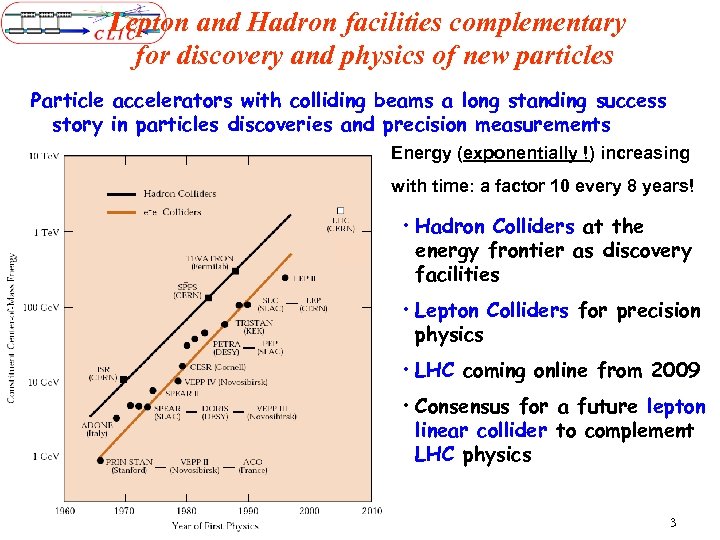 Lepton and Hadron facilities complementary for discovery and physics of new particles Particle accelerators with colliding beams a long standing success story in particles discoveries and precision measurements Energy (exponentially !) increasing with time: a factor 10 every 8 years! • Hadron Colliders at the energy frontier as discovery facilities • Lepton Colliders for precision physics • LHC coming online from 2009 • Consensus for a future lepton linear collider to complement LHC physics H. Schmickler 3
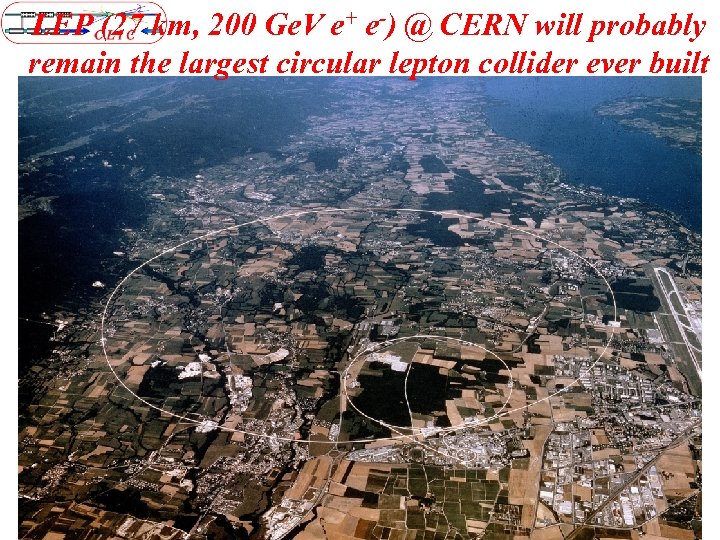 LEP (27 km, 200 Ge. V e+ e-) @ CERN will probably remain the largest circular lepton collider ever built H. Schmickler 4
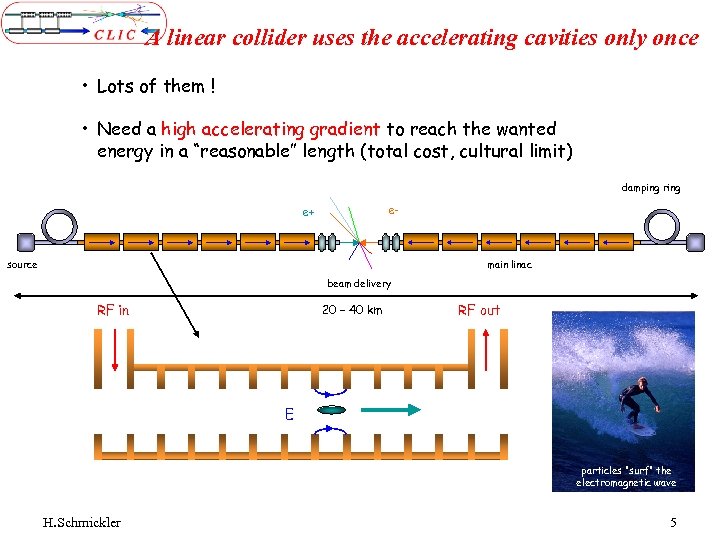 A linear collider uses the accelerating cavities only once • Lots of them ! • Need a high accelerating gradient to reach the wanted energy in a “reasonable” length (total cost, cultural limit) damping ring e- e+ source main linac beam delivery RF in 20 – 40 km RF out E particles “surf” the electromagnetic wave H. Schmickler 5
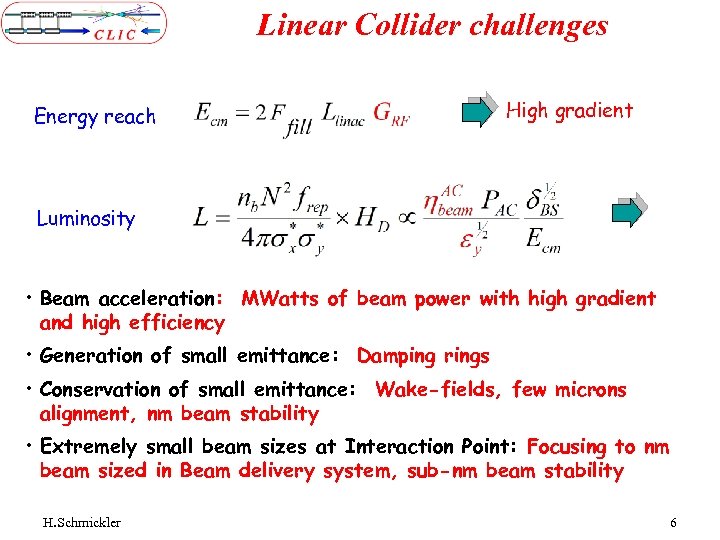 Linear Collider challenges Energy reach High gradient Luminosity • Beam acceleration: MWatts of beam power with high gradient and high efficiency • Generation of small emittance: Damping rings • Conservation of small emittance: Wake-fields, few microns alignment, nm beam stability • Extremely small beam sizes at Interaction Point: Focusing to nm beam sized in Beam delivery system, sub-nm beam stability H. Schmickler 6
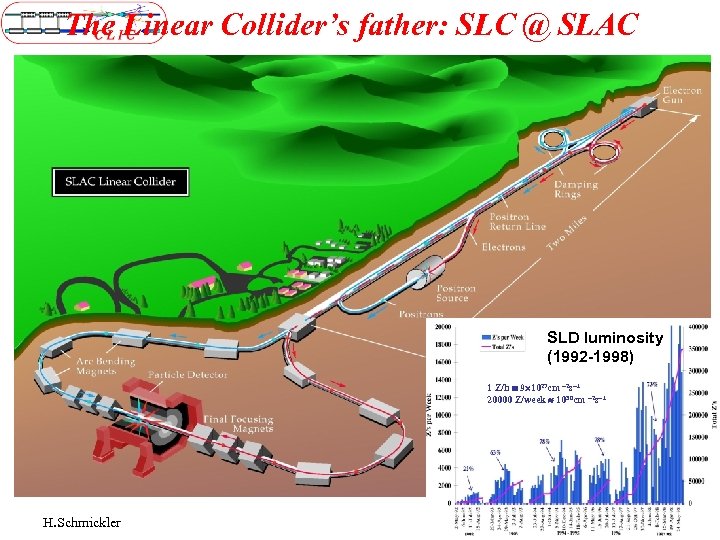 The Linear Collider’s father: SLC @ SLAC SLD luminosity (1992 -1998) 1 Z/h 9 1027 cm 2 s 1 20000 Z/week 1030 cm 2 s 1 H. Schmickler 7
 World consensus about a Linear Collider as the next HEP facility after LHC • 2001: ICFA recommendation of a world-wide collaboration to construct a high luminosity e+/e- Linear Collider with an energy range up to at least 400 Ge. V/c • 2003: ILC-Technical Review Committee to assess the technical status of the 15 years R&D on various technologies and designs of Linear Colliders • 2004: International Technology Recommendation Panel selected the Super-Conducting RF technology developed by the TESLA Collaboration for an International Linear Collider (ILC) in the Te. V energy range • 2004: CERN council support for R&D addressing the feasibility of the CLIC technology to possibly extend Linear Colliders into the Multi-Te. V energy range. H. Schmickler 8
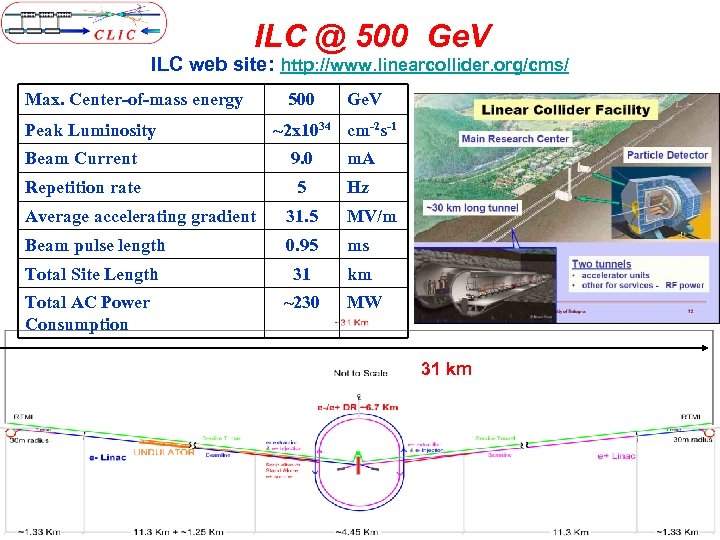 ILC @ 500 Ge. V ILC web site: http: //www. linearcollider. org/cms/ Max. Center-of-mass energy Peak Luminosity 500 Ge. V ~2 x 1034 cm-2 s-1 Beam Current 9. 0 m. A Repetition rate 5 Hz Average accelerating gradient 31. 5 MV/m Beam pulse length 0. 95 ms Total Site Length 31 km Total AC Power Consumption ~230 MW 31 km H. Schmickler 9
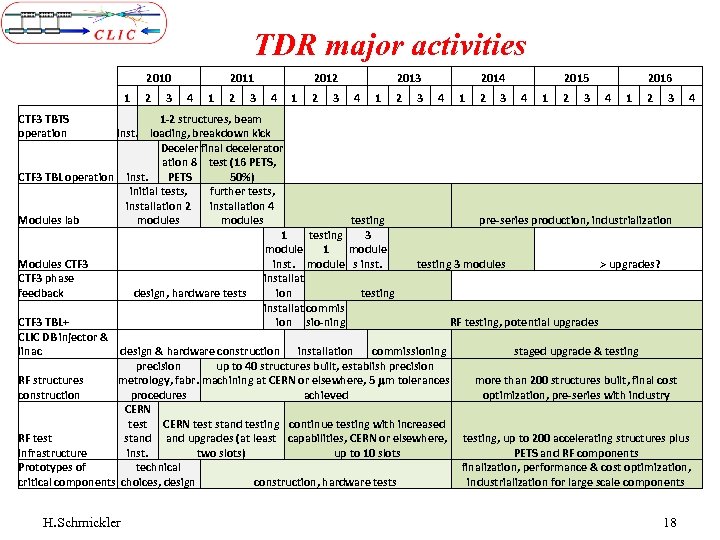
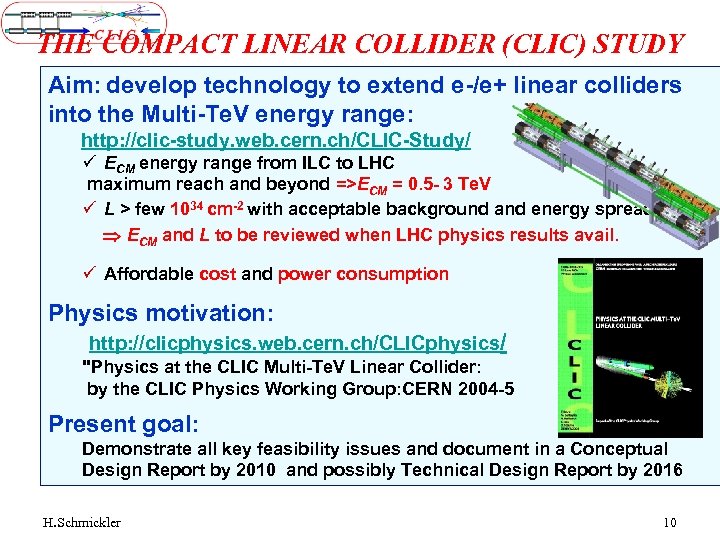 THE COMPACT LINEAR COLLIDER (CLIC) STUDY Aim: develop technology to extend e-/e+ linear colliders into the Multi-Te. V energy range: http: //clic-study. web. cern. ch/CLIC-Study/ ü ECM energy range from ILC to LHC maximum reach and beyond =>ECM = 0. 5 - 3 Te. V ü L > few 1034 cm-2 with acceptable background and energy spread ECM and L to be reviewed when LHC physics results avail. ü Affordable cost and power consumption Physics motivation: http: //clicphysics. web. cern. ch/CLICphysics/ "Physics at the CLIC Multi-Te. V Linear Collider: by the CLIC Physics Working Group: CERN 2004 -5 Present goal: Demonstrate all key feasibility issues and document in a Conceptual Design Report by 2010 and possibly Technical Design Report by 2016 H. Schmickler 10
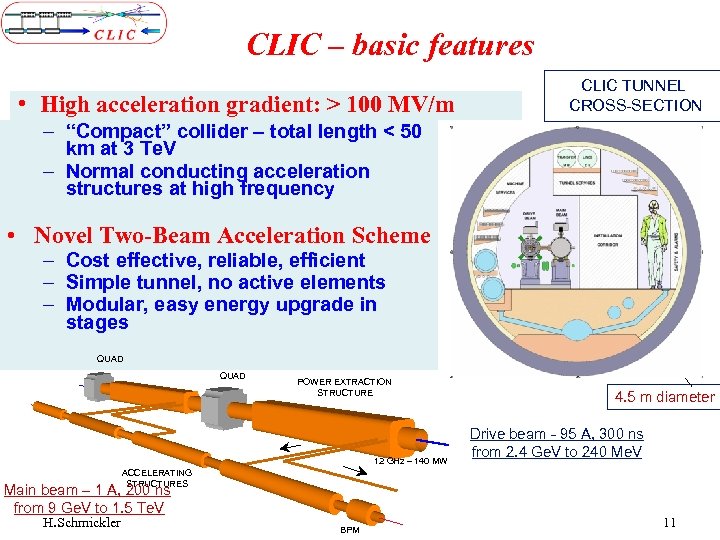 CLIC – basic features • High acceleration gradient: > 100 MV/m CLIC TUNNEL CROSS-SECTION – “Compact” collider – total length < 50 km at 3 Te. V – Normal conducting acceleration structures at high frequency • Novel Two-Beam Acceleration Scheme – Cost effective, reliable, efficient – Simple tunnel, no active elements – Modular, easy energy upgrade in stages QUAD POWER EXTRACTION STRUCTURE 12 GHz – 140 MW 4. 5 m diameter Drive beam - 95 A, 300 ns from 2. 4 Ge. V to 240 Me. V ACCELERATING STRUCTURES Main beam – 1 A, 200 ns from 9 Ge. V to 1. 5 Te. V H. Schmickler BPM 11
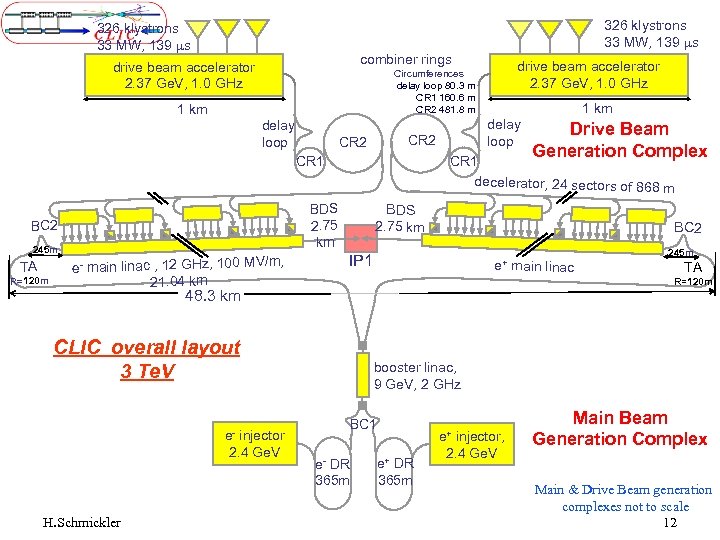 326 klystrons 33 MW, 139 ms combiner rings drive beam accelerator 2. 37 Ge. V, 1. 0 GHz 1 km delay loop TA R=120 m , e- main linac , 12 GHz, 100 MV/m 21. 04 km BC 2 IP 1 e+ H. Schmickler main linac 245 m TA R=120 m CLIC overall layout 3 Te. V injector 2. 4 Ge. V Drive Beam Generation Complex BDS 2. 75 km 48. 3 km e- 1 km CR 1 decelerator, 24 sectors of 868 m BDS 2. 75 km BC 2 delay loop CR 2 CR 1 245 m drive beam accelerator 2. 37 Ge. V, 1. 0 GHz Circumferences delay loop 80. 3 m CR 1 160. 6 m CR 2 481. 8 m booster linac, 9 Ge. V, 2 GHz BC 1 e- DR 365 m e+ injector, 2. 4 Ge. V Main Beam Generation Complex Main & Drive Beam generation complexes not to scale 12
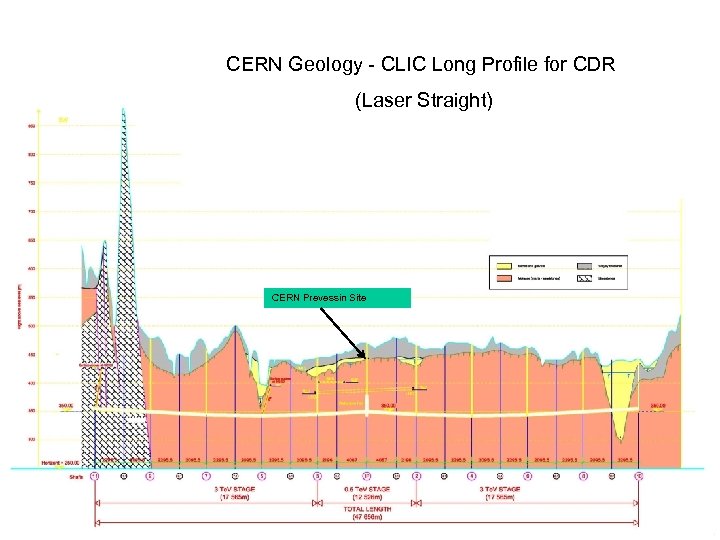 CERN Geology - CLIC Long Profile for CDR (Laser Straight) CERN Prevessin Site
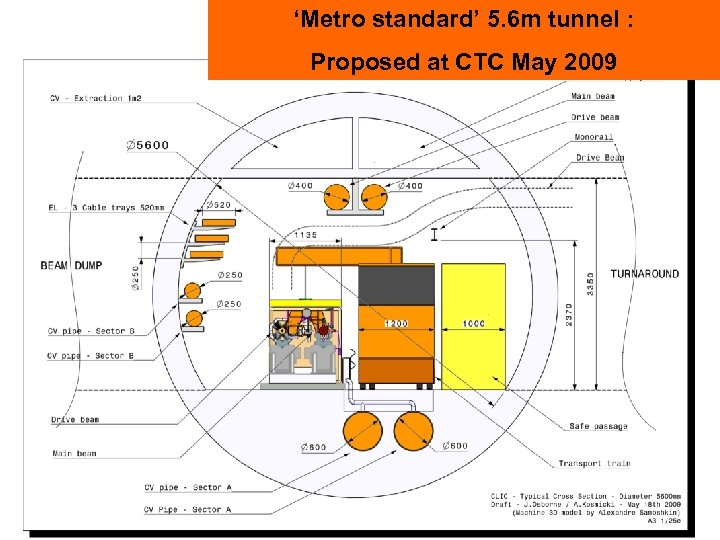 ‘Metro standard’ 5. 6 m tunnel : Proposed at CTC May 2009
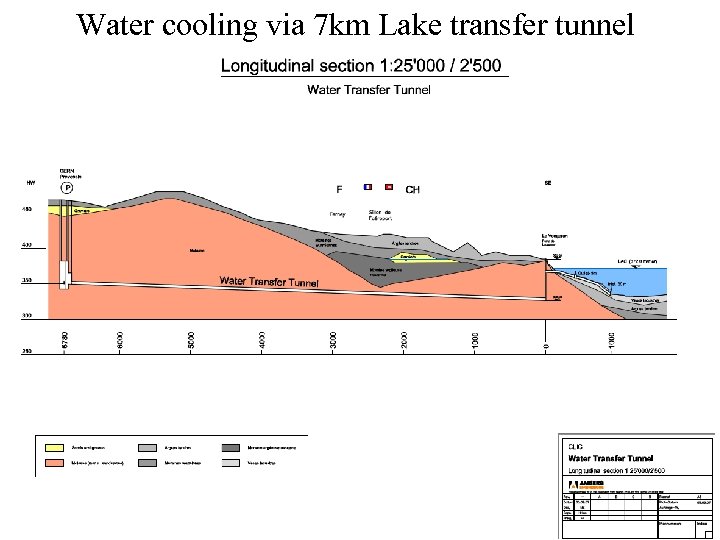 Water cooling via 7 km Lake transfer tunnel
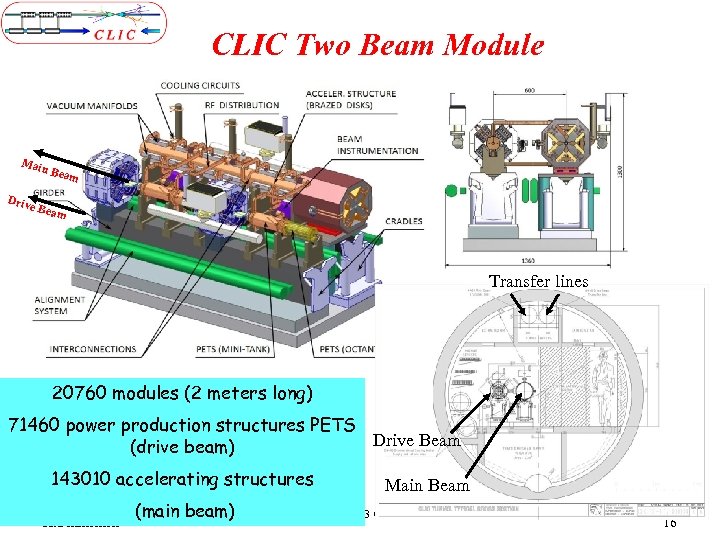 CLIC Two Beam Module Mai Driv n Be am e Bea m Transfer lines 20760 modules (2 meters long) 71460 power production structures PETS Drive Beam (drive beam) 143010 accelerating structures H. Schmickler (main beam) Main Beam EPAC 2008 CLIC / CTF 3 G. Geschonke, CERN 16 16
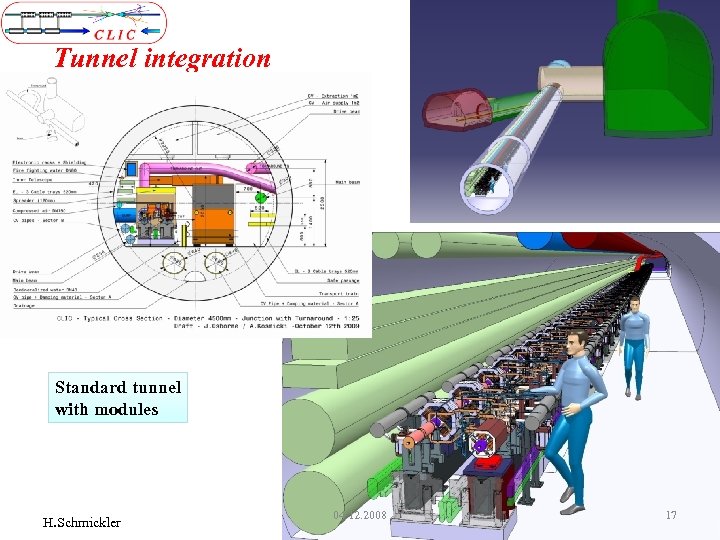 Tunnel integration DB turn-around DB dump UTRA cavern Standard tunnel with modules H. Schmickler 04. 12. 2008 17 17
 TDR major activities 2010 1 2 3 2011 4 1 2 3 2012 4 1 2 3 2013 4 1 2 3 2014 4 1 2 3 2015 4 1 2 3 2016 4 1 2 3 CTF 3 TBTS operation 4 1 -2 structures, beam inst. loading, breakdown kick Deceler final decelerator ation 8 test (16 PETS, CTF 3 TBL operation inst. PETS 50%) initial tests, further tests, installation 2 installation 4 Modules lab modules testing pre-series production, industrialization 1 testing 3 module 1 module Modules CTF 3 inst. module s inst. testing 3 modules > upgrades? CTF 3 phase installat feedback design, hardware tests ion testing installat commis CTF 3 TBL+ ion sio-ning RF testing, potential upgrades CLIC DB injector & linac design & hardware construction installation commissioning staged upgrade & testing precision up to 40 structures built, establish precision RF structures more than 200 structures built, final cost metrology, fabr. machining at CERN or elsewhere, 5 mm tolerances construction procedures achieved optimization, pre-series with industry CERN test stand testing continue testing with increased RF test stand upgrades (at least capabilities, CERN or elsewhere, testing, up to 200 accelerating structures plus infrastructure inst. two slots) up to 10 slots PETS and RF components Prototypes of technical finalization, performance & cost optimization, critical components choices, design construction, hardware tests industrialization for large scale components H. Schmickler 18