 Скачать презентацию Overview Ch 4 v Describe the factors that
2392c1d11507b0a83fcd8ad9fb155c99.ppt
- Количество слайдов: 37



Overview Ch. 4 v Describe the factors that influence consumer behaviour online v Describe how companies are building one-toone relationship with customers v Discuss the issues of e-loyalty and e-trust in EC v Describe consumer market research in EC v Describe the objectives of web advertising on the web v Describe various online promotions
Company-Centric B 2 B and Collaborative Commerce
Learning Objectives v Describe the major types of B 2 B models v Describe the characteristics of the sell-side v v v marketplace Describe the sell-side intermediaries models Describe the characteristics of the buy-side marketplace and e-procurement Explain how forward and backward auctions work in B 2 B Describe B 2 B aggregation and group purchasing models Describe collaborative e-commerce Describe infrastructure for B 2 B
Concepts, Characteristics and Models of B 2 B EC v B 2 B EC or e. B 2 B (electronic B 2 B) defined § Transaction conducted electronically between business over the networks • Internet • Extranets • Intranets • Private networks (e. g. , EDI) § Automated trading improves the process v Market size and content § Expected to grow from $1. 1 trillion in 2003 to $10 trillion by 2005 § Percentage of Internet-based B 2 B from 2. 1% in 2000 to 10% in 2005
![Concepts, Characteristics and Models of B 2 B EC [2] v How is B](https://present5.com/presentation/2392c1d11507b0a83fcd8ad9fb155c99/image-5.jpg "Concepts, Characteristics and Models of B 2 B EC [2] v How is B")
Concepts, Characteristics and Models of B 2 B EC [2] v How is B 2 B conducted? § Directly between buyer and seller § Via an online intermediary: an online third-party that brokers a transaction between a buyer and a seller; can be virtual or click-and-mortar § With or without intermediaries v Types of transactions § Spot buying • Purchasing of goods and services as they are needed, usually at prevailing market prices, which are determined dynamically by supply and demand § Strategic sourcing • Purchases made in long term contracts that are usually based on private negotiation between sellers and buyers
![Concepts, Characteristics and Models of B 2 B EC [3] v Types of Materials](https://present5.com/presentation/2392c1d11507b0a83fcd8ad9fb155c99/image-6.jpg "Concepts, Characteristics and Models of B 2 B EC [3] v Types of Materials")
Concepts, Characteristics and Models of B 2 B EC [3] v Types of Materials § Direct materials • materials used in the production of a product (e. g. , steel in a car or paper in a book) § Indirect materials • materials used to support production (e. g. , office supplies or light bulbs) § MROs (Maintenance, Repairs, and Operations) • indirect materials used in activities that support production
![Concepts, Characteristics and Models of B 2 B EC [4] v Direction of Trade](https://present5.com/presentation/2392c1d11507b0a83fcd8ad9fb155c99/image-7.jpg "Concepts, Characteristics and Models of B 2 B EC [4] v Direction of Trade")
Concepts, Characteristics and Models of B 2 B EC [4] v Direction of Trade § Vertical marketplaces • Markets that deal with one industry or industry section • Examples: electronics, cars, steel or chemicals § Horizontal • Markets that concentrate on a service or a product used in all types of industries • Examples: office supplies, PCs or travel services
The Basic B 2 B Transaction Types v Sell side § one seller to many buyers v Buy side § one buyer from many sellers v Exchanges § many sellers to many buyers v Collaborative commerce § communication and sharing of information, design, and planning among business partners
One-to-Many and Many-to-One: Company Centric Transactions v Company-centric EC § e-commerce that focuses on a single company’s buying needs (many-to-one, or buy-side) or selling needs (one-to-many, or sell-side) v Private e-marketplaces § markets in which the individual sell-side or buy-side company has complete control over participation in the selling or buying transaction
Many-to-Many: Exchanges v Exchanges § many-to-many e-marketplaces, usually owned and run by a third party or a consortium, in which many buyers and many sellers meet electronically to trade with each other § also called trading communities or trading exchanges v Public e-marketplaces § third-party markets that are open to all interested parties (sellers and buyers)
Virtual service industries in B 2 B § § § Travel and tourism services Real estate Electronic payments Online stock trading Online financing Other online services
Benefits of B 2 B § Eliminate paper-based systems and reduces administrative costs § Expedite cycle time § Lower search costs and time for buyers § Increase employee productivity dealing with buying and/or selling § Reduce errors and/or improve quality of services § Reduce inventory levels and costs § Increase production flexibility, permitting just-in-time delivery § Facilitate mass customization § Increase opportunities for collaboration
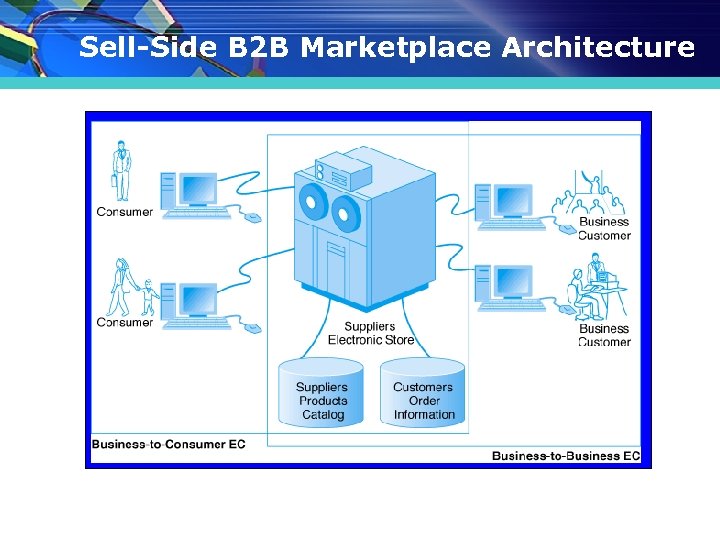
Sell-Side B 2 B Marketplace Architecture
Sell-Side Marketplaces: One-to-Many v Sell-side e-marketplace § a Web-based marketplace in which one company sells to many business buyers, frequently over an extranet v 3 major methods for direct sale in the one-tomany model: § Selling from electronic catalogs § Selling via forward auctions § One-to-one selling under a negotiated, long-term contract
Direct Sales from Catalogs v Companies may: § Offer one catalog for all customers § Customized catalog for each customer § Facilitate the B 2 B direct sale by providing the buyer with a buyer customized shopping cart v Configuration and customization § Efficient customization for direct sales § Business customers customize products, receive price quote, submit order
![Direct Sales from Catalogs [2] v Benefits § Reduces costs (to buyers and sellers)](https://present5.com/presentation/2392c1d11507b0a83fcd8ad9fb155c99/image-16.jpg "Direct Sales from Catalogs [2] v Benefits § Reduces costs (to buyers and sellers)")
Direct Sales from Catalogs [2] v Benefits § Reduces costs (to buyers and sellers) and errors during the process § Speeds up order cycle § Ability to customize products § Offer different prices to different customers v Limitations § Channel conflicts with distribution systems § High cost when traditional EDI used § Large number of business partners is needed to justify system
Selling via Auctions v Using auctions on the sell-side § Revenue generation § Increased page views • Stickiness—characteristic of customer loyalty to a Web site, demonstrated by the number and length of visits to a site § Member acquisition and retention • Bidding transactions result in additional registered members
Buy Side Marketplaces: One-from-Many v Procurement methods § Buy from manufacturers, wholesalers, or retailers at their storefronts, from catalogs, and by negotiation § Buy from the catalog of an intermediary § Buy from an internal-buyer’s catalog § Conduct a bidding or tendering system § Buy at private or public auction sites § Join a group-purchasing system
![Buy Side Marketplaces: One-from-Many [2] v Procurement management § the coordination of all the](https://present5.com/presentation/2392c1d11507b0a83fcd8ad9fb155c99/image-19.jpg "Buy Side Marketplaces: One-from-Many [2] v Procurement management § the coordination of all the")
Buy Side Marketplaces: One-from-Many [2] v Procurement management § the coordination of all the activities relating to purchasing goods and services needed to accomplish the mission of an organization v Inefficiencies in procurement management § Purchasing personnel spend time and effort on procurement activities § Qualifying suppliers & Negotiating prices and terms v Potential inefficiencies: § Delays or Paying too much for rush orders § Maverick buying—unplanned purchases of items needed quickly, often from non-approved vendors or at higher prices
![Buy Side Marketplaces: One-from-Many [3] v Goals of procurement reengineering § Increase purchasing agent](https://present5.com/presentation/2392c1d11507b0a83fcd8ad9fb155c99/image-20.jpg "Buy Side Marketplaces: One-from-Many [3] v Goals of procurement reengineering § Increase purchasing agent")
Buy Side Marketplaces: One-from-Many [3] v Goals of procurement reengineering § Increase purchasing agent productivity § Lower purchasing prices of items § Improve information flow and management § Minimize maverick (unplanned) buying § Improve payment process § Streamline purchasing process to make it: • Simple • Fast
![Buy Side Marketplaces: One-from-Many [4] § Reduce administrative processing cost per order § Find](https://present5.com/presentation/2392c1d11507b0a83fcd8ad9fb155c99/image-21.jpg "Buy Side Marketplaces: One-from-Many [4] § Reduce administrative processing cost per order § Find")
Buy Side Marketplaces: One-from-Many [4] § Reduce administrative processing cost per order § Find new suppliers and vendors to provide faster/cheaper goods and services § Integrate procurement process with budgetary control in an efficient and effective way § Minimize human errors in buying or shipping process
Buy Side E-Marketplaces: Reverse Auctions v Buy-side e-marketplace § Web-based marketplace in which a buyer opens an electronic market on its own server and invites potential suppliers to bid on the items the buyer needs; also called the reverse auction, tendering, or bidding model v Request for quote (RFQ) § The “invitation” to a buy-side marketplace (reverse auction)
Conducting Reverse Auctions v Reverse auctions administered from a company’s Web site § Bidding process lasts a day or more § Bidders may bid only once or view the lowest bid and rebid several times v Increasing number of reverse auction sites makes it impossible for suppliers to monitor all of them § Online directories list open RFQs § Use software search-and-match agents to reduce the human burden in the bidding process
![Conducting Reverse Auctions [2] v Web-based reverse auction process § Buyers prepare bidding project](https://present5.com/presentation/2392c1d11507b0a83fcd8ad9fb155c99/image-24.jpg "Conducting Reverse Auctions [2] v Web-based reverse auction process § Buyers prepare bidding project")
Conducting Reverse Auctions [2] v Web-based reverse auction process § Buyers prepare bidding project information § Buyers post project on portal § Identify potential suppliers § Invite suppliers to bid § Suppliers download project information § Suppliers submit electronic bid § Reverse auction in real-time, or it can take a few days § Buyers evaluate and award contract
Benefits Reverse Auctions v Electronic process is faster v Administratively much less expensive v Enables location of cheapest possible products
Aggregating Catalogs v Aggregating suppliers’ catalogs: an internal marketplace § Maverick buying to save time leads to high prices § Aggregating all approved suppliers’ catalogs in one place v Reduced number of suppliers § Buyers at multiple corporate locations • Fewer and remote suppliers • Larger quantity/lower costs
Group Purchasing v Group purchasing—orders from several buyers are aggregated § Economy of scale § Reduced transaction processing cost § Putting together orders from multiple buyers to make large volumes/lower costs
Electronic Bartering v Electronic bartering § Exchange of goods or services without the use of money § Exchange a surplus for other need § Bartering exchange • Submit surplus to exchange for points • Points used to buy what company needs § Benefits: • Faster than manually • Easier to match
Collaborative Commerce (C-commerce) v Consisting of activities between business partners in jointly planning, designing, developing, managing, and researching products and services v Web-based systems used between and among suppliers for: § Communication § Design § Planning § Information sharing § Information discovery
![Collaborative Commerce (C-commerce) [2] v Varieties of c-commerce: § Joint design efforts § Forecasting](https://present5.com/presentation/2392c1d11507b0a83fcd8ad9fb155c99/image-30.jpg "Collaborative Commerce (C-commerce) [2] v Varieties of c-commerce: § Joint design efforts § Forecasting")
Collaborative Commerce (C-commerce) [2] v Varieties of c-commerce: § Joint design efforts § Forecasting § Between and within organizations v Aids communication and collaboration between headquarters and subsidiaries, franchisers and franchisees v C-commerce platform provides e-mail, message boards, chat rooms, online corporate data access around the globe, no matter what the time zone
Barriers to C-commerce v C-commerce is moving ahead fairly slowly because: § Technical reasons involving integration, standards, and networks § Security and privacy concerns over who has access control of information stored in a partner’s database § Internal resistance to new models and approaches § Lack of internal skills to conduct c-commerce
B 2 B Infrastructure v Server to host database and applications v Software for executing sell-side (catalogs) v Software for conducting auctions and reverse auctions v Software for e-procurement (buy-side) v Software for CRM v Security hardware and software v Software for building a storefront v Software for building exchanges v Telecommunications networks and protocols
Integration v Integration with existing information systems issues § Intranet-based work flow § Database management systems (DMBS) § Application packages § ERP v Integration with business partners § Easy integration with one company-centric side § Not easy to integrate for many buyers or sellers
The Role of XML in B 2 B Integration v Companies interact easily and effectively by connecting to their servers, applications, databases v Standard protocols and datarepresentation schemes are needed v Web is based on the standard communication protocols useful only for displaying static visual Web pages: § TCP/IP § HTTP § HTML
![The Role of XML in B 2 B Integration [2] v XML (e. Xtensible](https://present5.com/presentation/2392c1d11507b0a83fcd8ad9fb155c99/image-35.jpg "The Role of XML in B 2 B Integration [2] v XML (e. Xtensible")
The Role of XML in B 2 B Integration [2] v XML (e. Xtensible Markup Language) § Standard (and its variants) used to improve compatibility between the disparate systems of business partners by defining the meaning of data in business documents § Used to increase: • Interactivity • Accessibility
Summary v The B 2 B is very diversified and it can be divided into the following segments: § sell-side marketplaces § buy-side marketplaces § trading exchanges § c-commerce v Auctions play a major role in B 2 B v Increasing the exposure and/or the bargaining power of companies can be done by aggregating either the sellers or the buyers
Exercise v Why would a company want to decrease maverick purchases? v A firm wants to barter excess goods online for banner ads, but they cannot find a party willing to trade. What other options do they have?
Скачать презентацию Overview Ch 4 v Describe the factors that
2392c1d11507b0a83fcd8ad9fb155c99.ppt