


 Скачать презентацию Overview and applications Vinod Kulathumani West Virginia University
7deeb169219ebdd230790314b69686ee.ppt
- Количество слайдов: 43
 Overview and applications Vinod Kulathumani West Virginia University
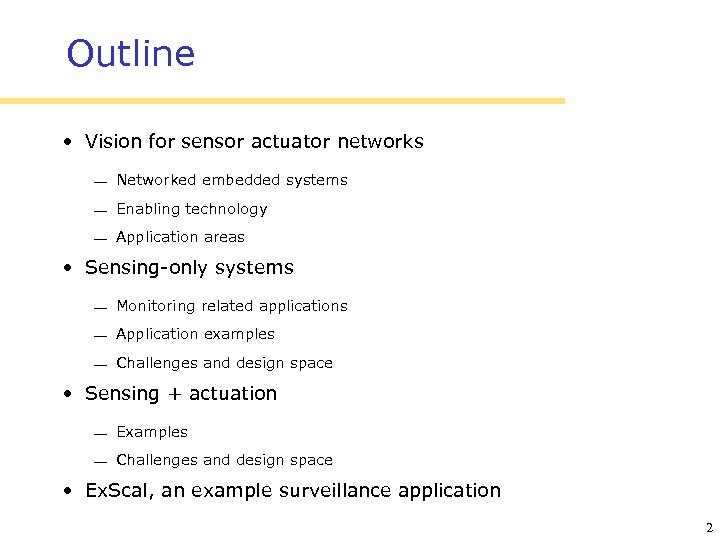 Outline • Vision for sensor actuator networks Networked embedded systems Enabling technology Application areas • Sensing-only systems Monitoring related applications Application examples Challenges and design space • Sensing + actuation Examples Challenges and design space • Ex. Scal, an example surveillance application 2
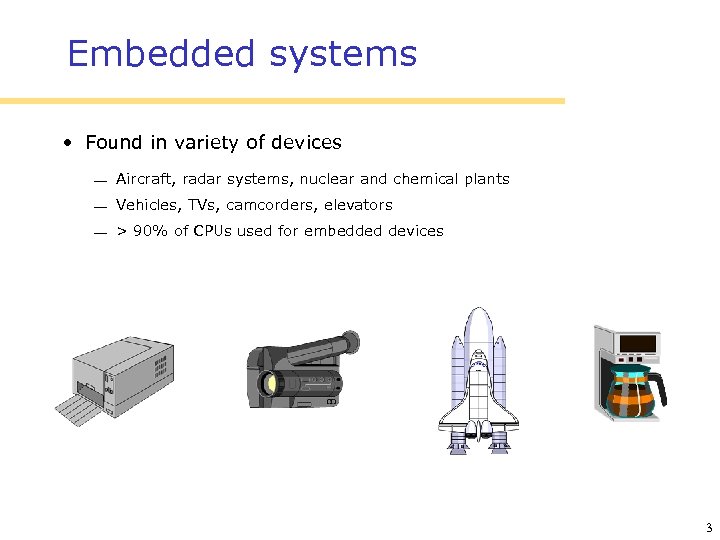 Embedded systems • Found in variety of devices Aircraft, radar systems, nuclear and chemical plants Vehicles, TVs, camcorders, elevators > 90% of CPUs used for embedded devices 3
 Networked embedded systems Currently • Embedded processors - part of a larger system • Application known apriori Little flexibility in programming What if? • embedded processors were connected – preferably wireless? • there was greater flexibility in programming ? • sensing and actuation capabilities were included ? 4
 The Vision for WSANs • Combine wireless networks with sensing / actuation Ubiquitous computing / pervasive computing • Fine-grained monitoring and control of environment • Network and interact with billions of embedded computers Reasons • Wireless communication - no need for infrastructure setup • Drop and play • Nodes are built using off-the-shelf cheap components • Feasible to deploy nodes densely 5
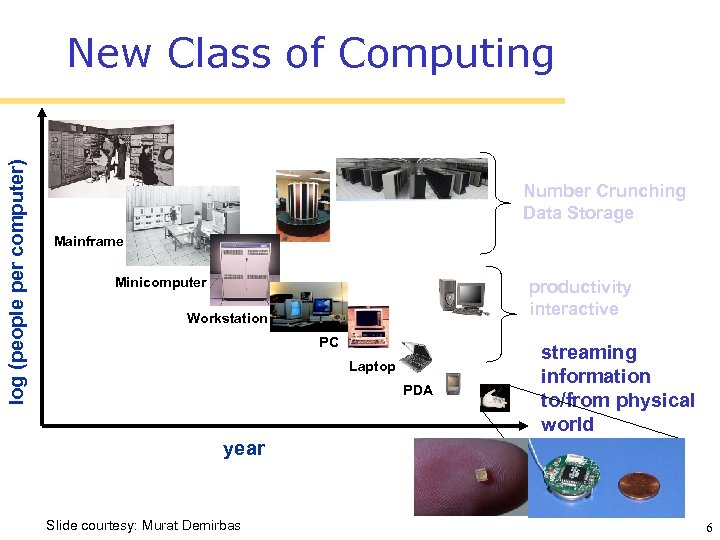 log (people per computer) New Class of Computing Number Crunching Data Storage Mainframe Minicomputer productivity interactive Workstation PC Laptop PDA streaming information to/from physical world year Slide courtesy: Murat Demirbas 6
 Opinions Tiny computers that constantly monitor ecosystems, buildings, and even human bodies could turn science on its head. - Nature, March 2006 The use of sensornets throughout society could well dwarf previous milestones in information revolution. - National Research Council report, 2001 Reinventing computer science - David Tennenhouse, Intel, 2000 7
 Enabling technology • Powerful microprocessors Small form factor Low energy consumption • Micro-sensors (MEMS, Materials, Circuits) acceleration, vibration, gyroscope, tilt, motion magnetic, heat, pressure, temp, light, moisture, humidity, barometric chemical (CO, CO 2, radon), biological, micro-radar actuators (mirrors, motors, smart surfaces, micro-robots) • Communication short range, low bit-rate, CMOS radios 8
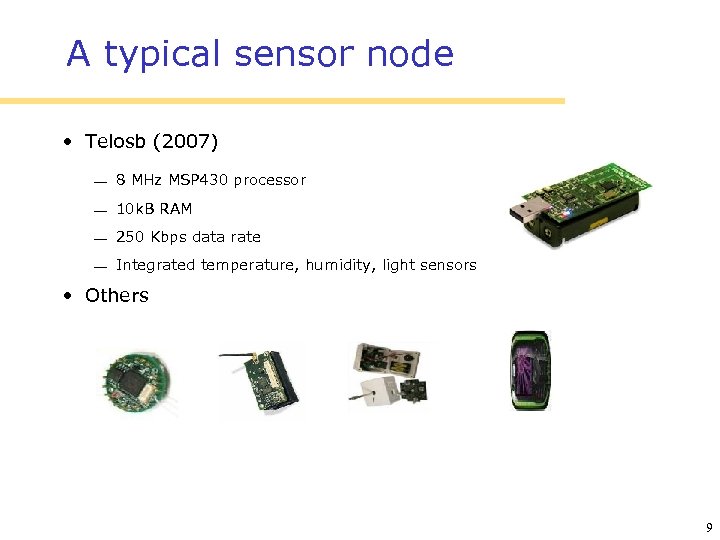 A typical sensor node • Telosb (2007) 8 MHz MSP 430 processor 10 k. B RAM 250 Kbps data rate Integrated temperature, humidity, light sensors • Others 9
 Application areas for WSANs • Science Environmental and habitat monitoring Oceanography, seismology, water management, … • Engineering Precision agriculture Industrial automation Control systems, … • Daily life Detecting emergencies and alerting, disaster recovery Health care Traffic management and many more 10
 Sensing only systems • Popular as wireless sensor networks • Useful for monitoring based applications • Large scale networks of embedded sensors Connected to a remote base station Self-configuring Typically resource constrained (Why? ) 11
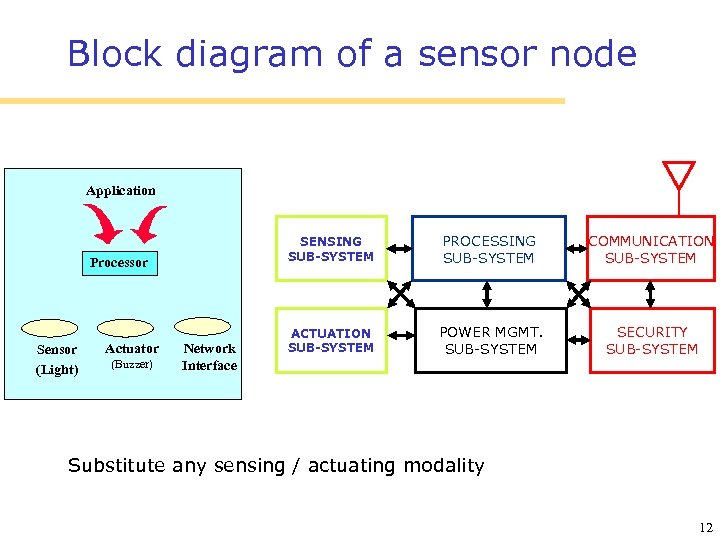 Block diagram of a sensor node Application SENSING SUB-SYSTEM Processor Sensor (Light) Actuator (Buzzer) Network Interface PROCESSING SUB-SYSTEM COMMUNICATION SUB-SYSTEM ACTUATION SUB-SYSTEM POWER MGMT. SUB-SYSTEM SECURITY SUB-SYSTEM Substitute any sensing / actuating modality 12
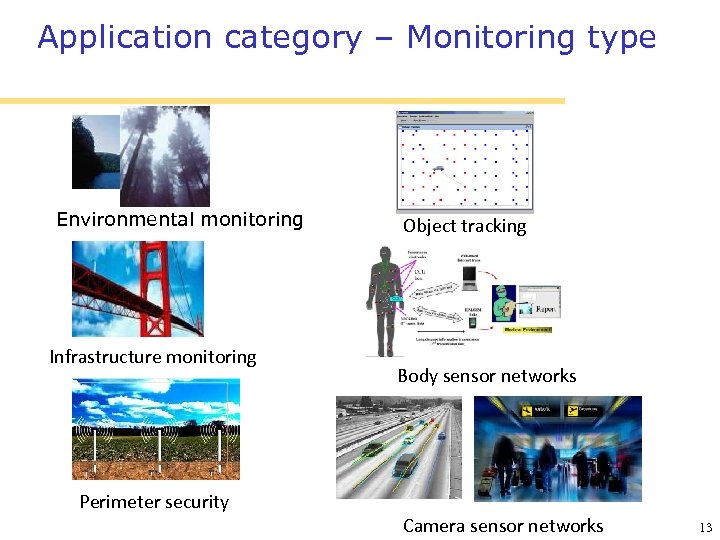 Application category – Monitoring type Environmental monitoring Infrastructure monitoring Perimeter security Object tracking Body sensor networks Camera sensor networks 13
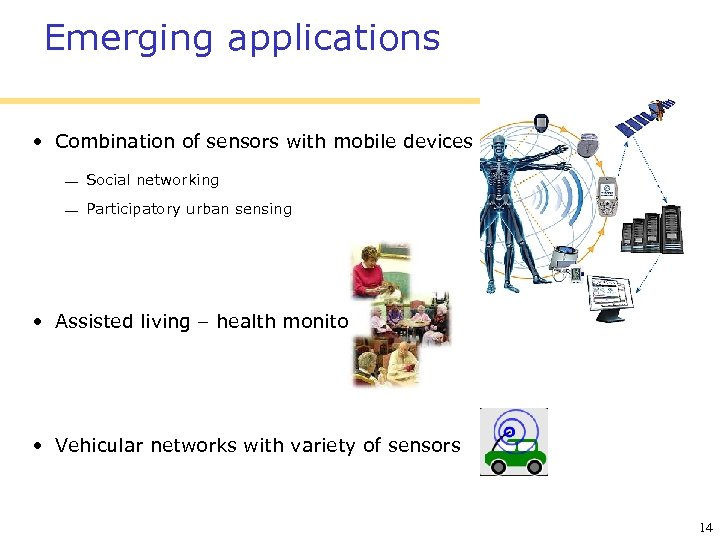 Emerging applications • Combination of sensors with mobile devices Social networking Participatory urban sensing • Assisted living – health monitoring • Vehicular networks with variety of sensors 14
 Specific examples • Detect and track intruders in a secure area • Detect chemical or biological attacks • Detect building fires and set up evacuation routes • Monitoring dangerous plants • Monitoring social behavior of animals in farms and natural habitats • Monitoring salinity of water • Monitoring cracks in bridges • Tracking dangerous goods • Shooter Localization • Epilepsy monitoring and suppression • Camera networks for urban surveillance • Monitoring traffic on a highway 15
 Challenges in sensor networks • Energy constraint : Nodes are battery powered • Unreliable communication • Unreliable sensors : Radio broadcast, limited bandwidth, bursty traffic : False positives • Ad hoc deployment : Pre-configuration inapplicable • Large scale networks : Algorithms should scale well • Distributed execution : Difficult to debug & get it right • Ease of use : All Scientists not programmers 16
 Sensing + actuation systems • Not simply monitoring events, objects Combined with actuation • Traditional control applications Decouple information availability Control assumes information is instantaneously available • What if information is transmitted over a sensor network? Losses, delays in information • New tools needed for programming, reasoning about such systems • Building blocks for Cyber-physical systems - recent buzzword! 17
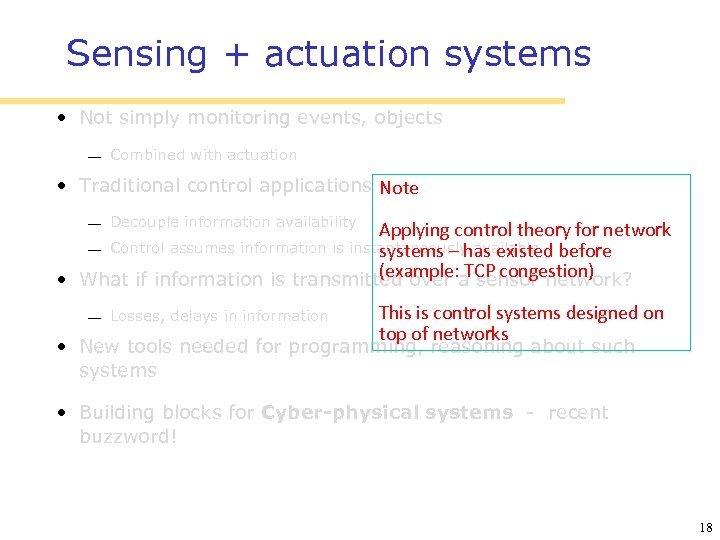 Sensing + actuation systems • Not simply monitoring events, objects Combined with actuation • Traditional control applications Note Decouple information availability Losses, delays in information Applying control theory for network Control assumes information is instantaneously available systems – has existed before (example: TCP congestion) • What if information is transmitted over a sensor network? This is control systems designed on top of networks • New tools needed for programming, reasoning about such systems • Building blocks for Cyber-physical systems - recent buzzword! 18
 Example sensor actuator networks • Robotic systems Self-configuring structures Robotic surgery Self-configuring table http: //www. youtube. com/ssrlab 0/#p/u/24/5 u. R 34 U 1 qc-Q • Autonomic vehicular platoons Use in UAV swarms Autonomous driving – Google Car! • Distributed vibration control • Distributed illumination control, irrigation, process control • Smart power grid 19
 We saw all these challenges for sensor networks • Energy constraint : Nodes are battery powered • Unreliable communication : Wireless, limited bandwidth, bursty traffic • Unreliable sensors : False positives, negatives • Ad hoc deployment : Pre-configuration inapplicable • Large scale networks : Algorithms should scale well • Distributed execution : Difficult to debug & get it right • Ease of use : All Scientists not programmers 20
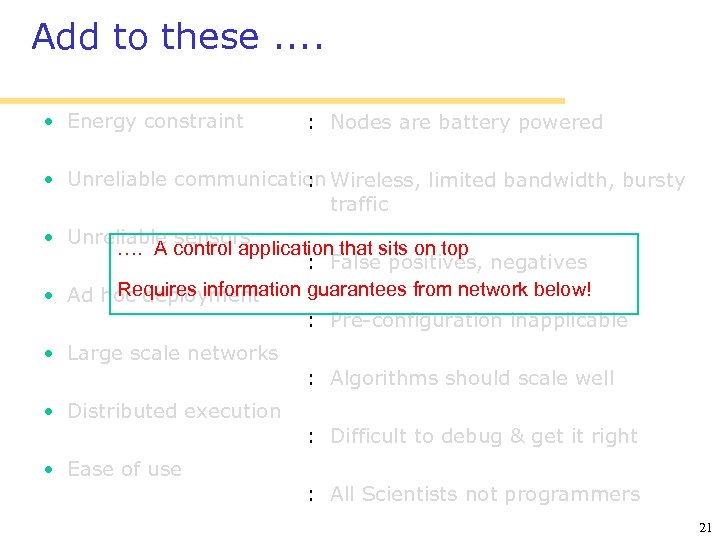 Add to these. . • Energy constraint : Nodes are battery powered • Unreliable communication Wireless, limited bandwidth, bursty : traffic • Unreliable sensors …. A control application that sits on top : False positives, negatives Requires information guarantees from network below! • Ad hoc deployment : Pre-configuration inapplicable • Large scale networks : Algorithms should scale well • Distributed execution : Difficult to debug & get it right • Ease of use : All Scientists not programmers 21
 Relation to CPS “Cyber-physical systems are physical, biological, and engineered systems whose operations are integrated, monitored, and/or controlled by a computational core. Components are networked at every scale. Computing is deeply embedded into every physical component, possibly even into materials. The computational core is an embedded system, usually demands real-time response, and is most often distributed. The behavior of a cyber-physical system is a fullyintegrated hybridization of computational (logical), physical, and human action. ” - National Science Foundation 22
 Characteristics of CPS • Cyber capability in every physical component • Interaction at large scales with wired or wireless networks • Dynamically re-organizing • Novel computational substrates (bio / nano) • Tight integration of computation, communication and control High degree of automation Operation must be dependable and certified Sensor nets + control + distributed computing + real-time systems 23
 Example: Automotive Telematics • Intra-vehicular sensing and control Engine control, Break system, Airbag deployment system, windshield wiper, Door locks, Entertainment system • V 2 V networks Cars are sensors and actuators Vehicular safety Autonomous navigation • Future Transportation Systems Incorporate both single person and mass transportation vehicles, air and ground transportations. achieve efficiency, safety, stability using real-time control and optimization. 24
 Example: Health Care and Medicine • Electronic Patient Records accessible anywhere, any time • Home care: monitoring and control Pulse oximeters, blood glucose monitors, infusion pumps, accelerometers, … • Operating Room of the Future Closed loop monitoring and control; multiple treatment stations, plug and play devices; robotic microsurgery System coordination challenge • Progress in bioinformatics: gene, protein expression, systems biology, disease dynamics, control mechanisms 25
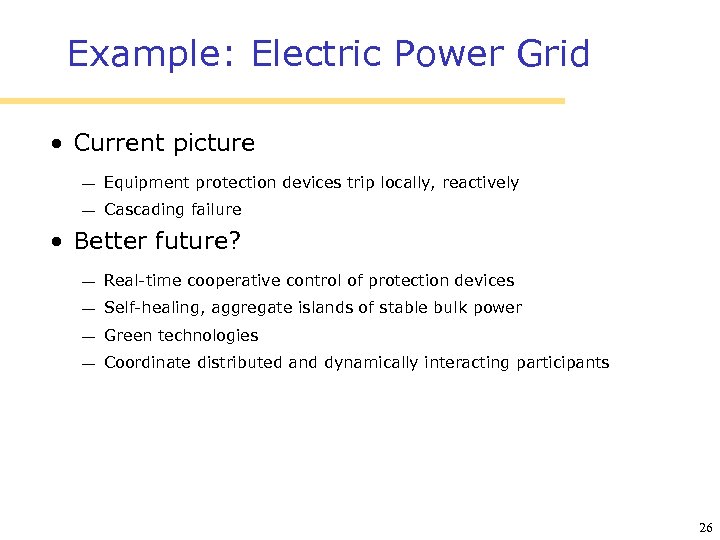 Example: Electric Power Grid • Current picture Equipment protection devices trip locally, reactively Cascading failure • Better future? Real-time cooperative control of protection devices Self-healing, aggregate islands of stable bulk power Green technologies Coordinate distributed and dynamically interacting participants 26
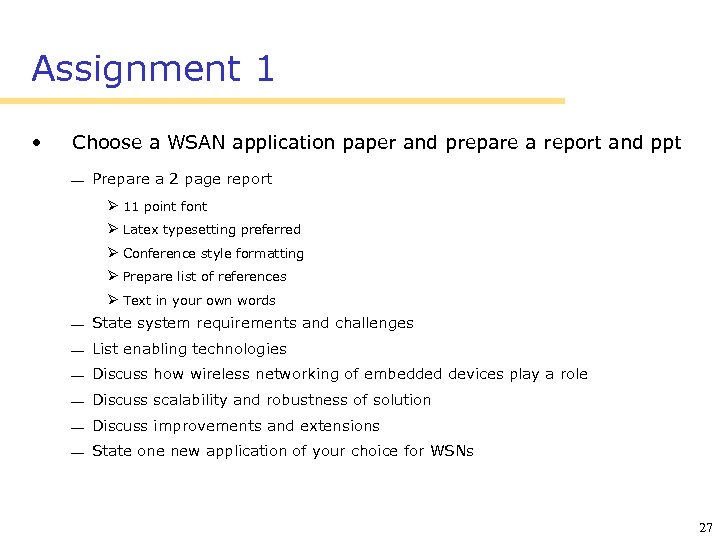 Assignment 1 • Choose a WSAN application paper and prepare a report and ppt Prepare a 2 page report 11 point font Latex typesetting preferred Conference style formatting Prepare list of references Text in your own words State system requirements and challenges List enabling technologies Discuss how wireless networking of embedded devices play a role Discuss scalability and robustness of solution Discuss improvements and extensions State one new application of your choice for WSNs 27
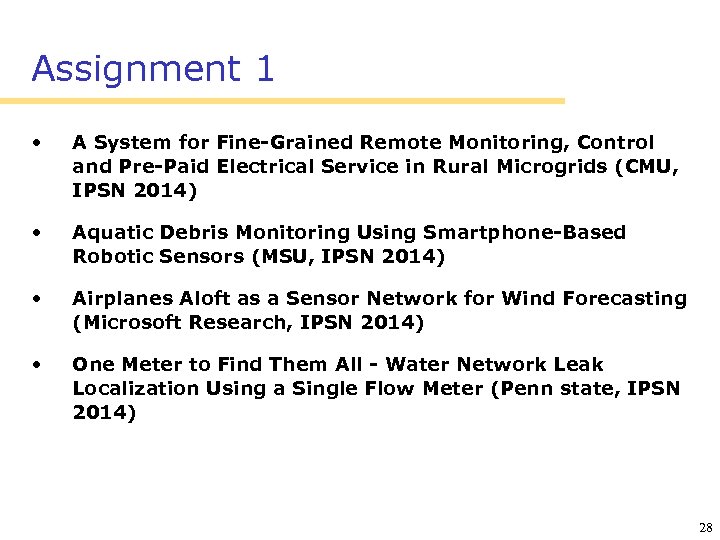 Assignment 1 • A System for Fine-Grained Remote Monitoring, Control and Pre-Paid Electrical Service in Rural Microgrids (CMU, IPSN 2014) • Aquatic Debris Monitoring Using Smartphone-Based Robotic Sensors (MSU, IPSN 2014) • Airplanes Aloft as a Sensor Network for Wind Forecasting (Microsoft Research, IPSN 2014) • One Meter to Find Them All - Water Network Leak Localization Using a Single Flow Meter (Penn state, IPSN 2014) 28
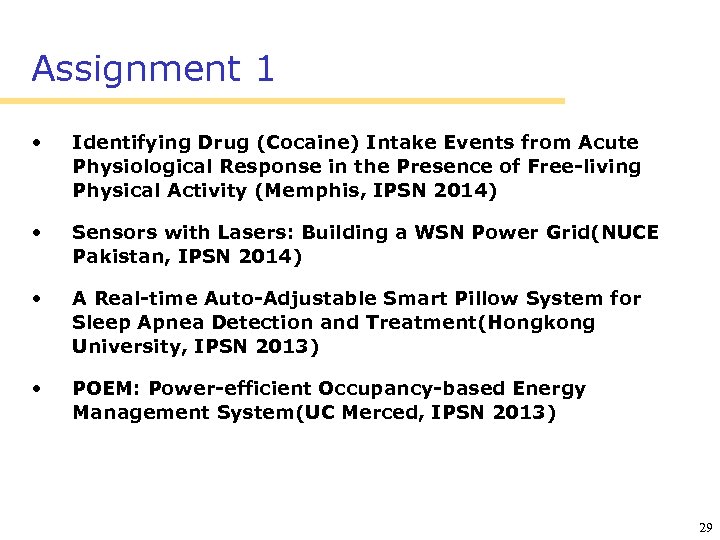 Assignment 1 • Identifying Drug (Cocaine) Intake Events from Acute Physiological Response in the Presence of Free-living Physical Activity (Memphis, IPSN 2014) • Sensors with Lasers: Building a WSN Power Grid(NUCE Pakistan, IPSN 2014) • A Real-time Auto-Adjustable Smart Pillow System for Sleep Apnea Detection and Treatment(Hongkong University, IPSN 2013) • POEM: Power-efficient Occupancy-based Energy Management System(UC Merced, IPSN 2013) 29
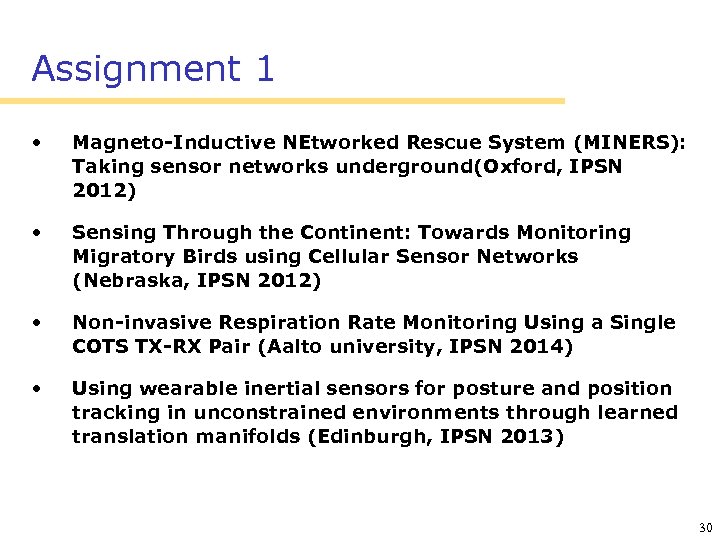 Assignment 1 • Magneto-Inductive NEtworked Rescue System (MINERS): Taking sensor networks underground(Oxford, IPSN 2012) • Sensing Through the Continent: Towards Monitoring Migratory Birds using Cellular Sensor Networks (Nebraska, IPSN 2012) • Non-invasive Respiration Rate Monitoring Using a Single COTS TX-RX Pair (Aalto university, IPSN 2014) • Using wearable inertial sensors for posture and position tracking in unconstrained environments through learned translation manifolds (Edinburgh, IPSN 2013) 30
 Other previous applications SLEWS: A Sensorbased Landslide Early Warning System Power grid monitoring Embedded systems for energy-efficient buildings (e. DIANA) Water quality monitoring Sensor networks for UV radiation control Precision agriculture and Agricultural applications Indoor environmental monitoring systems Damage detection in civil structures Participatory urban sensing 31
 Other previous applications Micro-strain sensor network for monitoring shuttle launch Smart room using camera networks Active visitor guidance system Analysis of a habitat monitoring application Smart-tag based data dissemination Meteorology and Hydrology in Yosemite Continuous medical monitoring Zebra. Net Virtual fences 32
 Other previous applications Sense. Web Car. Tel Assisted Living Wearable wireless body area networks (Health care) Adaptive house House_n project Responsive Environments Counter-sniper system Self-healing land mines 33
 Other previous applications • Take a look at Libelium Top 50 applications These are some of the potential application areas for sensor actuator networks: mostly non-military http: //www. libelium. com/top_50_iot_sensor_applications_ranking/ 34
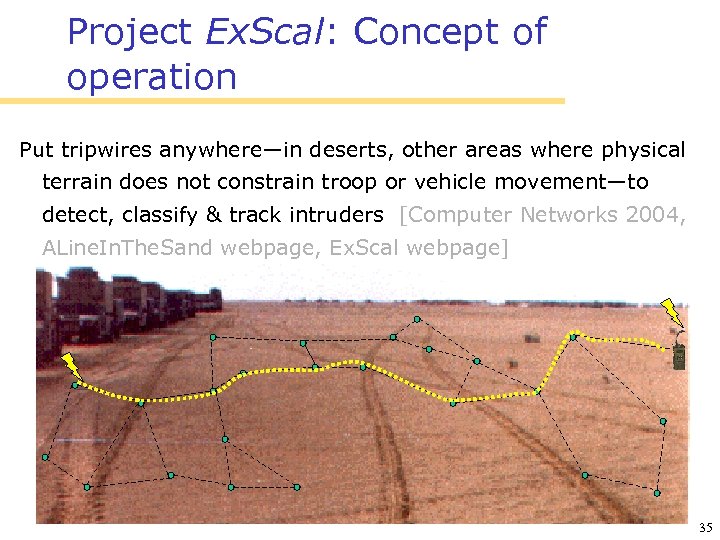 Project Ex. Scal: Concept of operation Put tripwires anywhere—in deserts, other areas where physical terrain does not constrain troop or vehicle movement—to detect, classify & track intruders [Computer Networks 2004, ALine. In. The. Sand webpage, Ex. Scal webpage] 35
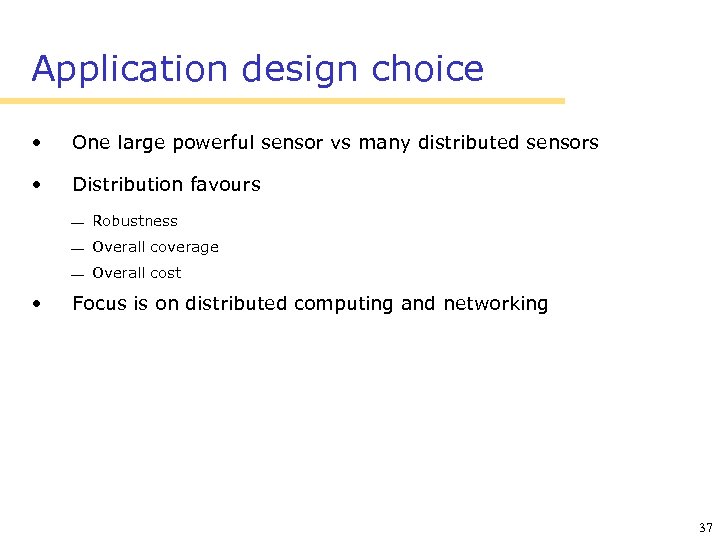 Application design choice • One large powerful sensor vs many distributed sensors • Distribution favours Overall coverage • Robustness Overall cost Focus is on distributed computing and networking 37
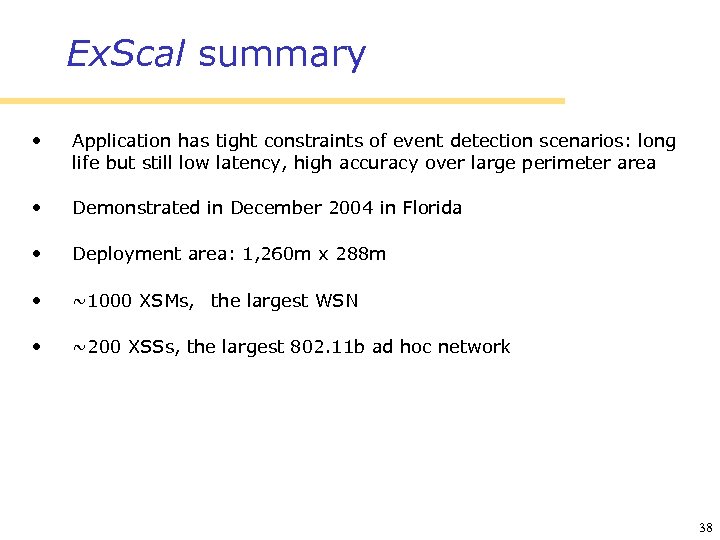 Ex. Scal summary • Application has tight constraints of event detection scenarios: long life but still low latency, high accuracy over large perimeter area • Demonstrated in December 2004 in Florida • Deployment area: 1, 260 m x 288 m • ~1000 XSMs, the largest WSN • ~200 XSSs, the largest 802. 11 b ad hoc network 38
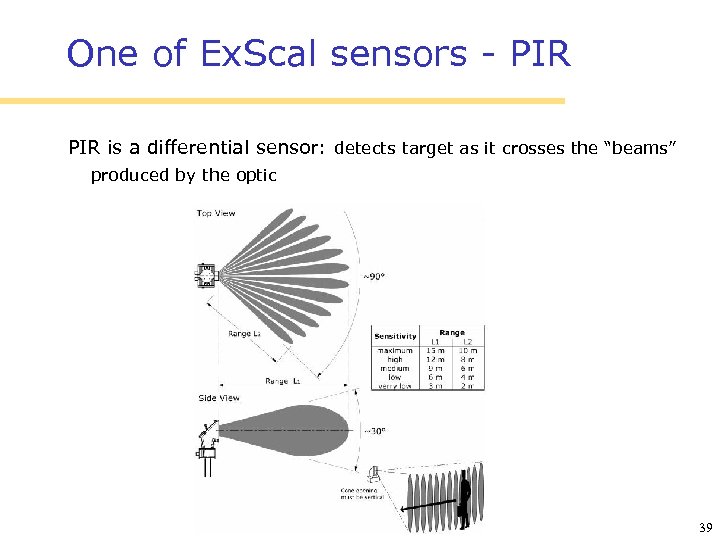 One of Ex. Scal sensors - PIR is a differential sensor: detects target as it crosses the “beams” produced by the optic 39
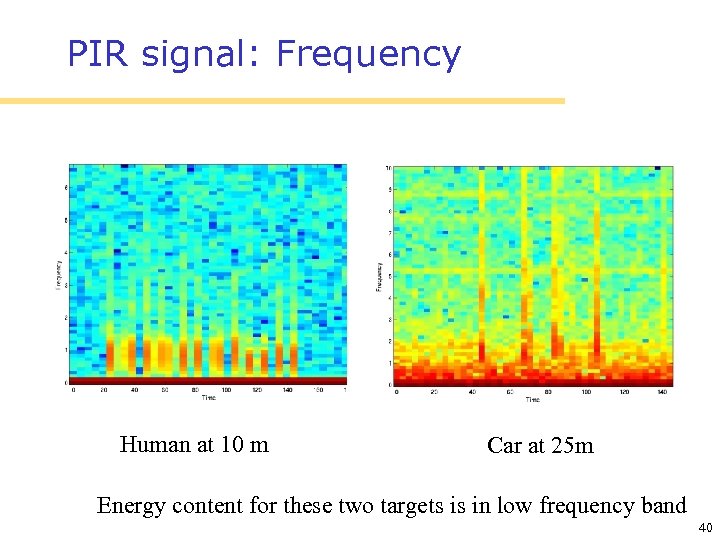 PIR signal: Frequency Human at 10 m Car at 25 m Energy content for these two targets is in low frequency band 40
![Pir target detector [0 -0. 3 Hz] Person at 12 m SUV at 25](https://present5.com/presentation/7deeb169219ebdd230790314b69686ee/image-40.jpg "Pir target detector [0 -0. 3 Hz] Person at 12 m SUV at 25") Pir target detector [0 -0. 3 Hz] Person at 12 m SUV at 25 m Bandpass: [0. 4 - 2 Hz] Bandpass: [2 - 4 Hz] 41
Pir target detector [0 -0. 3 Hz] Person at 12 m SUV at 25 m Bandpass: [0. 4 - 2 Hz] Bandpass: [2 - 4 Hz] 41
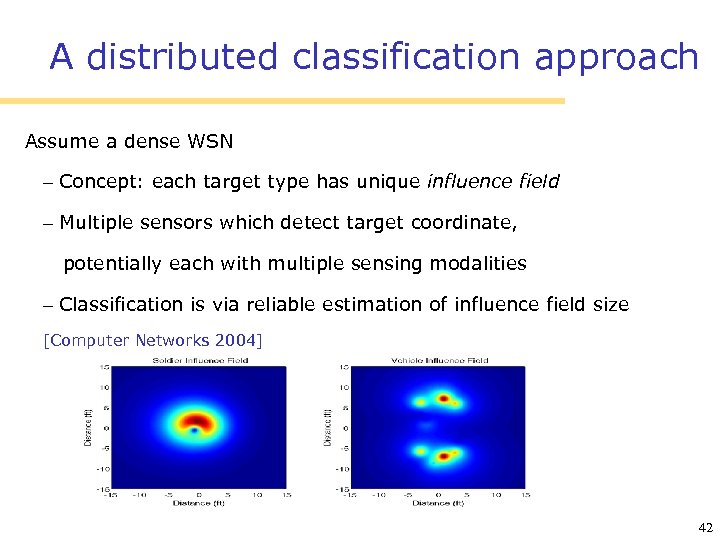 A distributed classification approach Assume a dense WSN – Concept: each target type has unique influence field – Multiple sensors which detect target coordinate, potentially each with multiple sensing modalities – Classification is via reliable estimation of influence field size [Computer Networks 2004] 42
 Further reading The Computer for 21 st Century Next century challenges: mobile networking for Smart Dust Connecting the physical world with pervasive networks D. Tennenhouse, Proactive computing Energy and performance considerations for smart dust Interesting Links on Sensor Networks www. wsnblog. com 43
 Further reading Some good advice for graduate students: • Edsger Dijkstra, The Three Golden Rules for Successful Scientific Research • Edsger Dijkstra, To a New Member of the Tuesday Afternoon Club • Jim Kurose, Ten Pieces of Advice I Wish My Ph. D Advisor Had Given Me • Andre De. Hon, Advice for Students Starting into Research • S. Keshav, How to Read a Paper • Philip W. L. Fong, How to Read a CS Research Paper? • William Strunk Jr. , E. B. White, The Elements of Style. (Recommended book on writing) 44