


 Скачать презентацию OVERSEAS EMPIRE Terms and People conquistador
ee09154bc639a70236e583f764ecea55.ppt
- Количество слайдов: 56
 OVERSEAS EMPIRE
 Terms and People • conquistador – a Spanish explorer who claimed lands in the Americas for Spain in the 1500 s and 1600 s • immunity – resistance to disease • Hernán Cortés – conquistador who landed in Mexico in 1519 and took over the Aztec empire • Tenochtitlán – the capital of the Aztec empire • Malinche – a young Indian woman who served as translator and advisor to Cortés
 Terms and People (continued) • alliance – formal agreement between two or more nations or powers to cooperate and come to one another’s defense • Moctezuma – the Aztec emperor who faced the Spanish invasion led by Cortés • Francisco Pizarro – Spanish conquistador who arrived in Peru in 1532, defeated the Incas, and conquered much of South America for Spain • civil war – a war fought between groups of people in the same nation
 Terms and People (continued) • • • peninsular – member of the highest class in Spain’s colonies in the Americas creole – an American-born descendant of Spanish settlers in Spain’s colonies in the Americas mestizo – a person of Native American and European descent in Spain’s colonies in the Americas mulatto – a person of African and European descent in Spain’s colonies in the Americas privateer – a pirate who operated with the approval of European governments
 Terms and People viceroy – a representative of the king who ruled in his name • encomienda – the right given to American colonists by the Spanish government to demand labor or tribute from Native Americans • Bartolomé de Las Casas – a Spanish priest who spoke out against the evils of the encomienda system and pleaded with the king to end the abuse • peon – a worker forced to labor for a landlord to pay off a debt •
 Terms and People • New France – French possession in present-day Canada from the 1500 s to 1763 • revenue – income • Pilgrims – English Protestants who rejected the Church of England • compact – an agreement among people
 Terms and People (continued) • French and Indian War – a war between France and England that erupted in 1754 in North America and ended in 1763 • Treaty of Paris – the agreement that officially ended the French and Indian War as well as other fighting between France and England, and ensured British dominance in North America
 Terms and People (continued) • entrepreneur – a person who takes on financial risks to make profits • mercantilism – an economic policy in which it was believed that a nation must export more goods than it imports to build its supply of gold and silver • tariff – a tax on imported goods
 Terms and People • Columbian Exchange – a vast global exchange of goods, people, plants, and animals that began with Columbus and profoundly affected the world • inflation – a rise in prices that is linked to a sharp increase in the amount of money available • price revolution – the period in European history during the 1500 s when inflation rose rapidly • capitalism – an economic system in which most businesses are owned privately
 How did a small number of Spanish conquistadors conquer huge Native American empires? Christopher Columbus landed in the Caribbean islands in 1492 and sparked a wave of exploration and conquest that would forever change the world. He was followed by Spanish armies that quickly defeated the Aztec and Inca empires.
 Christopher Columbus arrived in the West Indies and met the Taíno people in 1492. The Taínos lived in small farming villages. They were friendly to the Spanish. Despite this, Columbus and his men were hostile. They claimed the land for Spain and killed any Taínos who resisted.
 Conquistadors who arrived in the new world in Columbus’s wake followed this pattern. A cycle began in which Spanish conquerors seized Native American gold and killed vast numbers of people. The deaths were a result of both force and disease. Native Americans lacked immunity to European illnesses.
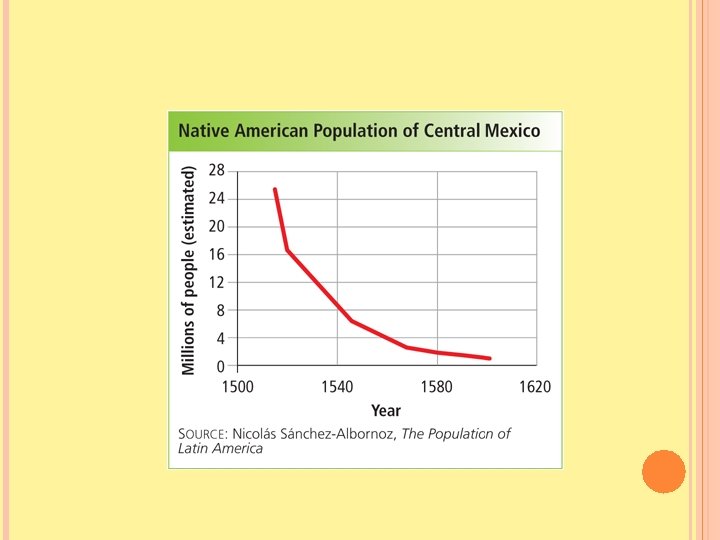
 A tiny force of hundreds of Spaniards conquered millions of Native Americans. • The Spanish had guns, cannons, and metal armor. • They also brought horses, which Native Americans had never seen. • But the biggest factor was disease. Smallpox, influenza, and measles killed up to 90 percent of the native population.
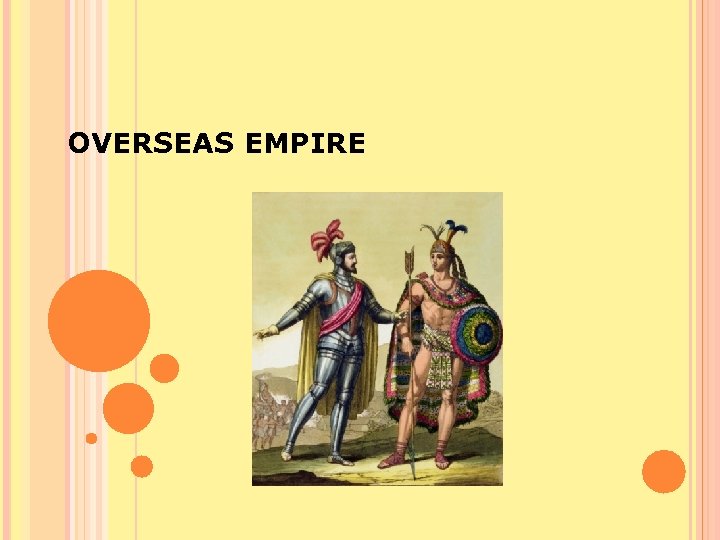
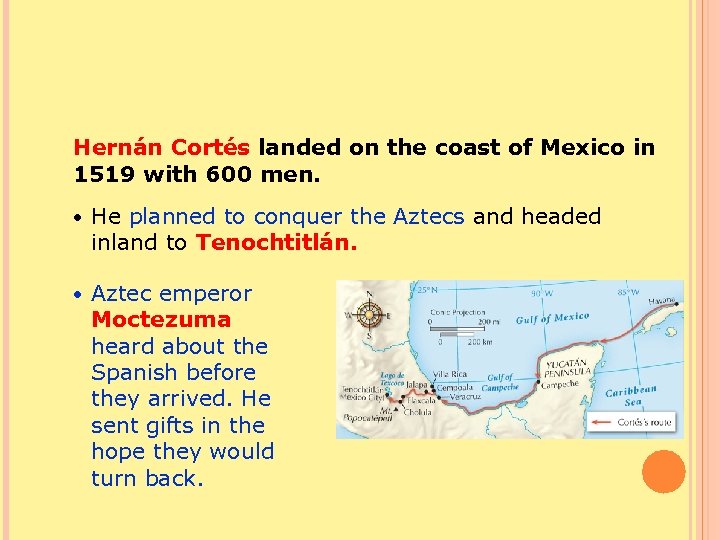 Hernán Cortés landed on the coast of Mexico in 1519 with 600 men. • He planned to conquer the Aztecs and headed inland to Tenochtitlán. • Aztec emperor Moctezuma heard about the Spanish before they arrived. He sent gifts in the hope they would turn back.
 Cortés was aided by a young Indian woman named Malinche, whom the Spanish called Doña Marina. . • Malinche served as translator and advisor to Cortés. • She helped him form alliances with Native American groups who had been previously conquered by the Aztecs and hated Aztec rule.
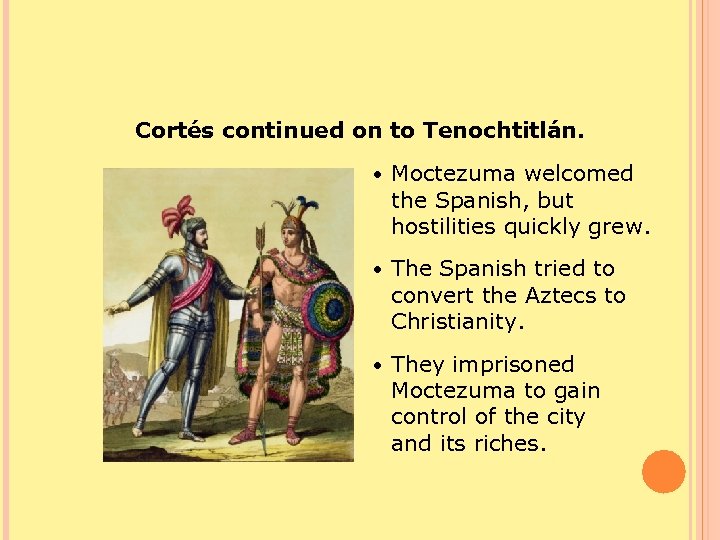 Cortés continued on to Tenochtitlán. • Moctezuma welcomed the Spanish, but hostilities quickly grew. • The Spanish tried to convert the Aztecs to Christianity. • They imprisoned Moctezuma to gain control of the city and its riches.
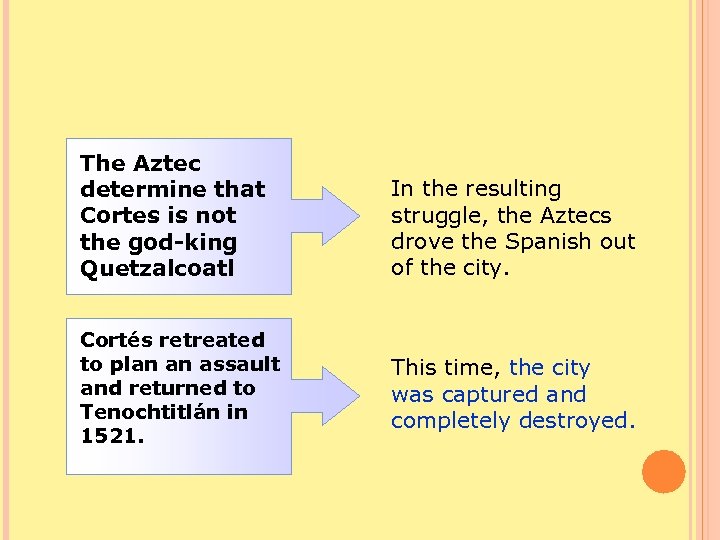 The Aztec determine that Cortes is not the god-king Quetzalcoatl Cortés retreated to plan an assault and returned to Tenochtitlán in 1521. In the resulting struggle, the Aztecs drove the Spanish out of the city. This time, the city was captured and completely destroyed.
 Francisco Pizarro was inspired by Cortés to conquer the Inca empire in Peru. • He began this quest in 1532, directly after an Inca civil war. • Atahualpa, the Inca ruler, refused to convert to Christianity. The Spanish captured and eventually killed him.
 Pizarro and his men overran the Inca empire and conquered much of the rest of South America for Spain. • Like Cortés, Pizarro benefited from superior weapons and diseases that killed millions of natives. • Pizarro was killed by a rival Spanish group, but his actions forever changed the continent.
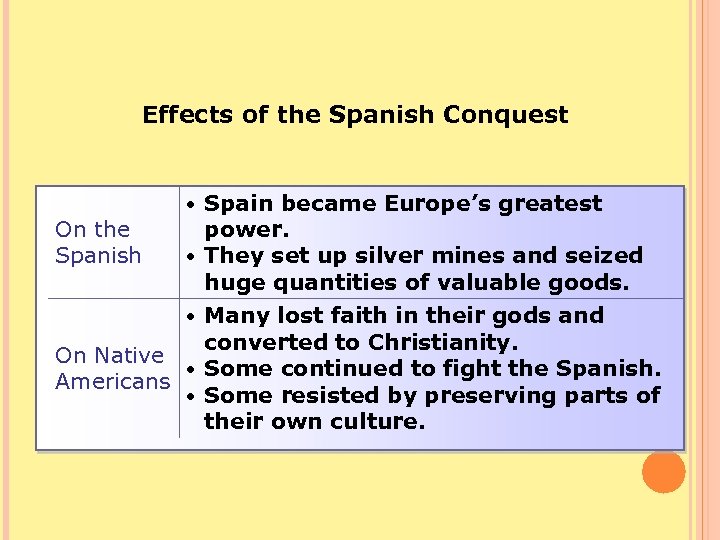 Effects of the Spanish Conquest Spain became Europe’s greatest power. • They set up silver mines and seized huge quantities of valuable goods. • On the Spanish Many lost faith in their gods and converted to Christianity. On Native • Some continued to fight the Spanish. Americans • Some resisted by preserving parts of their own culture. •
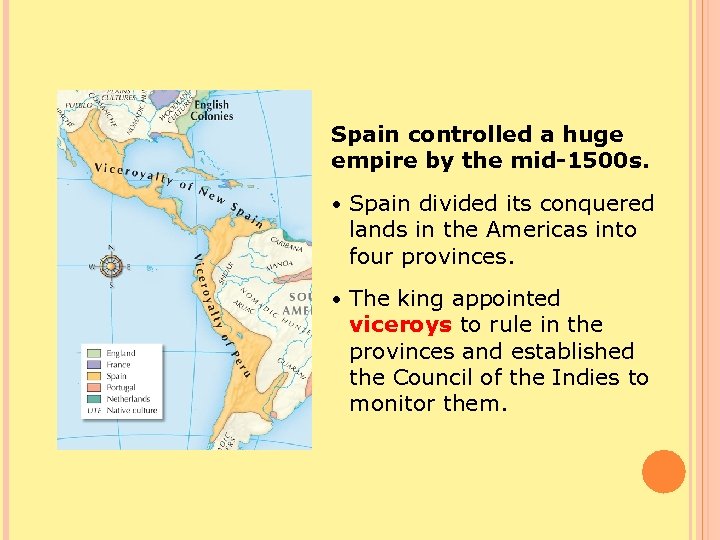 Spain controlled a huge empire by the mid-1500 s. • Spain divided its conquered lands in the Americas into four provinces. • The king appointed viceroys to rule in the provinces and established the Council of the Indies to monitor them.
 One of Spain’s main goals in the Americas was to spread Christianity. • As a result, Church leaders shared authority with royal officials. • Missionaries baptized thousands of Native Americans and worked to turn new converts into loyal subjects of Spain. • They also built churches, taught the Spanish language, and introduced European clothing and crafts.
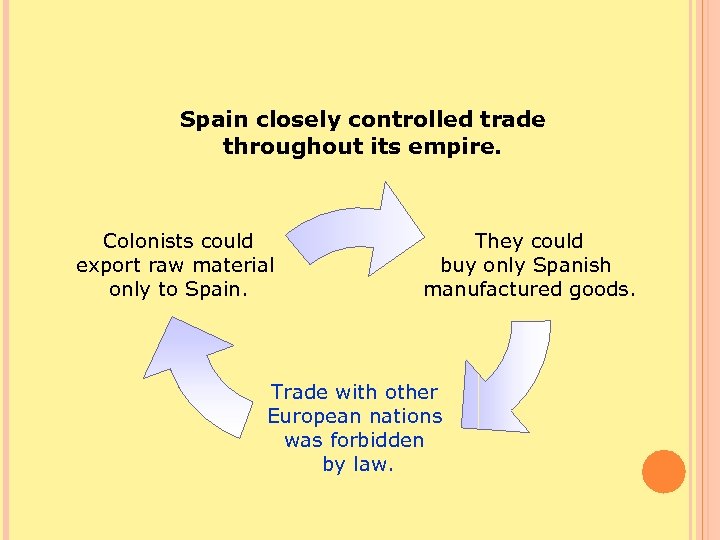 Spain closely controlled trade throughout its empire. Colonists could export raw material only to Spain. They could buy only Spanish manufactured goods. Trade with other European nations was forbidden by law.
 Spanish planters introduced sugar cane to the West Indies. The sugar industry soon became highly profitable. Sugar plantations required a large number of workers. Under the encomienda system, the Spanish could force Native Americans to work in mines and on plantations. Disease, starvation, and brutal conditions contributed to a sharp decline in the Native American population.
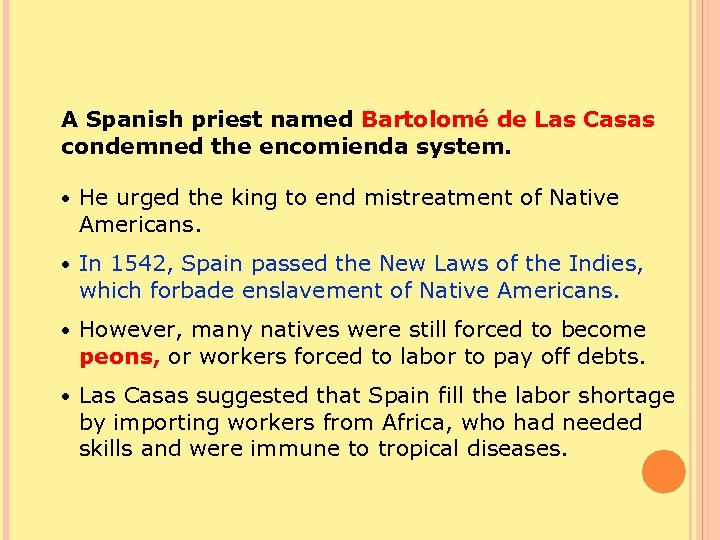 A Spanish priest named Bartolomé de Las Casas condemned the encomienda system. • He urged the king to end mistreatment of Native Americans. • In 1542, Spain passed the New Laws of the Indies, which forbade enslavement of Native Americans. • However, many natives were still forced to become peons, or workers forced to labor to pay off debts. • Las Casas suggested that Spain fill the labor shortage by importing workers from Africa, who had needed skills and were immune to tropical diseases.
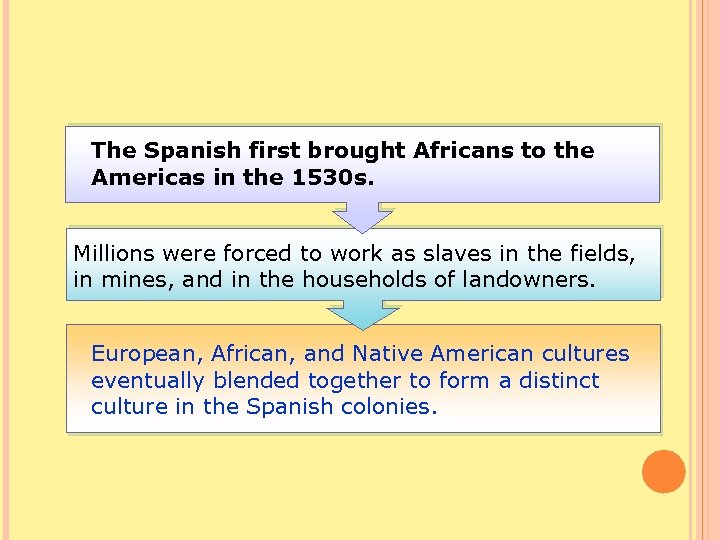 The Spanish first brought Africans to the Americas in the 1530 s. Millions were forced to work as slaves in the fields, in mines, and in the households of landowners. European, African, and Native American cultures eventually blended together to form a distinct culture in the Spanish colonies.
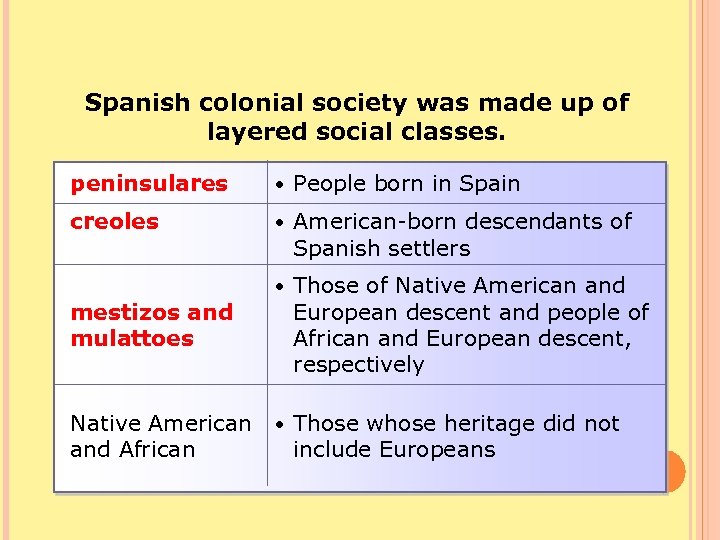 Spanish colonial society was made up of layered social classes. peninsulares • People born in Spain creoles • American-born descendants of Spanish settlers • Those of Native American and European descent and people of African and European descent, respectively • Those whose heritage did not include Europeans mestizos and mulattoes Native American and African
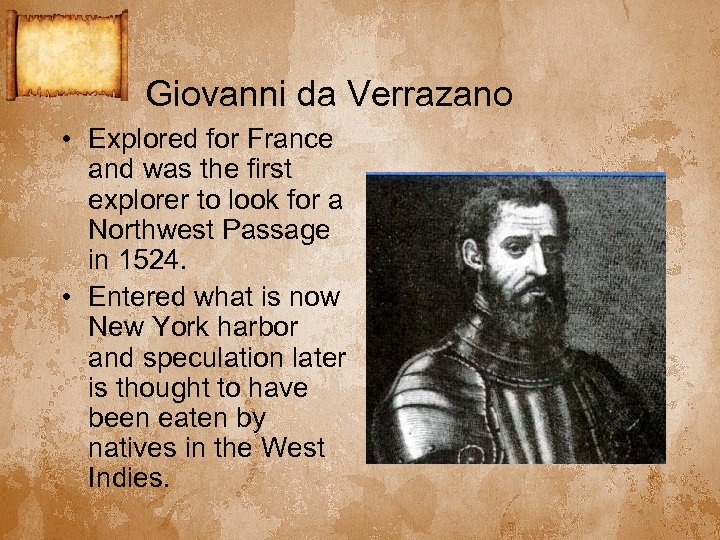 Giovanni da Verrazano • Explored for France and was the first explorer to look for a Northwest Passage in 1524. • Entered what is now New York harbor and speculation later is thought to have been eaten by natives in the West Indies.
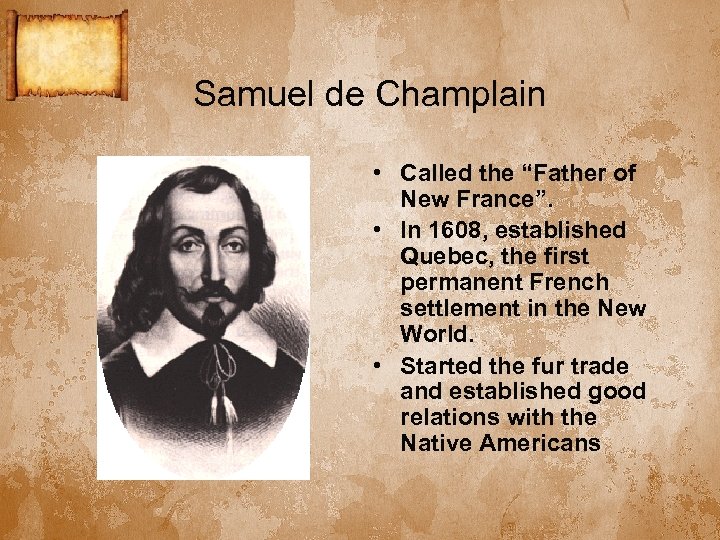 Samuel de Champlain • Called the “Father of New France”. • In 1608, established Quebec, the first permanent French settlement in the New World. • Started the fur trade and established good relations with the Native Americans
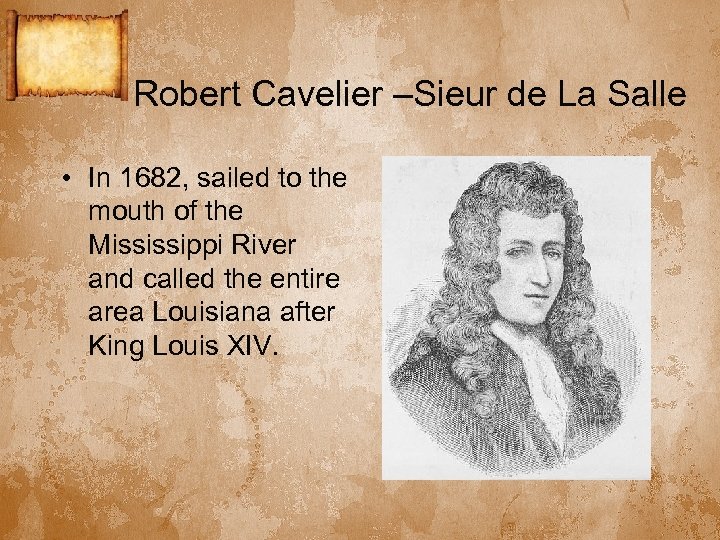 Robert Cavelier –Sieur de La Salle • In 1682, sailed to the mouth of the Mississippi River and called the entire area Louisiana after King Louis XIV.
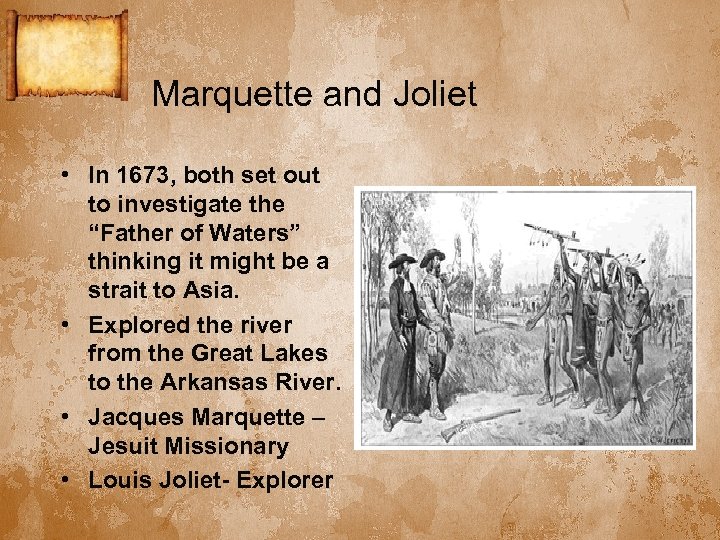 Marquette and Joliet • In 1673, both set out to investigate the “Father of Waters” thinking it might be a strait to Asia. • Explored the river from the Great Lakes to the Arkansas River. • Jacques Marquette – Jesuit Missionary • Louis Joliet- Explorer
 NEW NETHERLANDS English navigator Henry Hudson, claims land in North America for the Dutch in 1621. Dutch West India Company established the colonies in North America-New Amsterdam on Manhattan Island Dutch also establish a colony in 1652 in South Africa-Dutch Farmers called Boers settle at the Cape of Good Hope. By the 1700’s Dutch power was declining. England emerges as the leading European maritime nation.
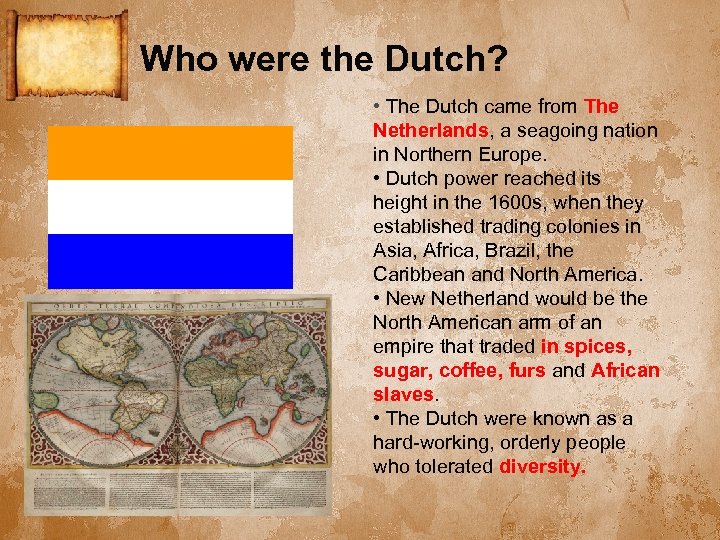 Who were the Dutch? • The Dutch came from The Netherlands, a seagoing nation in Northern Europe. • Dutch power reached its height in the 1600 s, when they established trading colonies in Asia, Africa, Brazil, the Caribbean and North America. • New Netherland would be the North American arm of an empire that traded in spices, sugar, coffee, furs and African slaves. • The Dutch were known as a hard-working, orderly people who tolerated diversity.
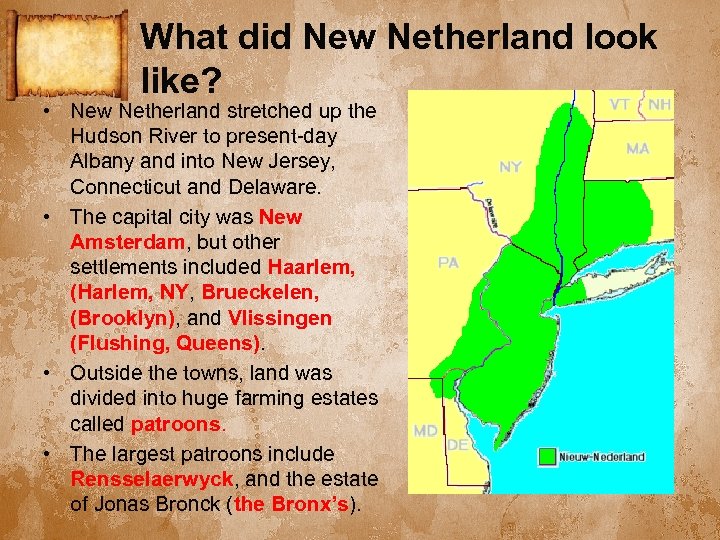 What did New Netherland look like? • New Netherland stretched up the Hudson River to present-day Albany and into New Jersey, Connecticut and Delaware. • The capital city was New Amsterdam, but other settlements included Haarlem, (Harlem, NY, Brueckelen, (Brooklyn), and Vlissingen (Flushing, Queens). • Outside the towns, land was divided into huge farming estates called patroons. • The largest patroons include Rensselaerwyck, and the estate of Jonas Bronck (the Bronx’s).
 English Explore the Americas • During the late 1400 s and 1500 s, explorers from England, France and the Netherlands began to explore America. • English explorers- Francis Drake and Italian-born John Cabot challenged Spain’s claim to the Americas. • Queen Elizabeth I built England into a sea power, which began a key chain of events: – Religious issues caused Spain and England to go to war. – In 1588 the Spanish king sent a fleet of 130 ships, called the Spanish Armada, to invade England. – England’s superior navy defeated the Spanish Armada, leaving England free to build American colonies.
 The English defeated the Spanish Armada and established several North American colonies. • After the defeat of the Spanish Armada, English colonists came to America for many reasons, including economic opportunity and adventure. • King James I issued a charter dividing North America between two groups of investors, the London Company and the Plymouth Company. • These companies were joint-stock ventures in which investors pooled their money, hoping to make a profit. • The companies governed and maintained the colonies and received most of the profit.
 The English in Virginia Roanoke Jamestown Key Events in Virginia History • In 1584 Sir Walter Raleigh sent a group to America. They claimed land along the Atlantic seaboard and named it Virginia. In 1587 they founded the colony of Roanoke. • In 1590 when the colony’s leader returned from England, he found the colony mysteriously empty of people. • Settled in 1607, this was the first English colony to survive, despite disease, contaminated water and lack of food. • John Smith, who imposed military discipline on the colonists, helped them survive hardships. • John Rolfe, who discovered tobacco and learned to cure it from his wife Pocahontas, made the colony profitable. • Formation of the House of Burgess, which was America’s first legislature, or law-making body • Use of indentured servants, who worked for a number of years in exchange for food, shelter and paid passage to America • Transition to slave labor by the late 1600 s
 The Puritans, seeking religious freedom, founded the Northern Colonies. • English Protestants who thought the Reformation did not go far enough were known as Puritans. • Some Puritans, known as Separatists, wanted total separation from the established church. • Separatists who left for America were known as the Pilgrims. • In 1620 a group of Separatists sailed to America on a ship called the Mayflower. Two months later, they reached present-day Massachusetts. • The Pilgrims signed the Mayflower Compact, a legal contract agreeing to make laws to protect the people. It was one of the first attempts at self-government in the English colonies.
 Northern Colonies Plymouth Colony • The pilgrims who signed the Mayflower Compact established this colony. They grew their own food and built their own houses. • Harsh conditions, which killed many of the colonists, included cold, hunger, and sickness. • Those who survived had help from the friendly local Indians. Massachusetts Bay Colony • This colony was established as both a religious haven and the headquarters of the Massachusetts Bay Company. • The colony’s success inspired the Great Migration, when 16, 000 English settlers crossed the Atlantic Ocean and settled in New England. Other Northern Colonies • In time, the strict rules of the Puritan colonies caused dissenters to leave and settle new towns in other parts of New England. • These new colonies included: Connecticut, Rhode Island, and New Hampshire.
 King Charles II granted friends and family land to rule, and they formed the Middle and Southern Colonies. • In the late 1600 s, a new and different phase of colonization began in the middle and southern regions. • A new king, Charles II, owed money and favors to many people. He repaid them with American land grants. • The colonies created – New York – New Jersey – Pennsylvania – Carolina • Unlike joint-stock colonies, these were not ruled by investors or colonial legislatures, but by their owners.
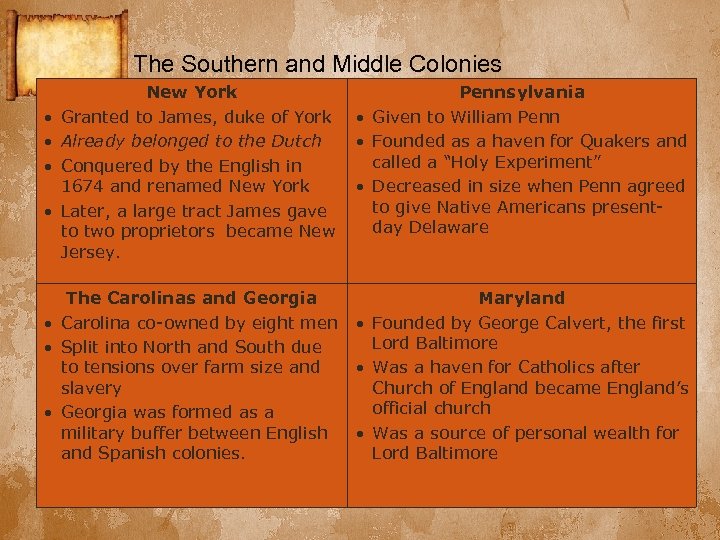 The Southern and Middle Colonies • • New York Granted to James, duke of York Already belonged to the Dutch Conquered by the English in 1674 and renamed New York Later, a large tract James gave to two proprietors became New Jersey. Pennsylvania • Given to William Penn • Founded as a haven for Quakers and called a “Holy Experiment” • Decreased in size when Penn agreed to give Native Americans presentday Delaware The Carolinas and Georgia Maryland • Carolina co-owned by eight men • Founded by George Calvert, the first Lord Baltimore • Split into North and South due to tensions over farm size and • Was a haven for Catholics after slavery Church of England became England’s official church • Georgia was formed as a military buffer between English • Was a source of personal wealth for and Spanish colonies. Lord Baltimore
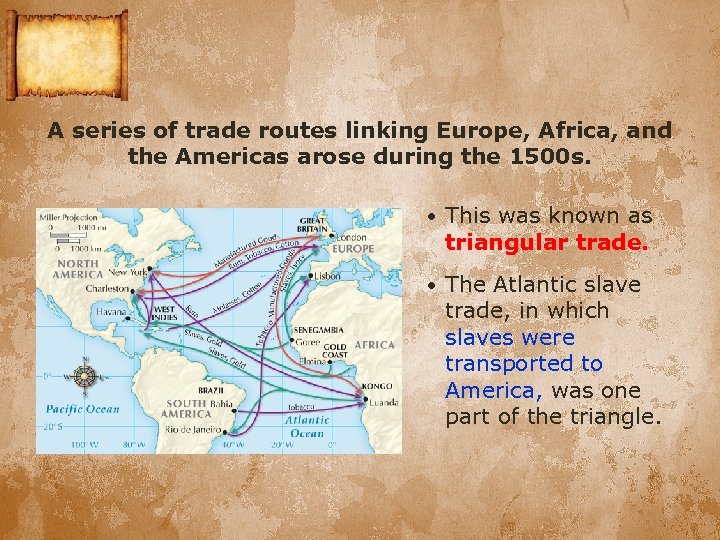 A series of trade routes linking Europe, Africa, and the Americas arose during the 1500 s. • This was known as triangular trade. • The Atlantic slave trade, in which slaves were transported to America, was one part of the triangle.
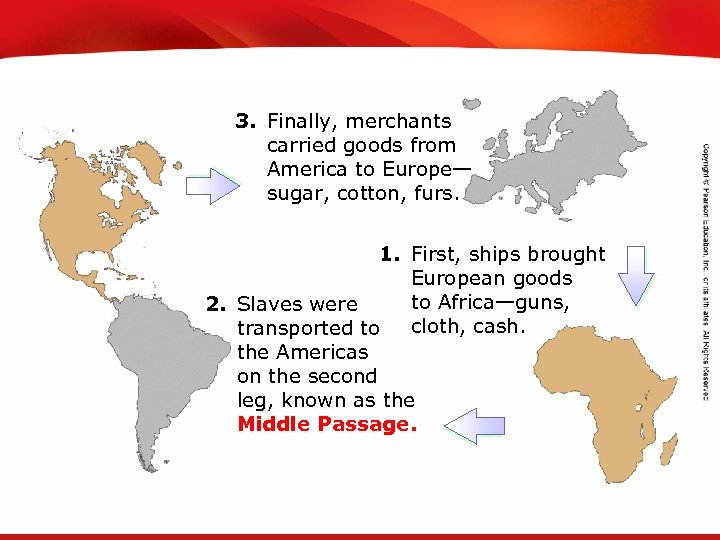 TEKS 8 C: Calculate percent composition and empirical and molecular formulas. 3. Finally, merchants carried goods from America to Europe— sugar, cotton, furs. 1. First, ships brought European goods to Africa—guns, 2. Slaves were cloth, cash. transported to the Americas on the second leg, known as the Middle Passage.
 TEKS 8 C: Calculate percent composition and empirical and molecular formulas. Triangular trade helped colonial economies grow. • Merchants and certain industries thrived. For example, shipbuilding and tobacco growing were very lucrative. • Port cities such as Bristol in England Newport, Rhode Island, grew quickly as a result.
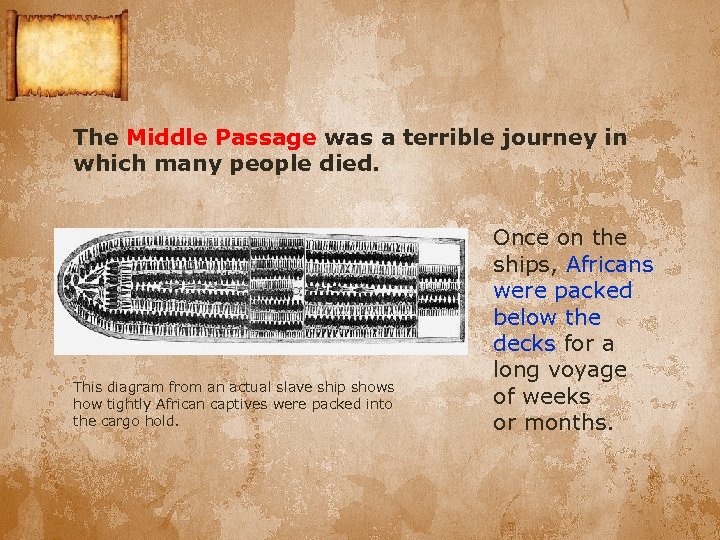 The Middle Passage was a terrible journey in which many people died. This diagram from an actual slave ship shows how tightly African captives were packed into the cargo hold. Once on the ships, Africans were packed below the decks for a long voyage of weeks or months.
 Slave ships faced many dangers and horrors on their journeys. Slave ships were “floating coffins” in which up to half of the Africans on board died. Most died of disease such as dysentery or smallpox. Others committed suicide. There were also mutinies, storms at sea, and raids by pirates.
 The impact of the Atlantic slave trade on Africans was devastating. African states and societies were torn apart. As many as 2 million Africans died during the brutal Middle Passage. Some 11 million enslaved Africans were taken to the Americas by the time the slave trade ended in the mid-1800 s.
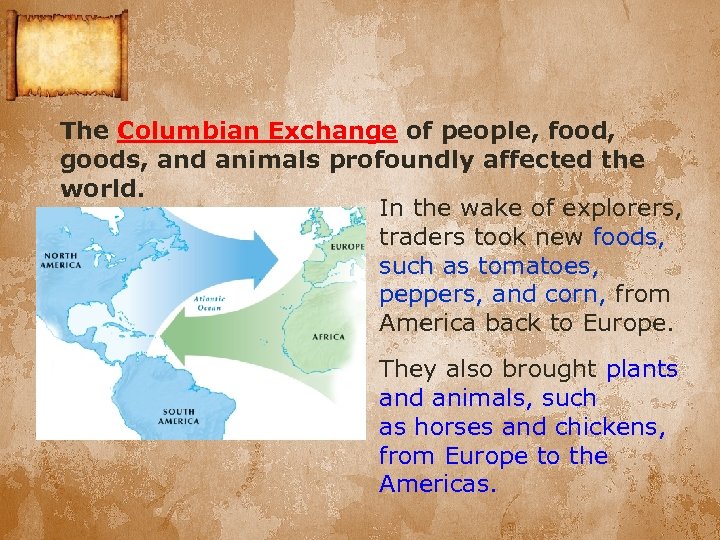 The Columbian Exchange of people, food, goods, and animals profoundly affected the world. In the wake of explorers, traders took new foods, such as tomatoes, peppers, and corn, from America back to Europe. They also brought plants and animals, such as horses and chickens, from Europe to the Americas.
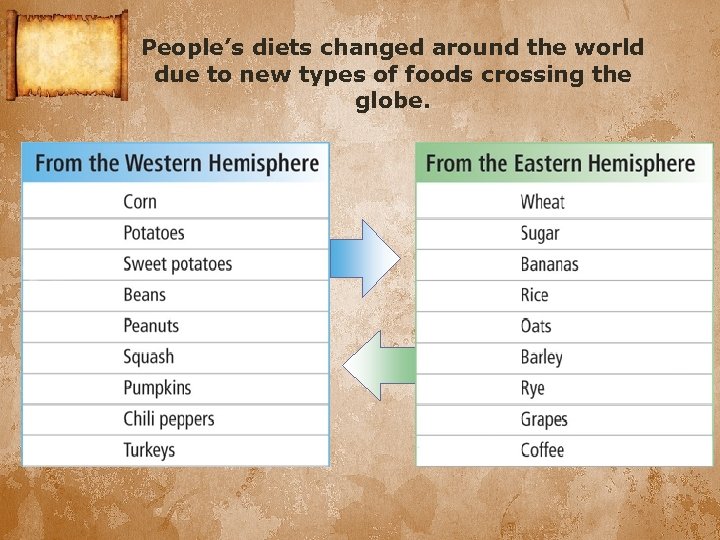 People’s diets changed around the world due to new types of foods crossing the globe.
 • One The global population started to explode by 1700. of the key causes was the spread of new food crops from the Americas. • However, Native American populations declined severely due to European diseases. Millions of people migrated at this time. Europeans spread out in the Americas. Africans were forced to the Americas by the slave trade.
 A commercial revolution occurred as a result of direct links between the continents. • Prices began to rise in Europe due to the huge amount of silver and gold coming in from the Americas. This led to inflation. • This time period was known as the price revolution and led to the growth of capitalism, in which most businesses are owned privately.
 . Capitalists sought to make money through investment, rather than through land or labor. • Entrepreneurs looked overseas for opportunities to make profits. • Investors formed joint stock companies to pool funds and lessen individual risk. • Capitalists adopted bookkeeping methods from the Arabs. • Banks became more important.
 Merchants began to bypass medieval guilds. • A merchant capitalist distributed raw material such as wool to peasant cottages. • Peasants processed it into cloth. Then, the merchant sold the finished product for a profit. • This system, known by the term “cottage industry, ” separated capital and labor for the first time.
 • European monarchs adopted a new economic policy called mercantilism. The goal of this policy was to build the nation’s gold and silver reserves by exporting more goods than it imported. • To do this, European nations had strict laws governing trade with their colonies and imposed tariffs. As a result of these measures, national governments had a lot of control over their economies.
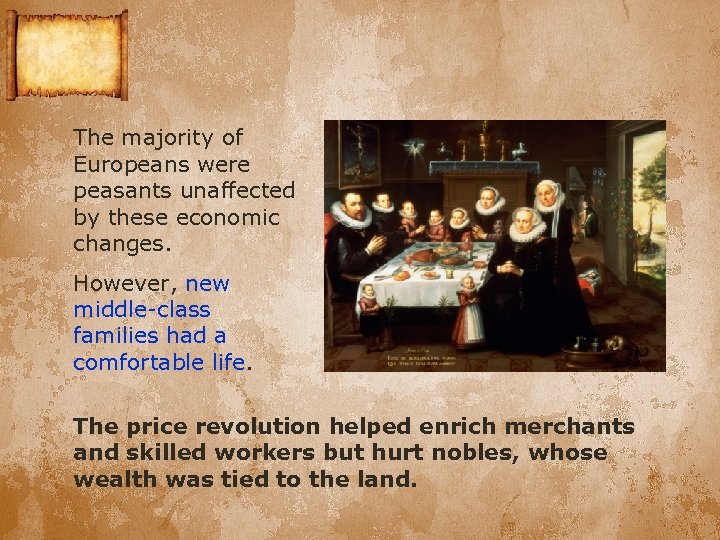 The majority of Europeans were peasants unaffected by these economic changes. However, new middle-class families had a comfortable life. The price revolution helped enrich merchants and skilled workers but hurt nobles, whose wealth was tied to the land.