Скачать презентацию OVERLAPPING SCALES and the ATMOSPHERIC CAUSES OF FLOODS
1d41dc7fd7b0a37a950fc473ecbe5001.ppt
- Количество слайдов: 65
 OVERLAPPING SCALES and the ATMOSPHERIC CAUSES OF FLOODS Katherine K. Hirschboeck Laboratory of Tree-ring Research University of Arizona
 PURPOSE • Overview of atmospheric causes of floods • Issues related to overlapping scales • Implications • Concluding remarks
 Flood studies / observations: • urban flash flooding; small basin floods in U. S. • Basin-wide and regional flooding in AZ, LA, and Mississippi RB • Largest US rainfall-runoff floods • Global flooding events in the Dartmouth Flood Observatory
 ATMOSPHERIC CAUSES
 CAUSAL ELEMENTS OF FLOODS • INGREDIENTS • PROCESS • PATTERN • PERSISTENCE • SYNERGY
 INGREDIENTS after Doswell et al. (1996) Heavy Precipitation “The heaviest precipitation occurs where the rainfall rate is the highest for the longest time. ”
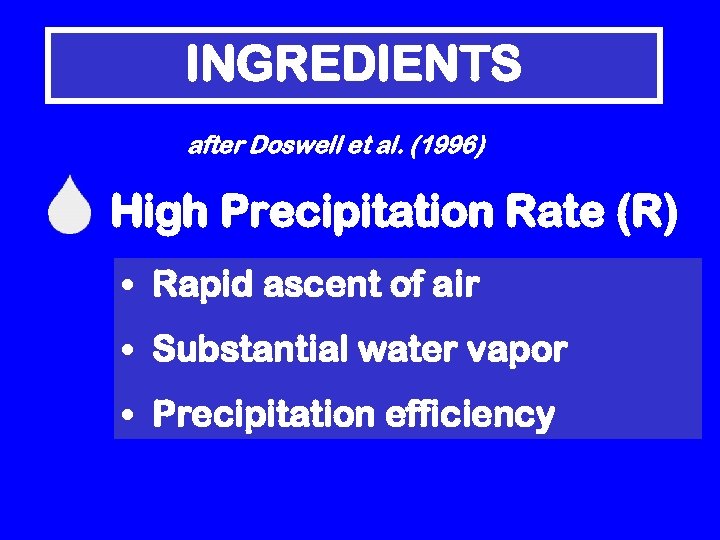 INGREDIENTS after Doswell et al. (1996) High Precipitation Rate (R) • Rapid ascent of air • Substantial water vapor • Precipitation efficiency
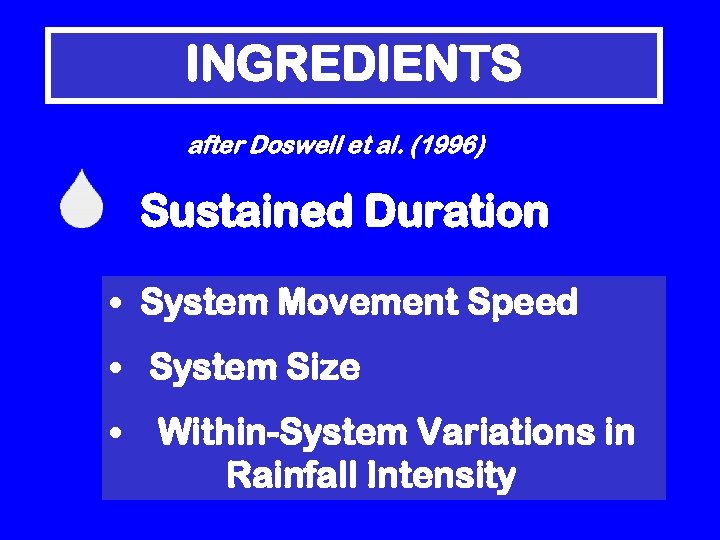 INGREDIENTS after Doswell et al. (1996) Sustained Duration • System Movement Speed • System Size • Within-System Variations in Rainfall Intensity
 INGREDIENTS SUMMARY Heavy Precipitation High Precipitation Rate Sustained Duration
 INGREDIENTS SUMMARY Rainfall rates associated with deep, moist convection are higher than with other rain-producing systems Meteorological processes bring these basic ingredients together
 CAUSAL ELEMENTS OF FLOODS • INGREDIENTS • PROCESS • PATTERN • PERSISTENCE • SYNERGY
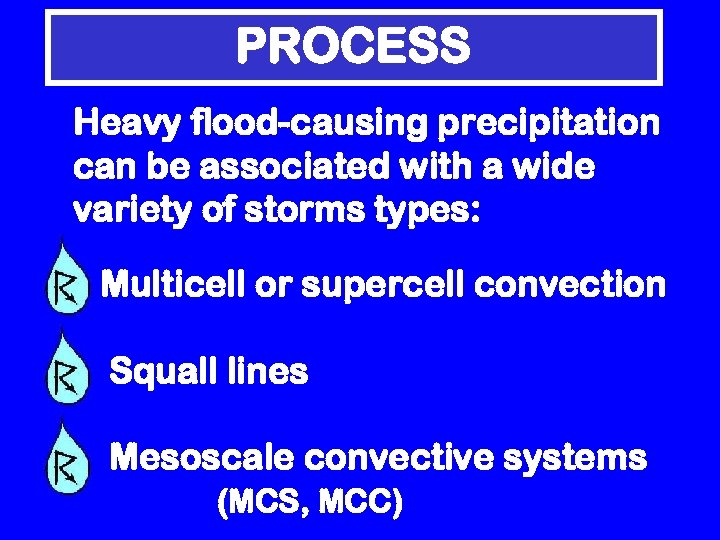 PROCESS Heavy flood-causing precipitation can be associated with a wide variety of storms types: Multicell or supercell convection Squall lines Mesoscale convective systems (MCS, MCC)
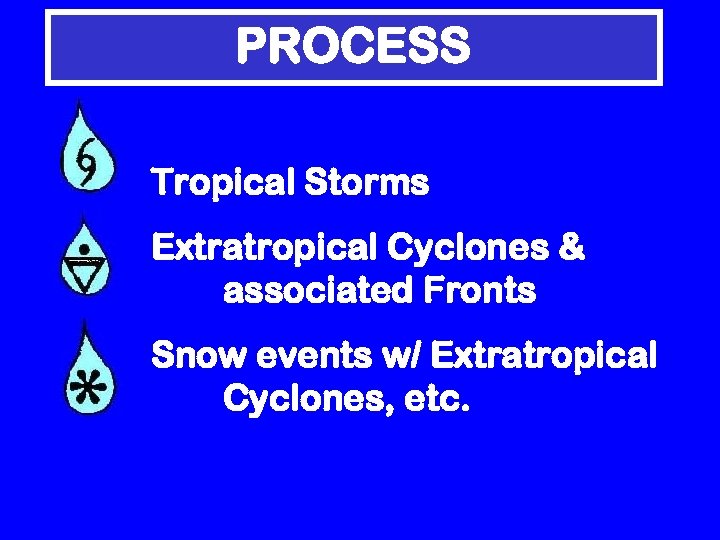 PROCESS Tropical Storms Extratropical Cyclones & associated Fronts Snow events w/ Extratropical Cyclones, etc.
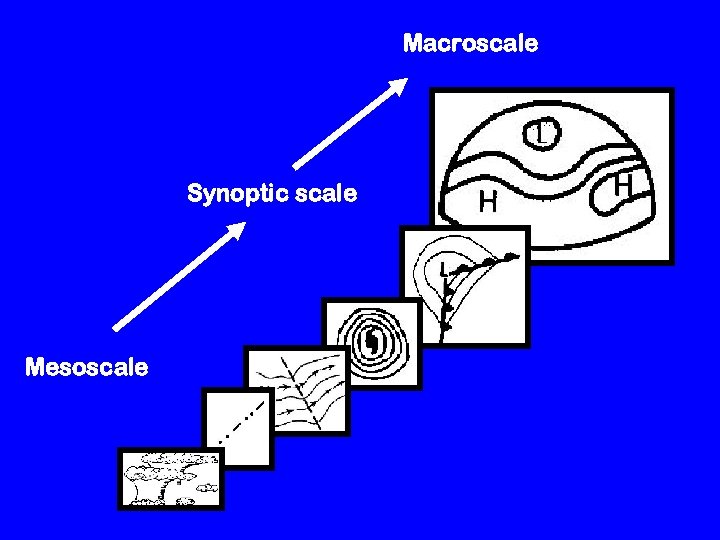
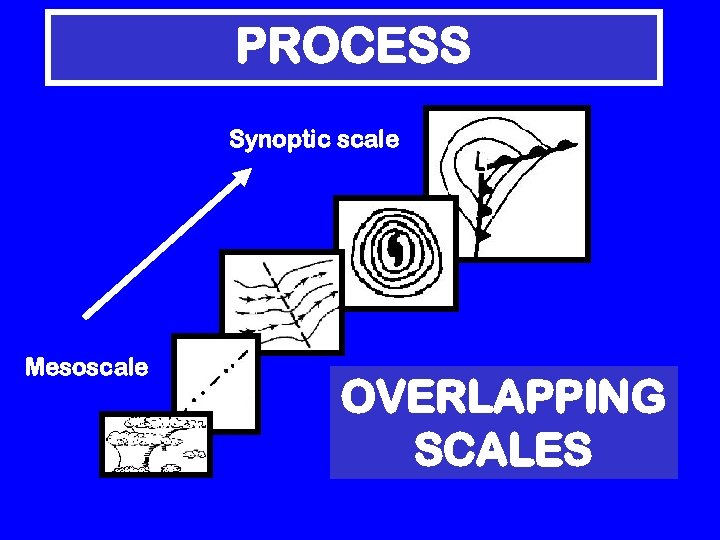 PROCESS Synoptic scale Mesoscale OVERLAPPING SCALES
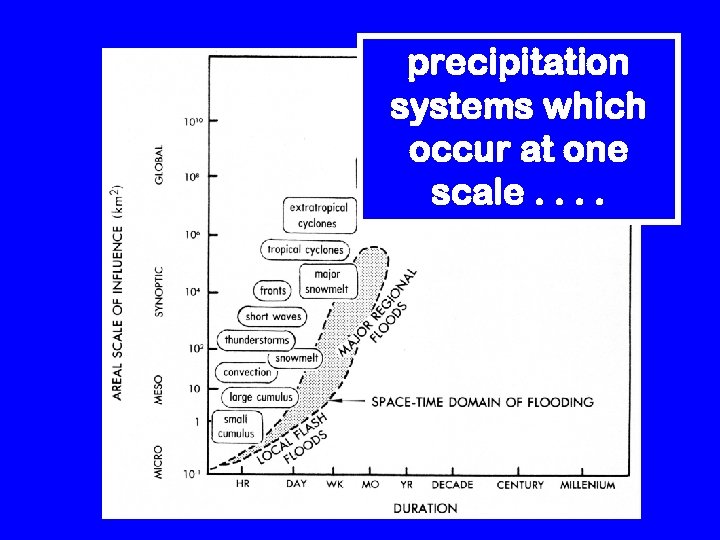 precipitation systems which occur at one scale. .
 . . . Are strongly interconnected with systems at other scales. . . and larger scale processes set the stage for activity at smaller scales.
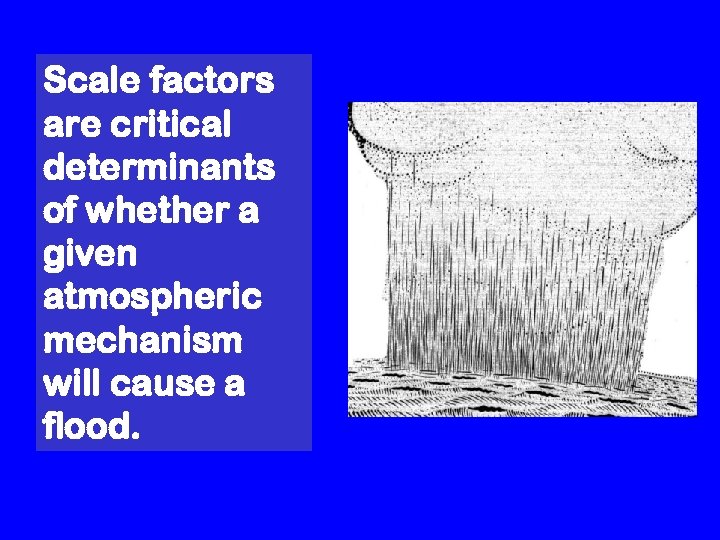 Scale factors are critical determinants of whether a given atmospheric mechanism will cause a flood.
 PROCESS Large-scale vertical motions typical do not initiate convection. . . but there is a connection between synoptic-scale weather systems and deep, moist convection
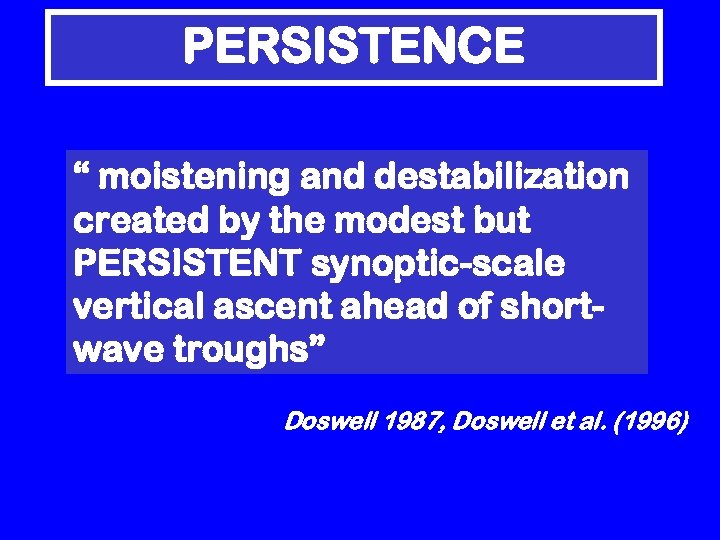
 PROCESS Connection: . . . via moistening and destabilization created by the modest but persistent SYNOPTIC-SCALE vertical ascent ahead of short-wave troughs Doswell 1987, Doswell et al. (1996)
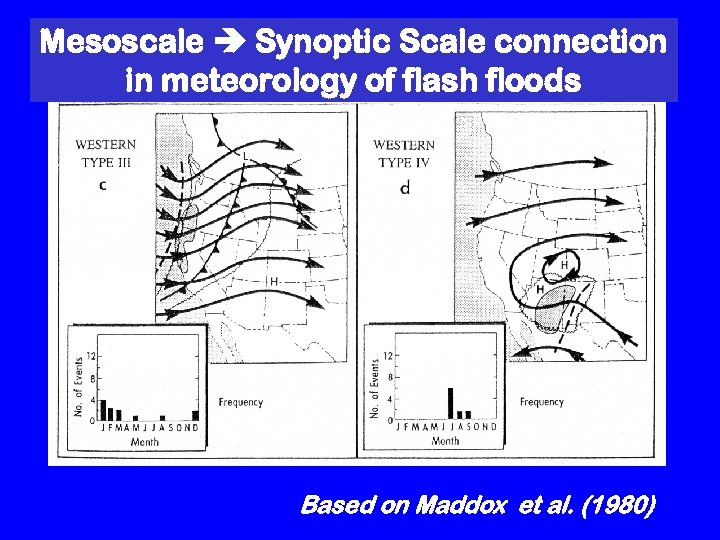 Mesoscale Synoptic Scale connection in meteorology of flash floods Based on Maddox et al. (1980)
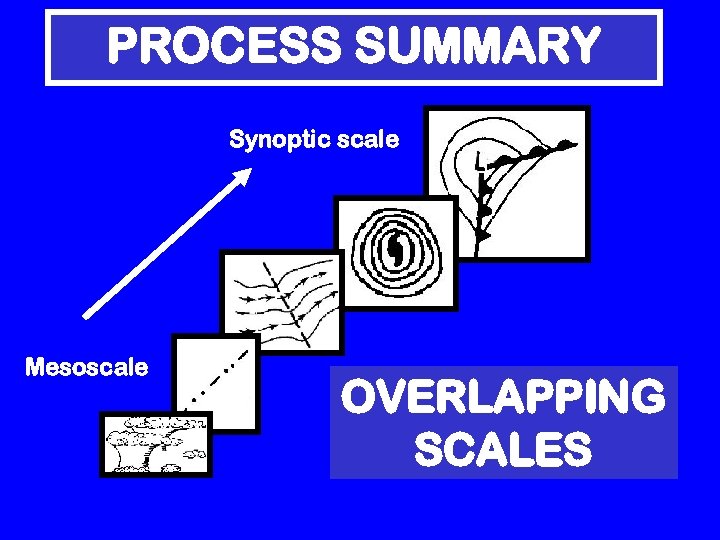 PROCESS SUMMARY Synoptic scale Mesoscale OVERLAPPING SCALES
 PROCESS SUMMARY • Linkage across scales does not necessary imply that there is a seamless process continuum in the nature of flood-causing storm systems • Distinct processes tend to concentrate around discrete and disparate states
 CAUSAL ELEMENTS OF FLOODS • INGREDIENTS • PROCESS • PATTERN • PERSISTENCE • SYNERGY
 Macroscale Synoptic scale Mesoscale
 PATTERN > Correlation fields > Composites > Principle components
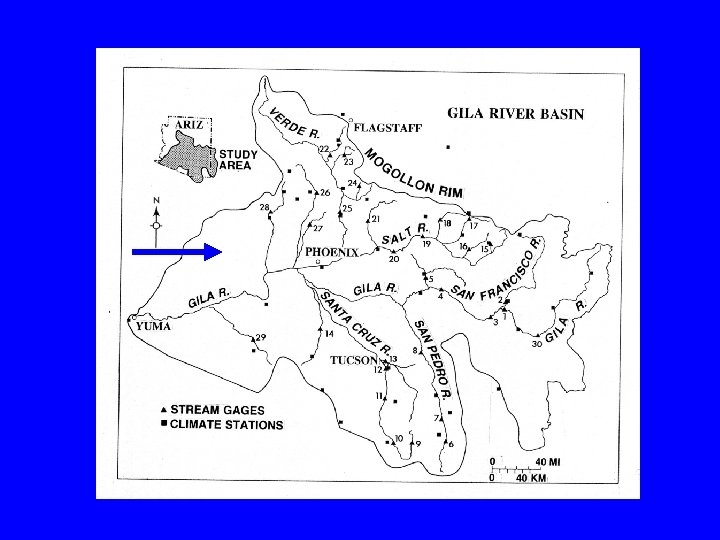
 Flooding in La Paz County, Arizona October, 2000
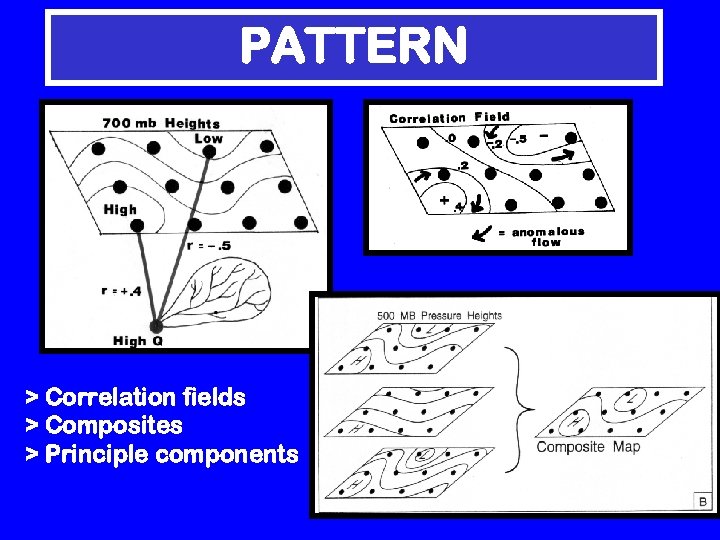
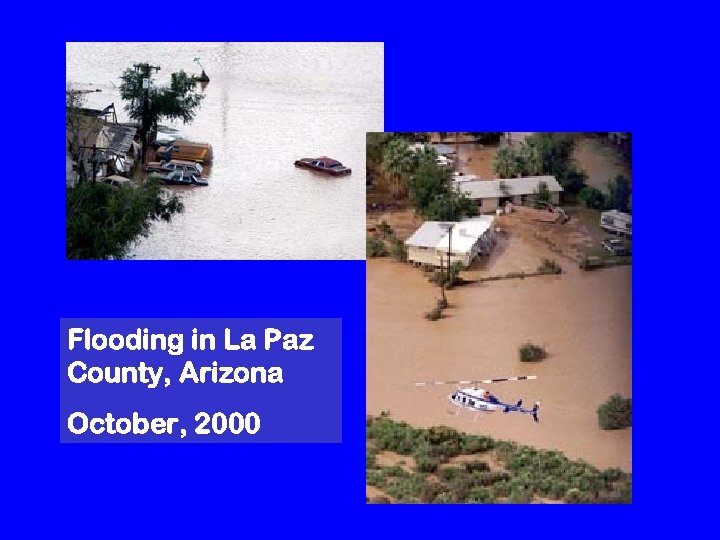
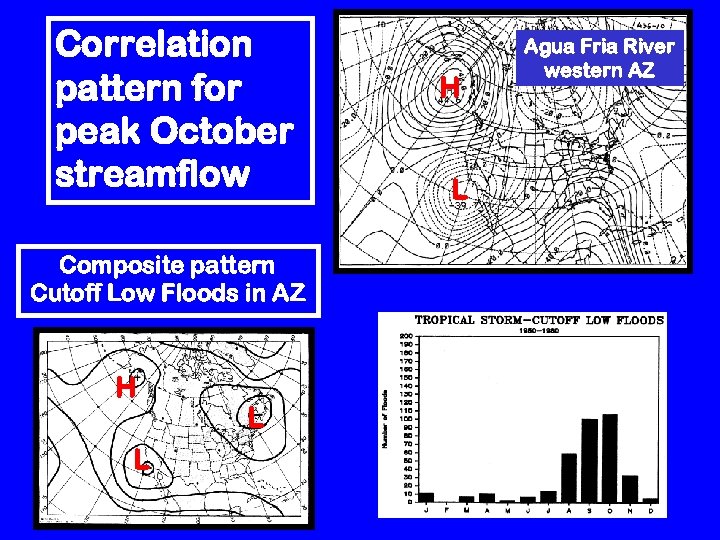 Correlation pattern for peak October streamflow Composite pattern Cutoff Low Floods in AZ H L L H L Agua Fria River western AZ
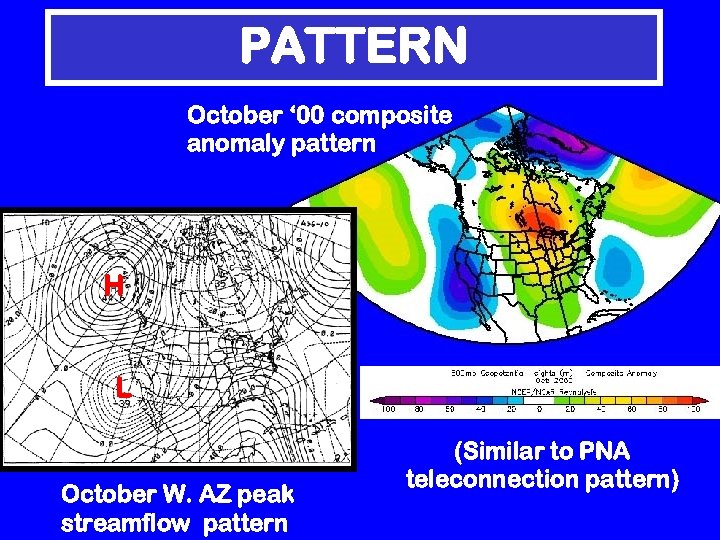 PATTERN October ‘ 00 composite anomaly pattern H L October W. AZ peak streamflow pattern (Similar to PNA teleconnection pattern)
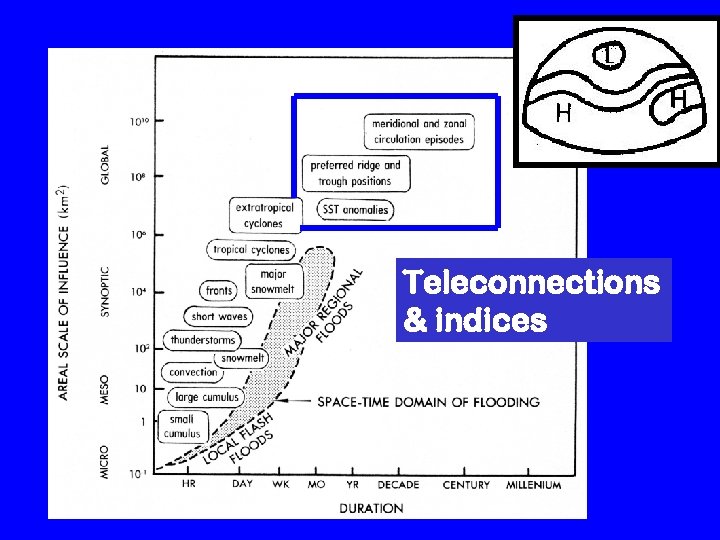 Teleconnections & indices
 PATTERN SUMMARY • Most floods in studies could be linked to one of several floodproducing synoptic-scale and/or larger-scale patterns • Patterns change regionally and seasonally • Frameworks forecasting and “backcasting”
 PATTERN SUMMARY • Pattern alone not always sufficient as causal explanation • If ingredients are not in place, heavy precipitation / flood may not develop • If ingredients are in place, a benign pattern may yield anomalous flooding (flash floods)
 CAUSAL ELEMENTS OF FLOODS • INGREDIENTS • PROCESS • PATTERN • PERSISTENCE • SYNERGY
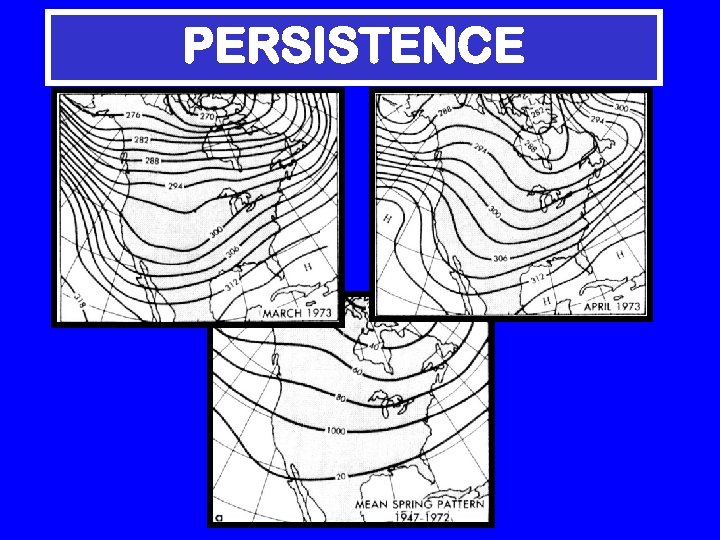
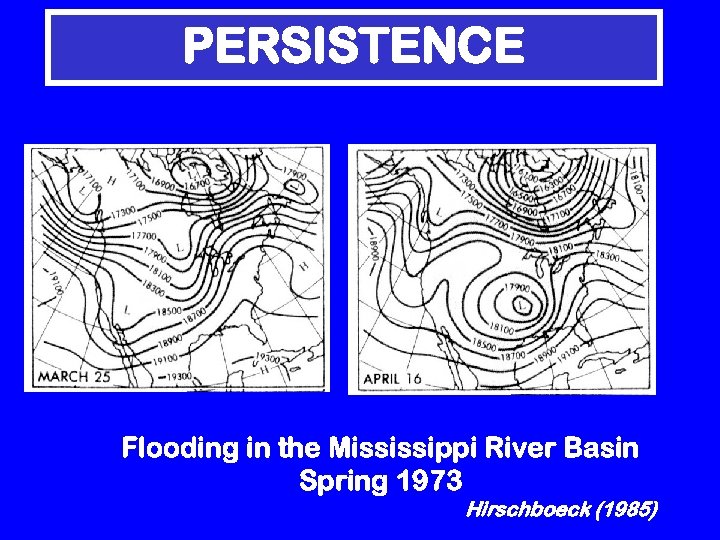 PERSISTENCE Flooding in the Mississippi River Basin Spring 1973 Hirschboeck (1985)
 PERSISTENCE
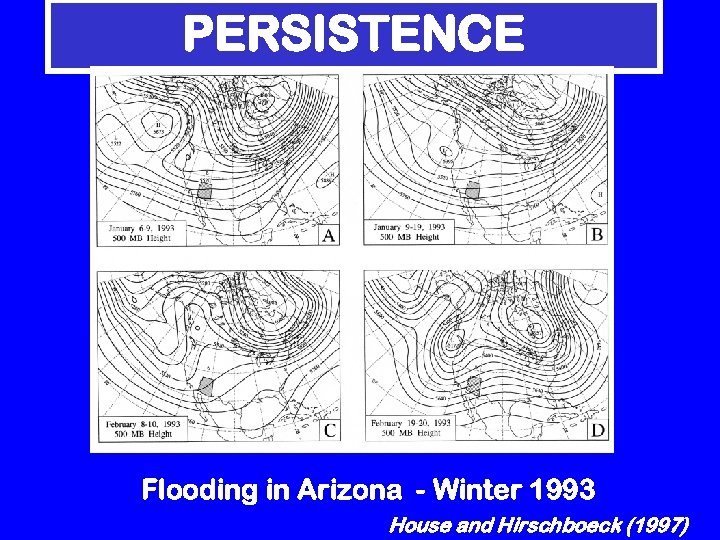 PERSISTENCE Flooding in Arizona - Winter 1993 House and Hirschboeck (1997)
 PERSISTENCE “ moistening and destabilization created by the modest but PERSISTENT synoptic-scale vertical ascent ahead of shortwave troughs” Doswell 1987, Doswell et al. (1996)
 PERSISTENCE SUMMARY • Persistence of INGREDIENTS (e. g. , deep moist convection environment) most important at small scales (flash floods) • Persistence of PATTERN most important at larger scales (basin -wide / regional floods)
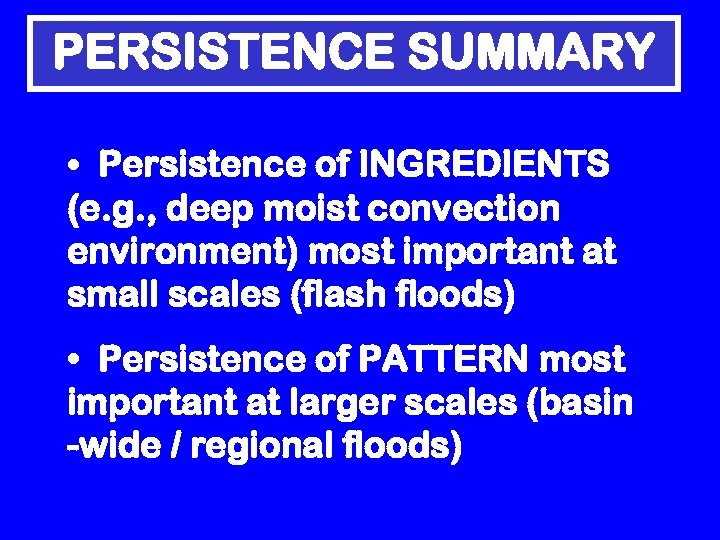
 PERSISTENCE SUMMARY • In the largest and most extreme floods studied, PERSISTENCE was always a factor • Persistence bridges meteorological and climatological time scales • Persistence = underlying factor in atmosphere / basin synergy
 CAUSAL ELEMENTS OF FLOODS • INGREDIENTS • PROCESS • PATTERN • PERSISTENCE • SYNERGY
 SYNERGY = A combined action or operation; a mutually advantageous conjunction or compatibility of distinct elements
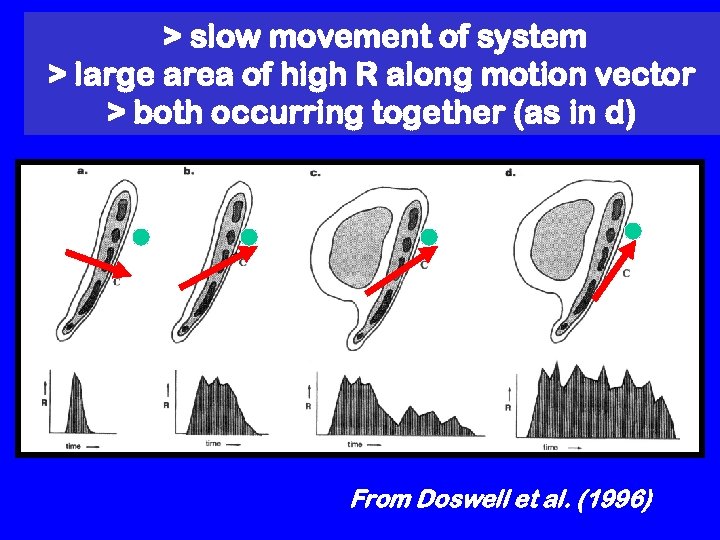 > slow movement of system > large area of high R along motion vector > both occurring together (as in d) From Doswell et al. (1996)
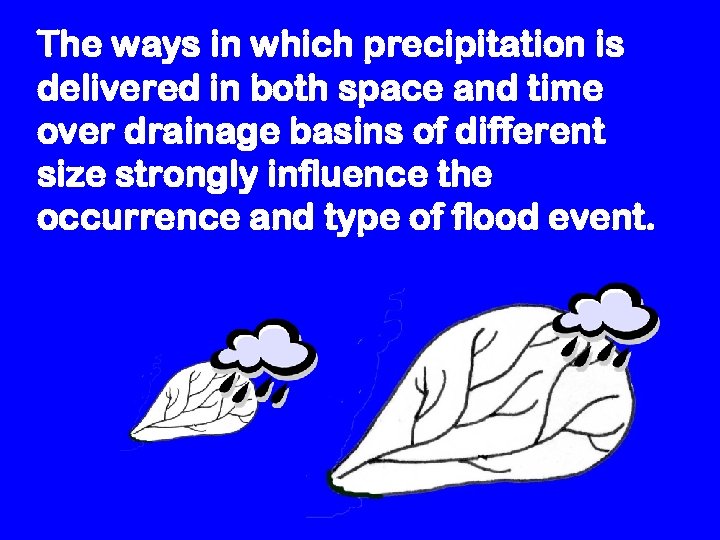 The ways in which precipitation is delivered in both space and time over drainage basins of different size strongly influence the occurrence and type of flood event.
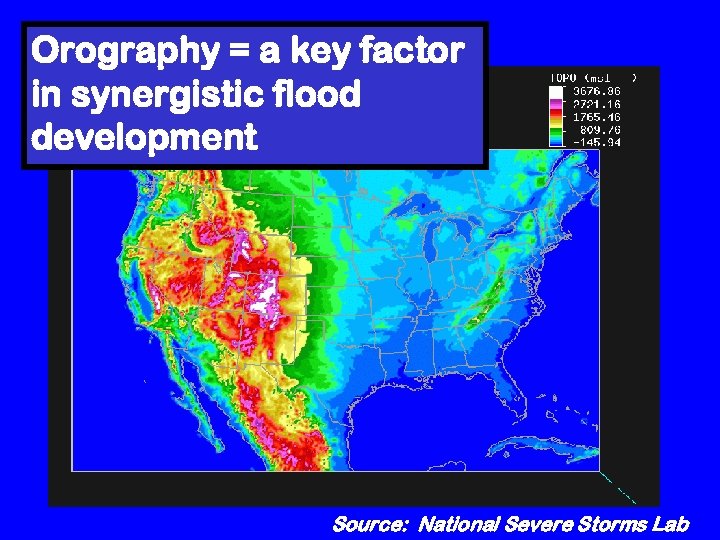 Orography = a key factor in synergistic flood development Source: National Severe Storms Lab
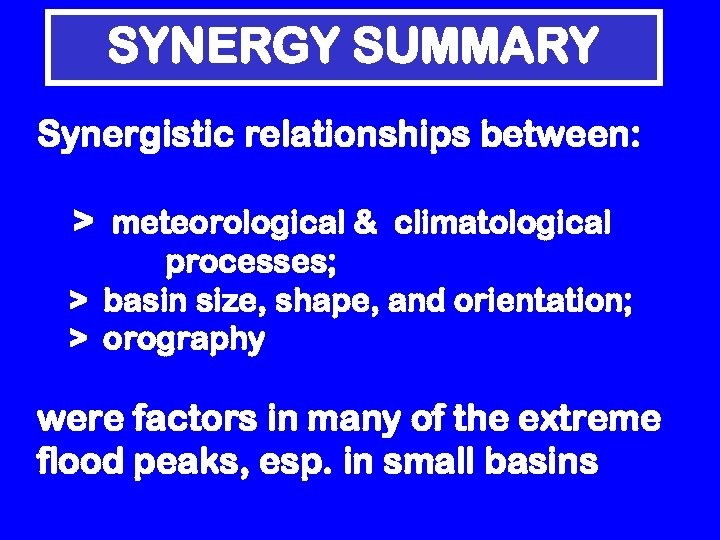 SYNERGY SUMMARY Synergistic relationships between: > meteorological & climatological processes; > basin size, shape, and orientation; > orography were factors in many of the extreme flood peaks, esp. in small basins
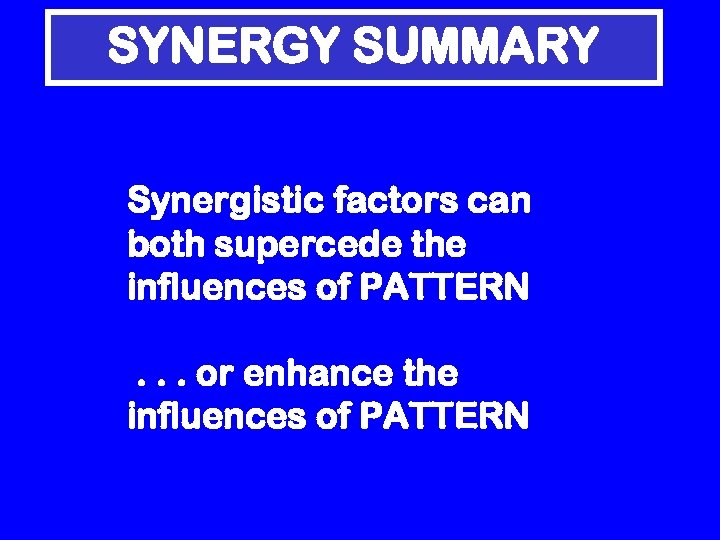 SYNERGY SUMMARY Synergistic factors can both supercede the influences of PATTERN. . . or enhance the influences of PATTERN
 IMPLICATIONS
 KEY QUESTION: Can flood-causing mechanisms be analyzed as a process continuum. . . using statistical techniques, (e. g. “upscaling” or “downscaling”). . .
 . . . Or do they concentrate around discrete scales? Are there limits in space and time to our ability to transfer causal-process information observed at one scale to that of another?
 Can processes and scale relationships observed in the gaged record be applied over longer time scales? • assess paleoflood causes • develop climatic forecasts for floods
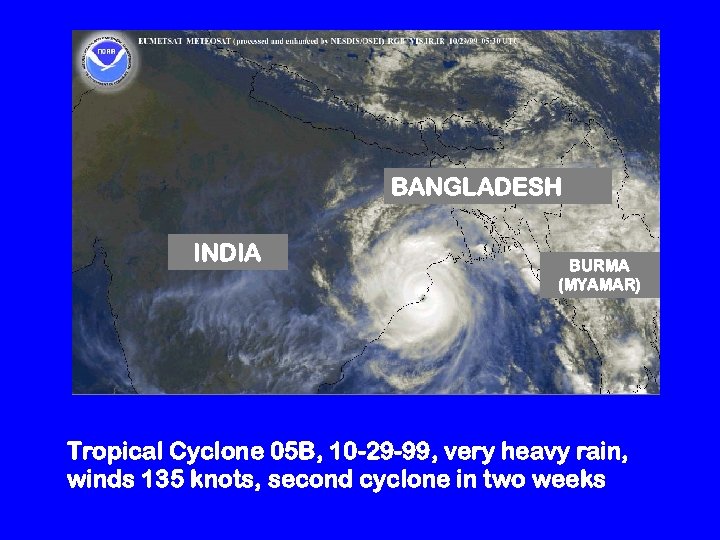 BANGLADESH INDIA BURMA (MYAMAR) Tropical Cyclone 05 B, 10 -29 -99, very heavy rain, winds 135 knots, second cyclone in two weeks
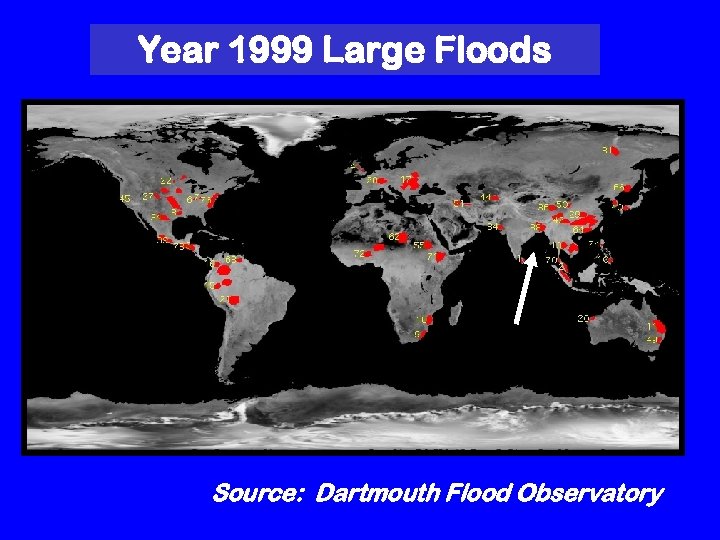 Year 1999 Large Floods Source: Dartmouth Flood Observatory
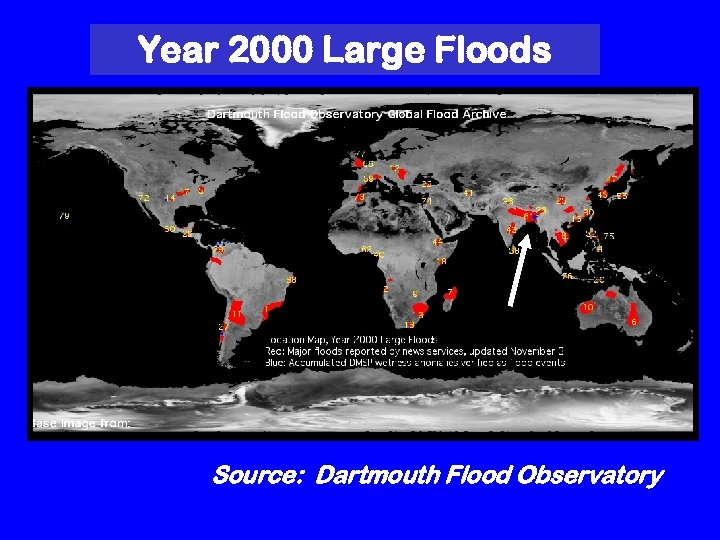 Year 2000 Large Floods Source: Dartmouth Flood Observatory
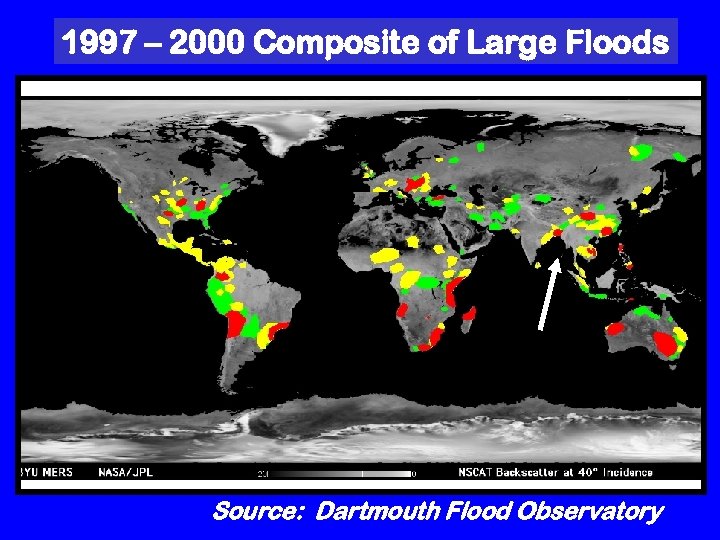 1997 – 2000 Composite of Large Floods Source: Dartmouth Flood Observatory
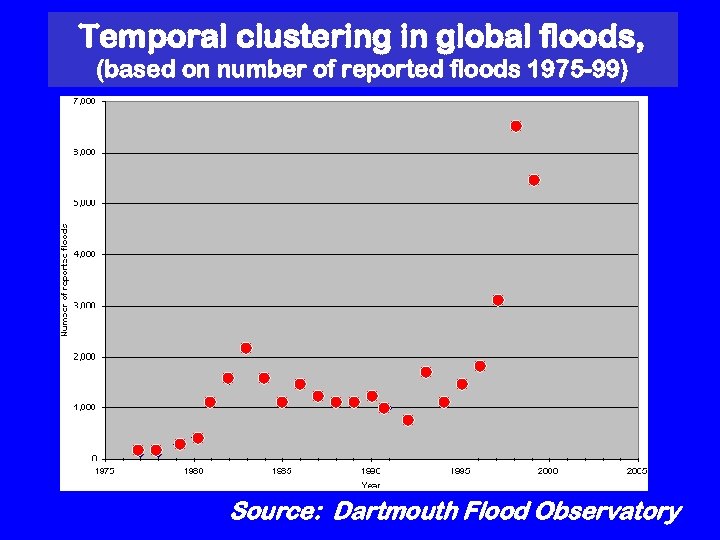 Temporal clustering in global floods, (based on number of reported floods 1975 -99) Source: Dartmouth Flood Observatory
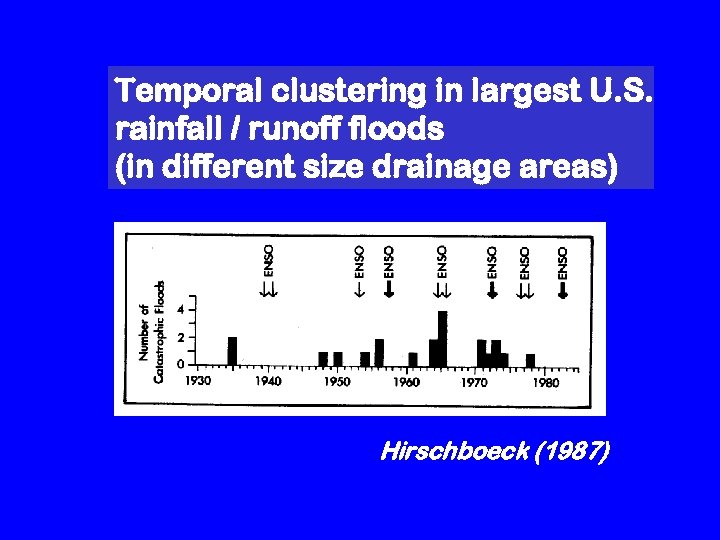 Temporal clustering in largest U. S. rainfall / runoff floods (in different size drainage areas) Hirschboeck (1987)
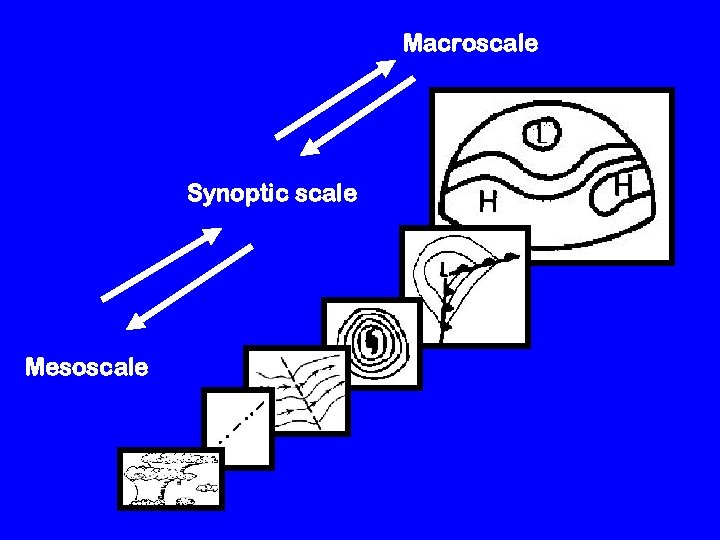 Macroscale Synoptic scale Mesoscale
 CONCLUDING REMARKS
 Concluding Remarks • INGREDIENTS • PROCESS • PATTERN • PERSISTENCE • SYNERGY
 Concluding Remarks Flood events tend to be discontinuous and episodic in time. . . and clustered in space. . . in response to varying states of the atmosphere
 Concluding Remarks Across all scales, the persistence of a precipitation system is a key element for generating exceptionally large floods
 Concluding Remarks Circulation features which enhance persistence tend to occur as discrete time / space anomalies that are not easily captured by upscaling or downscaling techniques.
 Concluding Remarks Most major floods are characterized by a synergistic combination of atmospheric, hydrologic, and drainage-basin factors that intensify the event and “tip the scales” beyond what might be expected in a smoothly telescoping process continuum.