 Скачать презентацию Overcoming Communication Barriers in the Care of Diverse
407f7d43e64c4b2c802f231e1883a1cd.ppt
- Количество слайдов: 19



Overcoming Communication Barriers in the Care of Diverse Patients: The IDEALL Project UCSF Primary Care Research Center, San Francisco General Hospital Dean Schillinger MD Jorge Palacios MA Audrey Tang FNP Christine Ho MD Alex Li MD Hali Hammer MD Ivonne Mc. Lean Michelle Schneiderman MD Ben Lui MD Margaret Handley MPH, Ph. D
Improving Diabetes Efforts Across Language & Literacy Family Health Center, General Medicine Clinic, Chinatown Health Center, UCSF Collaborative Research Network Supported by The Commonwealth Fund, The California Endowment, AHRQ, California Health Care Foundation, and the SF Department of Public Health
Background § Health systems place high literacy and language demands on patients § Growing body of evidence linking communication barriers to outcomes § Interactive communication can affect outcomes § Little is known about the extent to which population-based approaches can successfully engage high-risk patients with diabetes § Public-sector settings rarely have systematic disease mgmt programs tailored to vulnerable populations
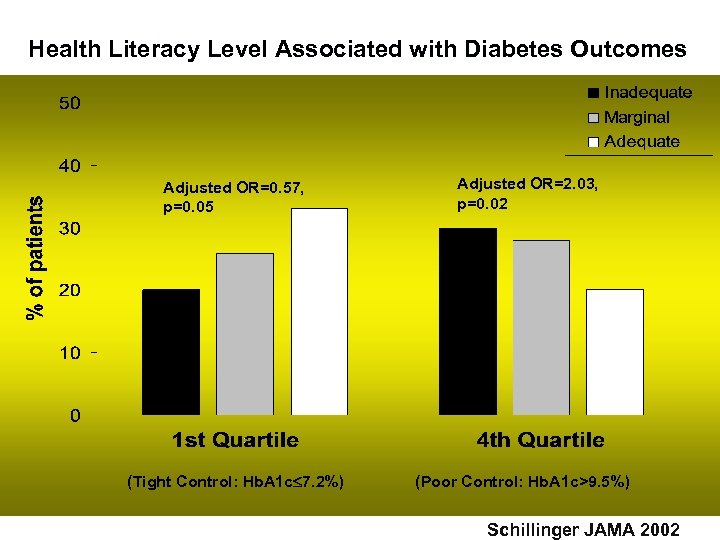
Health Literacy Level Associated with Diabetes Outcomes Adjusted OR=0. 57, p=0. 05 (Tight Control: Hb. A 1 c 7. 2%) Adjusted OR=2. 03, p=0. 02 (Poor Control: Hb. A 1 c>9. 5%) Schillinger JAMA 2002
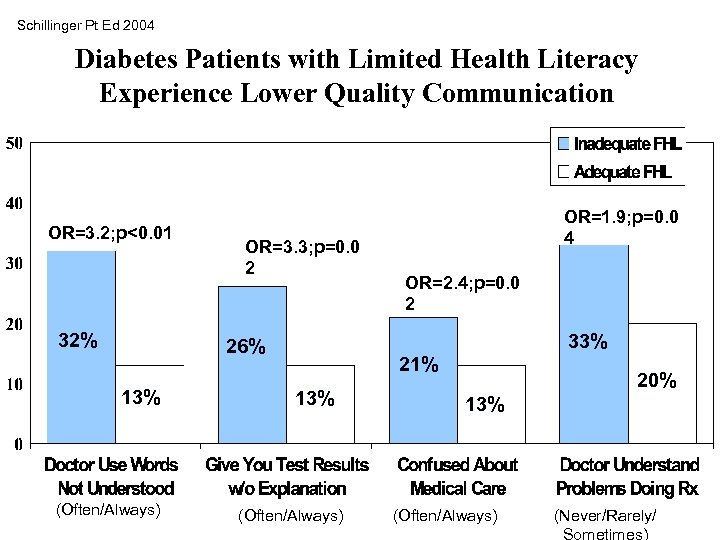
Schillinger Pt Ed 2004 Diabetes Patients with Limited Health Literacy Experience Lower Quality Communication OR=3. 2; p<0. 01 32% OR=3. 3; p=0. 0 2 (Often/Always) OR=2. 4; p=0. 0 2 33% 26% 13% OR=1. 9; p=0. 0 4 21% 13% (Often/Always) 20% 13% (Often/Always) (Never/Rarely/ Sometimes)
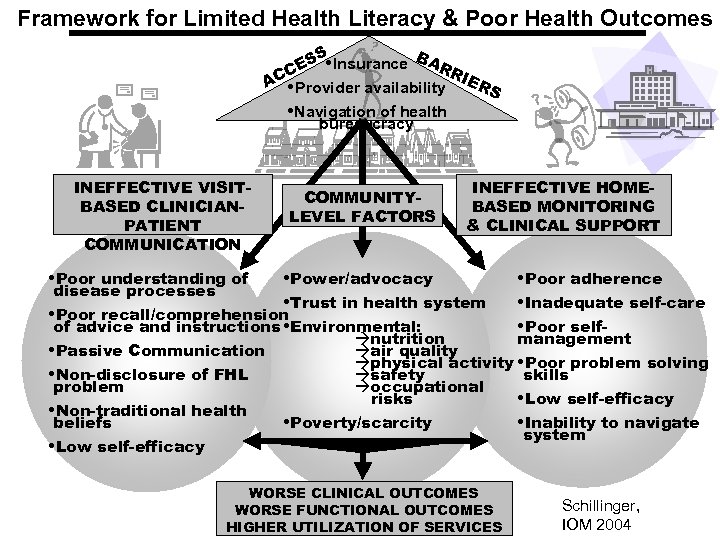
Framework for Limited Health Literacy & Poor Health Outcomes S B ES Insurance ARR C AC Provider availability IERS Navigation of health bureaucracy INEFFECTIVE VISITBASED CLINICIANPATIENT COMMUNICATION COMMUNITYLEVEL FACTORS INEFFECTIVE HOMEBASED MONITORING & CLINICAL SUPPORT Poor understanding of Power/advocacy Poor adherence disease processes Trust in health system Inadequate self-care Poor recall/comprehension of advice and instructions Environmental: Poor self nutrition management Passive Communication air quality physical activity Poor problem solving Non-disclosure of FHL safety skills problem occupational risks Low self-efficacy Non-traditional health beliefs Poverty/scarcity Inability to navigate system Low self-efficacy WORSE CLINICAL OUTCOMES WORSE FUNCTIONAL OUTCOMES HIGHER UTILIZATION OF SERVICES Schillinger, IOM 2004
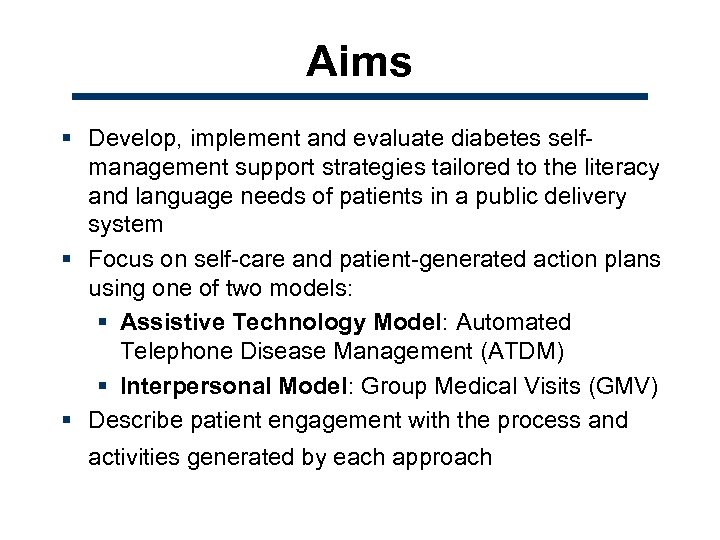
Aims § Develop, implement and evaluate diabetes selfmanagement support strategies tailored to the literacy and language needs of patients in a public delivery system § Focus on self-care and patient-generated action plans using one of two models: § Assistive Technology Model: Automated Telephone Disease Management (ATDM) § Interpersonal Model: Group Medical Visits (GMV) § Describe patient engagement with the process and activities generated by each approach
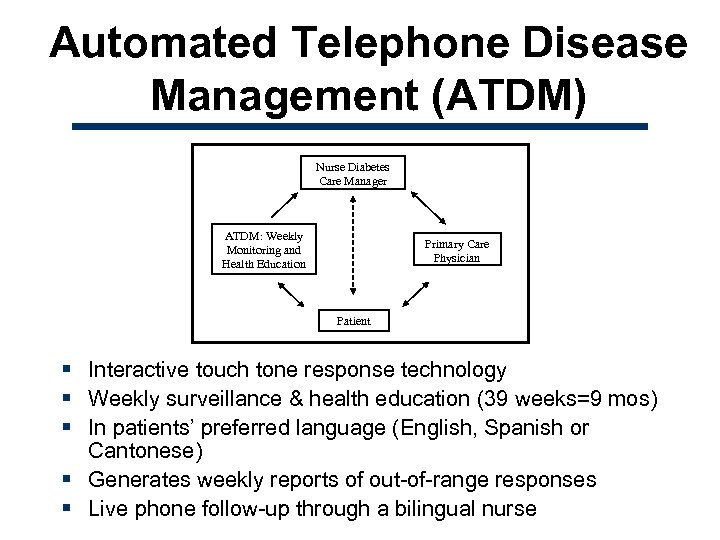
Automated Telephone Disease Management (ATDM) Nurse Diabetes Care Manager ATDM: Weekly Monitoring and Health Education Primary Care Physician Patient § Interactive touch tone response technology § Weekly surveillance & health education (39 weeks=9 mos) § In patients’ preferred language (English, Spanish or Cantonese) § Generates weekly reports of out-of-range responses § Live phone follow-up through a bilingual nurse
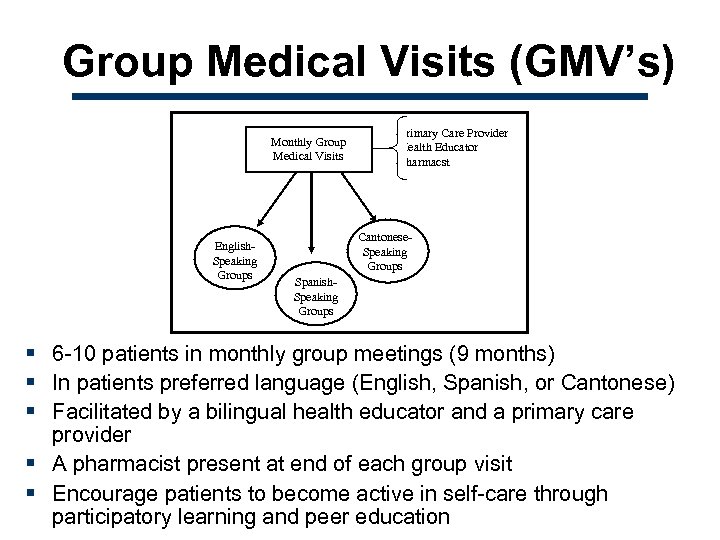
Group Medical Visits (GMV’s) Monthly Group Medical Visits English. Speaking Groups -Primary Care Provider -Health Educator -Pharmacst Cantonese. Speaking Groups Spanish. Speaking Groups § 6 -10 patients in monthly group meetings (9 months) § In patients preferred language (English, Spanish, or Cantonese) § Facilitated by a bilingual health educator and a primary care provider § A pharmacist present at end of each group visit § Encourage patients to become active in self-care through participatory learning and peer education
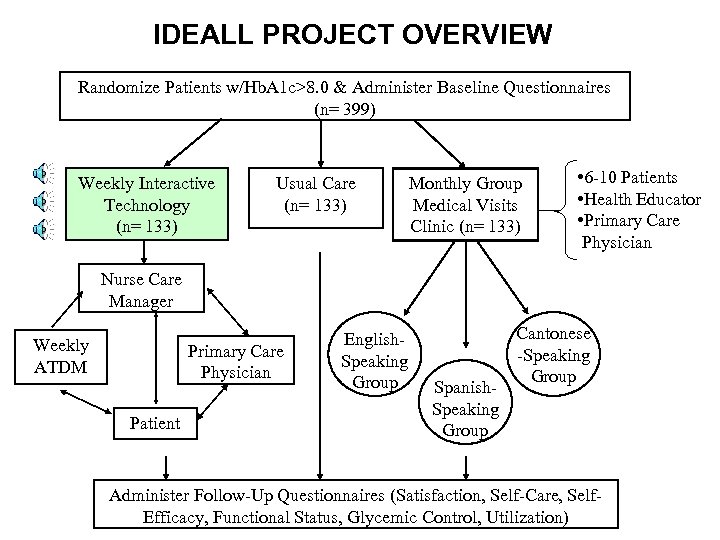
IDEALL PROJECT OVERVIEW Randomize Patients w/Hb. A 1 c>8. 0 & Administer Baseline Questionnaires (n= 399) Weekly Interactive Technology (n= 133) Usual Care (n= 133) Monthly Group Medical Visits Clinic (n= 133) • 6 -10 Patients • Health Educator • Primary Care Physician Nurse Care Manager Weekly ATDM Primary Care Physician Patient English. Speaking Group Spanish. Speaking Group Cantonese -Speaking Group Administer Follow-Up Questionnaires (Satisfaction, Self-Care, Self. Efficacy, Functional Status, Glycemic Control, Utilization)
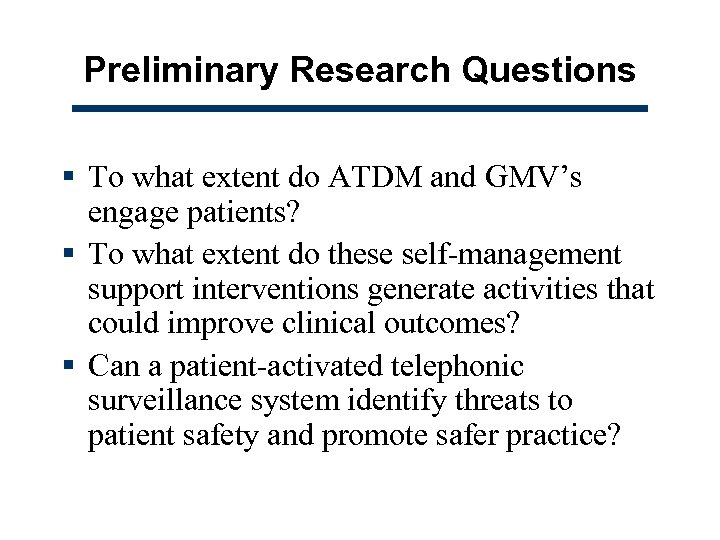
Preliminary Research Questions § To what extent do ATDM and GMV’s engage patients? § To what extent do these self-management support interventions generate activities that could improve clinical outcomes? § Can a patient-activated telephonic surveillance system identify threats to patient safety and promote safer practice?
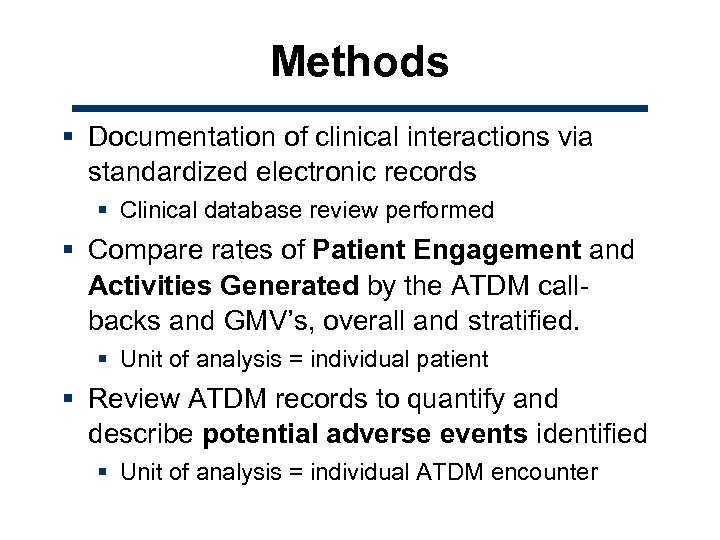
Methods § Documentation of clinical interactions via standardized electronic records § Clinical database review performed § Compare rates of Patient Engagement and Activities Generated by the ATDM callbacks and GMV’s, overall and stratified. § Unit of analysis = individual patient § Review ATDM records to quantify and describe potential adverse events identified § Unit of analysis = individual ATDM encounter
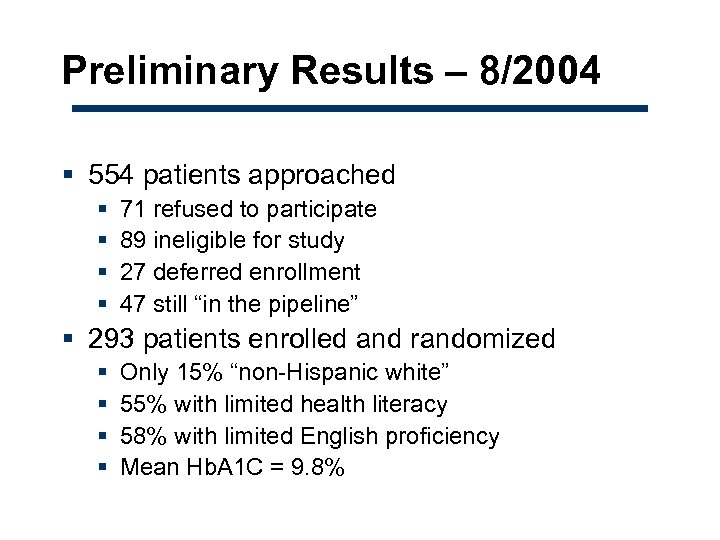
Preliminary Results – 8/2004 § 554 patients approached § § 71 refused to participate 89 ineligible for study 27 deferred enrollment 47 still “in the pipeline” § 293 patients enrolled and randomized § § Only 15% “non-Hispanic white” 55% with limited health literacy 58% with limited English proficiency Mean Hb. A 1 C = 9. 8%
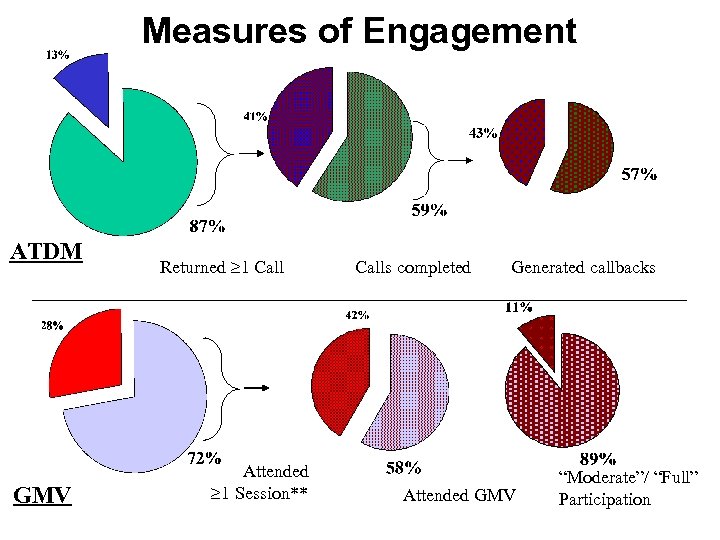
Measures of Engagement ATDM GMV Returned 1 Call Attended 1 Session** Calls completed Generated callbacks Attended GMV “Moderate”/ “Full” Participation
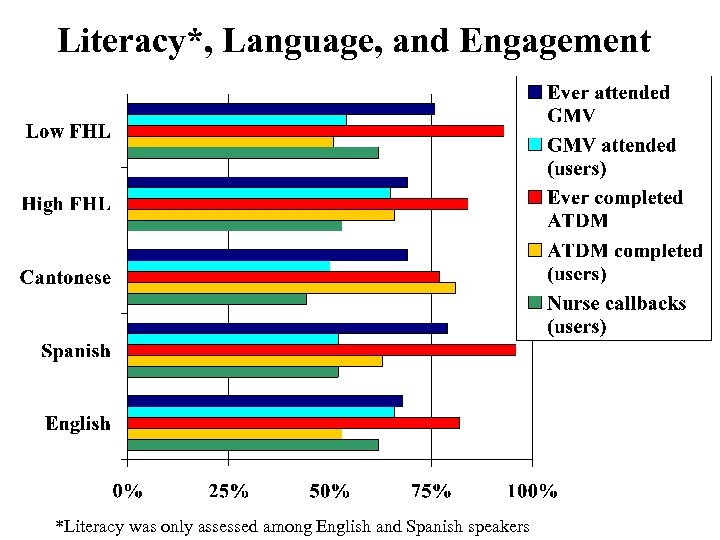
Literacy*, Language, and Engagement *Literacy was only assessed among English and Spanish speakers
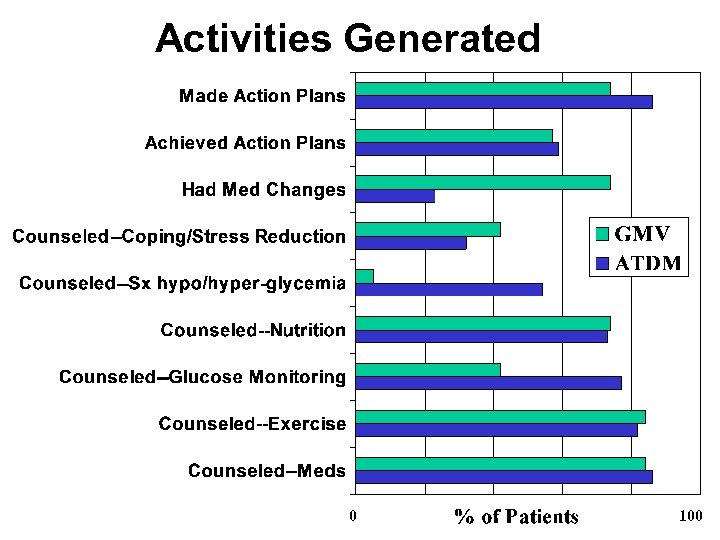
Activities Generated 0 100
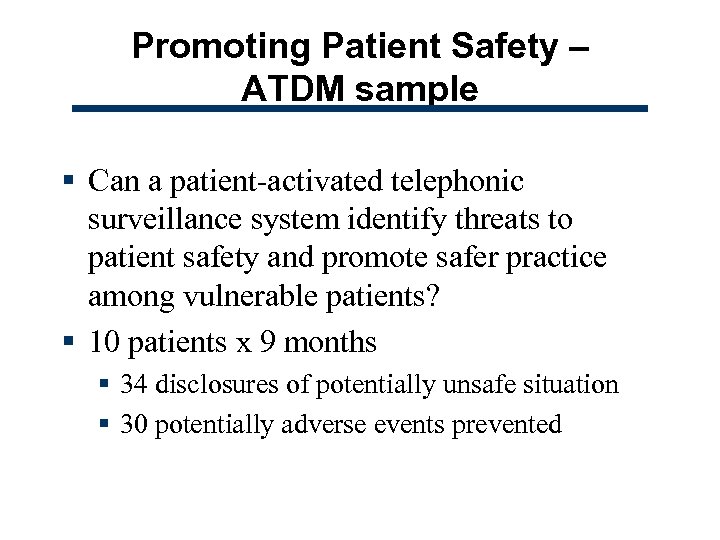
Promoting Patient Safety – ATDM sample § Can a patient-activated telephonic surveillance system identify threats to patient safety and promote safer practice among vulnerable patients? § 10 patients x 9 months § 34 disclosures of potentially unsafe situation § 30 potentially adverse events prevented
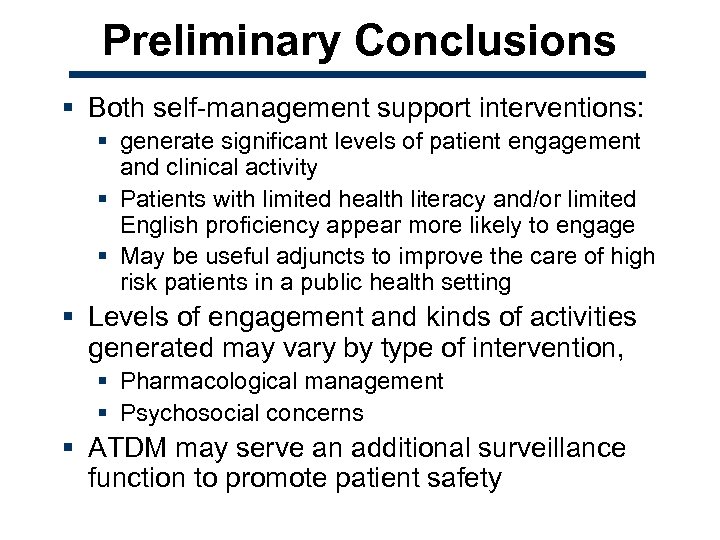
Preliminary Conclusions § Both self-management support interventions: § generate significant levels of patient engagement and clinical activity § Patients with limited health literacy and/or limited English proficiency appear more likely to engage § May be useful adjuncts to improve the care of high risk patients in a public health setting § Levels of engagement and kinds of activities generated may vary by type of intervention, § Pharmacological management § Psychosocial concerns § ATDM may serve an additional surveillance function to promote patient safety
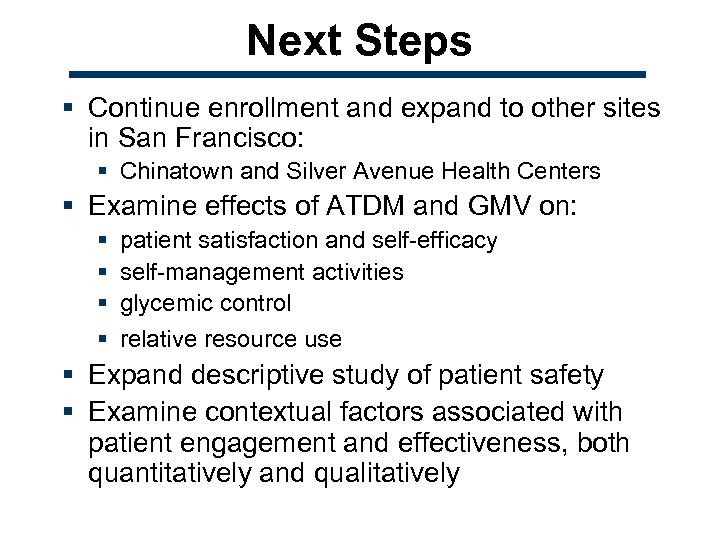
Next Steps § Continue enrollment and expand to other sites in San Francisco: § Chinatown and Silver Avenue Health Centers § Examine effects of ATDM and GMV on: § § patient satisfaction and self-efficacy self-management activities glycemic control relative resource use § Expand descriptive study of patient safety § Examine contextual factors associated with patient engagement and effectiveness, both quantitatively and qualitatively
Скачать презентацию Overcoming Communication Barriers in the Care of Diverse
407f7d43e64c4b2c802f231e1883a1cd.ppt