


 Скачать презентацию Overcoming a Middle Income Trap and Sustaining Growth
4ce4f56a35192b734253b9daa36e4e27.ppt
- Количество слайдов: 36
 Overcoming a Middle Income Trap and Sustaining Growth Prospects of Vietnam’s Development in the Context of the Regional and the Global Economy Kenichi Ohno Vietnam Development Forum (VDF) National Graduate Institute for Policy Studies (GRIPS) May 2011
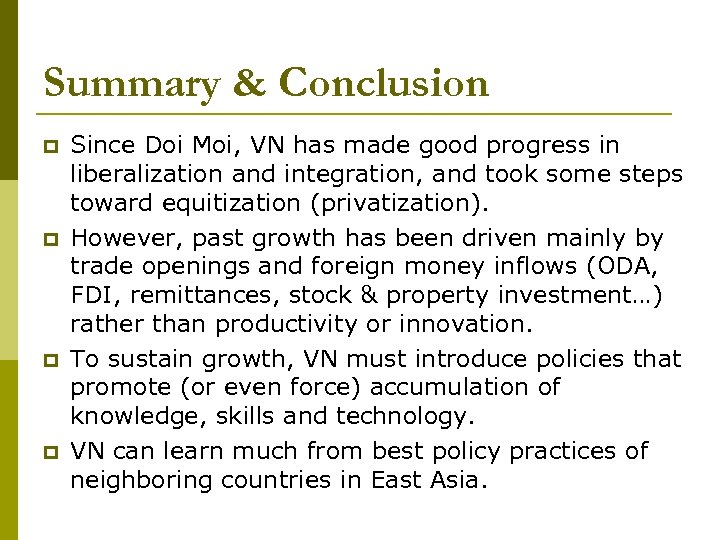 Summary & Conclusion p p Since Doi Moi, VN has made good progress in liberalization and integration, and took some steps toward equitization (privatization). However, past growth has been driven mainly by trade openings and foreign money inflows (ODA, FDI, remittances, stock & property investment…) rather than productivity or innovation. To sustain growth, VN must introduce policies that promote (or even force) accumulation of knowledge, skills and technology. VN can learn much from best policy practices of neighboring countries in East Asia.
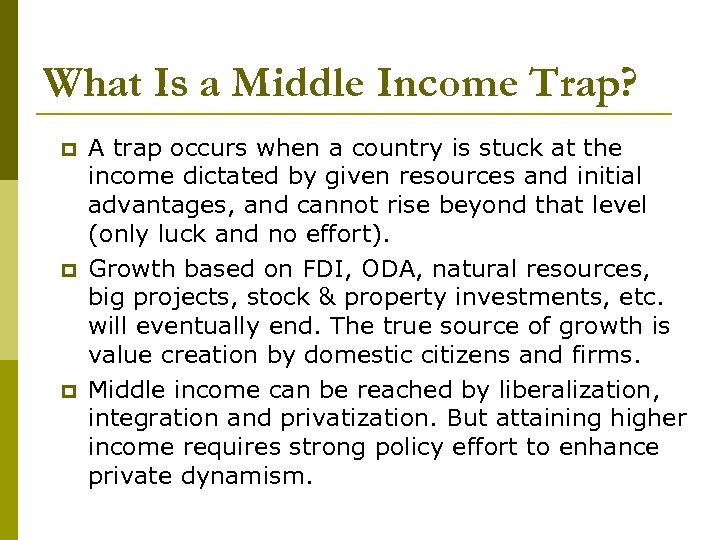 What Is a Middle Income Trap? p p p A trap occurs when a country is stuck at the income dictated by given resources and initial advantages, and cannot rise beyond that level (only luck and no effort). Growth based on FDI, ODA, natural resources, big projects, stock & property investments, etc. will eventually end. The true source of growth is value creation by domestic citizens and firms. Middle income can be reached by liberalization, integration and privatization. But attaining higher income requires strong policy effort to enhance private dynamism.
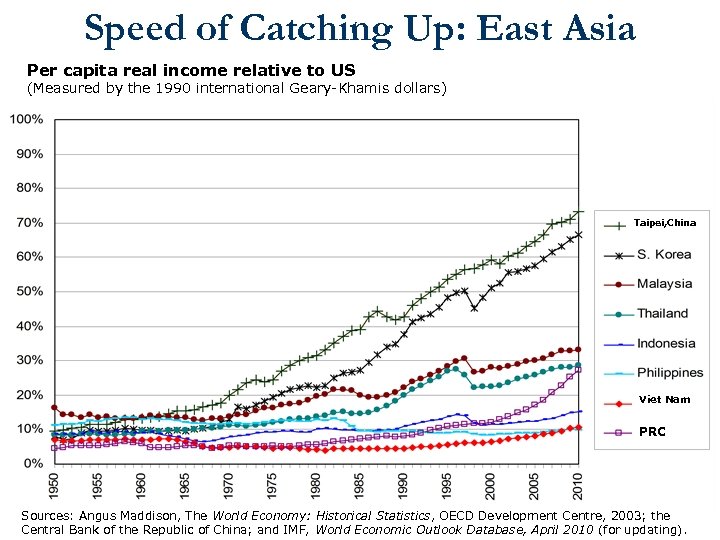 Speed of Catching Up: East Asia Per capita real income relative to US (Measured by the 1990 international Geary-Khamis dollars) Taipei, China Viet Nam PRC Sources: Angus Maddison, The World Economy: Historical Statistics, OECD Development Centre, 2003; the Central Bank of the Republic of China; and IMF, World Economic Outlook Database, April 2010 (for updating).
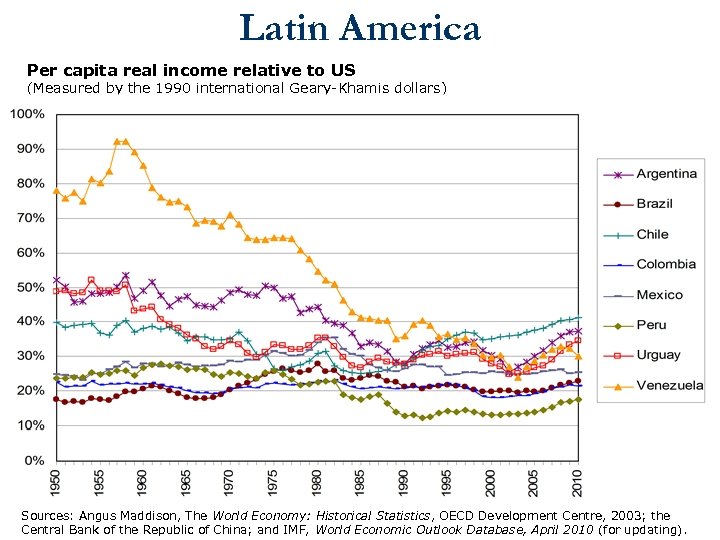 Latin America Per capita real income relative to US (Measured by the 1990 international Geary-Khamis dollars) Sources: Angus Maddison, The World Economy: Historical Statistics, OECD Development Centre, 2003; the Central Bank of the Republic of China; and IMF, World Economic Outlook Database, April 2010 (for updating).
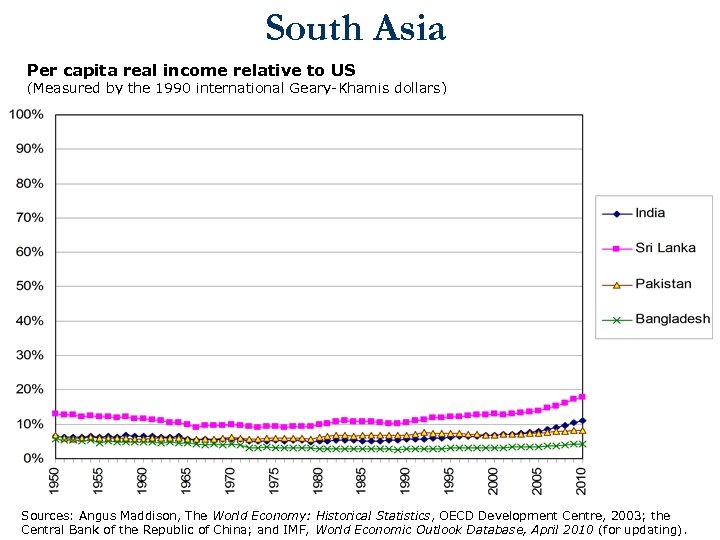 South Asia Per capita real income relative to US (Measured by the 1990 international Geary-Khamis dollars) Sources: Angus Maddison, The World Economy: Historical Statistics, OECD Development Centre, 2003; the Central Bank of the Republic of China; and IMF, World Economic Outlook Database, April 2010 (for updating).
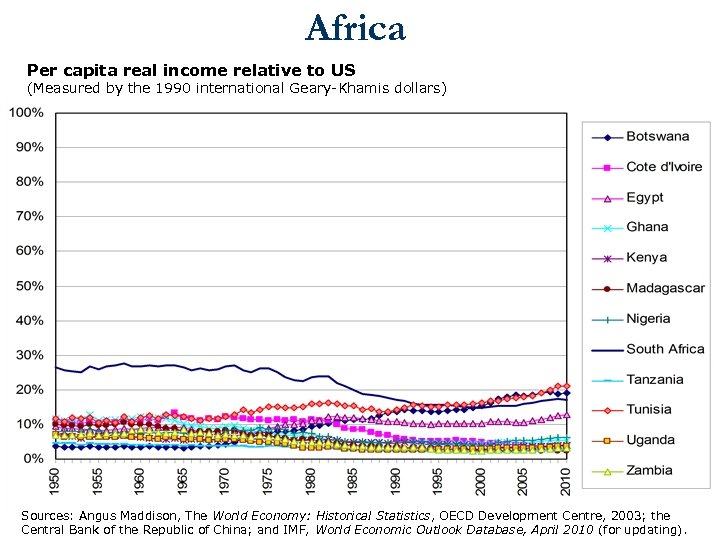 Africa Per capita real income relative to US (Measured by the 1990 international Geary-Khamis dollars) Sources: Angus Maddison, The World Economy: Historical Statistics, OECD Development Centre, 2003; the Central Bank of the Republic of China; and IMF, World Economic Outlook Database, April 2010 (for updating).
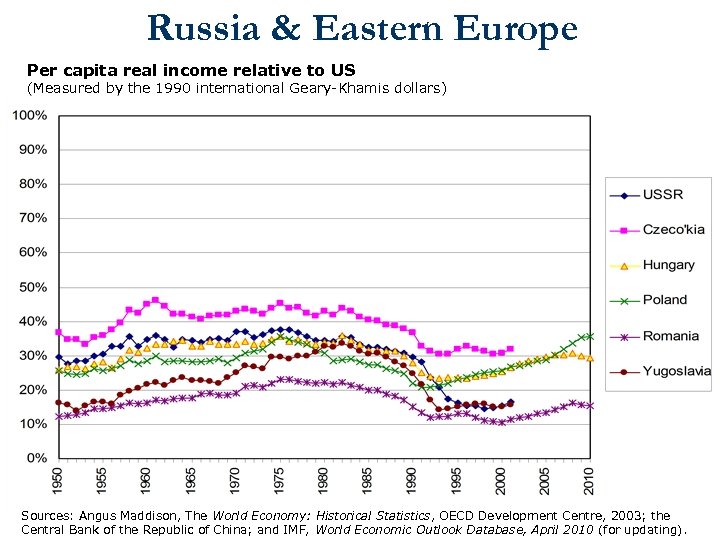 Russia & Eastern Europe Per capita real income relative to US (Measured by the 1990 international Geary-Khamis dollars) Sources: Angus Maddison, The World Economy: Historical Statistics, OECD Development Centre, 2003; the Central Bank of the Republic of China; and IMF, World Economic Outlook Database, April 2010 (for updating).
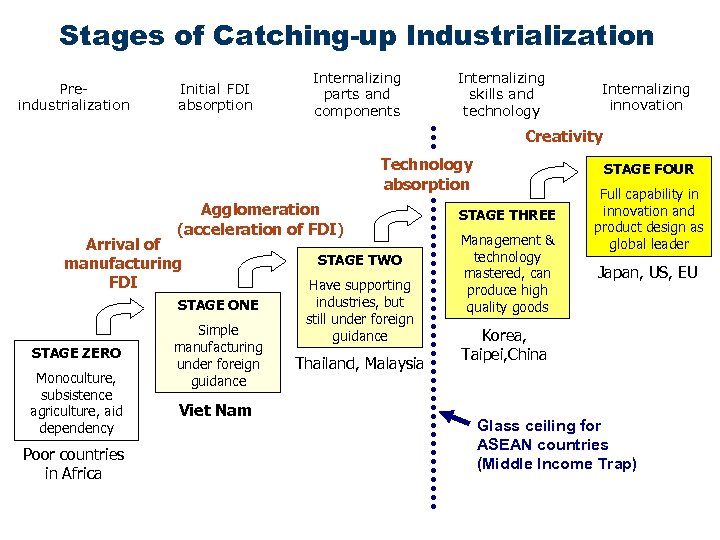 Stages of Catching-up Industrialization Preindustrialization Initial FDI absorption Internalizing parts and components Internalizing skills and technology Internalizing innovation Creativity Technology absorption Agglomeration (acceleration of FDI) Arrival of manufacturing FDI STAGE ONE STAGE ZERO Monoculture, subsistence agriculture, aid dependency Poor countries in Africa Simple manufacturing under foreign guidance Viet Nam STAGE TWO Have supporting industries, but still under foreign guidance Thailand, Malaysia STAGE FOUR STAGE THREE Management & technology mastered, can produce high quality goods Full capability in innovation and product design as global leader Japan, US, EU Korea, Taipei, China Glass ceiling for ASEAN countries (Middle Income Trap)
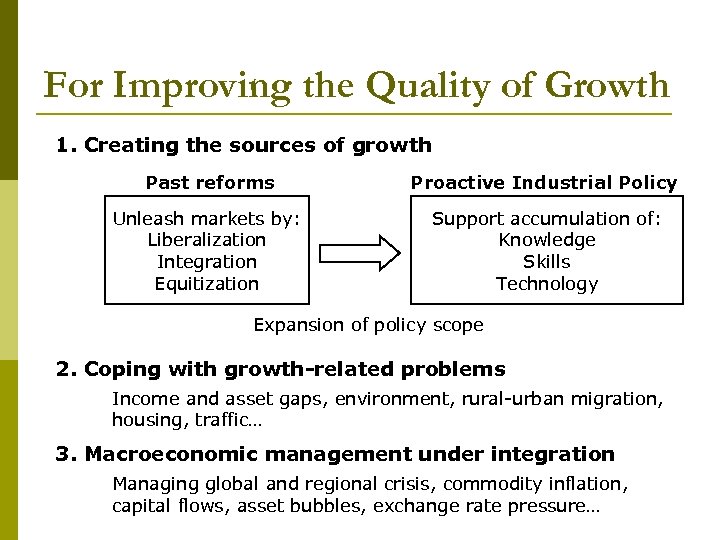 For Improving the Quality of Growth 1. Creating the sources of growth Past reforms Proactive Industrial Policy Unleash markets by: Liberalization Integration Equitization Support accumulation of: Knowledge Skills Technology Expansion of policy scope 2. Coping with growth-related problems Income and asset gaps, environment, rural-urban migration, housing, traffic… 3. Macroeconomic management under integration Managing global and regional crisis, commodity inflation, capital flows, asset bubbles, exchange rate pressure…
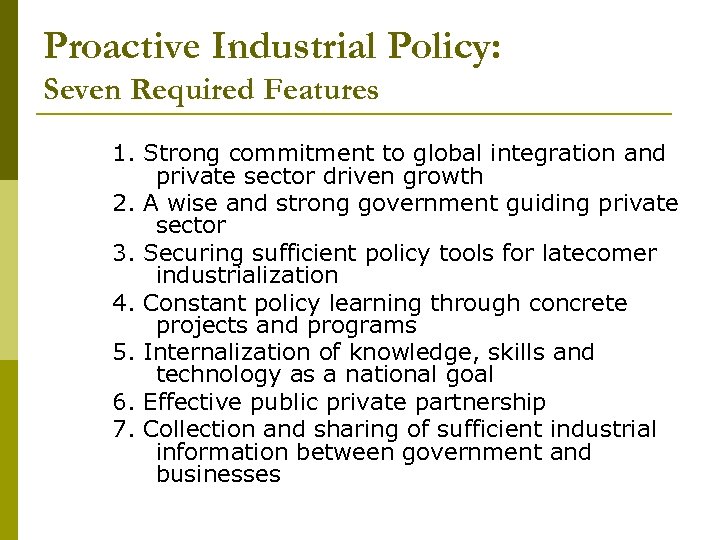 Proactive Industrial Policy: Seven Required Features 1. Strong commitment to global integration and private sector driven growth 2. A wise and strong government guiding private sector 3. Securing sufficient policy tools for latecomer industrialization 4. Constant policy learning through concrete projects and programs 5. Internalization of knowledge, skills and technology as a national goal 6. Effective public private partnership 7. Collection and sharing of sufficient industrial information between government and businesses
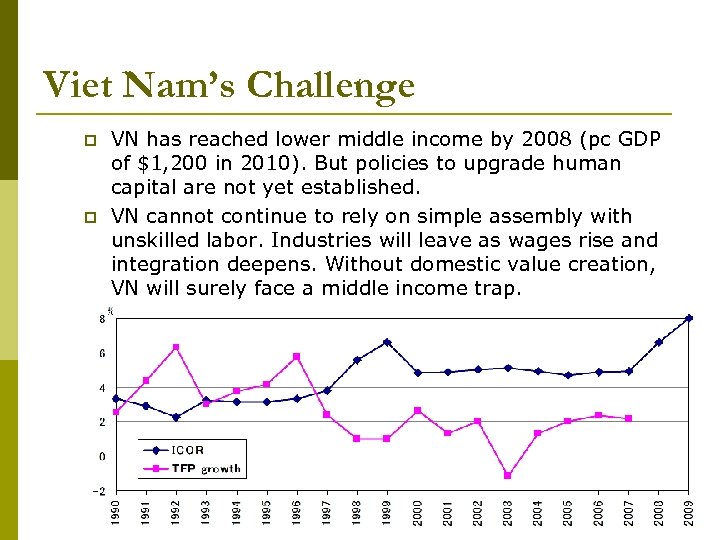 Viet Nam’s Challenge p p VN has reached lower middle income by 2008 (pc GDP of $1, 200 in 2010). But policies to upgrade human capital are not yet established. VN cannot continue to rely on simple assembly with unskilled labor. Industries will leave as wages rise and integration deepens. Without domestic value creation, VN will surely face a middle income trap.
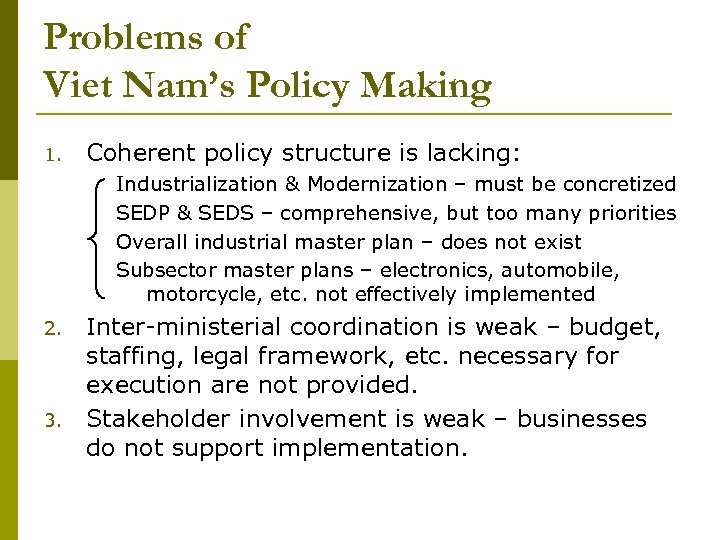 Problems of Viet Nam’s Policy Making 1. Coherent policy structure is lacking: Industrialization & Modernization – must be concretized SEDP & SEDS – comprehensive, but too many priorities Overall industrial master plan – does not exist Subsector master plans – electronics, automobile, motorcycle, etc. not effectively implemented 2. 3. Inter-ministerial coordination is weak – budget, staffing, legal framework, etc. necessary for execution are not provided. Stakeholder involvement is weak – businesses do not support implementation.
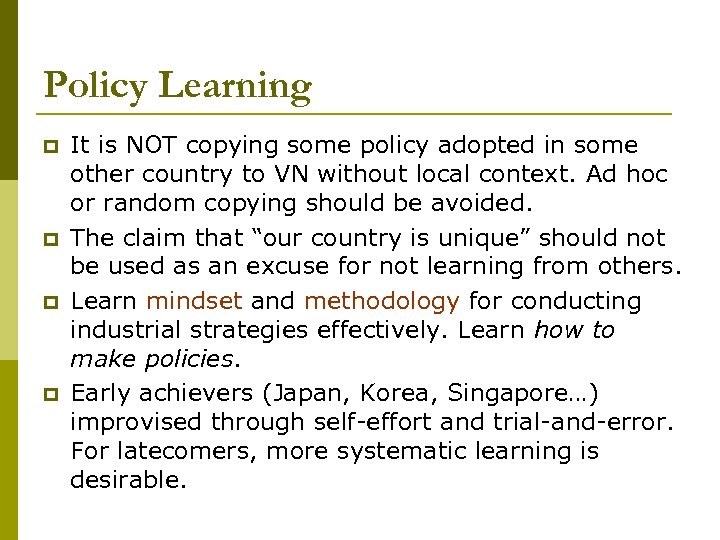 Policy Learning p p It is NOT copying some policy adopted in some other country to VN without local context. Ad hoc or random copying should be avoided. The claim that “our country is unique” should not be used as an excuse for not learning from others. Learn mindset and methodology for conducting industrial strategies effectively. Learn how to make policies. Early achievers (Japan, Korea, Singapore…) improvised through self-effort and trial-and-error. For latecomers, more systematic learning is desirable.
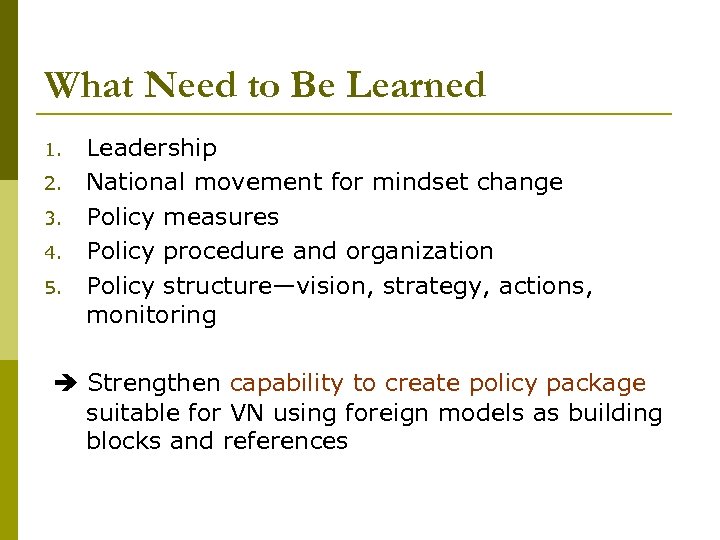 What Need to Be Learned 1. 2. 3. 4. 5. Leadership National movement for mindset change Policy measures Policy procedure and organization Policy structure—vision, strategy, actions, monitoring Strengthen capability to create policy package suitable for VN using foreign models as building blocks and references
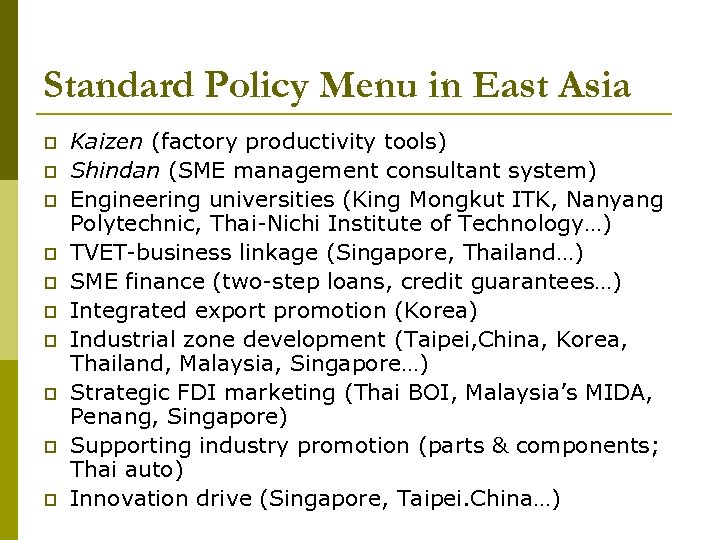 Standard Policy Menu in East Asia p p p p p Kaizen (factory productivity tools) Shindan (SME management consultant system) Engineering universities (King Mongkut ITK, Nanyang Polytechnic, Thai-Nichi Institute of Technology…) TVET-business linkage (Singapore, Thailand…) SME finance (two-step loans, credit guarantees…) Integrated export promotion (Korea) Industrial zone development (Taipei, China, Korea, Thailand, Malaysia, Singapore…) Strategic FDI marketing (Thai BOI, Malaysia’s MIDA, Penang, Singapore) Supporting industry promotion (parts & components; Thai auto) Innovation drive (Singapore, Taipei. China…)
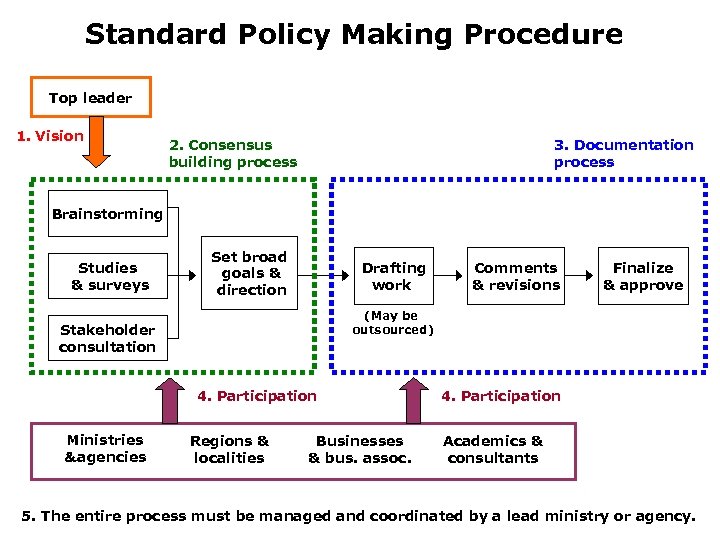 Standard Policy Making Procedure Top leader 1. Vision 2. Consensus building process 3. Documentation process Brainstorming Studies & surveys Set broad goals & direction Drafting work Finalize & approve (May be outsourced) Stakeholder consultation 4. Participation Ministries &agencies Comments & revisions Regions & localities Businesses & bus. assoc. 4. Participation Academics & consultants 5. The entire process must be managed and coordinated by a lead ministry or agency.
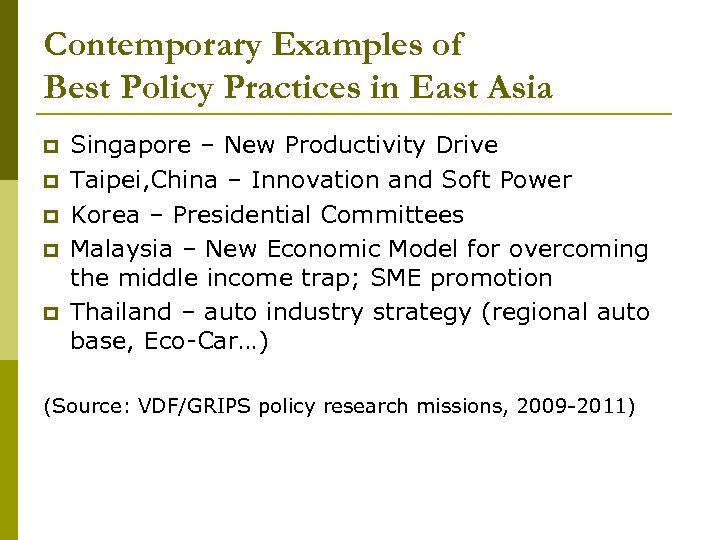 Contemporary Examples of Best Policy Practices in East Asia p p p Singapore – New Productivity Drive Taipei, China – Innovation and Soft Power Korea – Presidential Committees Malaysia – New Economic Model for overcoming the middle income trap; SME promotion Thailand – auto industry strategy (regional auto base, Eco-Car…) (Source: VDF/GRIPS policy research missions, 2009 -2011)
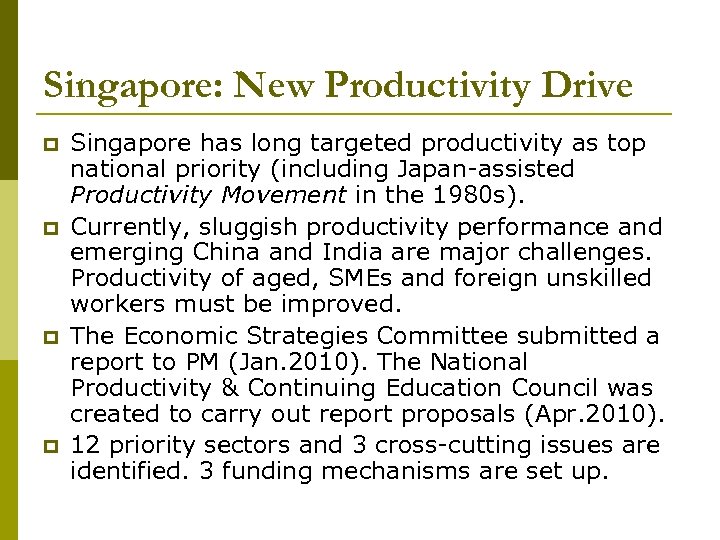 Singapore: New Productivity Drive p p Singapore has long targeted productivity as top national priority (including Japan-assisted Productivity Movement in the 1980 s). Currently, sluggish productivity performance and emerging China and India are major challenges. Productivity of aged, SMEs and foreign unskilled workers must be improved. The Economic Strategies Committee submitted a report to PM (Jan. 2010). The National Productivity & Continuing Education Council was created to carry out report proposals (Apr. 2010). 12 priority sectors and 3 cross-cutting issues are identified. 3 funding mechanisms are set up.
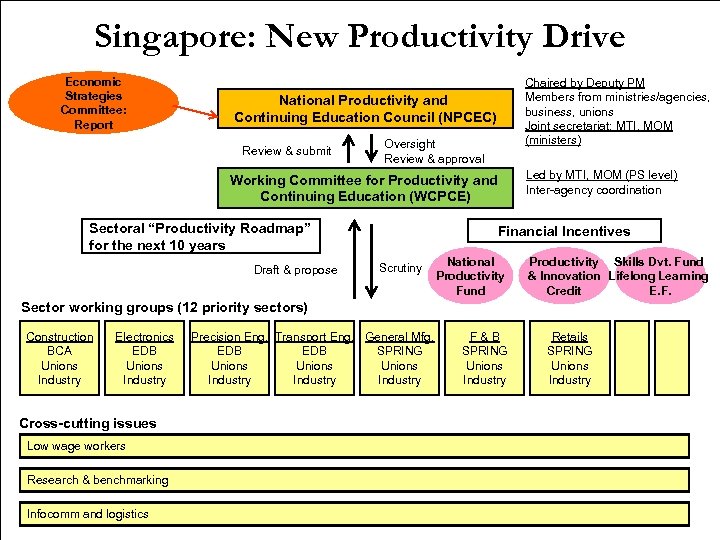 Singapore: New Productivity Drive Economic Strategies Committee: Report Chaired by Deputy PM Members from ministries/agencies, business, unions Joint secretariat: MTI, MOM (ministers) National Productivity and Continuing Education Council (NPCEC) Review & submit Oversight Review & approval Working Committee for Productivity and Continuing Education (WCPCE) Sectoral “Productivity Roadmap” for the next 10 years Draft & propose Led by MTI, MOM (PS level) Inter-agency coordination Financial Incentives Scrutiny National Productivity Fund Productivity Skills Dvt. Fund & Innovation Lifelong Learning Credit E. F. Sector working groups (12 priority sectors) Construction BCA Unions Industry Electronics EDB Unions Industry Cross-cutting issues Low wage workers Research & benchmarking Infocomm and logistics Precision Eng. Transport Eng. General Mfg. EDB SPRING Unions Industry F&B SPRING Unions Industry Retails SPRING Unions Industry
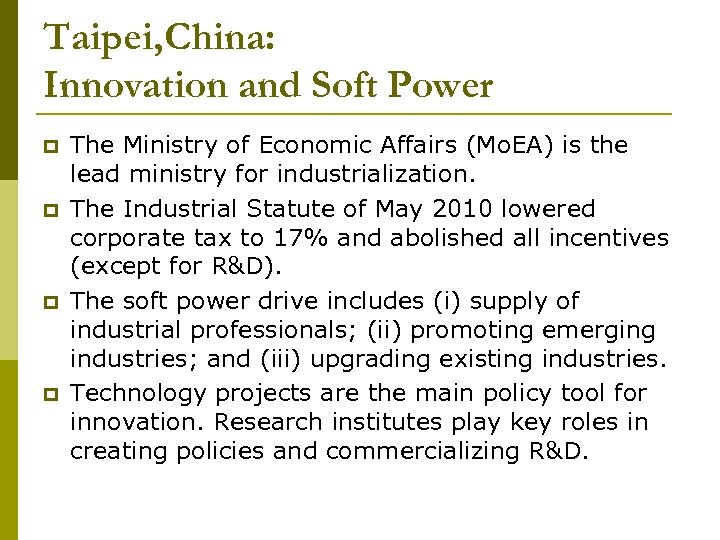 Taipei, China: Innovation and Soft Power p p The Ministry of Economic Affairs (Mo. EA) is the lead ministry for industrialization. The Industrial Statute of May 2010 lowered corporate tax to 17% and abolished all incentives (except for R&D). The soft power drive includes (i) supply of industrial professionals; (ii) promoting emerging industries; and (iii) upgrading existing industries. Technology projects are the main policy tool for innovation. Research institutes play key roles in creating policies and commercializing R&D.
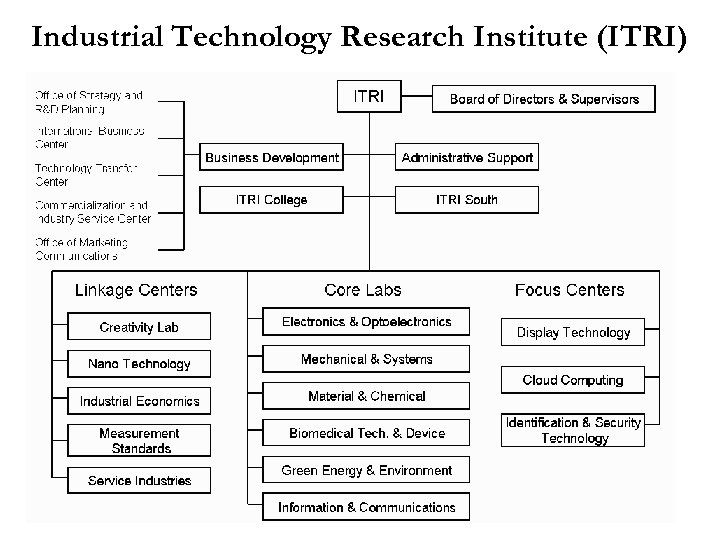 Industrial Technology Research Institute (ITRI)
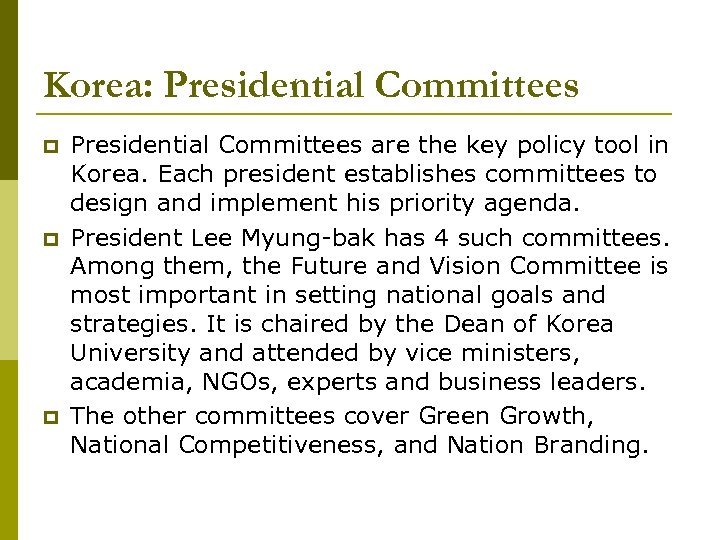 Korea: Presidential Committees p p p Presidential Committees are the key policy tool in Korea. Each president establishes committees to design and implement his priority agenda. President Lee Myung-bak has 4 such committees. Among them, the Future and Vision Committee is most important in setting national goals and strategies. It is chaired by the Dean of Korea University and attended by vice ministers, academia, NGOs, experts and business leaders. The other committees cover Green Growth, National Competitiveness, and Nation Branding.
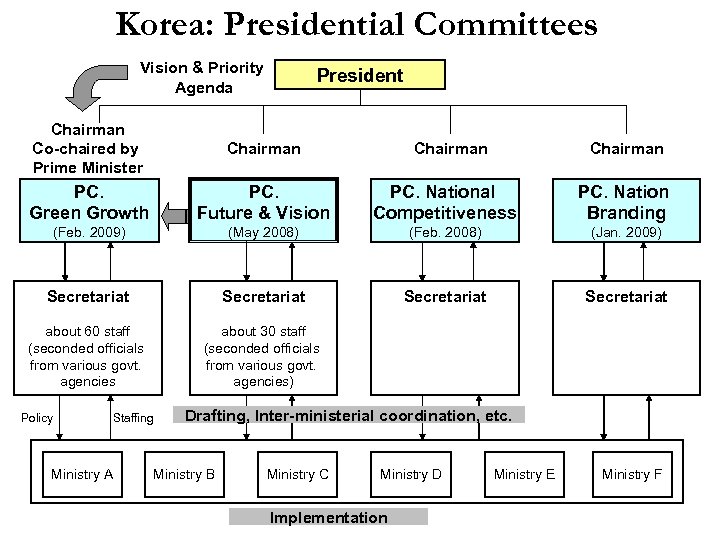 Korea: Presidential Committees Vision & Priority Agenda President Chairman Co-chaired by Prime Minister Chairman PC. Green Growth PC. Future & Vision PC. National Competitiveness PC. Nation Branding (Feb. 2009) (May 2008) (Feb. 2008) (Jan. 2009) Secretariat about 60 staff (seconded officials from various govt. agencies about 30 staff (seconded officials from various govt. agencies) Policy Ministry A Staffing Chairman Drafting, Inter-ministerial coordination, etc. Ministry B Ministry C Ministry D Implementation Ministry E Ministry F
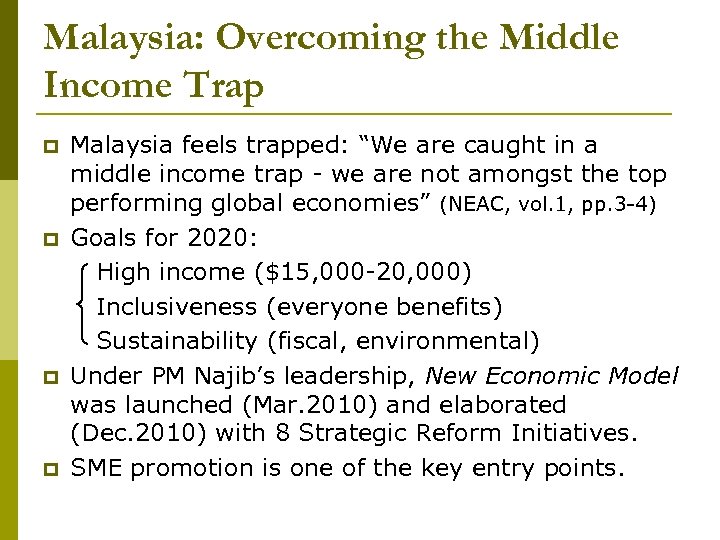 Malaysia: Overcoming the Middle Income Trap p p Malaysia feels trapped: “We are caught in a middle income trap - we are not amongst the top performing global economies” (NEAC, vol. 1, pp. 3 -4) Goals for 2020: High income ($15, 000 -20, 000) Inclusiveness (everyone benefits) Sustainability (fiscal, environmental) Under PM Najib’s leadership, New Economic Model was launched (Mar. 2010) and elaborated (Dec. 2010) with 8 Strategic Reform Initiatives. SME promotion is one of the key entry points.
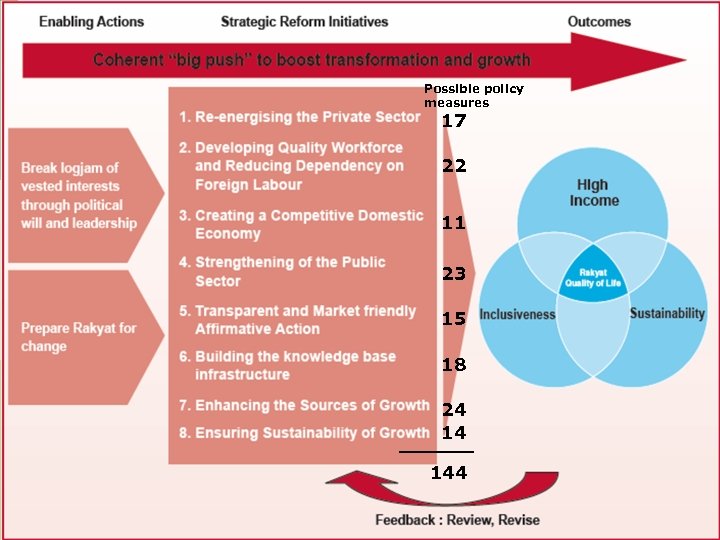 Possible policy measures 17 22 11 23 15 18 24 14 144
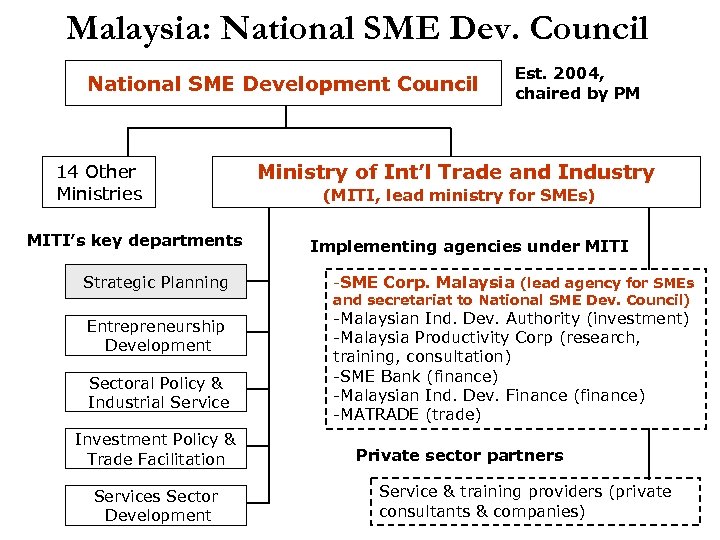 Malaysia: National SME Dev. Council National SME Development Council 14 Other Ministries MITI’s key departments Strategic Planning Est. 2004, chaired by PM Ministry of Int’l Trade and Industry (MITI, lead ministry for SMEs) Implementing agencies under MITI -SME Corp. Malaysia (lead agency for SMEs and secretariat to National SME Dev. Council) Entrepreneurship Development Sectoral Policy & Industrial Service Investment Policy & Trade Facilitation Services Sector Development -Malaysian Ind. Dev. Authority (investment) -Malaysia Productivity Corp (research, training, consultation) -SME Bank (finance) -Malaysian Ind. Dev. Finance (finance) -MATRADE (trade) Private sector partners Service & training providers (private consultants & companies)
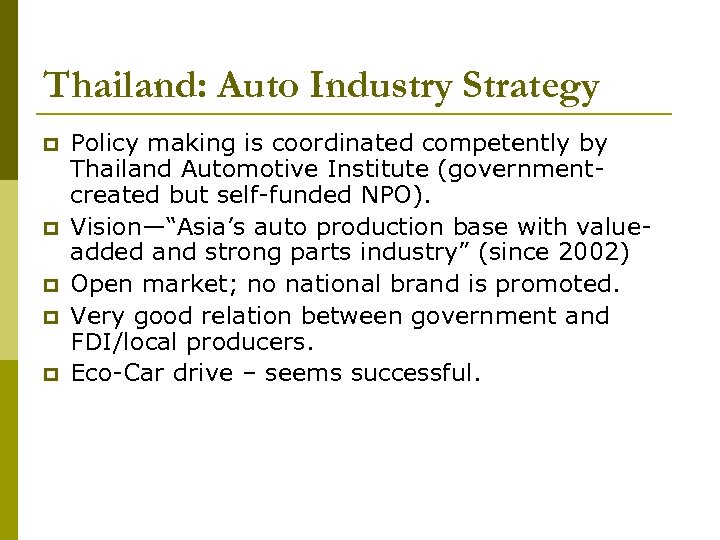 Thailand: Auto Industry Strategy p p p Policy making is coordinated competently by Thailand Automotive Institute (governmentcreated but self-funded NPO). Vision—“Asia’s auto production base with valueadded and strong parts industry” (since 2002) Open market; no national brand is promoted. Very good relation between government and FDI/local producers. Eco-Car drive – seems successful.
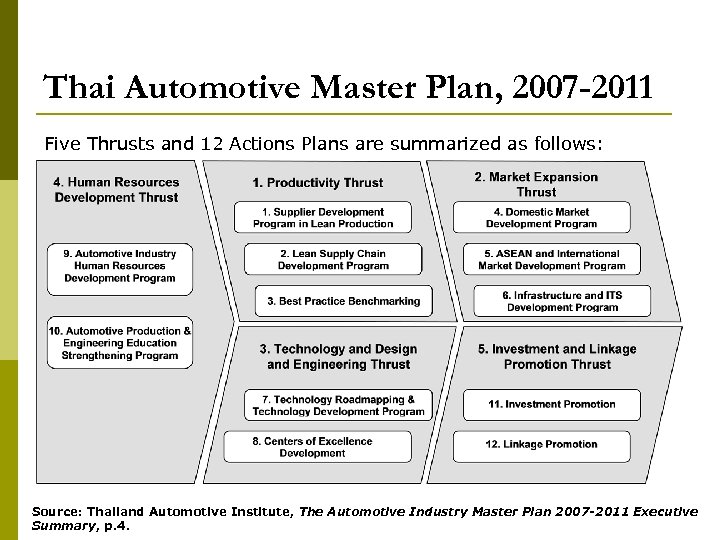 Thai Automotive Master Plan, 2007 -2011 Five Thrusts and 12 Actions Plans are summarized as follows: Source: Thailand Automotive Institute, The Automotive Industry Master Plan 2007 -2011 Executive Summary, p. 4.
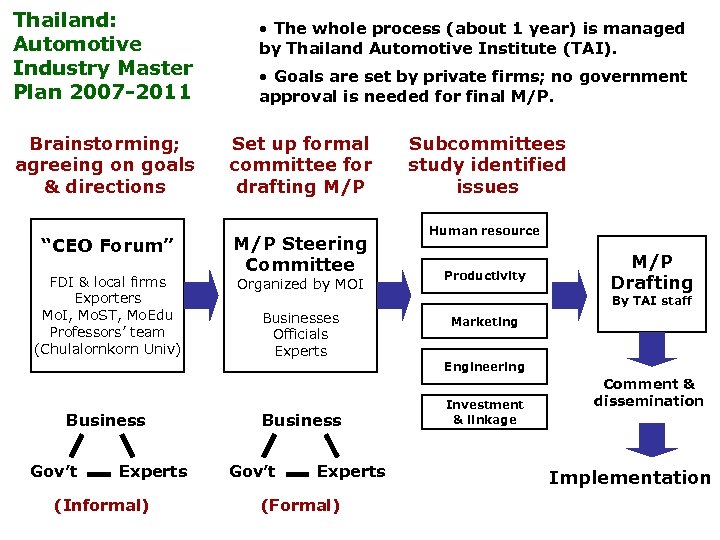 Thailand: Automotive Industry Master Plan 2007 -2011 Brainstorming; agreeing on goals & directions “CEO Forum” FDI & local firms Exporters Mo. I, Mo. ST, Mo. Edu Professors’ team (Chulalornkorn Univ) Business Gov’t Experts (Informal) • The whole process (about 1 year) is managed by Thailand Automotive Institute (TAI). • Goals are set by private firms; no government approval is needed for final M/P. Set up formal committee for drafting M/P Steering Committee Organized by MOI Subcommittees study identified issues Human resource Productivity M/P Drafting By TAI staff Businesses Officials Experts Business Gov’t Experts (Formal) Marketing Engineering Investment & linkage Comment & dissemination Implementation
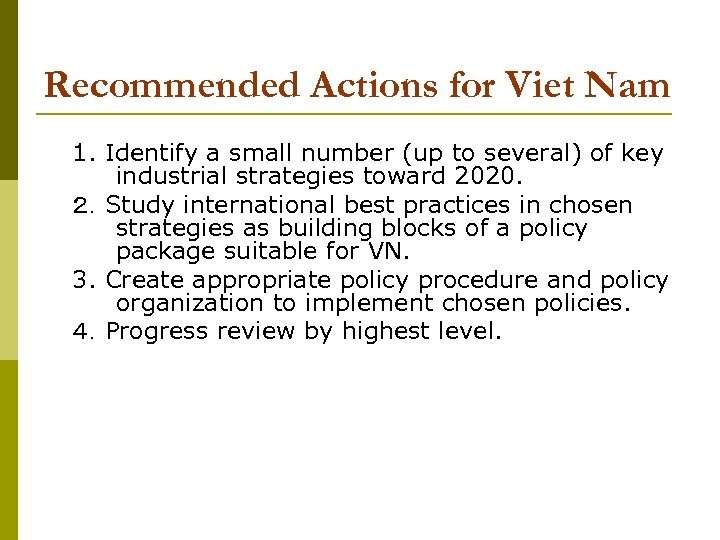 Recommended Actions for Viet Nam 1. Identify a small number (up to several) of key industrial strategies toward 2020. 2.Study international best practices in chosen strategies as building blocks of a policy package suitable for VN. 3. Create appropriate policy procedure and policy organization to implement chosen policies. 4.Progress review by highest level.
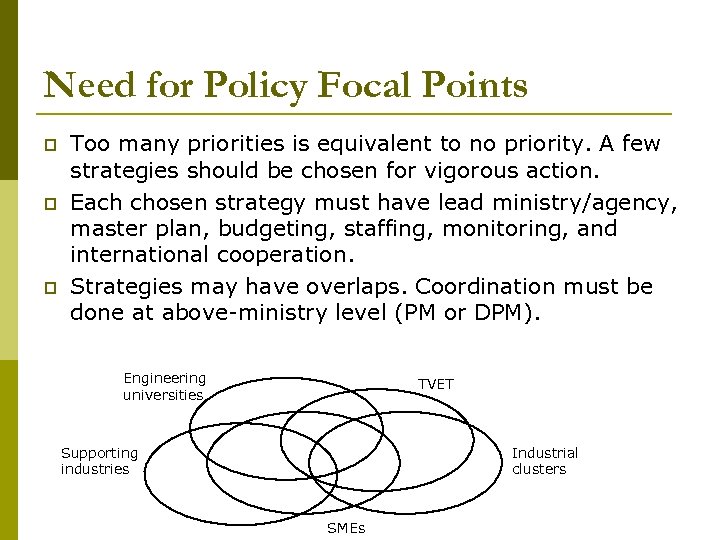 Need for Policy Focal Points p p p Too many priorities is equivalent to no priority. A few strategies should be chosen for vigorous action. Each chosen strategy must have lead ministry/agency, master plan, budgeting, staffing, monitoring, and international cooperation. Strategies may have overlaps. Coordination must be done at above-ministry level (PM or DPM). Engineering universities TVET Supporting industries Industrial clusters SMEs
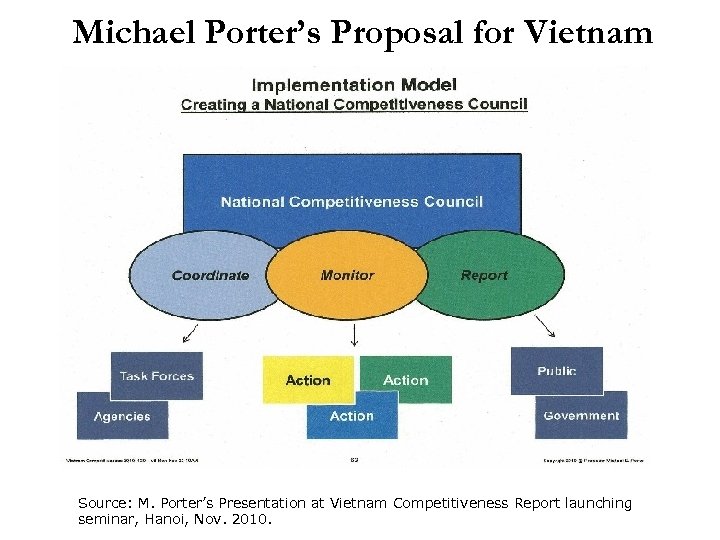 Michael Porter’s Proposal for Vietnam Source: M. Porter’s Presentation at Vietnam Competitiveness Report launching seminar, Hanoi, Nov. 2010.
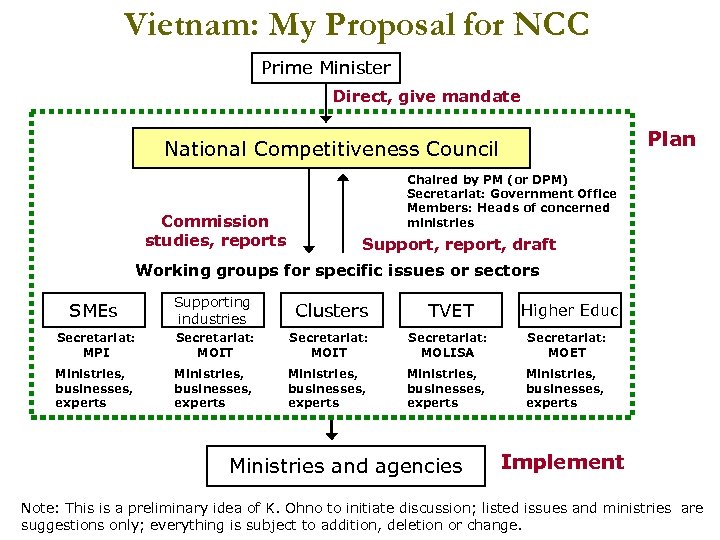 Vietnam: My Proposal for NCC Prime Minister Direct, give mandate Plan National Competitiveness Council Commission studies, reports Chaired by PM (or DPM) Secretariat: Government Office Members: Heads of concerned ministries Support, report, draft Working groups for specific issues or sectors SMEs Supporting industries Clusters TVET Higher Educ Secretariat: MPI Secretariat: MOIT Secretariat: MOLISA Secretariat: MOET Ministries, businesses, experts Ministries, businesses, experts Ministries and agencies Implement Note: This is a preliminary idea of K. Ohno to initiate discussion; listed issues and ministries are suggestions only; everything is subject to addition, deletion or change.
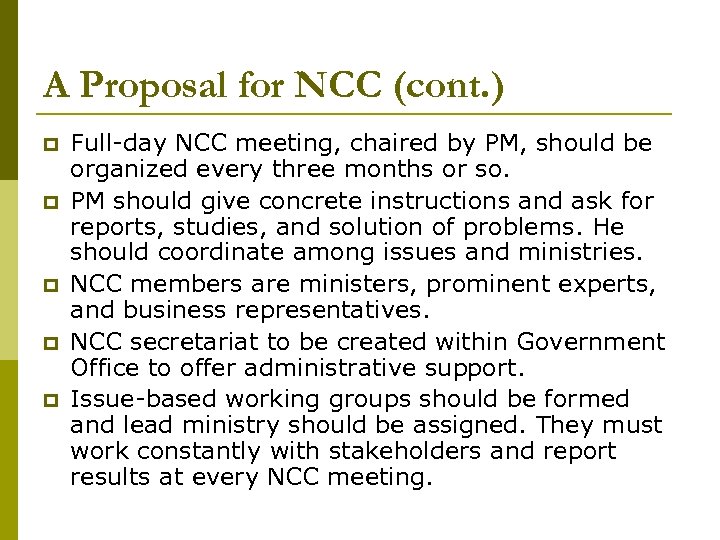 A Proposal for NCC (cont. ) p p p Full-day NCC meeting, chaired by PM, should be organized every three months or so. PM should give concrete instructions and ask for reports, studies, and solution of problems. He should coordinate among issues and ministries. NCC members are ministers, prominent experts, and business representatives. NCC secretariat to be created within Government Office to offer administrative support. Issue-based working groups should be formed and lead ministry should be assigned. They must work constantly with stakeholders and report results at every NCC meeting.
 References GRIPS Development Forum (2010 and 2011), “Mission Reports” for Singapore, South Korea and Taiwan. Ketels, Christian, Nguyen Dinh Cung, Nguyen Thi Tue Anh, and Do Hong Hanh (2010), Vietnam Competitiveness Report 2010, Central Institute for Economic Management and Lee Kuan Yew School of Public Policy. National Economic Advisory Council (2010), New Economic Model for Malaysia, March and December. Ohno, Izumi, and Masumi Shimamura (2007), Managing the Development Process and Aid: East Asian Experience in Building Central Economic Agencies, GRIPS Development Forum, March. Ohno, Kenichi (2009), “Avoiding the middle-income trap: renovating industrial policy formulation in Vietnam, ” ASEAN Economic Bulletin, 26(1), 25 -43. Ohno, Kenichi (2011), “Policy Procedure and Organization for Executing High Priority Industrial Strategies, ” a paper prepared for the NEU-National Assembly Conference on the Quality of Growth, Hanoi, Feb. 24. Ohno, Kenichi (forthcoming), Learning to Industrialize: Catch-up Strategies for Twenty-first Century Latecomers, Routledge. Vietnam Development Forum, and Goodwill Consultant (2011), “Survey on Comparison of Backgrounds, Policy Measures and Outcomes for Development of Supporting Industries in ASEAN, JICA and VDF, Publishing Houseof Communication and Tranport. World Bank (2010), “Avoiding the Middle-income Trap: Priorities for Vietnam’s Long-term Growth, ” a paper presented at Senior Policy Seminar, Hanoi, August.