


 Скачать презентацию Over-Complete Sparse Representations for Image Decomposition Michael
5499b34e870c7c2ce3649344a06c2759.ppt
- Количество слайдов: 41
 Over-Complete & Sparse Representations for Image Decomposition* Michael Elad The Computer Science Department The Technion – Israel Institute of Technology Haifa 32000, Israel AMS Special Session on Multiscale and Oscillatory Phenomena: Modeling, Numerical Techniques, and Applications Phoenix AZ - January 2004 * Joint work with: Jean-Luc Starck – CEA - Service d’Astrophysique, CEA-Saclay, France David L. Donoho – Statistics, Stanford. Sparse representations for Image Decomposition
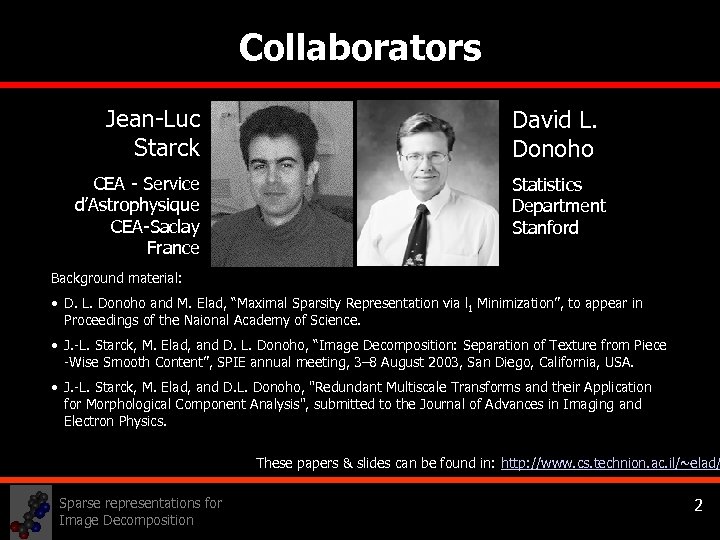 Collaborators Jean-Luc Starck CEA - Service d’Astrophysique CEA-Saclay France David L. Donoho Statistics Department Stanford Background material: • D. L. Donoho and M. Elad, “Maximal Sparsity Representation via l 1 Minimization”, to appear in Proceedings of the Naional Academy of Science. • J. -L. Starck, M. Elad, and D. L. Donoho, “Image Decomposition: Separation of Texture from Piece -Wise Smooth Content”, SPIE annual meeting, 3– 8 August 2003, San Diego, California, USA. • J. -L. Starck, M. Elad, and D. L. Donoho, "Redundant Multiscale Transforms and their Application for Morphological Component Analysis", submitted to the Journal of Advances in Imaging and Electron Physics. These papers & slides can be found in: http: //www. cs. technion. ac. il/~elad/ Sparse representations for Image Decomposition 2
 General • Sparsity and over-completeness have important roles in analyzing and representing signals. • Our efforts so far have been concentrated on analysis of the (basis/matching) pursuit algorithms, properties of sparse representations (uniqueness), and applications. • Today we discuss the image decomposition application (image=cartoon+texture). We present both § Theoretical analysis serving this application, and § Practical considerations. Sparse representations for Image Decomposition 3
 Agenda 1. Introduction Sparsity and Over-completeness!? 2. Theory of Decomposition Uniqueness and Equivalence 3. Decomposition in Practice 4. 5. Practical Considerations, Numerical algorithm 4. Discussion Sparse representations for Image Decomposition 4
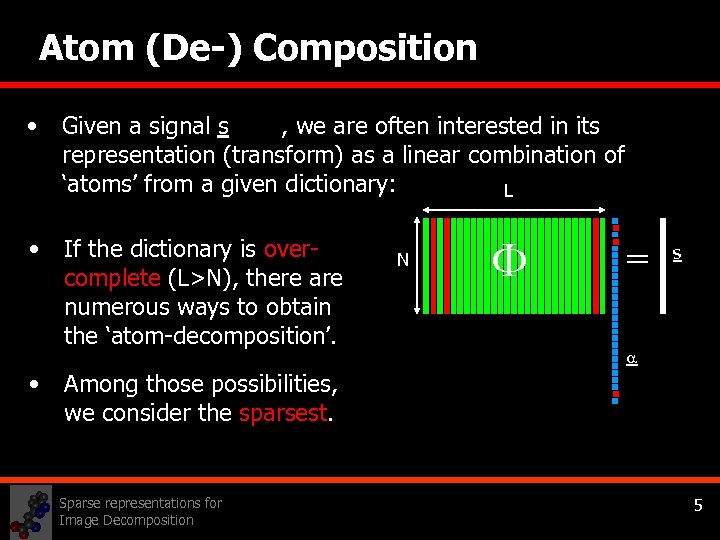 Atom (De-) Composition • Given a signal s , we are often interested in its representation (transform) as a linear combination of ‘atoms’ from a given dictionary: L • If the dictionary is overcomplete (L>N), there are numerous ways to obtain the ‘atom-decomposition’. • N = s Among those possibilities, we consider the sparsest. Sparse representations for Image Decomposition 5
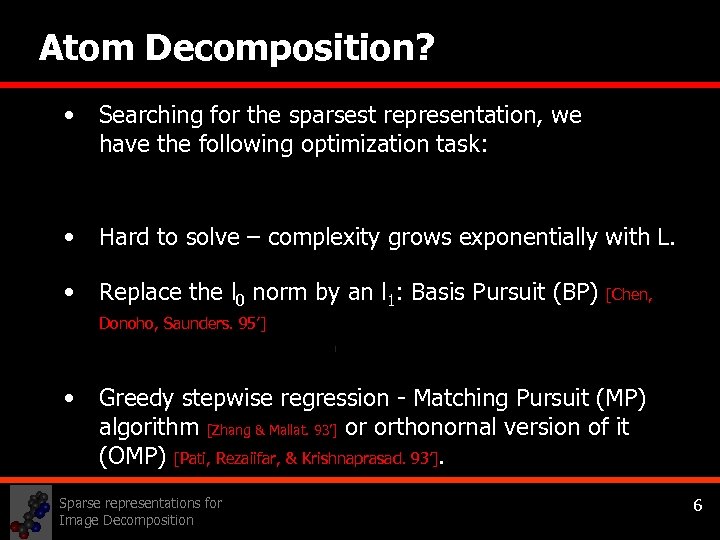 Atom Decomposition? • Searching for the sparsest representation, we have the following optimization task: • Hard to solve – complexity grows exponentially with L. • Replace the l 0 norm by an l 1: Basis Pursuit (BP) [Chen, Donoho, Saunders. 95’] • Greedy stepwise regression - Matching Pursuit (MP) algorithm [Zhang & Mallat. 93’] or orthonornal version of it (OMP) [Pati, Rezaiifar, & Krishnaprasad. 93’]. Sparse representations for Image Decomposition 6
 Questions about Decomposition • Interesting observation: In many cases it successfully the pursuit algorithms find the sparsest representation. • Why BP/MP/OMP should work well? Are there Conditions to this success? • Could there be several different sparse representations? What about uniqueness? • How all this leads to image separation? Sparse representations for Image Decomposition 7
 Agenda 1. Introduction Sparsity and Over-completeness!? 2. Theory of Decomposition Uniqueness and Equivalence 3. Decomposition in Practice 4. 5. Practical Considerations, Numerical algorithm 4. Discussion Sparse representations for Image Decomposition 8
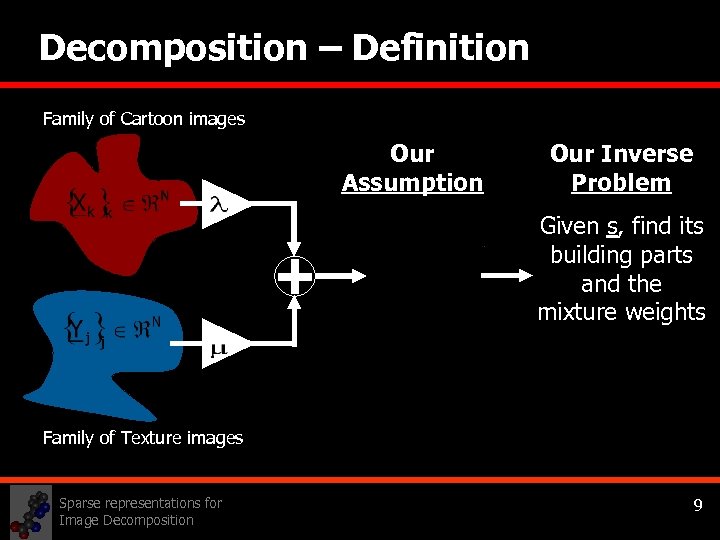 Decomposition – Definition Family of Cartoon images Our Assumption Our Inverse Problem Given s, find its building parts and the mixture weights Family of Texture images Sparse representations for Image Decomposition 9
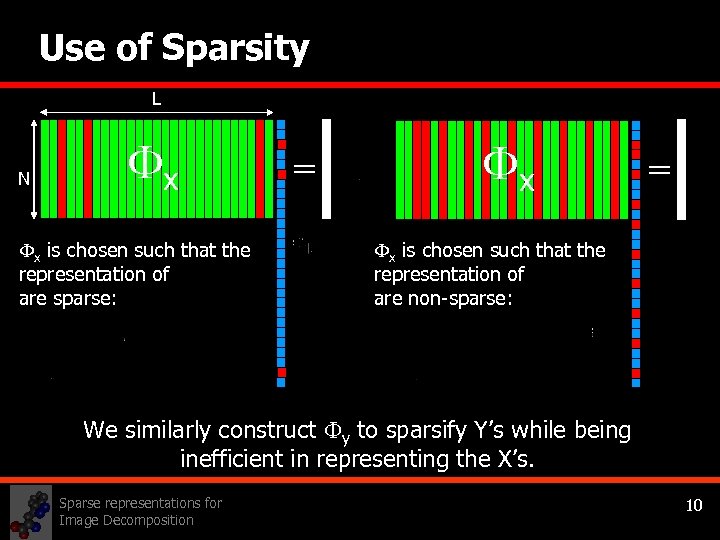 Use of Sparsity L N x x is chosen such that the representation of are sparse: = x is chosen such that the representation of are non-sparse: We similarly construct y to sparsify Y’s while being inefficient in representing the X’s. Sparse representations for Image Decomposition 10
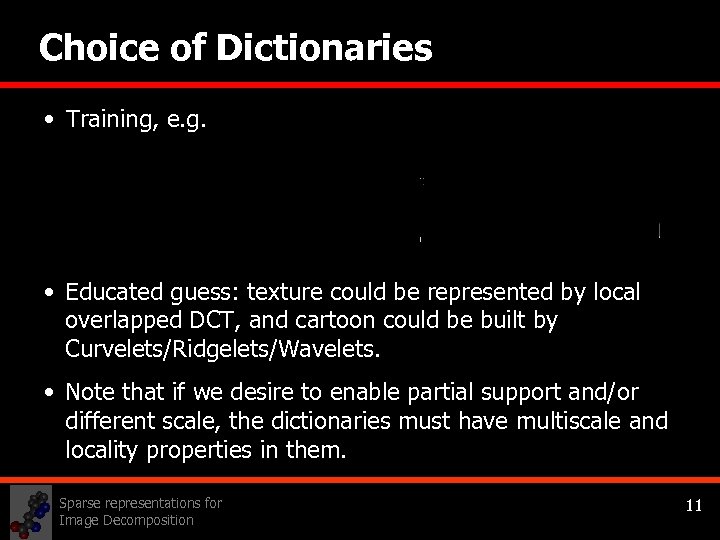 Choice of Dictionaries • Training, e. g. • Educated guess: texture could be represented by local overlapped DCT, and cartoon could be built by Curvelets/Ridgelets/Wavelets. • Note that if we desire to enable partial support and/or different scale, the dictionaries must have multiscale and locality properties in them. Sparse representations for Image Decomposition 11
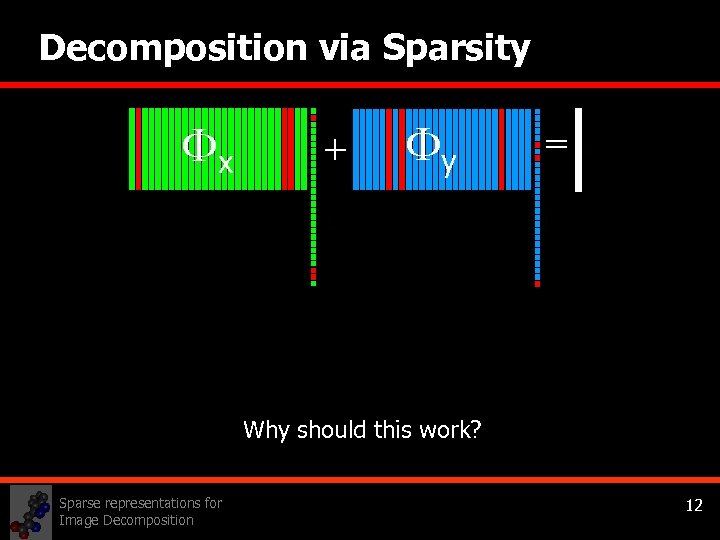 Decomposition via Sparsity x + y = Why should this work? Sparse representations for Image Decomposition 12
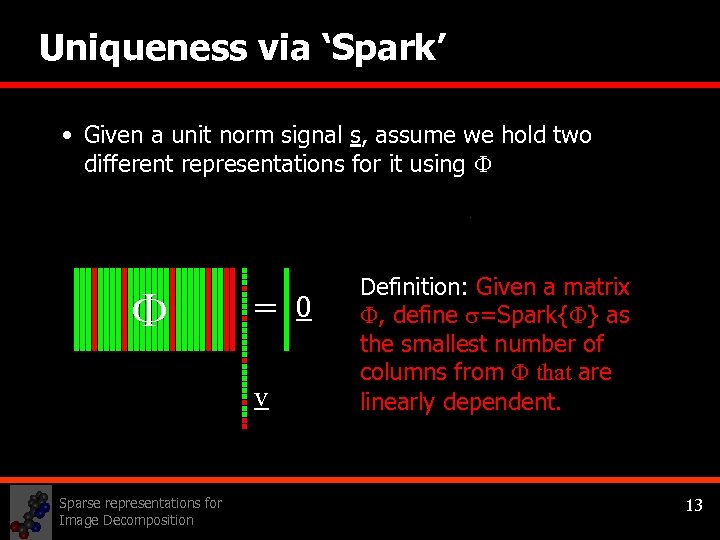 Uniqueness via ‘Spark’ • Given a unit norm signal s, assume we hold two different representations for it using = v Sparse representations for Image Decomposition 0 Definition: Given a matrix , define =Spark{ } as the smallest number of columns from that are linearly dependent. 13
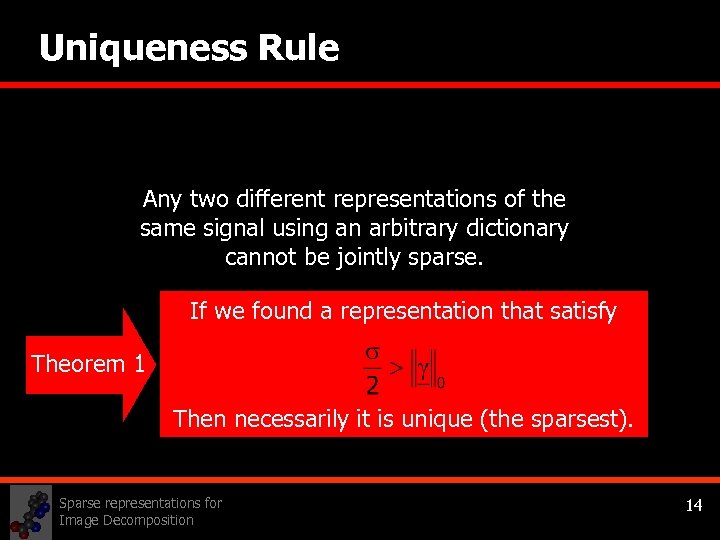 Uniqueness Rule Any two different representations of the same signal using an arbitrary dictionary cannot be jointly sparse. If we found a representation that satisfy Theorem 1 Then necessarily it is unique (the sparsest). Sparse representations for Image Decomposition 14
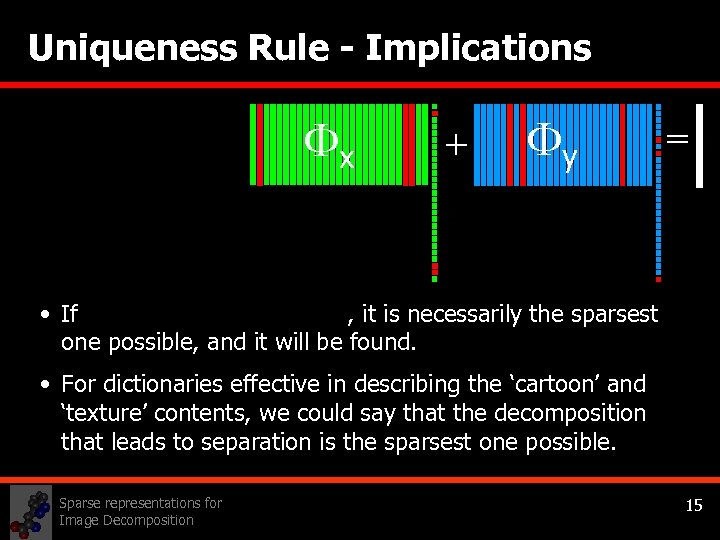 Uniqueness Rule - Implications x + y = • If , it is necessarily the sparsest one possible, and it will be found. • For dictionaries effective in describing the ‘cartoon’ and ‘texture’ contents, we could say that the decomposition that leads to separation is the sparsest one possible. Sparse representations for Image Decomposition 15
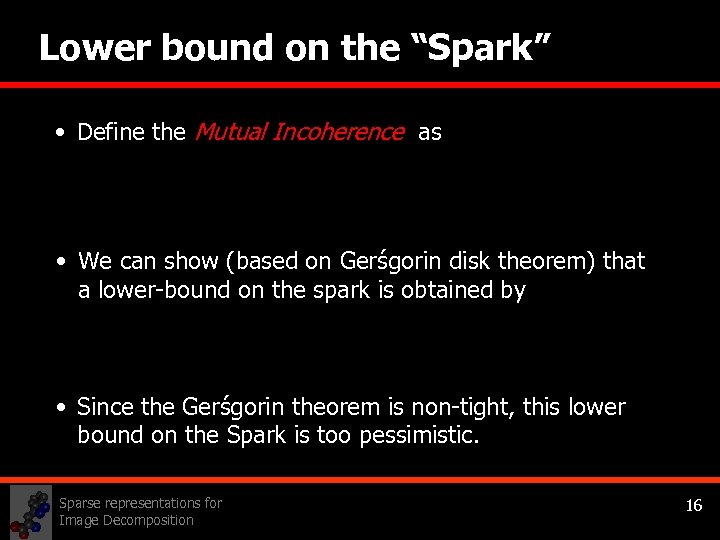 Lower bound on the “Spark” • Define the Mutual Incoherence as • We can show (based on Gerśgorin disk theorem) that a lower-bound on the spark is obtained by • Since the Gerśgorin theorem is non-tight, this lower bound on the Spark is too pessimistic. Sparse representations for Image Decomposition 16
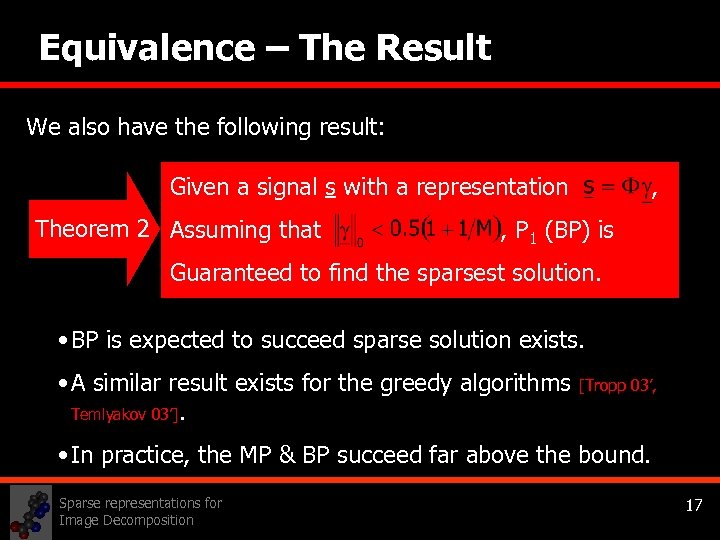 Equivalence – The Result We also have the following result: Given a signal s with a representation , Theorem 2 Assuming that , P 1 (BP) is Guaranteed to find the sparsest solution. • BP is expected to succeed sparse solution exists. • A similar result exists for the greedy algorithms [Tropp 03’, Temlyakov 03’]. • In practice, the MP & BP succeed far above the bound. Sparse representations for Image Decomposition 17
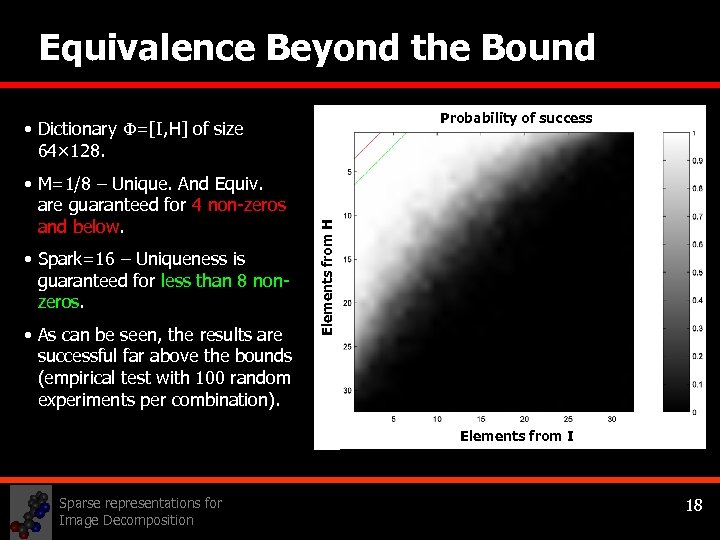 Equivalence Beyond the Bound Probability of success • M=1/8 – Unique. And Equiv. are guaranteed for 4 non-zeros and below. • Spark=16 – Uniqueness is guaranteed for less than 8 nonzeros. • As can be seen, the results are successful far above the bounds (empirical test with 100 random experiments per combination). Elements from H • Dictionary =[I, H] of size 64× 128. Elements from I Sparse representations for Image Decomposition 18
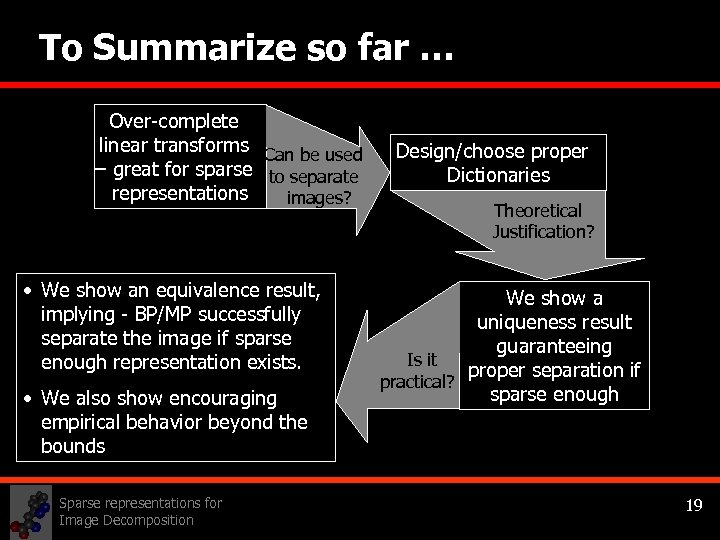 To Summarize so far … Over-complete linear transforms Can be used – great for sparse to separate representations images? • We show an equivalence result, implying - BP/MP successfully separate the image if sparse enough representation exists. • We also show encouraging empirical behavior beyond the bounds Sparse representations for Image Decomposition Design/choose proper Dictionaries Theoretical Justification? We show a uniqueness result guaranteeing Is it proper separation if practical? sparse enough 19
 Agenda 1. Introduction Sparsity and Over-completeness!? 2. Theory of Decomposition Uniqueness and Equivalence 3. Decomposition in Practice 4. 5. Practical Considerations, Numerical algorithm 4. Discussion Sparse representations for Image Decomposition 20
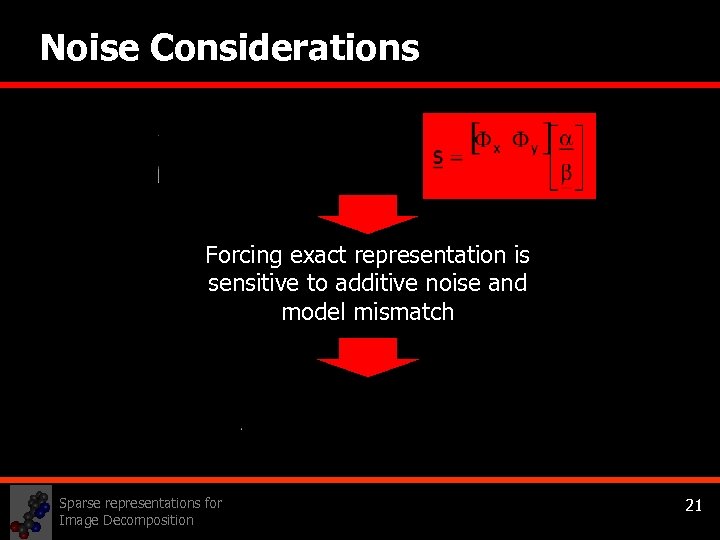 Noise Considerations Forcing exact representation is sensitive to additive noise and model mismatch Sparse representations for Image Decomposition 21
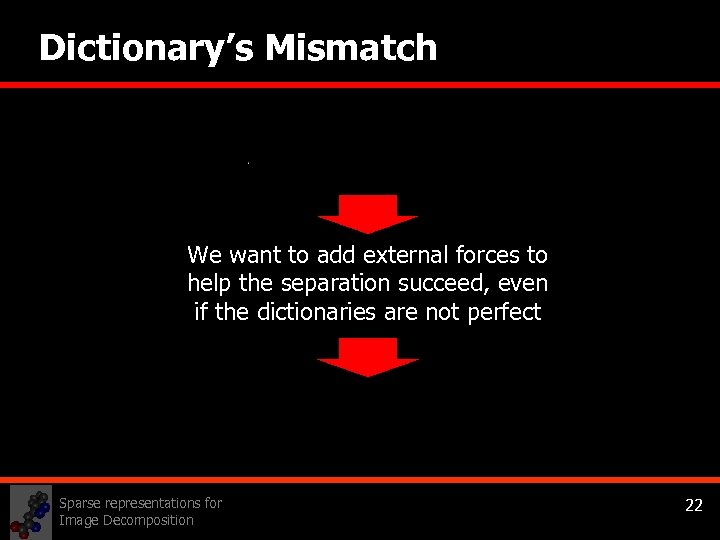 Dictionary’s Mismatch We want to add external forces to help the separation succeed, even if the dictionaries are not perfect Sparse representations for Image Decomposition 22
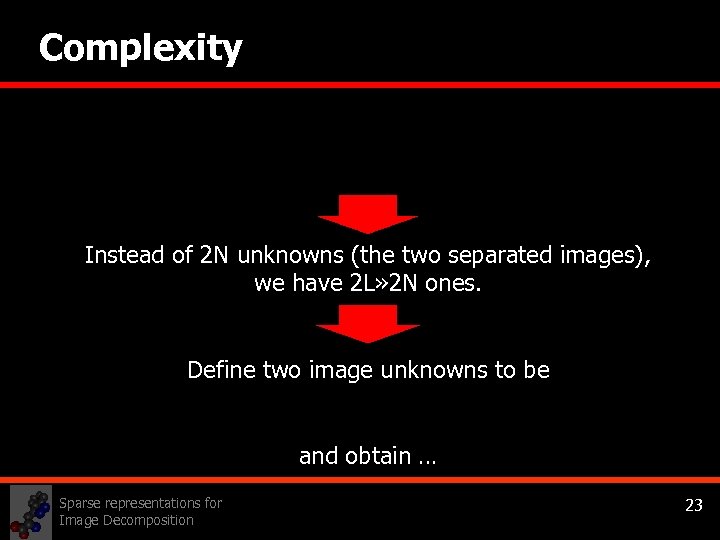 Complexity Instead of 2 N unknowns (the two separated images), we have 2 L» 2 N ones. Define two image unknowns to be and obtain … Sparse representations for Image Decomposition 23
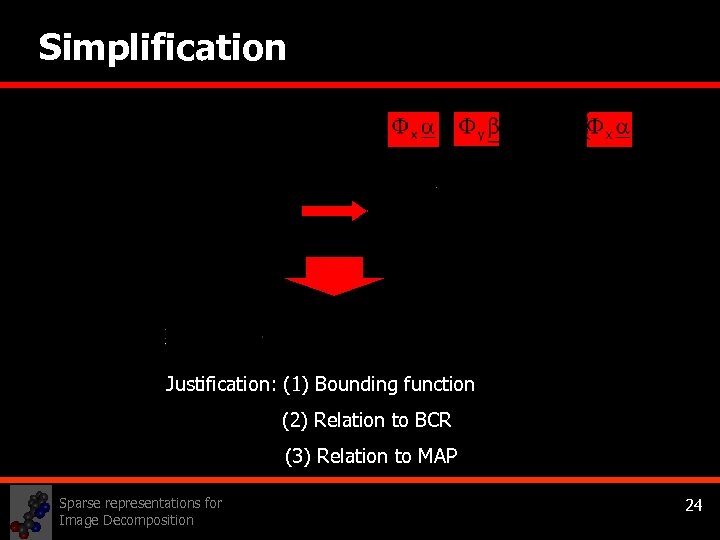 Simplification Justification: (1) Bounding function (2) Relation to BCR (3) Relation to MAP Sparse representations for Image Decomposition 24
 Algorithm An algorithm was developed to solve the above problem: • It iterates between an update of sx to update of sy. • Every update (for either sx or sy) is done by a forward and backward fast transforms – this is the dominant computational part of the algorithm. • The update is performed using diminishing soft-thresholding (similar to BCR but sub-optimal due to the non unitary dictionaries). • The TV part is taken-care-of by simple gradient descent. • Convergence is obtained after 10 -15 iterations. Sparse representations for Image Decomposition 25
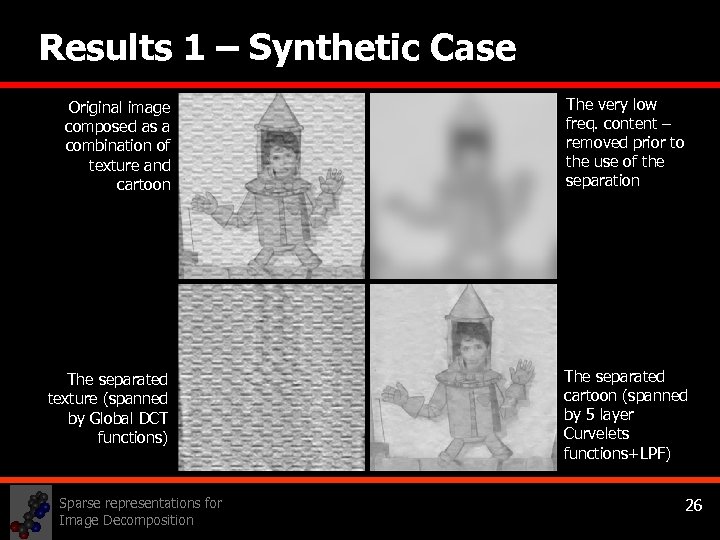 Results 1 – Synthetic Case Original image composed as a combination of texture and cartoon The very low freq. content – removed prior to the use of the separation The separated texture (spanned by Global DCT functions) The separated cartoon (spanned by 5 layer Curvelets functions+LPF) Sparse representations for Image Decomposition 26
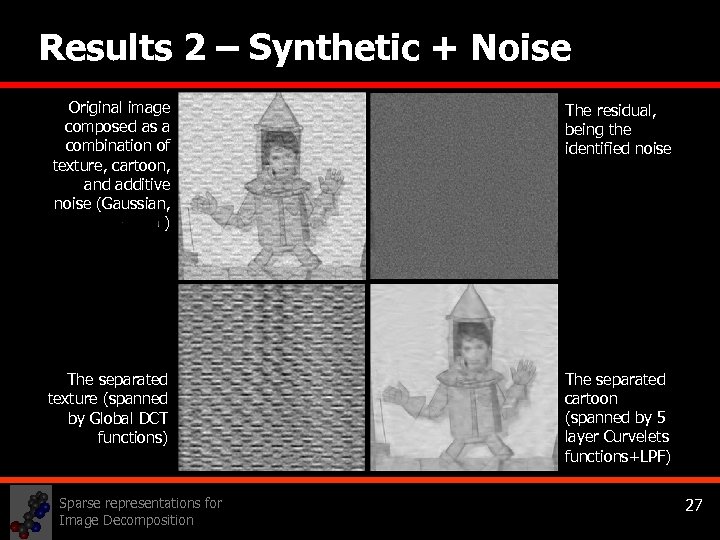 Results 2 – Synthetic + Noise Original image composed as a combination of texture, cartoon, and additive noise (Gaussian, ) The separated texture (spanned by Global DCT functions) Sparse representations for Image Decomposition The residual, being the identified noise The separated cartoon (spanned by 5 layer Curvelets functions+LPF) 27
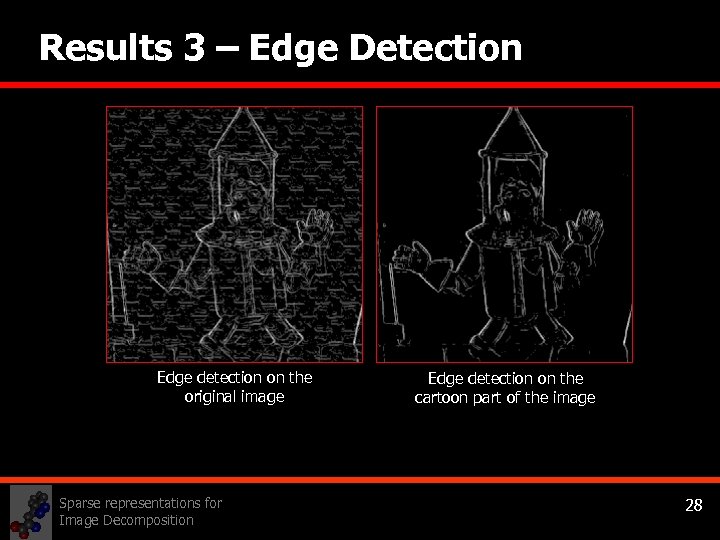 Results 3 – Edge Detection Edge detection on the original image Sparse representations for Image Decomposition Edge detection on the cartoon part of the image 28
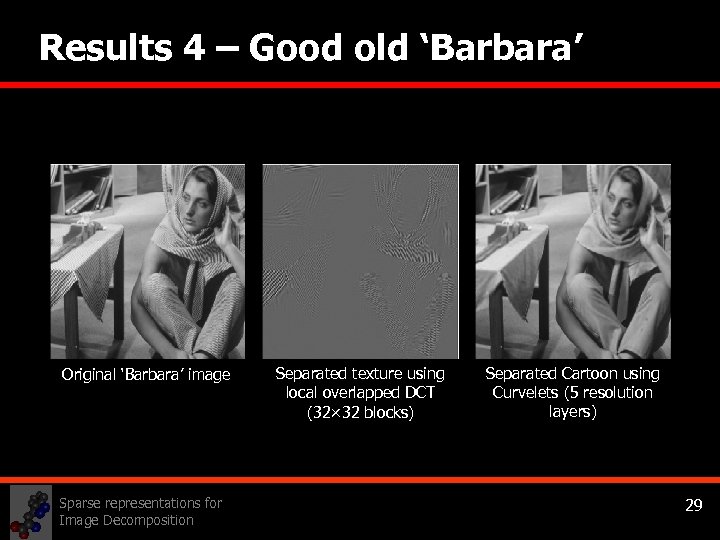 Results 4 – Good old ‘Barbara’ Original ‘Barbara’ image Sparse representations for Image Decomposition Separated texture using local overlapped DCT (32× 32 blocks) Separated Cartoon using Curvelets (5 resolution layers) 29
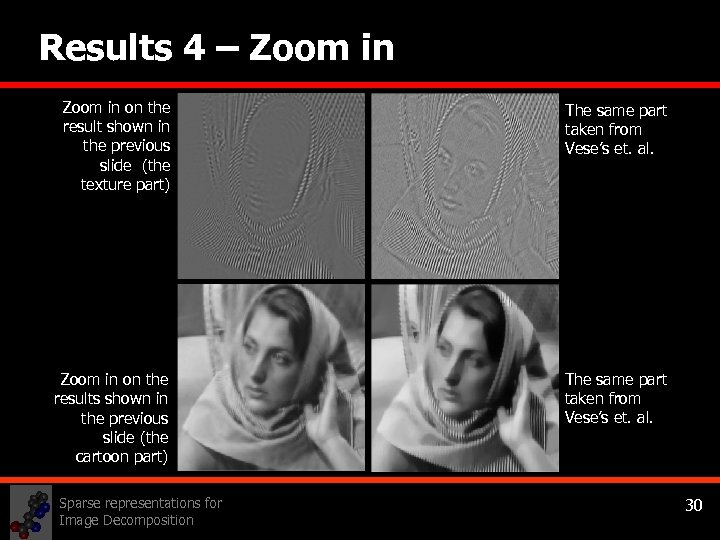 Results 4 – Zoom in on the result shown in the previous slide (the texture part) The same part taken from Vese’s et. al. Zoom in on the results shown in the previous slide (the cartoon part) The same part taken from Vese’s et. al. Sparse representations for Image Decomposition 30
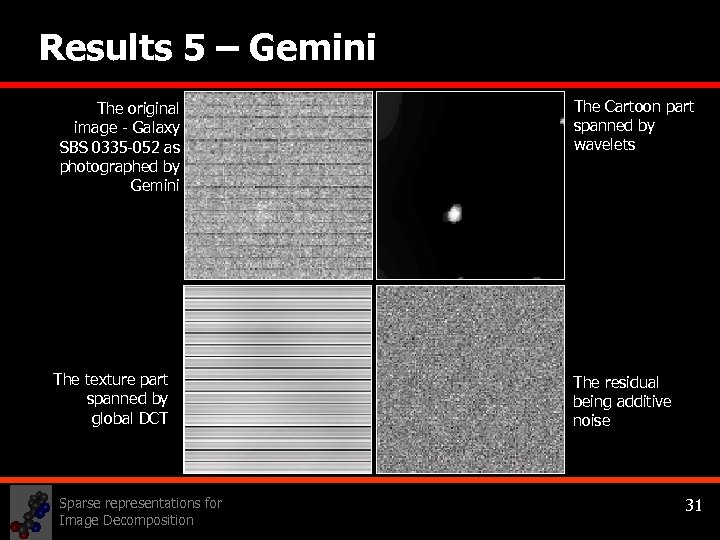 Results 5 – Gemini The original image - Galaxy SBS 0335 -052 as photographed by Gemini The texture part spanned by global DCT Sparse representations for Image Decomposition The Cartoon part spanned by wavelets The residual being additive noise 31
 Agenda 1. Introduction Sparsity and Over-completeness!? 2. Theory of Decomposition Uniqueness and Equivalence 3. Decomposition in Practice 4. 5. Practical Considerations, Numerical algorithm 4. Discussion Sparse representations for Image Decomposition 32
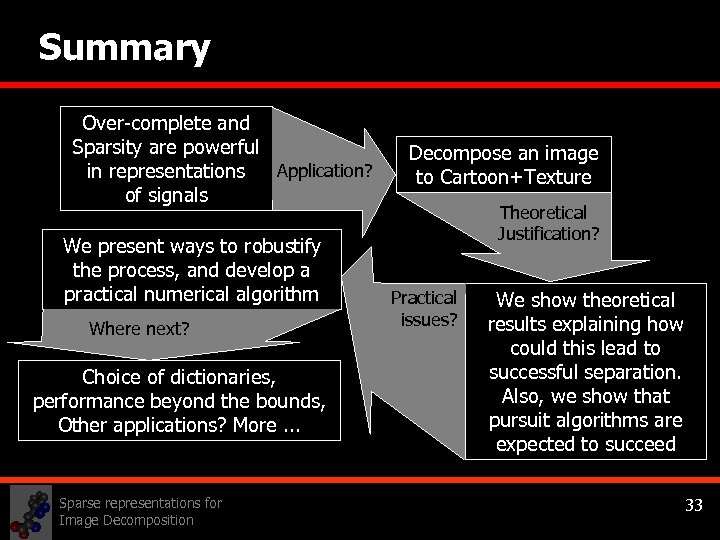 Summary Over-complete and Sparsity are powerful in representations Application? of signals We present ways to robustify the process, and develop a practical numerical algorithm Where next? Choice of dictionaries, performance beyond the bounds, Other applications? More. . . Sparse representations for Image Decomposition Decompose an image to Cartoon+Texture Theoretical Justification? Practical issues? We show theoretical results explaining how could this lead to successful separation. Also, we show that pursuit algorithms are expected to succeed 33
 These slides and related papers can be found in: http: //www. cs. technion. ac. il/~elad THANK YOU FOR STAYING SO LATE! Sparse representations for Image Decomposition 34
 Why Over-Completeness? 0. 1 0. 05 1 0 -0. 05 -0. 1 0. 05 2 0 1. 0 0 0. 3 0. 1 10 -2 0 10 -0. 05 -0. 1 + 1 3 0. 5 0 1 4 0. 5 00 64 -0. 1 -4 10 -0. 2 -6 10 -0. 3 |T{ 1+0. 3 2}| -8 -0. 410 -0. 5 -10 10 0 -0. 6 0. 05 |T{ 1+0. 3 2+0. 5 3+0. 05 4}| 20 40 60 80 100 120 DCT Coefficients 128 Sparse representations for Image Decomposition 35
 Desired Decomposition 10 10 0 -2 -4 In this trivial example we have planted the seeds to signal decomposition via sparse & 10 over-complete representations 10 -6 10 10 -8 -10 0 40 80 DCT Coefficients Sparse representations for Image Decomposition 120 160 200 240 Spike (Identity) Coefficients 36
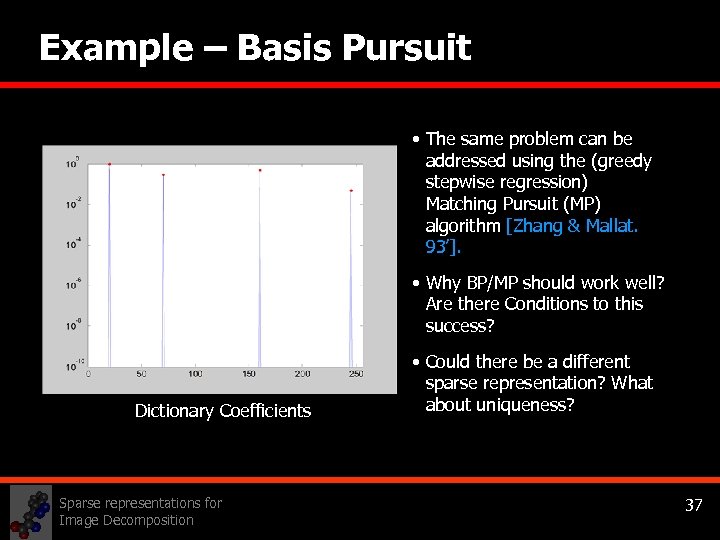 Example – Basis Pursuit • The same problem can be addressed using the (greedy stepwise regression) Matching Pursuit (MP) algorithm [Zhang & Mallat. 93’]. • Why BP/MP should work well? Are there Conditions to this success? Dictionary Coefficients Sparse representations for Image Decomposition • Could there be a different sparse representation? What about uniqueness? 37
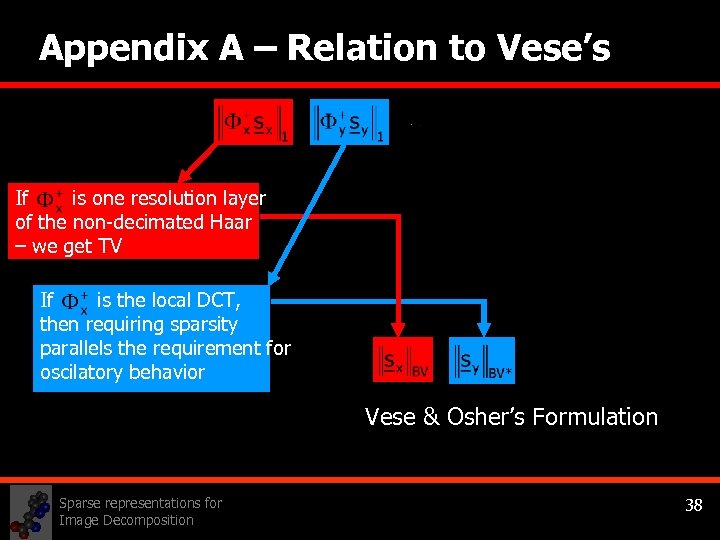 Appendix A – Relation to Vese’s If is one resolution layer of the non-decimated Haar – we get TV If is the local DCT, then requiring sparsity parallels the requirement for oscilatory behavior Vese & Osher’s Formulation Sparse representations for Image Decomposition 38
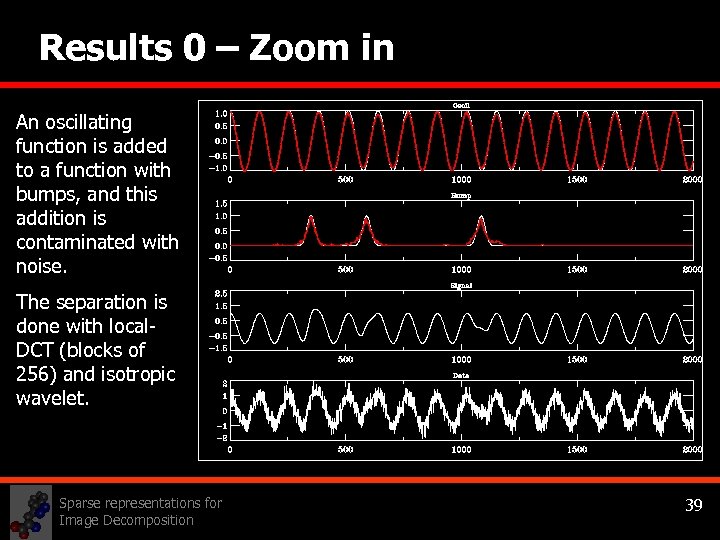 Results 0 – Zoom in An oscillating function is added to a function with bumps, and this addition is contaminated with noise. The separation is done with local. DCT (blocks of 256) and isotropic wavelet. Sparse representations for Image Decomposition 39
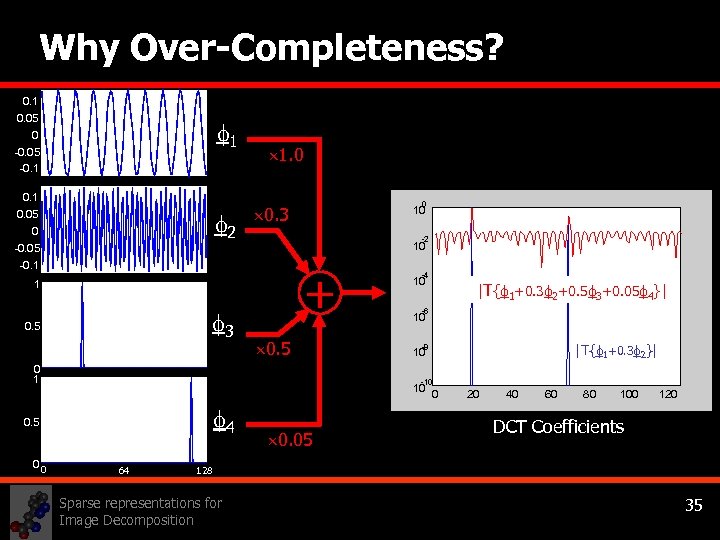
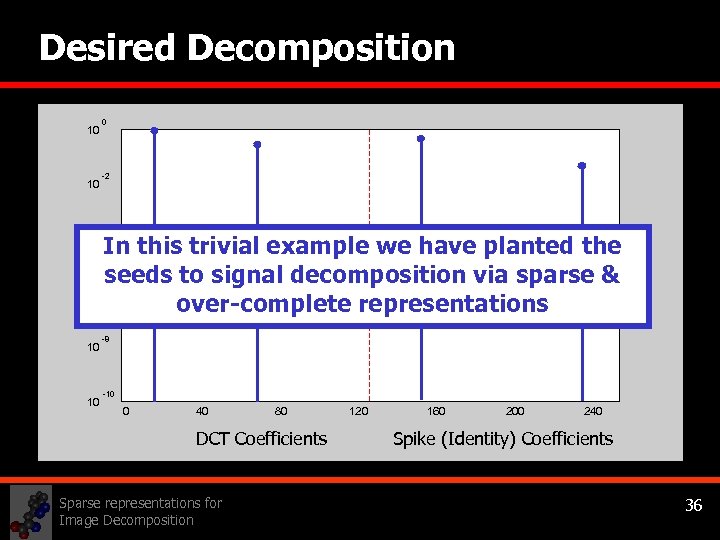
 Why Over-Completeness? • Many available square linear transforms – sinusoids, wavelets, packets, … • Definition: Successful transform is one which leads to sparse (sparse=simple) representations. • Observation: Lack of universality - Different bases good for different purposes. § § • Sound = harmonic music (Fourier) + click noise (Wavelet), Image = lines (Ridgelets) + points (Wavelets). Proposed solution: Over-Complete dictionaries, and possibly combination of bases. Sparse representations for Image Decomposition 40
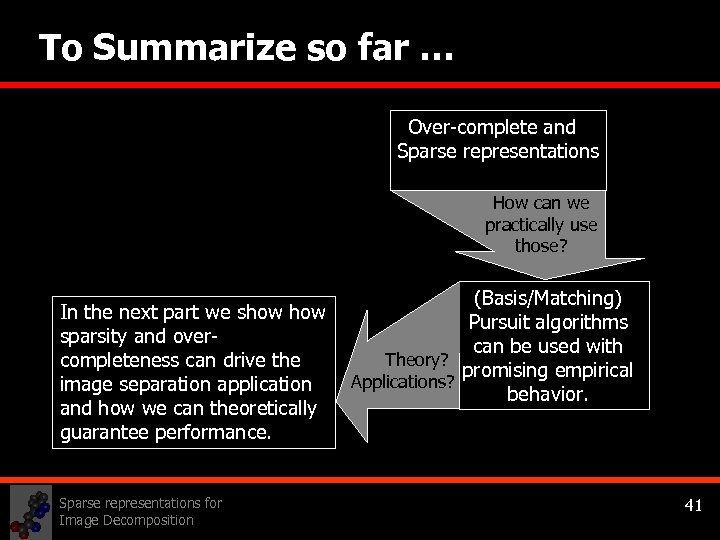 To Summarize so far … Over-complete and Sparse representations How can we practically use those? (Basis/Matching) In the next part we show Pursuit algorithms sparsity and overcan be used with Theory? completeness can drive the promising empirical Applications? image separation application behavior. and how we can theoretically guarantee performance. Sparse representations for Image Decomposition 41