 Скачать презентацию Outline Review Pressure and Density n Begin n
8ad1a5cfec22a8bd05da911a43ca9e2f.ppt
- Количество слайдов: 19



Outline Review Pressure and Density. n Begin n Buoyant Forces. n Continuity Equation. n Bernoulli’s Principle. n n CAPA and Examples. 1
Pressure and Density n Density = Mass/Volume n n A property of the material. Pressure = Force/Area n n n Depends on the height of the fluid. Same in all directions. Units are: n n n Force/Area = N/m 2. Pascals 1 Pa = 1 N/m 2. Atmosphere 1 atm = 1. 013 X 105 N/m 2. 2
Pressure n n Pressure = Force/Area. P = F/A. n n n Depends on the height of the fluid. Same in all directions. Units are: n n n Force/Area = N/m 2. Pascals 1 Pa = 1 N/m 2. Atmosphere 1 atm = 1. 013 X 105 N/m 2. 3
Pressure n Pressure = Force/Area. n P = F/A. n Depends on the height of the fluid. F = Mg = ( V)g = ( (A*h) )g F/A = ( (A*h) )g / A = gh P = gh 4
Buoyancy n n n Fluid or gas exerts a force on materials it touches For an immersed object, the sum of forces from surrounding material is the buoyancy If the net force on an object is upward, then it “rises”, if it is downward then it “sinks”, if zero then it “floats” 5
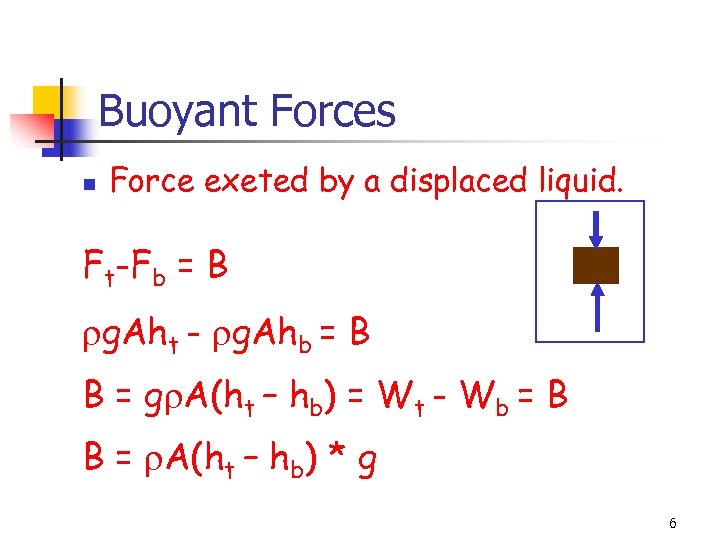
Buoyant Forces n Force exeted by a displaced liquid. Ft-Fb = B g. Aht - g. Ahb = B B = g A(ht – hb) = Wt - Wb = B B = A(ht – hb) * g 6
Ice and Water n Why does ice float? n n n Solids are generally denser than liquids Liquids are generally denser than liquids Ice should sink In fact, “really” cold water is denser o than ice (I. e. water at 34 F is denser o than ice at 32 F) If this wasn’t true, oceans and lakes would freeze from the bottom up 7
Equation of Continuity n n n The flow of a liquid is constant throughout a system (if no liquid is added or subtracted) The amount of water going into a pipe is the same as coming out Amount of liquid flow is Flow = Av 8
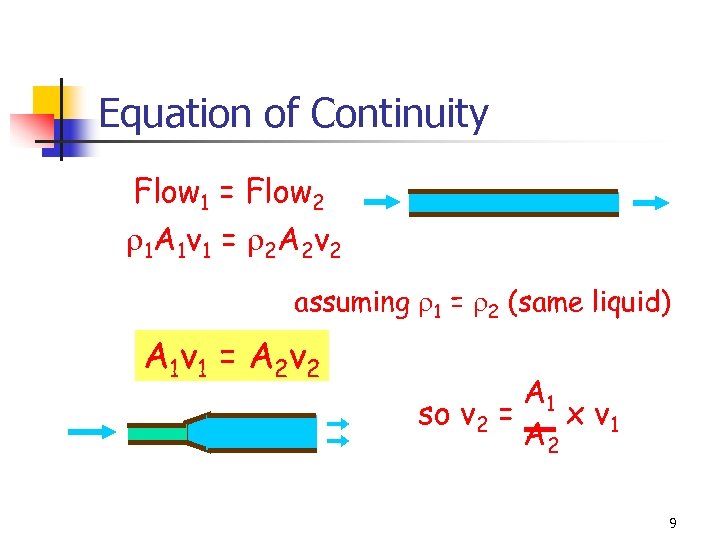
Equation of Continuity Flow 1 = Flow 2 1 A 1 v 1 = 2 A 2 v 2 assuming 1 = 2 (same liquid) A 1 v 1 = A 2 v 2 A 1 so v 2 = x v 1 A 2 9
Bernoulli’s Principle where the velocity of a fluid is high the pressure is low and where the velocity is low, the pressure is high n This is why baseballs spin, aspirators work, a roof can blow off a house in high winds and sailboats can sail into the wind Let’s see it work, take out a piece of paper… 10
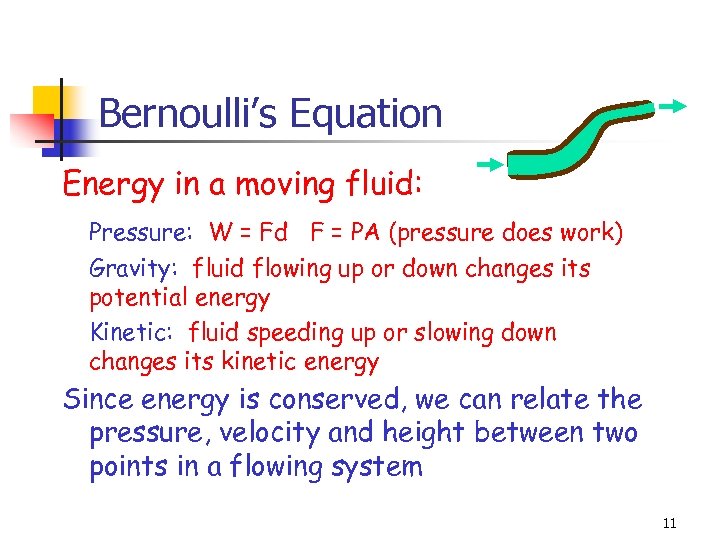
Bernoulli’s Equation Energy in a moving fluid: Pressure: W = Fd F = PA (pressure does work) Gravity: fluid flowing up or down changes its potential energy Kinetic: fluid speeding up or slowing down changes its kinetic energy Since energy is conserved, we can relate the pressure, velocity and height between two points in a flowing system 11
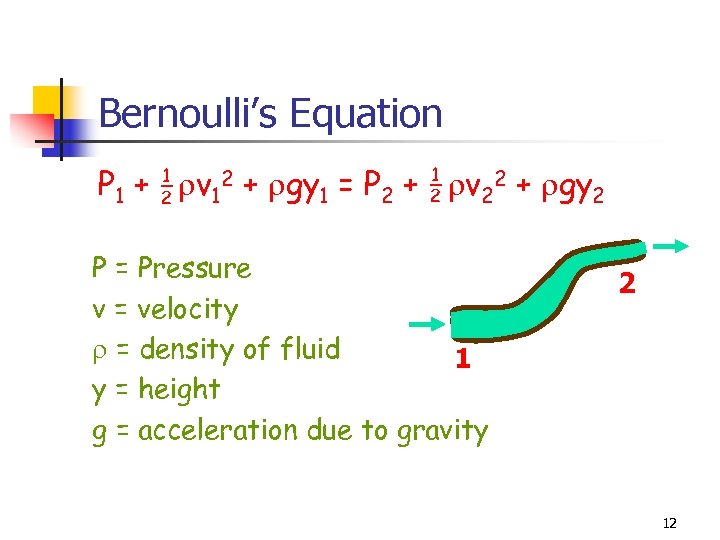
Bernoulli’s Equation 1 1 P 1 + _ v 12 + gy 1 = P 2 + _ v 22 + gy 2 2 2 P = Pressure v = velocity = density of fluid 1 y = height g = acceleration due to gravity 2 12
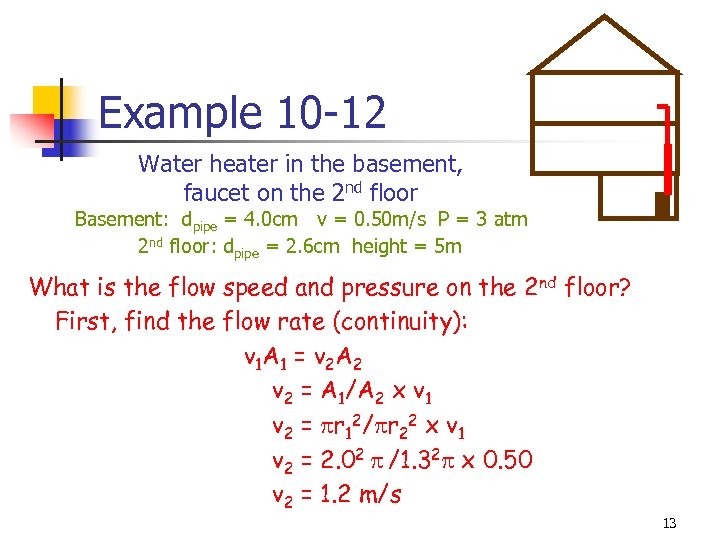
Example 10 -12 Water heater in the basement, faucet on the 2 nd floor Basement: dpipe = 4. 0 cm v = 0. 50 m/s P = 3 atm 2 nd floor: dpipe = 2. 6 cm height = 5 m What is the flow speed and pressure on the 2 nd floor? First, find the flow rate (continuity): v 1 A 1 = v 2 A 2 v 2 = A 1/A 2 x v 1 v 2 = r 12/ r 22 x v 1 v 2 = 2. 02 /1. 32 x 0. 50 v 2 = 1. 2 m/s 13
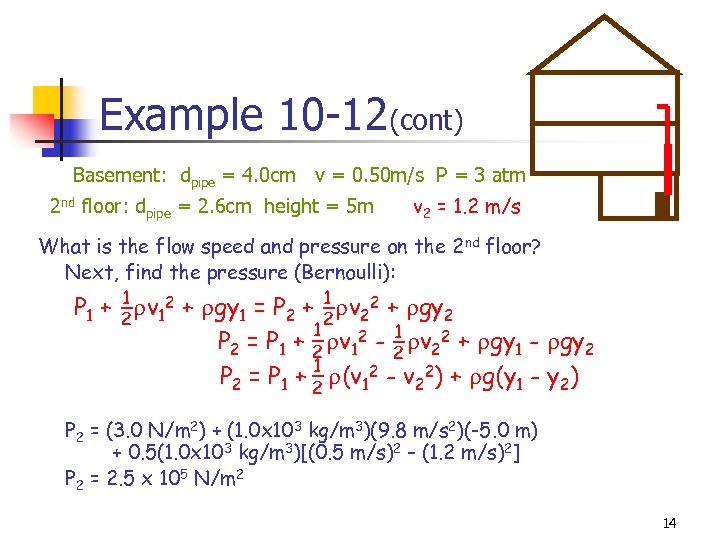
Example 10 -12(cont) Basement: dpipe = 4. 0 cm v = 0. 50 m/s P = 3 atm 2 nd floor: dpipe = 2. 6 cm height = 5 m v 2 = 1. 2 m/s What is the flow speed and pressure on the 2 nd floor? Next, find the pressure (Bernoulli): 1 1 P 1 + _ v 12 + gy 1 = P 2 + _ v 22 + gy 2 2 2 1 1 _ P 2 = P 1 + 2 v 12 - _ v 22 + gy 1 - gy 2 2 1 P 2 = P 1 + _ (v 12 - v 22) + g(y 1 - y 2) 2 P 2 = (3. 0 N/m 2) + (1. 0 x 103 kg/m 3)(9. 8 m/s 2)(-5. 0 m). + 0. 5(1. 0 x 103 kg/m 3)[(0. 5 m/s)2 – (1. 2 m/s)2] P 2 = 2. 5 x 10⁵ N/m 2 14
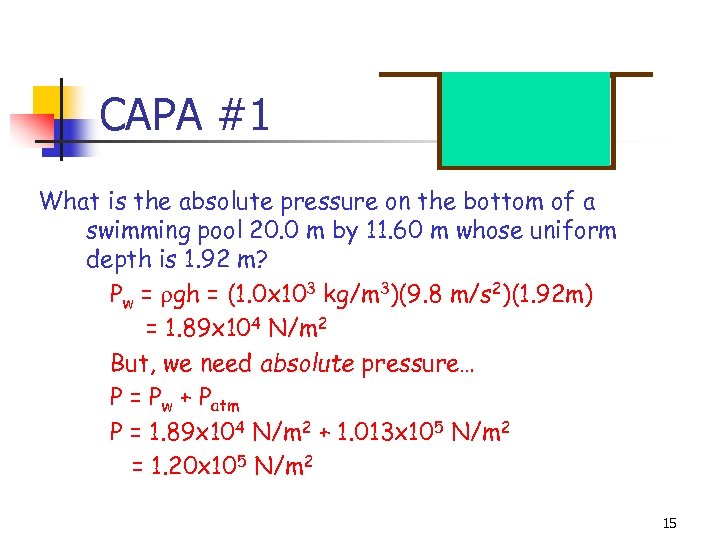
CAPA #1 What is the absolute pressure on the bottom of a swimming pool 20. 0 m by 11. 60 m whose uniform depth is 1. 92 m? Pw = gh = (1. 0 x 103 kg/m 3)(9. 8 m/s 2)(1. 92 m) = 1. 89 x 104 N/m 2 But, we need absolute pressure… P = Pw + Patm P = 1. 89 x 104 N/m 2 + 1. 013 x 105 N/m 2 = 1. 20 x 105 N/m 2 15
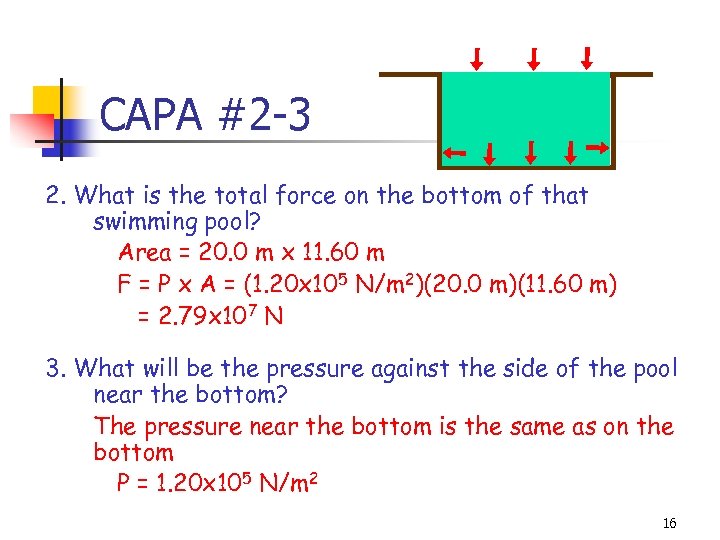
CAPA #2 -3 2. What is the total force on the bottom of that swimming pool? Area = 20. 0 m x 11. 60 m F = P x A = (1. 20 x 105 N/m 2)(20. 0 m)(11. 60 m) = 2. 79 x 107 N 3. What will be the pressure against the side of the pool near the bottom? The pressure near the bottom is the same as on the bottom P = 1. 20 x 105 N/m 2 16
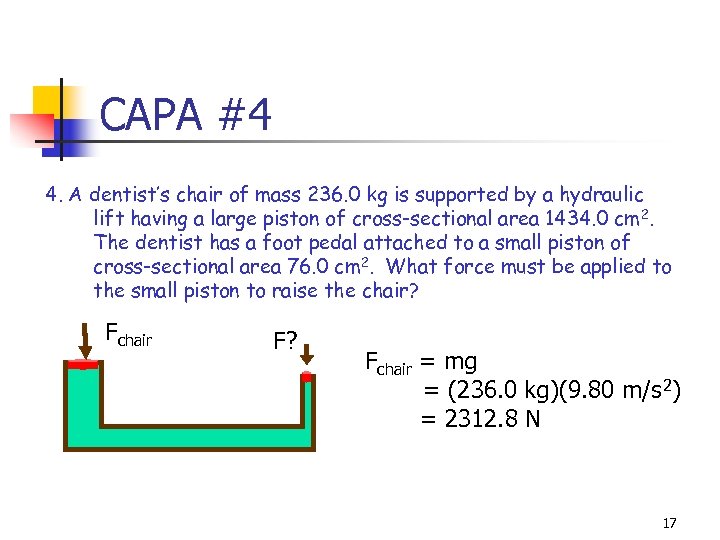
CAPA #4 4. A dentist’s chair of mass 236. 0 kg is supported by a hydraulic lift having a large piston of cross-sectional area 1434. 0 cm 2. The dentist has a foot pedal attached to a small piston of cross-sectional area 76. 0 cm 2. What force must be applied to the small piston to raise the chair? Fchair F? Fchair = mg = (236. 0 kg)(9. 80 m/s 2) = 2312. 8 N 17
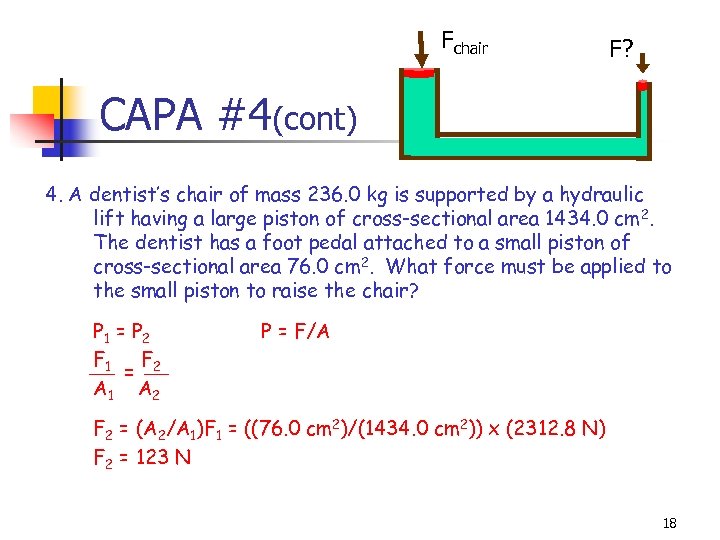
Fchair F? CAPA #4(cont) 4. A dentist’s chair of mass 236. 0 kg is supported by a hydraulic lift having a large piston of cross-sectional area 1434. 0 cm 2. The dentist has a foot pedal attached to a small piston of cross-sectional area 76. 0 cm 2. What force must be applied to the small piston to raise the chair? P 1 = P 2 F 1 F 2 ___ = ___ A 1 A 2 P = F/A F 2 = (A 2/A 1)F 1 = ((76. 0 cm 2)/(1434. 0 cm 2)) x (2312. 8 N) F 2 = 123 N 18

Next Time n n n Larry Dennis will be back Monday. Continue Chapter 10. CAPA Problems. Prepare for Quiz 7. Please see me with any questions or comments. See you Monday. 19
Скачать презентацию Outline Review Pressure and Density n Begin n
8ad1a5cfec22a8bd05da911a43ca9e2f.ppt