


 Скачать презентацию outline Political life The Monarchy The Government The
politicalsystemoftheuk-131031224125-phpapp01.ppt
- Количество слайдов: 57
 outline Political life The Monarchy The Government The Parliament British Political System Elections 1
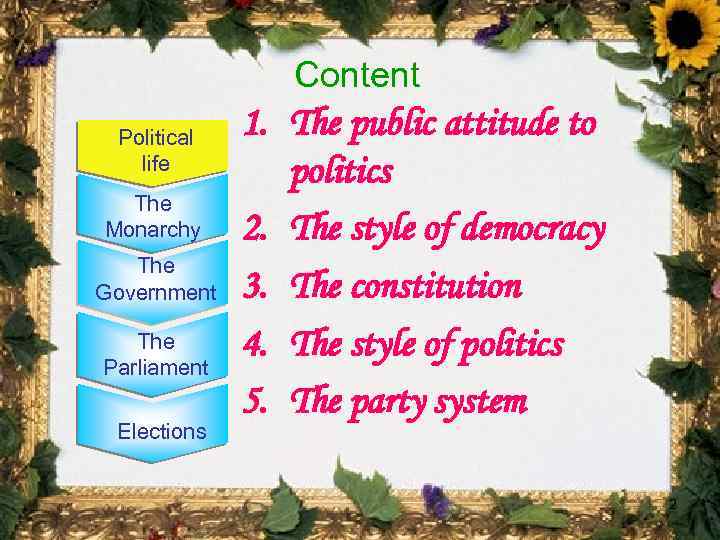 Content Political life The Monarchy The Government The Parliament Elections 1. The public attitude to politics 2. The style of democracy 3. The constitution 4. The style of politics 5. The party system 2
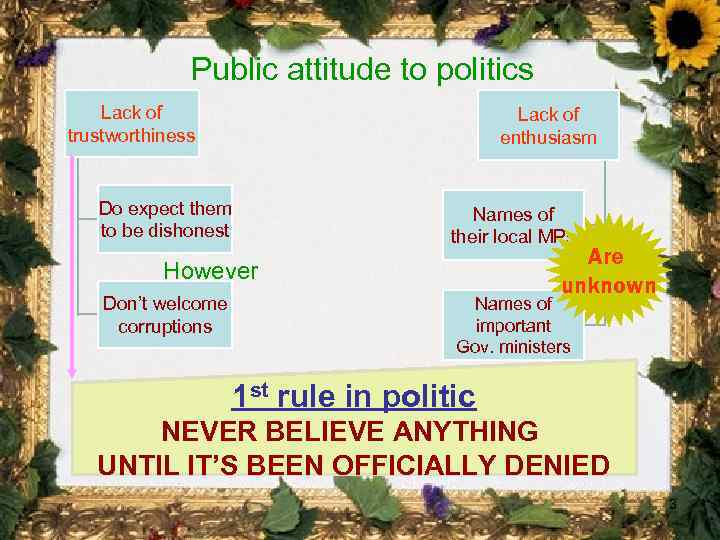 Public attitude to politics Lack of trustworthiness Lack of enthusiasm Do expect them to be dishonest Names of their local MPs However Don’t welcome corruptions Are unknown Names of important Gov. ministers 1 st rule in politic NEVER BELIEVE ANYTHING UNTIL IT’S BEEN OFFICIALLY DENIED 3
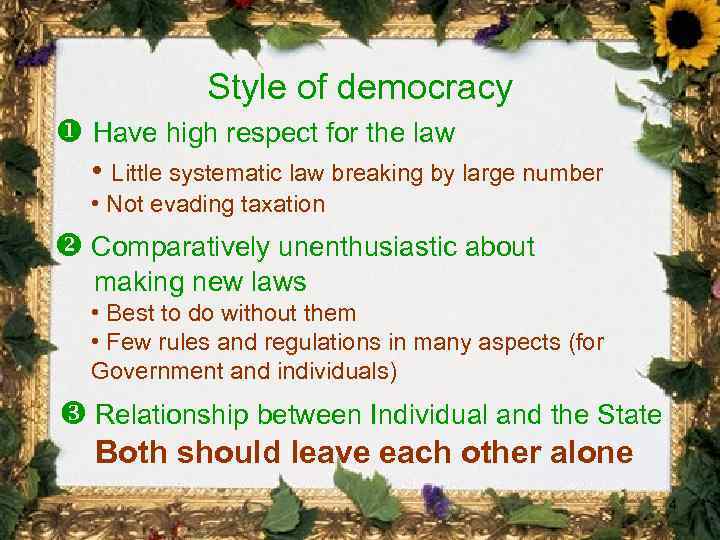 Style of democracy Have high respect for the law • Little systematic law breaking by large number • Not evading taxation Comparatively unenthusiastic about making new laws • Best to do without them • Few rules and regulations in many aspects (for Government and individuals) Relationship between Individual and the State Both should leave each other alone 4
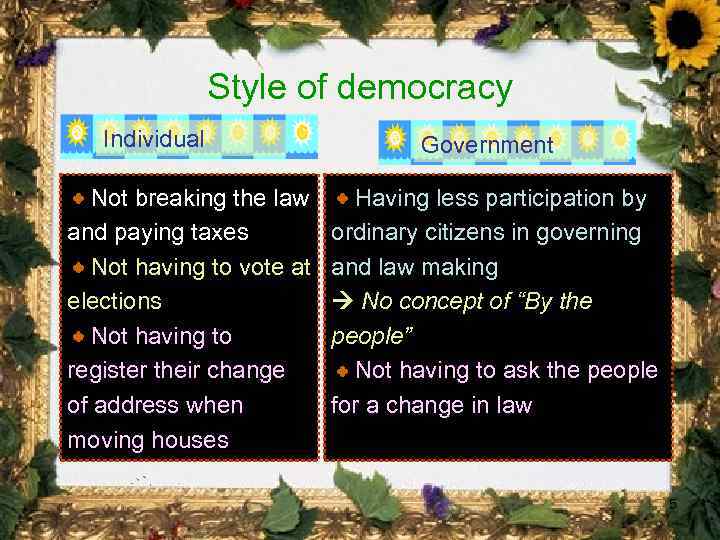 Style of democracy Individual Not breaking the law and paying taxes Not having to vote at elections Not having to register their change of address when moving houses Government Having less participation by ordinary citizens in governing and law making No concept of “By the people” Not having to ask the people for a change in law 5
 Style of democracy People choose who is to govern the country and let them get on with it 6
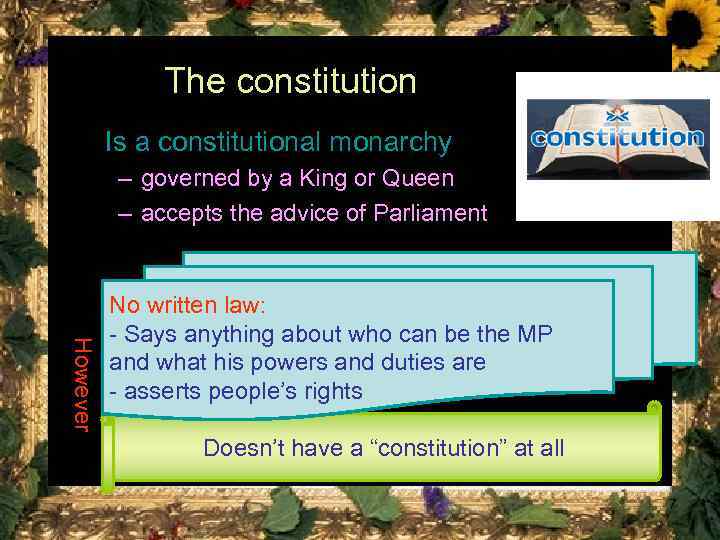 The constitution Is a constitutional monarchy – governed by a King or Queen – accepts the advice of Parliament However No written law: - Says anything about who can be the MP and what his powers and duties are - asserts people’s rights Doesn’t have a “constitution” at all 7
 The style of politics Political life is still influenced by the traditional British respect for privacy and love of informality Comparatively informal Important decisions are to be taken at lunch, over dinner, or in chance encounters in the corridors of power 8
 The party system A two – party system 9
 The party system The parties choose candidates in elections (independent candidates are rarely elected) The party that wins the majority of seat forms the Gov. and its leaders (= MPs) The largest minority party = opposition (criticize the party running the country ) Without agreement between the political parties, the British parliamentary system would break down 10
 outline Political life The Monarchy The Government The Parliament 1. 2. 3. 4. 5. The appearance The reality The role of the monarch The value of the monarch The future of the monarch Elections 11
 The appearance In written law, the Queen has absolute power to: ü Choose the Prime Minister ü Dismiss ministers and governments ü Dissolve Parliament ü Refuse to agree to legislation passed by Parliament ü Dismiss the governments of other countries of which she is monarch ü Embody the law in the courts ü Can do nothing that is legally wrong 12
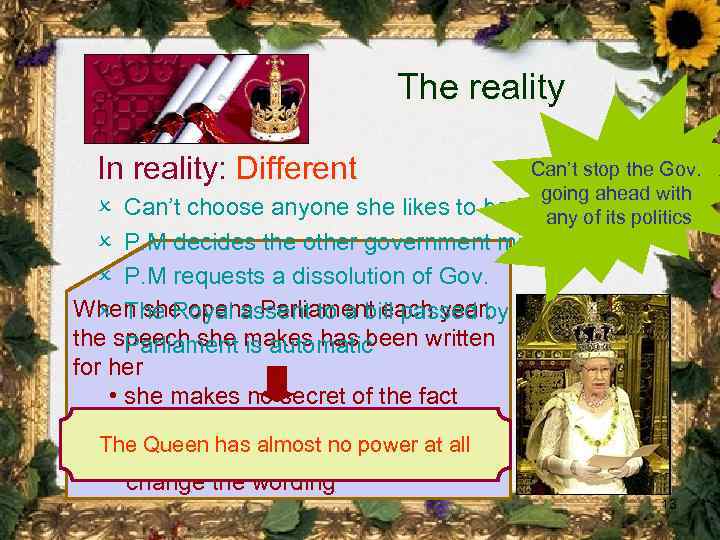 The reality In reality: Different Can’t stop the Gov. going ahead with P. M of its politics any O Can’t choose anyone she likes to be O P. M decides the other government ministers O P. M requests a dissolution of Gov. When she opens Parliament each year, O The Royal assent to a bill passed by the speech she makes has been written Parliament is automatic for her • she makes no secret of the fact • She reads word for word The Queen has almost Gov. minister to • She might ask the no power at all change the wording 13
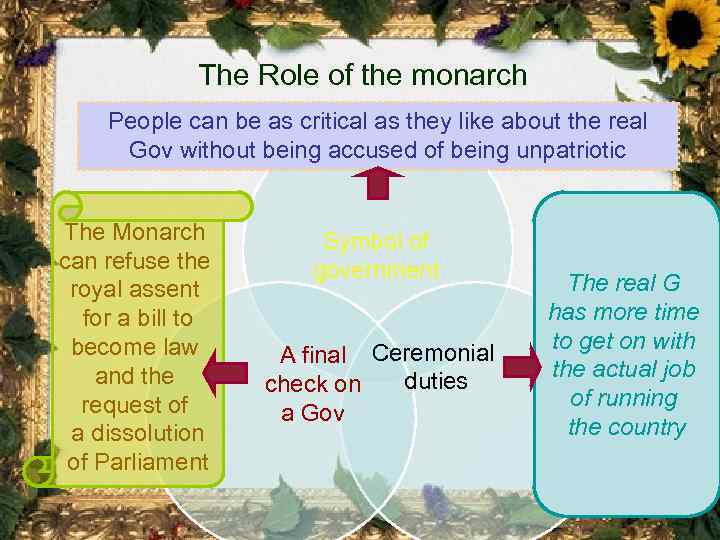 The Role of the monarch People can be as critical as they like about the real Gov without being accused of being unpatriotic The Monarch can refuse the royal assent for a bill to become law and the request of a dissolution of Parliament Symbol of government A final Ceremonial duties check on a Gov The real G has more time to get on with the actual job of running the country 14
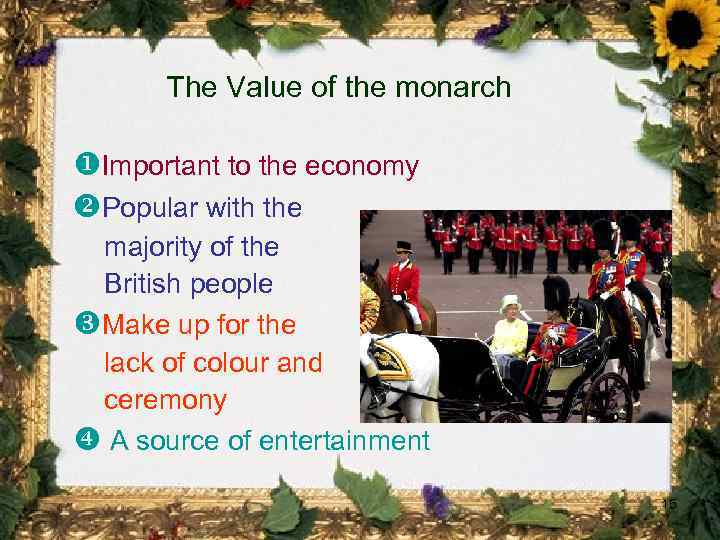 The Value of the monarch Important to the economy Popular with the majority of the British people Make up for the lack of colour and ceremony A source of entertainment 15
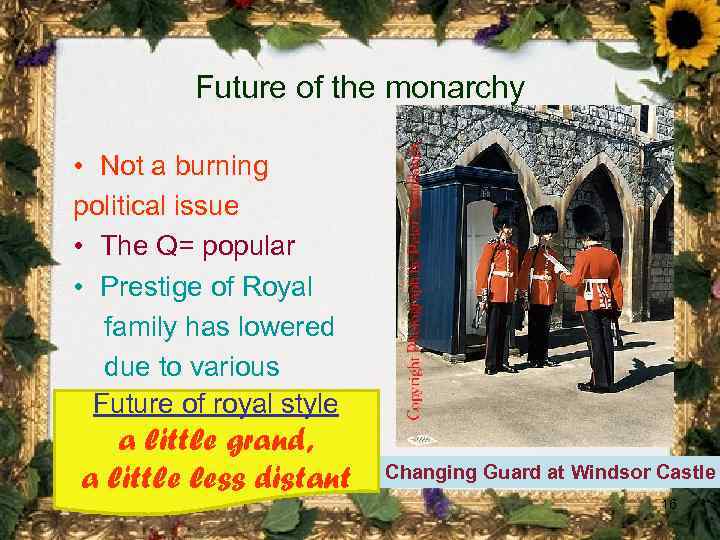 Future of the monarchy • Not a burning political issue • The Q= popular • Prestige of Royal family has lowered due to various Future of royal style marital problems a little grand, a little less distant Changing Guard at Windsor Castle 16
 outline Political life The Monarchy The Government The Parliament Elections 1. 2. 3. 4. 5. 6. The Government Structure Collective Responsibility The cabinet The Prime Minister The civil service Central and local government 17
 Government structure • The Government includes: – The Prime Minister: most powerful – 20 MPs: • Heads of the Gov. Departments (Minister of. . . ) • Belong to the same political party • Appointed by the monarch (on the advice of the PM) but are accountable to Parliament • Take on various responsibilities of managing Parliament but have COLLECTIVE RESPONSIBILITY 18
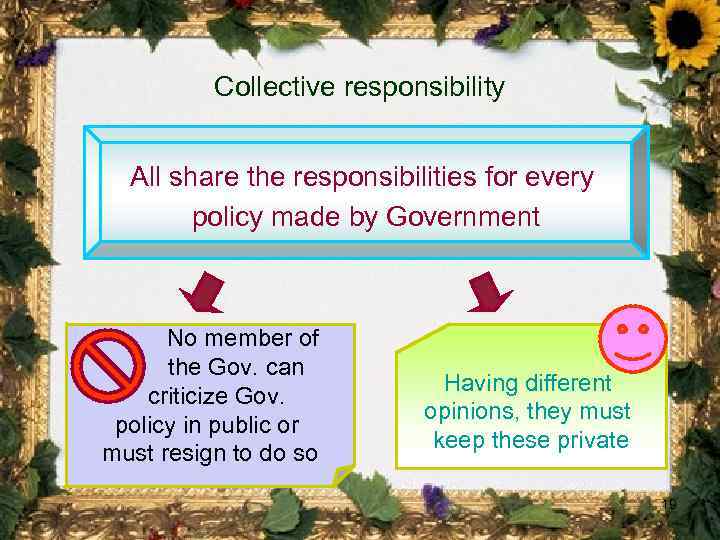 Collective responsibility All share the responsibilities for every policy made by Government No member of the Gov. can criticize Gov. policy in public or must resign to do so Having different opinions, they must keep these private 19
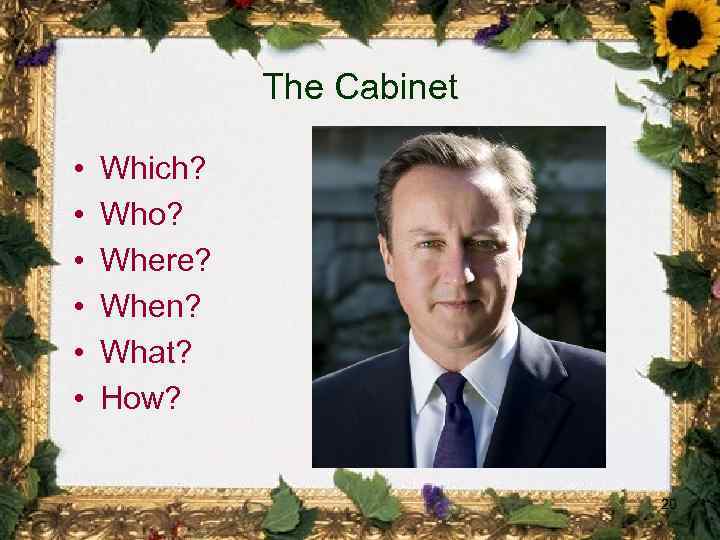 The Cabinet • • • Which? Who? Where? When? What? How? 20
 The Cabinet Which? Who? Where? The committee at the centre of the British political system and is the supreme decision-making body in government Prime Minister and all Ministers in om in et ro t the abin governingeparty the C ing Stre In own D 21
 ursday, nally Th ing Traditio ay morn w Tuesd no When? What? How? The Cabinet out new b isions a entation ake dec implem T ies, the olicies and polic isting p he various of ex ing of t ents he runn epartm t Gov. D - Cabinet meetings are confidential - The PM chairs the meeting -Who says what is secret - Reports are made and circulated to Gov. Depart. -Gov. Depart. summarizes the topic discussed 22 and decisions taken
 The Prime Minister the leader of his party in the House of Commons Has a great deal of power in reality – Appoints the cabinet and change his cabinet – Makes final decisions on major issues – Decides the agenda for cabinet meetings which he also chairs – Dissolve Parliament Has the power of public image 23
 The civil service v Helps run the Government day-to day and implement policies v Remains though Governments come and go v Knows the secrets of previous Gov which the present minister is unaware of v Is reputed for absolute impartiality v Top civil servants exercise quite a lot of control over their ministers 24
 The civil service v. Unknown to the larger public v. Is a career § get a high salary § have absolute job security § stand a good chance of being awarded an official honour 25
 The civil service Criticism Its efficiency • From the same narrow section of society – Have been to. Solutions a public school and then - Doesn’t have enough expertise in matters Oxford and Cambridge such as economics or technology Ministers have their own – Studied history and classical languages - Lives in its closed world, cut off from the political advisers working corners of alongside with their most people in society civil servants 26
 Central and local government Local Government has similar system of national Government – Elected representatives = councilors ≈ MPs – Meet in council chamber in the Town Hall or County Hall ≈ Parliament – Make policy implemented by local Government officers ≈ Civil Servants 27
 Central and local government v Local Government authorities (= councils) only have powers given by the Central Government v Most people have far more direct dealings with local Gov. – Manage nearly all public services – Employ 3 times as many people 28
 outline Political life The Monarchy The Government The Parliament Elections 1. The House of Lords 2. House of Commons 3. The Atmosphere of Parliament 4. The Stages of legislation 5. Parliamentary business 6. MP’s way of working 7. MP’s life 29
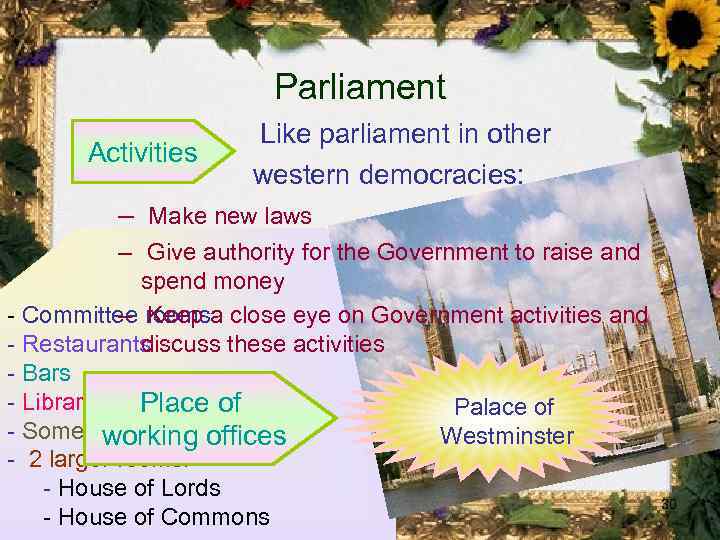 Parliament Activities Like parliament in other western democracies: – Make new laws – Give authority for the Government to raise and spend money – Keep - Committee roomsa close eye on Government activities and discuss these activities - Restaurants - Bars - Libraries Place of Palace of - Some places of residence Westminster working offices - 2 larger rooms: - House of Lords - House of Commons 30
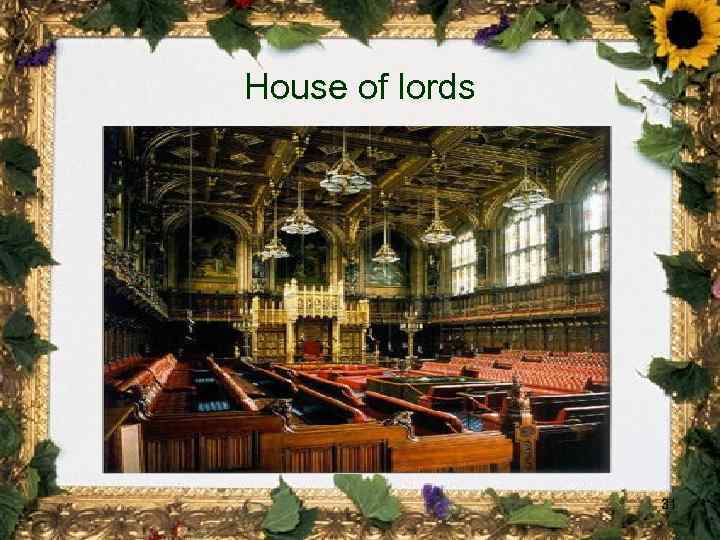 House of lords 31
 House of lords • The upper chamber • No fixed number of members, now 747 – Historically most members = hereditary peers undemocratic Labour Government abolished the right of all Now 92 – Almost all = life peers = no fixed number but the current one is 629 (senior politicians + distinguished figures) – The rest = 26 Archbishops and Bishops of the Church of England. • Its main job is to 'double check' new laws, but not on Money Bills • Is a forum for public discussion 32
 House of commons • The lower chamber • Chaired by the Speaker • Currently 646 seats, each seat = geographical constituency (60, 000 rural – 80, 000 urban voters) • Sits most days of the week for about half of the weeks of the year 33
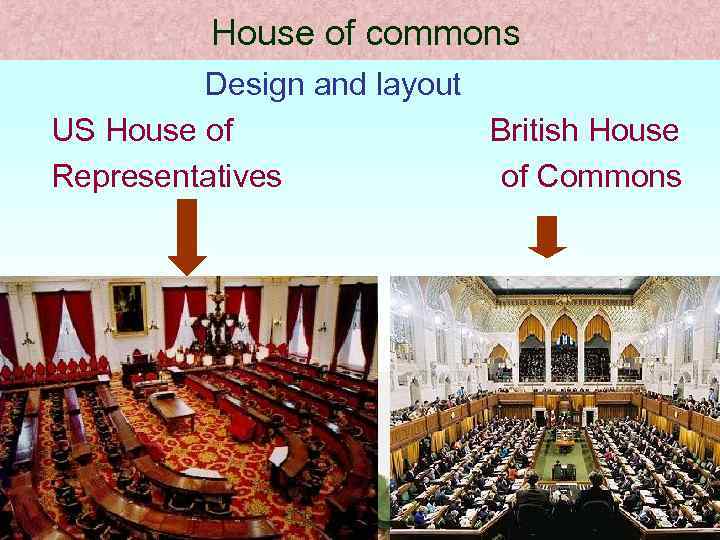 House of commons Design and layout US House of British House Representatives of Commons 34
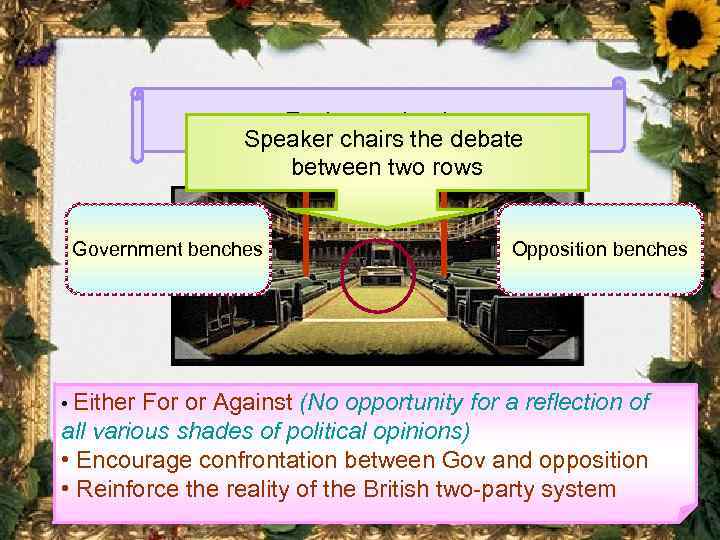 Facing each other Speaker chairs the debate between two rows Government benches Opposition benches • Either For or Against (No opportunity for a reflection of all various shades of political opinions) • Encourage confrontation between Gov and opposition • Reinforce the reality of the British two-party system 35
 House of commons Other features 1. Has no front 2. Has no desks for MPs 3. Is small MPs are encouraged to co-operate MPs speak in a conversational Creates fairly informal atmosphere don’t tone and normally speak for long 36
 The atmosphere of parliament MPs are forbidden to address one another directly or use personal names • All remarks and questions must go “through the chair” • Use “the honourable Member of Winchester” or “my right honourable friend” Take the “heat” out of debate and decrease the possibility that violence may break down 37
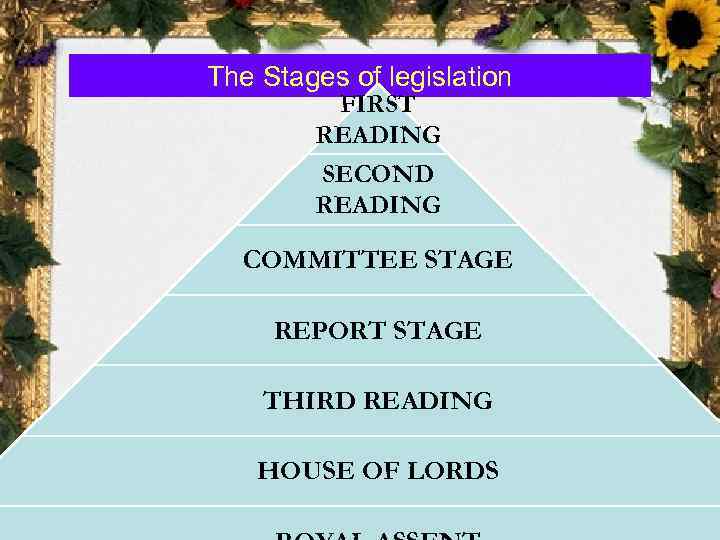 The Stages of legislation FIRST READING SECOND READING COMMITTEE STAGE REPORT STAGE THIRD READING HOUSE OF LORDS 38
 Parliamentary business • Much of the work is done in Committees (not on the floor of the chamber) – Select Committees: lifetime of a Parliament; conduct investigations, and issue reports – General Committees: temporary bodies; examine the detail of a particular piece of legislation and consider amendments to the Bill • MPs have to vote for or against by walking through one of 2 corridors at the side of the house (page 91) – Aye: agree – No: disagree 39
 Parliamentary business • Prime Minister's Question Time on any subject for 30 minutes every Wednesday • Easy accessibility for the press The committees are becoming • There also permanent committees to a more the more important part investigate and activities of government in of the field particular business of the Commons – include 40 members – have power to call certain people such as civil servants to come and answer their questions 40
 MP’s way of working MPs nearly vote the way that their party tells them to do WHIP • Each of the 2 major parties has several MPs who perform this role • Those make sure MPs do this by informing all MPs in their party how they should vote 41
 MP’s life • Traditionally, MPs weren’t supposed to be specialist politicians vshould be ordinary people videally come from all walks of life • MPs weren’t paid until early 20 th vsupposed to do a public service, not making a career vonly rich people could afford to be MPs • MPs have incredibly poor facilities: share with at least more than 2 MPs van office va secretary 42
 However MP’s life Politics in Britain in the last 40 years has become professional v Most MPs = full-time politicians and do another part-time job (if at all) v Spend more time at work than any other professional in the country 43
 A busy life MP’s life • Mornings are taken up with committee work, busy that they have littlespeeches So research, preparing time for • dealing with the problems of andpursuing another career • for families constituents (higher rate of divorce) • Afternoons = meetings in the house • Weekends are not free: – Visit their constituencies – Listen to the problems of anybody who wants to see them 44
 The system • The electoral system used in Britain doesn’t seem to add up The “first-past- the-post” system E. g. : General Election in May 2005 - Labour party = 355 seats - Conservative Party = 198 seats - Liberal Democrat Party = 62 seats - Other small parties= 31 • Nearly everybody votes for a candidate on the basis of the party (s)he represents, not on the qualities or political opinions of the candidate 46
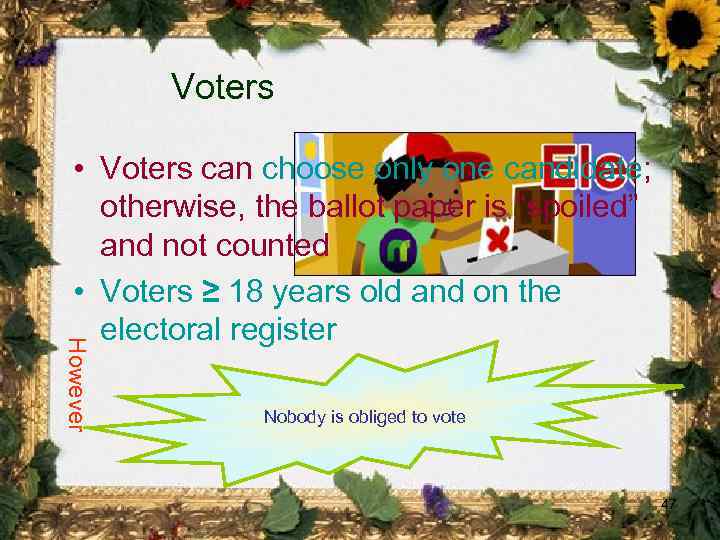 Voters However • Voters can choose only one candidate; otherwise, the ballot paper is “spoiled” and not counted • Voters ≥ 18 years old and on the electoral register Nobody is obliged to vote 47
 Time for New Election • It is the Government which decides when to hold an election • An election has to take place at least every five years usually shorter 48
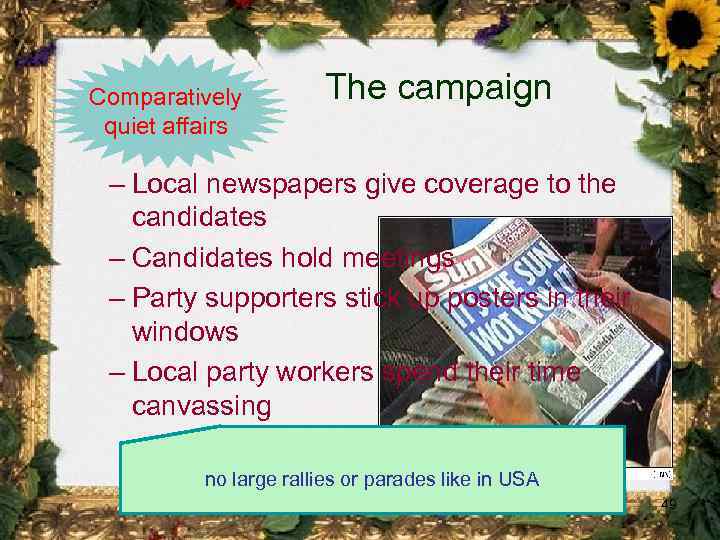 Comparatively quiet affairs The campaign – Local newspapers give coverage to the candidates – Candidates hold meetings – Party supporters stick up posters in their windows – Local party workers spend their time canvassing no large rallies or parades like in USA 49
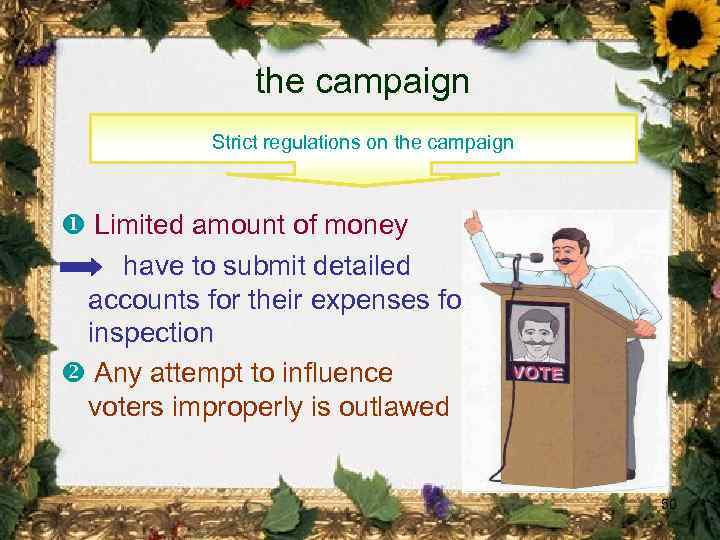 the campaign Strict regulations on the campaign Limited amount of money have to submit detailed accounts for their expenses for inspection Any attempt to influence voters improperly is outlawed 50
 the real campaign • Takes place at a national level • The parties spend millions of pounds advertising on hoardings and newspapers Emphasis is on the • They don’t buy time on TV= USA but given a national party personalities number of strictly timed “party election rather than local candidates broadcasts” • Each party also holds a daily televised news conference 51
 Process of Election The country is divided into a number of areas of roughly equal population = constituencies Anyone wishing to become an MP must declare himself belonging to one of these constituencies (after depositing £ 500 with the Returning Officer) 52
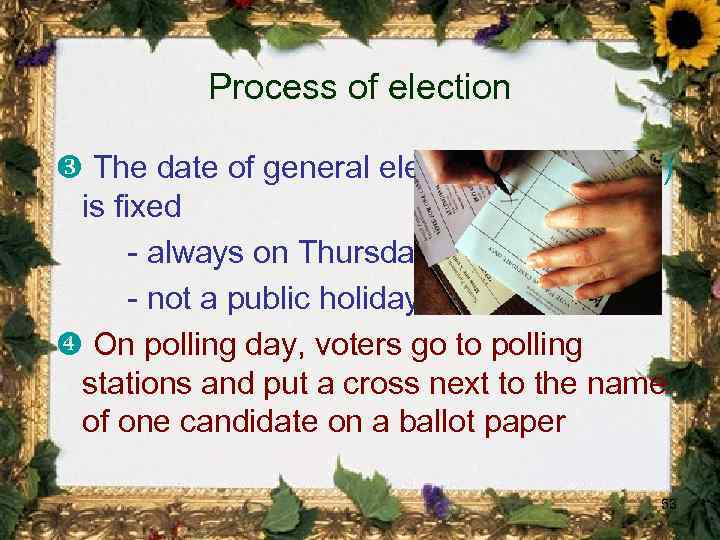 Process of election The date of general election (polling day) is fixed - always on Thursday - not a public holiday On polling day, voters go to polling stations and put a cross next to the name of one candidate on a ballot paper 53
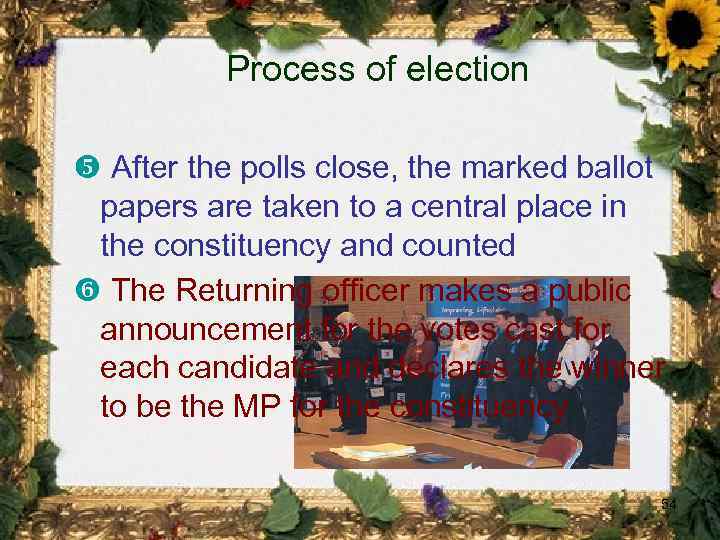 Process of election After the polls close, the marked ballot papers are taken to a central place in the constituency and counted The Returning officer makes a public announcement for the votes cast for each candidate and declares the winner to be the MP for the constituency 54
 Process of election At the election night, TV start their programmes By midnight, experts will be making predictions about the composition of the newly elected House of Commons By 2 in the morning, ≥ ½ of the constituencies will have declared their results. 55
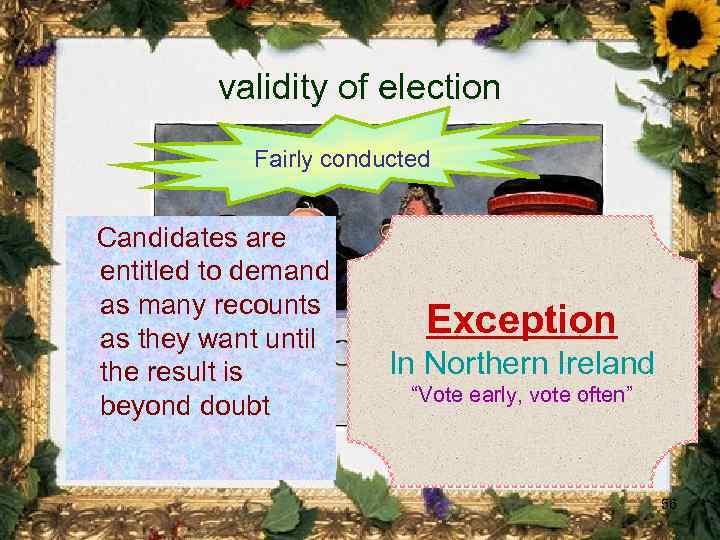 validity of election Fairly conducted Candidates are entitled to demand as many recounts as they want until the result is beyond doubt Exception In Northern Ireland “Vote early, vote often” 56
 By- election Whenever a sitting MP can no longer fulfill his duties, there has to be a special new election in the constituency which he represents By elections No system of can take place ready substitutes at any time 57
 Suggestions for further reading 1. Conservative party and labour party – which is better for the British 2. Stages of legislation: how a bill becomes law 3. British judiciary system 4. British general election 58