


 Скачать презентацию Outline of Isaiah q q q 1 -35
81a1b982c6e853bb657e71a2b0a47785.ppt
- Количество слайдов: 15

 Outline of Isaiah: q q q 1 -35 36 -39 40 -66 prophecies ag. nations history prophecies of redemption
 Outline of Isaiah: q q q 1 -35 36 -39 40 -66 Ø prophecies ag. nations history prophecies of redemption 49 -57 redemption provided Ø 52: 13 -53: 12 the Redeemer
 Historical Context: 51: 13 - oppressed 735/4 B. C. 701 B. C. 681… B. C. Israel and Aram Assyria
 I. The Need To Trust God: Ch. 49: Judah rejects God’s message of hope 1 -13, "Restore…comfort" a message of hope 14 -26, "But Zion said…" blame and doubt 14, "The Lord has forgotten/forsaken me" 24, "Can the prey be taken from the strong man? " Summary: God is either weak or wicked. “Tis better to be thought a fool, than to speak and leave no doubt. ”
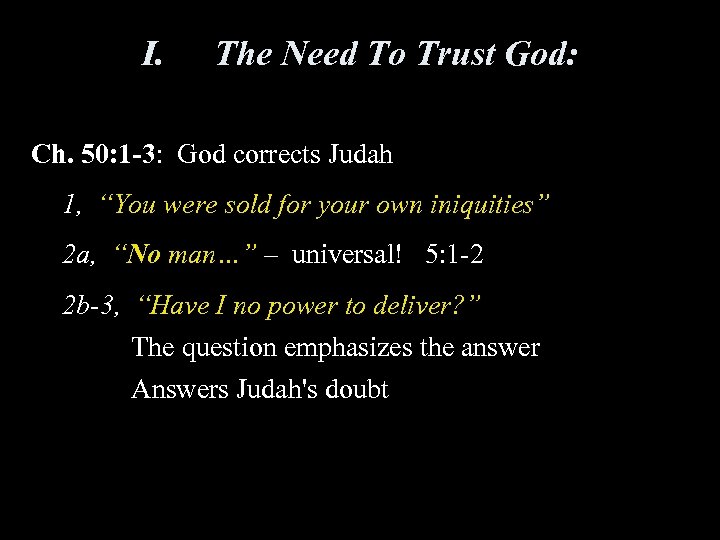 I. The Need To Trust God: Ch. 50: 1 -3: God corrects Judah 1, “You were sold for your own iniquities” 2 a, “No man…” – universal! 5: 1 -2 2 b-3, “Have I no power to deliver? ” The question emphasizes the answer Answers Judah's doubt
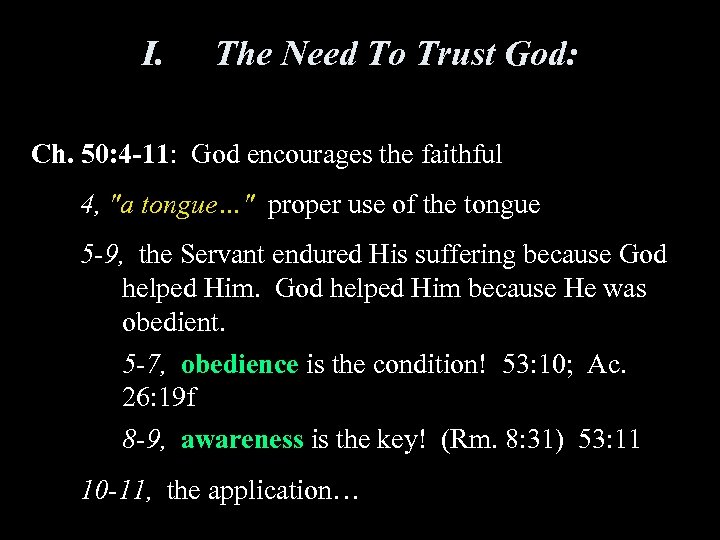 I. The Need To Trust God: Ch. 50: 4 -11: God encourages the faithful 4, "a tongue…" proper use of the tongue 5 -9, the Servant endured His suffering because God helped Him because He was obedient. 5 -7, obedience is the condition! 53: 10; Ac. 26: 19 f 8 -9, awareness is the key! (Rm. 8: 31) 53: 11 10 -11, the application…
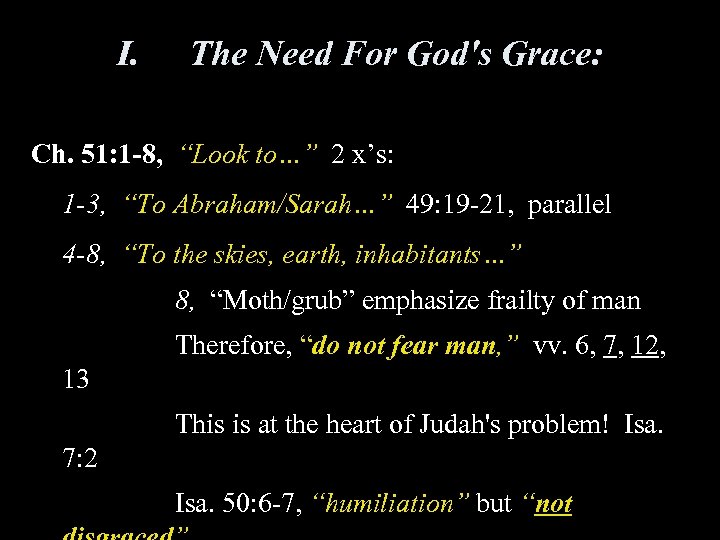 I. The Need For God's Grace: Ch. 51: 1 -8, “Look to…” 2 x’s: 1 -3, “To Abraham/Sarah…” 49: 19 -21, parallel 4 -8, “To the skies, earth, inhabitants…” 8, “Moth/grub” emphasize frailty of man Therefore, “do not fear man, ” vv. 6, 7, 12, 13 This is at the heart of Judah's problem! Isa. 7: 2 Isa. 50: 6 -7, “humiliation” but “not
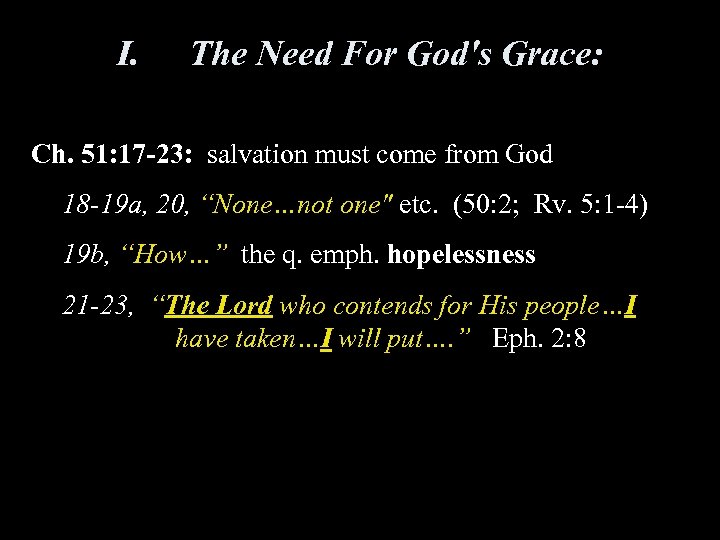 I. The Need For God's Grace: Ch. 51: 17 -23: salvation must come from God 18 -19 a, 20, “None…not one" etc. (50: 2; Rv. 5: 1 -4) 19 b, “How…” the q. emph. hopelessness 21 -23, “The Lord who contends for His people…I have taken…I will put…. ” Eph. 2: 8
 III. The Need To Confess Jesus As Christ: Isa. 52: 13 -53: 12 • In Lk. 22: 37, Jesus said Isa. 53: 12 refers to "Me" • V. 1 – doubt – Isa. 49: 24 - doubt that God could send a Savior – Jn. 12: 38 - doubt that Jesus was the Savior – A. D. 2006 - doubt that the world needs a Savior A. Note the pronouns – “we, ” “our, ” etc. (v. 10)
 Ch. 54: the results of the Servant’s work: 1 -3, the barren one will bear 4 -8, the widow will marry again 11 -17, the blessings of God’s people: "Antimony"
 IV. The Need To Repent: Chs. 55 -57 A. The invitation: – 55: 1 a, “Every one” universal invitation – 55: 1 b, “Buy…without money” Then how? • 7, change • 8 -9, new thoughts (Jer. 10: 23) – 55: 10 -11, deliverance and compassion are certain
 IV. The Need To Repent: Chs. 55 -57 B. The urgency: 55: 6; 56: 1 C. The motivation: 57: 1 -21 – 2, the R. man enters peace – 21, the u. R. man has no peace
 V. The Need To Persevere: This passage is primarily directed to the faithful: 51: 1, 7; 50: 10
 “Never give in - never, in nothing great or small, large or petty, never give in except to convictions of honor and good sense. Never yield to the apparently overwhelming might of the enemy. ” (Winston Churchill, 1941)