 Скачать презентацию Outline ö consequence ö bar of short order
b8f1e305bd1a58cfdc95edb0be674414.ppt
- Количество слайдов: 51



Outline ö consequence ö bar of short order lead time code ö technical details, benefits, process to adopt ö RFID ö technical details, milestones, benefits, and issues 1
Our Perspectives ö to improve processes in logistics & supply chains ö not ö to to focus on technical details of technologies identify sources of relevant information 2
Benefits of Short Order Lead Time 3
Benefits of Short Lead Time in Retailing ö two discount stores, A and B ö re-order lead time: 1 day (3 days) for A (B) ö what can be said about the two stores? ö what are the advantages of store A? 4
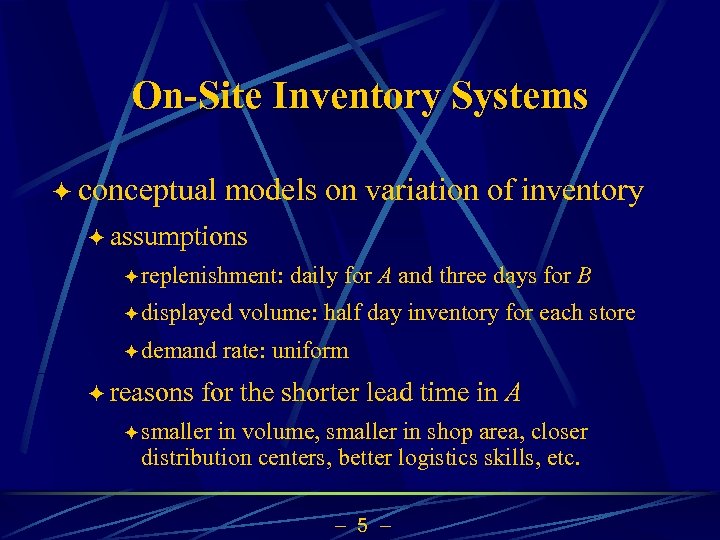
On-Site Inventory Systems ö conceptual models on variation of inventory ö assumptions ö replenishment: ö displayed ö demand ö reasons daily for A and three days for B volume: half day inventory for each store rate: uniform for the shorter lead time in A ö smaller in volume, smaller in shop area, closer distribution centers, better logistics skills, etc. 5
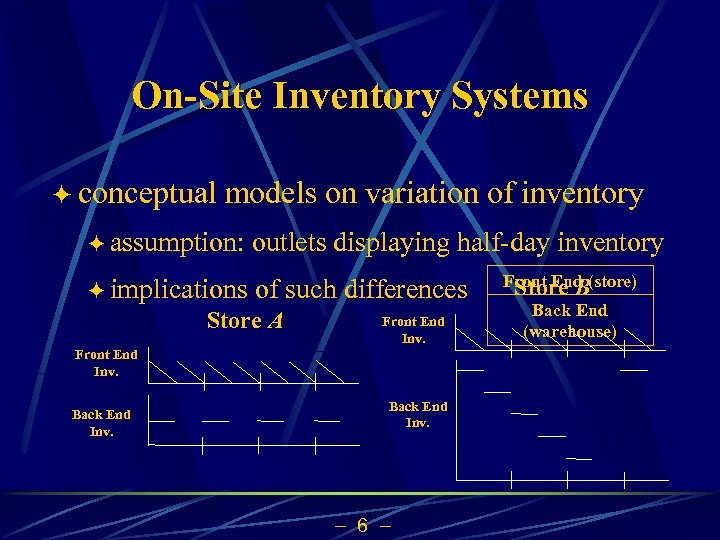
On-Site Inventory Systems ö conceptual models on variation of inventory ö assumption: outlets displaying half-day inventory ö implications of such differences Store A Front End Inv. Back End Inv. 6 Front End (store) Store B Back End (warehouse)
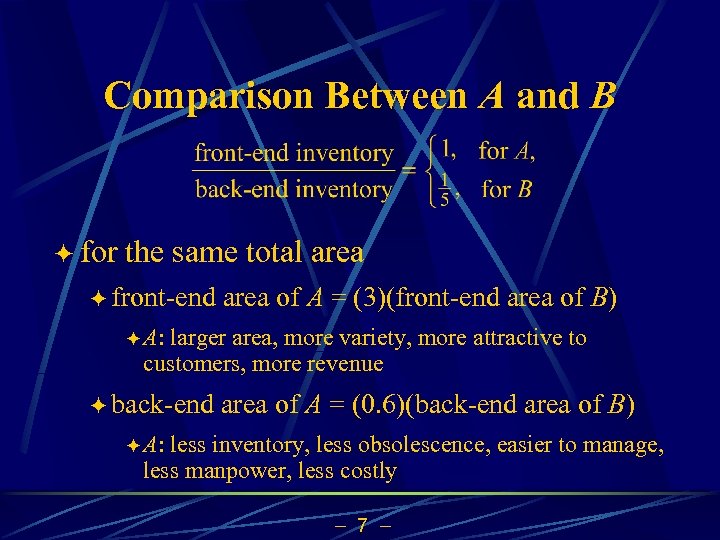
Comparison Between A and B ö for the same total area ö front-end area of A = (3)(front-end area of B) ö A: larger area, more variety, more attractive to customers, more revenue ö back-end area of A = (0. 6)(back-end area of B) ö A: less inventory, less obsolescence, easier to manage, less manpower, less costly 7
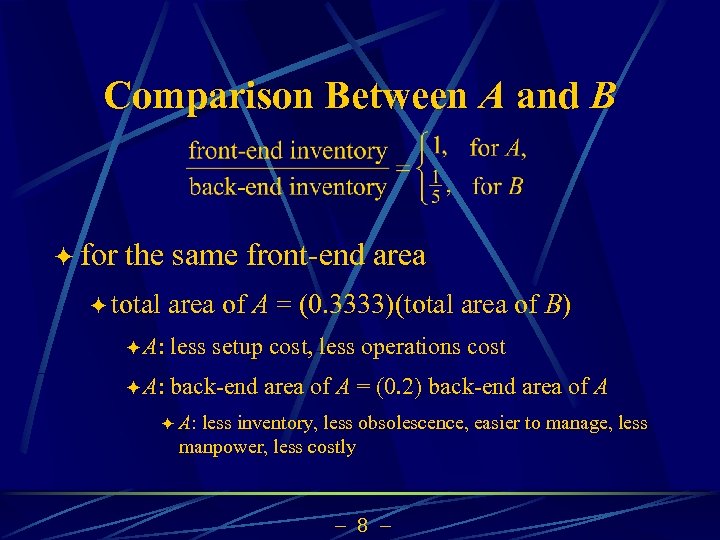
Comparison Between A and B ö for the same front-end area ö total area of A = (0. 3333)(total area of B) ö A: less setup cost, less operations cost ö A: back-end area of A = (0. 2) back-end area of A ö A: less inventory, less obsolescence, easier to manage, less manpower, less costly 8
Comparison Between A and B ö delivery frequency: daily for A and once per three days for B ö for the same demand rate ö A: one-third of the volume of B in each trip ö transportation ö A: cost more even workload in warehouse 9
Comparison Between A and B ö ö all in all good to have shorter lead time why doesn’t B cut short its lead time? ö physical limitations, e. g. , already quickest means by airfreight ö uncontrollable factors, e. g. , customs ö design of system, e. g. , far away distribution center ö infrastructure of system, e. g. , information systems not strong enough ö operations policy, e. g. , ineffective logistics support 10
To Cut Short Lead Time and To Simplify Operations Process 11
To Cut Short Lead Time ö objectives: short lead time, simple & smooth process ö delay in distribution center ö operations: receiving, putaway, pick up, sorting, unitizing, shipping, transport ö capturing information: product ID, quality, quantity, manufacturer, production and expiry dates, etc. ö handling paperwork 12
To Cut Short the Lead Time ö objectives: short lead time, simple & smooth process ö delay in retail outlet ö physical handling of goods ö capturing information ö pricing ö inventory management 13
Reducing Time and Effort in Capturing Information ö essential to capture information for warehouses or retail outlets ö ö time spent on capturing information ö ö for daily operations and management, and for data for automatic systems counting and checking (at every touch, into and out of DC, into outlets), imputing data to computer systems automatic identification and communication (AIS) equipment ö factors to select: accuracy, speed, cost, industrial standard, handiness, robustness 14
Bar Code 15
Hardware & Software for a Bar Coding System ö bar code production – bar code printer ö to generate or to print bar codes on labels, documents, goods, Windows applications, or on the Internet, etc. ö direct marking ö ink ö jet, laser etching label production ö dot matrix printing, laser printer, direct thermal printer, thermal transfer printing 16
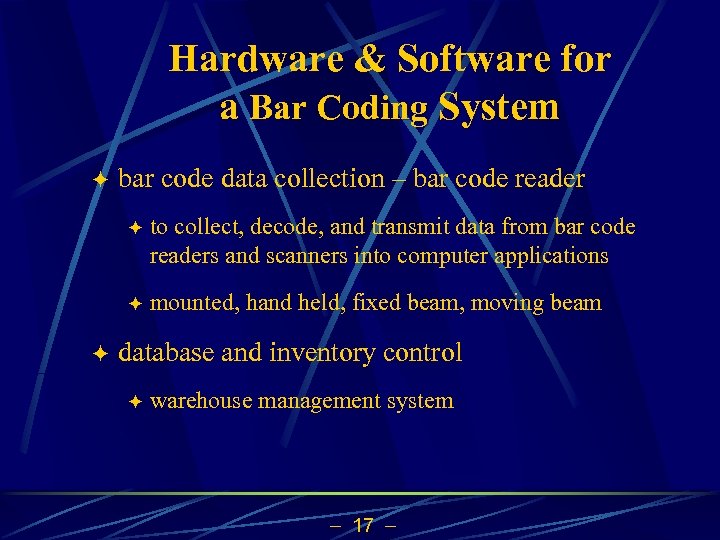
Hardware & Software for a Bar Coding System ö bar code data collection – bar code reader ö ö ö to collect, decode, and transmit data from bar code readers and scanners into computer applications mounted, hand held, fixed beam, moving beam database and inventory control ö warehouse management system 17
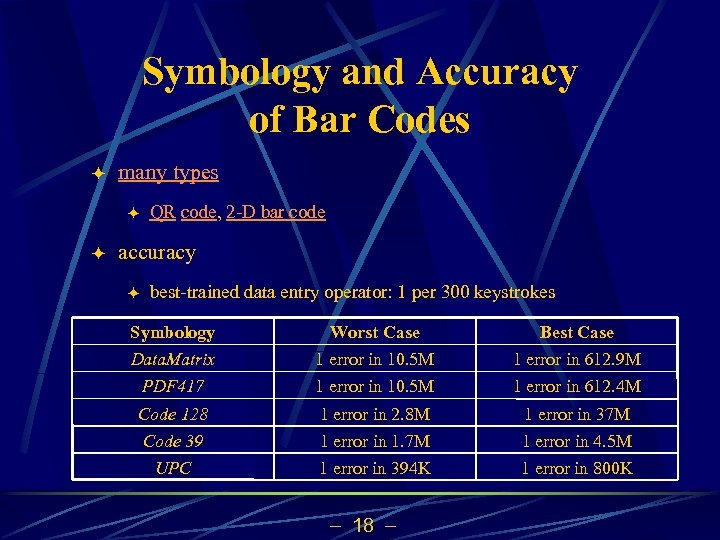
Symbology and Accuracy of Bar Codes ö many types ö ö QR code, 2 -D bar code accuracy ö best-trained data entry operator: 1 per 300 keystrokes Symbology Worst Case Best Case Data. Matrix 1 error in 10. 5 M 1 error in 612. 9 M PDF 417 1 error in 10. 5 M 1 error in 612. 4 M Code 128 1 error in 2. 8 M 1 error in 37 M Code 39 1 error in 1. 7 M 1 error in 4. 5 M UPC 1 error in 394 K 1 error in 800 K 18
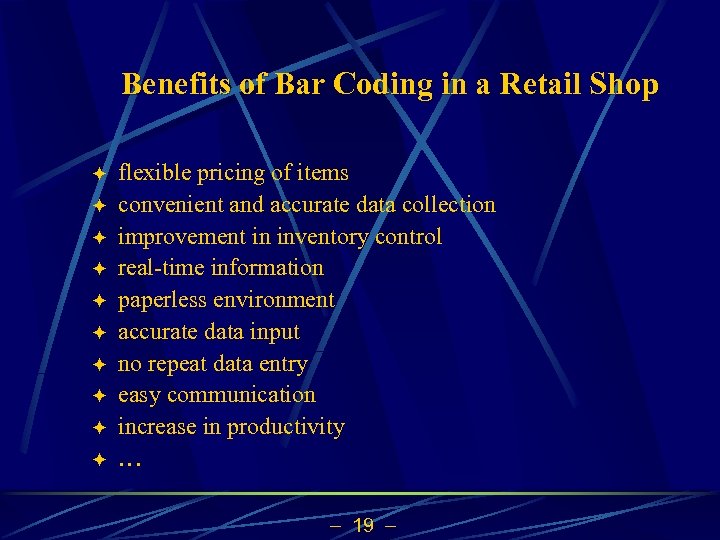
Benefits of Bar Coding in a Retail Shop ö ö ö ö ö flexible pricing of items convenient and accurate data collection improvement in inventory control real-time information paperless environment accurate data input no repeat data entry easy communication increase in productivity … 19
Adoption of Bar Code Systems 20
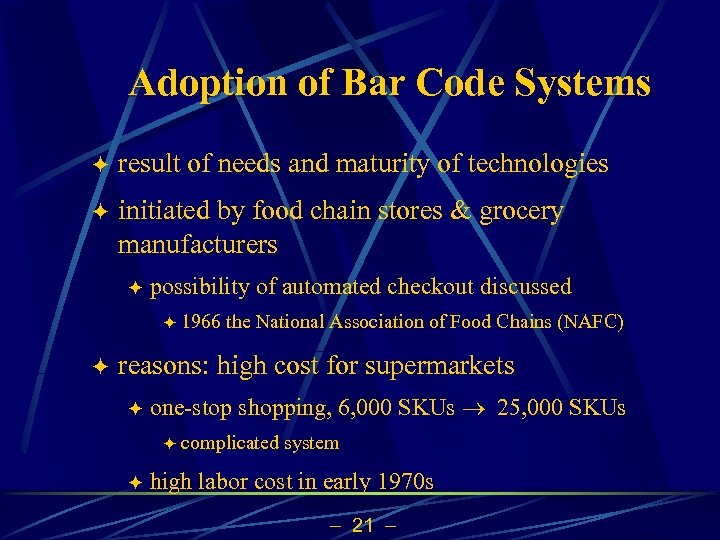
Adoption of Bar Code Systems ö result of needs and maturity of technologies ö initiated by food chain stores & grocery manufacturers ö possibility of automated checkout discussed ö 1966 ö the National Association of Food Chains (NAFC) reasons: high cost for supermarkets ö one-stop shopping, 6, 000 SKUs 25, 000 SKUs ö complicated ö system high labor cost in early 1970 s 21
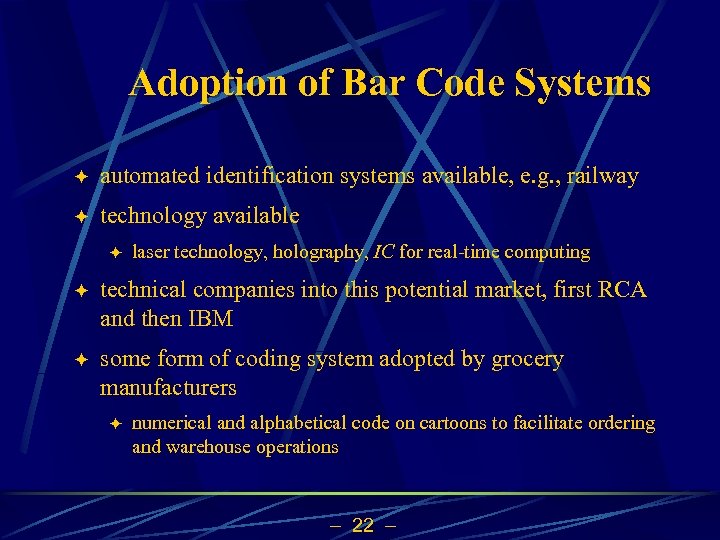
Adoption of Bar Code Systems ö automated identification systems available, e. g. , railway ö technology available ö laser technology, holography, IC for real-time computing ö technical companies into this potential market, first RCA and then IBM ö some form of coding system adopted by grocery manufacturers ö numerical and alphabetical code on cartoons to facilitate ordering and warehouse operations 22
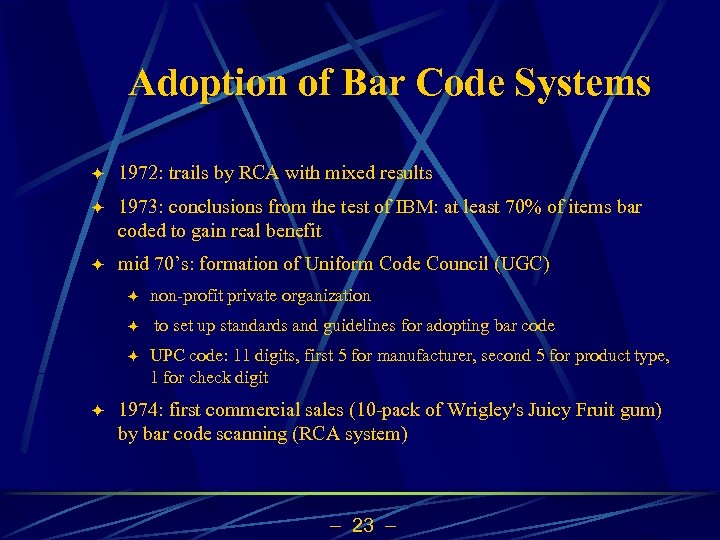
Adoption of Bar Code Systems ö 1972: trails by RCA with mixed results ö 1973: conclusions from the test of IBM: at least 70% of items bar coded to gain real benefit ö mid 70’s: formation of Uniform Code Council (UGC) ö ö non-profit private organization to set up standards and guidelines for adopting bar code UPC code: 11 digits, first 5 for manufacturer, second 5 for product type, 1 for check digit 1974: first commercial sales (10 -pack of Wrigley's Juicy Fruit gum) by bar code scanning (RCA system) 23
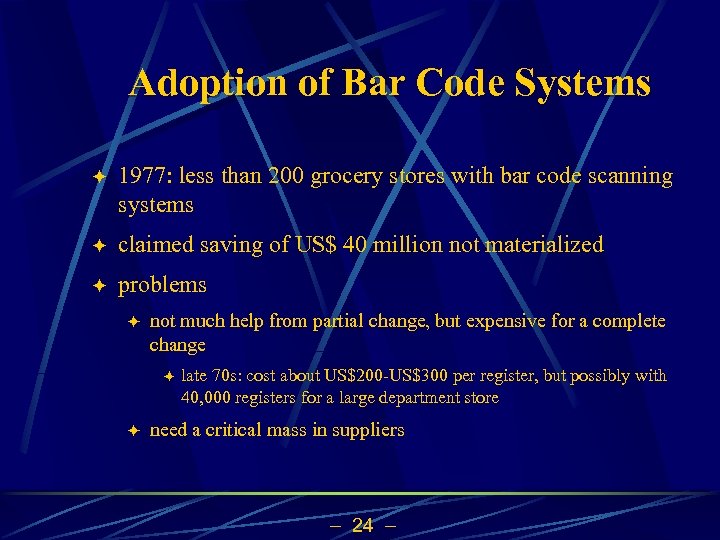
Adoption of Bar Code Systems ö 1977: less than 200 grocery stores with bar code scanning systems ö claimed saving of US$ 40 million not materialized ö problems ö not much help from partial change, but expensive for a complete change ö ö late 70 s: cost about US$200 -US$300 per register, but possibly with 40, 000 registers for a large department store need a critical mass in suppliers 24
Adoption of Bar Code Systems ö benefits for retailers ö quicker in checking out ö shorter waiting line ö less checkers ö ö less errors ö ö simpler training for part-time checkers of high turnaround automatic data collection to accounting and inventory management systems benefits for manufacturers: better sales information, less out of stock 25
Adoption of Bar Code Systems ö 1976: 75% items in a supermarket adopted UPC code ö 1981: all supplies to Department of Defense bar coded ö 1983 -87: adoption of bar code by the apparel industry ö K-Mart (1983), Wal-Mart (1987) ö different reasons from grocery: product identification and inventory management to handle the huge product variety ö 1986: formation of Voluntary Interindustry Communication Standards (VICs) Committee by suppliers, manufacturers, and retailers in apparel ö ö ö to courage the adoption of the standard adoption of UPC-A for point-of sales systems 1992: 69% of companies adopted UPC-A 26
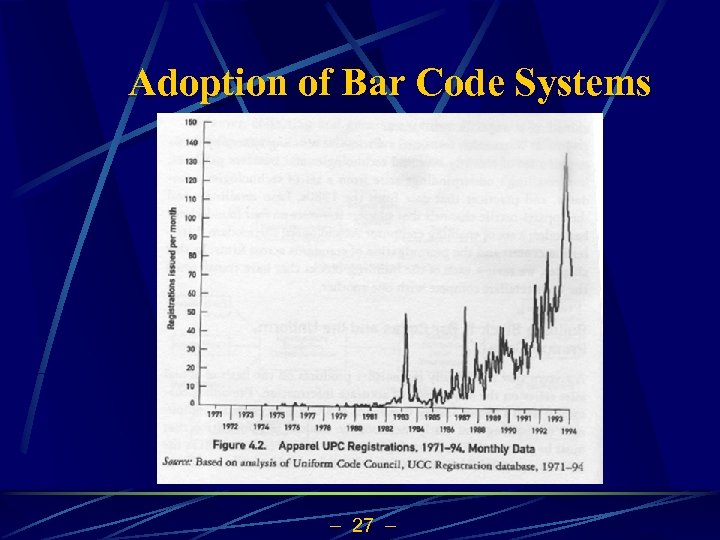
Adoption of Bar Code Systems 27

RFID 28
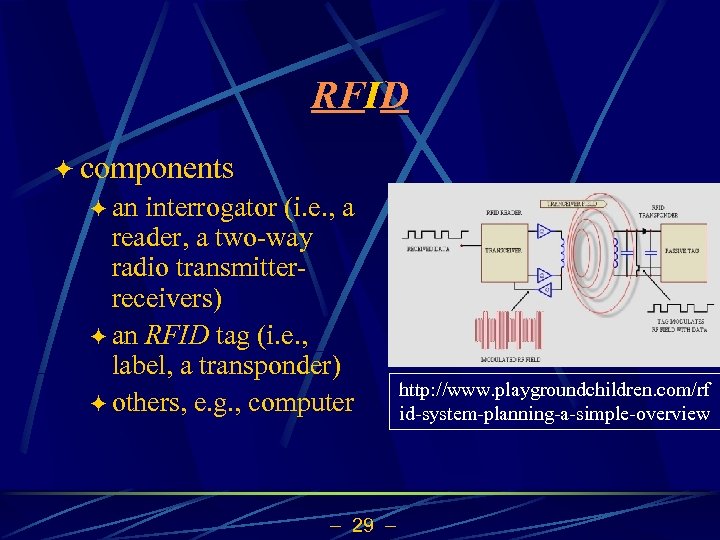
R F ID ö components ö an interrogator (i. e. , a reader, a two-way radio transmitterreceivers) ö an RFID tag (i. e. , label, a transponder) ö others, e. g. , computer 29 http: //www. playgroundchildren. com/rf id-system-planning-a-simple-overview
RFID Readers ö sending RF signals to an RFID tag and getting its response ö activating ö signals an RFID tag within a finite range blocked by metal and diffused by water 30
An RFID Tag ö at least two parts ö ö ö an IC (information storing and processing for data and RF signals, and DC power collecting from reader’s signals, etc. ) an antenna for receiving and transmitting signals three types ö passive: power from reader’s signals ö active: battery available, possibly to emit signals ö battery assisted passive: battery available, turned active by reader’s signals ö finite battery life time 31
RFID ö RFID (when compared with Bar Code) ö no contact for reading ö quicker in reading ö tags can be placed anywhere ö error free reading ö robust: moving; dirty, oily surfaces; any material ö long life for passive RFID tags ö hard to fake RFID tags ö read-write tags are intelligent ö store a great amount of data ö tags can be read or written 32
Benefits of RFID ö accurate inventory ö less shortage ö reduced customer trip times ö less inventory in supply chains ö simpler check out process ö shorter waiting time ö less shop-lifting 33

Milestones 34
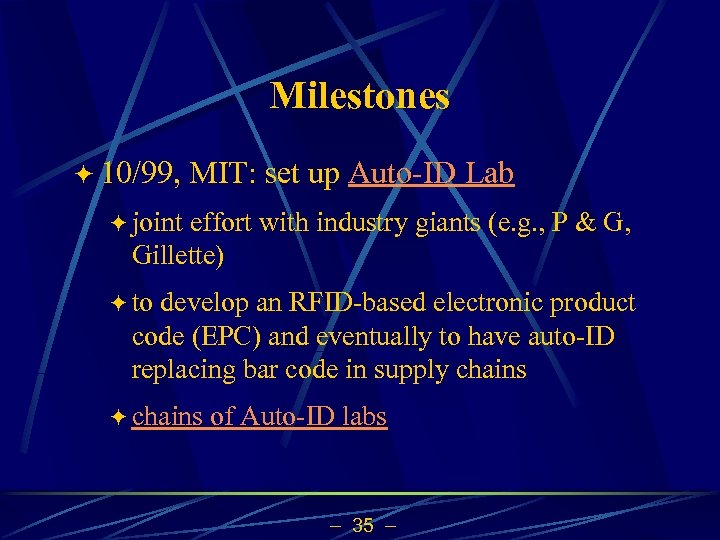
Milestones ö 10/99, MIT: set up Auto-ID Lab ö joint effort with industry giants (e. g. , P & G, Gillette) ö to develop an RFID-based electronic product code (EPC) and eventually to have auto-ID replacing bar code in supply chains ö chains of Auto-ID labs 35
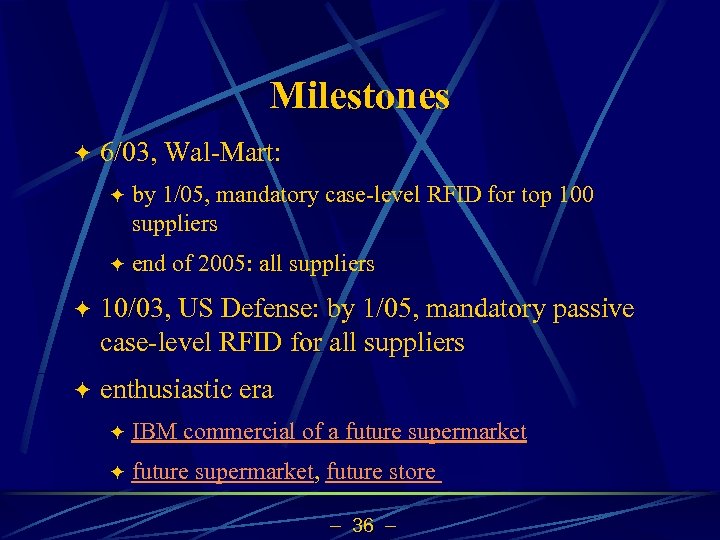
Milestones ö 6/03, Wal-Mart: ö by 1/05, mandatory case-level RFID for top 100 suppliers ö end of 2005: all suppliers ö 10/03, US Defense: by 1/05, mandatory passive case-level RFID for all suppliers ö enthusiastic era ö IBM commercial of a future supermarket ö future supermarket, future store 36
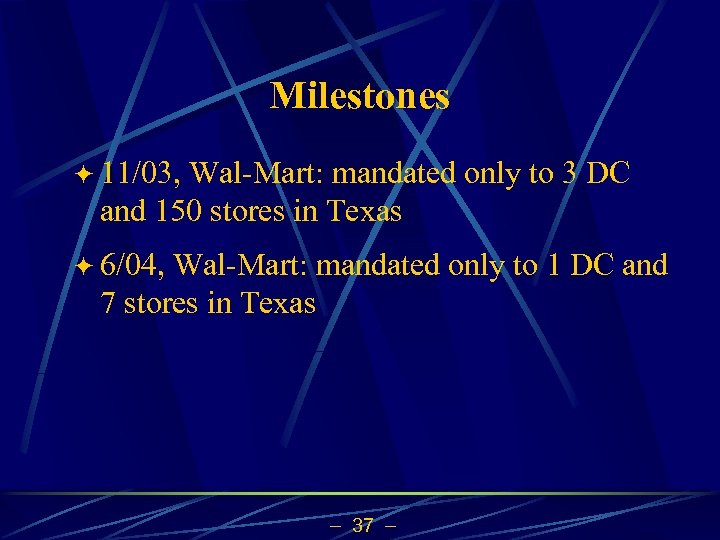
Milestones ö 11/03, Wal-Mart: mandated only to 3 DC and 150 stores in Texas ö 6/04, Wal-Mart: mandated only to 1 DC and 7 stores in Texas 37
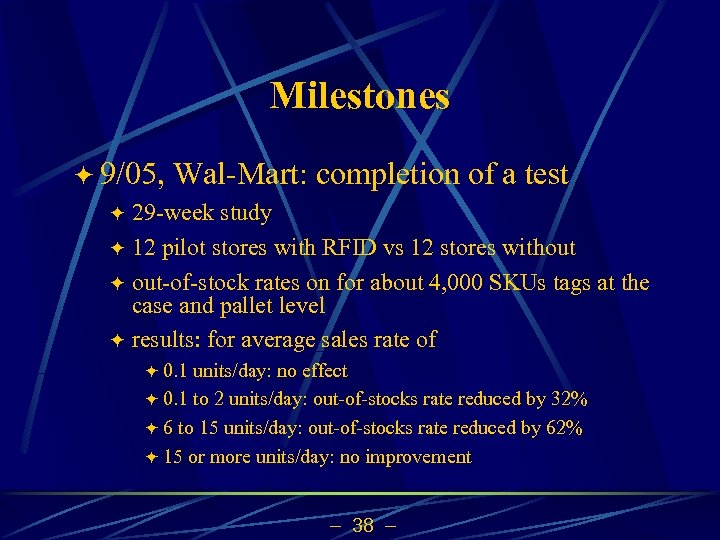
Milestones ö 9/05, Wal-Mart: completion of a test ö 29 -week study ö 12 pilot stores with RFID vs 12 stores without ö out-of-stock rates on for about 4, 000 SKUs tags at the case and pallet level ö results: for average sales rate of ö 0. 1 units/day: no effect ö 0. 1 to 2 units/day: out-of-stocks rate reduced by 32% ö 6 to 15 units/day: out-of-stocks rate reduced by 62% ö 15 or more units/day: no improvement 38
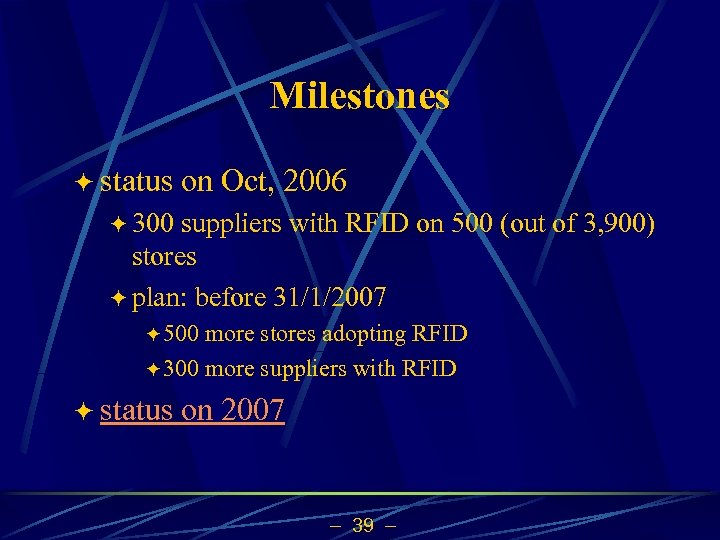
Milestones ö status on Oct, 2006 ö 300 suppliers with RFID on 500 (out of 3, 900) stores ö plan: before 31/1/2007 ö 500 more stores adopting RFID ö 300 more suppliers with RFID ö status on 2007 39
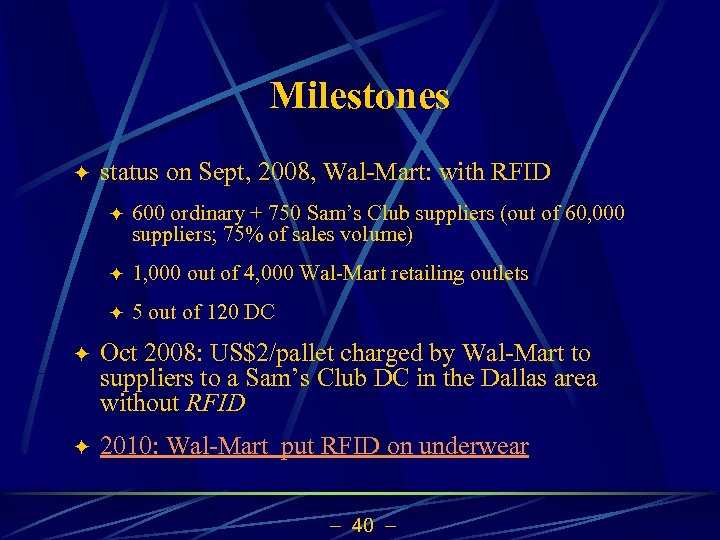
Milestones ö status on Sept, 2008, Wal-Mart: with RFID ö 600 ordinary + 750 Sam’s Club suppliers (out of 60, 000 suppliers; 75% of sales volume) ö 1, 000 out of 4, 000 Wal-Mart retailing outlets ö 5 out of 120 DC ö Oct 2008: US$2/pallet charged by Wal-Mart to suppliers to a Sam’s Club DC in the Dallas area without RFID ö 2010: Wal-Mart put RFID on underwear 40
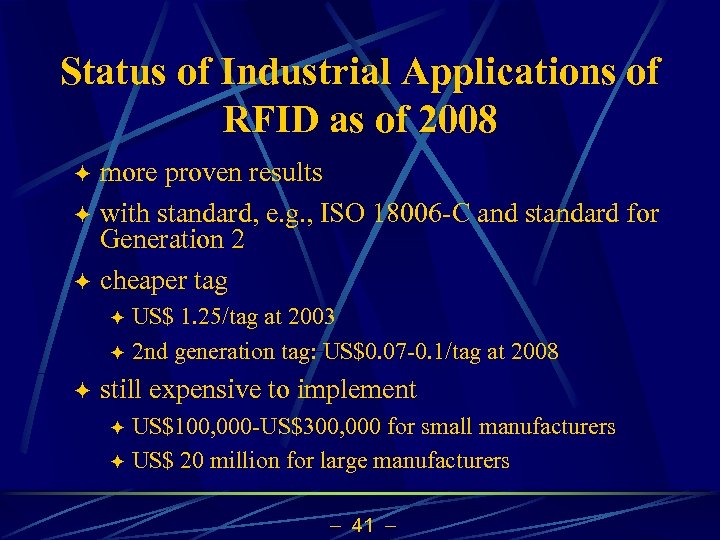
Status of Industrial Applications of RFID as of 2008 more proven results ö with standard, e. g. , ISO 18006 -C and standard for Generation 2 ö cheaper tag ö US$ 1. 25/tag at 2003 ö 2 nd generation tag: US$0. 07 -0. 1/tag at 2008 ö ö still expensive to implement US$100, 000 -US$300, 000 for small manufacturers ö US$ 20 million for large manufacturers ö 41
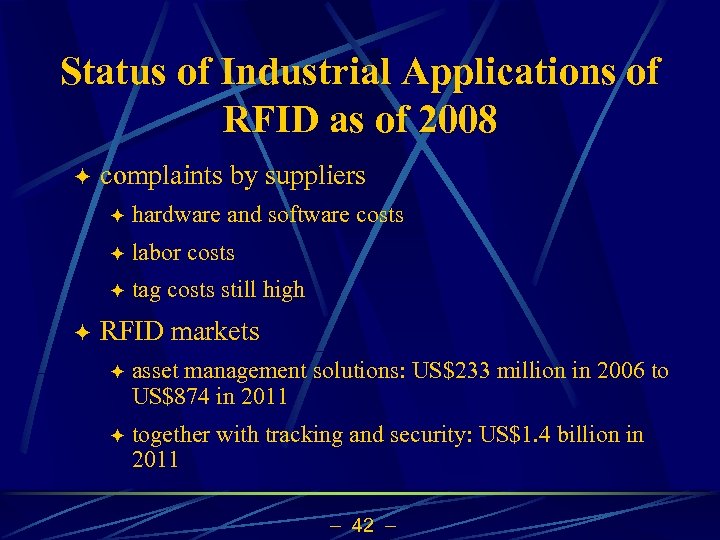
Status of Industrial Applications of RFID as of 2008 ö complaints by suppliers ö ö labor costs ö ö hardware and software costs tag costs still high RFID markets ö asset management solutions: US$233 million in 2006 to US$874 in 2011 ö together with tracking and security: US$1. 4 billion in 2011 42
Pacific Coast Producers (2008) 43
Pacific Coast Producers California-based manufacturer of canned fruits and tomatoes ö revenue US $450 million (2008) ö a supplier driven by Wal-Mart to implement RFID ö right from beginning: abandoning manual system ö automatic system integrating RFID into production process ö ö RFID on cases and pallets 44
Pacific Coast Producers ö implementation process öexperimentation öread on integration rate öwith water and metal in products, initial 33% ölater to 90+% with 1 st generation RFID öEPC Gen 2 tags: 99. 7% ö 100% with verification check 45
Pacific Coast Producers ö software ö to communicate with ERP about order information ö to generates EPC data ö to code the tags ö to receive electronic data from Wal-Mart on status and sales of products 46
Pacific Coast Producers ö applications of RFID ö to study the possible improvement in product availability by RFID tag ö 50% less chance of shortage ö to check the effectiveness of product promotions ö e. g. , synchronization of promotion schedule and product availability 47
Issues of RFID as at 2008 48
Issues of RFID ö interference of radio frequency ö incompatible standards ö cost ö integration with existing systems ö application dependent technology 49
Complaints on RFID: market created by technology ö no industry standard yet (2011) ö unknown future of vendors ö tags not 100% accurate ö immature technology leading to obsolete investments ö privacy issues for consumers ö cost effectiveness not proven yet ö 50
Latest News of RFID ö 2010 Wal-Mart: tag RFID on Jeans and underwear to check items displayed ö many RFID applications, though not exactly replacing bar code in logistics and supply chains 51
Скачать презентацию Outline ö consequence ö bar of short order
b8f1e305bd1a58cfdc95edb0be674414.ppt