


 Скачать презентацию OUTLINE FOR CHAPTER 13 Understand Translation Exposure
9fe478055027f9d359285884c4aeb8d0.ppt
- Количество слайдов: 102
 OUTLINE FOR CHAPTER 13 • Understand Translation Exposure – How does translation exposure arise? – Definition – How do the Current and Temporal Methods work? – What are the U. S. rules? – Calculation of exchange gains/losses 1
 Chapter 13 - Translation Exposure • Arises because financial statements of foreign affiliates which are typically stated in foreign currencies need to be restated (translated) in terms of the currency of the parent • Main purpose of translation - preparation of consolidated financial statements 2
 Translation Exposure • Definition - Potential for an increase or decrease on the parent’s net worth and reported net income caused by a change in the exchange rate • Operating exposure is more important (for financial managers) but in the real world translation exposure is quite important 3
 Translation Methods • Methods we will discuss in class: Current Rate - most prevalent in the world Temporal Method 4
 Current Rate Method • Assets and liabilities use current rate • Income statement - use actual exchange rate for the day when revenues, expenses, etc. were incurred or use an appropriate weighted average exchange rate • Dividends - use exchange rate in effect on date of payment 5
 Current Rate Method - Continued • Equity - common stock and paid-in capital accounts use an appropriate historical rate • In the U. S. , translation gains / losses are put in a special account (Cumulative Translation Adjustment - CTA). When foreign affiliate is sold or liquidated gains or losses become realized 6
 Temporal Method (similar to the Monetary/Nonmonetary Method) • Monetary assets (cash, marketable securities, accounts receivable, etc. ) and monetary liabilities (current liabilities and long-term debt) use current exchange rate • Nonmonetary assets (inventory, fixed assets, etc. ) use appropriate historical rate • Dividends - use exchange rate in effect on date of payment 7
 Temporal Method - Continued • Income statement - In general use average exchange rate for period. For depreciation and cost of goods sold use appropriate historical rate • Common stock and paid-in capital accounts use appropriate historical rate • Gains / losses from translation go to current consolidated income 8
 U. S. Rules • For each affiliate must figure out the functional currency • Functional currency - currency of the primary economic environment in which the affiliate operates and generates cash flows • See page 338 for more information in deciding what is the functional currency of the subsidiary. 9
 U. S. Rules - Continued • From page 340 of Multinational Business Finance • If the financial statements of the foreign affiliate are in U. S. dollars no translation is required • If the financial statements of the foreign affiliate are in the local currency and the local currency is the functional currency use the current rate method 10
 U. S. Rules - Continued • If the financial statements of the foreign affiliate are in the local currency and the dollar is the functional currency use (remeasured by) temporal method • If the financial statements of the foreign affiliate are in the local currency and neither the local currency nor the dollar is the functional currency, then financial statements are first remeasured into the functional currency by the temporal method and then translated by the current rate method 11
 U. S. Rules - Continued • If a country has cumulative inflation of approximately 100 % over a 3 year period must use the temporal method 12
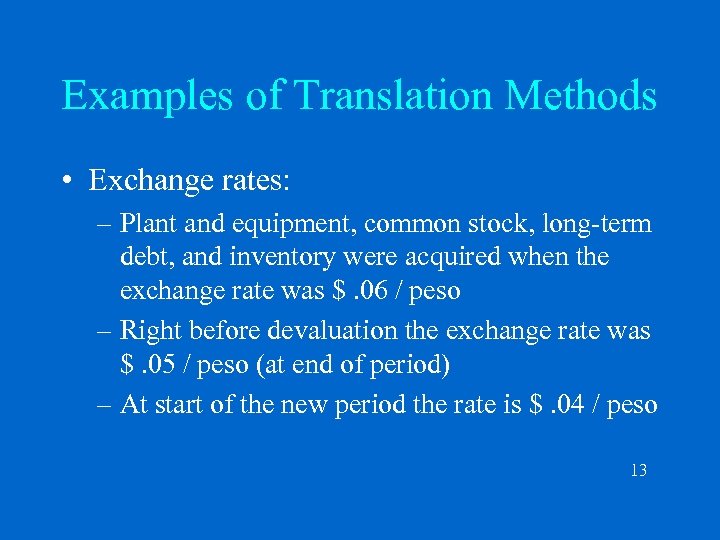 Examples of Translation Methods • Exchange rates: – Plant and equipment, common stock, long-term debt, and inventory were acquired when the exchange rate was $. 06 / peso – Right before devaluation the exchange rate was $. 05 / peso (at end of period) – At start of the new period the rate is $. 04 / peso 13
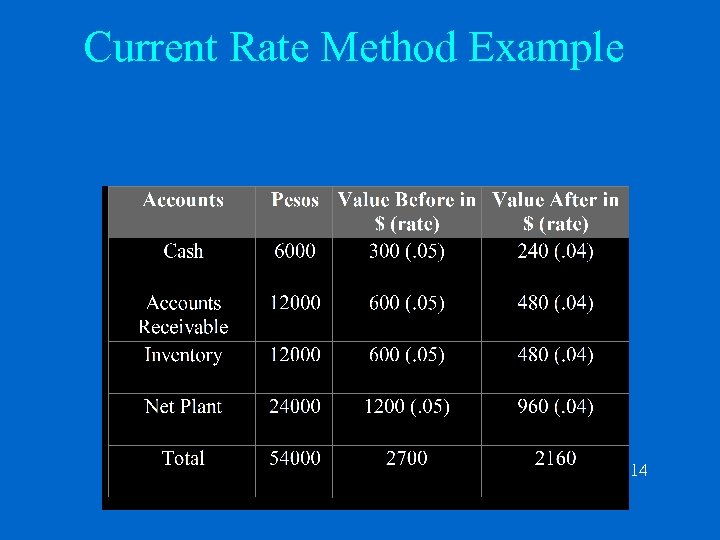 Current Rate Method Example 14
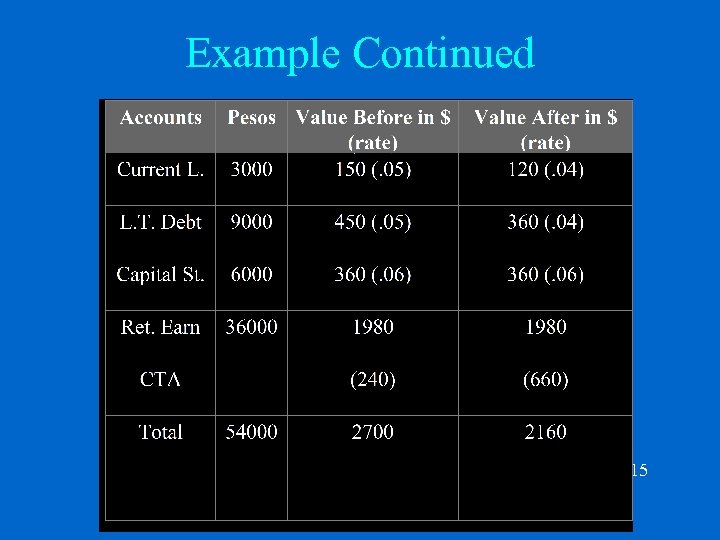 Example Continued 15
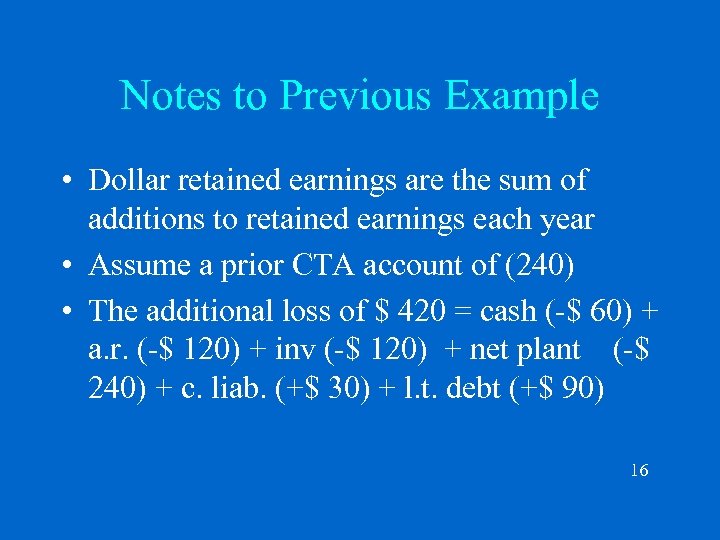 Notes to Previous Example • Dollar retained earnings are the sum of additions to retained earnings each year • Assume a prior CTA account of (240) • The additional loss of $ 420 = cash (-$ 60) + a. r. (-$ 120) + inv (-$ 120) + net plant (-$ 240) + c. liab. (+$ 30) + l. t. debt (+$ 90) 16
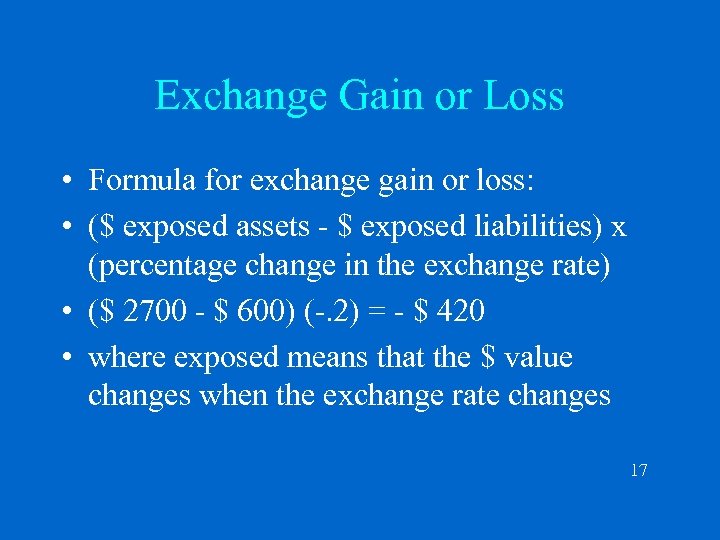 Exchange Gain or Loss • Formula for exchange gain or loss: • ($ exposed assets - $ exposed liabilities) x (percentage change in the exchange rate) • ($ 2700 - $ 600) (-. 2) = - $ 420 • where exposed means that the $ value changes when the exchange rate changes 17
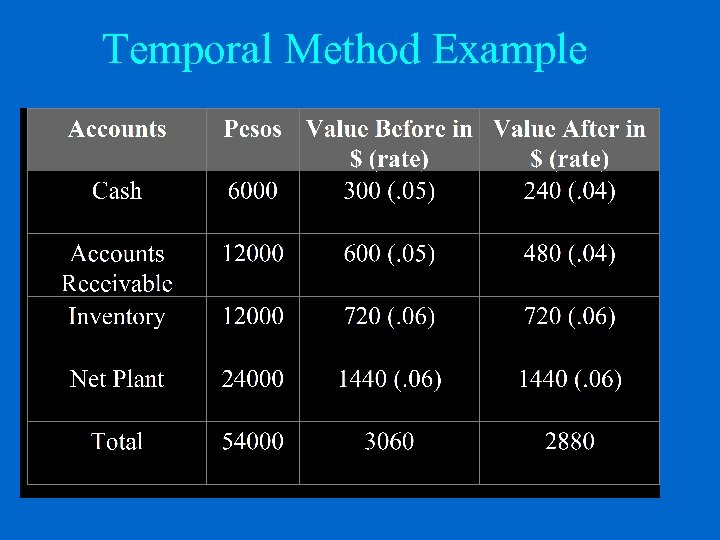 Temporal Method Example 18
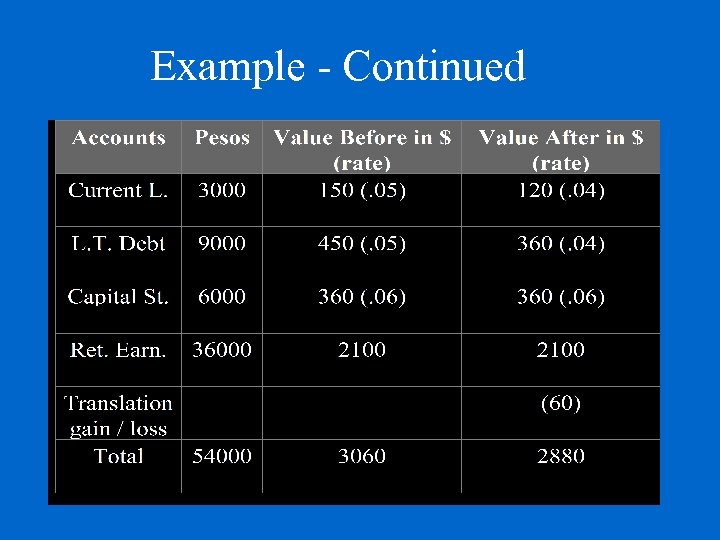 Example - Continued 19
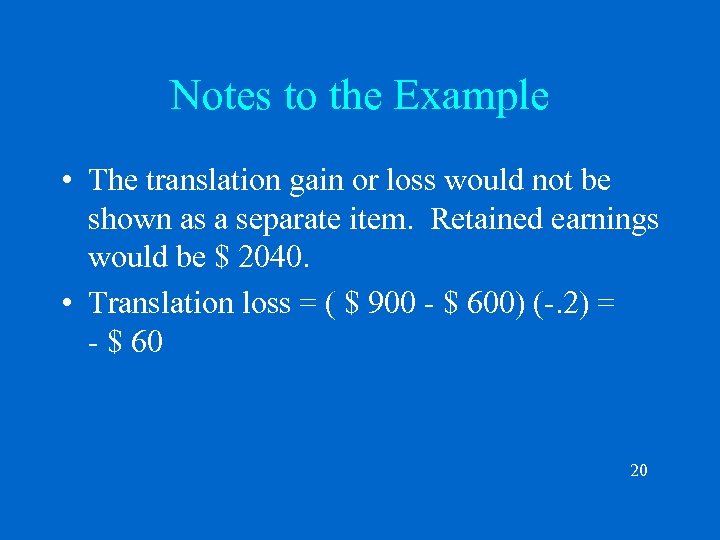 Notes to the Example • The translation gain or loss would not be shown as a separate item. Retained earnings would be $ 2040. • Translation loss = ( $ 900 - $ 600) (-. 2) = - $ 60 20
 Comparison of Temporal and Current Rate Methods • Note in this example the two methods give very different magnitudes of losses • Can also have the situation where there accounting losses (gains) but operating gains (losses) 21
 Managing Translation Exposure • Balance Sheet Hedge - make $ exposed assets = $ exposed liabilities ( no matter what the exchange rate does there will be no accounting losses or gains) • Creating a balance sheet hedge may and probably will reduce operating efficiency (may for example have too much inventory) 22
 Managing - Continued • Under the temporal method in this example could borrow 6000 pesos and convert to dollars or buy inventory or plant and equipment • Under the current rate method could borrow 42000 pesos and convert to dollars 23
 Rules in Other Countries • Many countries make a distinction between an integrated foreign entity (foreign affiliate is an extension of the parent and cash flows of affiliate are highly related to cash flows of parent) and a self-sustaining foreign entity (basically cash flows of local affiliate are “independent” of those of the parent) 24
 Rules - Continued • In many countries integrated foreign entities use the temporal method and self-sustaining entities use current rate method 25
 Homework - Chapter 13 • # 8 (do both the current rate method and the temporal method) 26
 OUTLINE FOR CHAPTER 9 • Understand Interest Rate Exposure – How does the problem arise? – Techniques to minimize the problem (forward rate agreements, interest rate futures, interest rate swaps, and currency swaps) 27
 Chapter 9 - Interest Rate Exposure • This has become a more important topic in recent years due to : (1) increased volatility of interest rates (2) increased use of short-term debt (3) increased pressure to earn “competitive” yields on marketable securities 28
 Interest Rate Exposure Continued • The problem for many non-financial firms is that they have relatively few interest rate sensitive assets but many interest rate sensitive liabilities so firms can get hurt when interest rates go up 29
 Management of Interest Rate Risk • Techniques that we will discuss: (1) Forward Rate Agreement (4) Interest Rate Futures (3) Interest Rate Swaps (4) Currency Swaps 30
 Forward Rate Agreements • The buyer of a forward rate agreement obtains the right to lock in an interest rate (say 6%) that will begin in the future • The seller (buyer) of the agreement will pay the buyer (seller) the difference in interest expense if interest rates rise (fall) above the 6% in our example 31
 Forward Rate Agreements Continued • Maturities available typically 1, 3, 6, 9, and 12 months 32
 Interest Rate Futures • Suppose a manager wants to hedge a floating rate interest rate payment that will begin in three months (she will borrow in three months at a rate that will determined in three months) and she worries that the interest rates will increase in 90 days • Can hedge by selling short a futures (sell a futures that you don’t own and must buy it 33 before you “deliver” it)
 Interest Rate Futures - Continued • If interest rates rise, the value of the futures contract will fall and she will make money on the contract thus offsetting the rise in interest rates that she will pay to borrow • If interest rates fall, borrowing costs will be less but she will lose money because the futures contract will lose money • In essence, she can guarantee her future 34 borrowing costs
 Interest Rate Futures - Continued • In theory, if a manager is going to earn interest on a future date (investment in the future) she can hedge by buying a futures contract. • If interest rates go up (down) this is good (bad) for the investment and money will be lost (gained) on the futures 35
 Interest Rate and Currency Swaps • Swaps are agreements to exchange or swap debt service obligations • Interest Rate Swap - exchange fixed interest rate payments for floating rate payments • Currency Swaps - exchange debt service obligations in one currency for those of another currency 36
 Interest Rate Swap Example • Example : Company A can borrow at 10 % or prime +. 25%. It prefers to borrow floating. Company B can borrow at 12 % or prime +. 75%. It prefers fixed. • Note A has a relative advantage in fixed (borrow 2 % less than B) and B has a relative advantage in floating (only. 5% more than A) 37
 Interest Rate Swap Example Continued • Note A has an absolute advantage over B in borrowing both fixed and floating • Both firms can gain if they borrow (it must work out this way) the way they have a relative advantage and then swap for the preferred payment • Typically an intermediary will help in the process and get a cut. 38
 Example - Continued • A borrows fixed at 10% and arranges with the intermediary to pay prime and the intermediary will service A’s debt (or gives A the money to pay off the original debt). At the same time, B borrows at prime +. 75% and arranges with intermediary to pay fixed at 11% and the intermediary “services” B’s debt. Intermediary gets. 25% 39
 Example - Continued • In this example, A arranges with the intermediary to receive fixed pay floating while B receive floating pay fixed 40
 Example - Continued • Note A saves. 25%, B saves 1% and the intermediary keeps. 25% • Assuming equal principal, the cost before the swap was 10% (A) + prime +. 75% (B) = prime + 10. 75%. After the swap, the cost is prime (A) + 11% (B) = prime + 10. 75% +. 25% (intermediary) • Note the savings could have been divided up differently 41
 Currency Swap • Discussed in Chapter 12 (exchange debt service obligations in one currency for those of another currency) • A firm might do this because it was not able originally to borrow in its preferred currency • A firm often would like to service debt in the currency where it was getting a lot of its cash flow 42
 Interest Rate Swaps and Currency Swaps Combined • A firm for example can arrange to swap fixed $ payments for floating rate Euro payments 43
 Homework - Chapter 9 • 9. 7 (assume no intermediary and that benefits are shared equally between the two companies) 44
 OUTLINE FOR CHAPTER 14 • Calculation of WACC • To understand the benefits of gaining access to global capital markets 45
 Chapter 14 - Global Cost and Availability of Capital • When firms get access to global markets costs can be reduced as well as availability of funds increased. • Benefits are potentially the highest for small firms and firms in illiquid or segmented markets. 46
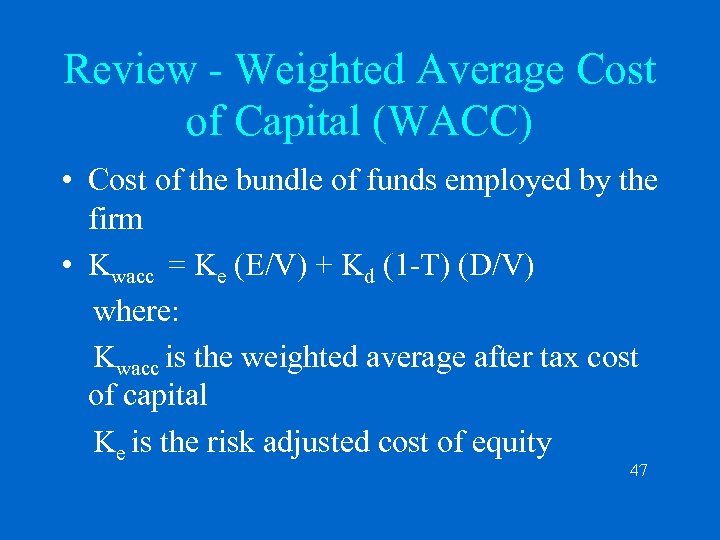 Review - Weighted Average Cost of Capital (WACC) • Cost of the bundle of funds employed by the firm • Kwacc = Ke (E/V) + Kd (1 -T) (D/V) where: Kwacc is the weighted average after tax cost of capital Ke is the risk adjusted cost of equity 47
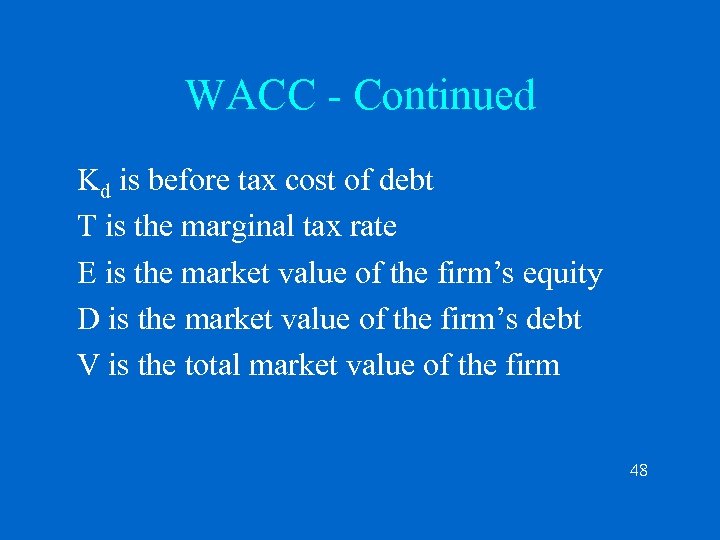 WACC - Continued Kd is before tax cost of debt T is the marginal tax rate E is the market value of the firm’s equity D is the market value of the firm’s debt V is the total market value of the firm 48
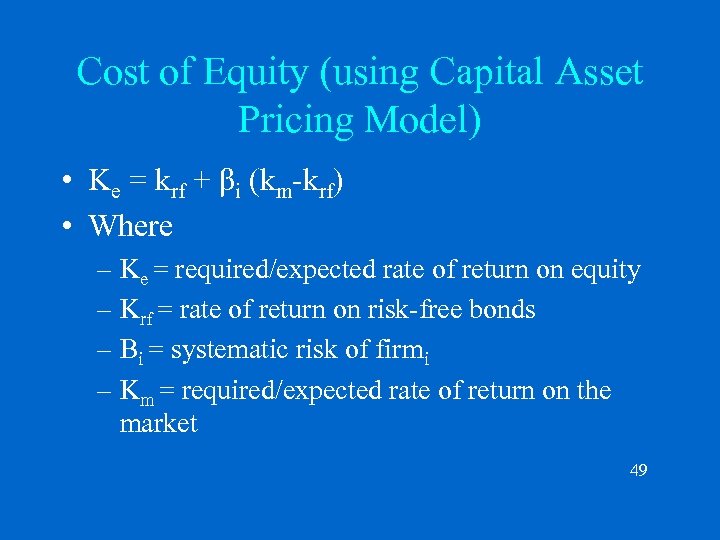 Cost of Equity (using Capital Asset Pricing Model) • Ke = krf + βi (km-krf) • Where – Ke = required/expected rate of return on equity – Krf = rate of return on risk-free bonds – Βi = systematic risk of firmi – Km = required/expected rate of return on the market 49
 Beta • B 50
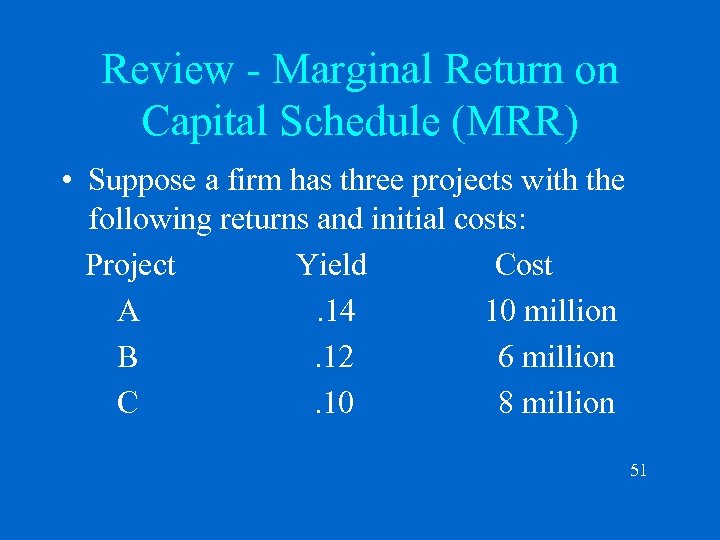 Review - Marginal Return on Capital Schedule (MRR) • Suppose a firm has three projects with the following returns and initial costs: Project Yield Cost A. 14 10 million B. 12 6 million C. 10 8 million 51
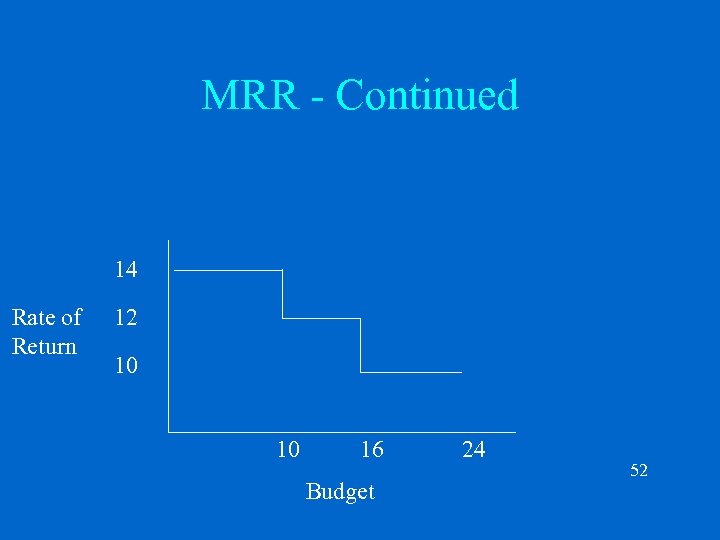 MRR - Continued 14 Rate of Return 12 10 10 16 Budget 24 52
 Improving Market Liquidity • Market liquidity: if a firm issues a new security will market price suffer and will a change in price of any if its securities elicit a big order flow • It is assumed that a firm can not raise unlimited funds without the cost of those funds increasing even if firm maintains optimal capital structure 53
 Improving Market Liquidity Continued • Key idea: if a firm is able to get international sources of capital, it should have a lower marginal cost of capital at some point at least in the short-run (see diagram on page 385). • A firm would raise funds both in international markets as well as domestic markets. 54
 Improving Market Liquidity Continued • As a result, the firm may be able to take on more projects which will add value. • These benefits may be significant for firms residing in countries with illiquid capital markets 55
 Overcoming Market Segmentation • Definition of market segmentation: Return/risk tradeoffs are different in various markets after adjusting foreign exchange risk and political risk • Likely a firm operating in a segmented market will have a higher marginal cost of capital than if it were in an integrated market 56
 Gains form Overcoming Market Segmentation • See diagram on page 385 for these gains • Markets are becoming more and more integrated so these gains are becoming less and less 57
 What Causes Market Segmentation • (1) Information barriers (language, accounting principles, quality of disclosure) - foreign investors may not have access to good information and therefore may not want to invest in a market full of these barriers • (2) Transaction costs (taxes, commissions, etc. ) if too high investors will go to other markets 58
 Causes - Continued • (3) Foreign exchange risk - if exchange rates are too volatile or if currency depreciates too much, foreigners may not want to invest there • (4) Small-country bias (volume too low for international investors, maybe an illiquid market) 59
 Causes - Continued • (5) Political Risk - fear of government intervention (example - capital controls) • (6) Regulatory barriers (excessive rules) discourage investors from investing in that market 60
 Comparing Cost of Capital for Multinationals and Domestic Firms • Read pages 393 -397. 61
 OUTLINE FOR CHAPTER 15 • Crosslisting • ADRs • Sourcing Equity Abroad 62
 Chapter 15 - Sourcing Equity Globally • Emphasis in this chapter are firms operating in less liquid or segmented markets • Often US and UK firms source overseas to fund large foreign acquisitions and not for their existing domestic or foreign operations 63
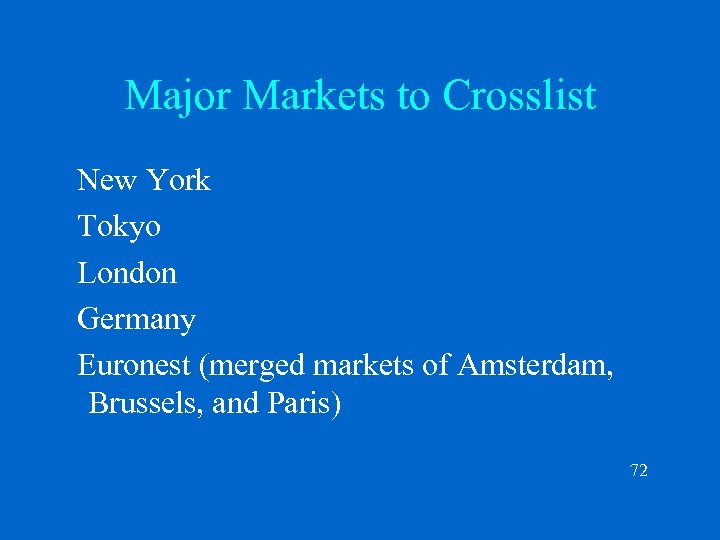
 Crosslisting • Listing your company shares on a foreign market 64
 Why Crosslist on Foreign Stock Exchanges • (1) Improve the liquidity for existing shareholders by letting them trade in their home markets and currencies • (2) Possibly have a favorable effect on share price if markets are segmented or illiquid 65
 Why Crosslisting - Continued • (3) If a company wants to issue stock in the future in a particular market may want to crosslist now. • (4) Might help if trying to acquire firms in foreign markets (if pay in stock, not cash) 66
 Why Crosslisting - Continued • (5) Increase firm’s visibility and political acceptance to customers, suppliers, creditors and local governments - if there is local ownership the firm may be more popular • (6) Create a secondary market for shares to reward employees 67
 Barriers to Crosslisting • For non-U. S. firms the disclosure requirements for the SEC are tough and continuous • May also need a continual program of investor relations 68
 ADRs • Crosslisting usually done through depositary receipts (shares). In U. S. foreign shares are usually traded as American depositary receipts (ADRs) • Negotiable certificates issued by a U. S. bank to represent foreign stock which are held in trust in foreign bank 69
 ADRs - Continued • ADRs represent some multiple of the foreign stock • ADRs sold, registered, and transferred in U. S. like any other stock • Dividends paid in U. S. dollars • Can be sponsored (created by request of foreign firm) or unsponsored (U. S. firm initiated process) 70
 ADRs - Continued • Different levels of ADRs (see page 414) – Note with level III and 144 a a firm can raise new equity capital 71
 Major Markets to Crosslist New York Tokyo London Germany Euronest (merged markets of Amsterdam, Brussels, and Paris) 72
 Sourcing New Equity Shares • Examples: (1) Sale of directed public share issue to investors in a foreign country. Would be underwritten in part by institutions in that country. 73
 Sourcing New Equity Issues Continued (2) Sale of Euro-equity issues - firm issues shares simultaneously in more than one market (could be domestic as well as foreign). Underwritten by an international syndicate. Examples include some privatizations of government owned businesses (British Telecom, British Steel, and Telefonos de Mexico)) 74
 Sourcing New Equity Issues Continued • (3) Private Placement Under SEC Rule 144 A – Sales often to insurance and investment companies 75
 OUTLINE FOR CHAPTER 16 • Explaining optimal financial structure • Understand some of the principles involved in sourcing debt overseas – General guidelines for issuing debt – Cost of foreign debt – International debt markets 76
 Chapter 16 – Financial Structure and International Debt • Chapter discusses: • (1) Optimal Financial Structure (2) Guidelines for issuing debt (3) Overview of some international debt markets 77
 Optimal Financial Structure • Generally argued that a moderate amount of debt is good (tax advantage) but too much debt is bad (bankruptcy risk) • Also WACC is effectively minimized over a range of debt (say 30% -60%) and not at some precise amount say 44 % 78
 Optimal Financial Structure for Multinationals • From Chapter 11, one big advantage for U. S. multinationals or large non-U. S. multinationals is that they are able to raise “lots” of capital without the cost of these funds increasing much • This is not the case for small domestic firms and most multinationals operating in small or illiquid markets 79
 Financial Risk Reduction through International Diversification • Possible to argue that multinationals can have more debt because their cash flows are more diversified and hence less bankruptcy risk • In reality, multinationals have less debt than comparable domestic firms after adjusting for size 80
 Financial Structure for Foreign Affiliates • Goal for firm: minimize WACC for entire firm, not for each affiliate • Note when discussing debt for a subsidiary what is relevant is debt borrowed from sources outside of the multinational firm (not debt from the parent or sister affiliate. Also hard to distinguish between debt and equity from the parent) 81
 Advantages to Conforming to Local D/E Ratios • Reduce criticism from local Government officials or from others (for example, too much debt or too little debt) • Easier to evaluate firm with local competitors when all firms have same capital structure 82
 Disadvantage of Conforming to Local D/E Ratios • Multinational should exploit its advantages (one of them is its ability perhaps to have a lower cost of capital). If multinational tries to localize its cost of capital for each subsidiary, it may result in losing one of its key advantages 83
 Conclusion - Local D/E Ratios • The firm should strive to have the lowest overall cost of capital for the firm as a whole • If there is no penalty for conforming to local norms, then the firm should try and do so 84
 Guidelines for Issuing Debt • Maturity Matching – Firm divides its assets in three categories - (1) fixed assets, (2) permanent current assets (the minimum amount of current assets the firm has), and (3) temporary current assets (total current assets - permanent current assets) – In theory, could finance all fixed assets and permanent current assets with long-term debt and equity and temporary current assets with short-term debt (see diagram) 85
 Maturity Matching - Continued – In general, short-term financing is cheaper (rates are generally cheaper and also firm does not have to pay interest when funds are not needed) – However, short-term financing is riskier (interest rate risk) – So firm may deviate from maturity matching depending on its return/risk tradeoffs (a conservative firm might use relatively more long-term financing) 86
 Guidelines - Continued • Currency Matching - match by cash flows not denomination of assets – For example if the firm has a lot of cash flows in Euros then might consider borrowing in Euros 87
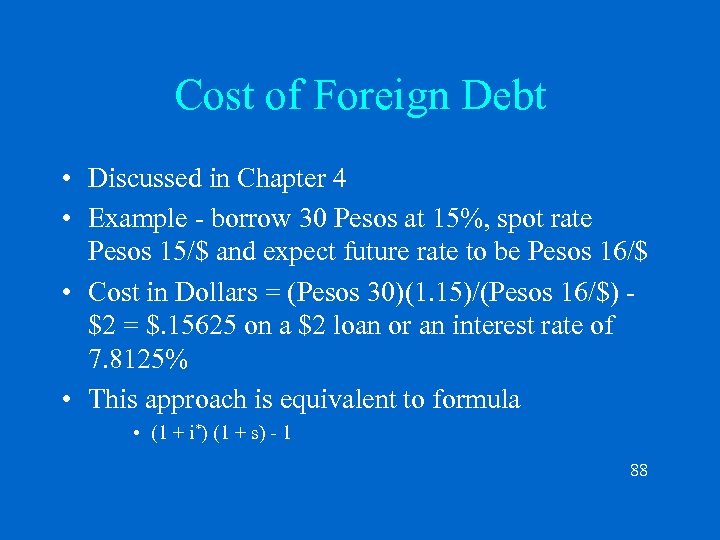 Cost of Foreign Debt • Discussed in Chapter 4 • Example - borrow 30 Pesos at 15%, spot rate Pesos 15/$ and expect future rate to be Pesos 16/$ • Cost in Dollars = (Pesos 30)(1. 15)/(Pesos 16/$) $2 = $. 15625 on a $2 loan or an interest rate of 7. 8125% • This approach is equivalent to formula • (1 + i*) (1 + s) - 1 88
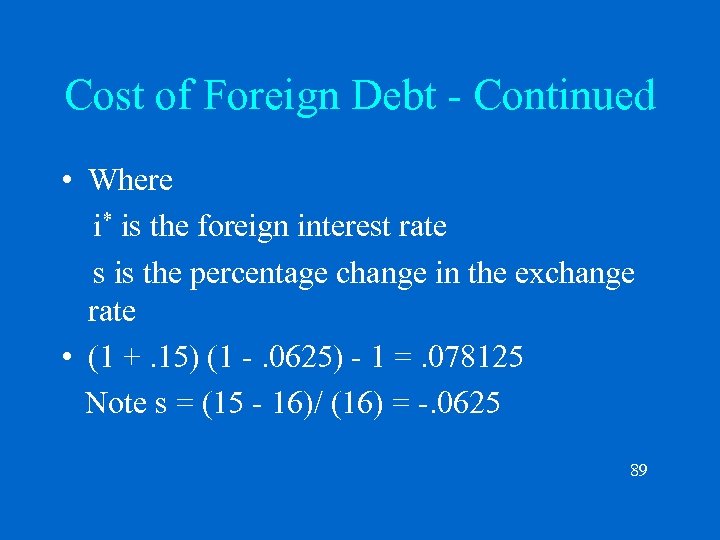 Cost of Foreign Debt - Continued • Where i* is the foreign interest rate s is the percentage change in the exchange rate • (1 +. 15) (1 -. 0625) - 1 =. 078125 Note s = (15 - 16)/ (16) = -. 0625 89
 Cost of Foreign Debt - Continued • Interest payments are tax deductible in the U. S. • Cost of debt after tax = kd (1 -T) Where kd is the before tax cost of debt T is the marginal tax rate for the firm 90
 Digression - Eurocurrency or Eurodollar Market • A Eurodollar is a U. S. $ deposited in an interest bearing deposit in a bank outside of the U. S. (foreign bank, overseas branch of a U. S. bank, or an “offshore” entity called an International Banking Facility) • Same idea for Euroyen 91
 Eurocurrency Market - Continued • Good market to deposit excess funds and also borrow funds. The market can do this because it is a wholesale market, no reserve requirements, and no FDIC (Federal Deposit Insurance Corporation) fees. Hence the spread (difference between borrowing and deposit rates) is often less than 1%, which is smaller than most domestic markets 92
 Eurocurrency Market - Continued • The market originally started with Eastern European countries with dollars wanting to deposit them outside the control of the U. S. government • Also U. K. authorities worried about the weakening of the pound in 1957 imposed controls of U. K. banks lending pounds to non-residents, so U. K. banks started loaning dollars 93 • Now a source and use of dollars
 International Debt Markets • Three major sources – Bank Loans and syndicated credits – Euronote market – International bond market • Purpose of this section is to give an overview of these markets and not to provide all of the facts about each of the markets • Please read for more detail pages 418 -423 94
 Bank Loans and Syndicated Credits • Eurocredits - Bank loans denominated in Eurocurrencies and given by banks in countries other than the country in which the loan is denominated (if the loan is in Yen the loan is not given in Japan) • Syndicated credits - Lending banks form a syndicate to diversify risk because size of loans is usually large 95
 Eurocredits - Continued • Borrowing rate based on LIBOR (London Interbank Offered Rate) which is the deposit rate on interbank loans • Borrower pays LIBOR + individual premium • Loans have short and medium-term maturities • Usually fixed term and no provision for early repayment 96
 Euronote Market • Important examples: Euronotes - short-term, negotiable, promissory, underwritten notes Euro-Commercial Paper – short-term debt obligation of a firm or bank Euro-Medium-Term Notes - mostly nonunderwritten and it is like a bond 97
 International Bond Market • Two main types: Eurobonds Foreign bonds 98
 Eurobonds • Underwritten by an international syndicate • Sold in countries other than the country in which the issue is denominated (example, English borrower, denominated in pounds, and sold everywhere but U. K. ) • Bearer form (name and country of residence of the owner not on coupon) • Call provisions and sinking funds 99
 Advantages of Eurobond Market • (1) Less regulatory interference (governments would impose less stringent requirements on bonds denominated in another currency) • (2) Less stringent disclosure requirements than SEC (less of a factor for private placements – Rule #144 A) 100
 Advantages - Continued • (3) Possible tax advantages - no withholding taxes and since bonds are in bearer form may result in tax avoidance 101
 Foreign Bonds • Underwritten by syndicate composed of members from one country • Sold within that country • Denominated in that currency • Example: U. S. firm issues bond in pounds in U. K. and underwritten by a British syndicate 102