 Скачать презентацию Outline Brief of Ga West s 5 -year
1bf74d3b0df69474436bfce8f08290ee.ppt
- Количество слайдов: 11



Outline: • Brief of Ga West’s 5 -year Compound Sanitation Strategy • HFC Boafo’s micro-finance loan products • Findings from sanitation financing interviews
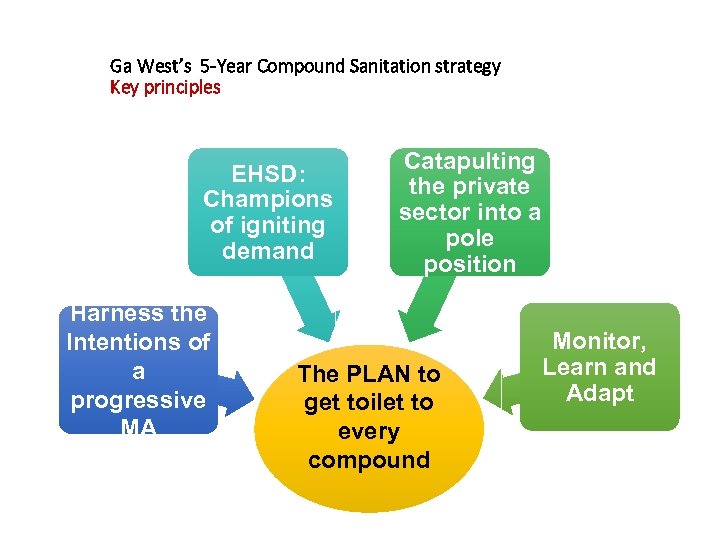
Ga West’s 5 -Year Compound Sanitation strategy Key principles EHSD: Champions of igniting demand Harness the Intentions of a progressive MA Catapulting the private sector into a pole position The PLAN to get toilet to every compound Monitor, Learn and Adapt
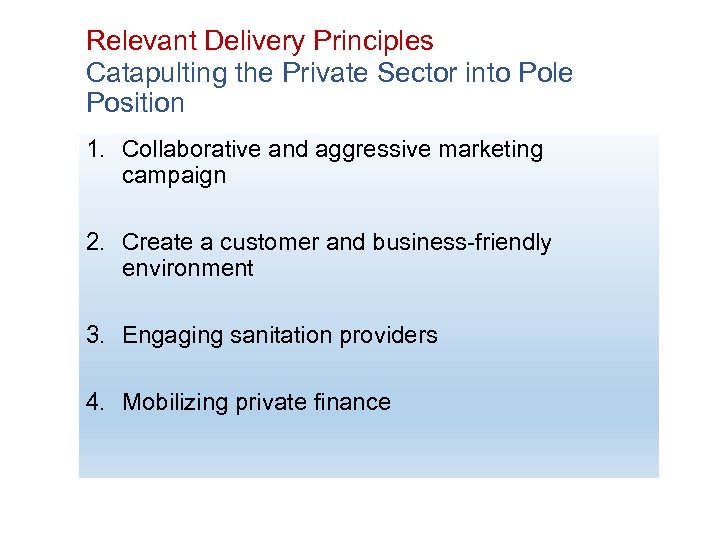
Relevant Delivery Principles Catapulting the Private Sector into Pole Position 1. Collaborative and aggressive marketing campaign 2. Create a customer and business-friendly environment 3. Engaging sanitation providers 4. Mobilizing private finance
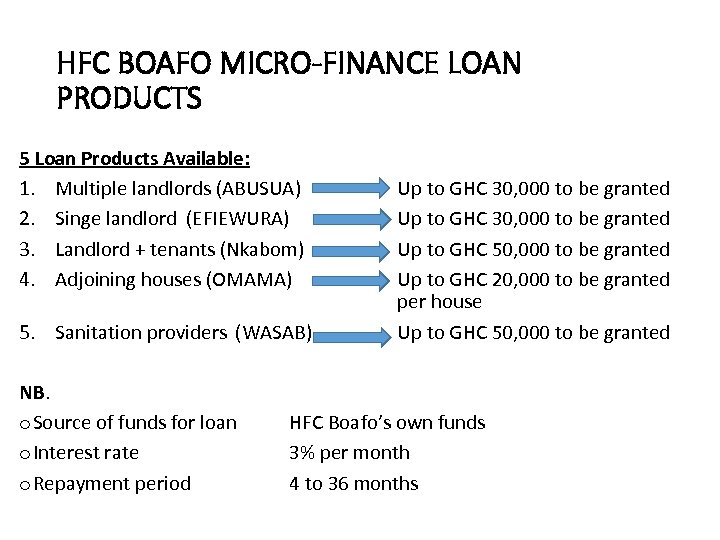
HFC BOAFO MICRO-FINANCE LOAN PRODUCTS 5 Loan Products Available: 1. Multiple landlords (ABUSUA) 2. Singe landlord (EFIEWURA) 3. Landlord + tenants (Nkabom) 4. Adjoining houses (OMAMA) 5. Sanitation providers (WASAB) NB. o. Source of funds for loan o. Interest rate o. Repayment period Up to GHC 30, 000 to be granted Up to GHC 50, 000 to be granted Up to GHC 20, 000 to be granted per house Up to GHC 50, 000 to be granted HFC Boafo’s own funds 3% per month 4 to 36 months
Key results of sanitation financing interviews conducted by PATH – 8 Interviews: • Microfinance Institutions (MFIs) (2) • Banks (2) • Government (1) o. Greater Accra Metropolitan Area (GAMA) Sanitation and Water Project (World Bank funded) • NGOs (2) o. YSEF, Slum Dwellers International • Clean Team (1) • Goal: Gain understanding of role, operations, potential involvement of finance organizations in Ghana.
Ghana: Macroeconomic instability and credit contraction • Financing requirement of the government is effectively vacuuming credit and liquidity out of the private sector. o o • Inflation: non-food rate 23%. Government of Ghana 180 -day Treasury bonds yield 26%. All banks/MFIs noted three strategic initiatives: o o o Reduce loans. Buy Treasury bonds. Increase deposits. “Loan recoveries are a problem. We are buying government bonds” - Bank “Approved loan clients are down 25% in the last three months” - MFI
Ghana: Macroeconomic instability and credit contraction • $1 bn International Monetary Fund rescue loan tied to a structural adjustment program. o Stabilization to be a painful multi-year process through at least 2017. • Credit is very expensive: o Commercial loans >30% o MFIs 40%-60% Overall effect: Private-sector financing is restricted.
Reliance on concessionary international capital • • Major sanitation finance projects in Ghana 100% grant funded Revolving loan demonstration project could pave new approach o Possible to Profitable (P 2 P) project § Dutch Ministry of Foreign Affairs, SNV, and Fidelity Bank § € 2 M grant (project administration), € 4 M revolving fund; target 3000+ households and 500+ MSMEs o Opportunity International (UK) and Sinapi Aba § Department for International Development, Opportunity International, and Sinapi Aba MFI-cum-bank § Pending funding, broadly similar to SNV-Fidelity Bank project GAMA Sanitation and Water Project § World Bank and municipal government of Accra § $34/150 M for sanitation, 5 -year grant project; target 50, 000 HH toilets o • Near-term opportunities with World Bank project
Key Takeaways o o o Severe credit contraction eliminates most financing options. Notable Sanitation Financing pilots in Ghana depend on grant capital. Low-hanging fruit opportunity with World Bank project in Accra. Challenging access to low-cost capital for MFIs: ü Identify and connect with social ventures/donors to provide seed capital for revolving funds ü Lower cost capital = lower interest rates charged while remaining profitable to MFI partner. ü Lower interest rates = greater loan ‘affordability’ and potential beneficiary reach. o
There are opportunities to: partner with well-capitalized Sanitation Financing projects such as SNV-Fidelity to extend and enhance their impact; and o collaborate with World Bank GAMA PCU project in Accra. o

THANK YOU
Скачать презентацию Outline Brief of Ga West s 5 -year
1bf74d3b0df69474436bfce8f08290ee.ppt