


 Скачать презентацию OUTLET SELECTION z Consumer shopping choices z Electronic
e6ecc3ee5f6e6315d42752e0073011fe.ppt
- Количество слайдов: 34
 OUTLET SELECTION z Consumer shopping choices z Electronic Commerce (covered later) z Store marketing issues z Dealing with complaints MKTG 371 OUTLET SELECTION Lars Perner, Instructor 1
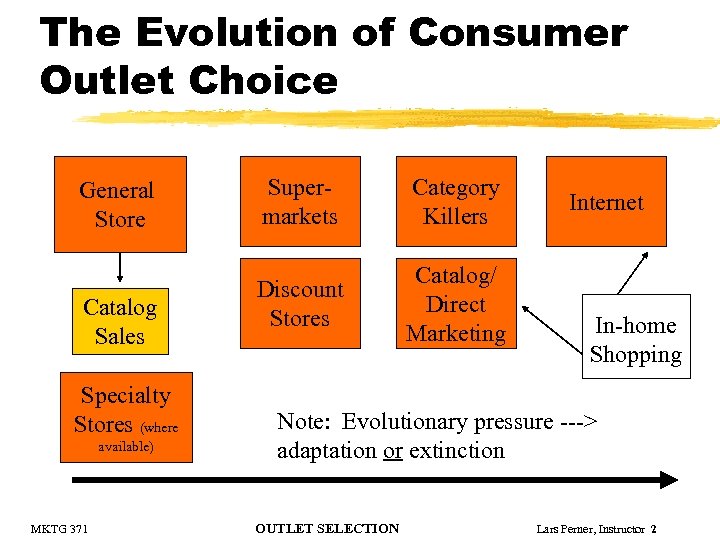 The Evolution of Consumer Outlet Choice General Store Catalog Sales Specialty Stores (where available) MKTG 371 Supermarkets Category Killers Discount Stores Catalog/ Direct Marketing Internet In-home Shopping Note: Evolutionary pressure ---> adaptation or extinction OUTLET SELECTION Lars Perner, Instructor 2
 Issues in Outlet Marketing z Store positioning yrelevant competition ystore image z Store location/size z Store brands z In-store marketing y. P-O-P displays x. Featured promoted brand x. Store brand MKTG 371 OUTLET SELECTION Lars Perner, Instructor 3
 Store Layout/Atmosphere z Location of merchandise z Music/aroma MKTG 371 OUTLET SELECTION Lars Perner, Instructor 4
 Retailing z Positioning issues z Margins z Retail pricing strategies z Strategic developments in retailing MKTG 371 OUTLET SELECTION Lars Perner, Instructor 5
 Positioning Issues z Some ways to profitability: y. Low cost, high volumes, low unit margins, low to moderate service (profit on volume) y. Higher priced, higher per unit margins, lower sales z “Stuck in the Middle”--midlevel retailers (e. g. , Sears, J. C. Penney) face competition both from above and below MKTG 371 OUTLET SELECTION Lars Perner, Instructor 6
 Attributes Influencing Retail Outlet Selection z. Outlet image z. Retailer (store) brands y. U. S. vs. Europe z. Retail advertising y. For store y. Co-op, brand supported store ads z. Location z. Size MKTG 371 OUTLET SELECTION Lars Perner, Instructor 7
 Consumer Shopping Orientations--Segments z Chameleons—constantly changing strategies z Collectors/gatherers— stockpilers z Foragers—focused on desired items MKTG 371 z Hibernants—indifferent and opportunistic; will postpone shopping z Predators—shoppers who dislike shoppers but plan ahead to minimize time spent z Scavengers—”recreational shopping” OUTLET SELECTION Lars Perner, Instructor 8
 Influences on Shopping Behavior z Point-of-purchase (POP) shoppers z Promotions y. In-store coupons y. Sales y. Other deals z Stockouts y. Major problem y. Difficult to avoid y. Technology can help predict sales z Sales personnel z Outlet atmosphere MKTG 371 OUTLET SELECTION Lars Perner, Instructor 9
 Margins z Margins y. Gross = sale price paid to wholesaler x. Per unit x. Per dollar x. Per unit of space z Very large increases in sales volumes are needed to “break even” on low prices y. Net margin = gross margin vs. allocated overhead MKTG 371 OUTLET SELECTION Lars Perner, Instructor 10
 Two Types of Retail Pricing z “High-low” y. High everyday prices y. Frequent sales y. Profit on price discrimination--only some people will bother to z Every Day Low Price (EDLP) x. Shop while sale is on x. Switch brands MKTG 371 OUTLET SELECTION y. Consistent prices-theoretically no sales, but lower non-sale prices y. Typically lower service y. Note that retailers provide for many promotions Lars Perner, Instructor 11
 Strategic Issues z Importance of convenience z Increasing power of retailers z Private label branding y. Lower price but higher margins y. Longer history in Europe MKTG 371 OUTLET SELECTION Lars Perner, Instructor 12
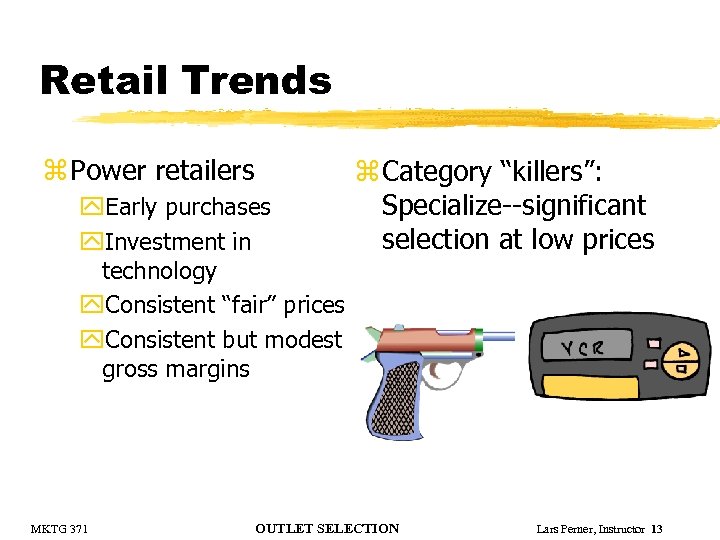 Retail Trends z Power retailers y. Early purchases y. Investment in technology y. Consistent “fair” prices y. Consistent but modest gross margins MKTG 371 z Category “killers”: Specialize--significant selection at low prices OUTLET SELECTION Lars Perner, Instructor 13
 Retailing Polarity z Trend toward either y. Low price--e. g. , Wal. Mark, Kmart, Sports Authority y. High quality--e. g. , Nordstrom’s, Starbuck’s MKTG 371 OUTLET SELECTION Lars Perner, Instructor 14
 Electronic Commerce z Penetration vs. potential z Obstacles y. Security y. Trial y. Delayed delivery y. Limited demographics y. Glitches y. Resentment of commercial intrusions MKTG 371 OUTLET SELECTION Lars Perner, Instructor 15
 SERVICE OUTPUTS AND SEGMENTATION z Service outputs z Trends z Segmentation MKTG 371 OUTLET SELECTION Lars Perner, Instructor 16
 SERVICE OUTPUTS: DISTRIBUTION FROM THE CUSTOMER’S POINT OF VIEW z Bulk breaking z Spatial convenience z Waiting and delivery time z Breadth of assortment MKTG 371 OUTLET SELECTION Lars Perner, Instructor 17
 Trends in Consumer Preferences z Poverty of time (in U. S. ) z Increased knowledge y. Travel y. Information sources z Polarity of incomes y. Some increase in top incomes in U. S. y. Incomes slowly equalizing Worldwide MKTG 371 OUTLET SELECTION Lars Perner, Instructor 18
 Example: Food Customers z Resellers--restaurants buy from suppliers z Institutional--hospitals buy to feed patients z Families y“Nuclear”--may buy from regular food stores; will favor large sizes MKTG 371 OUTLET SELECTION y. Small families, singles, and yuppies--will shop more in convenience store; single serving sizes more popular y. Value conscious--buy at warehouses y. Time conscious--will pay extra for delivery y. Service conscious-other services demanded Lars Perner, Instructor 19
 FOOD CONSUMPTION, MANUFACTURING, AND MARKETING z Food consumption patterns z Demographics and trends z International comparisons z Issues in food markets z Food marketing choices MKTG 371 OUTLET SELECTION Lars Perner, Instructor 20
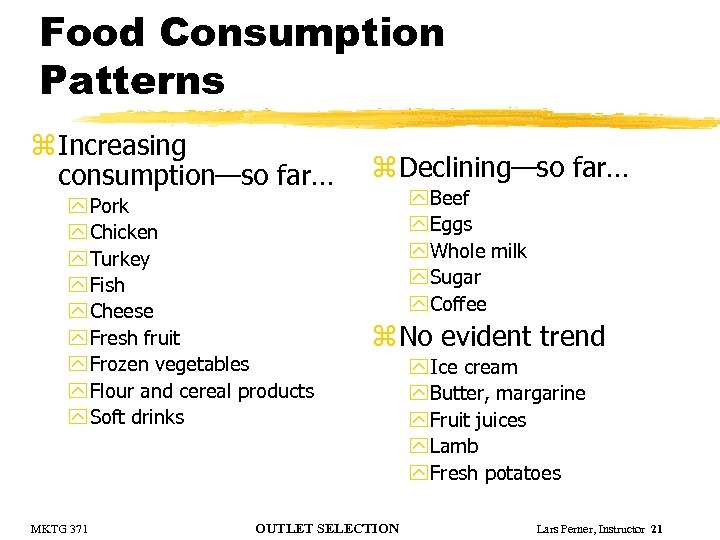 Food Consumption Patterns z Increasing consumption—so far… y Pork y Chicken y Turkey y Fish y Cheese y Fresh fruit y Frozen vegetables y Flour and cereal products y Soft drinks MKTG 371 z Declining—so far… y Beef y Eggs y Whole milk y Sugar y Coffee z No evident trend OUTLET SELECTION y Ice cream y Butter, margarine y Fruit juices y Lamb y Fresh potatoes Lars Perner, Instructor 21
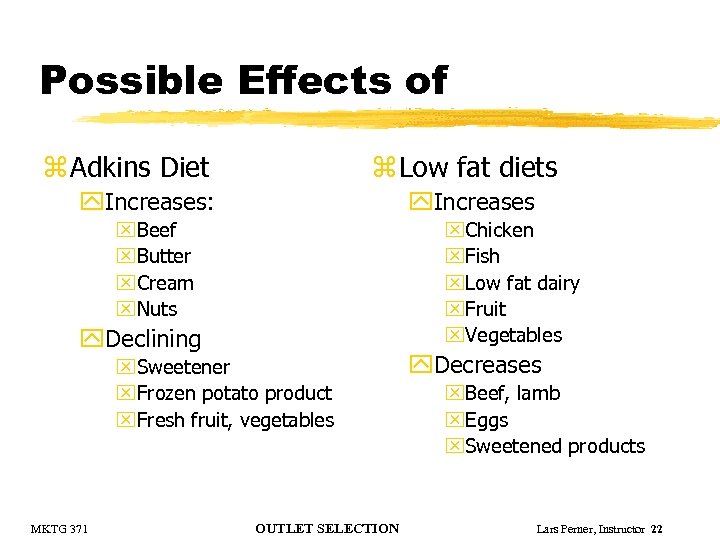 Possible Effects of z Adkins Diet z Low fat diets y. Increases: y. Increases x. Beef x. Butter x. Cream x. Nuts x. Chicken x. Fish x. Low fat dairy x. Fruit x. Vegetables y. Declining x. Sweetener x. Frozen potato product x. Fresh fruit, vegetables MKTG 371 OUTLET SELECTION y. Decreases x. Beef, lamb x. Eggs x. Sweetened products Lars Perner, Instructor 22
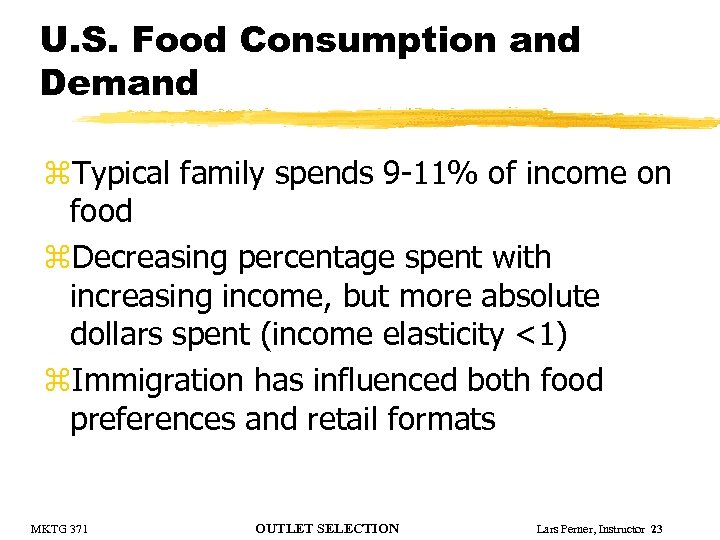 U. S. Food Consumption and Demand z. Typical family spends 9 -11% of income on food z. Decreasing percentage spent with increasing income, but more absolute dollars spent (income elasticity <1) z. Immigration has influenced both food preferences and retail formats MKTG 371 OUTLET SELECTION Lars Perner, Instructor 23
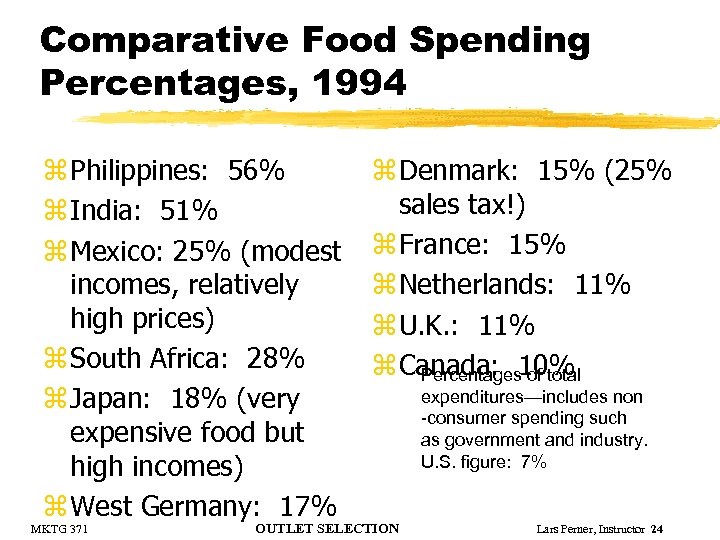 Comparative Food Spending Percentages, 1994 z Philippines: 56% z India: 51% z Mexico: 25% (modest incomes, relatively high prices) z South Africa: 28% z Japan: 18% (very expensive food but high incomes) z West Germany: 17% MKTG 371 z Denmark: 15% (25% sales tax!) z France: 15% z Netherlands: 11% z U. K. : 11% z Canada: 10% Percentages of total OUTLET SELECTION expenditures—includes non -consumer spending such as government and industry. U. S. figure: 7% Lars Perner, Instructor 24
 Some Common U. S. Food Outlets z Supermarkets z Neighborhood food stores z Convenience stores z Drug and discount stores z Gas stations z Vending machines z Food stands, street vendors MKTG 371 z Restaurants z Cafeterias z Specialty food stores z Door-to-door sales z Online and catalog orders OUTLET SELECTION Lars Perner, Instructor 25
 Some International Characteristics z. Japan: Strong emphasis on neighborhood stores, vending machines z. Europe: Large food stores are available, some may deliver; government protection of smaller retailers z. Developing countries: Food often bought at open markets MKTG 371 OUTLET SELECTION Lars Perner, Instructor 26
 Some Food Demand Issues z Income elasticity z Price elasticity y. Normal vs. “inferior” goods MKTG 371 z Cross-price elasticity z “Trading Up” within select categories z Increased interest in convenience foods z Conflict between demand for healthier and “junk” foods z Unplanned purchases and consumption OUTLET SELECTION“Functional” foods Instructor 27 Lars Perner, z
 Away-From-Home and Prepared Foods z 48% of food expenditures on items eaten away from home (1999) z. Large part of restaurant meals is for nonfood costs y. Labor y. Ambiance y. Facilities z. Increase in take-out foods from restaurants and stores MKTG 371 OUTLET SELECTION Lars Perner, Instructor 28
 Public Food Programs z Food stamps were created mostly to promote demand for farm products (thus only American products) z Only a limited amount of food stamp value goes toward increased consumption (cash is diverted elsewhere) MKTG 371 OUTLET SELECTION Lars Perner, Instructor 29
 Some Food Marketing Issues z. Branding z. Innovation y. Brand extensions and improvements to existing product categories y. New product categories z. Consumer brand loyalty: The ability to resist promotional efforts of competitors— not consistent choice of brand z. Multi-brand loyalty MKTG 371 OUTLET SELECTION Lars Perner, Instructor 30
 POST PURCHASE PROCESSES z. Satisfaction z. Customer commitment z. Word-of-mouth MKTG 371 OUTLET SELECTION Lars Perner, Instructor 31
 Post Purchase Dissonance z Regret of purchase or z Influences on question of wisdom of magnitude purchase y. Degree of irrevocability /reversal “dissonance reduction of decision (trialability) strategies” y. Return product y. Rationalization z Consumption guilt MKTG 371 OUTLET SELECTION y. Importance of decision y. Difficulty of choice y. Anxiety proneness of consumer Lars Perner, Instructor 32
 Product Use and Non-Use z Products bought and y. Used as intended y. Stored y. Not-used y. Used for purposes other than intended (use innovativeness) x. E. g. , baking soda for odor reduction, upset stomach x. E. g. , WD 40: fish bait additive, removal of gum, enhanced conduction of electricity, shining of boots MKTG 371 OUTLET SELECTION Lars Perner, Instructor 33
 Disposition z. Disposal y. Garbage y. Recycling z. Sale ye. Bay: Very old products for sale—e. g. , 1980 s typewriters, CB radios z. Donation/gifting MKTG 371 OUTLET SELECTION Lars Perner, Instructor 34