


 Скачать презентацию Outgassing Test and the Getter Specification Dean Walters
783956dfb96fd1b6067eca23d8bb8b85.ppt
- Количество слайдов: 17
 Outgassing Test and the Getter Specification Dean Walters Nuclear Engineering Division Argonne National Laboratory
 Gettering and Outgassing n n n System Requirements Gettering Technology Design layout Test setup Status Future Work 2
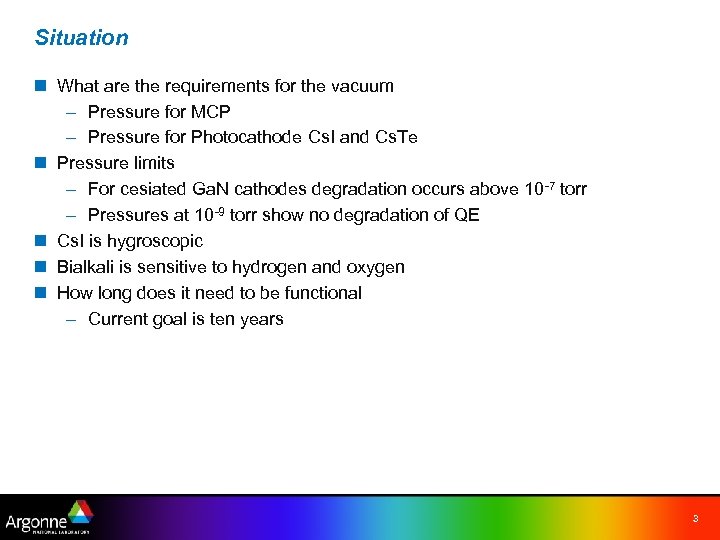 Situation n What are the requirements for the vacuum – Pressure for MCP – Pressure for Photocathode Cs. I and Cs. Te n Pressure limits – For cesiated Ga. N cathodes degradation occurs above 10 -7 torr – Pressures at 10 -9 torr show no degradation of QE n Cs. I is hygroscopic n Bialkali is sensitive to hydrogen and oxygen n How long does it need to be functional – Current goal is ten years 3
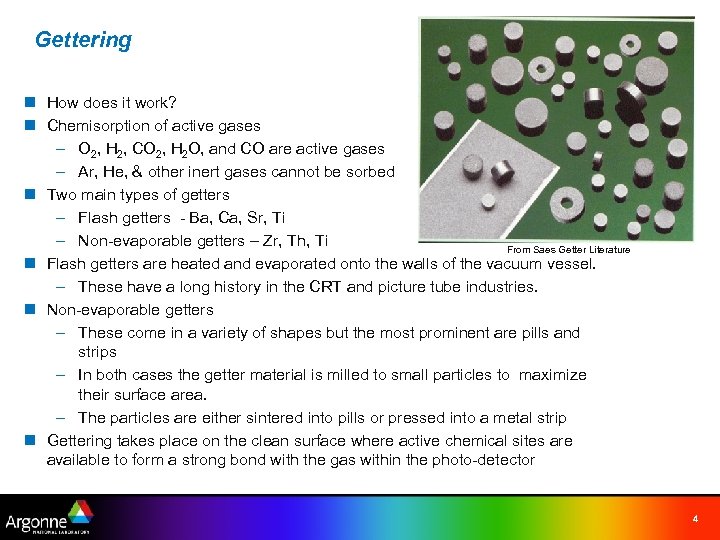 Gettering n How does it work? n Chemisorption of active gases – O 2, H 2, CO 2, H 2 O, and CO are active gases – Ar, He, & other inert gases cannot be sorbed n Two main types of getters – Flash getters - Ba, Ca, Sr, Ti – Non-evaporable getters – Zr, Th, Ti From Saes Getter Literature n Flash getters are heated and evaporated onto the walls of the vacuum vessel. – These have a long history in the CRT and picture tube industries. n Non-evaporable getters – These come in a variety of shapes but the most prominent are pills and strips – In both cases the getter material is milled to small particles to maximize their surface area. – The particles are either sintered into pills or pressed into a metal strip n Gettering takes place on the clean surface where active chemical sites are available to form a strong bond with the gas within the photo-detector 4
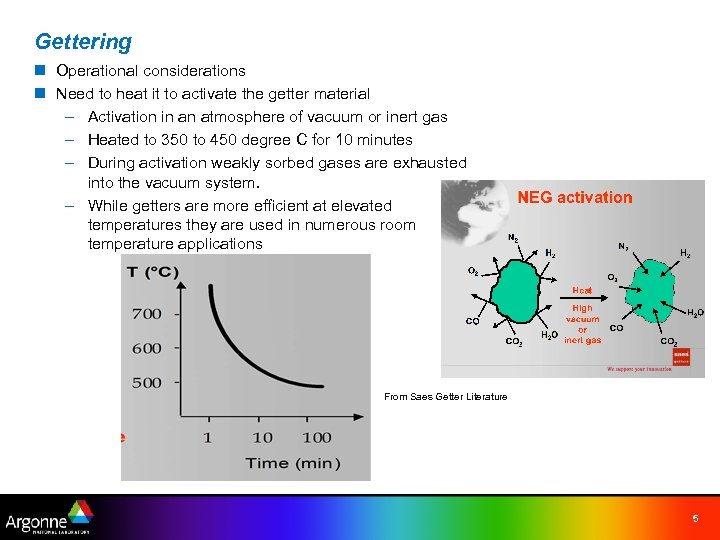 Gettering n Operational considerations n Need to heat it to activate the getter material – Activation in an atmosphere of vacuum or inert gas – Heated to 350 to 450 degree C for 10 minutes – During activation weakly sorbed gases are exhausted into the vacuum system. – While getters are more efficient at elevated temperatures they are used in numerous room temperature applications From Saes Getter Literature 5
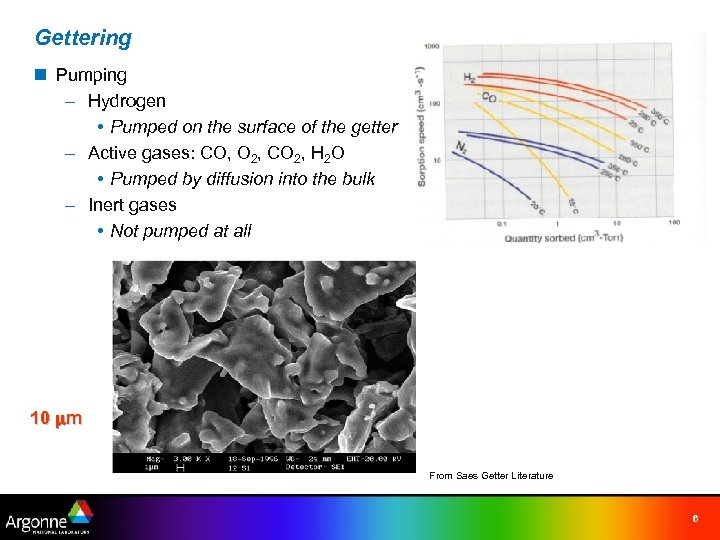 Gettering n Pumping – Hydrogen • Pumped on the surface of the getter – Active gases: CO, O 2, CO 2, H 2 O • Pumped by diffusion into the bulk – Inert gases • Not pumped at all 10 m From Saes Getter Literature 6
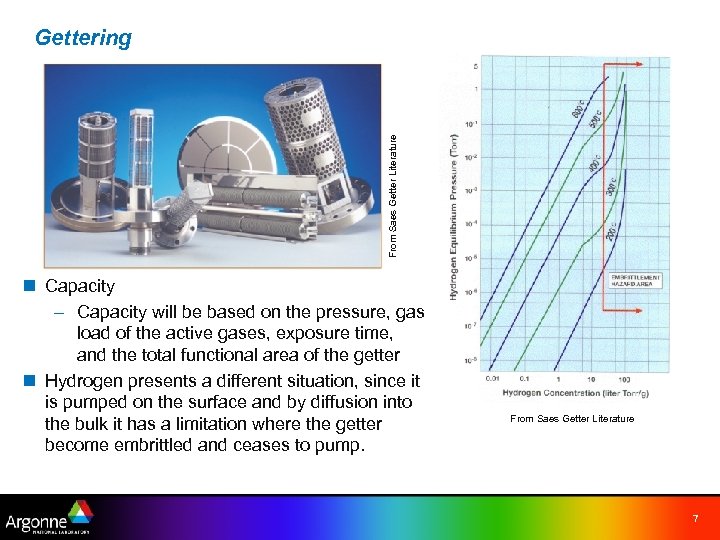 From Saes Getter Literature Gettering n Capacity – Capacity will be based on the pressure, gas load of the active gases, exposure time, and the total functional area of the getter n Hydrogen presents a different situation, since it is pumped on the surface and by diffusion into the bulk it has a limitation where the getter become embrittled and ceases to pump. From Saes Getter Literature 7
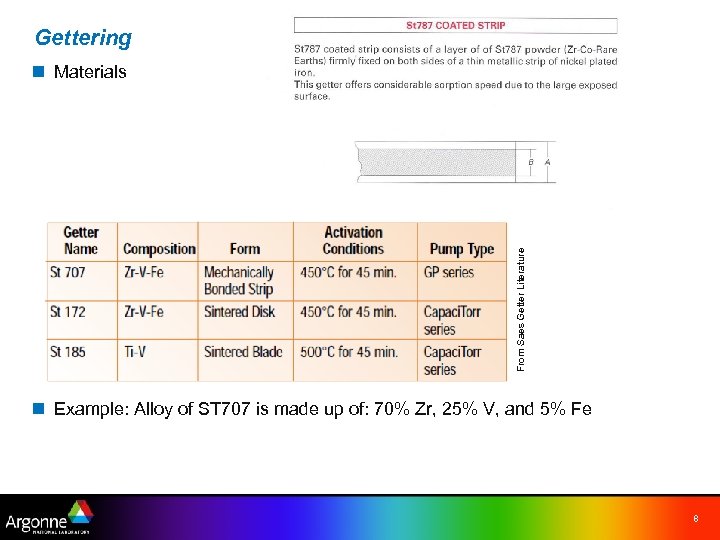 Gettering From Saes Getter Literature n Materials n Example: Alloy of ST 707 is made up of: 70% Zr, 25% V, and 5% Fe 8
 Materials From Saes Getter Literature 9
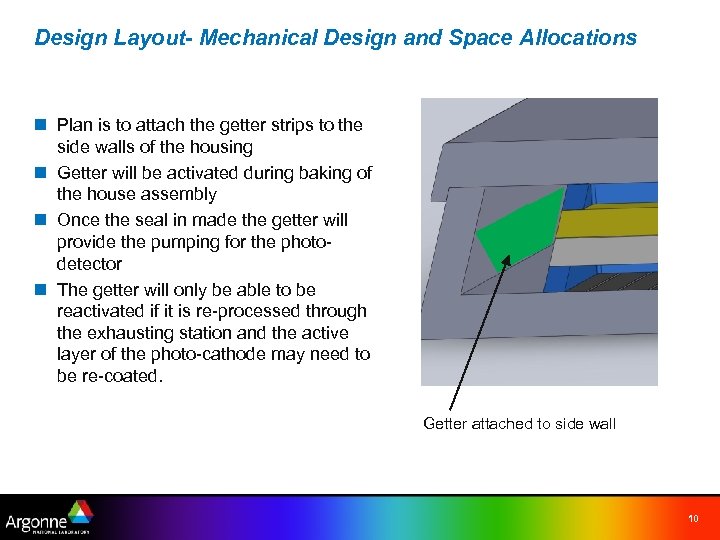 Design Layout- Mechanical Design and Space Allocations n Plan is to attach the getter strips to the side walls of the housing n Getter will be activated during baking of the house assembly n Once the seal in made the getter will provide the pumping for the photodetector n The getter will only be able to be reactivated if it is re-processed through the exhausting station and the active layer of the photo-cathode may need to be re-coated. Getter attached to side wall 10
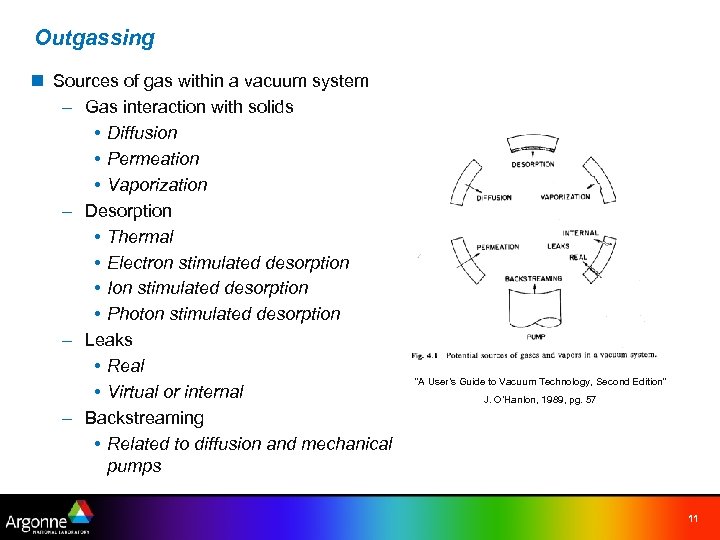 Outgassing n Sources of gas within a vacuum system – Gas interaction with solids • Diffusion • Permeation • Vaporization – Desorption • Thermal • Electron stimulated desorption • Ion stimulated desorption • Photon stimulated desorption – Leaks • Real • Virtual or internal – Backstreaming • Related to diffusion and mechanical pumps “A User’s Guide to Vacuum Technology, Second Edition” J. O’Hanlon, 1989, pg. 57 11
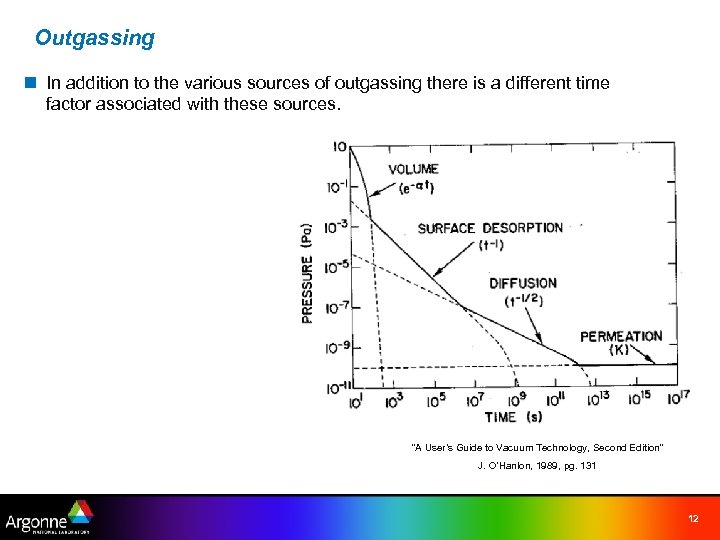 Outgassing n In addition to the various sources of outgassing there is a different time factor associated with these sources. “A User’s Guide to Vacuum Technology, Second Edition” J. O’Hanlon, 1989, pg. 131 12
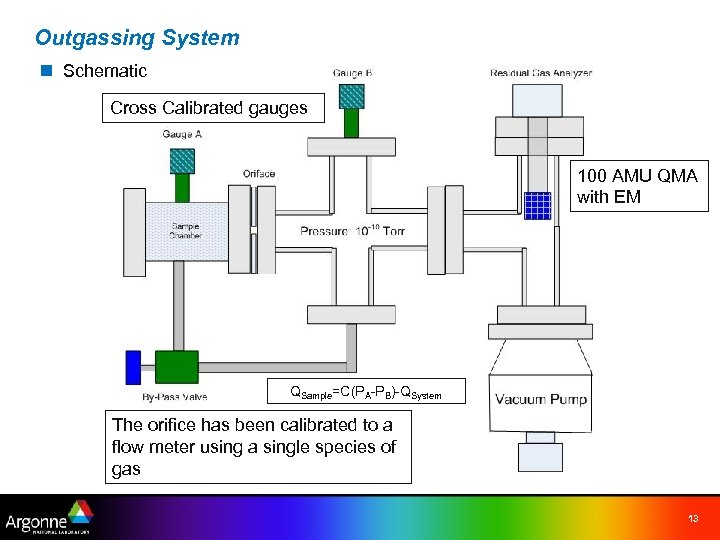 Outgassing System n Schematic Cross Calibrated gauges 100 AMU QMA with EM QSample=C(PA-PB)-QSystem The orifice has been calibrated to a flow meter using a single species of gas 13
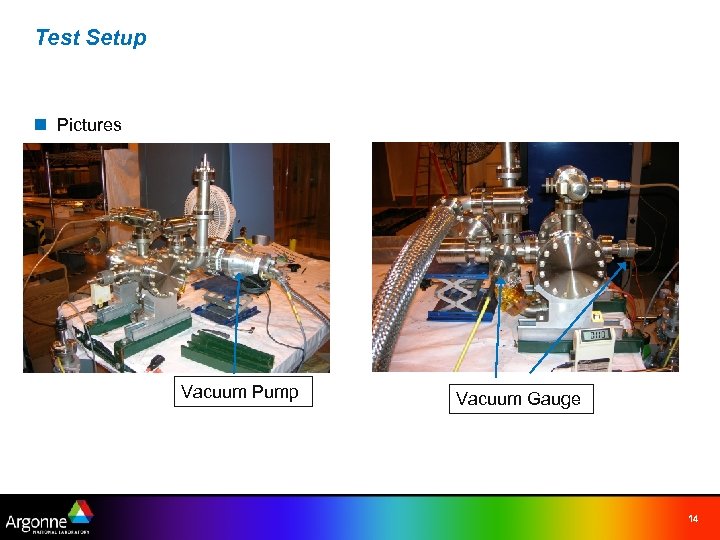 Test Setup n Pictures Vacuum Pump Vacuum Gauge 14
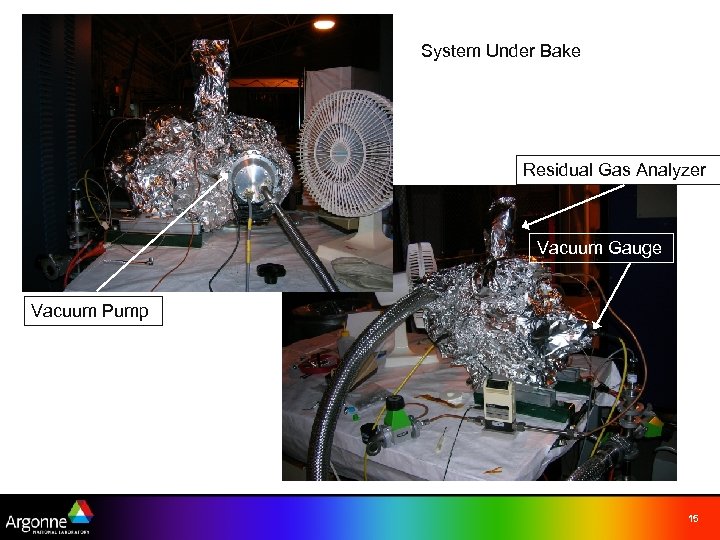 System Under Bake Residual Gas Analyzer Vacuum Gauge Vacuum Pump 15
 Status n Status – First bakeout was halted after 5 days due to limitations of temperature. • Max Temperature 275 C • After cool down the base pressure was high, 1 x 10 -7 Torr. • Orientation of components with insufficient heat lead to cold spots that limited base pressure. • Small leak found in system. – Heating issues resolved and the system is able to reach 400 C – Pressures are improving with the reorientation of the valves and the heater tapes. – Both helium leak detection and the RGA have shown the system to be free of leaks. n Plan – Outgassing system continues bake 16
 Future Activities n Going Forward – By measuring the outgassing rate and identifying the species of the residual gas evolving from the parts will aid in the estimation of the gas load that the getters will pump. – Will be able to experiment with different temperatures to determine the best bake out temperature. – Will be able to perform trials on some of the proposed processes. • Like Indium sealing and examples of glass frit joints. – A note of appreciation to Bob Garcia from Saes Getters for his assistance on this talk. 17