


 Скачать презентацию Outcomes in the Long Run Ingredients for Children s
809572295bb875f4cf07dcc487eecbf3.ppt
- Количество слайдов: 27
 Outcomes in the Long Run: Ingredients for Children’s Protection and Welfare Outcomes Programs (the good, the bad, and the ugly) John D. Fluke, Ph. D. Director Child Protection Research Center American Humane Association The Second Canadian Roundtable on Child Welfare Outcomes Center for Research on Children and Families, Centres of Excellence for Children’s Well-Being: Child Welfare, Montreal, Canada 8 – 9 October, 2009
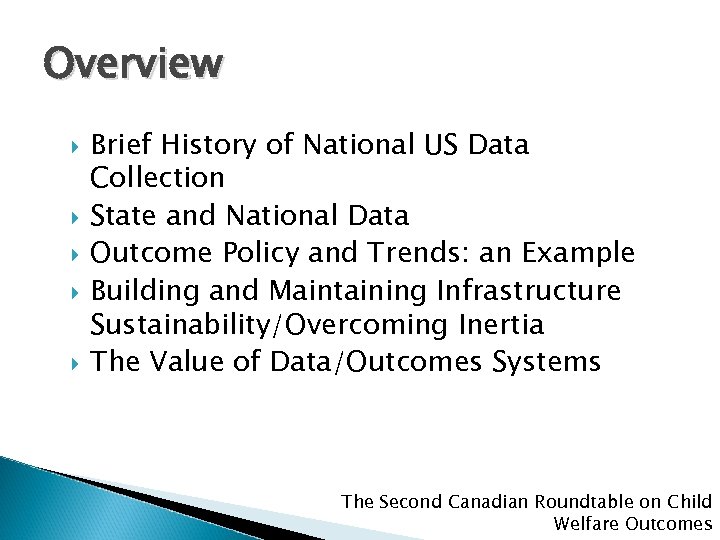 Overview Brief History of National US Data Collection State and National Data Outcome Policy and Trends: an Example Building and Maintaining Infrastructure Sustainability/Overcoming Inertia The Value of Data/Outcomes Systems The Second Canadian Roundtable on Child Welfare Outcomes
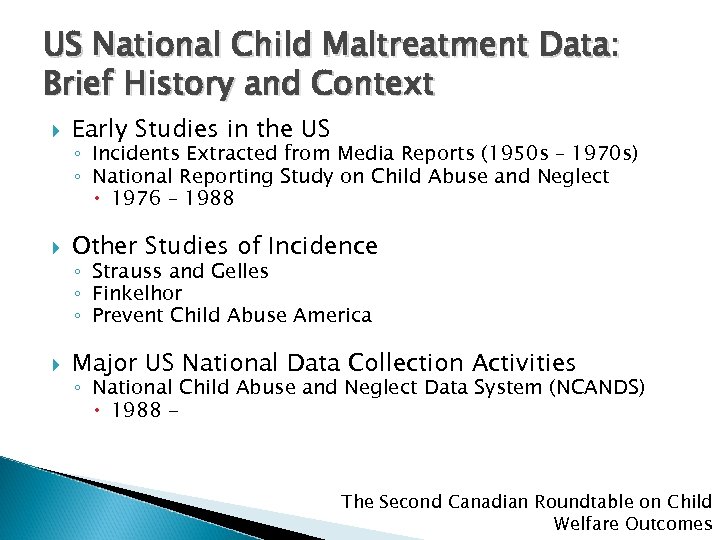 US National Child Maltreatment Data: Brief History and Context Early Studies in the US Other Studies of Incidence Major US National Data Collection Activities ◦ Incidents Extracted from Media Reports (1950 s – 1970 s) ◦ National Reporting Study on Child Abuse and Neglect 1976 – 1988 ◦ Strauss and Gelles ◦ Finkelhor ◦ Prevent Child Abuse America ◦ National Child Abuse and Neglect Data System (NCANDS) 1988 - The Second Canadian Roundtable on Child Welfare Outcomes
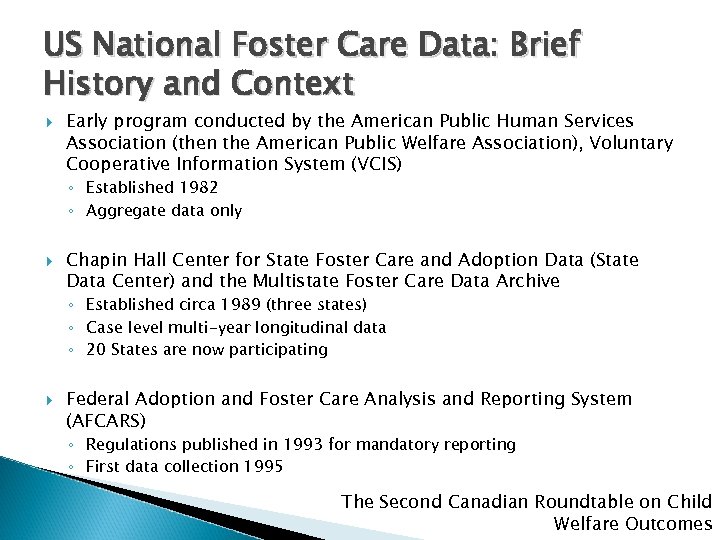 US National Foster Care Data: Brief History and Context Early program conducted by the American Public Human Services Association (then the American Public Welfare Association), Voluntary Cooperative Information System (VCIS) ◦ Established 1982 ◦ Aggregate data only Chapin Hall Center for State Foster Care and Adoption Data (State Data Center) and the Multistate Foster Care Data Archive ◦ Established circa 1989 (three states) ◦ Case level multi-year longitudinal data ◦ 20 States are now participating Federal Adoption and Foster Care Analysis and Reporting System (AFCARS) ◦ Regulations published in 1993 for mandatory reporting ◦ First data collection 1995 The Second Canadian Roundtable on Child Welfare Outcomes
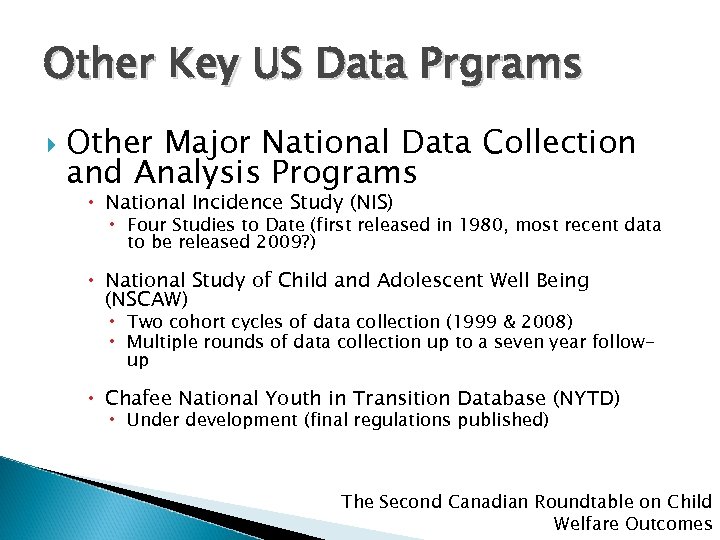 Other Key US Data Prgrams Other Major National Data Collection and Analysis Programs National Incidence Study (NIS) Four Studies to Date (first released in 1980, most recent data to be released 2009? ) National Study of Child and Adolescent Well Being (NSCAW) Two cohort cycles of data collection (1999 & 2008) Multiple rounds of data collection up to a seven year followup Chafee National Youth in Transition Database (NYTD) Under development (final regulations published) The Second Canadian Roundtable on Child Welfare Outcomes
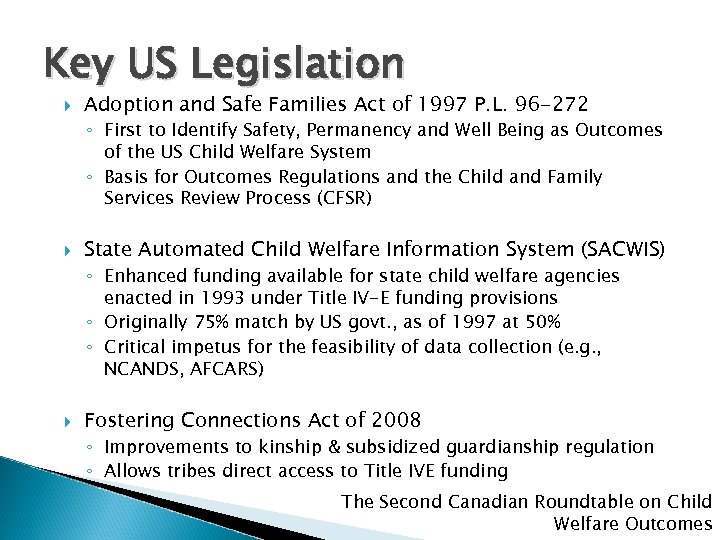 Key US Legislation Adoption and Safe Families Act of 1997 P. L. 96 -272 ◦ First to Identify Safety, Permanency and Well Being as Outcomes of the US Child Welfare System ◦ Basis for Outcomes Regulations and the Child and Family Services Review Process (CFSR) State Automated Child Welfare Information System (SACWIS) ◦ Enhanced funding available for state child welfare agencies enacted in 1993 under Title IV-E funding provisions ◦ Originally 75% match by US govt. , as of 1997 at 50% ◦ Critical impetus for the feasibility of data collection (e. g. , NCANDS, AFCARS) Fostering Connections Act of 2008 ◦ Improvements to kinship & subsidized guardianship regulation ◦ Allows tribes direct access to Title IVE funding The Second Canadian Roundtable on Child Welfare Outcomes
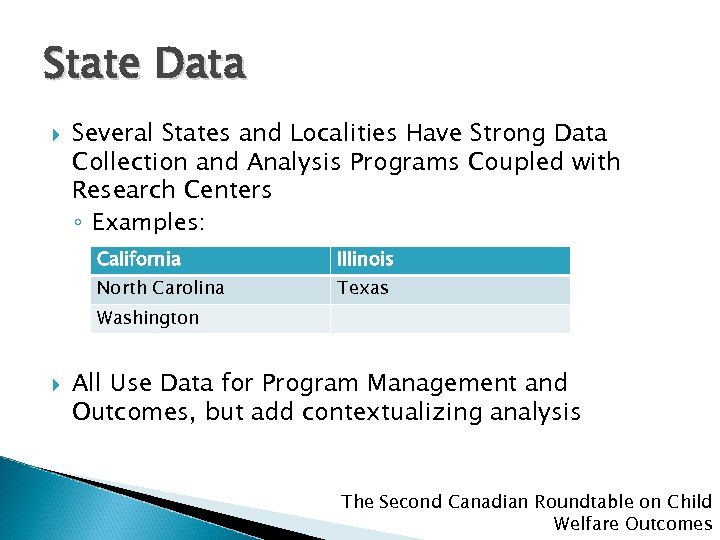 State Data Several States and Localities Have Strong Data Collection and Analysis Programs Coupled with Research Centers ◦ Examples: California Illinois North Carolina Texas Washington All Use Data for Program Management and Outcomes, but add contextualizing analysis The Second Canadian Roundtable on Child Welfare Outcomes
 Outcome Policy and Trends: an Example National Child Abuse and Neglect Data System (NCANDS)
 Scope, Goals and Purposes of the NCANDS Data Collection Program Meets US legal requirements to collect child maltreatment data Provides data that are critical to policymakers and administrators of CPS programs Data are used to support a range of US initiatives, notably ◦ ASFA Outcome Measures ◦ Child and Family Services Review Process ◦ Office of Management and Budget Program Assessment Rating Tool (PART) Contribute to the understanding of child maltreatment and the impact of intervention policy The Second Canadian Roundtable on Child Welfare Outcomes
 How Did NCANDS Get to the Current Stage? Facilitators of Case Level Data Collection in the US ◦ US Legislation ◦ Related Programs State Automated Child Welfare Information Systems (SACWIS) Child and Family Service Review Process (CFSR) System has evolved ◦ Almost all States are Now Providing Case Level Data (48 in 2007) ◦ Data are timely and available annually ◦ Range of applications has expanded dramatically The Second Canadian Roundtable on Child Welfare Outcomes
 NCANDS Characteristics/Features Action (regulations, policy, programs) ◦ Data collection program is authorized by US Office of Management and Budget (OMB) ◦ Supports US HHS Children’s Bureau Child and Family Services Review Process (CSFR) ◦ Support Children’s Bureau OMB Program Assessment Rating Tool (PART) measures Evaluation ◦ Contract is competitively bid by the US HHS Children’s Bureau Feedback loop ◦ Project convenes a State Advisory Group each year ◦ Data program is reviewed for revision every three year by the US Office of Management and Budget (OMB) The Second Canadian Roundtable on Child Welfare Outcomes
 NCANDS Data Collection and Analysis Methods Longitudinal ◦ Aggregate data since 1990; case level data since 1993. ◦ Encrypted unique child and perpetrator identifiers. Time Period ◦ Data are collected annually Mapping and Validation of Data ◦ Data are mapped to national categories ◦ Data are validated for coding, internal consistency, and analytical accuracy and comprehensiveness The Second Canadian Roundtable on Child Welfare Outcomes
 NCANDS Data Collection and Analysis Methods Measures of Maltreatment ◦ Six major categories (Physical, neglect, medical neglect, sexual, emotional, other). Analytic Environment ◦ Comprehensive Data Quality Assessment Process ◦ OLAP Reporting Tools ◦ Specialty Ad-hoc Research and Analysis Capacity The Second Canadian Roundtable on Child Welfare Outcomes
 Policy and Trends (Example) : Child and Family Service Review (CFSR) Maltreatment Recurrence In August 2001, the US Children’s Bureau set the first national standard for recurrence : ◦ A State meets the national standard if of all children who were victims of substantiated or indicated child abuse and/or neglect during the first 6 months of the period under review, 6. 1 percent or fewer children had another substantiated or indicated report within 6 months. The Second Canadian Roundtable on Child Welfare Outcomes
 Child and Family Service Review (CFSR) Maltreatment Recurrence (continued) As of June 2006 the Standard was revised ◦ Of all children who were victims of a substantiated or indicated maltreatment allegation during the first 6 months of FY 2004, what percent were not victims of another substantiated or indicated maltreatment allegation within the 6 -months following that maltreatment incident? ◦ National Standard Based on 45 States: 94. 6% or higher The Second Canadian Roundtable on Child Welfare Outcomes
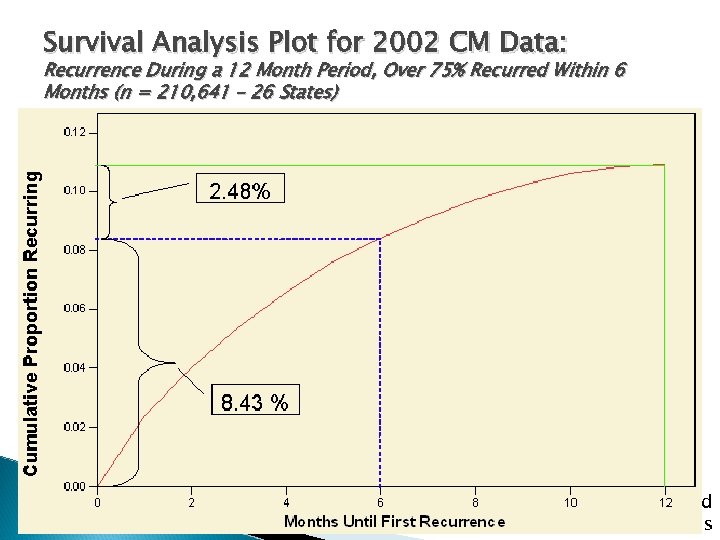 Survival Analysis Plot for 2002 CM Data: Recurrence During a 12 Month Period, Over 75% Recurred Within 6 Months (n = 210, 641 – 26 States) The Second Canadian Roundtable on Child January 18, 2007 Outcomes Welfare EUROPEAN SEMINAR ON MONITORING SYSTEMS OF CHILD ABUSE
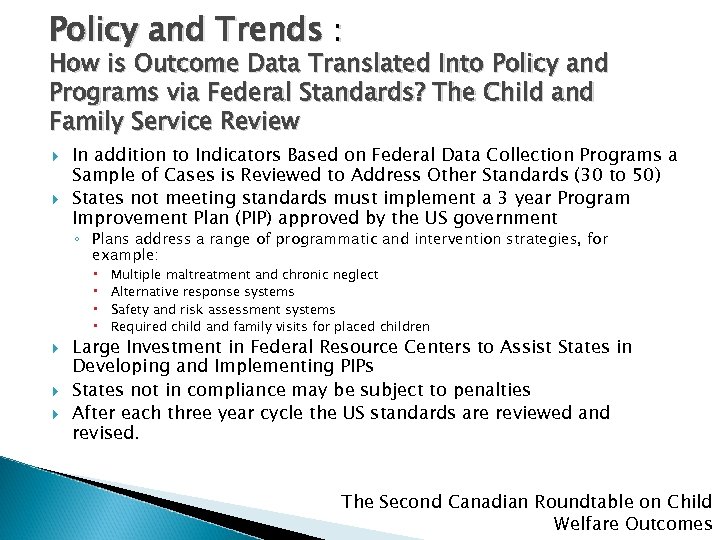 Policy and Trends : How is Outcome Data Translated Into Policy and Programs via Federal Standards? The Child and Family Service Review In addition to Indicators Based on Federal Data Collection Programs a Sample of Cases is Reviewed to Address Other Standards (30 to 50) States not meeting standards must implement a 3 year Program Improvement Plan (PIP) approved by the US government ◦ Plans address a range of programmatic and intervention strategies, for example: Multiple maltreatment and chronic neglect Alternative response systems Safety and risk assessment systems Required child and family visits for placed children Large Investment in Federal Resource Centers to Assist States in Developing and Implementing PIPs States not in compliance may be subject to penalties After each three year cycle the US standards are reviewed and revised. The Second Canadian Roundtable on Child Welfare Outcomes
 Considerations for Next Steps: In Search of the Magic Data Button Power to Change the World for Children and Families
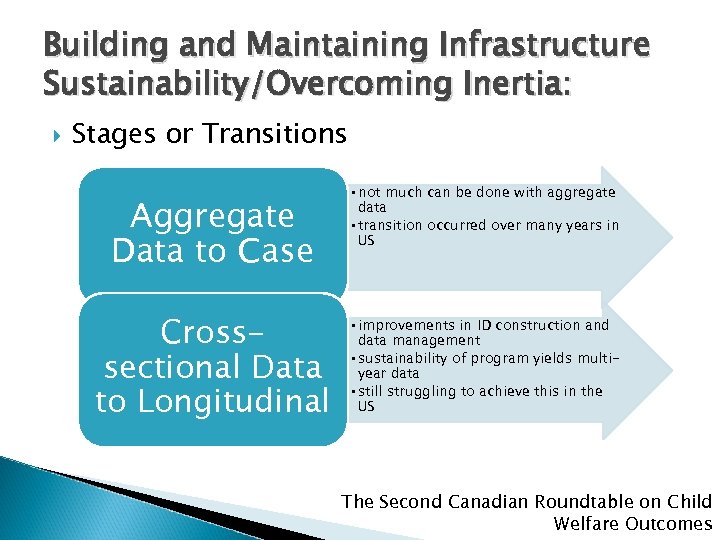 Building and Maintaining Infrastructure Sustainability/Overcoming Inertia: Stages or Transitions Aggregate Data to Case Crosssectional Data to Longitudinal • not much can be done with aggregate data • transition occurred over many years in US • improvements in ID construction and data management • sustainability of program yields multiyear data • still struggling to achieve this in the US The Second Canadian Roundtable on Child Welfare Outcomes
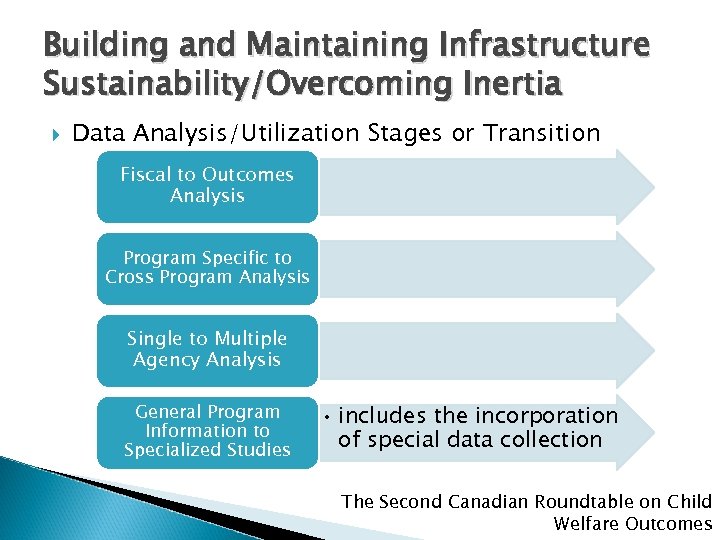 Building and Maintaining Infrastructure Sustainability/Overcoming Inertia Data Analysis/Utilization Stages or Transition Fiscal to Outcomes Analysis Program Specific to Cross Program Analysis Single to Multiple Agency Analysis General Program Information to Specialized Studies • includes the incorporation of special data collection The Second Canadian Roundtable on Child Welfare Outcomes
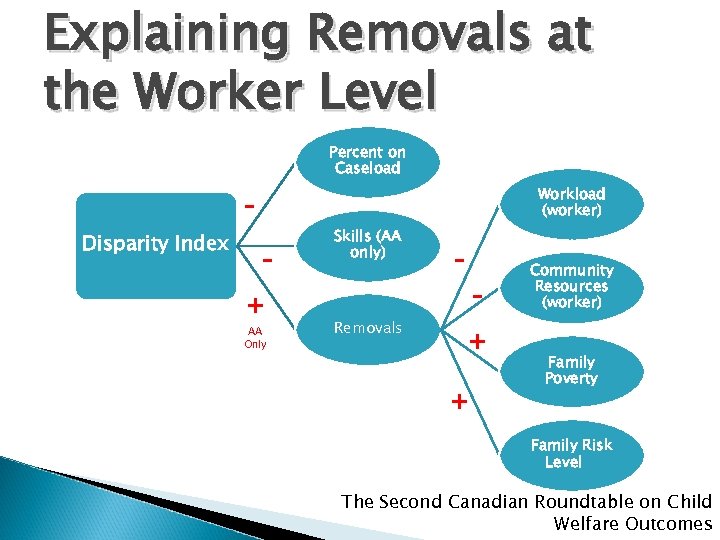 Explaining Removals at the Worker Level Percent on Caseload Workload (worker) Disparity Index + AA Only Skills (AA only) Removals + + Community Resources (worker) Family Poverty Family Risk Level The Second Canadian Roundtable on Child Welfare Outcomes
 Building and Maintaining Infrastructure Sustainability/Overcoming Inertia Infrastructure ◦ Enabling Legislation and Regulatory Framework for Data ◦ Strong Information Technology and Operational Systems Architecture Key Analytic Design Components (e. g. , OLAP capacity) ◦ Data Quality Improvement Processes Research/Evaluation Capacity Mechanisms for insuring data integrity Documentation The Second Canadian Roundtable on Child Welfare Outcomes
 Building and Maintaining Infrastructure Sustainability/Overcoming Inertia Sustainability ◦ Recognition of Long-Term Benefits/Minimal Short Term Expectations ◦ Long Term Funding ◦ Data use agreements and confidentiality ◦ Workforce Dissemination ◦ Archives ◦ Reports and Publications ◦ Technical Assistance The Second Canadian Roundtable on Child Welfare Outcomes
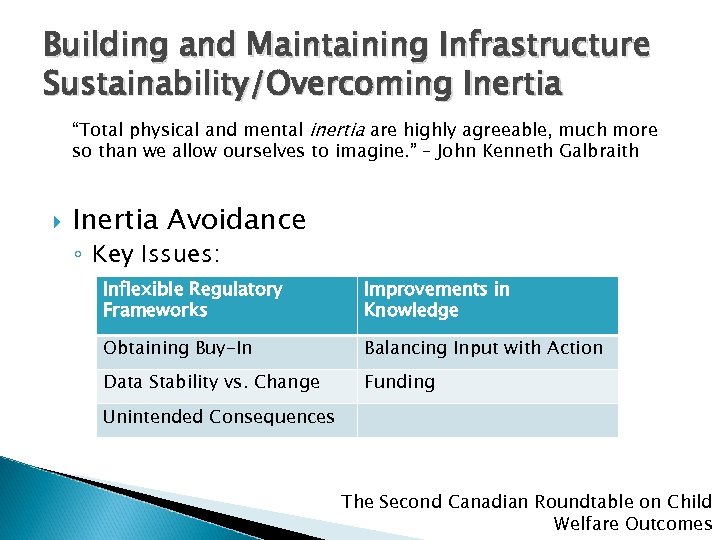 Building and Maintaining Infrastructure Sustainability/Overcoming Inertia “Total physical and mental inertia are highly agreeable, much more so than we allow ourselves to imagine. ” – John Kenneth Galbraith Inertia Avoidance ◦ Key Issues: Inflexible Regulatory Frameworks Improvements in Knowledge Obtaining Buy-In Balancing Input with Action Data Stability vs. Change Funding Unintended Consequences The Second Canadian Roundtable on Child Welfare Outcomes
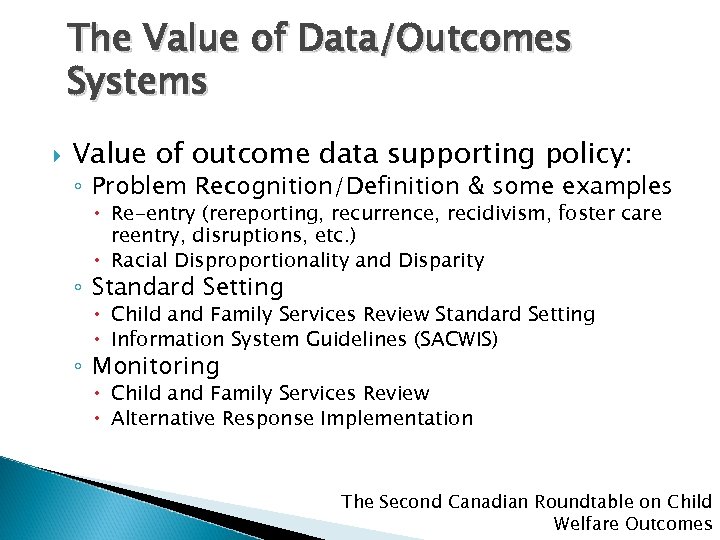 The Value of Data/Outcomes Systems Value of outcome data supporting policy: ◦ Problem Recognition/Definition & some examples Re-entry (rereporting, recurrence, recidivism, foster care reentry, disruptions, etc. ) Racial Disproportionality and Disparity ◦ Standard Setting Child and Family Services Review Standard Setting Information System Guidelines (SACWIS) ◦ Monitoring Child and Family Services Review Alternative Response Implementation The Second Canadian Roundtable on Child Welfare Outcomes
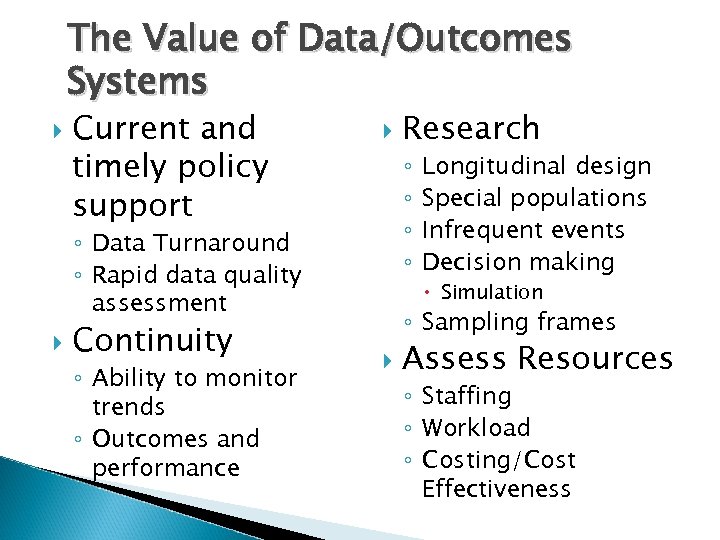 The Value of Data/Outcomes Systems Current and timely policy support ◦ ◦ ◦ Data Turnaround ◦ Rapid data quality assessment Continuity ◦ Ability to monitor trends ◦ Outcomes and performance Research Longitudinal design Special populations Infrequent events Decision making Simulation ◦ Sampling frames Assess Resources ◦ Staffing ◦ Workload ◦ Costing/Cost Effectiveness
 Contact John D. Fluke Director Child Protection Research Center American Humane Association USA (303) 810 1934 johnf@americanhumane. org