 Скачать презентацию Outbreak Management E Mc Namara PHL HSE SWA
f0b6d19edf0971c523da3feb32e04f16.ppt
- Количество слайдов: 48



Outbreak Management E. Mc. Namara PHL, HSE, SWA. and St James’s Hosp. Jump to first page
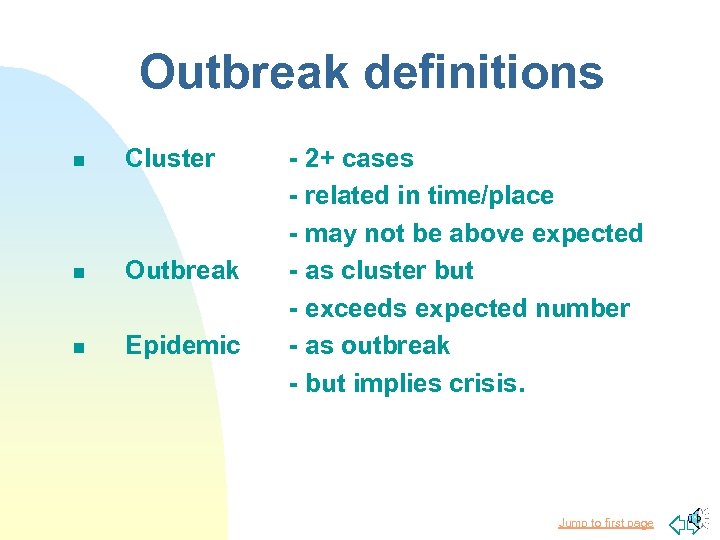
Outbreak definitions n Cluster n Outbreak n Epidemic - 2+ cases - related in time/place - may not be above expected - as cluster but - exceeds expected number - as outbreak - but implies crisis. Jump to first page
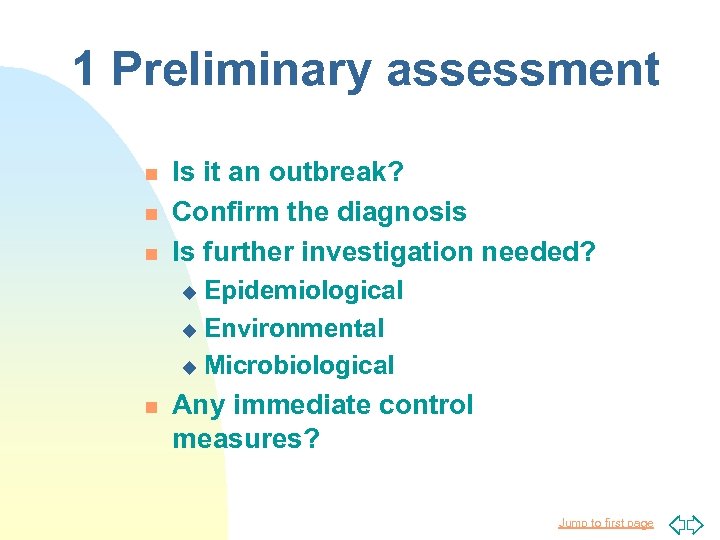
1 Preliminary assessment n n n Is it an outbreak? Confirm the diagnosis Is further investigation needed? Epidemiological u Environmental u Microbiological u n Any immediate control measures? Jump to first page
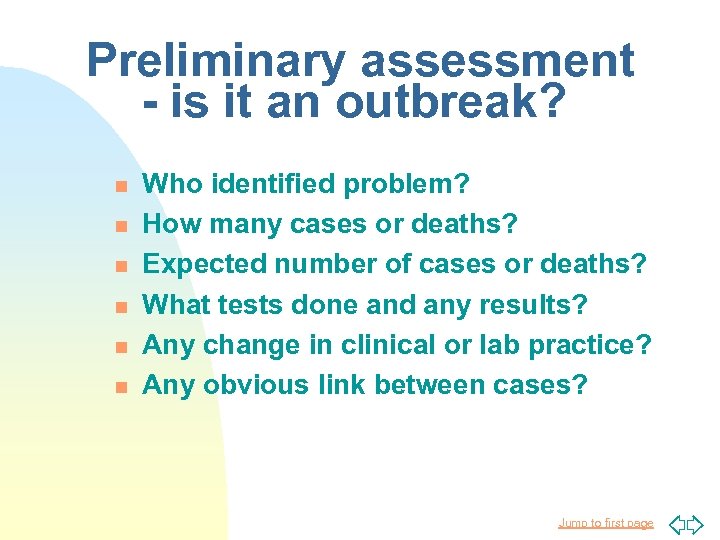
Preliminary assessment - is it an outbreak? n n n Who identified problem? How many cases or deaths? Expected number of cases or deaths? What tests done and any results? Any change in clinical or lab practice? Any obvious link between cases? Jump to first page
Preliminary assessment - confirm the diagnosis n n n Review clinical case histories Interview several cases Discuss tests/specimens with lab Arrange tests/get results quickly Repeat tests or confirmatory tests? Consult experts? Jump to first page
Preliminary assessment Is further investigation needed? n n n illness serious? Cases still occurring? More than 1 location involved? Any secondary cases? Risk of recurrence? Jump to first page
Preliminary assessment - immediate control measures? n n n n n Prevent further cases: Stop symptomatic food handlers working? Close ward, Stop admissions? Clean/disinfect premises or equipment? Cease drinking water? Close premises/stop production? Review operational practices Recall product? Prevent person-to-person spread Offer prophylaxis e. g. immunisation Jump to first page
Case definition and identification n Case ascertainment Case definition Define population at risk Quantification of incident. Jump to first page
Case definition and identification: n n n Time Place Person Symptoms Lab results. n Confirmed Probable Possible n Master List n n Jump to first page
Descriptive study: Time, place and person n Data collection standard format line listing denominator data n Data analysis epidemic curve attack rates Generate Hypothesis. Jump to first page
Analytical studies? To Test hypothesis Cohort Study n Start with population (cohort) exposed to factor n Calculate relative risk (RR) of exposure. Case-control study n Start with cases n Identify controls n Calculate odds ratio (estimate of RR) Jump to first page
Special studies Verify hypothesis, Source. n Microbiological u u u n Identify Pathogen Typing of isolates Food and environmental samples? Other Specialities u u Veterinary, Enviromental Meteorological data Tracer studies e. g. water, air Entomological Jump to first page
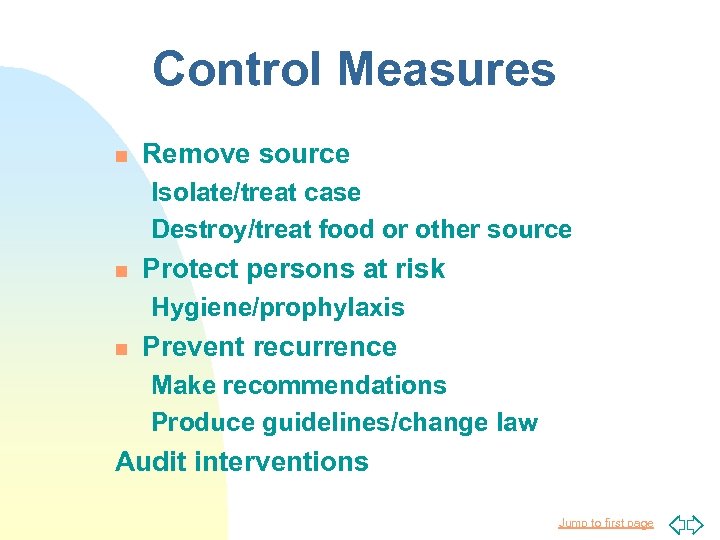
Control Measures n Remove source Isolate/treat case Destroy/treat food or other source n Protect persons at risk Hygiene/prophylaxis n Prevent recurrence Make recommendations Produce guidelines/change law Audit interventions Jump to first page
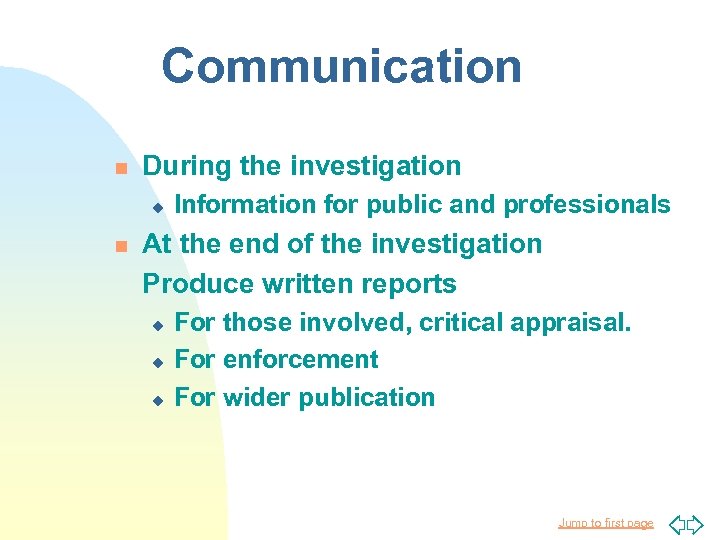
Communication n During the investigation u n Information for public and professionals At the end of the investigation Produce written reports u u u For those involved, critical appraisal. For enforcement For wider publication Jump to first page
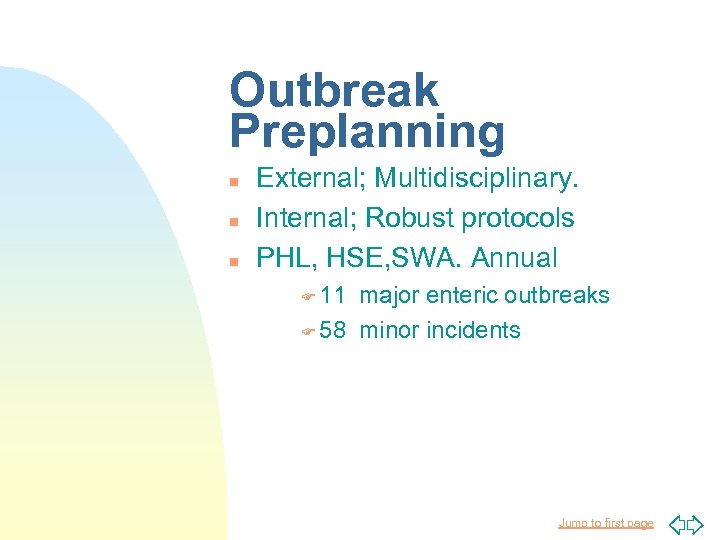
Outbreak Preplanning n n n External; Multidisciplinary. Internal; Robust protocols PHL, HSE, SWA. Annual F 11 major enteric outbreaks F 58 minor incidents Jump to first page
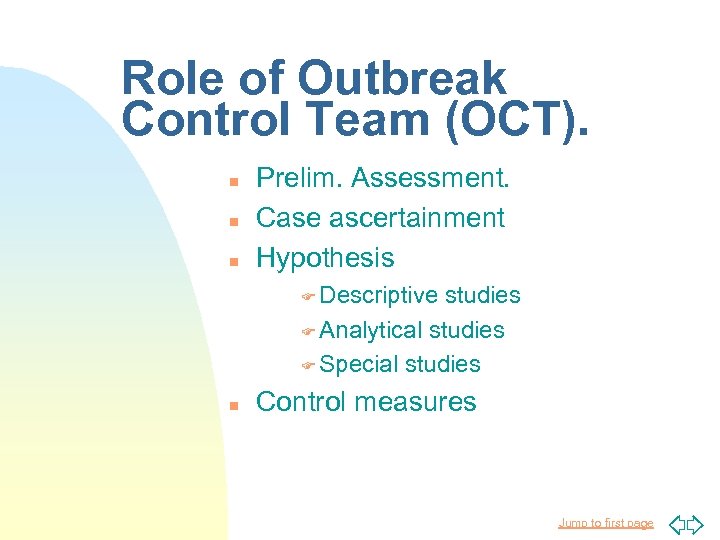
Role of Outbreak Control Team (OCT). n n n Prelim. Assessment. Case ascertainment Hypothesis F Descriptive studies F Analytical studies F Special studies n Control measures Jump to first page
Emergency Plan for Outbreaks n n n OCT; roles, responsibilities and legislation. Multidisciplinary Strategy to investigate and manage, SOP. Risk assessment, Interventions, Monitor effectiveness. Adequate surge resources. Communication: internal, external, media. Jump to first page
OCT n n n n Meetings minuted. Multidisciplinary updates. Continuous reassessment of public health risk. Rationale for interventions, agreed, designated and time frame. Conclusion, Debriefing, lessons learnt. Recommendations to prevent recurrence. Outbreak report. Jump to first page
Initial OCT Meeting n Confirm: F PHL sample receipt requirements F Pathogen analysis. F Health and safety issues F PHL result communication, format, status, to whom. F Clinical advice and interpretation F Pathogen/sample storage F PHL liason person attending OCT. Jump to first page
OCT Meetings (Lab. ) n n n Provide update on lab. results. Provide specialist result interpretation. Advise on pathogen related risk assessment. Advise on infection control. Advise on interventions. Jump to first page
PHL Outbreak Plan n n Notification, Outbreak code. Specimen receipt F Urgency, quantity, type. F Time and mode of delivery F Pathogen screen F Request details, O/B code, GP, contact Nos. F Documented chain of custody F Rejection criteria Jump to first page
Health and Safety Advice n n n For patient sample procurement For sample collector Sample packaging and transport At lab. reception During analysis Sample disposal Jump to first page
Internal Laboratory Briefing n n n Clarify nature of outbreak. Outbreak code Designate Senior Technologist as Outbreak Co-ordinator. Confirm agreed communication route with OCT. Methodology, IQC and safety. Jump to first page
Briefing cont. n n n n Establish potential sample numbers Devise outbreak staff rota and duties. Consider deferring routine work. Do stock audit. Review lab. space. Documentation; Receipt, Tech. work. Document daily dispatch of cumulative validated results to agreed personnel. Jump to first page
Reference Laboratory n n n Establish early communication. Source of advice. Clarify: F Typing methods F Turnaround time F Urgency F PHL contact person Jump to first page
Outbreak conclusion n n Attend debriefing. Assess lab. response. Review lessons learnt. Modify lab. plan if necessary. Jump to first page
Investigation of a Outbreak. Jump to first page
Index Case n n 19 Y/O Admitted SHB Bloody Diarrhoea 23/6/04 Fri. 25/6/04 PHD notified ? E. coli 0157. What next? Jump to first page
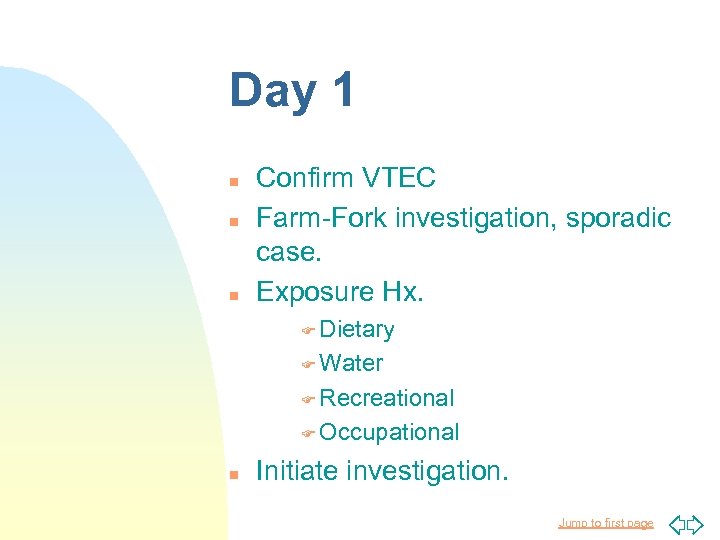
Day 1 n n n Confirm VTEC Farm-Fork investigation, sporadic case. Exposure Hx. F Dietary F Water F Recreational F Occupational n Initiate investigation. Jump to first page
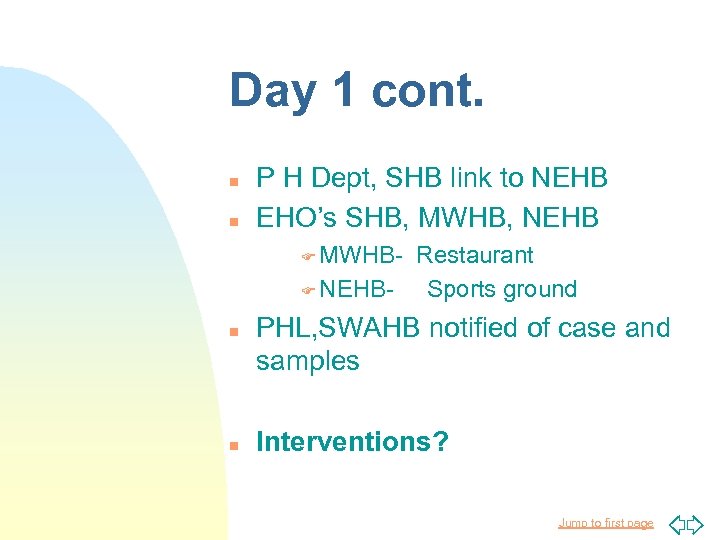
Day 1 cont. n n P H Dept, SHB link to NEHB EHO’s SHB, MWHB, NEHB F MWHB- Restaurant F NEHBSports ground n n PHL, SWAHB notified of case and samples Interventions? Jump to first page
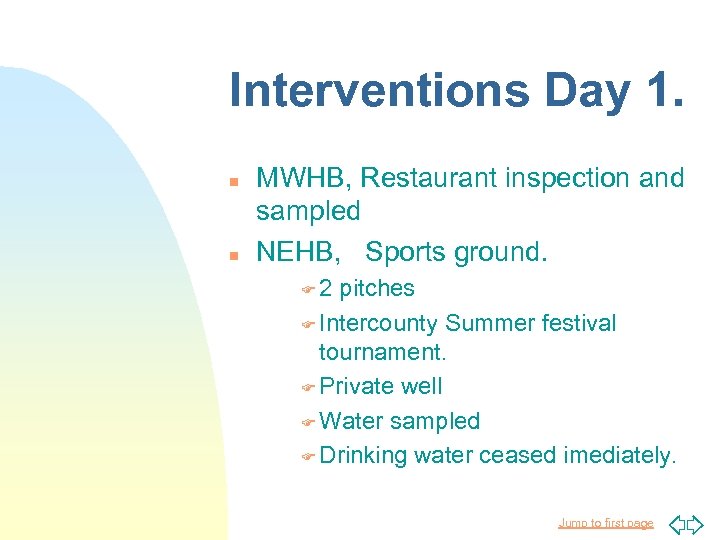
Interventions Day 1. n n MWHB, Restaurant inspection and sampled NEHB, Sports ground. F 2 pitches F Intercounty Summer festival tournament. F Private well F Water sampled F Drinking water ceased imediately. Jump to first page
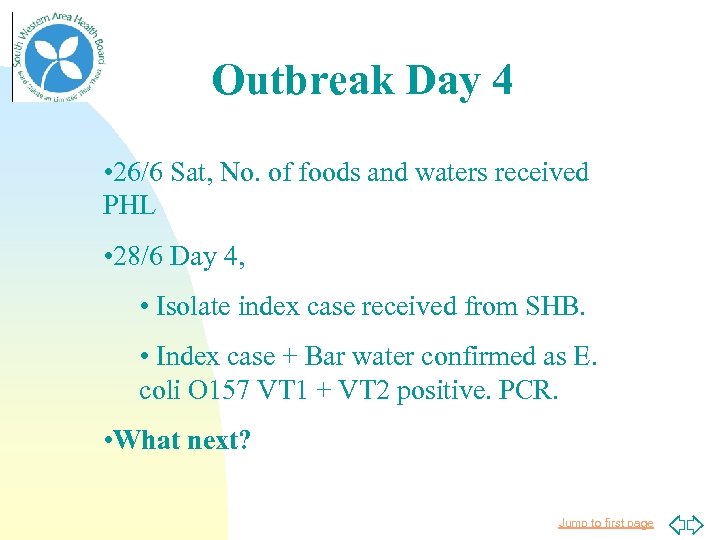
Outbreak Day 4 • 26/6 Sat, No. of foods and waters received PHL • 28/6 Day 4, • Isolate index case received from SHB. • Index case + Bar water confirmed as E. coli O 157 VT 1 + VT 2 positive. PCR. • What next? Jump to first page
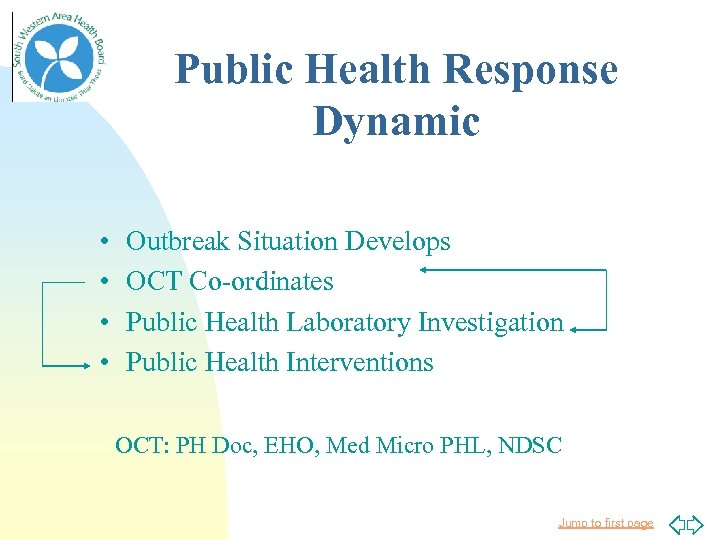
Public Health Response Dynamic • • Outbreak Situation Develops OCT Co-ordinates Public Health Laboratory Investigation Public Health Interventions OCT: PH Doc, EHO, Med Micro PHL, NDSC Jump to first page
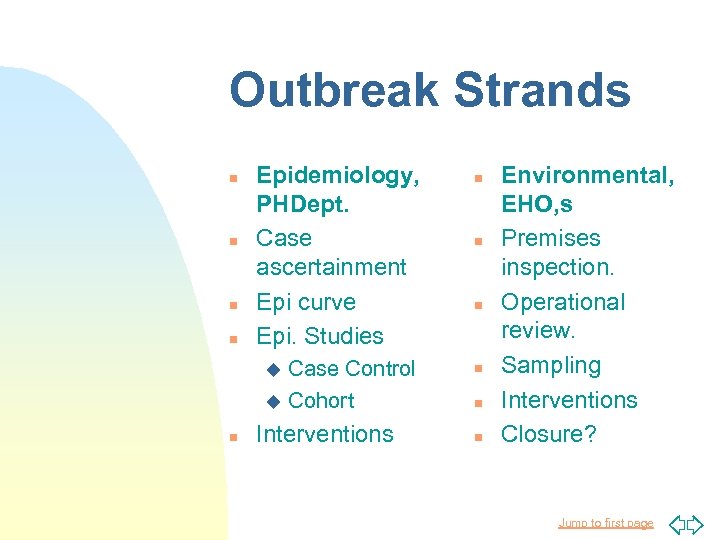
Outbreak Strands n n Epidemiology, PHDept. Case ascertainment Epi curve Epi. Studies Case Control u Cohort u n Interventions n n n Environmental, EHO, s Premises inspection. Operational review. Sampling Interventions Closure? Jump to first page
Premises • Sports grounds • Recent Tournaments • Playing/training pitches • Club house • Investigations? Jump to first page
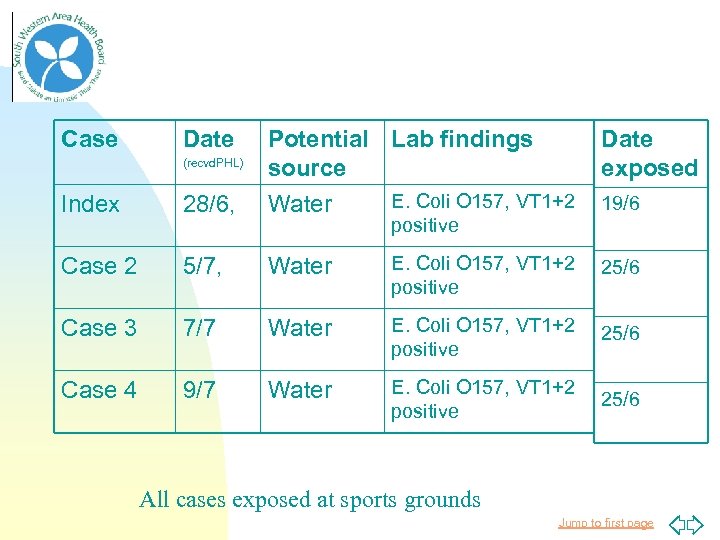
Case Date Index 28/6, Potential Lab findings source E. Coli O 157, VT 1+2 Water Case 2 5/7, Water E. Coli O 157, VT 1+2 positive 25/6 Case 3 7/7 Water E. Coli O 157, VT 1+2 positive 25/6 Case 4 9/7 Water E. Coli O 157, VT 1+2 positive 25/6 (recvd. PHL) positive Date exposed 19/6 All cases exposed at sports grounds Jump to first page
Linked Cases Public Health • Sports festival 100+ kids 21/6 -26/6 • Case assertainment • Symptomatic Tested • Asyptomatic not tested, advice given to them and GPs Jump to first page
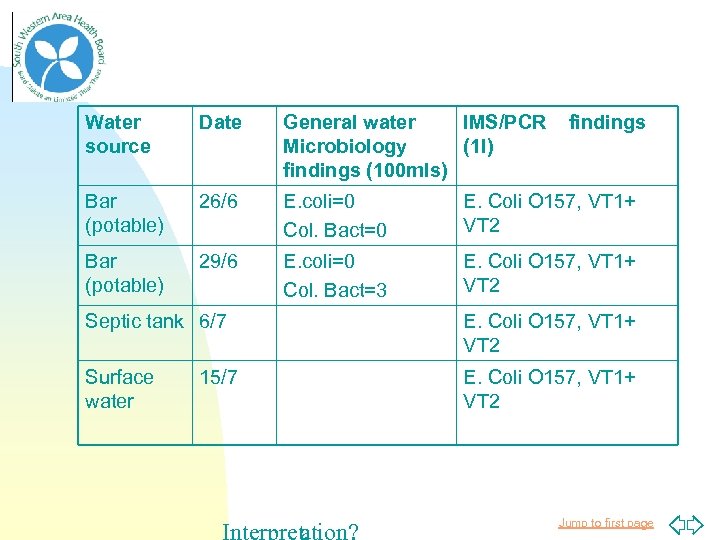
Water source Date General water IMS/PCR Microbiology (1 l) findings (100 mls) findings Bar (potable) 26/6 E. coli=0 Col. Bact=0 E. Coli O 157, VT 1+ VT 2 Bar (potable) 29/6 E. coli=0 Col. Bact=3 E. Coli O 157, VT 1+ VT 2 Septic tank 6/7 E. Coli O 157, VT 1+ VT 2 Surface water E. Coli O 157, VT 1+ VT 2 15/7 Jump to first page
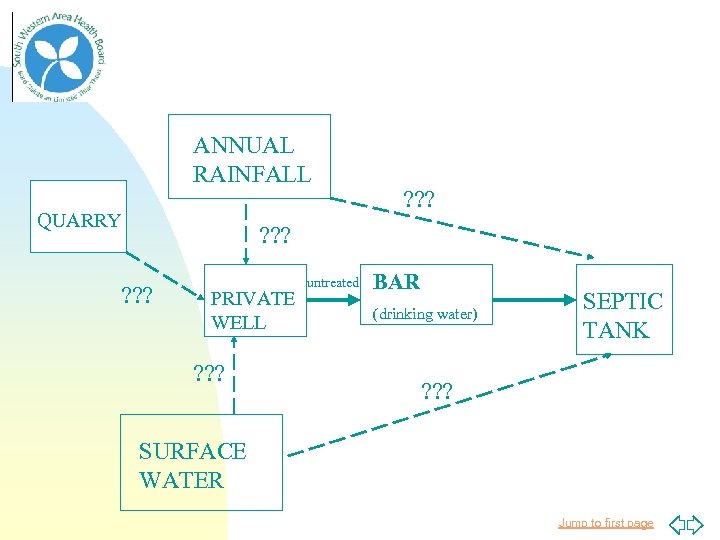
ANNUAL RAINFALL QUARRY ? ? ? PRIVATE WELL ? ? ? untreated BAR (drinking water) SEPTIC TANK ? ? ? SURFACE WATER Jump to first page
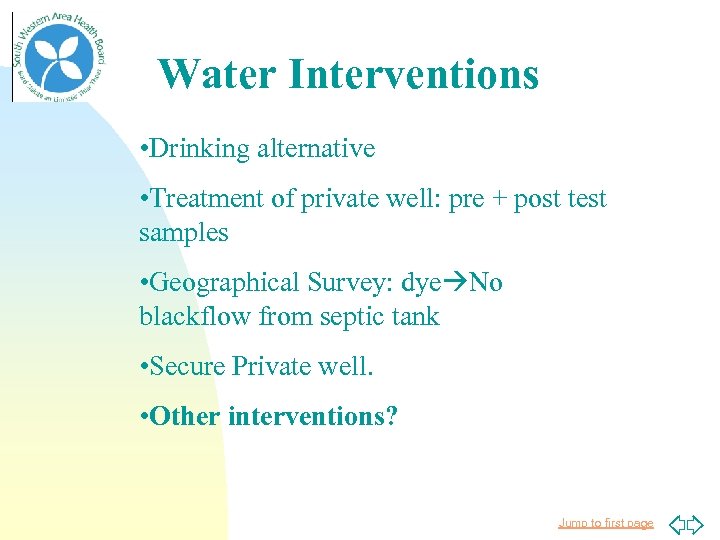
Water Interventions • Drinking alternative • Treatment of private well: pre + post test samples • Geographical Survey: dye No blackflow from septic tank • Secure Private well. • Other interventions? Jump to first page
Other Interventions. • Playing pitch fenced • Training pitch not fenced • Animals on training pitch • No. of animal droppings sampled • Clean grounds • Washing hand notices • Fence training pitch Jump to first page
Other samples Sheep droppings Received 14/7 • Non-O 157, • VT 1 positive • Interpret? Jump to first page
Other samples 14/7 clinical Sample Contact of positive case • Non-O 157 • VT 1 positive • Interpret? Jump to first page
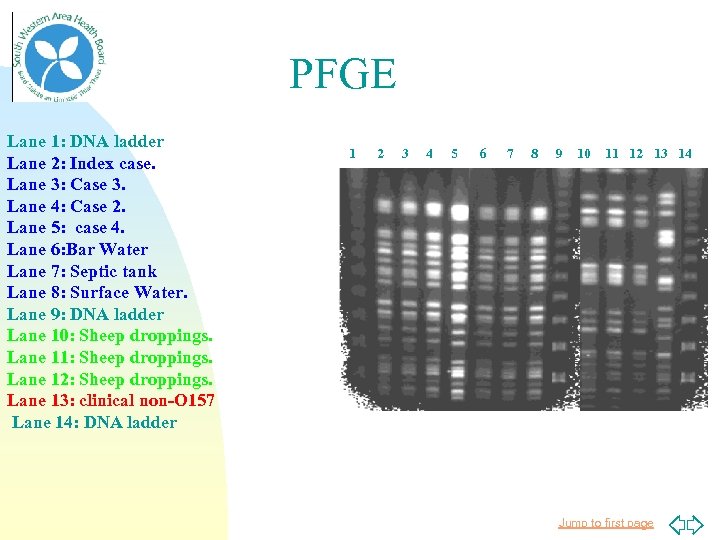
PFGE Lane 1: DNA ladder Lane 2: Index case. Lane 3: Case 3. Lane 4: Case 2. Lane 5: case 4. Lane 6: Bar Water Lane 7: Septic tank Lane 8: Surface Water. Lane 9: DNA ladder Lane 10: Sheep droppings. Lane 11: Sheep droppings. Lane 12: Sheep droppings. Lane 13: clinical non-O 157 Lane 14: DNA ladder 1 2 3 4 5 6 7 8 9 10 11 12 13 14 Jump to first page
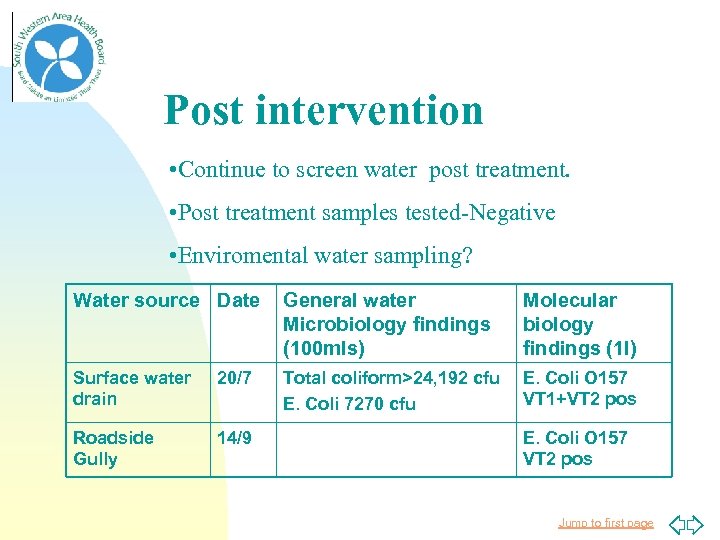
Post intervention • Continue to screen water post treatment. • Post treatment samples tested-Negative • Enviromental water sampling? Water source Date General water Microbiology findings (100 mls) Molecular biology findings (1 l) Surface water drain 20/7 Total coliform>24, 192 cfu E. Coli 7270 cfu E. Coli O 157 VT 1+VT 2 pos Roadside Gully 14/9 E. Coli O 157 VT 2 pos Jump to first page
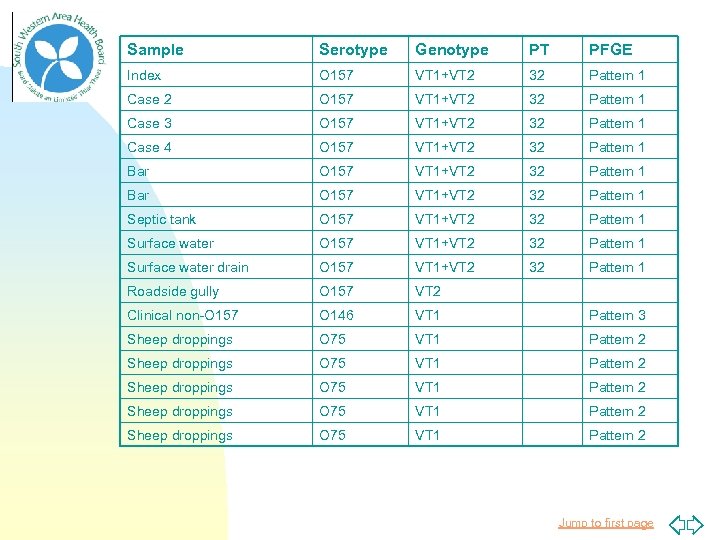
Sample Serotype Genotype PT PFGE Index O 157 VT 1+VT 2 32 Pattern 1 Case 2 O 157 VT 1+VT 2 32 Pattern 1 Case 3 O 157 VT 1+VT 2 32 Pattern 1 Case 4 O 157 VT 1+VT 2 32 Pattern 1 Bar O 157 VT 1+VT 2 32 Pattern 1 Septic tank O 157 VT 1+VT 2 32 Pattern 1 Surface water drain O 157 VT 1+VT 2 32 Pattern 1 Roadside gully O 157 VT 2 Clinical non-O 157 O 146 VT 1 Pattern 3 Sheep droppings O 75 VT 1 Pattern 2 Sheep droppings O 75 VT 1 Pattern 2 Jump to first page
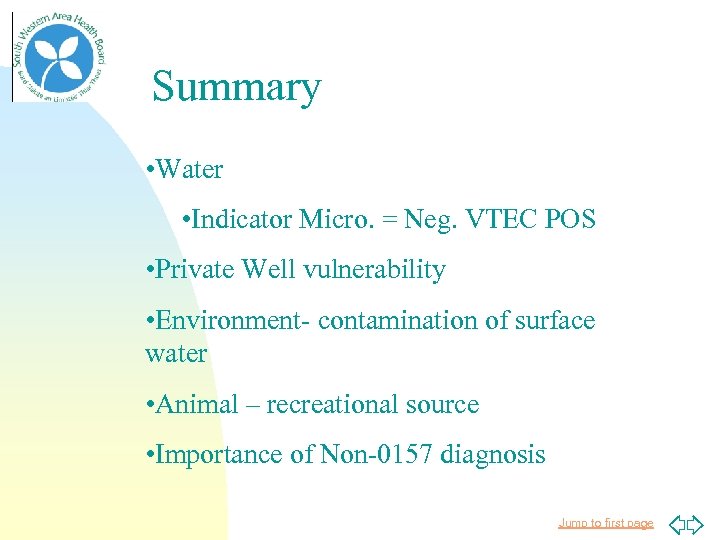
Summary • Water • Indicator Micro. = Neg. VTEC POS • Private Well vulnerability • Environment- contamination of surface water • Animal – recreational source • Importance of Non-0157 diagnosis Jump to first page
Jump to first page
Скачать презентацию Outbreak Management E Mc Namara PHL HSE SWA
f0b6d19edf0971c523da3feb32e04f16.ppt