


 Скачать презентацию Out of the words students make phrases Out
13ba4944dac7af6c1061928c1e812119.ppt
- Количество слайдов: 39
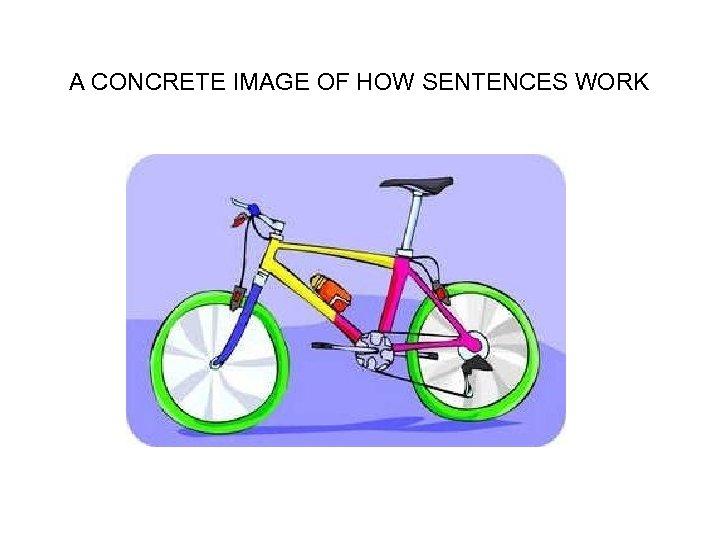
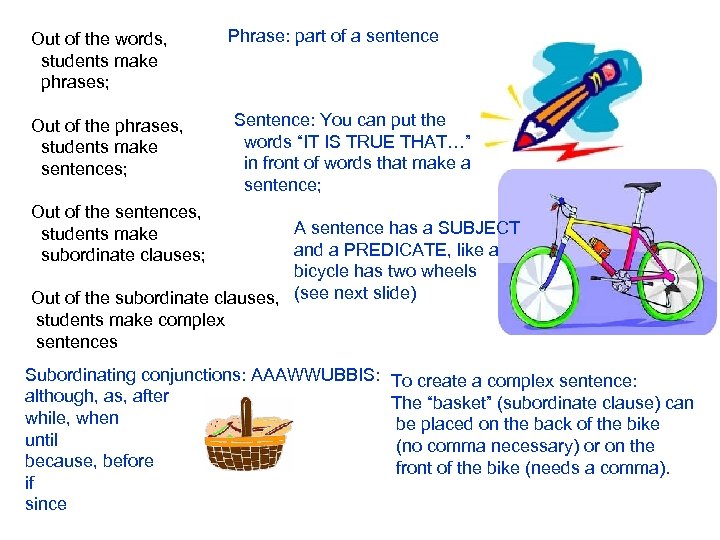 Out of the words, students make phrases; Out of the phrases, students make sentences; Phrase: part of a sentence Sentence: You can put the words “IT IS TRUE THAT…” in front of words that make a sentence; Out of the sentences, students make subordinate clauses; A sentence has a SUBJECT and a PREDICATE, like a bicycle has two wheels Out of the subordinate clauses, (see next slide) students make complex sentences Subordinating conjunctions: AAAWWUBBIS: although, as, after while, when until because, before if since To create a complex sentence: The “basket” (subordinate clause) can be placed on the back of the bike (no comma necessary) or on the front of the bike (needs a comma).
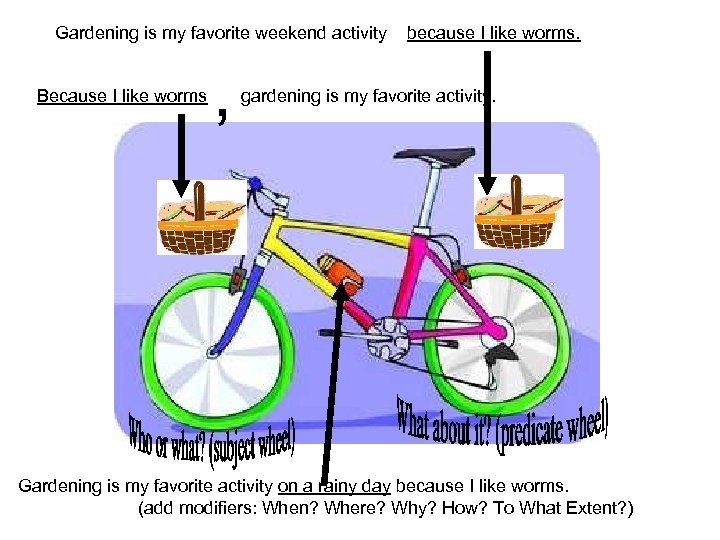 Gardening is my favorite weekend activity Because I like worms , because I like worms. gardening is my favorite activity. Gardening is my favorite activity on a rainy day because I like worms. (add modifiers: When? Where? Why? How? To What Extent? )
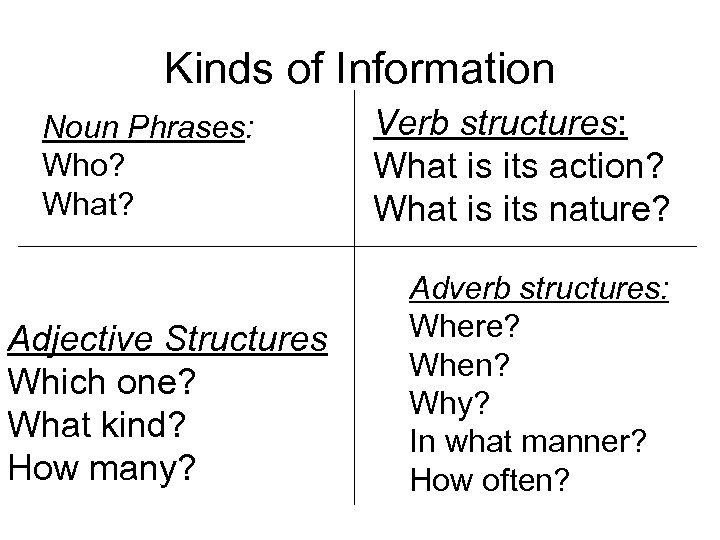 Kinds of Information Noun Phrases: Who? What? Adjective Structures Which one? What kind? How many? Verb structures: What is its action? What is its nature? Adverb structures: Where? When? Why? In what manner? How often?
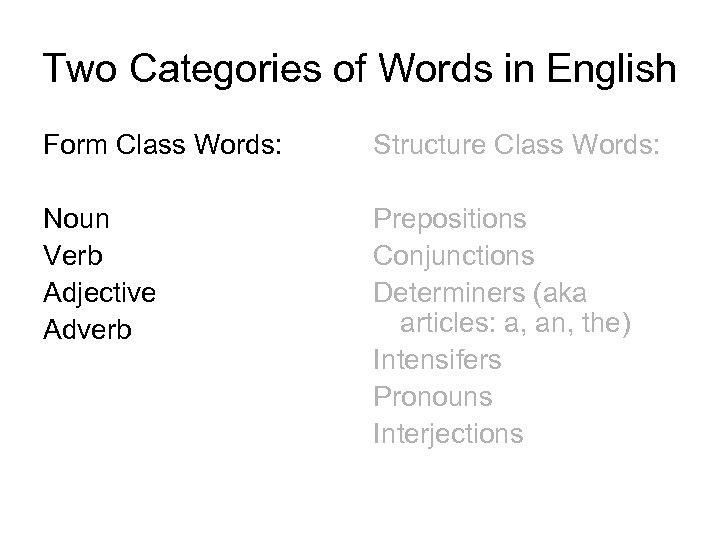 Two Categories of Words in English Form Class Words: Structure Class Words: Noun Verb Adjective Adverb Prepositions Conjunctions Determiners (aka articles: a, an, the) Intensifers Pronouns Interjections
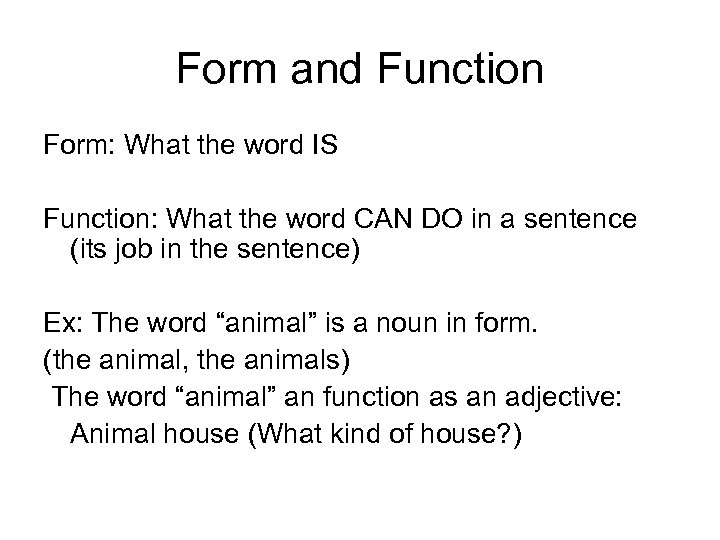 Form and Function Form: What the word IS Function: What the word CAN DO in a sentence (its job in the sentence) Ex: The word “animal” is a noun in form. (the animal, the animals) The word “animal” an function as an adjective: Animal house (What kind of house? )
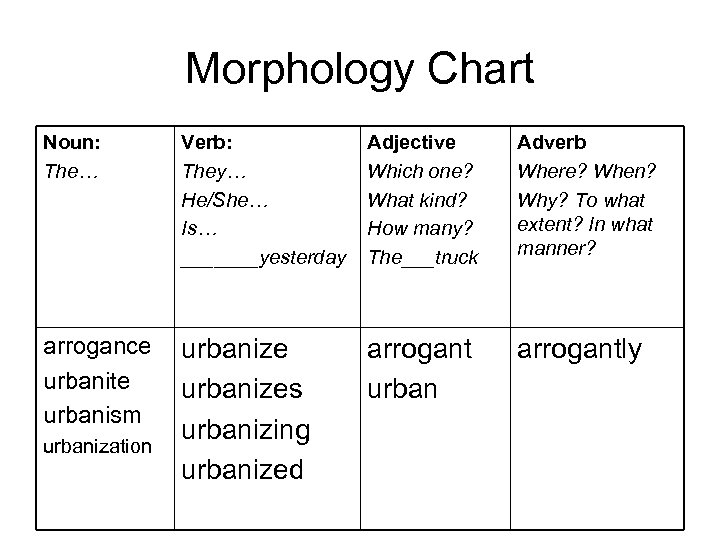 Morphology Chart Noun: The… Verb: They… He/She… Is… _______yesterday Adjective Which one? What kind? How many? The___truck Adverb Where? When? Why? To what extent? In what manner? arrogance urbanite urbanism urbanizes urbanizing urbanized arrogant urban arrogantly urbanization
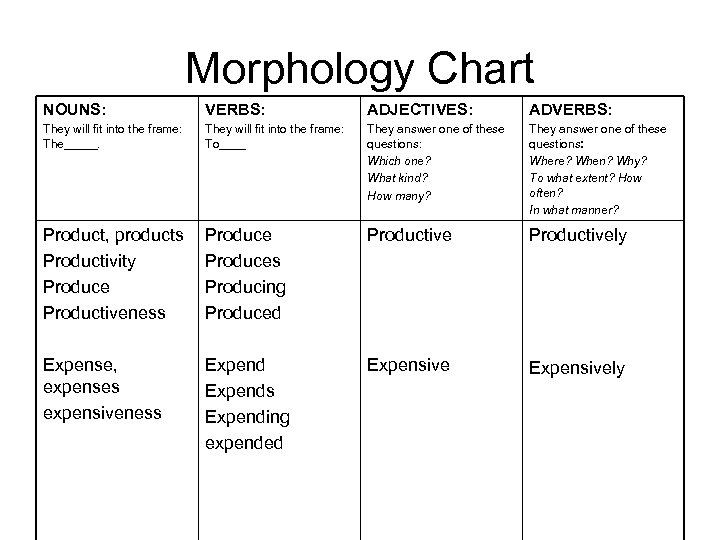 Morphology Chart NOUNS: VERBS: ADJECTIVES: ADVERBS: They will fit into the frame: The_____. They will fit into the frame: To____ They answer one of these questions: Which one? What kind? How many? They answer one of these questions: Where? When? Why? To what extent? How often? In what manner? Product, products Productivity Produce Productiveness Produces Producing Produced Productively Expense, expenses expensiveness Expends Expending expended Expensively
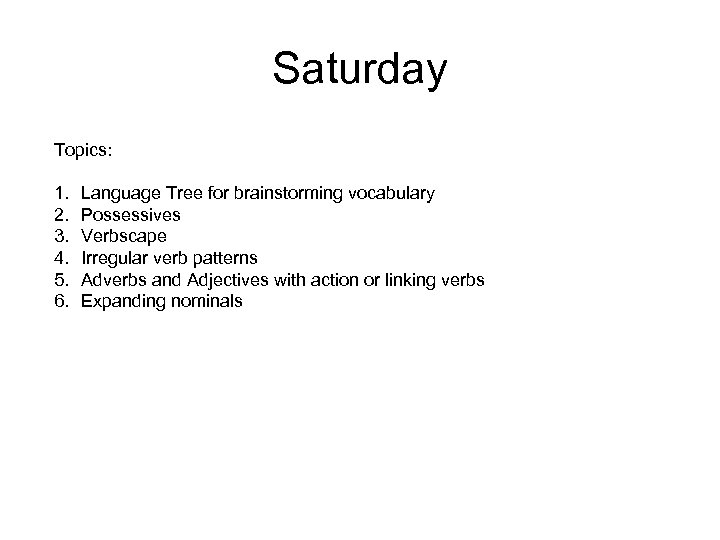 Saturday Topics: 1. 2. 3. 4. 5. 6. Language Tree for brainstorming vocabulary Possessives Verbscape Irregular verb patterns Adverbs and Adjectives with action or linking verbs Expanding nominals
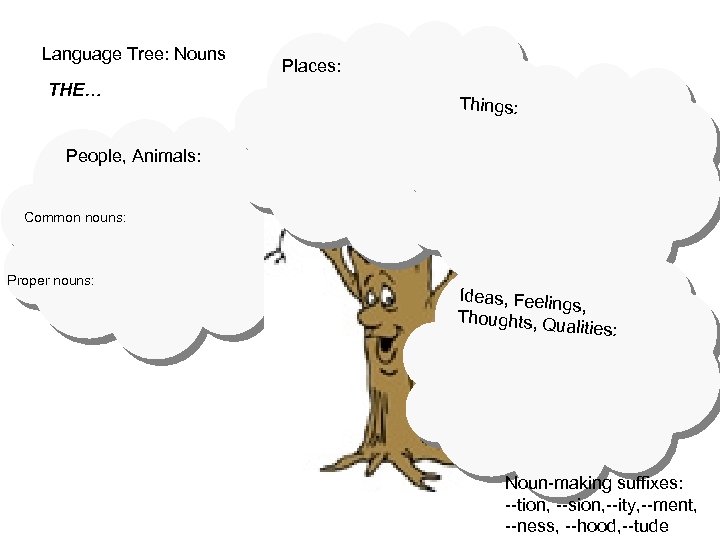 Language Tree: Nouns THE… Places: Things: People, Animals: Common nouns: Proper nouns: Ideas, Feeling s, Thoughts, Qu aliti es: Noun-making suffixes: --tion, --sion, --ity, --ment, --ness, --hood, --tude
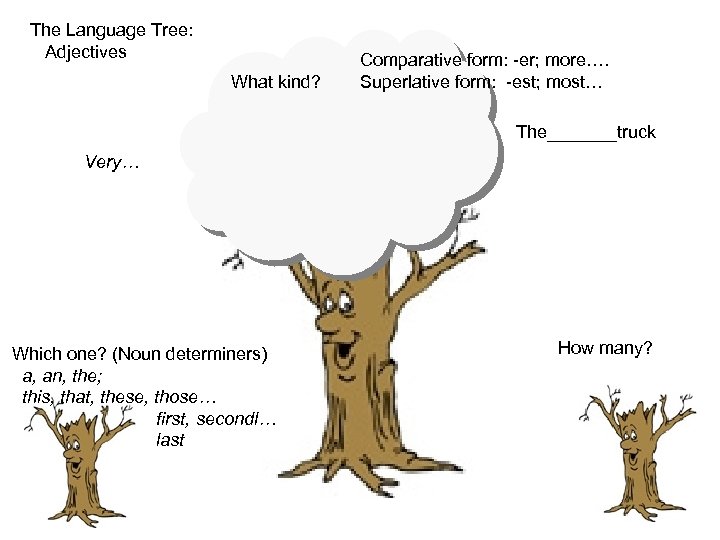 The Language Tree: Adjectives What kind? Comparative form: -er; more…. Superlative form: -est; most… The_______truck Very… Which one? (Noun determiners) a, an, the; this, that, these, those… first, secondl… last How many?
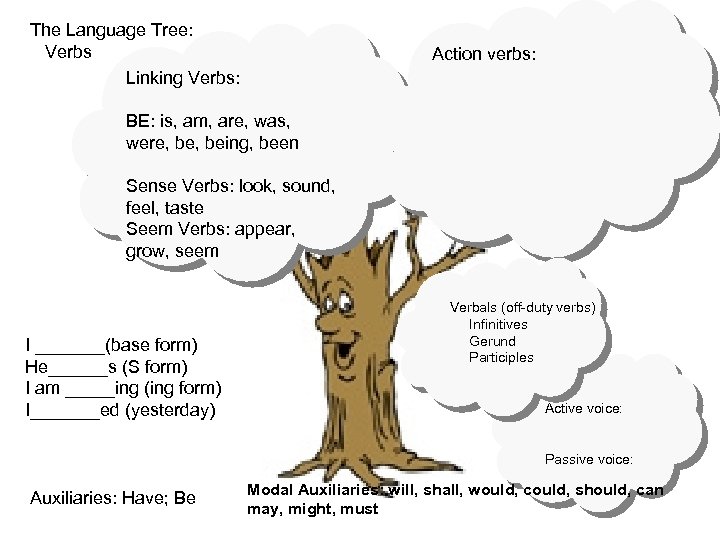 The Language Tree: Verbs Linking Verbs: Action verbs: BE: is, am, are, was, were, being, been Sense Verbs: look, sound, feel, taste Seem Verbs: appear, grow, seem I _______(base form) He______s (S form) I am _____ing (ing form) I_______ed (yesterday) Verbals (off-duty verbs) Infinitives Gerund Participles Active voice: Passive voice: Auxiliaries: Have; Be Modal Auxiliaries: will, shall, would, could, should, can may, might, must
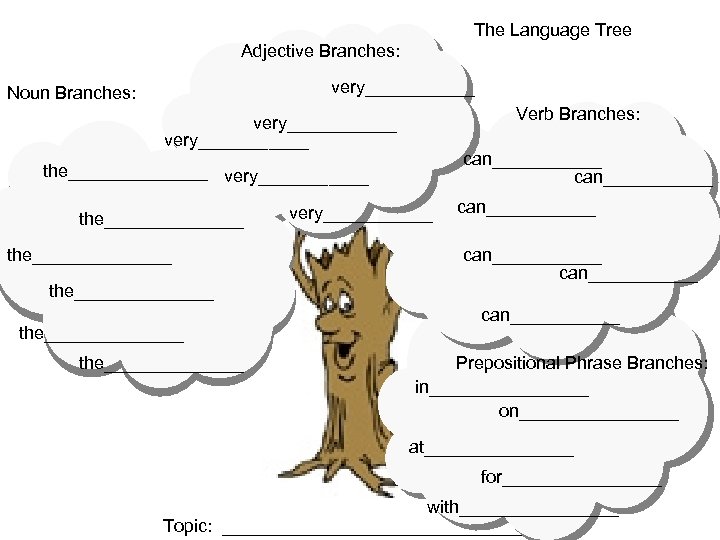 The Language Tree Adjective Branches: very______ Noun Branches: Verb Branches: very___________ can___________ the_______ very___________ the______________ the_________ the_______ very___________ can___________ can______ Prepositional Phrase Branches: in________ on________ at________ for________ with________ Topic: _______________
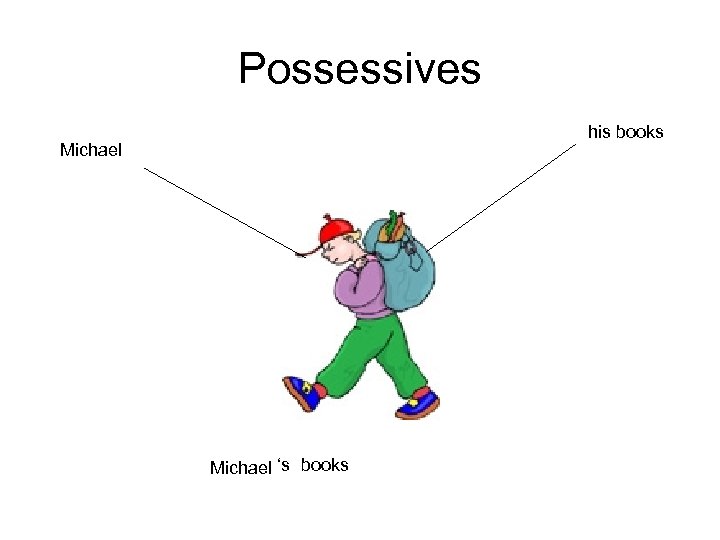 Possessives his books Michael ‘s books
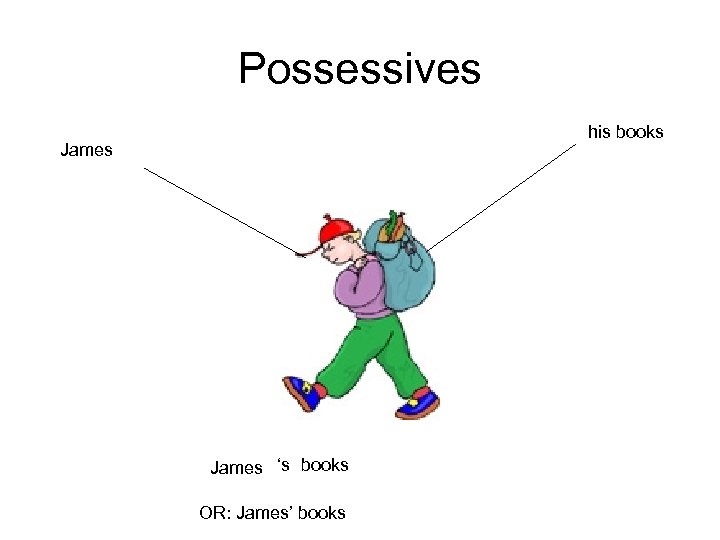 Possessives his books James ‘s books OR: James’ books
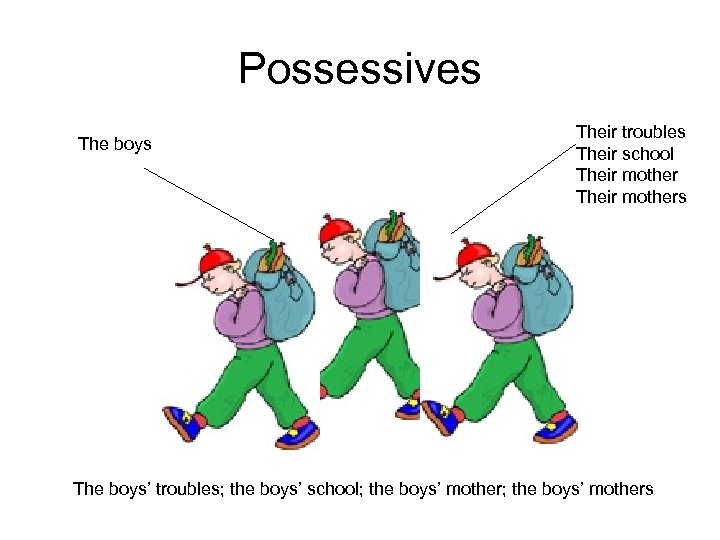 Possessives The boys Their troubles Their school Their mothers The boys’ troubles; the boys’ school; the boys’ mothers
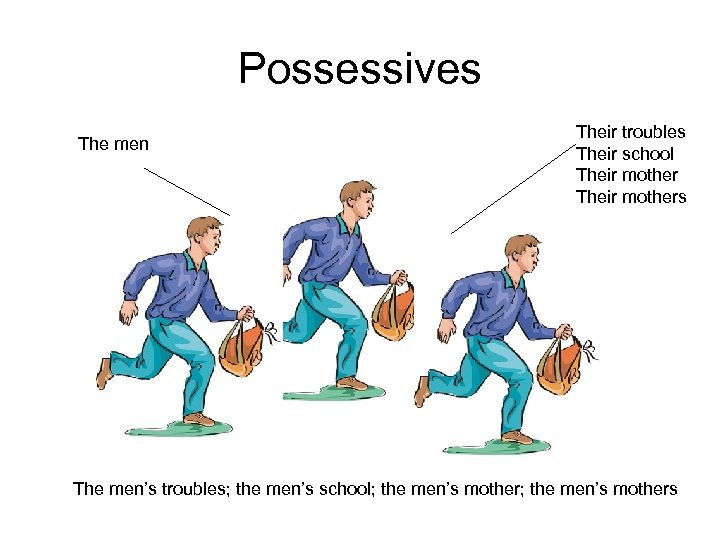 Possessives The men Their troubles Their school Their mothers The men’s troubles; the men’s school; the men’s mothers
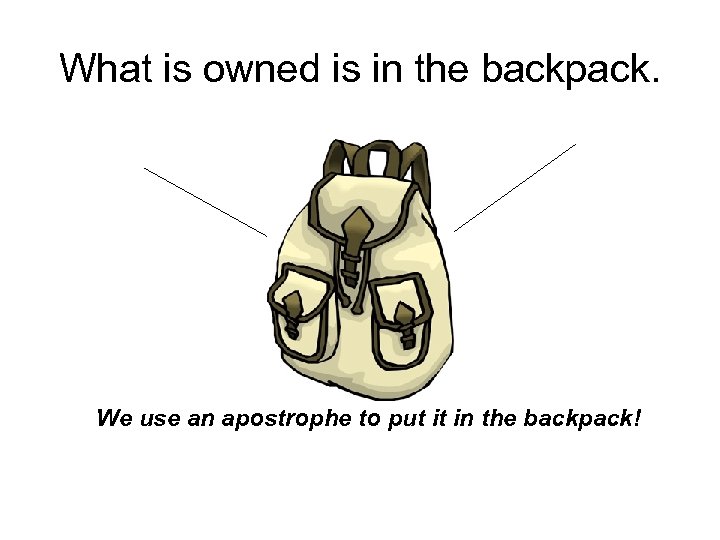 What is owned is in the backpack. We use an apostrophe to put it in the backpack!
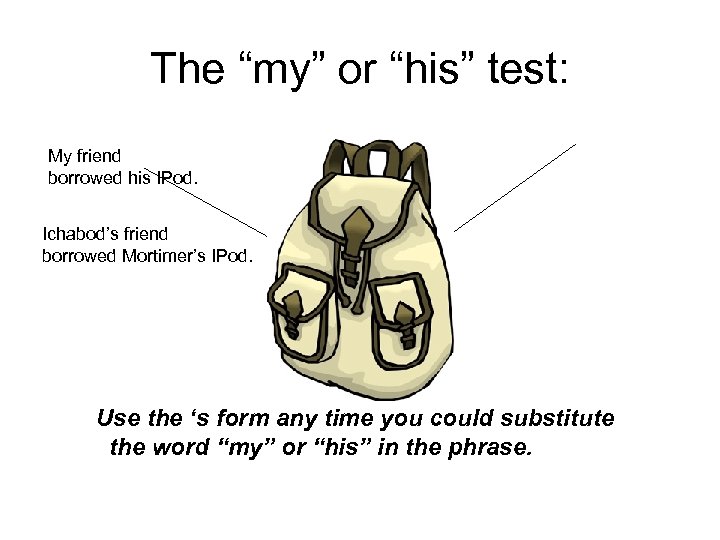 The “my” or “his” test: My friend borrowed his IPod. Ichabod’s friend borrowed Mortimer’s IPod. Use the ‘s form any time you could substitute the word “my” or “his” in the phrase.
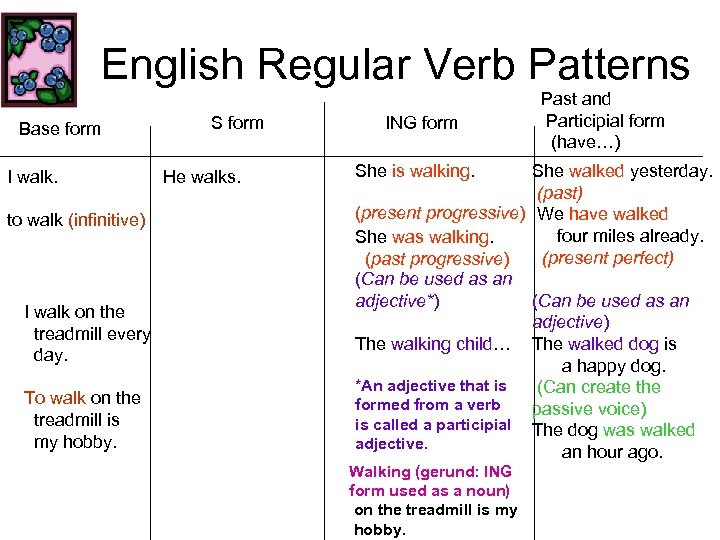 English Regular Verb Patterns Base form I walk. to walk (infinitive) I walk on the treadmill every day. To walk on the treadmill is my hobby. S form He walks. ING form She is walking. Past and Participial form (have…) She walked yesterday. (past) (present progressive) We have walked four miles already. She was walking. (present perfect) (past progressive) (Can be used as an adjective*) (Can be used as an adjective) The walking child… The walked dog is a happy dog. *An adjective that is (Can create the formed from a verb passive voice) is called a participial The dog was walked adjective. an hour ago. Walking (gerund: ING form used as a noun) on the treadmill is my hobby.
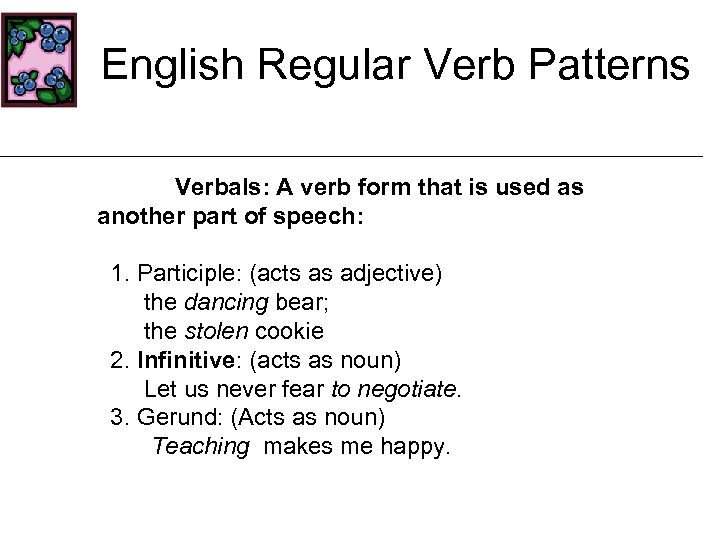 English Regular Verb Patterns Verbals: A verb form that is used as another part of speech: 1. Participle: (acts as adjective) the dancing bear; the stolen cookie 2. Infinitive: (acts as noun) Let us never fear to negotiate. 3. Gerund: (Acts as noun) Teaching makes me happy.
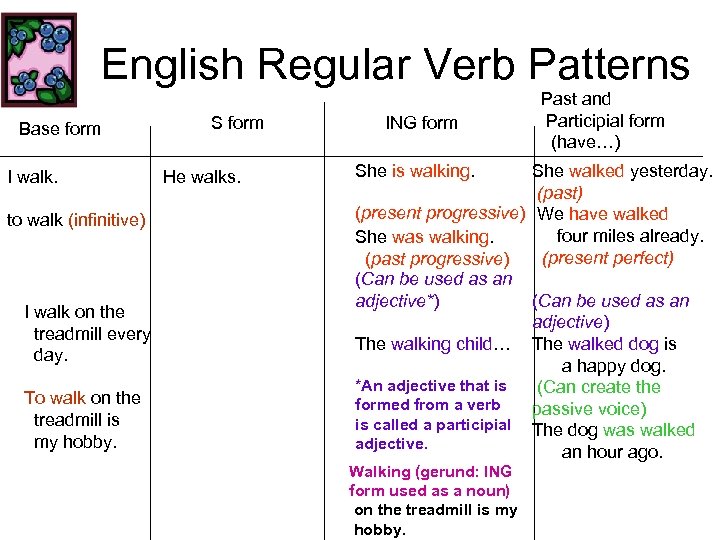 English Regular Verb Patterns Base form I walk. to walk (infinitive) I walk on the treadmill every day. To walk on the treadmill is my hobby. S form He walks. ING form She is walking. Past and Participial form (have…) She walked yesterday. (past) (present progressive) We have walked four miles already. She was walking. (present perfect) (past progressive) (Can be used as an adjective*) (Can be used as an adjective) The walking child… The walked dog is a happy dog. *An adjective that is (Can create the formed from a verb passive voice) is called a participial The dog was walked adjective. an hour ago. Walking (gerund: ING form used as a noun) on the treadmill is my hobby.
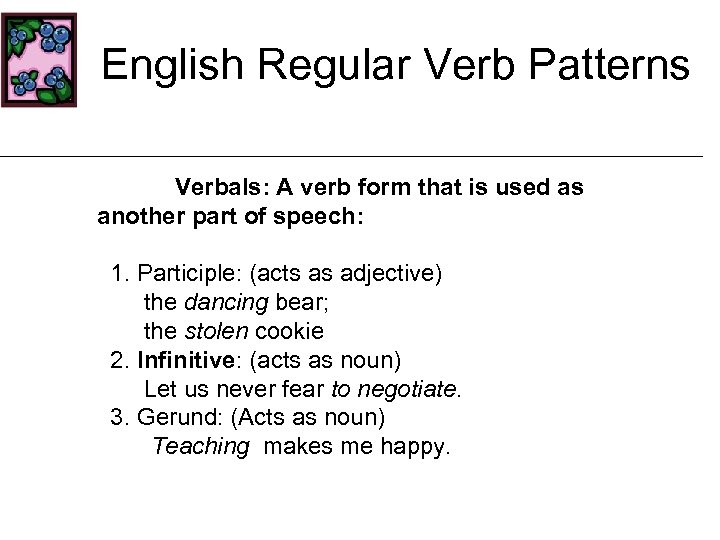 English Regular Verb Patterns Verbals: A verb form that is used as another part of speech: 1. Participle: (acts as adjective) the dancing bear; the stolen cookie 2. Infinitive: (acts as noun) Let us never fear to negotiate. 3. Gerund: (Acts as noun) Teaching makes me happy.
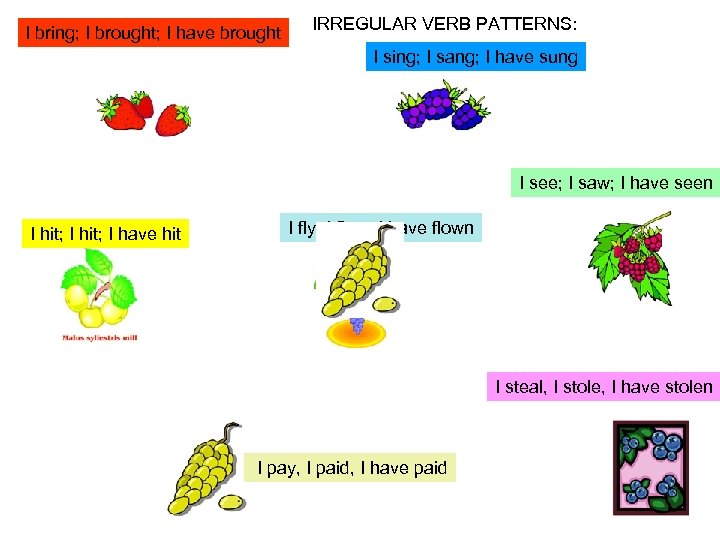 I bring; I brought; I have brought IRREGULAR VERB PATTERNS: I sing; I sang; I have sung I see; I saw; I have seen I hit; I have hit I fly; I flew; I have flown I steal, I stole, I have stolen I pay, I paid, I have paid
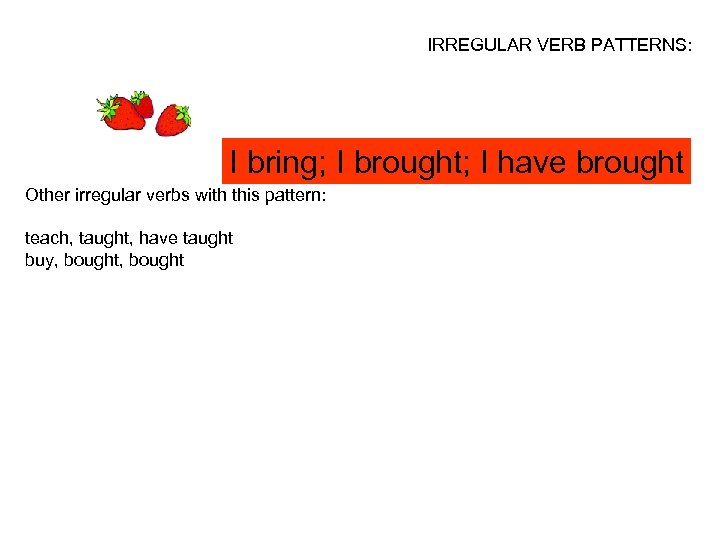 IRREGULAR VERB PATTERNS: I bring; I brought; I have brought Other irregular verbs with this pattern: teach, taught, have taught buy, bought
 IRREGULAR VERB PATTERNS: I sing; I sang; I have sung Other irregular verbs with this pattern: ring, rang, have rung drink, drank, have drunk shrink, shrank, have shrunk Sound-alikes, but NOT IRREG: blink, blinked, have blinked
 IRREGULAR VERB PATTERNS: I hit; I have hit Sound-alikes, but IRREGULAR in a different way: sit, sat, have sat Put, put, have put Set, set, have set Bet, bet, have bet Cut, cut, have cut
 IRREGULAR VERB PATTERNS: I fly; I flew; I have flown Sound-alikes, but NOT IRREG: Try, tried, have tried Cry, cried, have cried Flow, flowed, have flowed Glow, glowed, have glowed Know, knew, have known Blow, blew, have blown Grow, grew, have grown Sound alikes, but IRREGULAR in a different way: show, showed, have shown
 IRREGULAR VERB PATTERNS: I see; I saw; I have seen Other verbs that have no matching pattern: Go, went, have gone BE: Is, am, are, was, were, being, been
 IRREGULAR VERB PATTERNS: I steal, I stole, I have stolen speak, spoke, have spoken take, took, have taken Sound-alikes that are NOT IRREG: reveal, revealed, have revealed seal, sealed, have sealed creak, creaked, have creaked
 IRREGULAR VERB PATTERNS: I pay, I paid, I have paid Sound-alikes that are NOT IRREG: say, said, have said lay, laid, have laid relay, relayed, have relayed convey, conveyed, have conveyed stay, stayed pray, prayed, have prayed spray, sprayed, have sprayed Sound-alikes that are IRREGULAR in a different way: slay, slew, have slain lie, lay, have lain
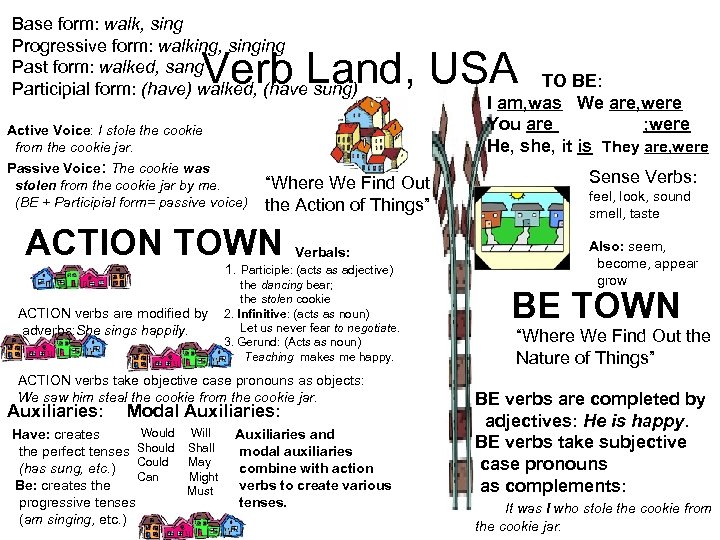 Base form: walk, sing Progressive form: walking, singing Past form: walked, sang Participial form: (have) walked, (have sung) Verb Land, USA Active Voice: I stole the cookie from the cookie jar. Passive Voice: The cookie was stolen from the cookie jar by me. (BE + Participial form= passive voice) “Where We Find Out the Action of Things” ACTION TOWN Verbals: 1. Participle: (acts as adjective) ACTION verbs are modified by adverbs: She sings happily. the dancing bear; the stolen cookie 2. Infinitive: (acts as noun) Let us never fear to negotiate. 3. Gerund: (Acts as noun) Teaching makes me happy. ACTION verbs take objective case pronouns as objects: We saw him steal the cookie from the cookie jar. Auxiliaries: Modal Auxiliaries: Would Will Have: creates the perfect tenses Should Shall Could May (has sung, etc. ) Can Might Be: creates the Must progressive tenses (am singing, etc. ) Auxiliaries and modal auxiliaries combine with action verbs to create various tenses. TO BE: I am, was We are, were You are ; were He, she, it is They are, were Sense Verbs: feel, look, sound smell, taste Also: seem, become, appear grow BE TOWN “Where We Find Out the Nature of Things” BE verbs are completed by adjectives: He is happy. BE verbs take subjective case pronouns as complements: It was I who stole the cookie from the cookie jar.
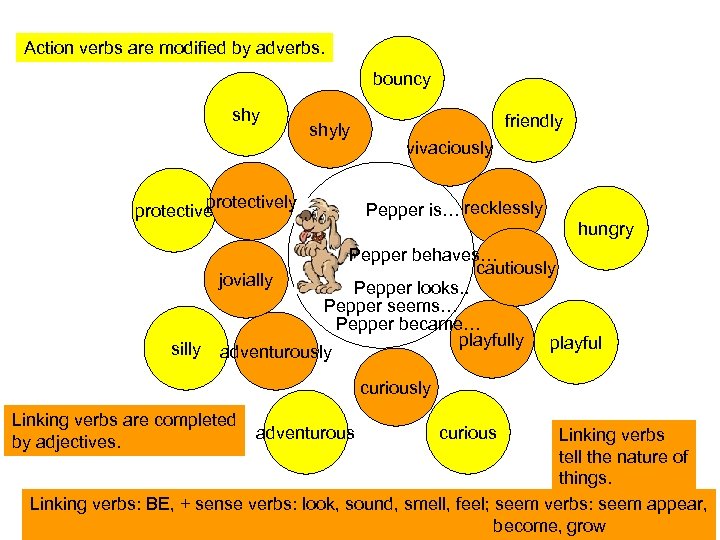 Action verbs are modified by adverbs. bouncy shyly protective silly friendly vivaciously Pepper is… recklessly hungry Pepper behaves… cautiously jovially Pepper looks. . Pepper seems… Pepper became… playfully playful adventurously curiously Linking verbs are completed by adjectives. adventurous curious Linking verbs tell the nature of things. Linking verbs: BE, + sense verbs: look, sound, smell, feel; seem verbs: seem appear, become, grow
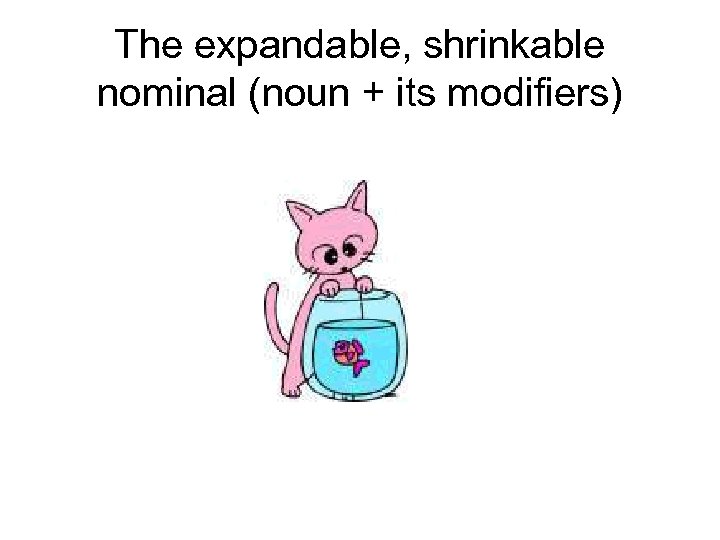 The expandable, shrinkable nominal (noun + its modifiers)
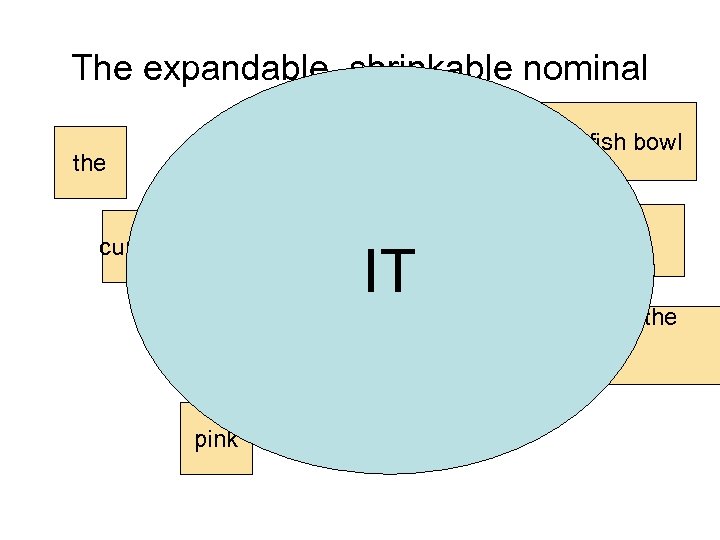 The expandable, shrinkable nominal standing over the fish bowl the curious IT little pink on the bookshelf, looking hungrily at the rainbow fish
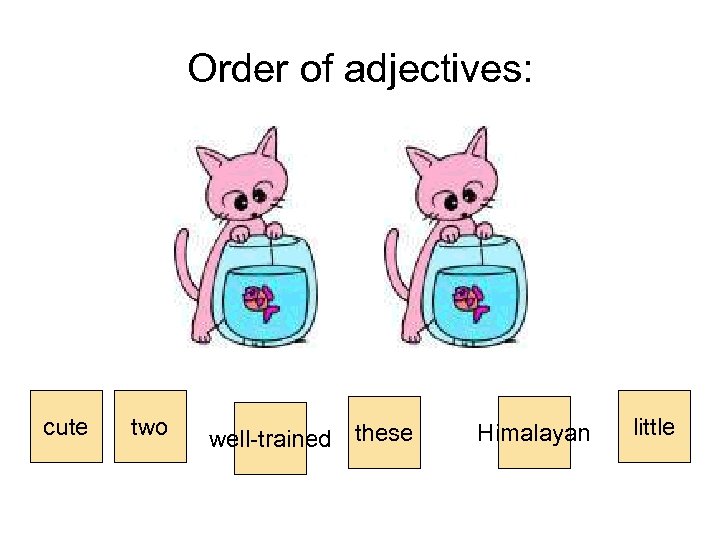 Order of adjectives: cute two well-trained these Himalayan little
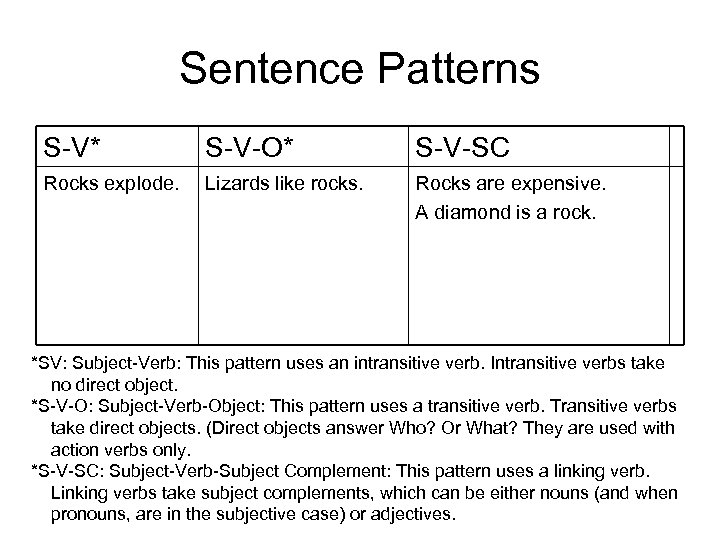 Sentence Patterns S-V* S-V-O* S-V-SC Rocks explode. Lizards like rocks. Rocks are expensive. A diamond is a rock. *SV: Subject-Verb: This pattern uses an intransitive verb. Intransitive verbs take no direct object. *S-V-O: Subject-Verb-Object: This pattern uses a transitive verb. Transitive verbs take direct objects. (Direct objects answer Who? Or What? They are used with action verbs only. *S-V-SC: Subject-Verb-Subject Complement: This pattern uses a linking verb. Linking verbs take subject complements, which can be either nouns (and when pronouns, are in the subjective case) or adjectives.
 A CONCRETE IMAGE OF HOW SENTENCES WORK
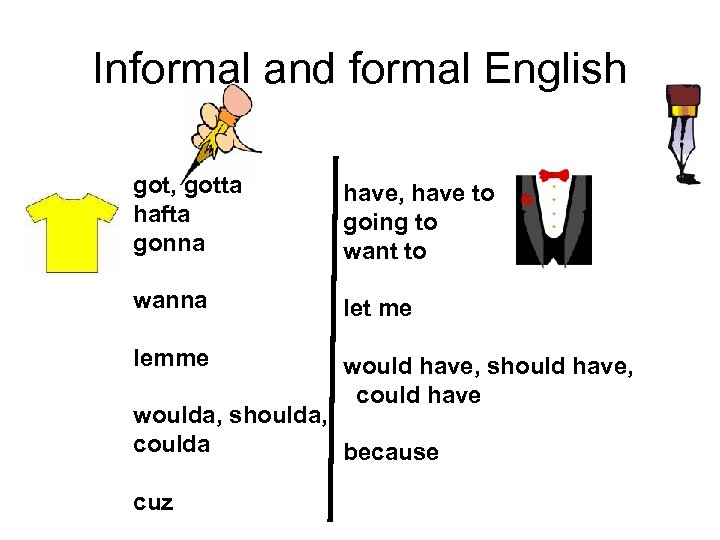 Informal and formal English got, gotta hafta gonna have, have to going to want to wanna let me lemme would have, should have, could have woulda, shoulda, coulda because cuz
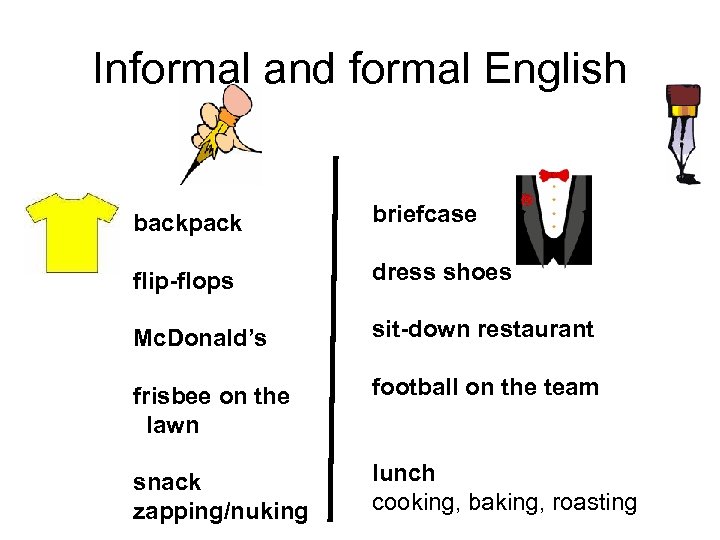 Informal and formal English backpack briefcase flip-flops dress shoes Mc. Donald’s sit-down restaurant frisbee on the lawn football on the team snack zapping/nuking lunch cooking, baking, roasting