 Скачать презентацию Our Abundance and Use of Resources Are Changing
ebef755cdfeb4f8c0d5e6fee53978c12.ppt
- Количество слайдов: 56



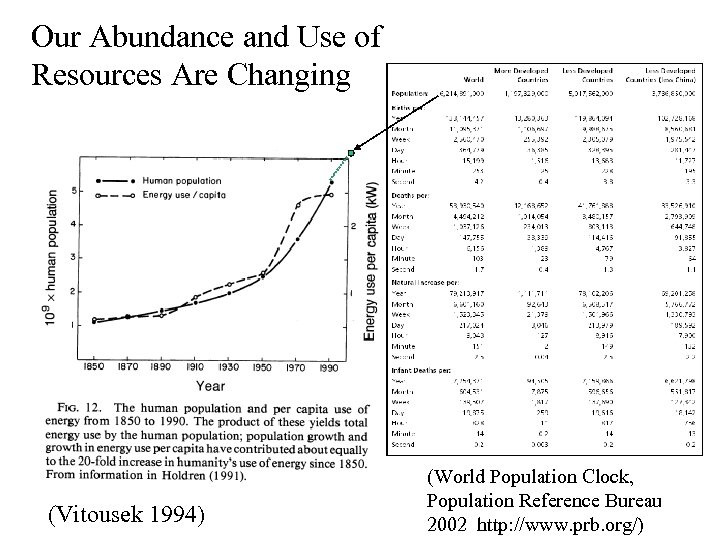
Our Abundance and Use of Resources Are Changing (Vitousek 1994) (World Population Clock, Population Reference Bureau 2002 http: //www. prb. org/)
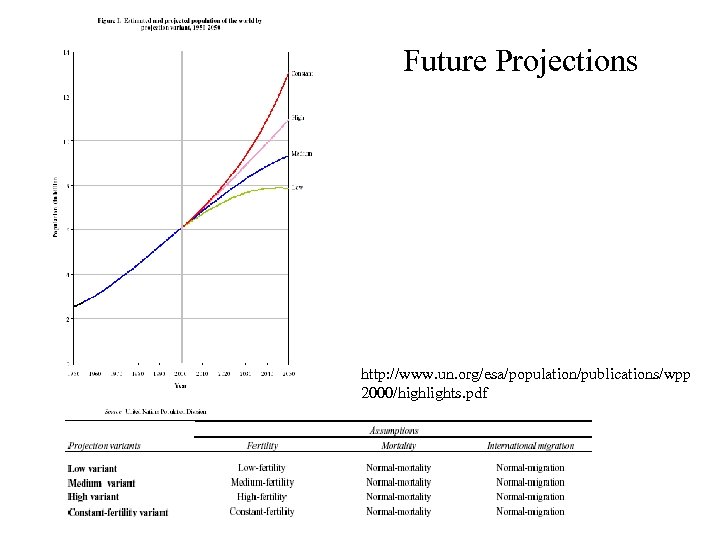
Future Projections http: //www. un. org/esa/population/publications/wpp 2000/highlights. pdf
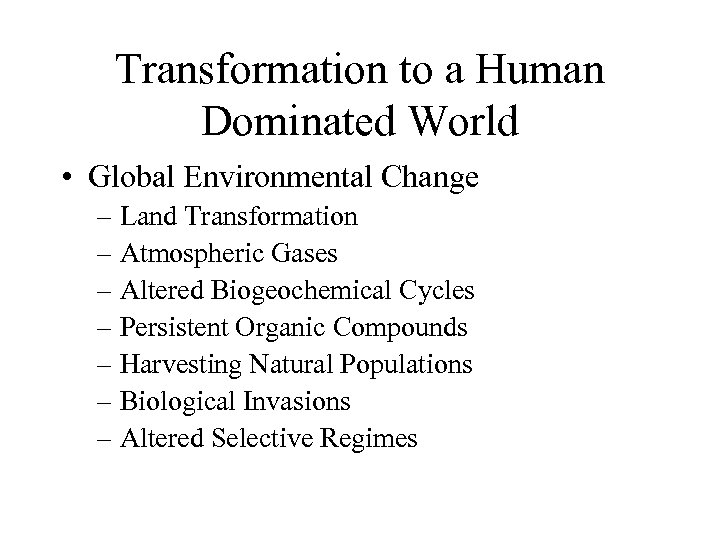
Transformation to a Human Dominated World • Global Environmental Change – Land Transformation – Atmospheric Gases – Altered Biogeochemical Cycles – Persistent Organic Compounds – Harvesting Natural Populations – Biological Invasions – Altered Selective Regimes
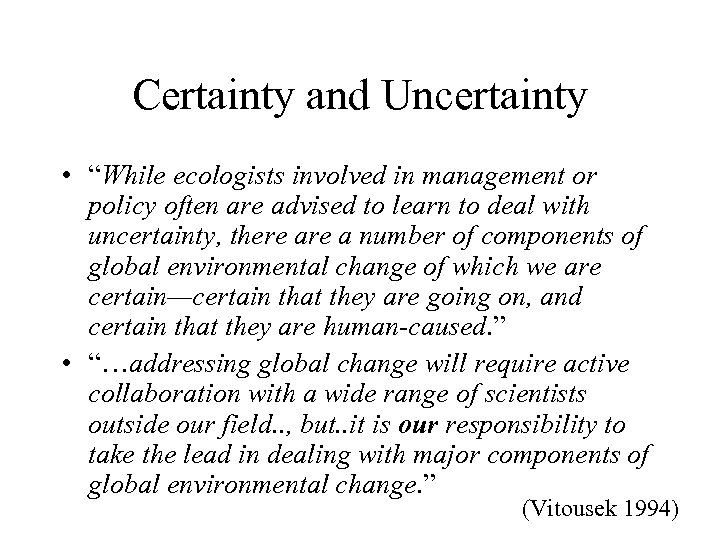
Certainty and Uncertainty • “While ecologists involved in management or policy often are advised to learn to deal with uncertainty, there a number of components of global environmental change of which we are certain—certain that they are going on, and certain that they are human-caused. ” • “…addressing global change will require active collaboration with a wide range of scientists outside our field. . , but. . it is our responsibility to take the lead in dealing with major components of global environmental change. ” (Vitousek 1994)
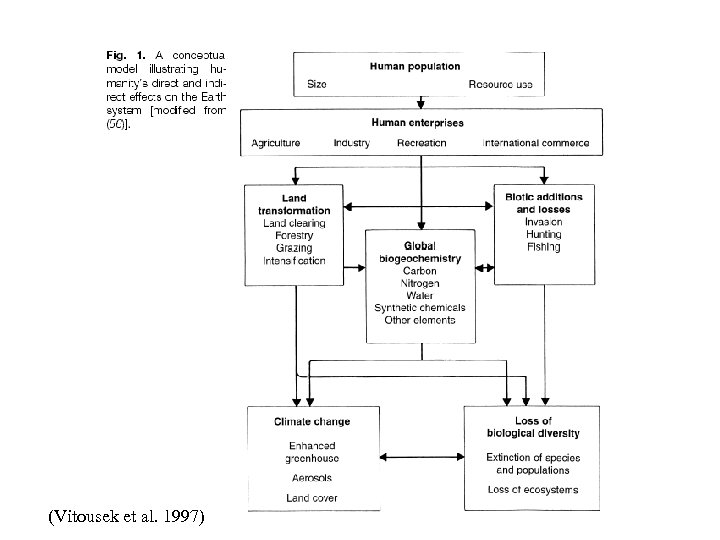
(Vitousek et al. 1997)
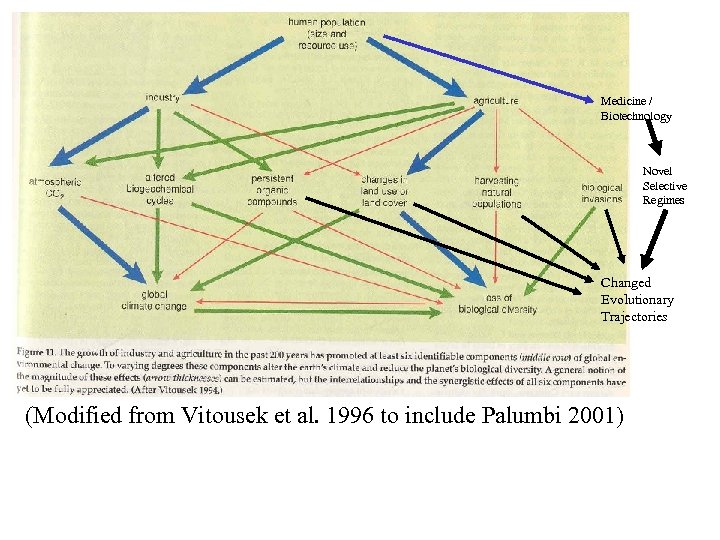
Medicine / Biotechnology Novel Selective Regimes Changed Evolutionary Trajectories (Modified from Vitousek et al. 1996 to include Palumbi 2001)
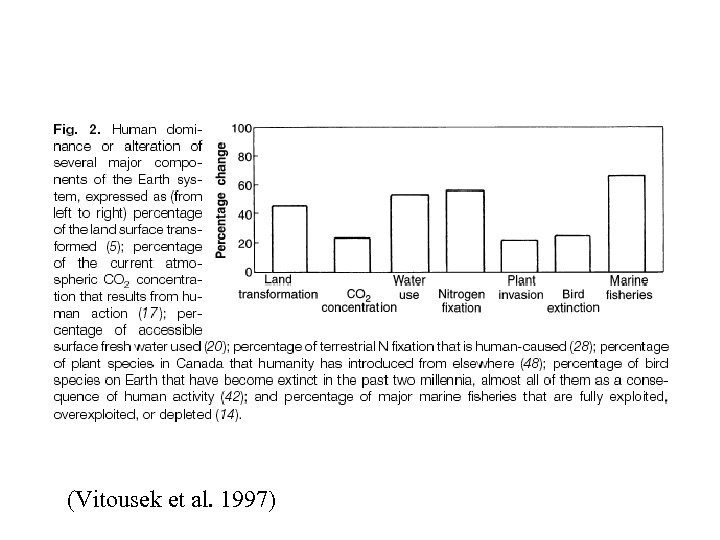
(Vitousek et al. 1997)
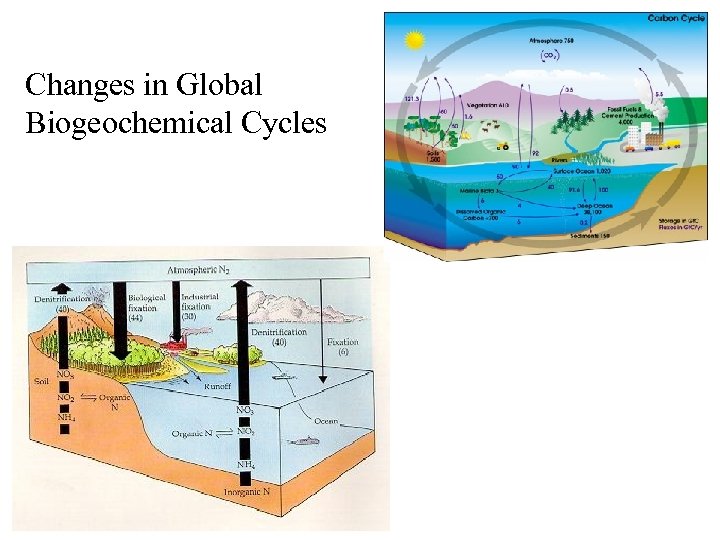
Changes in Global Biogeochemical Cycles
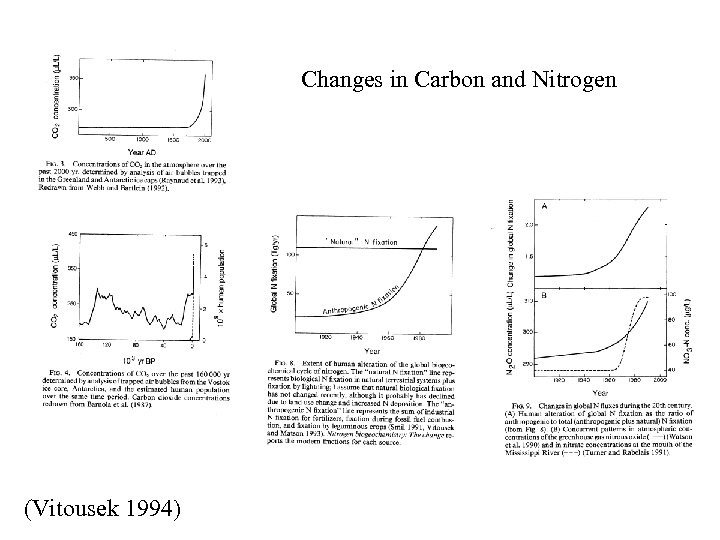
Changes in Carbon and Nitrogen (Vitousek 1994)
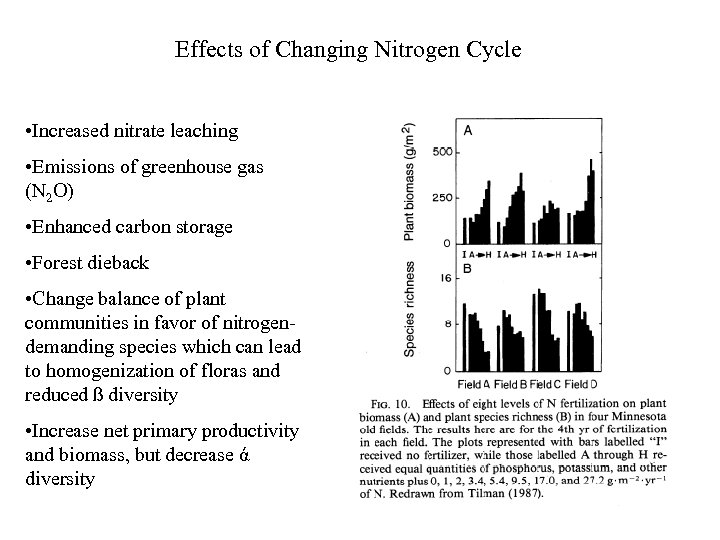
Effects of Changing Nitrogen Cycle • Increased nitrate leaching • Emissions of greenhouse gas (N 2 O) • Enhanced carbon storage • Forest dieback • Change balance of plant communities in favor of nitrogendemanding species which can lead to homogenization of floras and reduced ß diversity • Increase net primary productivity and biomass, but decrease ά diversity
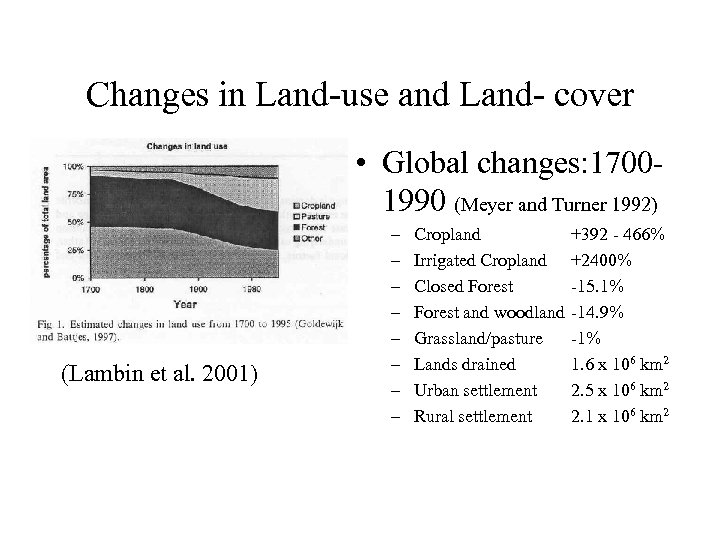
Changes in Land-use and Land- cover • Global changes: 17001990 (Meyer and Turner 1992) (Lambin et al. 2001) – – – – Cropland Irrigated Cropland Closed Forest and woodland Grassland/pasture Lands drained Urban settlement Rural settlement +392 - 466% +2400% -15. 1% -14. 9% -1% 1. 6 x 10⁶ km 2 2. 5 x 10⁶ km 2 2. 1 x 10⁶ km 2
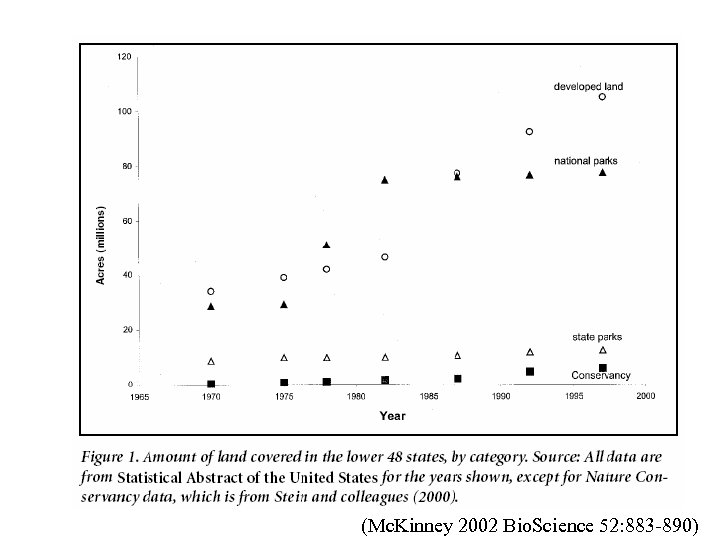
(Mc. Kinney 2002 Bio. Science 52: 883 -890)
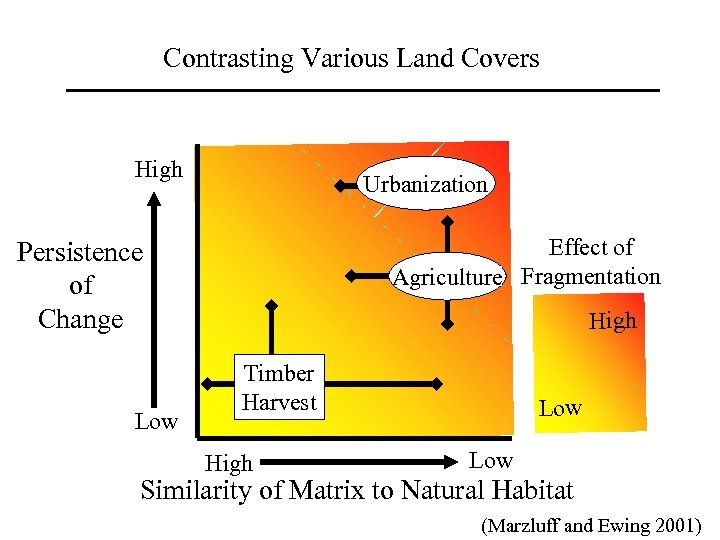
Contrasting Various Land Covers High Urbanization Effect of Agriculture Fragmentation Persistence of Change Low High Timber Harvest High Low Similarity of Matrix to Natural Habitat (Marzluff and Ewing 2001)
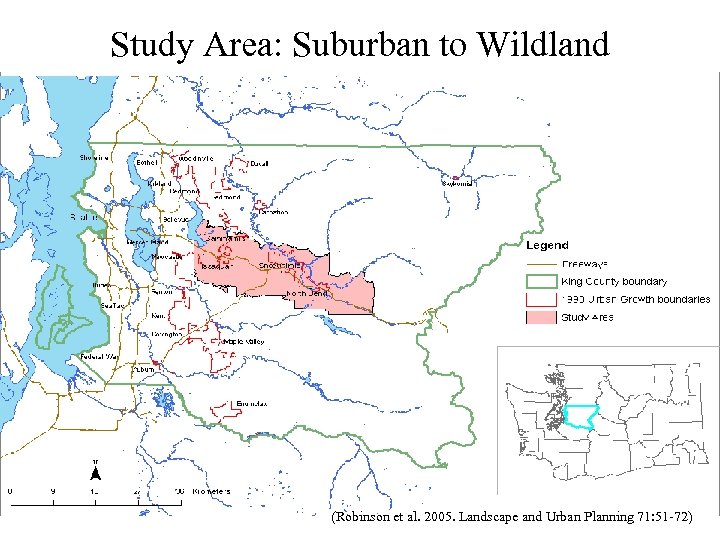
Study Area: Suburban to Wildland Gradients Along I-90 Corridor (Robinson et al. 2005. Landscape and Urban Planning 71: 51 -72)
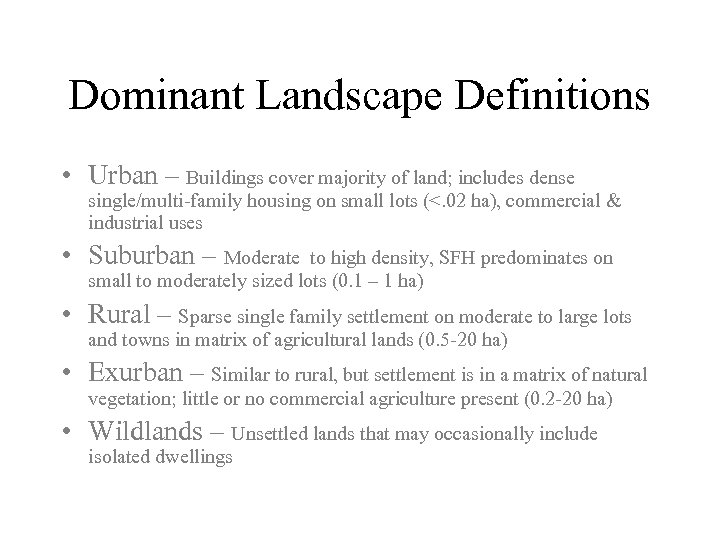
Dominant Landscape Definitions • Urban – Buildings cover majority of land; includes dense single/multi-family housing on small lots (<. 02 ha), commercial & industrial uses • Suburban – Moderate to high density, SFH predominates on small to moderately sized lots (0. 1 – 1 ha) • Rural – Sparse single family settlement on moderate to large lots and towns in matrix of agricultural lands (0. 5 -20 ha) • Exurban – Similar to rural, but settlement is in a matrix of natural vegetation; little or no commercial agriculture present (0. 2 -20 ha) • Wildlands – Unsettled lands that may occasionally include isolated dwellings
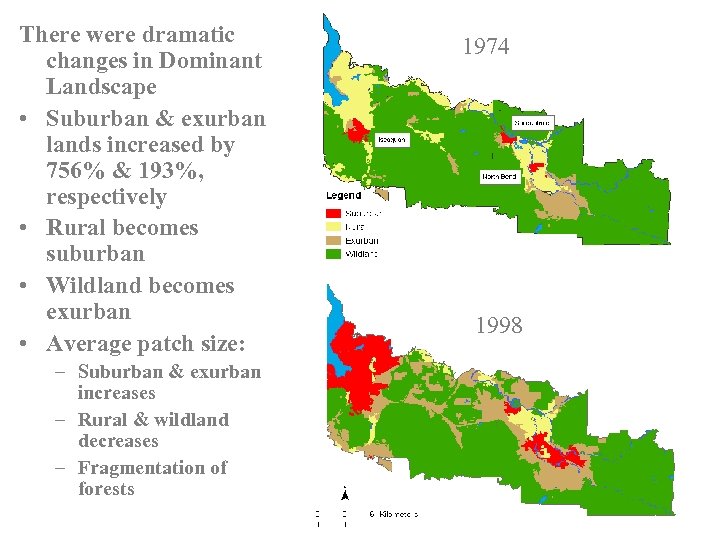
There were dramatic changes in Dominant Landscape • Suburban & exurban lands increased by 756% & 193%, respectively • Rural becomes suburban • Wildland becomes exurban • Average patch size: – Suburban & exurban increases – Rural & wildland decreases – Fragmentation of forests 1974 1998
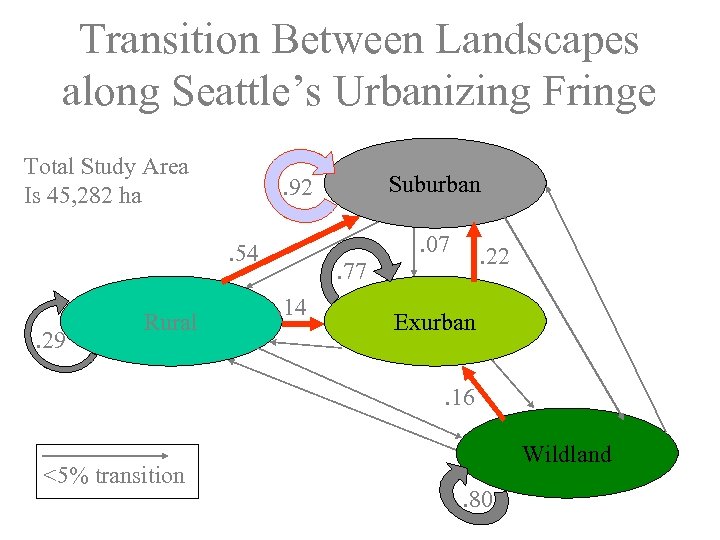
Transition Between Landscapes along Seattle’s Urbanizing Fringe Total Study Area Is 45, 282 ha . 07 . 54 . 29 Rural Suburban . 92 . 22 . 77. 14 Exurban. 16 <5% transition Wildland. 80
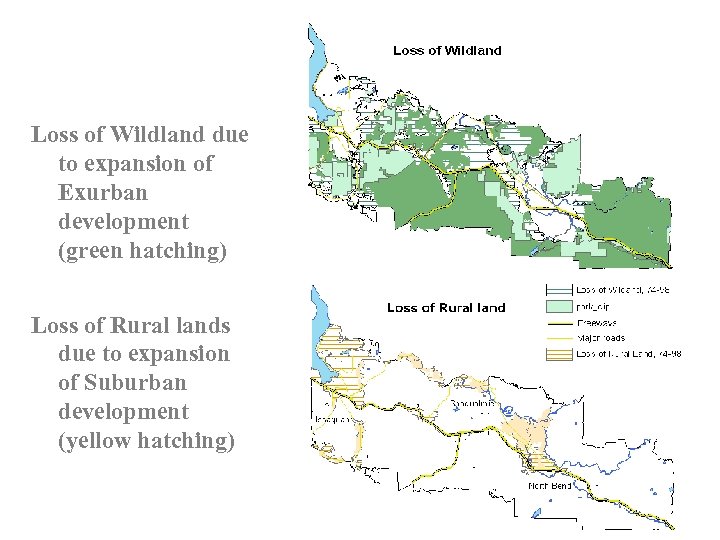
Loss of Wildland due to expansion of Exurban development (green hatching) Loss of Rural lands due to expansion of Suburban development (yellow hatching)
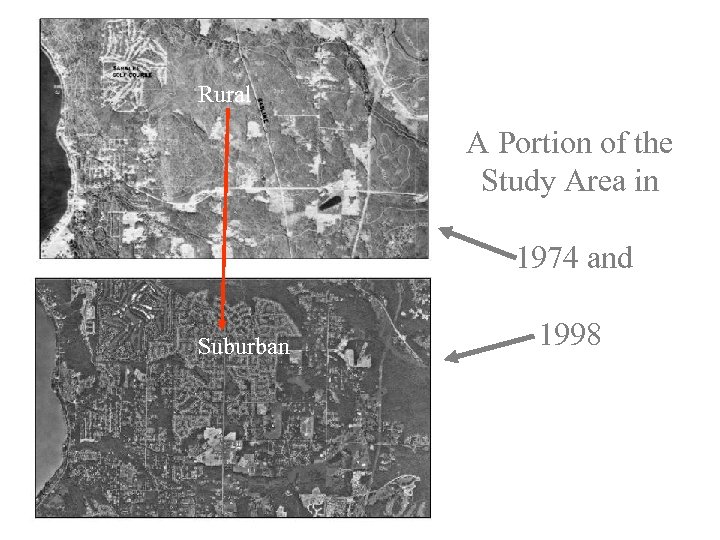
Rural A Portion of the Study Area in 1974 and Suburban 1998
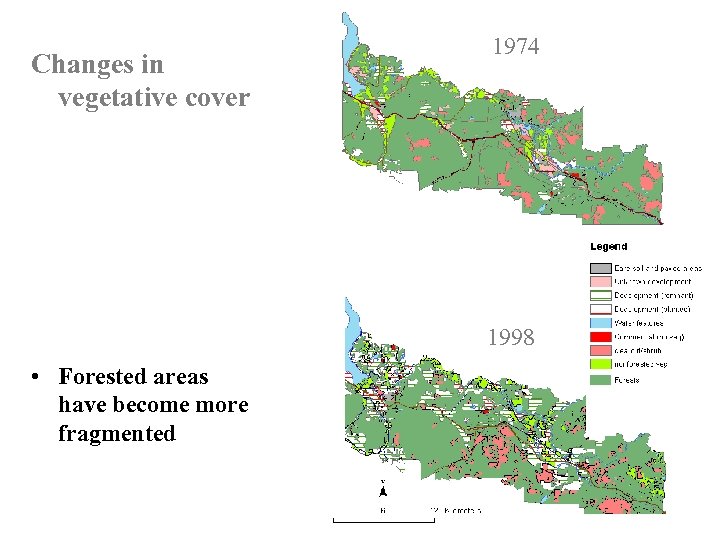
Changes in vegetative cover 1974 1998 • Forested areas have become more fragmented
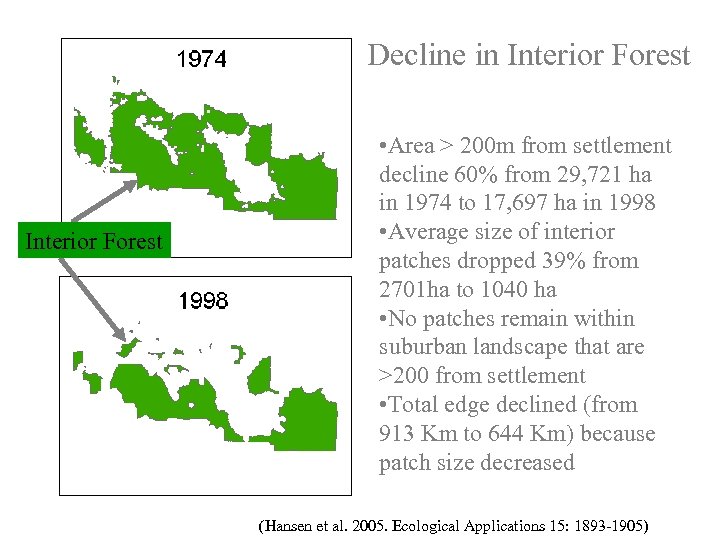
Decline in Interior Forest • Area > 200 m from settlement decline 60% from 29, 721 ha in 1974 to 17, 697 ha in 1998 • Average size of interior patches dropped 39% from 2701 ha to 1040 ha • No patches remain within suburban landscape that are >200 from settlement • Total edge declined (from 913 Km to 644 Km) because patch size decreased (Hansen et al. 2005. Ecological Applications 15: 1893 -1905)
Variations on the Theme • Forest generally decreases with increasing population density – Not so around Chicago (and much of eastern US) where it has increased due to regrowth of logged areas – Not so in Jitai Basin, China where government policy mandates reforestation • Agriculture generally declines with increasing population density – Clear around Chicago and Seattle – Not so in south Florida where wetlands are drained to increase agricultural land (primarily sugar cane) (National Academies of India, China, US 2001)
Ecological Effects of Land-cover and Land-use Change • • Trace gas emissions (CO 2, methane, nitrous oxide) Climate change (by above and direct change in C) Reduced diversity of native species Habitat quality reduced by fragmentation and increased edge • Reduced soil quality resulting from erosion • Increased fertilizer • Changed water quality and flow (Meyer and Turner 1992; Dale 1997)
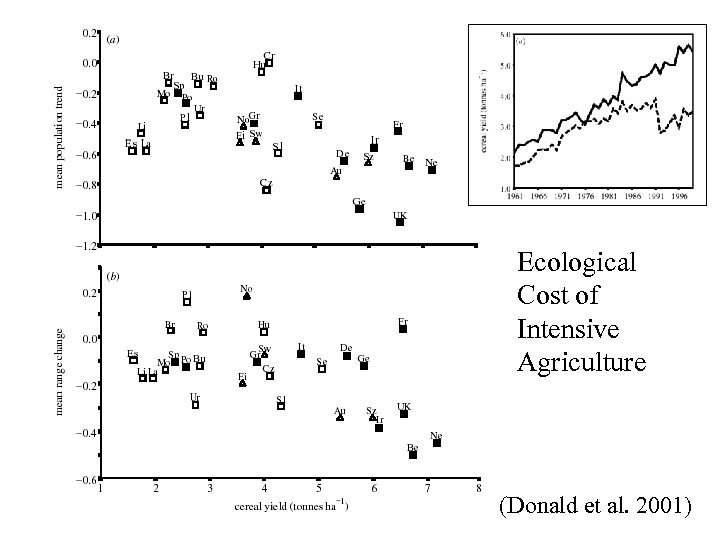
Ecological Cost of Intensive Agriculture (Donald et al. 2001)
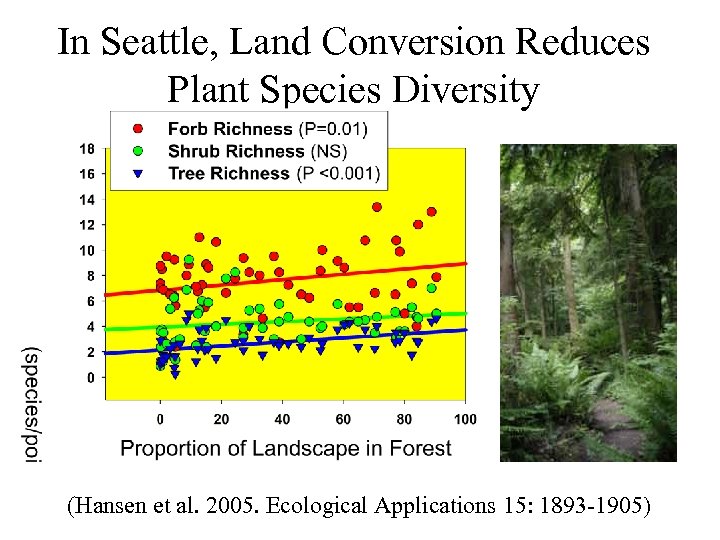
In Seattle, Land Conversion Reduces Plant Species Diversity (Hansen et al. 2005. Ecological Applications 15: 1893 -1905)
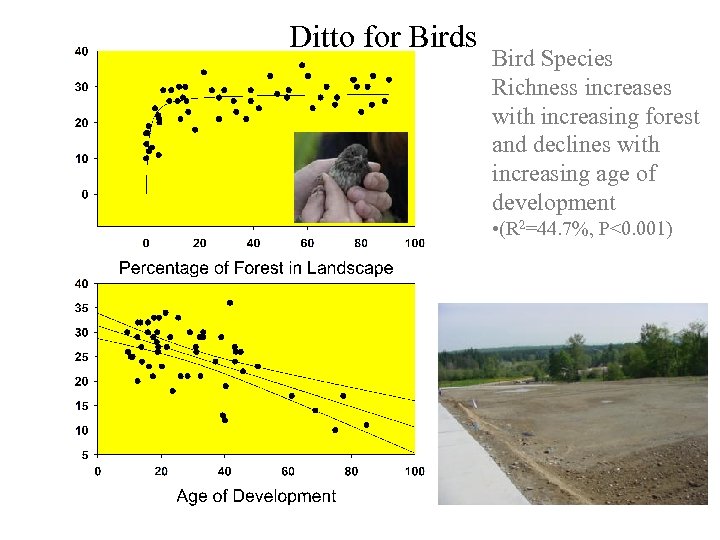
Ditto for Birds Bird Species Richness increases with increasing forest and declines with increasing age of development • (R 2=44. 7%, P<0. 001)
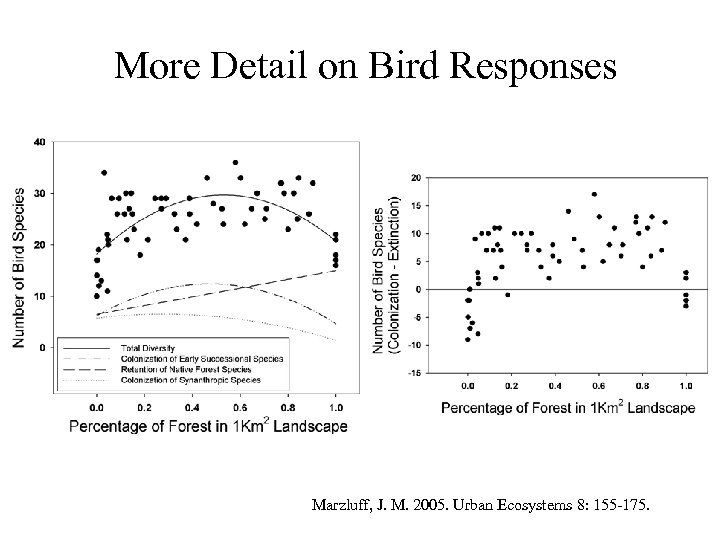
More Detail on Bird Responses Marzluff, J. M. 2005. Urban Ecosystems 8: 155 -175.
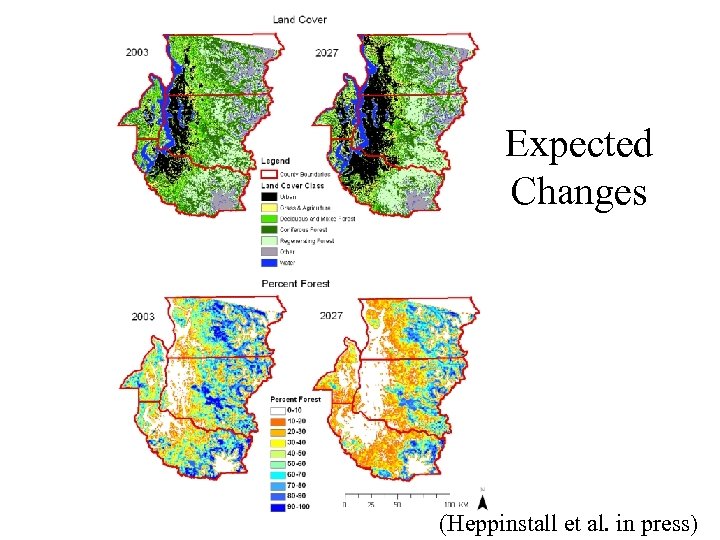
Expected Changes (Heppinstall et al. in press)
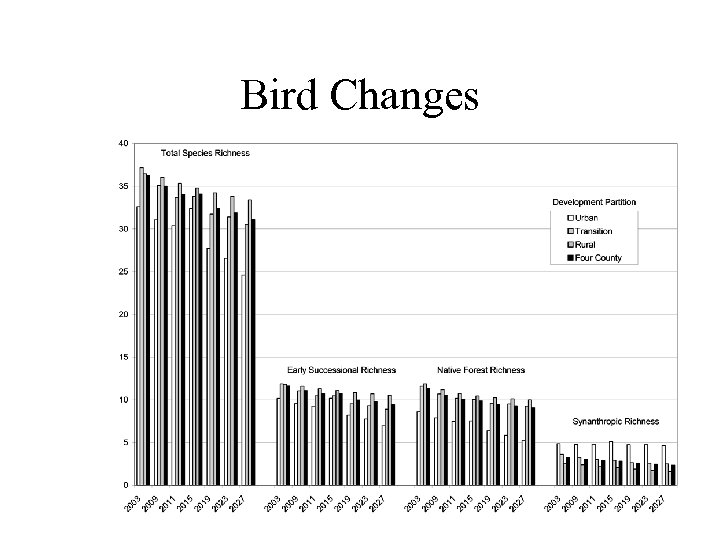
Bird Changes
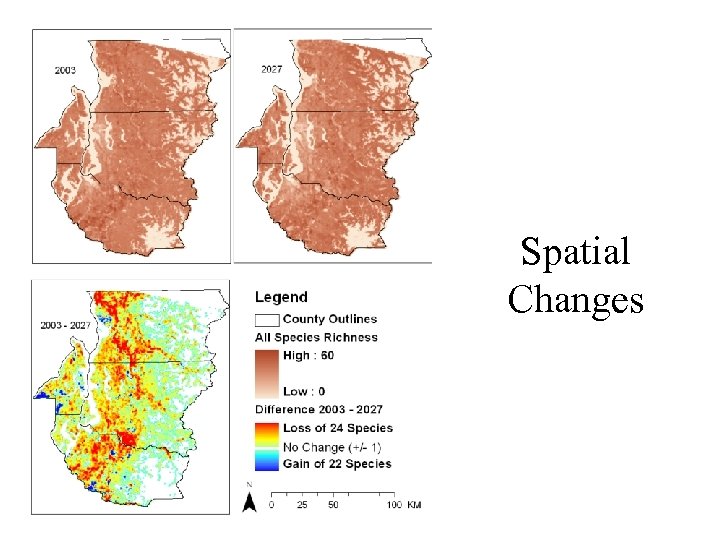
Spatial Changes
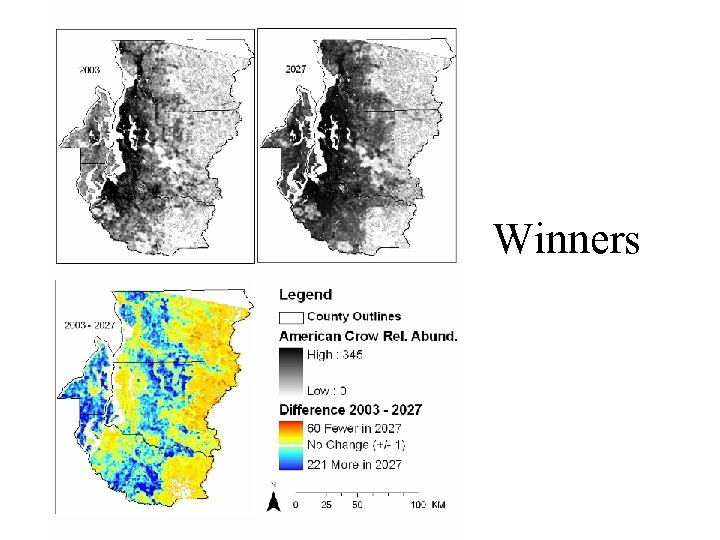
Winners
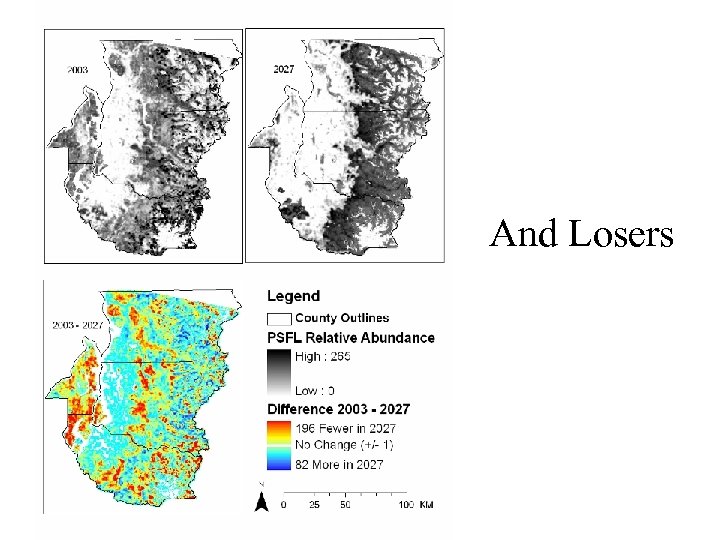
And Losers
Change in Global Climate • 0. 6°C increase in average global temperature over last 100 years • Projected to continue at rapid rate (1. 4 -5. 8°C by 2100) • Increase CO 2 is a primary reason for Global Warming • Changed nitrogen cycle (increased N 2 O) also plays a role • Land use change is less important
Effects of Global Warming • Largest effects expected in north, where temp changes are greatest – Change in density or distribution • (75 – 81% of studies show expected change; 6 km/decade north) – Change in timing of events • Migration, flowering, egg laying (87% of studies confirm) – Change in composition of community • (74 – 91% confirm more northern species) – Change in morphology – Change in gene frequency (Root et al. 2003, Parmesan and Yohe 2003))
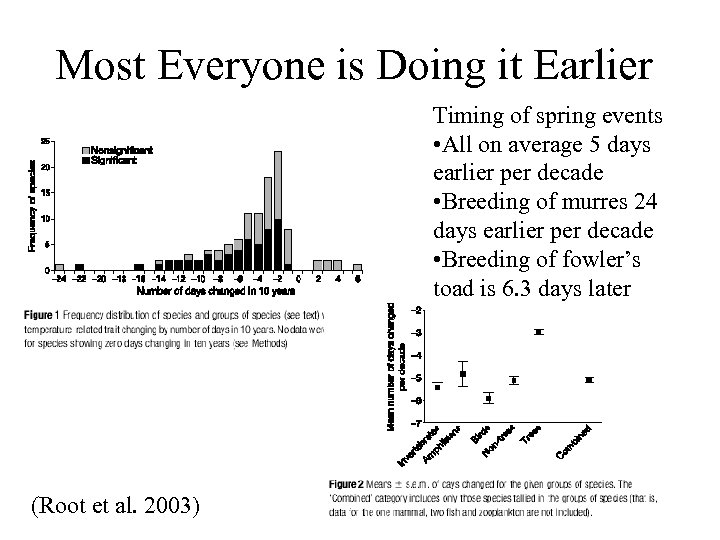
Most Everyone is Doing it Earlier Timing of spring events • All on average 5 days earlier per decade • Breeding of murres 24 days earlier per decade • Breeding of fowler’s toad is 6. 3 days later (Root et al. 2003)
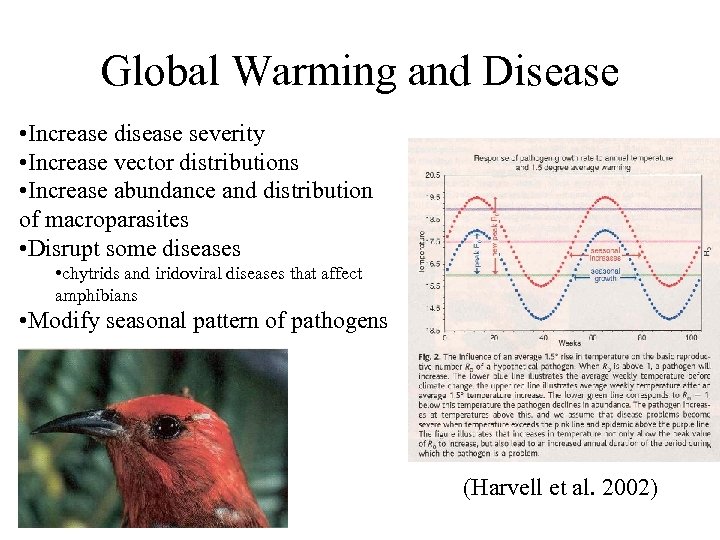
Global Warming and Disease • Increase disease severity • Increase vector distributions • Increase abundance and distribution of macroparasites • Disrupt some diseases • chytrids and iridoviral diseases that affect amphibians • Modify seasonal pattern of pathogens (Harvell et al. 2002)
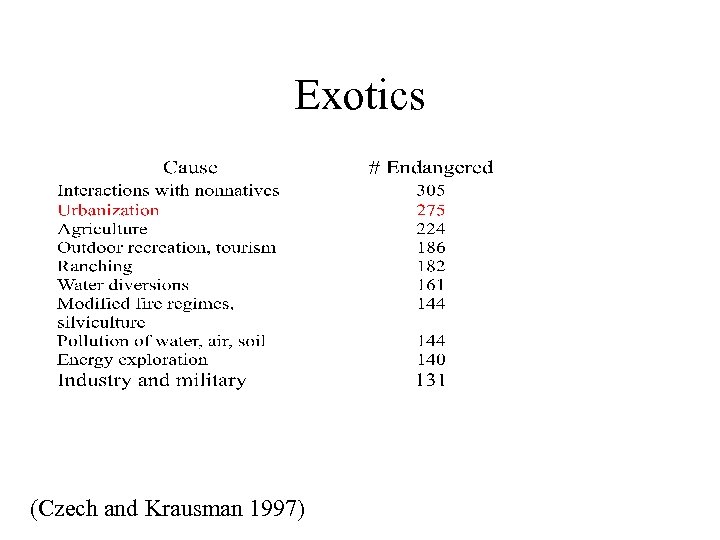
Exotics (Czech and Krausman 1997)
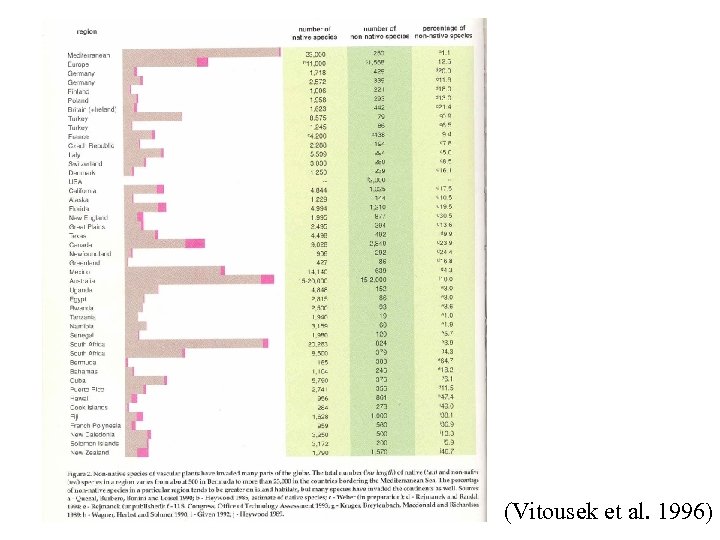
(Vitousek et al. 1996)
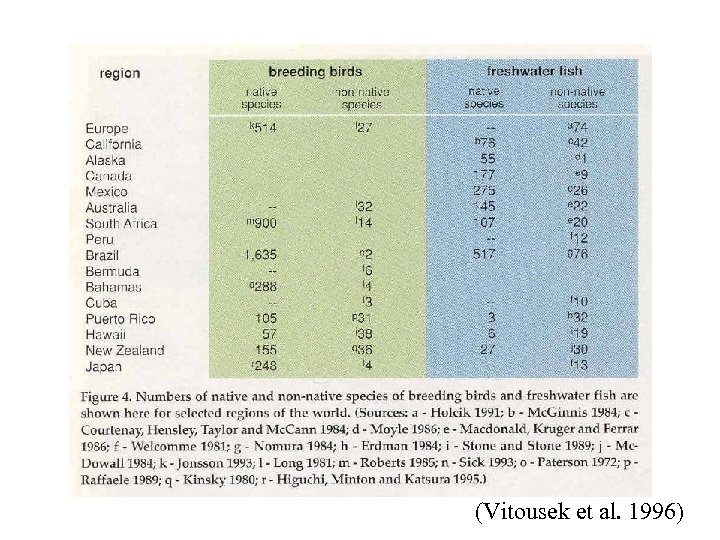
(Vitousek et al. 1996)
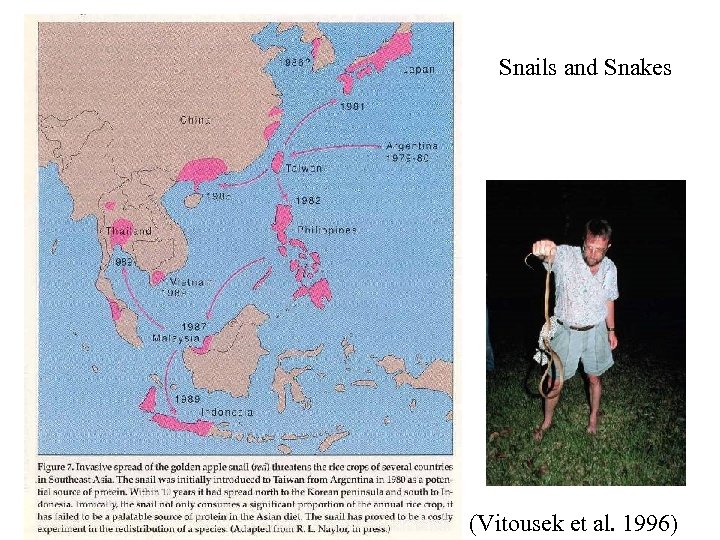
Snails and Snakes (Vitousek et al. 1996)
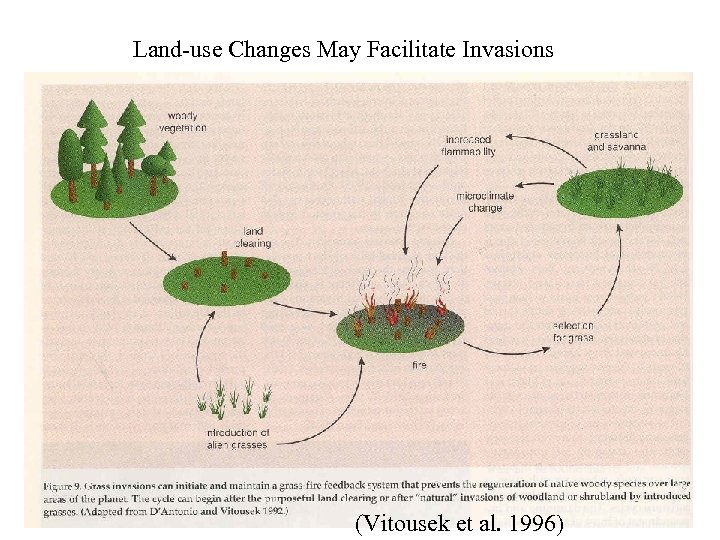
Land-use Changes May Facilitate Invasions (Vitousek et al. 1996)
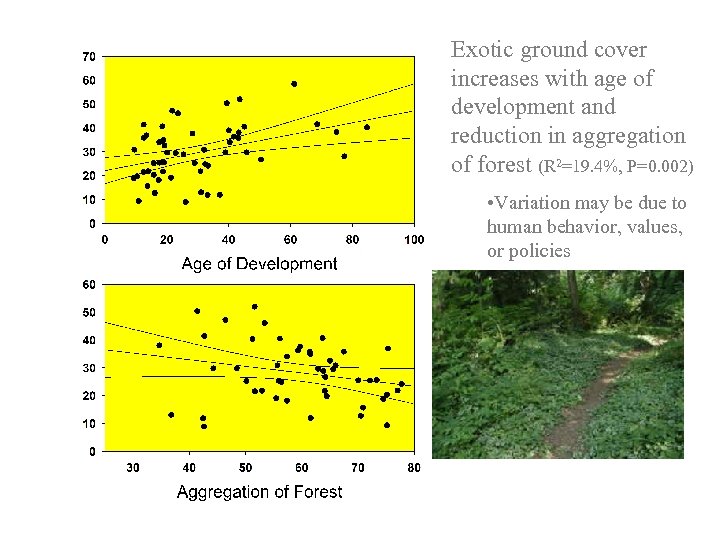
Exotic ground cover increases with age of development and reduction in aggregation of forest (R 2=19. 4%, P=0. 002) • Variation may be due to human behavior, values, or policies
Parks are Not Immune • Pigs, goats, burros, mountain goats • Lake, brook, and rainbow trout • White pine blister rust – 100 yrs ago from Europe nurserys – Whitebark pines in Glacier, Yellowstone, Grand Teton • Loss of important grizzly food • Barred owls and spotted owls
Consequences of Exotic Invasions • Newly introduced species can act as vectors of disease – Asian tiger mosquito • Invaders can drain resources – Apple snail ($28 -45 million in Philippines in 1990) • Invaders can alter ecosystem processes – Myrica faya in Hawaii facilitates succession on volcanic soils by fixing nitrogen • Reduce Biological diversity – Gypsy moths, chestnut blights, etc. • Promote extinction – Importance to ESA listing (Vitousek et al. 1996)
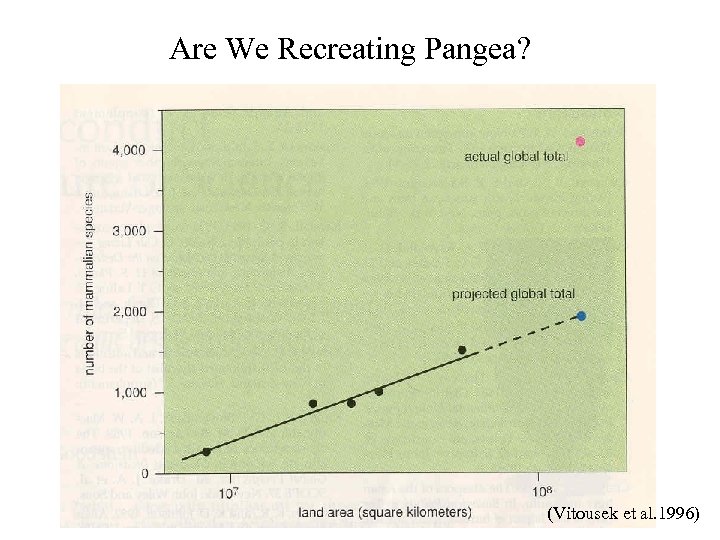
Are We Recreating Pangea? (Vitousek et al. 1996)
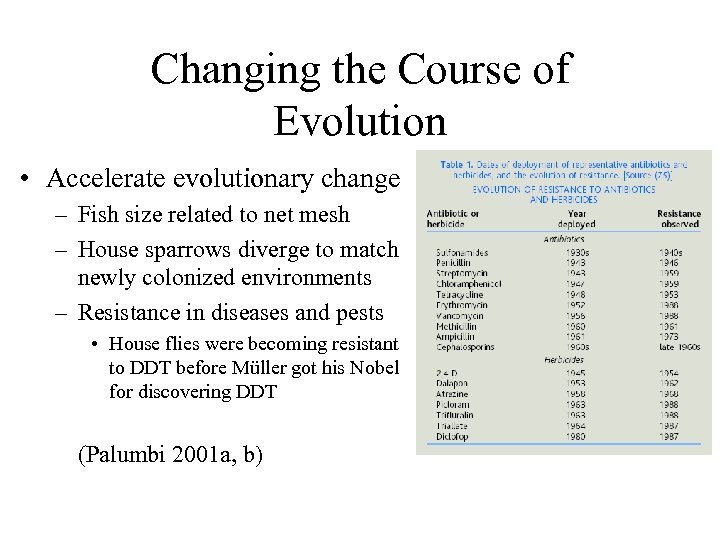
Changing the Course of Evolution • Accelerate evolutionary change – Fish size related to net mesh – House sparrows diverge to match newly colonized environments – Resistance in diseases and pests • House flies were becoming resistant to DDT before Müller got his Nobel for discovering DDT (Palumbi 2001 a, b)
Debate over Direct and Indirect Effect of Population, per se • Is IPAT too simple? • Other factors may mediate or determine the effect of humans • Malthus vs. neoclassical economics – will we exceed k or will we keep increasing k? • Population may be large scale factor – Increasing population demands more resources – But local social, institutional, political, and economic factors determine where and how resources are taken » Globalization allows disconnect between sources of demand location of production (Meyer and Turner 1992; Lambin et al. 2001; National Academies of India, China, US 2001)
• Land change appears to result from: – “individual and social responses follow from changing economic conditions, mediated by institutional factors. Opportunities and constraints for new land uses are created by markets and policies, increasingly influenced by global factors. Extreme biophysical events occasionally trigger further changes. Various human-environment conditions react to and reshape the impacts of drivers differently, leading to specific pathyways of land-use change. ” (Lambin et al. 2001)
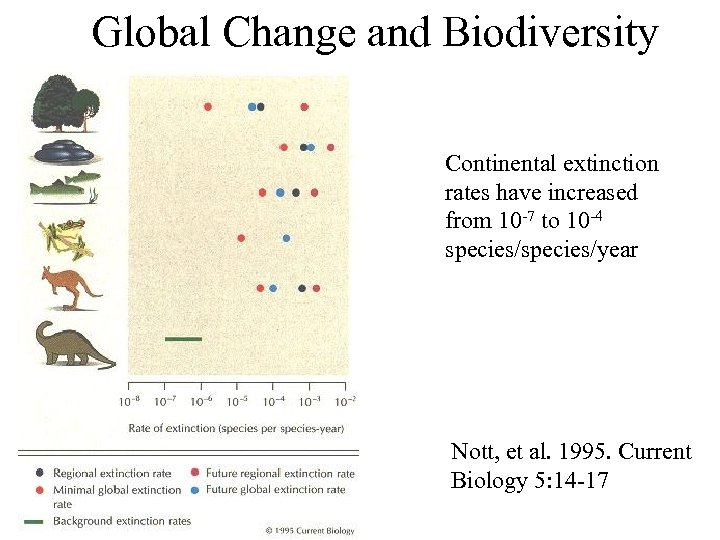
Global Change and Biodiversity Continental extinction rates have increased from 10 -7 to 10 -4 species/year Nott, et al. 1995. Current Biology 5: 14 -17
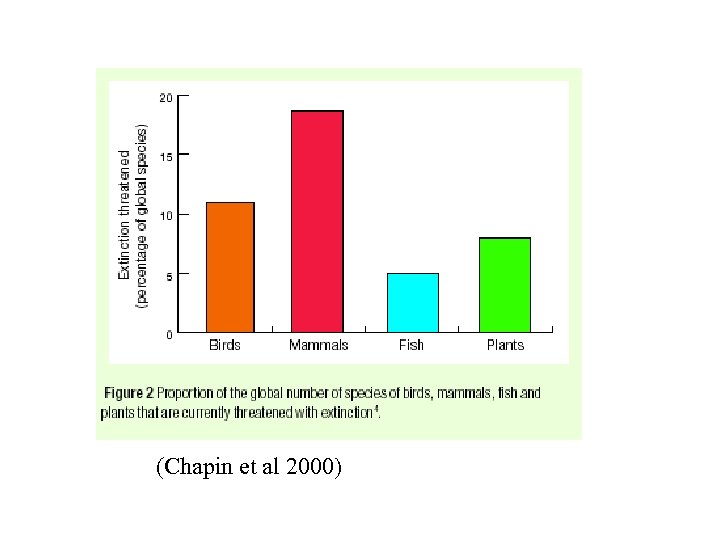
(Chapin et al 2000)
Does it Matter? • Hell Yes – Much is unknown, so save the parts • Leopold’s advice for intelligent tinkering is to save all the parts – How many rivets can we pop? • Ehrlich and Ehrlich 1983. Extinction: the causes and consequences of the disappearance of species. New York: Ballatine Books – Biodiversity is connected to ecosystem function • Loreau 2000; Tilman 2000; Chapin et al. 2000.
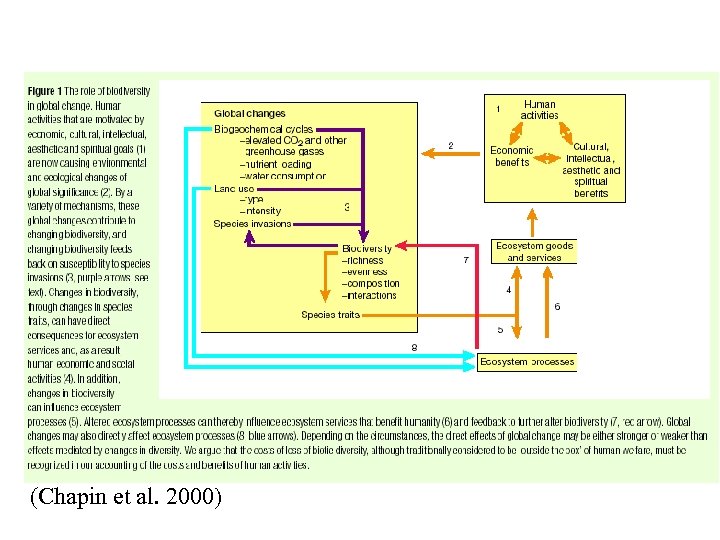
(Chapin et al. 2000)
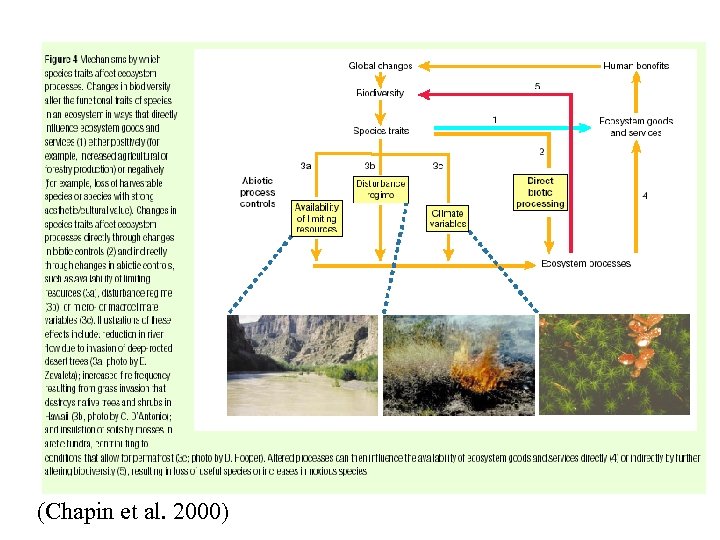
(Chapin et al. 2000)
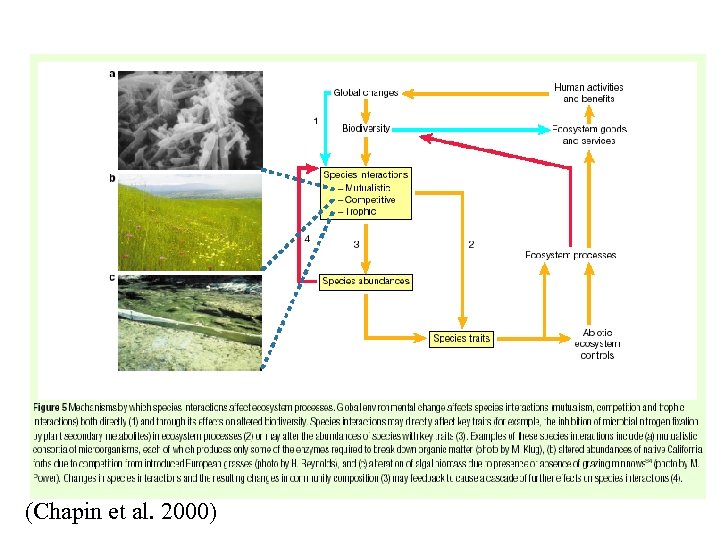
(Chapin et al. 2000)
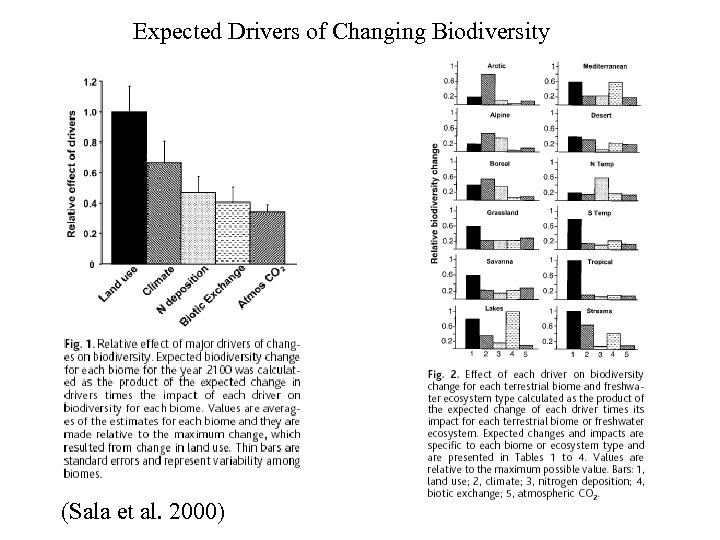
Expected Drivers of Changing Biodiversity (Sala et al. 2000)
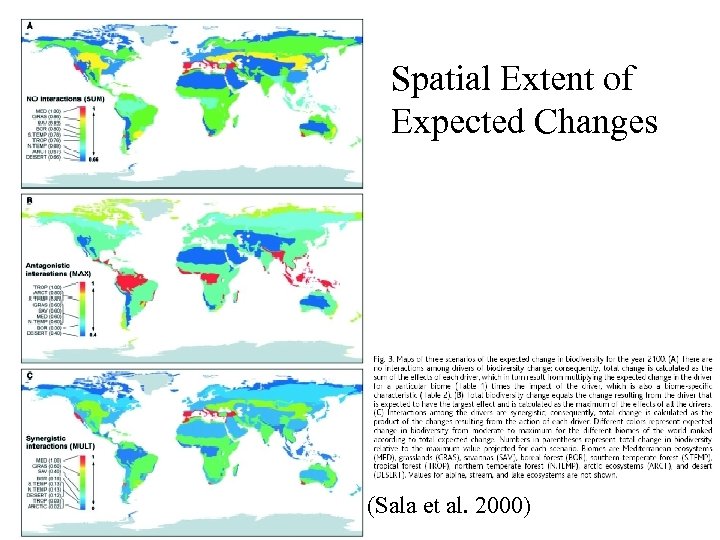
Spatial Extent of Expected Changes (Sala et al. 2000)
Скачать презентацию Our Abundance and Use of Resources Are Changing
ebef755cdfeb4f8c0d5e6fee53978c12.ppt