 Скачать презентацию ОТКРЫТОЕ АКЦИОНЕРНОЕ ОБЩЕСТВО ОРДЕНА ЛЕНИНА НАУЧНО-ИССЛЕДОВАТЕЛЬСКИЙ И КОНСТРУКТОРСКИЙ
0b4b9ff5c7c685c41a16932a947d477e.ppt
- Количество слайдов: 24



ОТКРЫТОЕ АКЦИОНЕРНОЕ ОБЩЕСТВО «ОРДЕНА ЛЕНИНА НАУЧНО-ИССЛЕДОВАТЕЛЬСКИЙ И КОНСТРУКТОРСКИЙ ИНСТИТУТ ЭНЕРГОТЕХНИКИ ИМЕНИ Н. А. ДОЛЛЕЖАЛЯ» N. A. Dollezhal Research and Development Institute of Power Engineering SCIENTIFIC AND TECHNICAL SUPPORT OF CHANNEL-TYPE REACTOR PLANT OPERATION Dragunov Y. G. , Petrov А. А. MNTK-2010
MAIN PERFORMANCE INDICATORS OF RBMK NPPs IN 2009 ШPower generation – 75382, 3 million KW/h (46, 2% of the total output); ШCapacity factor – 78, 23%; ШAvailability factor – 80, 41%; ШNumber of violations– 13 (in 2008 – 18); ШNumber of scrams – 7 (in 2008 – 4). Note: This period was characterised by modernisation and special system introduction at power units Kursk-4 and Leningrad-4 which was the reason for those units long-term shutdowns. 2 2
MAIN ACTIVITIES AT RBMK POWER UNITS completed in the second half of 2008 – beginning of 2010 with OAO RDIPE specialists’ involvement ь Completion of Kursk-4 and Leningrad-4 power units modernisation and reconstruction; ь ISA development for Smolensk-1 and Leningrad-3 power units; ь Performance of work on Leningrad-3 power unit life time extension; ь Development of substantiation for Kursk-2, Leningrad-2 & 3 power units operation at 105% power; ь Testing of Kursk-1 & 2 and Leningrad-2 power units at increased power. 3 3
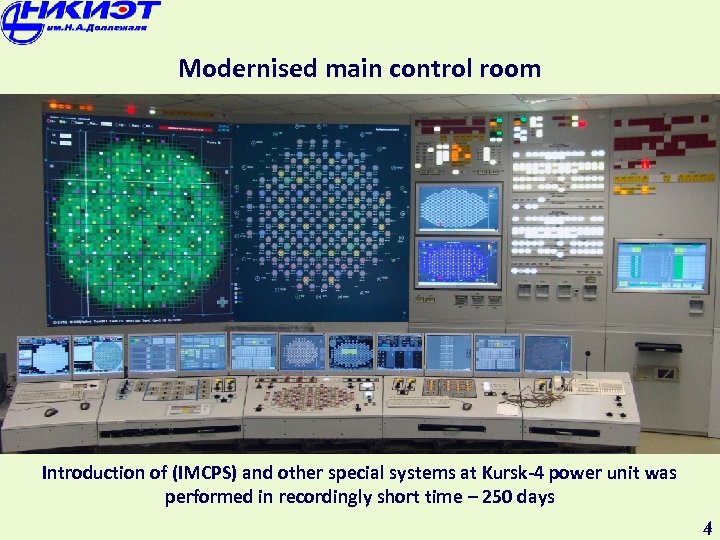
Modernised main control room Introduction of (IMCPS) and other special systems at Kursk-4 power unit was performed in recordingly short time – 250 days 4 4
WORK ON REACTOR NEUTRONICS AND FUEL UTILIZATION EFFICIENCY IMPROVEMENT q In 2008 -2009 core modernisation involving IICPS introduction was completed at Leningrad-3, Kursk-3 & 4 power units. q Replacement of CPS regulators with cluster-type ones. q Reactor neutronics calculations and experimental study were performed. q. Modernisation of the reactor cores led to reactor neutronics and nuclear safety improvement. Changes in reactor neutronics at the rated power following core modernisation are demonstrated with an example of Kursk-4 power unit. 5 5
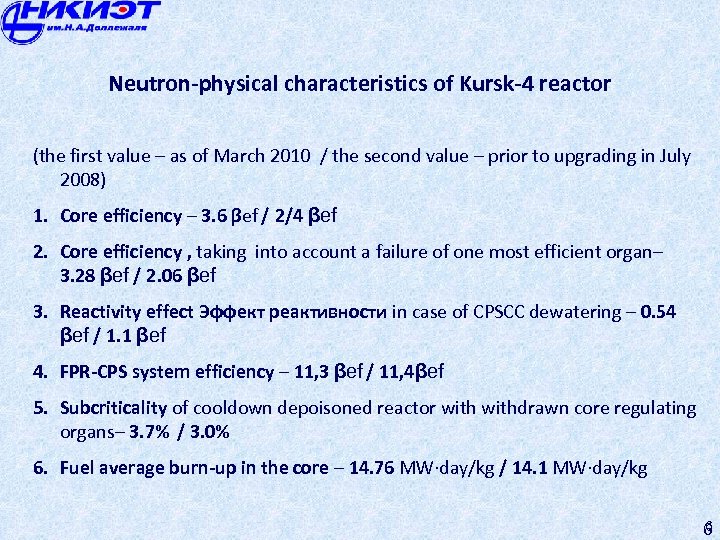
Neutron-physical characteristics of Kursk-4 reactor (the first value – as of March 2010 / the second value – prior to upgrading in July 2008) 1. Core efficiency – 3. 6 βef / 2/4 βef 2. Core efficiency , taking into account a failure of one most efficient organ– 3. 28 βef / 2. 06 βef 3. Reactivity effect Эффект реактивности in case of CPSCC dewatering – 0. 54 βef / 1. 1 βef 4. FPR-CPS system efficiency – 11, 3 βef / 11, 4βef 5. Subcriticality of cooldown depoisoned reactor withdrawn core regulating organs– 3. 7% / 3. 0% 6. Fuel average burn-up in the core – 14. 76 MW·day/kg / 14. 1 MW·day/kg 6 6
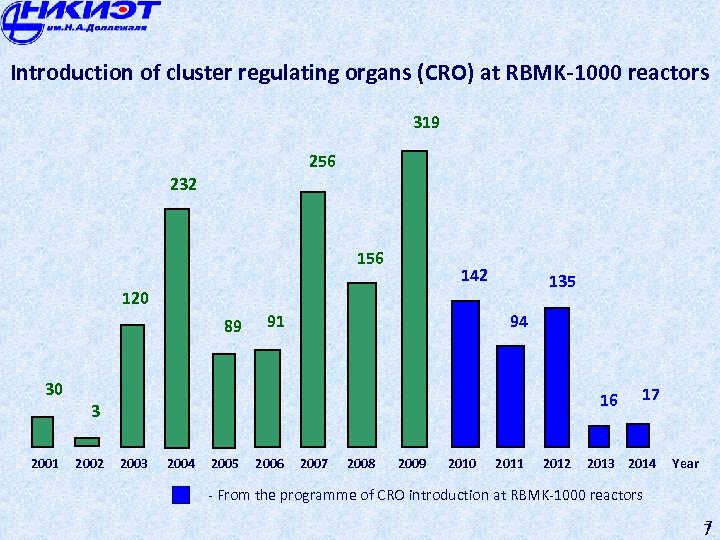
Introduction of cluster regulating organs (CRO) at RBMK-1000 reactors 319 256 232 156 142 135 120 89 30 3 91 94 16 17 2001 2002 2003 2004 2005 2006 2007 2008 2009 2010 2011 2012 2013 2014 Year - From the programme of CRO introduction at RBMK-1000 reactors 7 7
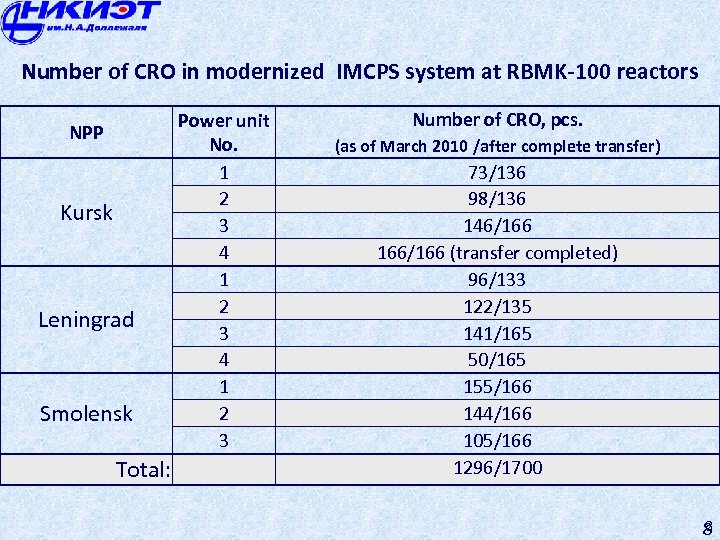
Number of CRO in modernized IMCPS system at RBMK-100 reactors NPP Kursk Leningrad Smolensk Total: Power unit No. 1 2 3 4 1 2 3 Number of CRO, pcs. (as of March 2010 /after complete transfer) 73/136 98/136 146/166 166/166 (transfer completed) 96/133 122/135 141/165 50/165 155/166 144/166 105/166 1296/1700 8 8
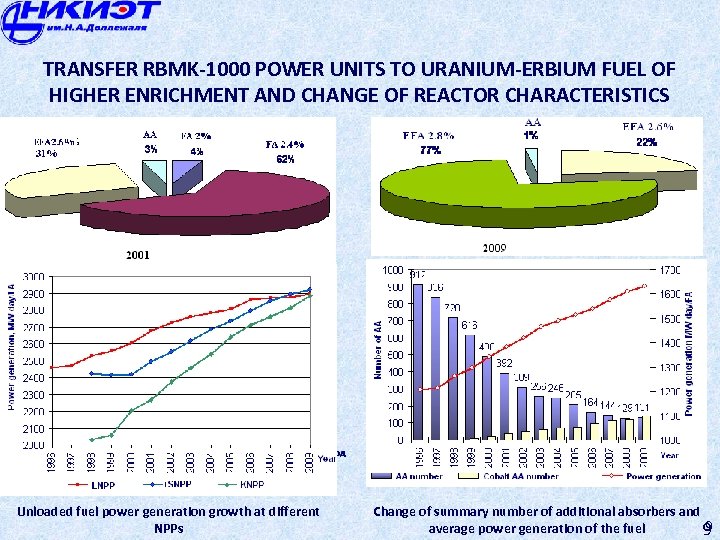
TRANSFER RBMK-1000 POWER UNITS TO URANIUM-ERBIUM FUEL OF HIGHER ENRICHMENT AND CHANGE OF REACTOR CHARACTERISTICS 2001 год Unloaded fuel power generation growth at different NPPs 2009 год Change of summary number of additional absorbers and 9 average power generation of the fuel 9
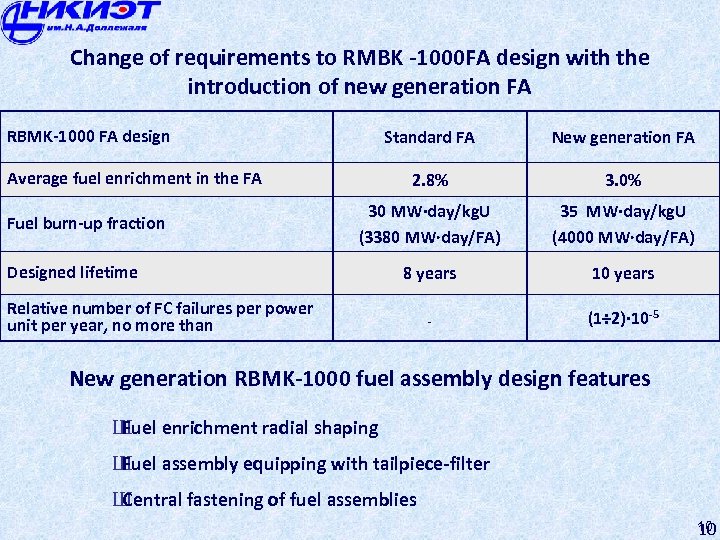
Change of requirements to RMBK -1000 FA design with the introduction of new generation FA RBMK-1000 FA design Standard FA New generation FA 2. 8% 3. 0% 30 MW∙day/kg. U (3380 MW day/FA) 35 MW∙day/kg. U (4000 MW day/FA) 8 years 10 years - (1÷ 2)∙ 10 -5 Average fuel enrichment in the FA Fuel burn-up fraction Designed lifetime Relative number of FC failures per power unit per year, no more than New generation RBMK-1000 fuel assembly design features Ш Fuel enrichment radial shaping Ш Fuel assembly equipping with tailpiece-filter Ш Central fastening of fuel assemblies 10 10
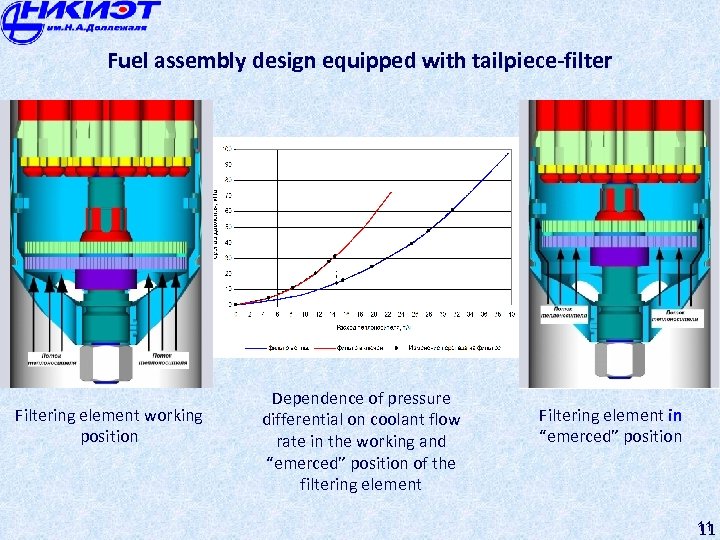
Fuel assembly design equipped with tailpiece-filter Filtering element working position Dependence of pressure differential on coolant flow rate in the working and “emerced” position of the filtering element Filtering element in “emerced” position 11 11
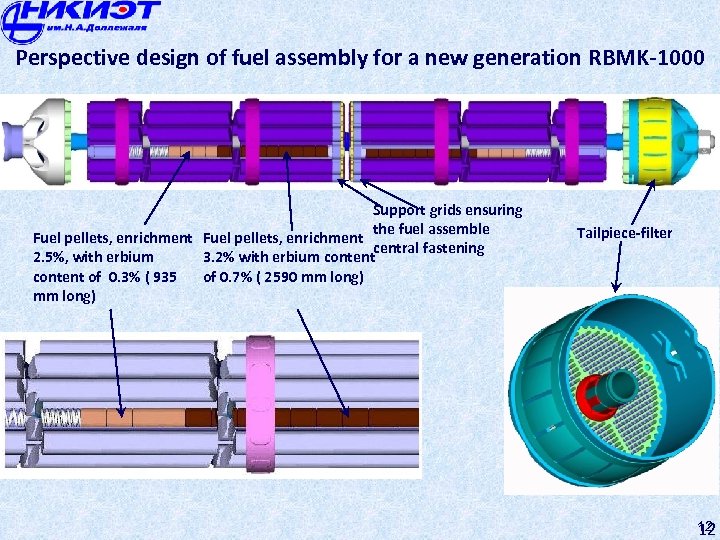
Perspective design of fuel assembly for a new generation RBMK-1000 Support grids ensuring the fuel assemble Fuel pellets, enrichment central fastening 2. 5%, with erbium 3. 2% with erbium content of 0. 3% ( 935 of 0. 7% ( 2590 mm long) Tailpiece-filter 12 12
CALCULATION, ANALYTICAL AND EXPERIMENTAL WORKS FOR CALCULATION CODES UPGRADING Ш Development operative three-dimensional neutron-hydraulic code based on PC SADCO (introduction at Power Unit 2 of Leningrad NPP in 2010); Ш Development of PC and calculation models for 3 D precision neutron-physical calculations for RBMK reactors by Monte-Carlo method; Ш Performing experimental research at TKR (fuel channel – rupture) test device (ENIC) of FC brittle rupture and possibility of dependant rupture of neighbouring channels (for U_STACK code verification); Ш At the PSB-RBMK test device (ENIC), a series of experiments is being performed to support RELAP 5/Mod 3. 2 calculation code verification. 13 13
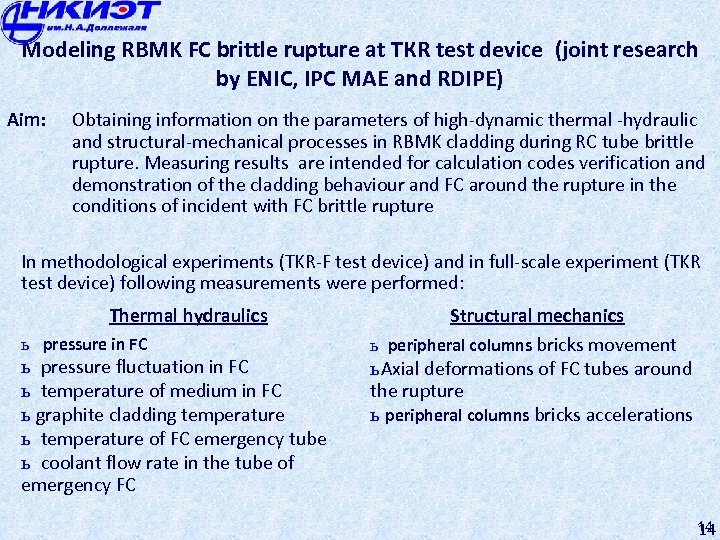
Modeling RBMK FC brittle rupture at ТКR test device (joint research by ENIC, IPC MAE and RDIPE) Aim: Obtaining information on the parameters of high-dynamic thermal -hydraulic and structural-mechanical processes in RBMK cladding during RC tube brittle rupture. Measuring results are intended for calculation codes verification and demonstration of the cladding behaviour and FC around the rupture in the conditions of incident with FC brittle rupture In methodological experiments (TKR-F test device) and in full-scale experiment (TKR test device) following measurements were performed: Thermal hydraulics ь pressure in FC ь pressure fluctuation in FC ь temperature of medium in FC ь graphite cladding temperature ь temperature of FC emergency tube ь coolant flow rate in the tube of emergency FC Structural mechanics ь peripheral columns bricks movement ь Axial deformations of FC tubes around the rupture ь peripheral columns bricks accelerations 14 14
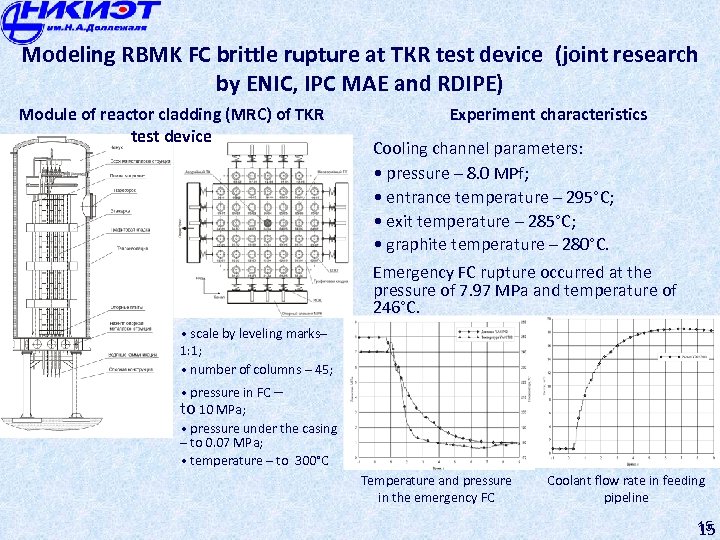
Modeling RBMK FC brittle rupture at ТКR test device (joint research by ENIC, IPC MAE and RDIPE) Module of reactor cladding (MRC) of TKR test device Experiment characteristics Cooling channel parameters: • pressure – 8. 0 МPf; • entrance temperature – 295°С; • exit temperature – 285°С; • graphite temperature – 280°С. Emergency FC rupture occurred at the pressure of 7. 97 МPa and temperature of 246°С. • scale by leveling marks– 1: 1; • number of columns – 45; • pressure in FC – to 10 MPa; • pressure under the casing – to 0. 07 MPa; • temperature – to 300°С Temperature and pressure in the emergency FC Coolant flow rate in feeding pipeline 15 15
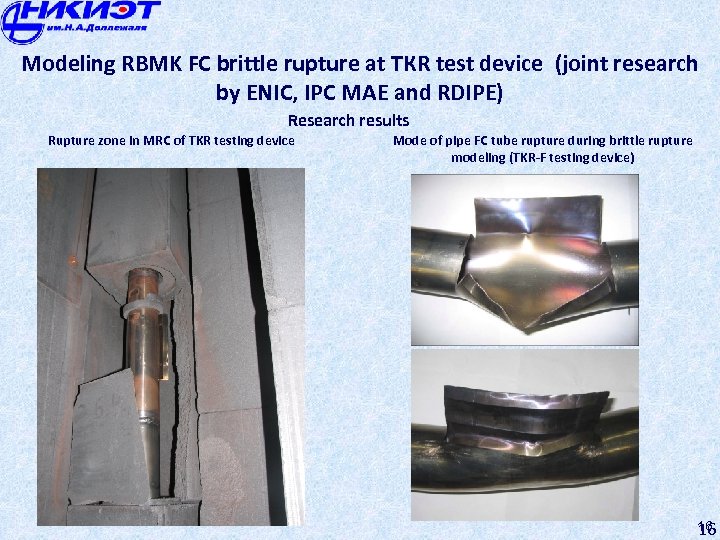
Modeling RBMK FC brittle rupture at ТКR test device (joint research by ENIC, IPC MAE and RDIPE) Research results Rupture zone in MRC of TKR testing device Mode of pipe FC tube rupture during brittle rupture modeling (TKR-F testing device) 16 16
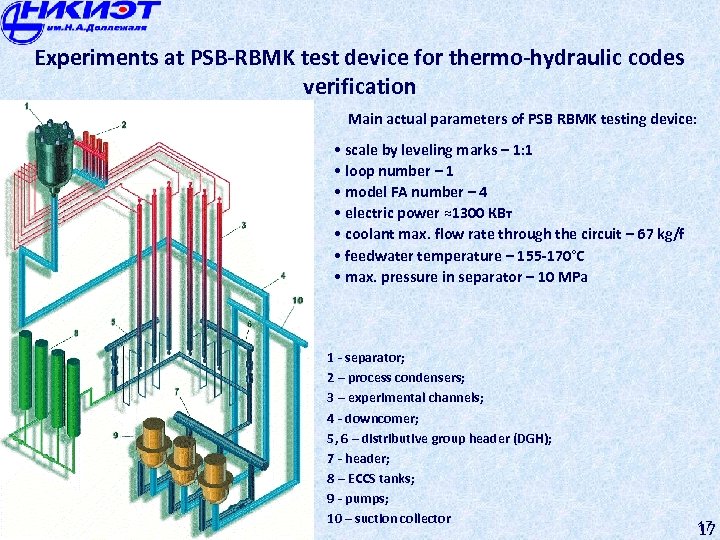
Experiments at PSB-RBMK test device for thermo-hydraulic codes verification Main actual parameters of PSB RBMK testing device: • scale by leveling marks – 1: 1 • loop number – 1 • model FA number – 4 • electric power ≈1300 КВт • coolant max. flow rate through the circuit – 67 kg/f • feedwater temperature – 155 -170°С • max. pressure in separator – 10 MPa 1 - separator; 2 – process condensers; 3 – experimental channels; 4 - downcomer; 5, 6 – distributive group header (DGH); 7 - header; 8 – ECCS tanks; 9 - pumps; 10 – suction collector 17 17
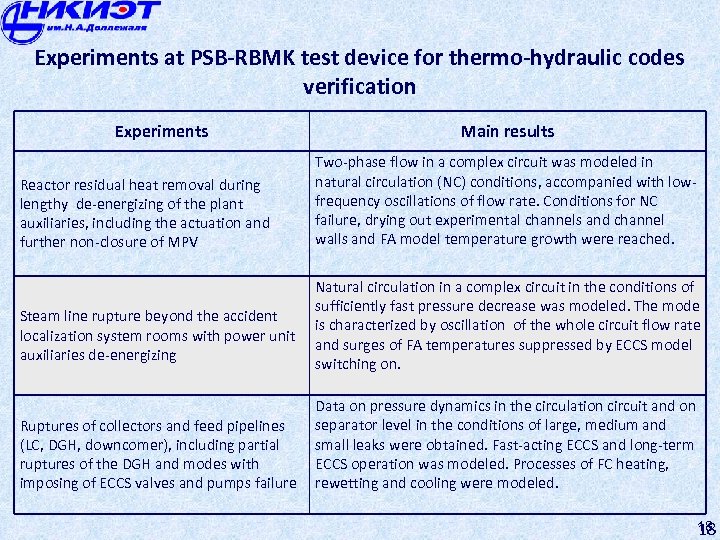
Experiments at PSB-RBMK test device for thermo-hydraulic codes verification Experiments Reactor residual heat removal during lengthy de-energizing of the plant auxiliaries, including the actuation and further non-closure of MPV Steam line rupture beyond the accident localization system rooms with power unit auxiliaries de-energizing Ruptures of collectors and feed pipelines (LC, DGH, downcomer), including partial ruptures of the DGH and modes with imposing of ECCS valves and pumps failure Main results Two-phase flow in a complex circuit was modeled in natural circulation (NC) conditions, accompanied with lowfrequency oscillations of flow rate. Conditions for NC failure, drying out experimental channels and channel walls and FA model temperature growth were reached. Natural circulation in a complex circuit in the conditions of sufficiently fast pressure decrease was modeled. The mode is characterized by oscillation of the whole circuit flow rate and surges of FA temperatures suppressed by ECCS model switching on. Data on pressure dynamics in the circulation circuit and on separator level in the conditions of large, medium and small leaks were obtained. Fast-acting ECCS and long-term ECCS operation was modeled. Processes of FC heating, rewetting and cooling were modeled. 18 18
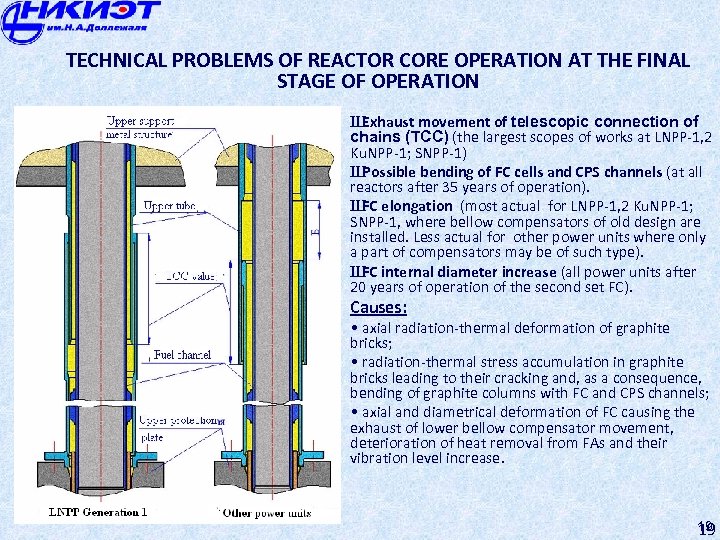
TECHNICAL PROBLEMS OF REACTOR CORE OPERATION AT THE FINAL STAGE OF OPERATION Ш Exhaust movement of telescopic connection of chains (ТСC) (the largest scopes of works at LNPP-1, 2 Ku. NPP-1; SNPP-1) Ш Possible bending of FC cells and CPS channels (at all reactors after 35 years of operation). Ш FC elongation (most actual for LNPP-1, 2 Ku. NPP-1; SNPP-1, where bellow compensators of old design are installed. Less actual for other power units where only a part of compensators may be of such type). Ш FC internal diameter increase (all power units after 20 years of operation of the second set FC). Causes: • axial radiation-thermal deformation of graphite bricks; • radiation-thermal stress accumulation in graphite bricks leading to their cracking and, as a consequence, bending of graphite columns with FC and CPS channels; • axial and diametrical deformation of FC causing the exhaust of lower bellow compensator movement, deterioration of heat removal from FAs and their vibration level increase. 19 19
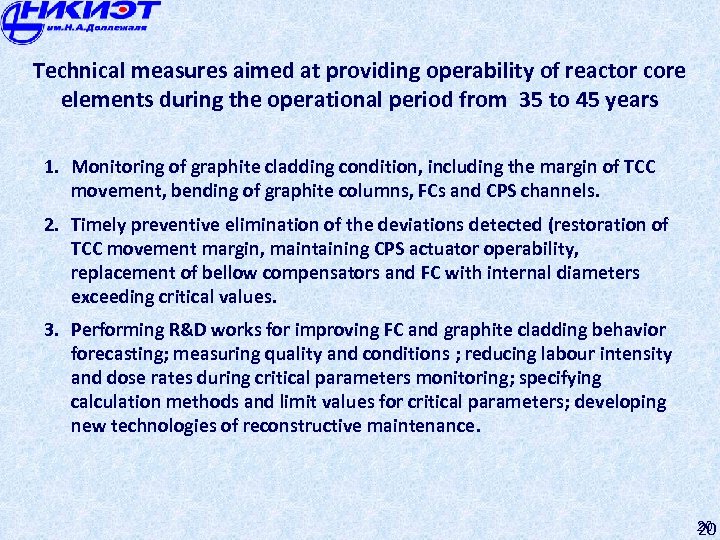
Technical measures aimed at providing operability of reactor core elements during the operational period from 35 to 45 years 1. Monitoring of graphite cladding condition, including the margin of TCC movement, bending of graphite columns, FCs and CPS channels. 2. Timely preventive elimination of the deviations detected (restoration of TCC movement margin, maintaining CPS actuator operability, replacement of bellow compensators and FC with internal diameters exceeding critical values. 3. Performing R&D works for improving FC and graphite cladding behavior forecasting; measuring quality and conditions ; reducing labour intensity and dose rates during critical parameters monitoring; specifying calculation methods and limit values for critical parameters; developing new technologies of reconstructive maintenance. 20 20
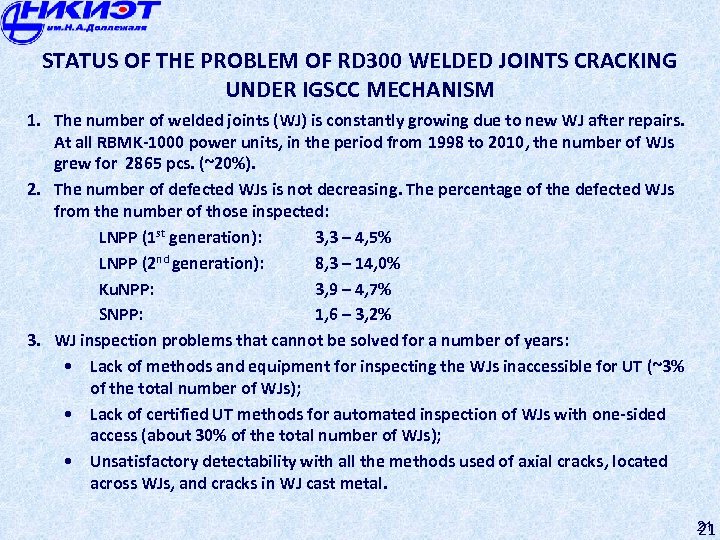
STATUS OF THE PROBLEM OF RD 300 WELDED JOINTS CRACKING UNDER IGSCC MECHANISM 1. The number of welded joints (WJ) is constantly growing due to new WJ after repairs. At all RBMK-1000 power units, in the period from 1998 to 2010, the number of WJs grew for 2865 pcs. (~20%). 2. The number of defected WJs is not decreasing. The percentage of the defected WJs from the number of those inspected: LNPP (1 st generation): 3, 3 – 4, 5% LNPP (2 nd generation): 8, 3 – 14, 0% Ku. NPP: 3, 9 – 4, 7% SNPP: 1, 6 – 3, 2% 3. WJ inspection problems that cannot be solved for a number of years: • Lack of methods and equipment for inspecting the WJs inaccessible for UT (~3% of the total number of WJs); • Lack of certified UT methods for automated inspection of WJs with one-sided access (about 30% of the total number of WJs); • Unsatisfactory detectability with all the methods used of axial cracks, located across WJs, and cracks in WJ cast metal. 21 21
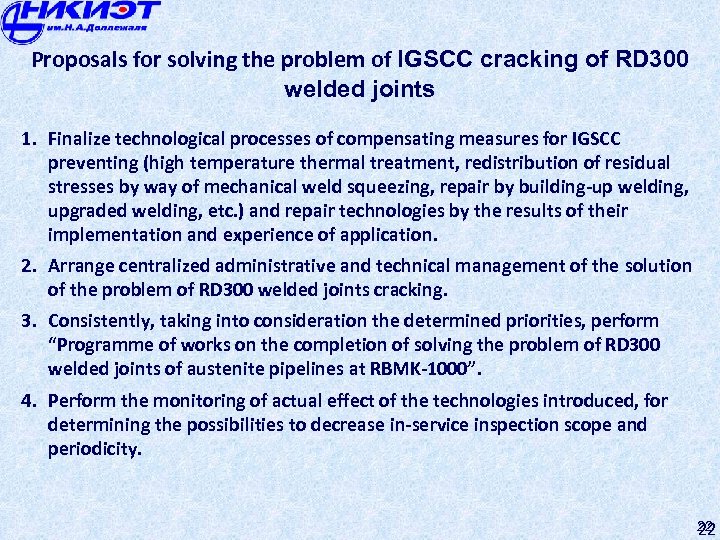
Proposals for solving the problem of IGSCC cracking of RD 300 welded joints 1. Finalize technological processes of compensating measures for IGSCC preventing (high temperature thermal treatment, redistribution of residual stresses by way of mechanical weld squeezing, repair by building-up welding, upgraded welding, etc. ) and repair technologies by the results of their implementation and experience of application. 2. Arrange centralized administrative and technical management of the solution of the problem of RD 300 welded joints cracking. 3. Consistently, taking into consideration the determined priorities, perform “Programme of works on the completion of solving the problem of RD 300 welded joints of austenite pipelines at RBMK-1000”. 4. Perform the monitoring of actual effect of the technologies introduced, for determining the possibilities to decrease in-service inspection scope and periodicity. 22 22
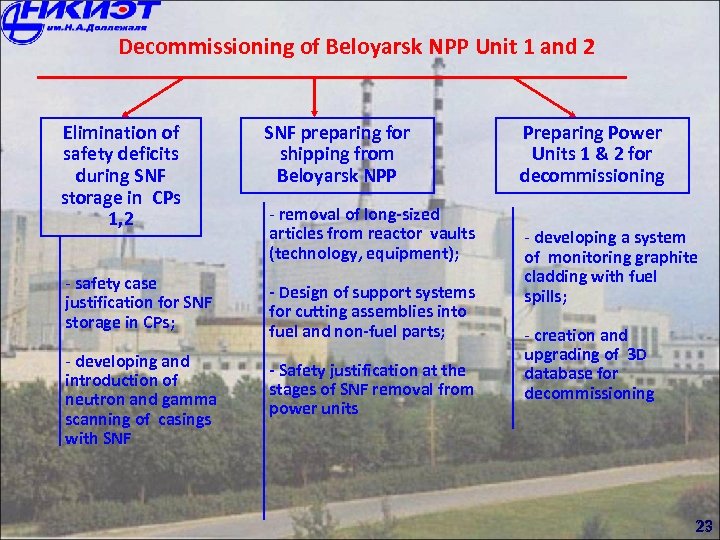
Decommissioning of Beloyarsk NPP Unit 1 and 2 Elimination of safety deficits during SNF storage in CPs 1, 2 - safety case justification for SNF storage in CPs; - developing and introduction of neutron and gamma scanning of casings with SNF preparing for shipping from Beloyarsk NPP - removal of long-sized articles from reactor vaults (technology, equipment); - Design of support systems for cutting assemblies into fuel and non-fuel parts; - Safety justification at the stages of SNF removal from power units Preparing Power Units 1 & 2 for decommissioning - developing a system of monitoring graphite cladding with fuel spills; - creation and upgrading of 3 D database for decommissioning 23 23
MAIN TASKS 1. Develop and implement R&D comprehensive programme, which results will permit to improve the methods of assessment of the reactor unit critical elements residual resource at the final operation stage. 2. Using upgraded methods, develop an operation programme for each power unit permitting to provide optimal technical and economic indicators, forecast necessary scope of in-service inspection and restorative maintenance in order to ensure safety and operability of reactor core elements at each stages of additional operation of all reactor plants. 24 24
Скачать презентацию ОТКРЫТОЕ АКЦИОНЕРНОЕ ОБЩЕСТВО ОРДЕНА ЛЕНИНА НАУЧНО-ИССЛЕДОВАТЕЛЬСКИЙ И КОНСТРУКТОРСКИЙ
0b4b9ff5c7c685c41a16932a947d477e.ppt