


 Скачать презентацию Other World LIIs A modestly decentralised proposal for
050d236eaf509793a893154be9392e7a.ppt
- Количество слайдов: 19
 Other World. LIIs A modestly decentralised proposal for global free access Graham Greenleaf Co-Director Aust. LII / World. LII / HKLII
 Need for ‘global free access’ n Who needs free access to global law? n Developing countries n n n Developed countries n n Comparative law research is essential to development of legal infrastructure Law libraries and fee services are impossible Law librarians, students, international trade lawyers etc To ‘raise the bar’ for what commercial services must offer For countries and subjects beyond commercial services Law as part of the cyberspace commons n Essential law / ‘public legal information’ can be cooperatively provided as part of a global commons
 Relationships n n LIIs and levels of access to free law Relationships between LIIs and government services LIIs and commercial publishers
 Levels of access to free law How to provide global access to free law? n Cooperating high quality law sites n n Distributed searches (search brokering) n n Sites excluding spiders but accepting searches ‘Websearch’ - web-spider-based searches n n n Standards-based shared search results Dedicated ‘law only’ search engines Extracting law from generic search engines Sites / data only accessible via catalogs n n n Sites excluding web spiders Dynamically generated pages with no fixed URLs Page formats / files types resistant to web spiders
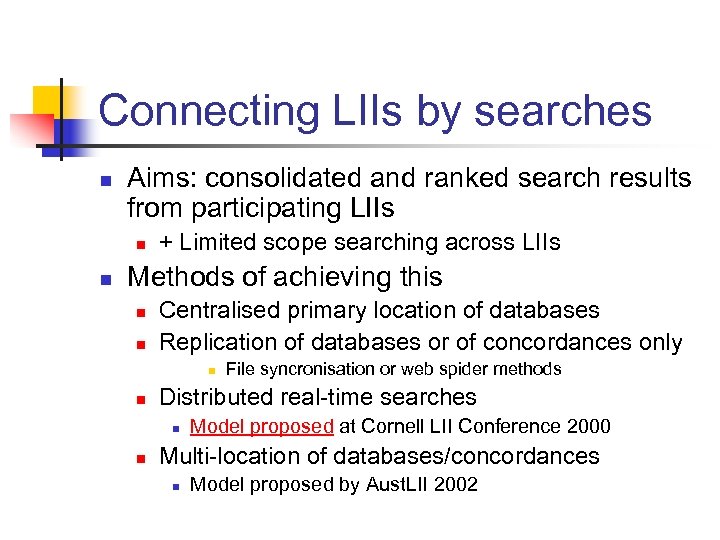 Connecting LIIs by searches n Aims: consolidated and ranked search results from participating LIIs n n + Limited scope searching across LIIs Methods of achieving this n n Centralised primary location of databases Replication of databases or of concordances only n n Distributed real-time searches n n File syncronisation or web spider methods Model proposed at Cornell LII Conference 2000 Multi-location of databases/concordances n Model proposed by Aust. LII 2002
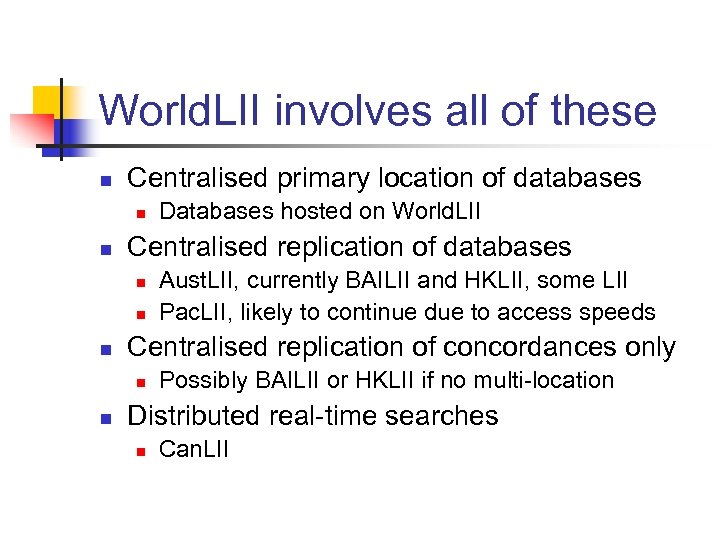 World. LII involves all of these n Centralised primary location of databases n n Centralised replication of databases n n n Aust. LII, currently BAILII and HKLII, some LII Pac. LII, likely to continue due to access speeds Centralised replication of concordances only n n Databases hosted on World. LII Possibly BAILII or HKLII if no multi-location Distributed real-time searches n Can. LII
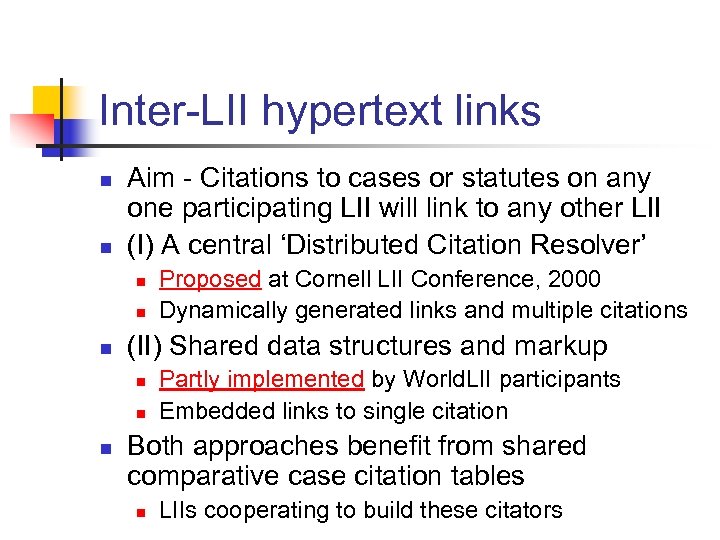 Inter-LII hypertext links n n Aim - Citations to cases or statutes on any one participating LII will link to any other LII (I) A central ‘Distributed Citation Resolver’ n n n (II) Shared data structures and markup n n n Proposed at Cornell LII Conference, 2000 Dynamically generated links and multiple citations Partly implemented by World. LII participants Embedded links to single citation Both approaches benefit from shared comparative case citation tables n LIIs cooperating to build these citators
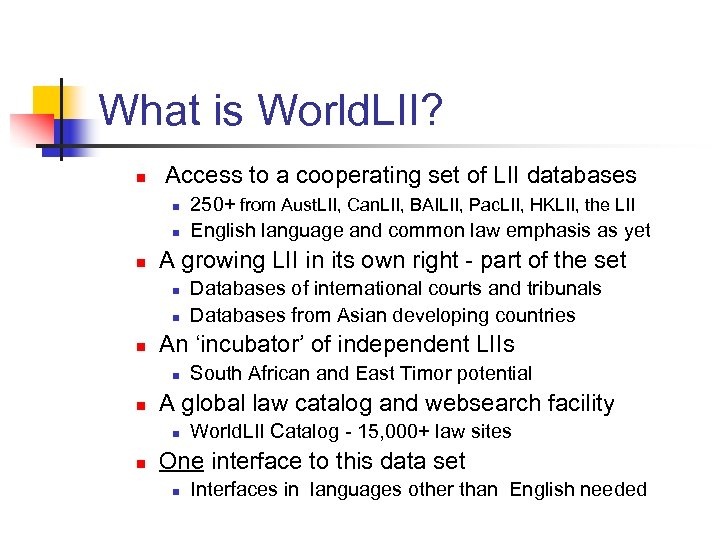 What is World. LII? n Access to a cooperating set of LII databases n n n A growing LII in its own right - part of the set n n n South African and East Timor potential A global law catalog and websearch facility n n Databases of international courts and tribunals Databases from Asian developing countries An ‘incubator’ of independent LIIs n n 250+ from Aust. LII, Can. LII, BAILII, Pac. LII, HKLII, the LII English language and common law emphasis as yet World. LII Catalog - 15, 000+ law sites One interface to this data set n Interfaces in languages other than English needed
 World. LII’s research universe
 Other World. LIIs? n Hypothesis: n n World. LII is a hub of one set of LIIs Equal. LII is another (Franc. LII? ? Mondial. LII? ? ) Both World. LII and Equal. LII are interfaces to all the data, and ‘hubs’ for some of it Other-world. LII’s can exist …. … but may not need to

 Modestly decentralised? … n A small number of interconnected ‘hubs’ with a regional / linguistic / national basis n n n Hubs coordinate groups of participating LIIs Attention to interface etc needs of those participants and their user communities Very distributed data maintenance responsibilities More decentralised over time as more LIIs emerge Global load balancing and redundancy reduces the de/centralisation distinction LIIs still only cover a modest part of the free law universe …
 Free law beyond the LIIs n Search brokering (to non-LIIs) n n Dedicated (law only) websearches n n No serious efforts yet. Impossible? Google etc rank differently, reach differently Commercial websearches can be compromised an alternative is needed Ability to limit scope of searches eg to legislation Catalogs / indexes of law sites n n n Collaborative development is the only future Multi-lingual development is necessary Not ODP amateurism, but LII professionalism
 LIIs and government services n ‘Official’ systems are good but not enough n State systems often fail, are sold, or are 3 rd rate n n n Even when they are excellent, they do not do everything Independent systems give different value-adding Universities are most likely free-access alternative Full free access requires choice of providers Two simultaneous approaches for LIIs n n Keep insisting on independent access to source data Government services as World. LII participants? n an interim measure?
 Free ‘v’ commercial publishers n n n What are commercial legal publishers? Are LII’s here to stay? Relationships between LIIs and publishers?
 What are commercial legal publishers? n n n No such thing as a local legal publisher Kluwer / Reed-Elsevier / Thomson oligopoly The occupying foreign powers of Australian law n n Only owners of many primary material backsets The status quo results from “unequal treaties” n n 10 years of CLIRS monopoly in Australia (82 -92) West’s relationship with US Courts everywhere surrendered citation control NZ government had to buy back its own legislation
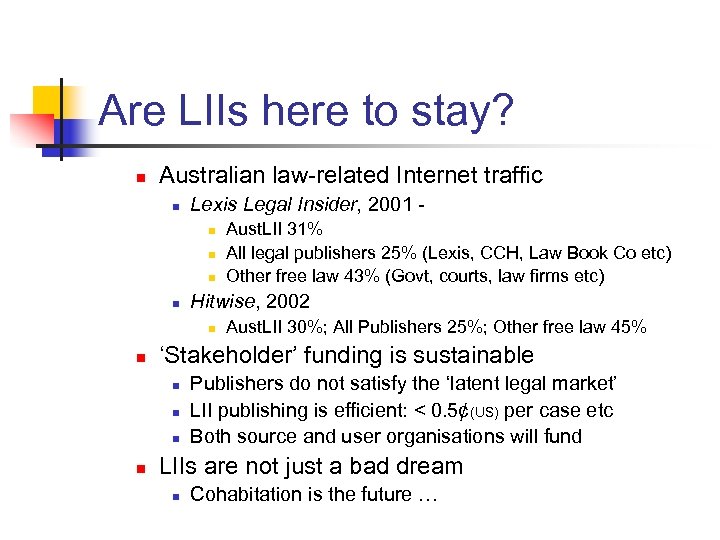 Are LIIs here to stay? n Australian law-related Internet traffic n Lexis Legal Insider, 2001 n n Hitwise, 2002 n n Aust. LII 30%; All Publishers 25%; Other free law 45% ‘Stakeholder’ funding is sustainable n n Aust. LII 31% All legal publishers 25% (Lexis, CCH, Law Book Co etc) Other free law 43% (Govt, courts, law firms etc) Publishers do not satisfy the ‘latent legal market’ LII publishing is efficient: < 0. 5¢(US) per case etc Both source and user organisations will fund LIIs are not just a bad dream n Cohabitation is the future …
 Relationships between LIIs and publishers n n n ‘Friendly’ self-interest on both sides “Keep the b******* honest” (Don Chipp) Raising the bar for value-adding n n Leveraging LII market share n n CCH $80 K p/a for ‘Publishers search’ Finding justifiable balances of interest n n ‘If we can automate it, you can’t sell it’ (Aust. LII) Thomsons and the High Court’s centenary ‘For free’ and ‘for fee’ are complementary n n Legal publishers have invented and preserved the law New audiences and new technology require a new balance
 “Does legal information really want to be free? ” n n Q - Was supposed to be the opening Q of this Conference - let’s close with it An n Yes, essential/public legal information is part of the common heritage of mankind - it should be in the digital commons No, it will not be free of its own volition, we must work to free the law and keep it free