


 Скачать презентацию Other Development Considerations n CIS 679 Management of
4f076671ed296c8aa855f28389c986e7.ppt
- Количество слайдов: 155
 Other Development Considerations n CIS 679 Management of Information Systems Slide Set 4 of notes for lectures n © Copyright 2000 Murray Turoff n Copyright 2000 Murray Tuorff 1
 Evaluation Copyright 2000 Murray Tuorff 2
 Biased Computer Systems I n Preexisting Bias: roots in social system, practices and attitudes n Individual: on the part of designers or users creating specifications n Medical n students assignments to hospitals. Societal: from society or the organizations involved n Credit risk based upon geography Copyright 2000 Murray Tuorff 3
 Biased Computer Systems II n Technical Bias: results from technical constraints or considerations n n Computer tools: database to match organs to recipients displays a certain order Decontextualized Algorithms: scheduling airplanes for takeoff alphabetically Random Number Generation: some routines not truly random Formalization of Human Constructs: legal expert system advising defendant on whether or not to plea bargain Copyright 2000 Murray Tuorff 4
 Biased Computer Systems III n Emergent Bias arises in a context of use with real users, after a design is completed or a system is in use. n New Societal Knowledge: A medical expert system has no mechanism for incorporating changes in value or costs, stock advisement, etc. n Mismatch between users and system design: significant difference between assumed users and actual users n Different Expertise: ATM with only English text in a neighborhood with large new immigrant population. n Different Values: teaching math through a competitive game to people from non competitive or collaborative cultures. Copyright 2000 Murray Tuorff 5
 Medical Assignment Example n n n Hospitals express rank orders for available students Students express rank order for hospitals No way to satisfy everyone Who gets highest choices students or hospitals n What about rural small hospitals n A lot of information not present or used n Copyright 2000 Murray Tuorff 6
 Welfare System Example n Process User fills out application form Data entry operator enters it Computer finds error and mails new form back to applicant n User fills it out again n Data entry clerk enters it n Computer finds next error in form!!!! n Etc. n n n Many welfare users low on literacy likely to make many errors Three week cycle for each error. Copyright 2000 Murray Tuorff 7
 Recommendations on Bias n n n Minimize preexisting bias by reviewing design for hidden biases. Designers must relate the design, algorithms, and the interfaces to moral and/or ethical values of the users and the organization. Designers must envision not just intended situations of use but project future use. When client wants a bias in the system it becomes a professional ethics issue. Bias examination should be part of design process Bias removal should be objective for any development effort Copyright 2000 Murray Tuorff 8
 Evaluation of Systems 1 n Computer science n n Expert judgment Wisdom Features comparison Network & flow models Copyright 2000 Murray Tuorff 9
 Evaluation of Systems 2 n Industrial engineering n n n Ergonomics Human error analyses Activity monitoring Human factors Motor abilities Simulations & models of human motor functions Copyright 2000 Murray Tuorff 10
 Evaluation of Systems 3 n Psychological and sociological n n n n Mental abilities Protocol analysis Focused groups Controlled experiments Field trials Interviews Surveys Longitudinal studies Copyright 2000 Murray Tuorff 11
 Evaluation of Systems 4 n Management sciences n n n System monitoring User satisfaction Cost - benefits / productivity Efficiency Quality Opportunities Copyright 2000 Murray Tuorff 12
 Evaluation of Systems 5 n Cognitive psychology n n Cognitive processes Task analysis Human problem solving Sociological n n Group processes Environmental interaction Copyright 2000 Murray Tuorff 13
 Evaluation of Systems 6 n Anthropological n n n Archaeological n n Metaphors Participant observation Artifacts & tools Philosophical n Virtual reality Copyright 2000 Murray Tuorff 14
 Evaluation "implementation without a formal assessment is like trying to negotiate a minefield blindfolded. " James Bair in the Office of the Future Copyright 2000 Murray Tuorff 15
 Formative Evaluation n Feedback permits corrective action if performance is sub optimal and suggestions for improvement (guides system evolution) Produces implementation guidelines Prevents incorrect & surface interpretations Copyright 2000 Murray Tuorff 16
 Summative Evaluation n n Measure and "prove" significant benefits and costs in terms of impacts Usually necessary to assure continued funding of use of the system after a pilot Copyright 2000 Murray Tuorff 17
 Evaluation Model 1 n Environmental factors n n n External Independent variables Cannot be influenced Difficult to relate directly sometimes Influence system E. g. job marketplace Control variables Can change system and output Difficult to measure or even find in field studies n Manipulated control variables n E. g. salary policy n n Copyright 2000 Murray Tuorff 18
 Evaluation Model 2 n Intervening variables Can be measured Hope they relate independent and dependent variables n E. g. job satisfaction n Output variables n n n Dependent on what? Variables of interest E. g. , job turnover Copyright 2000 Murray Tuorff 19
 Evaluation Guidelines n n Should be over time Measurement points n n Before usage Short term Long term Should use several methods of data collection Copyright 2000 Murray Tuorff 20
 Questionnaires & Surveys n Main source of quantifiable data n n n Subjected to multivariate analysis To untangle causality Repeat some questions n n n Two or more points in time Observe changes in user behavior Longitudinal Studies Copyright 2000 Murray Tuorff 21
 Evaluation Methods 1 n n n Surveys Protocol analysis Interviews Focused groups Activity monitoring Participant observation Copyright 2000 Murray Tuorff 22
 Evaluation Methods 2 n n n n Mental models Cognitive walkthroughs Pilot & prototype testing Controlled experiments Longitudinal studies Field trials Artifact & tool analysis Copyright 2000 Murray Tuorff 23
 Performance of IS 1 n Quantitative n n n n Throughput Reliability Timeliness Accuracy Quantity Availability Aptitude Use Copyright 2000 Murray Tuorff 24
 Performance of IS 2 n Qualitative & subjective n n n n n Quality Opportunity Relevance Selectivity Cooperation Attitudes Change Moral & cohesion Stress & effort Copyright 2000 Murray Tuorff 25
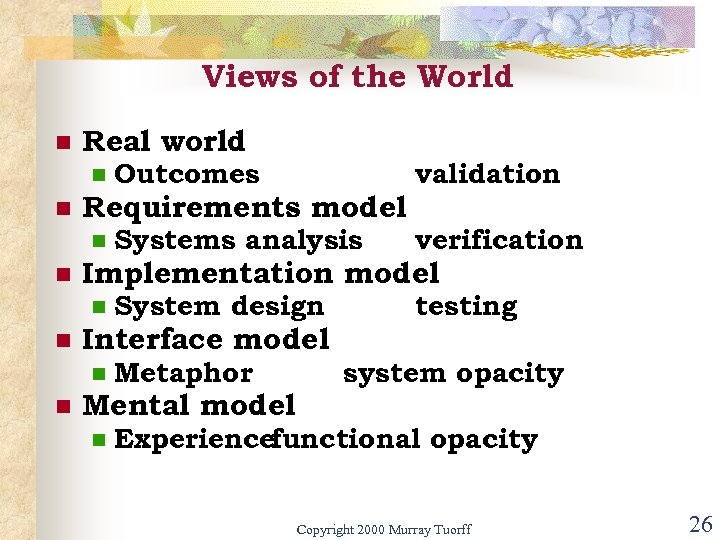 Views of the World n Real world n n verification System design testing Interface model n n Systems analysis Implementation model n n validation Requirements model n n Outcomes Metaphor Mental model n system opacity Experiencefunctional opacity Copyright 2000 Murray Tuorff 26
 User Roles and Types n n n n Novice, casual Intermediary Frequent Operator, specialized Experienced, routine Problem solver Power Results: n n Different roles in one system Multiple interface methods Copyright 2000 Murray Tuorff 27
 User Response to Inadequate System 1 n Dis-use: n n Mis-use: n n Using inappropriate ways Partial use: n n Turn to other sources Use of wrong subset Distant use: n Use of intermediary Copyright 2000 Murray Tuorff 28
 User Response to Inadequate System 2 n Modification of task: n n Compensatory activity: n n User has to do more Direct programming: n n Change task to fit system User modifies system Non-use: n Avoiding the system Copyright 2000 Murray Tuorff 29
 Productivity Copyright 2000 Murray Tuorff 30
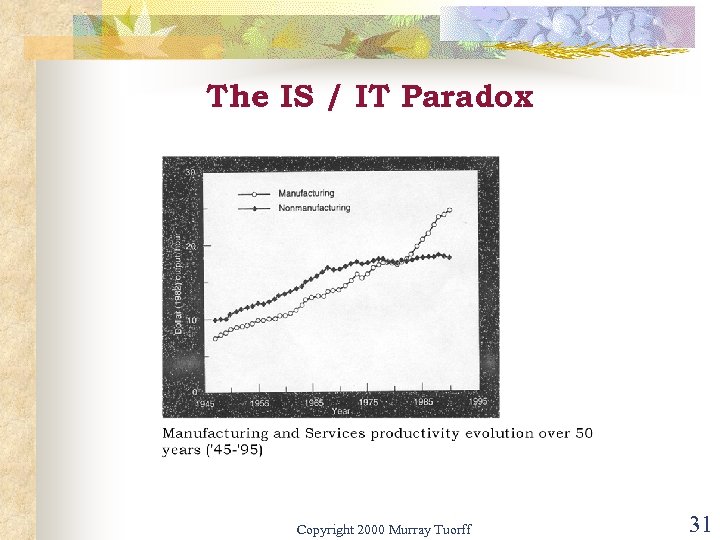 The IS / IT Paradox Copyright 2000 Murray Tuorff 31
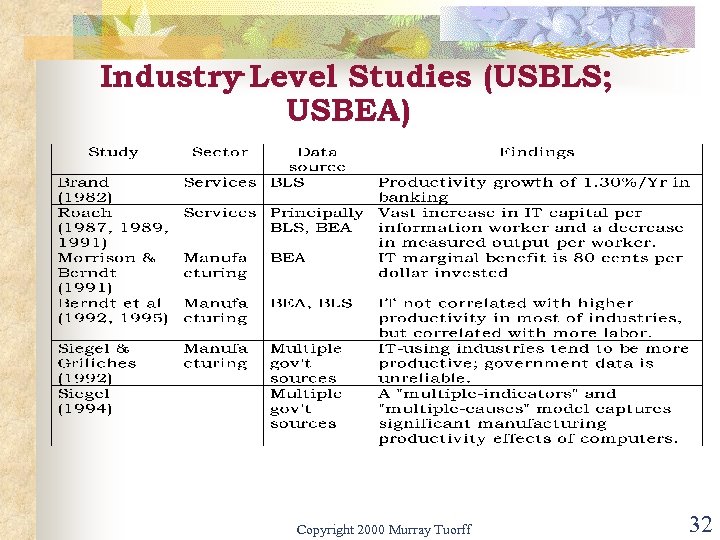 Industry ‑Level Studies (USBLS; USBEA) Copyright 2000 Murray Tuorff 32
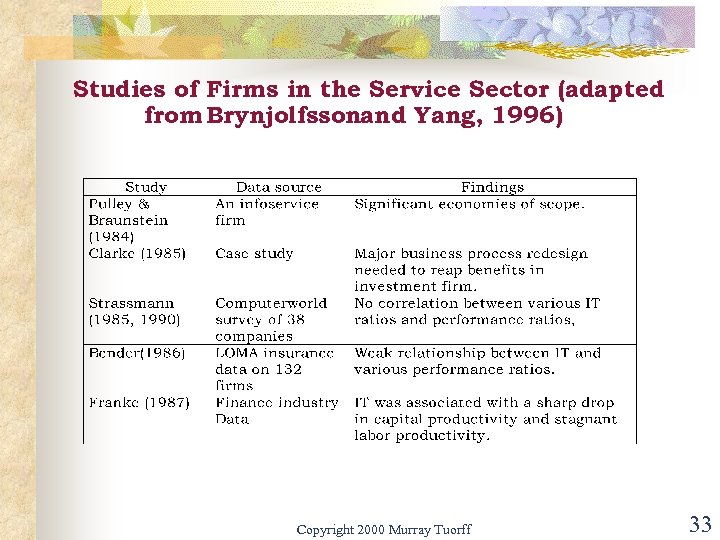 Studies of Firms in the Service Sector (adapted from Brynjolfssonand Yang, 1996) Copyright 2000 Murray Tuorff 33
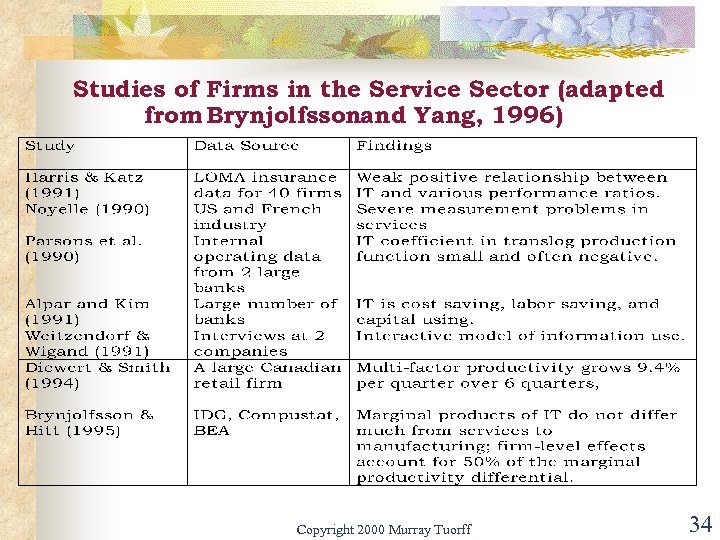 Studies of Firms in the Service Sector (adapted from Brynjolfssonand Yang, 1996) Copyright 2000 Murray Tuorff 34
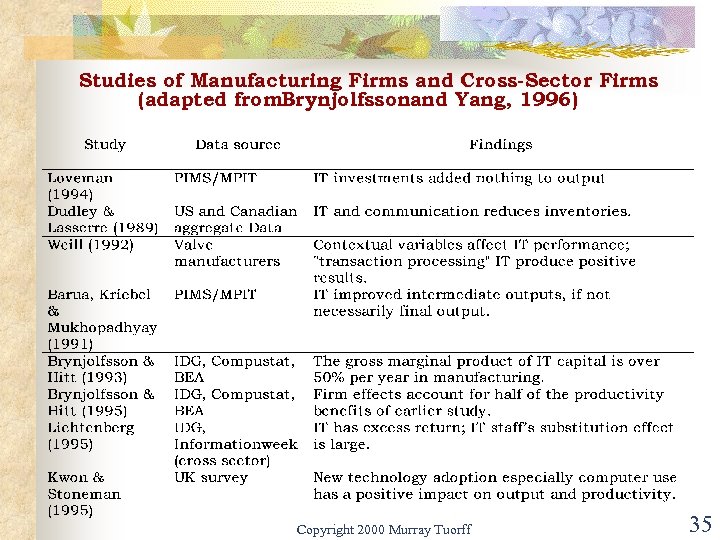 Studies of Manufacturing Firms and Cross-Sector Firms (adapted from. Brynjolfssonand Yang, 1996) Copyright 2000 Murray Tuorff 35
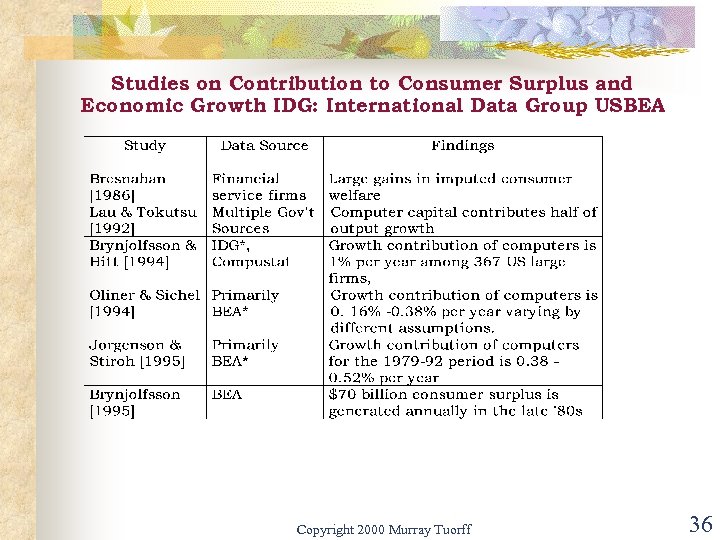 Studies on Contribution to Consumer Surplus and Economic Growth IDG: International Data Group USBEA Copyright 2000 Murray Tuorff 36
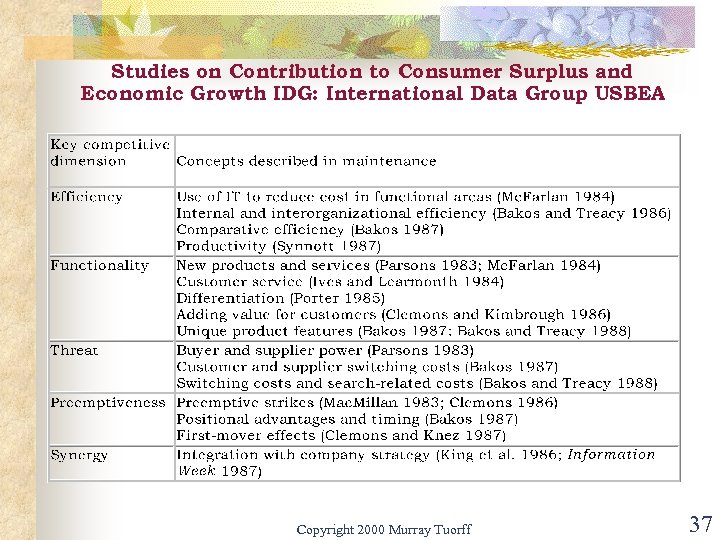 Studies on Contribution to Consumer Surplus and Economic Growth IDG: International Data Group USBEA Copyright 2000 Murray Tuorff 37
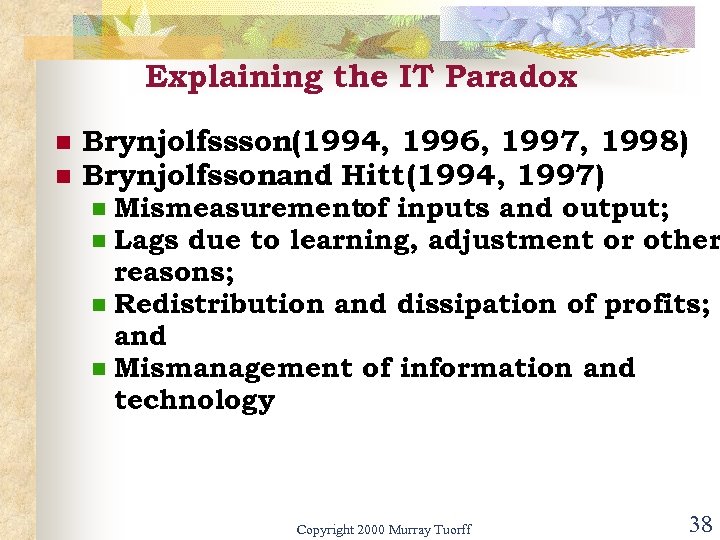 Explaining the IT Paradox n n Brynjolfssson(1994, 1996, 1997, 1998) Brynjolfssonand Hitt (1994, 1997) Mismeasurementof inputs and output; Lags due to learning, adjustment or other reasons; n Redistribution and dissipation of profits; and n Mismanagement of information and technology n n Copyright 2000 Murray Tuorff 38
 Measurement Problem n n Measurement at the core of the Productivity Paradox Example Banks reduce the cost of processing checks and are able to process more which increases output and reduces cost per item. n ATM’s reduce the number of checks so that this reduces output productivity. n Increase in convenience of ATM uncounted. n Copyright 2000 Murray Tuorff 39
 Specific IS Productivity Measures I n n n n Space reduction; Reduction in inventory levels; Increased use of machinery and equipment; Reduction in capital investment (for example, equipment, machinery); Increase in productivity of production employees; Increase in productivity of nonproduction employees; Decrease in set-up time; Reduction in rate of rejected items; Copyright 2000 Murray Tuorff 40
 Specific IS Productivity Measures II n n n n Decrease in rate of production of defective items; Increase in flexibility of manufacturing process; Reduction in lead time; Reduction of managerial controls; Improvement of working conditions; Improvement of the firm's image in the market; Increase in number of customized products offered; Increase in variety of products offered; Copyright 2000 Murray Tuorff 41
 Specific IS Productivity Measures III n n n n Increase in number of new products offered; Increase in the durability of products offered; Increase in the reliability of products offered; Decrease in the number of complaints by clients; Decrease in the number of repairs on products sold; Decrease in production costs (manufacturing); Decrease in cost of products; and Ability to meet deadlines. Copyright 2000 Murray Tuorff 42
 Proposed New Industry Classifications n n Collected Input Output Data does not measure effective IS / IT contribution to the economy Same true for such things as pollution, service industry Copyright 2000 Murray Tuorff 43
 Proposed Changes to Industry Classification I n KNOWLEDGE PRODUCTION AND COMMUNICATION INDUSTRIES n n n R&D and Inventive Industries Private Information Services INFORMATION DISTRIBUTION AND COMMUNICATION INDUSTRIES n n Education Public Information Services Regulated Communication Media Unregulated Communicated Media Copyright 2000 Murray Tuorff 44
 Proposed Changes to Industry Classification II n RISK MANAGEMENT n n Insurance Industries Finance Industries Speculative Broken SEARCH AND COORDINATION INDUSTRIES Search and Non-Speculative Brokerage Industries n Advertising Industries n Non-Market Coordination Institutions n Copyright 2000 Murray Tuorff 45
 Proposed Changes to Industry Classification III n n INFORMATION PROCESSING AND TRANSMISSION SERVICES n Non-Electronic Based Processing n Telecommunications Infrastructure INFORMATION GOODS INDUSTRIES n Non-Electronic Consumption or Intermediate Goods n Non-Electronic, Investment Goods n Electronic Consumption or Intermediate Goods n Electronic Investment Goods 46 Copyright 2000 Murray Tuorff
 Proposed Changes to Industry Classification IV n SELECTED GOVERNMENT ACTIVITIES Primary Information Services in the Federal Government Postal Service n State and Local Education n n SUPPORT FACILITIES n Information Structure Construction and Rental Office Furnishings Copyright 2000 Murray Tuorff 47
 Effect of Lags n n n When electricity first introduced in industry little productivity gain for 20 years. Building new factories designed around use of electricity was needed Consider classical IS applications and process redesign. Current failure rate in classical applications very high. Learning and cultural changes major factors where change lags the technology Copyright 2000 Murray Tuorff 48
 Innovation and profitability n n Things are now possible that were impossible before; Things are now possible in different ways that they were possible before; Previously separated things can now be "joined together" in a more "systemic approach" as a result of using IT; and The new become old very fast and the old became new in some cases. Copyright 2000 Murray Tuorff 49
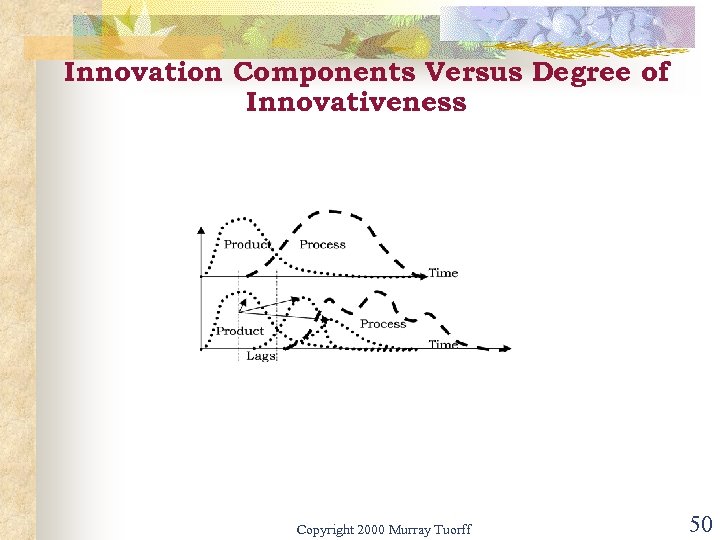 Innovation Components Versus Degree of Innovativeness Copyright 2000 Murray Tuorff 50
 Redistribution and dissipation of profits n n n Individual firms benefit but industry does not IS/IT valuable for marketing but adds nothing to total output. One company takes market away from other companies. Total output not increased. Copyright 2000 Murray Tuorff 51
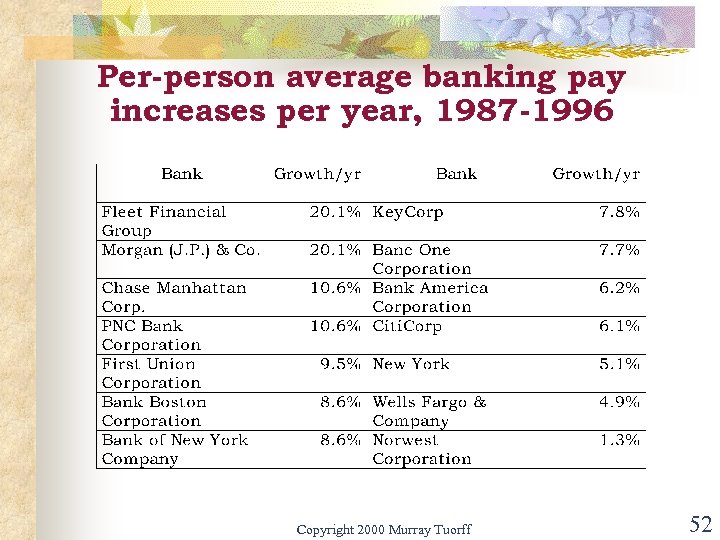 Per-person average banking pay increases per year, 1987 -1996 Copyright 2000 Murray Tuorff 52
 Mismanagement of IS n n Managers really not optimizing firm Increasing their slack, building inefficient systems, using outdate criteria Manufacturing sector has more tangible outputs than service sector Easier to manage, cannot survive bottlenecks Copyright 2000 Murray Tuorff 53
 Mismanagement n n Proper software not available, use of legacy software on newer technology Closed system cannot be productive, does not change human processing as limiting factor Professionals can not take advantage of the new technology Monopolistic regulation of industry such as communications Copyright 2000 Murray Tuorff 54
 Another View n n Productivity growth has slowed because things are more difficult and complex (e. g. effort to do income taxes and such unproductive undertakings) Without IS/IT it would have been worse!!! Copyright 2000 Murray Tuorff 55
 System Faults Copyright 2000 Murray Tuorff 56
 Major System Faults 1 n Reports inadequate/redundant n n Information overload n n n Lack of recall Lack of precision Low data accuracy Missed schedules Copyright 2000 Murray Tuorff 57
 Major system faults 2 n n n n Exceeded capacity Existing systems retained Not all processing/data included Cognitive & task mismatches Restrictive or inflexible Staff under pressure Difficult to learn Copyright 2000 Murray Tuorff 58
 System Fault Consequences n Higher costs n n Lower benefits n n Excessive maintenance More hardware More staff Problems not fully solved User dissatisfaction Poor quality outputs New problems created n n Management information not used Full potential of system unused Copyright 2000 Murray Tuorff 59
 Inadequate Reports n Managers n n n Did not know what to ask Did not know what to expect Were not computer literate Not quantitative oriented Analyst n n n Thought they knew best Produce easy reports Reports everything Copyright 2000 Murray Tuorff 60
 Low Data Accuracy n n n Input procedure too complex Exceptions not properly represented Another responsible for correction Copyright 2000 Murray Tuorff 61
 Person or Machine n n n Efficient use of printer Readable reports Spuds, Murphy's Minimize input errors User costs ignored Copyright 2000 Murray Tuorff 62
 Report & Data Solutions n n n User defined report capabilities Data source responsible for input Data source gains benefit from system Copyright 2000 Murray Tuorff 63
 System Failure Causes n n n n n Users do not participate Analyst thinks s/he knows best Poor investigation No objectives set No checkpoints Machines put first People ignored Pure automation approach No problem analysis Copyright 2000 Murray Tuorff 64
 Learning and Training Copyright 2000 Murray Tuorff 65
 Organizational Learning n Investment and initiation n n Technology learning & adaptation n n Failure: narrow focus & automation Rationalization & management control n n Failure: stagnation Failure: efficiency dominated Maturity & widespread use n Failure: rigidity Copyright 2000 Murray Tuorff 66
 End User Training Functions n Initiation n n n n Identify training needs Develop training methods Design the training environment Select trainees Compose training groups Train trainers Conduct Training Post training n n n Evaluate training and learning Support trainees Evaluate transfer of training Copyright 2000 Murray Tuorff 67
 Training Evaluation Space n Formative: n n n Intrinsic: critical features and rationale Pay-off: Think aloud commentary Summative n n Intrinsic: Comprehensive feature analysis Pay-off: Time on task and error rate Copyright 2000 Murray Tuorff 68
 Use of Users for Training I n n User can provide low cost quality training Users can provide effective local support Courses and courseware need to be task focused and related to work contexts Distributing training and support activities takes pressure off the IS professionals Copyright 2000 Murray Tuorff 69
 Use of Users for Training II n n Developing users as trainers provides personal and organizational benefits Management support for necessary training strategy formulation and implementation In-house training courses are popular due to convenience, tailoring to local work needs and social aspects. / Alternative strategies for required for “special” cases. Copyright 2000 Murray Tuorff 70
 Primary Firm Wide Infrastructures Services Survey I n n n Manage firm-wide communication network services Manage group-wide or firm-wide messaging services n Should be firm wide and include groupware Recommend standards for IT components Provide technology advice and support services n Can be decentralized Manage, maintain, and support large scale systems (e. g. mainframe operations). Manage firm-wide or business-unit applications and databases Copyright 2000 Murray Tuorff 71
 Primary Firm Wide Infrastructures Services II n Perform IS project management n n n Can be decentralized Provide data management advice and consultancy services Perform IS planning for business units or aid in process n Must be consistent plan Copyright 2000 Murray Tuorff 72
 Secondary Firm Wide Infrastructures Services I n n n Enforce IT architecture and Standards Manage firm wide or business-unit workstation networks Manage and negotiate with suppliers and outsourcers n And/or approve decentralized agreements Identify and test new technologies for business purposes Develop business unit specific applications n Can be decentralized Copyright 2000 Murray Tuorff 73
 Secondary Firm Wide Infrastructures Services II n n Provide firm wide or business-unit data management, including standards n Can be decentralized except for firm-wide databases and data quality standards n Allowing sources of data to input and to gain use of data is critical Develop and manage electronic linkages to suppliers to customers n Or supply the tools or standards to do so Copyright 2000 Murray Tuorff 74
 Secondary Firm Wide Infrastructures Services III n n n Develop a common systems development environment n Not possible for all application areas n Set standards for quality, testing, and acceptance Provide technology education services n Or facilitate it by providing materials, Help desks and backup Provide documents and multimedia publishing facilities n Establish exchange standards for Copyright 2000 Murray Tuorff 75
 IS Professionals Copyright 2000 Murray Tuorff 76
 People Structure 1 n n Progalyses One person all tasks n n n Historical approach Typical in n n From user request to evaluation Small business Under 15 technical people User organizational unit Technical staff as general workers Good moral Copyright 2000 Murray Tuorff 77
 People Structure 2 n User request n n Feasibility study n n n Business analyst Application systems analyst Investigation, analysis n n n Business analyst Application systems analyst Technical systems analyst Copyright 2000 Murray Tuorff 78
 People Structure 3 n System design n n Application system analyst Technical systems analyst Systems designer Interface designer Senior programmer Copyright 2000 Murray Tuorff 79
 People Structure 4 n Programming documentation n n System designer Senior programmer Application programmers System programmers Documentors Copyright 2000 Murray Tuorff 80
 People Structure 5 n System testing n n n System assurance officers Maintenance analysts Auditors Testers Trainers Copyright 2000 Murray Tuorff 81
 People Structure 6 n Conversion n n n n System analyst Application system analyst Maintenance operators System assurance officers Auditors Trainers Users Copyright 2000 Murray Tuorff 82
 People Structure 7 n Maintenance, evaluation n n Maintenance staff Users Trainers Business analysts Applications systems analysts Copyright 2000 Murray Tuorff 83
 IS Centralized Staffing 1 n Large organizations: n n n Business analysts Systems designers System programmers Application programmers Copyright 2000 Murray Tuorff 84
 IS Centralized Staffing 2 n Large organizations n n Systems assurance specialists Maintenance specialists Data base specialists Auxiliary specialties n Human factors, communications n Evaluation, auditing n Training, documentation Copyright 2000 Murray Tuorff 85
 People Structure 8 n Progalystadvantages n Simplified communications n Between people n Between phases n n Technically realistic systems Consistency of quality Copyright 2000 Murray Tuorff 86
 People Structure 9 n Progalystdisadvantages n n n n Limited number of projects Workload imbalance One SA can keep many busy Maintenance builds up Documentation often neglected Weak link in chain talent situation People skills and technical talent? Copyright 2000 Murray Tuorff 87
 People Structure 10 n Specialization advantages n n n Balanced workloads High degree of professionalism Clear advancement routes Productivity Accountability Copyright 2000 Murray Tuorff 88
 People Structure 11 n Specialization disadvantages n n n Arranging workable hand over points Enforcing rigorous documentation Post mortem analysis Coordinating parallel activities Creating meaningful jobs Preventing imbalances of: n Power n Status and authority Copyright 2000 Murray Tuorff 89
 System Analysts Copyright 2000 Murray Tuorff 90
 Technical Talents 1 n n SA’s and programmers Abilities n n n Communication Analysis Discipline Social sensitivity Detail Coordination Copyright 2000 Murray Tuorff 91
 Technical Talents 2 n Knowledge & experience n n n Hardware & software Data handling Management problems & techniques Communications & analytical techniques Business problems & techniques Individual & group processes Copyright 2000 Murray Tuorff 92
 SA Special Talents n n n Maintaining customer relations Maintaining customer communications Assessing customer needs Conducting presentations Training others Providing supervision & leadership Copyright 2000 Murray Tuorff 93
 Losing Objectivity n n n n ‘halo’ effect Done it before Personal relation to user Design in detail too early Withdraw in confusion Frustration with progress Too close to users Too distance from users Copyright 2000 Murray Tuorff 94
 Important Technical Talents 1 n n n Training others Documentation Providing supervision & leadership Technical knowledge Maintaining customer relations System modifications Copyright 2000 Murray Tuorff 95
 Important Technical Talents 2 n n n Maintaining communications Assessing customer needs Job commitment & effort Debugging & testing Conducting presentations Planning, organizing & scheduling Copyright 2000 Murray Tuorff 96
 Factors Affecting Systems Analysis 1 n n n Quality of management Management climate Staff relations climate Trust, confidence, fair dealing, delegation of authority n Mistrust, mockery, anger, interference n Copyright 2000 Murray Tuorff 97
 Factors Affecting Systems Analysis 2 n Process of creating projects n “this computer process is typical. My boss gets a bee in his bonnet about a new system. Probably he was sold the idea by someone else. Out of the blue, without consultation, he announces that a new system must go in by the end of the year”. Copyright 2000 Murray Tuorff 98
 Acquisitions Copyright 2000 Murray Tuorff 99
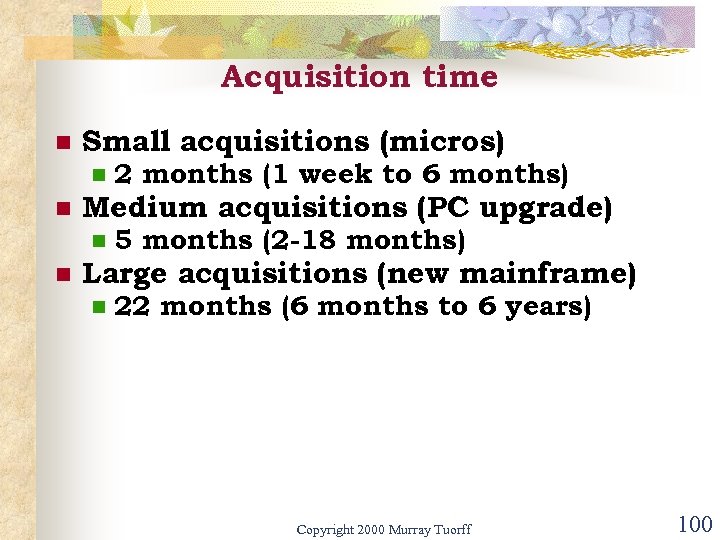 Acquisition time n Small acquisitions (micros) n n Medium acquisitions (PC upgrade) n n 2 months (1 week to 6 months) 5 months (2 -18 months) Large acquisitions (new mainframe) n 22 months (6 months to 6 years) Copyright 2000 Murray Tuorff 100
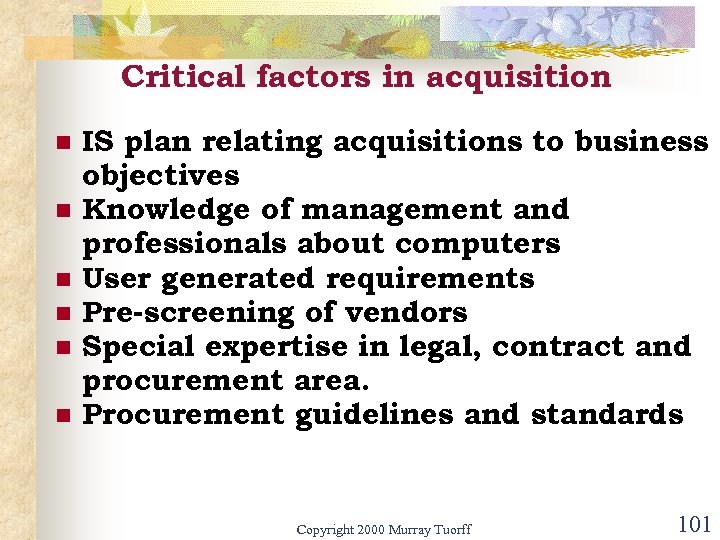 Critical factors in acquisition n n n IS plan relating acquisitions to business objectives Knowledge of management and professionals about computers User generated requirements Pre-screening of vendors Special expertise in legal, contract and procurement area. Procurement guidelines and standards Copyright 2000 Murray Tuorff 101
 Outsourcing Copyright 2000 Murray Tuorff 102
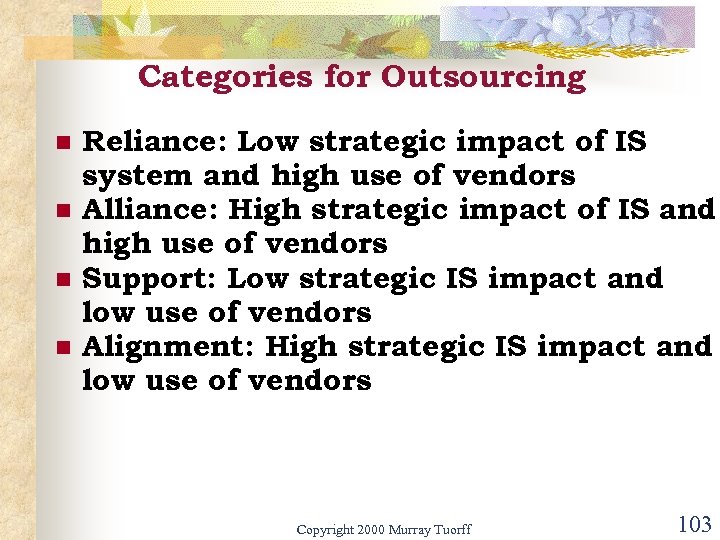 Categories for Outsourcing n n Reliance: Low strategic impact of IS system and high use of vendors Alliance: High strategic impact of IS and high use of vendors Support: Low strategic IS impact and low use of vendors Alignment: High strategic IS impact and low use of vendors Copyright 2000 Murray Tuorff 103
 Hypotheses for Outsourcing I n n As asset specificity of the relevant IS functions increase, the extend of substitution by vendors decreases. As asset specificity increases, the strategic impact of IS applications increases As the uncertainty of IS function increases, the extent of substitution by vendors decreases. As the number of available vendors increases, the extend of substitution by vendors increases. Copyright 2000 Murray Tuorff 104
 Hypotheses for Outsourcing II n n As a firms tacit knowledge in the IT area increases, the extent of substitution by vendors decreases As IS has a higher strategic impact in firms with high tacit knowledge of IT than in firms with low tacit knowledge Firms with a high extend of IT influence have a lower extent of substitution by vendors than firms with a low extent of IT influence As the heterogeneity of systems increases, the extent of substitution by vendors increases. Copyright 2000 Murray Tuorff 105
 Hypotheses for Outsourcing III n n n The greater the IS managers efforts in the decision analysis process, the greater the strategic impact of the IS application to be sourced. Client firms are more inclined to continue the outsourcing relationships in the reliance cell than in the support cell. Client firms are more inclined to continue the outsourcing relationship in the alignment cell than in the support cell. Copyright 2000 Murray Tuorff 106
 Hypotheses for Outsourcing IV n n n Client firms are more inclined to continue the outsourcing relationship in the alliance cell than in any of the others. As the client firms perceptions of vendors’ opportunism increases, client firms are less likely to be inclined to continue the relationships with their existing vendors As the duration of prior relationships with existing vendors increases, clients are more likely to be inclined to continue the relationships with the existing vendors Copyright 2000 Murray Tuorff 107
 Observations for Outsourcing n n Outsourcing very dependent upon companies situation. Vendors must be trustworthy as well as technically competent Alliance most extensive but unlikely to continue after current contract runs out (survey results) Not easy to verify most hypothesis in this area due to situational nature. Copyright 2000 Murray Tuorff 108
 Observations on Employee Outsourcing n Major causes: n n n Need to focus on core business Need for flexibility Dynamics of IS skills markets n Rapid changes in technology n Rapid changes in environment n Tight market for outstanding employees Copyright 2000 Murray Tuorff 109
 Problems in Outsourcing employees n n n Permanent employees have to train, supervise and monitor work of contract labor. Permanent employees have to undertake more complex jobs than they did before Will raise dissatisfaction and turnover of outstanding permanent employees. Copyright 2000 Murray Tuorff 110
 Costs and Impacts Copyright 2000 Murray Tuorff 111
 Costing Methods 1 n Free use center n n n Resource center n n n Development environment Single use applications Priorities Planned allocation Cost center n n n Full, marginal Average, actual Transactions Copyright 2000 Murray Tuorff 112
 Costing Methods 2 n Profit center n n n Free market Non cost related Considerations n n n Shared resources Make or buy Supply or use Predictability Understandable Copyright 2000 Murray Tuorff 113
 Governmental Difficulties n Budget agricultural cycle n n n Efficiency emphases Automation justification n n No decisions Staffing n n Lack of planning reliance Experts as managers Salaries Low cost awards Public exposure Copyright 2000 Murray Tuorff 114
 Governmental Counters n n n Camouflage (word processing) Number toying & fudging Crises opportunities n n n Create it Sticking ones neck out Co op important users User technology Turn taking Resource sharing Copyright 2000 Murray Tuorff 115
 Vendor Ploys 1 n n n n We don't need to write that down! You’re getting our best price! Price increase coming! Right to substitute and other shell games! Form contracts! Try it, you'll like it! We can't do it because GSA won't let us We would be setting a precedent! Copyright 2000 Murray Tuorff 116
 Vendor Ploys 2 n n We will announce a modification soon to handle that! You can be assured we will offer that in the future Our language matches the standard and then adds more If you sign for five years maintenance we can lower the base price Copyright 2000 Murray Tuorff 117
 Common Myths n n n My product has to be easy to use -- my secretary uses it It must be good -- I never heard complaints We will make it easy to use -- just quantify it for us I have added every easy to use feature I could think of It is easy to use -- I use it myself Copyright 2000 Murray Tuorff 118
 System Sexy n n n n n All functions Compatible with everything Easy to learn Easy to use Infinitely flexible Will help anyone for anything Will save a fortune Software works perfectly Ultimate reliability Has games Copyright 2000 Murray Tuorff 119
 Concerns about use of micros n Undetected errors in programs n n n Lack of user skills in testing Hidden models Lack of accountability Control of data accuracy Loss of key personal Duplication of resources Copyright 2000 Murray Tuorff 120
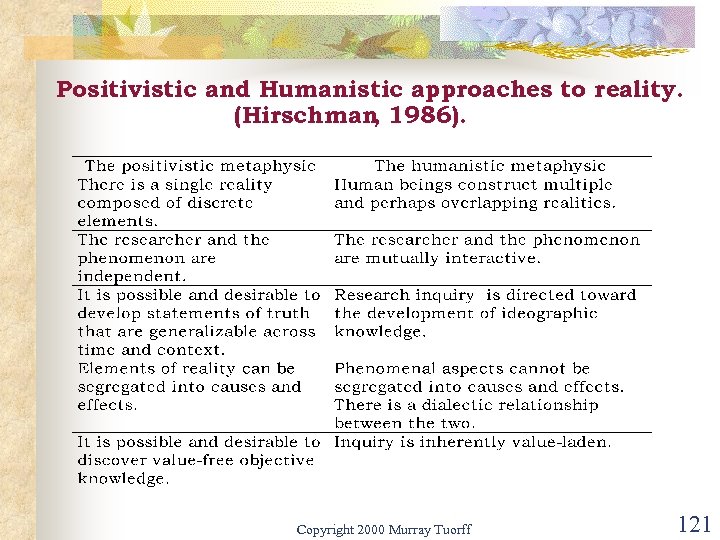 Positivistic and Humanistic approaches to reality. (Hirschman 1986). , Copyright 2000 Murray Tuorff 121
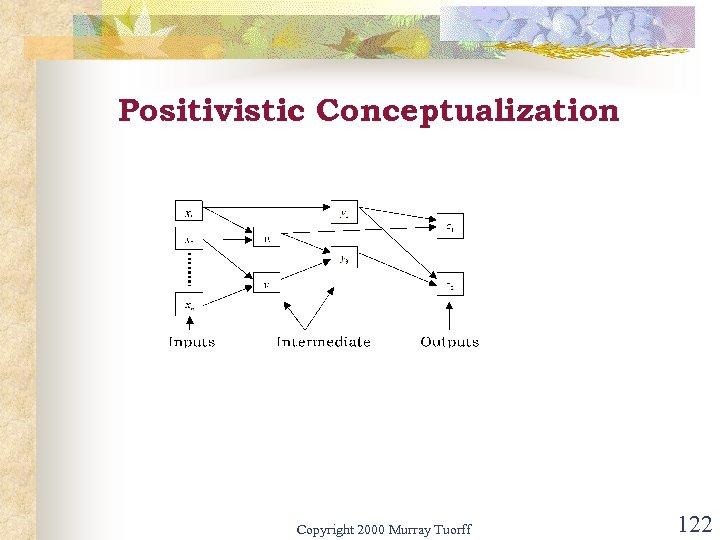 Positivistic Conceptualization Copyright 2000 Murray Tuorff 122
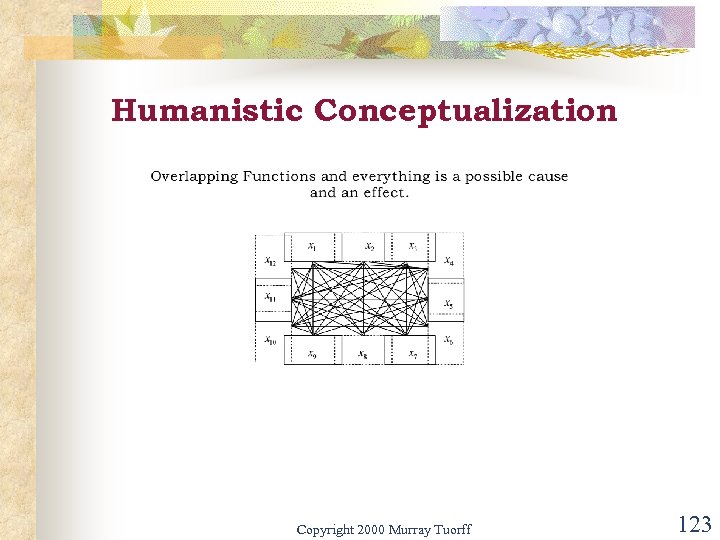 Humanistic Conceptualization Copyright 2000 Murray Tuorff 123
 Four models of Systems Development Copyright 2000 Murray Tuorff 124
 Functionalism n n n Systems Development as Instrumental Reasoning The analyst as systems expert or Platonic philosopher king. IS designed to meet specific objectives Development is objective and ordered Management as leaders Copyright 2000 Murray Tuorff 125
 Social Relativism n n n Systems Development as Sense Making Analyst as facilitator Knowledge is illusive Development is subjective and ordered Evolutionary social change Development is process oriented and a negotiated reality with management and users. Copyright 2000 Murray Tuorff 126
 Radical Structuralism n n n Systems Development as Dialectic Materialism Analyst as labor partisan, warrior for social progress Inherent conflict between management and labor Adaptation of tools to different stakeholders with different interests. Political realities, power, authority Copyright 2000 Murray Tuorff 127
 Neohumanism n n Systems Analyst as emancipator or social therapist Improving understanding and rationality of human action Freedom for unwarranted natural and social constraints Social engineering or IS as the design of social systems Copyright 2000 Murray Tuorff 128
 Software Engineering Research Short Term n n n Perspective n Portray Systems realistically n View systems as systems n Recognize change as intrinsic n Study and preserve software artifacts Practice n Codify software engineering knowledge for dissemination and reuse n Develop software engineering handbooks Research modes n Foster practitioner and researcher interactions Copyright 2000 Murray Tuorff 129
 Software Engineering Research Long Term I n Perspective n n Research a unifying model for software development Improve match between programming languages and application domains and design phases. Strengthen mathematical and scientific foundations Practice n n n Automate handbook knowledge, access, and reuse. Make development of routine software more routine Nurture collaboration among system developers and between developers and users Copyright 2000 Murray Tuorff 130
 Software Engineering Research Long Term II n Research modes Legitimize academic exploration of large software systems n Glean insights from behavioral and managerial sciences n Develop additional research directions and paradigms n Copyright 2000 Murray Tuorff 131
 Privacy & security n n Technology still expensive Internal abuse very possible n n n E. g. , personal records Hackers not the problem Key is: n n Management atmosphere Employee attitude Adequate tracking Reasonable precautions Copyright 2000 Murray Tuorff 132
 Privacy and security n n n Privacy emphasizes data confidentiality Security entails protective measures Overlapping area: The protection of an individual against improper collection and dissemination of data(privacy) n The protection of data against its use by unauthorized persons (security) n Copyright 2000 Murray Tuorff 133
 Privacy: data confidentiality n n n 1. The claim of individuals, groups or institutions to determine for themselves when, how , and to what extent data about them are communicated to or used by others; 2. The protection of an individual against harm or damage as a result of the operation of a record system; and 3. The protection of an individual (or class of individuals) against unwelcome, unfair, improper, or excessive collection or dissemination of data about that person Copyright 2000 Murray Tuorff 134
 Security: protective measures n n n 1. Protect a computer based system including its physical hardware, personnel, and data against deliberate or accidental damage from a defined threat; 2. Protect the system against denial-ofuser by its rightful owners; and 3. Protect data and/or programs and/or system privileges against divulgence to or use by unauthorized persons Copyright 2000 Murray Tuorff 135
 Security and privacy: overlapping area n n 1. The protection of an individual against improper collection and dissemination of data (privacy: #3). 2. The protection of data against its use by unauthorized persons (security: #3) Copyright 2000 Murray Tuorff 136
 Notes on Mowshowitz’s. Paper Copyright 2000 Murray Tuorff 137
 Technicism n n Instrument of progress Solutions chasing problems Promotion & belief Conversion of masses Copyright 2000 Murray Tuorff 138
 Progress individualism n n n Faith in progress Imperfections in humans Reformism & pragmatism Influence social change Near term concerns Copyright 2000 Murray Tuorff 139
 Elitism n n Expert guidance Social engineering Planned change Progress by technical & social innovation Copyright 2000 Murray Tuorff 140
 Pluralism n n n Information as power A democratic process All concerned parties Need for policies Social influences technology Copyright 2000 Murray Tuorff 141
 Determinism n n No human control over Technology Driving force is technology Too complex to understand Copyright 2000 Murray Tuorff 142
 Radical criticism n n Devolutionism Need for countering Social forces New social institutions Copyright 2000 Murray Tuorff 143
 Notes on Keen’s. Paper Copyright 2000 Murray Tuorff 144
 Information System Wargames n n n Who Who Who owns the data? will share it? will supply it? gains the benefits? gains the costs? Copyright 2000 Murray Tuorff 145
 Impact Potentials n What will be the “perceived” impact of redistribution on: n n n 1. 2. 3. 4. Evaluation Influence Authority Communications Introduction of a new information systems: n "declaration of war" Copyright 2000 Murray Tuorff 146
 Counterimplementation strategies 1 n Diverting resources n n Easy money: take resources Easy life: take charge Pork barrel: take piece Deflecting goals n n n Pile on: do it right Keep the peace: involve all Up for grabs: shift it around Copyright 2000 Murray Tuorff 147
 Counterimplementation strategies 2 n Dissipating energies n n n Tenacity: do it over Territory: that is our job Not our problem: pass it Odd man out: drop out after Reputation: latest & sexiest Copyright 2000 Murray Tuorff 148
 Counterimplementation strategies 3 n n n Contract for change Have a fixer(godfather) Seek out resistance & respond to it Become an insider Build credibility Build coalitions Introduce incrementally Co-op users early Simple things first Make it clear Make it definite Copyright 2000 Murray Tuorff 149
 Overcoming social inertia n Change is demand driven n n Change must find a place in organization n n Crises is the mother of invention Benefits to units in organization Change must be perceived n Institutionalize in planning process Copyright 2000 Murray Tuorff 150
 Partial References for Set Three & Four n n CIS 679 Management of Information Systems Course Lecture Notes Copyright 2000 Murray Tuorff 151
 References I n n n Blum, Bruce I. , A taxonomy of Software development Methods, CACM, 37(11), November 1994, 83 -94. Broadbent Marianne, Weil, Peter, The , implications of Information Technology Infrastructure for Business Process Redesign, MIS Quarterly, June 1999, 32(12) 159 -. Eisenstadt Marc, My Hairiest Bug War , Stories, CACM, 40(4), April 1997, 31 -37. Copyright 2000 Murray Tuorff 152
 References II n n n Friedman, Batya, & Nissenbaum, Helen, Bias in Computer Systems, ACM Transactions on Information Systems, 14(3), July 1996, 330 -347 Hirschheim R. H. , and Heinz, K. Klein, , Four Paradigms of Information Systems Development, CACM, 32(10), October 1989, 1199 -1216. Kraut, R. E. , & L. A. Streeter, Coordination in Software Development, CACM, 38(3), March 1985, 69 -81. Copyright 2000 Murray Tuorff 153
 References III n n n Mckeen J. D. , and Guimaraes, T. , , Successful strategies for user participation and development, Journal of MIS, 14(2), Fall 1997, 133 -150. Petre Marian, Why Looking Isn’t Always , Seeing, CACM, 38(6), June 1995, 33 -44 Stacy, Webb, Cognition Bias in Software Engineering, CACM 38(6), June 1995, 57 -63. Copyright 2000 Murray Tuorff 154
 References IV n n Requirements Gathering, Special Issue, CACM, 38(5), May 1995 Outsourcing, Special Issue, CACM, 39(7), July 1996 Scaling Up: A research agenda for software engineering, CACM, 33(3), March 1990, 281 -293 End User Training and Learning, Special Issue, CACM, 38(7), July 1995. Copyright 2000 Murray Tuorff 155