


 Скачать презентацию OT HER W EAPONS OF MAS S DESTR
22bcd77d7849be1e79053c00172f7237.ppt
- Количество слайдов: 33
 OT HER W EAPONS OF MAS S DESTR UCTION CHEMICAL WEAPONS, BIOLOGICAL WEAPONS, RADIOLOGICAL WEAPONS EVERYTHING BUT NUKES
 WHAT DO YOU KNOW ALREADY? • Can you think of a time recently when chemical weapons were used? • Can you name any type of Chemical weapon? • Can you name a Biological weapon? • Do you know of a time when a biological weapon was used? • Do you know what a “Dirty Bomb” is? • Do you know how Kim Jong-Un’s half brother was assassinated? • Have you ever heard of VX? Ricin? Anthrax?
 WEAPON OF MASS DESTRUCTION (WMD) • a chemical, biological or nuclear weapon capable of causing widespread death and destruction. – Some groups now also include explosives, bombs, grenades, etc (but other groups call this type “Conventional Weapons”) • The term was first used in 1937 in reference to the aerial bombardment of Guernica, Spain • After the September 11, 2001 attacks and the 2001 anthrax attacks in the United States, an increased fear of nonconventional weapons took hold in many countries. • The fear reached a crescendo with the 2002 alleged existence of weapons of mass destruction in Iraq that became the primary justification for the 2003 invasion of Iraq. • However, American forces found none in Iraq.
 CHEMICAL WEAPONS
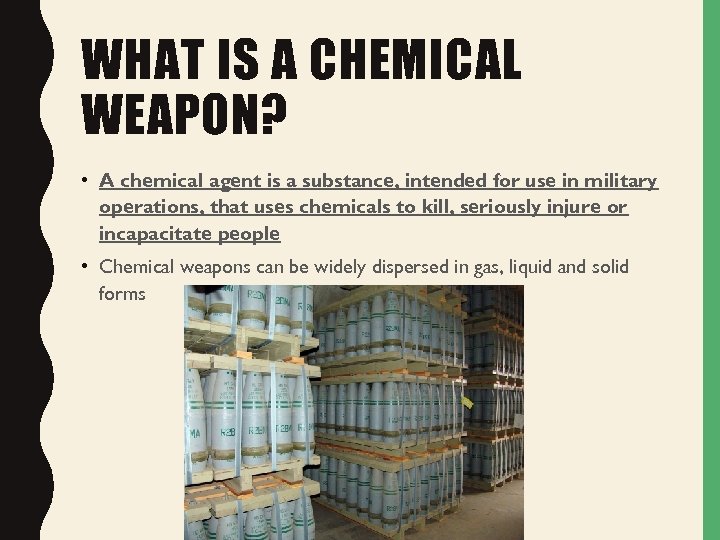 WHAT IS A CHEMICAL WEAPON? • A chemical agent is a substance, intended for use in military operations, that uses chemicals to kill, seriously injure or incapacitate people • Chemical weapons can be widely dispersed in gas, liquid and solid forms
 THEY’RE PROHIBITED • The 1925 Geneva Protocol was the first international law to prohibit the use of poisonous gas as a weapon of war. • The 1993 Chemical Weapons Convention took it a step further and asked signatories to stop producing chemical weapons and to safely destroy existing stockpiles of chemical arsenals. • Both the United States and Russia, the two countries with the largest stockpiles of chemical weapons, signed the convention and are still in the process of destroying their arsenals -- a slow, careful containment process that must be overseen by the OPCW. • Syria, North Korea, Egypt and Angola are the only countries that have not yet signed this treaty. Israel and Myanmar (Burma) have signed the treaty but have not ratified it.
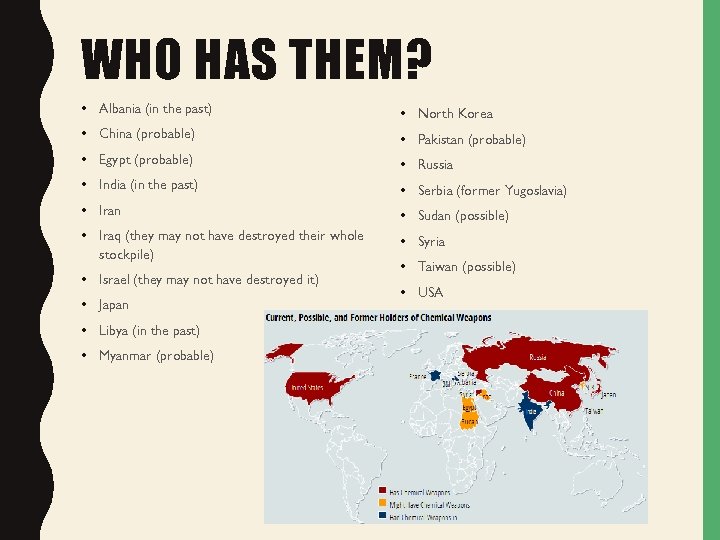 WHO HAS THEM? • Albania (in the past) • North Korea • China (probable) • Pakistan (probable) • Egypt (probable) • Russia • India (in the past) • Serbia (former Yugoslavia) • Iran • Sudan (possible) • Iraq (they may not have destroyed their whole stockpile) • Syria • Israel (they may not have destroyed it) • Japan • Libya (in the past) • Myanmar (probable) • Taiwan (possible) • USA
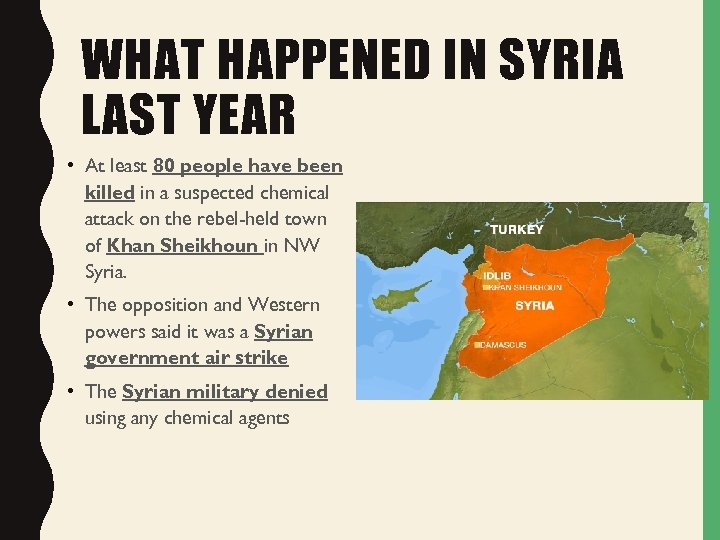 WHAT HAPPENED IN SYRIA LAST YEAR • At least 80 people have been killed in a suspected chemical attack on the rebel-held town of Khan Sheikhoun in NW Syria. • The opposition and Western powers said it was a Syrian government air strike • The Syrian military denied using any chemical agents
 WHAT HAPPENED? • Witnesses say warplanes attacked Khan Sheikhoun early on April 4, when many people were asleep • Victims experienced symptoms including redness of the eyes, foaming from the mouth, constricted pupils, blue facial skin and lips, severe shortness of breath and asphyxiation • 84 people were killed, including 27 children and 19 women • Another 546 people were injured • https: //www. youtube. com/watch? v=Dkh 4 VAm_ou. I Al Jazeera, Syrian government blamed for Aleppo chemical attack, 2: 18
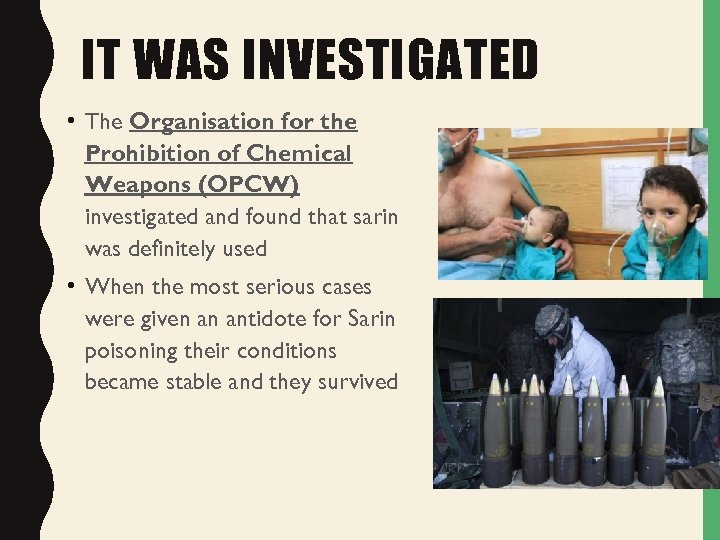 IT WAS INVESTIGATED • The Organisation for the Prohibition of Chemical Weapons (OPCW) investigated and found that sarin was definitely used • When the most serious cases were given an antidote for Sarin poisoning their conditions became stable and they survived
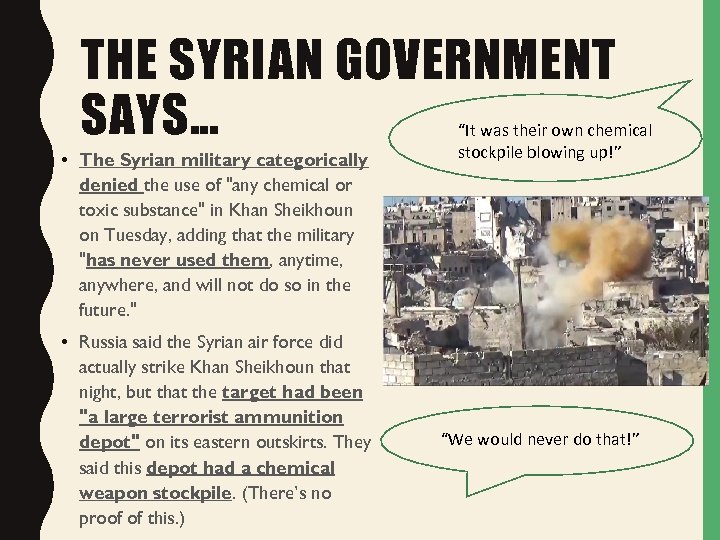 THE SYRIAN GOVERNMENT SAYS… • The Syrian military categorically denied the use of "any chemical or toxic substance" in Khan Sheikhoun on Tuesday, adding that the military "has never used them, anytime, anywhere, and will not do so in the future. " • Russia said the Syrian air force did actually strike Khan Sheikhoun that night, but that the target had been "a large terrorist ammunition depot" on its eastern outskirts. They said this depot had a chemical weapon stockpile. (There’s no proof of this. ) “It was their own chemical stockpile blowing up!” “We would never do that!”
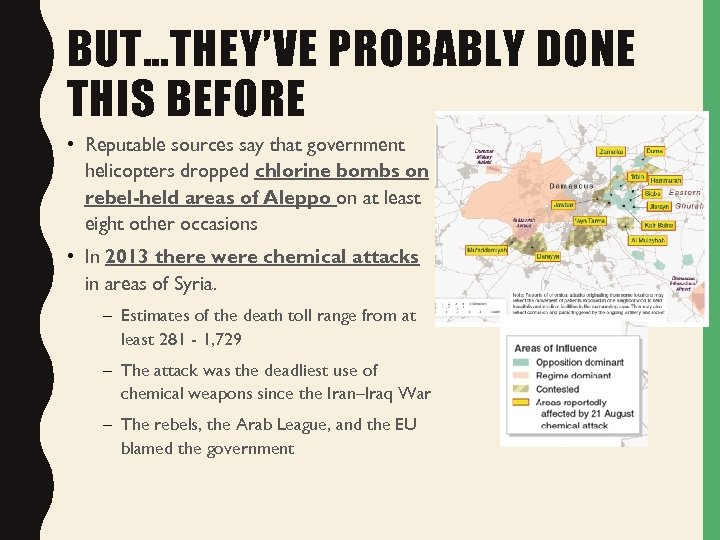 BUT…THEY’VE PROBABLY DONE THIS BEFORE • Reputable sources say that government helicopters dropped chlorine bombs on rebel-held areas of Aleppo on at least eight other occasions • In 2013 there were chemical attacks in areas of Syria. – Estimates of the death toll range from at least 281 - 1, 729 – The attack was the deadliest use of chemical weapons since the Iran–Iraq War – The rebels, the Arab League, and the EU blamed the government
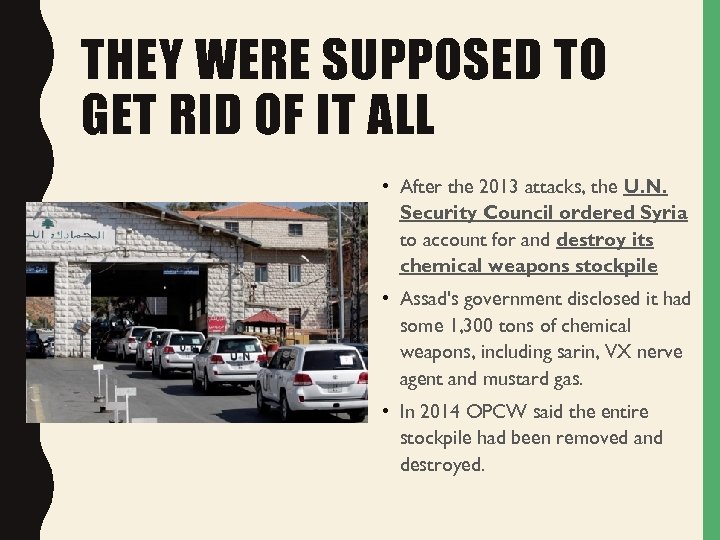 THEY WERE SUPPOSED TO GET RID OF IT ALL • After the 2013 attacks, the U. N. Security Council ordered Syria to account for and destroy its chemical weapons stockpile • Assad's government disclosed it had some 1, 300 tons of chemical weapons, including sarin, VX nerve agent and mustard gas. • In 2014 OPCW said the entire stockpile had been removed and destroyed.
 WHAT IS SARIN? • Sarin is highly toxic - 20 times as deadly as cyanide • Sarin inhibits the action of a certain enzyme, which deactivates signals that cause human nerve cells to fire • The heart and other muscles spasm • Sufficient exposure can lead to death via asphyxiation within minutes • Sarin is almost impossible to detect because it is a clear, colourless and tasteless liquid that has no odour in its purest form • It can also evaporate and spread through the air
 THE TYPES OF CHEMICAL WEAPONS
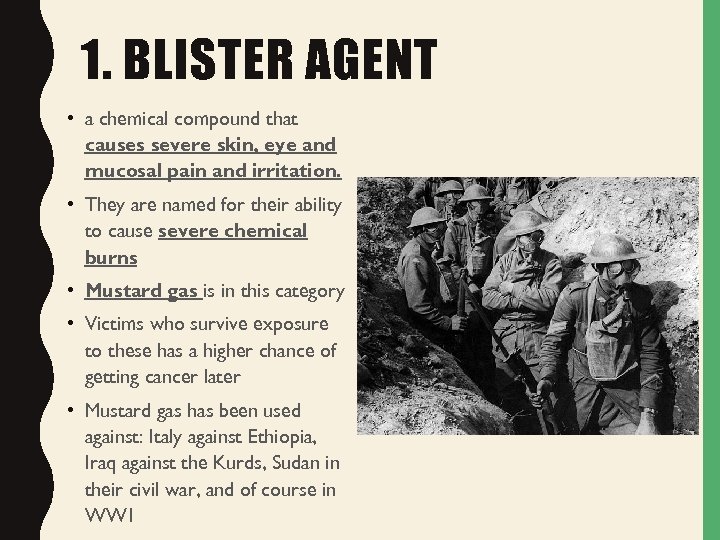 1. BLISTER AGENT • a chemical compound that causes severe skin, eye and mucosal pain and irritation. • They are named for their ability to cause severe chemical burns • Mustard gas is in this category • Victims who survive exposure to these has a higher chance of getting cancer later • Mustard gas has been used against: Italy against Ethiopia, Iraq against the Kurds, Sudan in their civil war, and of course in WW 1
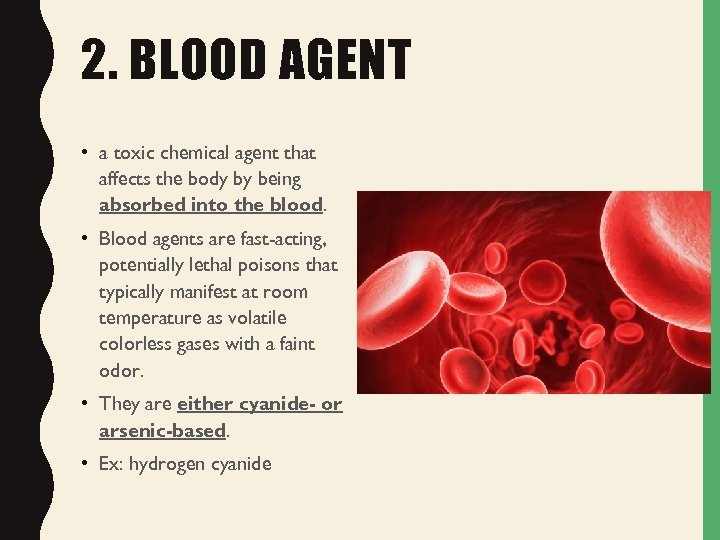 2. BLOOD AGENT • a toxic chemical agent that affects the body by being absorbed into the blood. • Blood agents are fast-acting, potentially lethal poisons that typically manifest at room temperature as volatile colorless gases with a faint odor. • They are either cyanide- or arsenic-based. • Ex: hydrogen cyanide
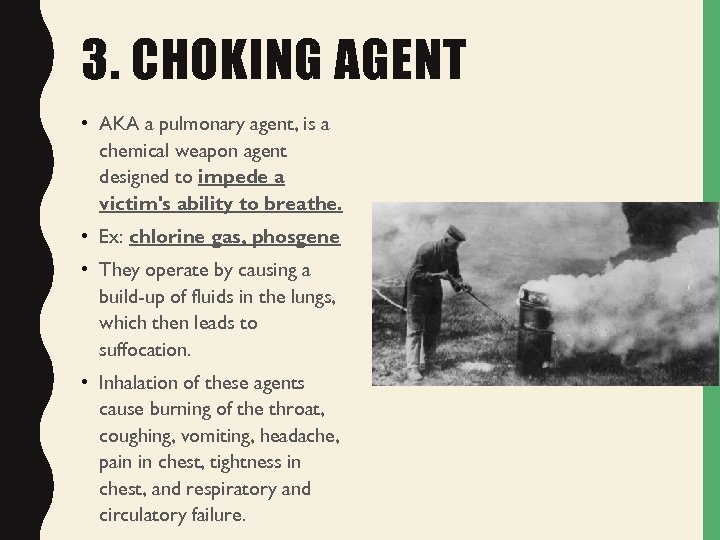 3. CHOKING AGENT • AKA a pulmonary agent, is a chemical weapon agent designed to impede a victim's ability to breathe. • Ex: chlorine gas, phosgene • They operate by causing a build-up of fluids in the lungs, which then leads to suffocation. • Inhalation of these agents cause burning of the throat, coughing, vomiting, headache, pain in chest, tightness in chest, and respiratory and circulatory failure.
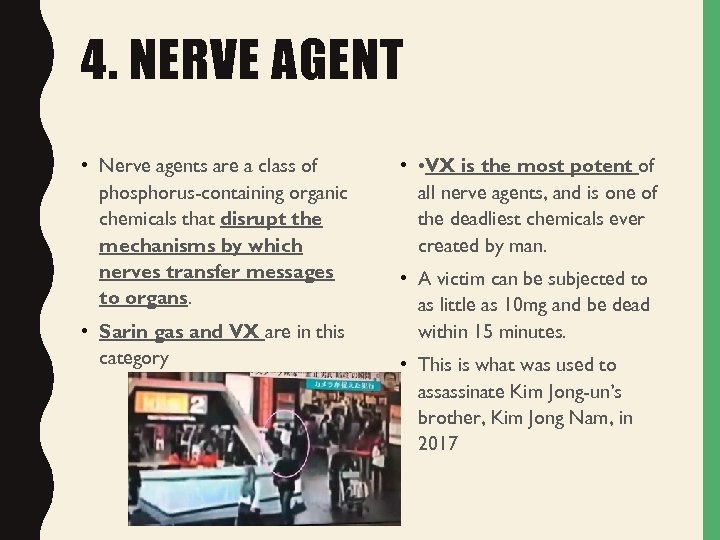 4. NERVE AGENT • Nerve agents are a class of phosphorus-containing organic chemicals that disrupt the mechanisms by which nerves transfer messages to organs. • Sarin gas and VX are in this category • • VX is the most potent of all nerve agents, and is one of the deadliest chemicals ever created by man. • A victim can be subjected to as little as 10 mg and be dead within 15 minutes. • This is what was used to assassinate Kim Jong-un’s brother, Kim Jong Nam, in 2017
 OTHER CHEMICAL WEAPON ATTACKS
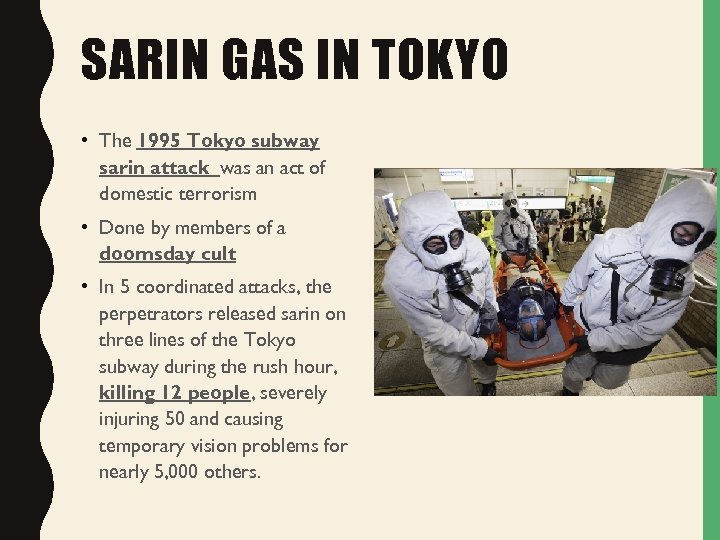 SARIN GAS IN TOKYO • The 1995 Tokyo subway sarin attack was an act of domestic terrorism • Done by members of a doomsday cult • In 5 coordinated attacks, the perpetrators released sarin on three lines of the Tokyo subway during the rush hour, killing 12 people, severely injuring 50 and causing temporary vision problems for nearly 5, 000 others.
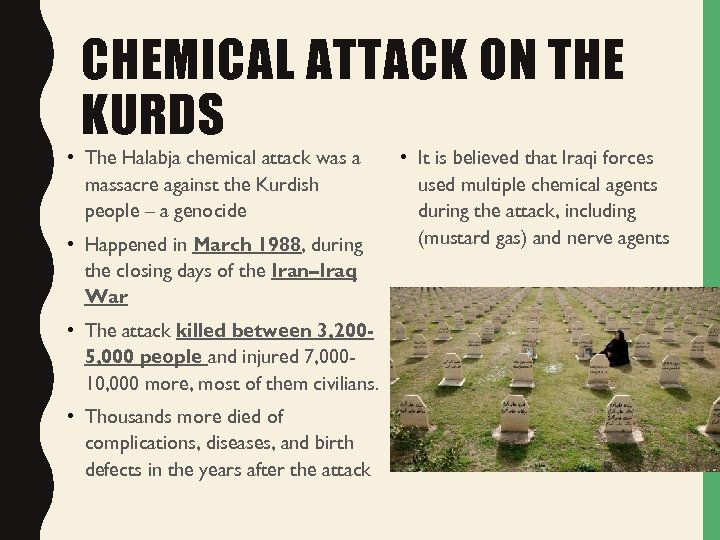 CHEMICAL ATTACK ON THE KURDS • The Halabja chemical attack was a massacre against the Kurdish people – a genocide • Happened in March 1988, during the closing days of the Iran–Iraq War • The attack killed between 3, 2005, 000 people and injured 7, 00010, 000 more, most of them civilians. • Thousands more died of complications, diseases, and birth defects in the years after the attack • It is believed that Iraqi forces used multiple chemical agents during the attack, including (mustard gas) and nerve agents
 OTHER ATTACKS • Gas bombs in the Yemen Civil War in the 1960 s, killing a few hundred • During the Rhodesian Bush War in the 1970 s, poisons were put on the enemy’s clothes, and in their food and drink. About 1, 000 died • Chechen terrorists exploded chlorine bombs in the 1990 s
 BIOLOGICAL WEAPONS
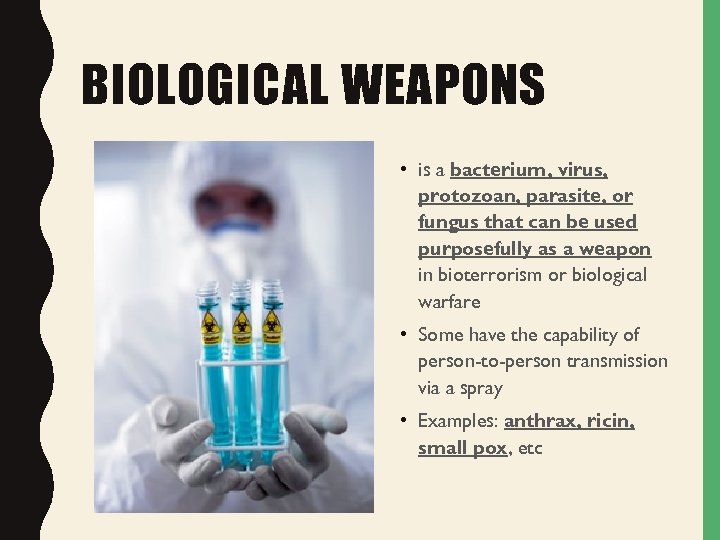 BIOLOGICAL WEAPONS • is a bacterium, virus, protozoan, parasite, or fungus that can be used purposefully as a weapon in bioterrorism or biological warfare • Some have the capability of person-to-person transmission via a spray • Examples: anthrax, ricin, small pox, etc
 • The Biological Weapons Convention (1972) is an international treaty banning the use or stockpiling of bio-agents; as of February 2015 there were 171 state signatories. • Bio-agents are, however, widely studied for defensive purposes under various biosafety levels and within biocontainment facilities throughout the world. • Who has them: China, Cuba, Egypt, Iran, Israel, North Korea, Russia, Syria, and Taiwan
 HISTORICAL BIOLOGICAL WARFARE • In 1346, the bodies of Mongol warriors of the Golden Horde who had died of plague were thrown over the walls of the besieged Crimean city of Kaffa. • During WW 2 the UK developed its own biological weapons but never used them • Japan used biological weapons against the Chinese in several military campaigns. – In 1940, the Japanese Army Air Force bombed Ningbo with ceramic bombs full of fleas carrying the bubonic plague. – Many of these operations were ineffective due to inefficient delivery systems, although up to 400, 000 people may have died
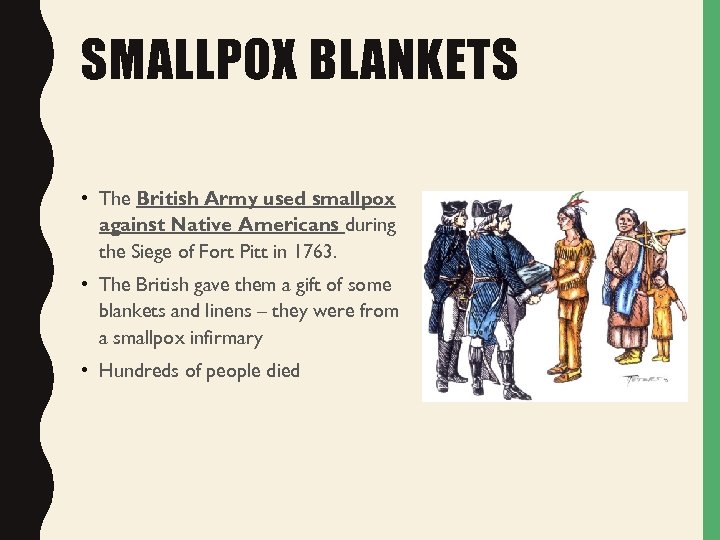 SMALLPOX BLANKETS • The British Army used smallpox against Native Americans during the Siege of Fort Pitt in 1763. • The British gave them a gift of some blankets and linens – they were from a smallpox infirmary • Hundreds of people died
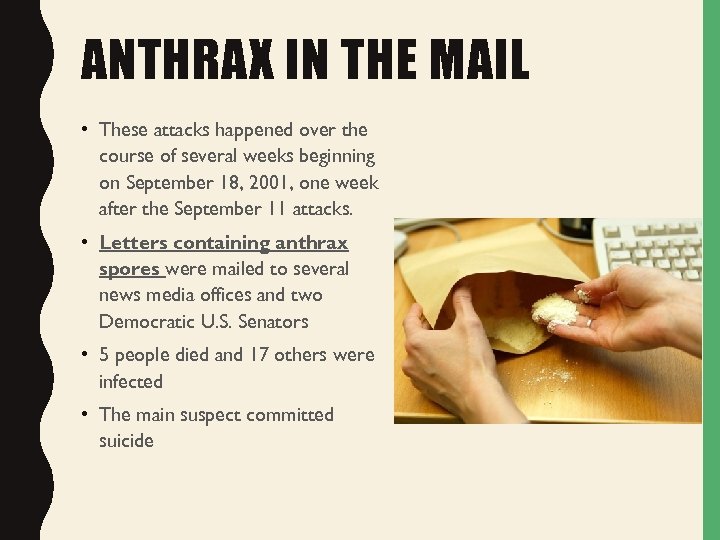 ANTHRAX IN THE MAIL • These attacks happened over the course of several weeks beginning on September 18, 2001, one week after the September 11 attacks. • Letters containing anthrax spores were mailed to several news media offices and two Democratic U. S. Senators • 5 people died and 17 others were infected • The main suspect committed suicide
 WHAT IS RICIN? • is a highly toxic, naturally occurring lectin (a carbohydrate-binding protein) produced in the seeds of the castor oil plant • A dose of purified ricin powder the size of a few grains of table salt can kill an adult human • Ricin is very poisonous if inhaled, injected, or ingested. It can also be poisonous if dust contacts the eyes or if it is absorbed through damaged skin • Symptoms can take 2 -5 days to appear
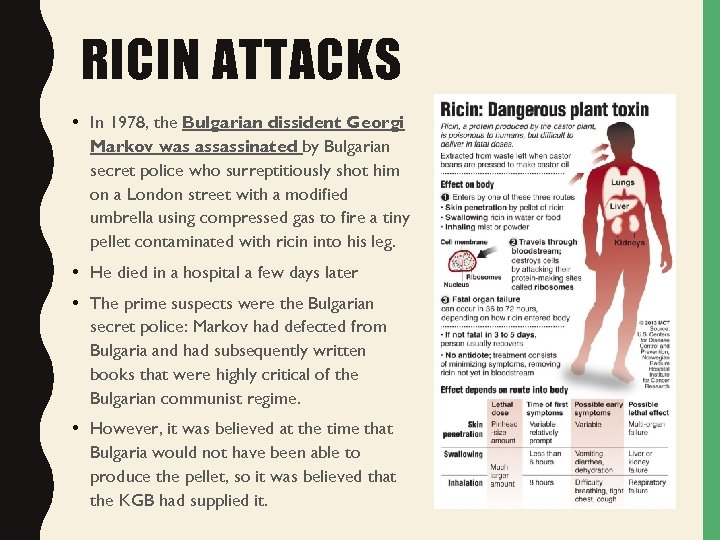 RICIN ATTACKS • In 1978, the Bulgarian dissident Georgi Markov was assassinated by Bulgarian secret police who surreptitiously shot him on a London street with a modified umbrella using compressed gas to fire a tiny pellet contaminated with ricin into his leg. • He died in a hospital a few days later • The prime suspects were the Bulgarian secret police: Markov had defected from Bulgaria and had subsequently written books that were highly critical of the Bulgarian communist regime. • However, it was believed at the time that Bulgaria would not have been able to produce the pellet, so it was believed that the KGB had supplied it.
 RADIOLOGICAL WEAPONS • any weapon that is designed to spread radioactive material with the intent to kill and cause disruption • “Dirty bomb” uses conventional explosives to spread radioactive material, most commonly the spent fuels from nuclear power plants or radioactive medical waste • These are not nuclear weapons. Nuclear weapons involve a complex nuclear-fission reaction and are thousands of times more devastating. • They are nothing more than some kind of contaminated material that is rigged with conventional explosives. • A dirty bomb has never been detonated
 WMD VIDEO • https: //www. youtube. com/watch? v=OX 6 zxjxl. A_4 “Weapons of Mass Destruction”, 16 min • https: //www. youtube. com/watch? v=7 esod. Xk. It 2 I, “Can chemical and biological weapons save lives? ” 15 min