


 Скачать презентацию OSHA s Proposed Chrome PEL SFIC Washington Forum Washington
604bac52f45bb359d48356f771f1f84b.ppt
- Количество слайдов: 18
 OSHA’s Proposed Chrome PEL SFIC Washington Forum Washington, DC May 11, 2005 Jeff Hannapel The Policy Group One Thomas Circle, NW, 10 th Floor Washington, DC 20005 202 -457 -0630 jhannapel@thepolicygroup. com Stu Sessions Environomics, Inc. 4405 East-West Highway, Ste 307 Bethesda, Maryland 20814 301 -657 -7762 sessions@environomics. com
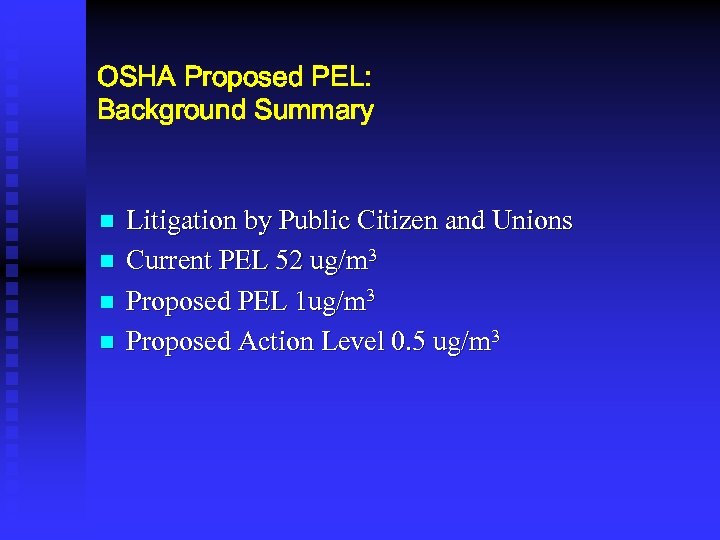 OSHA Proposed PEL: Background Summary n n Litigation by Public Citizen and Unions Current PEL 52 ug/m 3 Proposed PEL 1 ug/m 3 Proposed Action Level 0. 5 ug/m 3
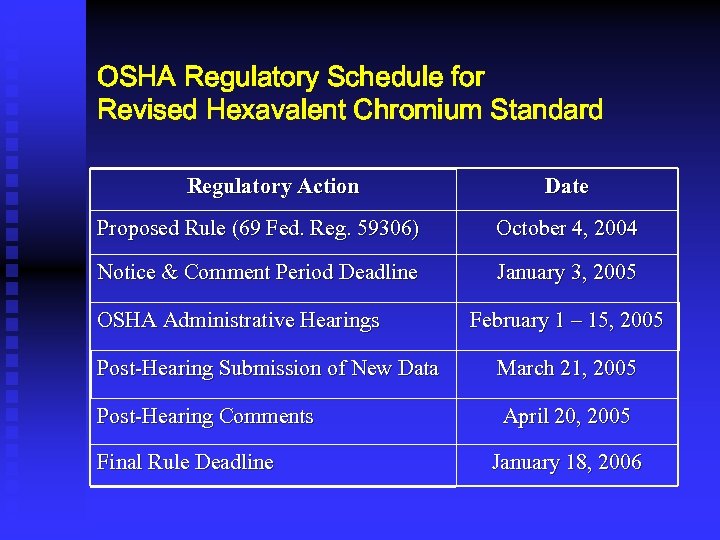 OSHA Regulatory Schedule for Revised Hexavalent Chromium Standard Regulatory Action Date Proposed Rule (69 Fed. Reg. 59306) October 4, 2004 Notice & Comment Period Deadline January 3, 2005 OSHA Administrative Hearings February 1 – 15, 2005 Post-Hearing Submission of New Data March 21, 2005 Post-Hearing Comments April 20, 2005 Final Rule Deadline January 18, 2006
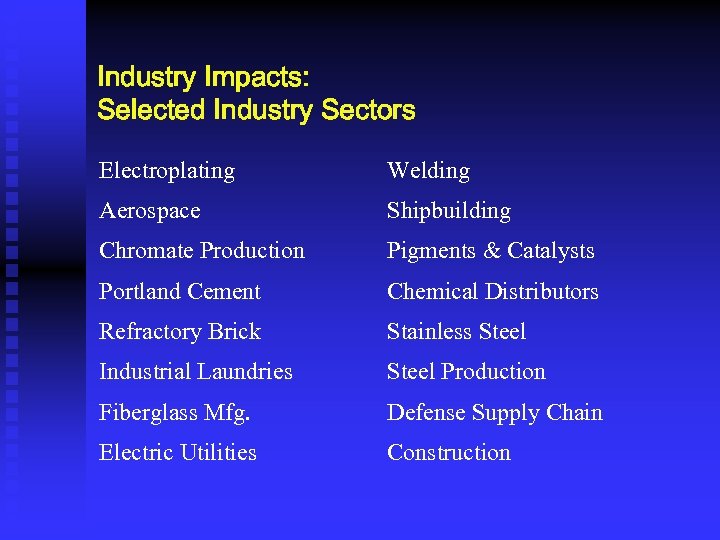 Industry Impacts: Selected Industry Sectors Electroplating Welding Aerospace Shipbuilding Chromate Production Pigments & Catalysts Portland Cement Chemical Distributors Refractory Brick Stainless Steel Industrial Laundries Steel Production Fiberglass Mfg. Defense Supply Chain Electric Utilities Construction
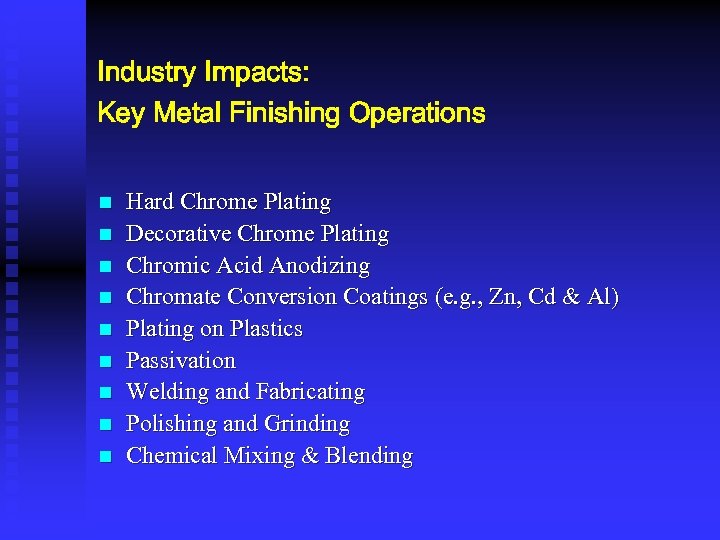 Industry Impacts: Key Metal Finishing Operations n n n n n Hard Chrome Plating Decorative Chrome Plating Chromic Acid Anodizing Chromate Conversion Coatings (e. g. , Zn, Cd & Al) Plating on Plastics Passivation Welding and Fabricating Polishing and Grinding Chemical Mixing & Blending
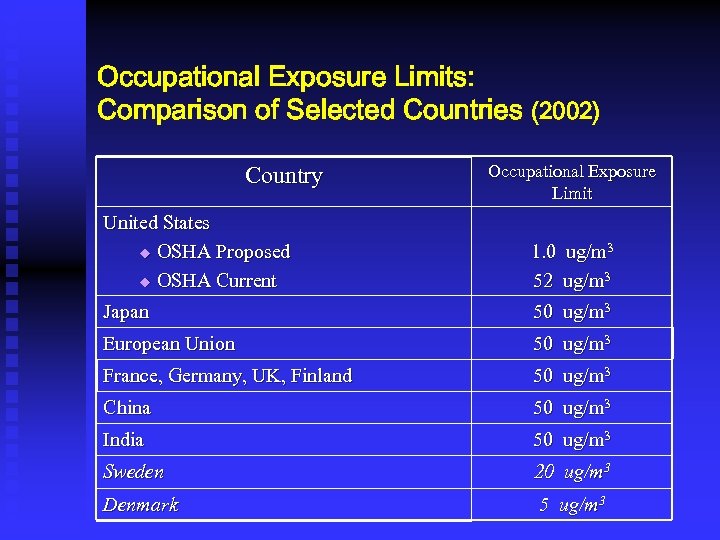 Occupational Exposure Limits: Comparison of Selected Countries (2002) Country Occupational Exposure Limit United States u OSHA Proposed u OSHA Current 1. 0 ug/m 3 52 ug/m 3 Japan 50 ug/m 3 European Union 50 ug/m 3 France, Germany, UK, Finland 50 ug/m 3 China 50 ug/m 3 India 50 ug/m 3 Sweden 20 ug/m 3 Denmark 5 ug/m 3
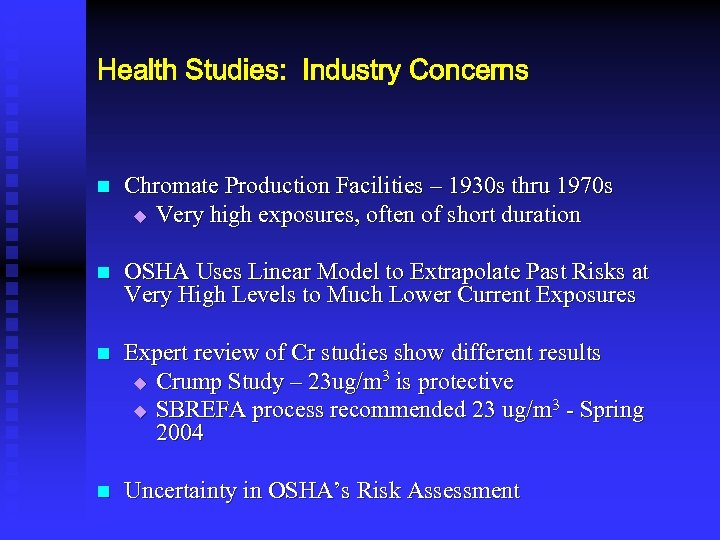 Health Studies: Industry Concerns n Chromate Production Facilities – 1930 s thru 1970 s u Very high exposures, often of short duration n OSHA Uses Linear Model to Extrapolate Past Risks at Very High Levels to Much Lower Current Exposures n Expert review of Cr studies show different results u Crump Study – 23 ug/m 3 is protective u SBREFA process recommended 23 ug/m 3 - Spring 2004 n Uncertainty in OSHA’s Risk Assessment
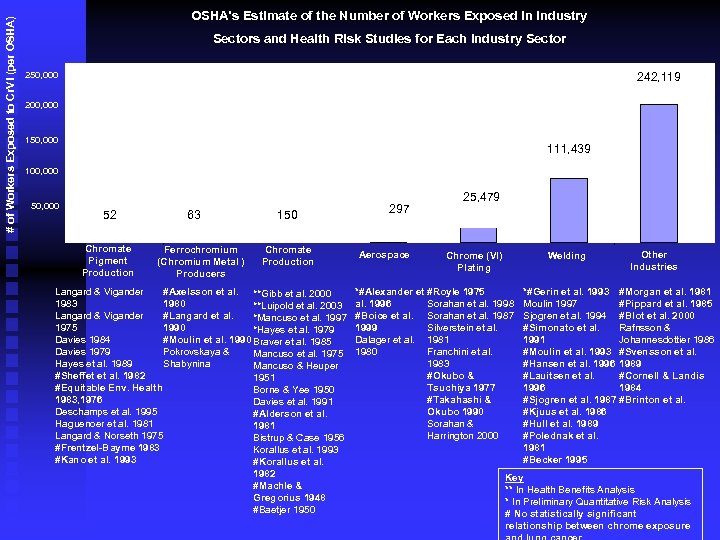 # of Workers Exposed to Cr. VI (per OSHA) OSHA’s Estimate of the Number of Workers Exposed in Industry Sectors and Health Risk Studies for Each Industry Sector 250, 000 242, 119 200, 000 150, 000 111, 439 100, 000 52 Chromate Pigment Production 63 Ferrochromium (Chromium Metal ) Producers 150 Chromate Production Langard & Vigander #Axelsson et al. **Gibb et al. 2000 1983 1980 **Luipold et al. 2003 Langard & Vigander #Langard et al. *Mancuso et al. 1997 1975 1990 *Hayes et al. 1979 Davies 1984 #Moulin et al. 1990 Braver et al. 1985 Davies 1979 Pokrovskaya & Mancuso et al. 1975 Hayes et al. 1989 Shabynina Mancuso & Heuper #Sheffet et al. 1982 1951 #Equitable Env. Health Borne & Yee 1950 1983, 1976 Davies et al. 1991 Deschamps et al. 1995 #Alderson et al. Haguenoer et al. 1981 Langard & Norseth 1975 Bistrup & Case 1956 #Frentzel-Bayme 1983 Korallus et al. 1993 #Kano et al. 1993 #Korallus et al. 1982 #Machle & Gregorius 1948 #Baetjer 1950 1, 297 Aerospace 25, 479 Chrome (VI) Plating Welding *#Alexander et #Royle 1975 al. 1996 Sorahan et al. 1998 #Boice et al. Sorahan et al. 1987 1999 Silverstein et al. Dalager et al. 1981 1980 Franchini et al. 1983 #Okubo & Tsuchiya 1977 #Takahashi & Okubo 1990 Sorahan & Harrington 2000 Other Industries *#Gerin et al. 1993 #Morgan et al. 1981 Moulin 1997 #Pippard et al. 1985 Sjogren et al. 1994 #Blot et al. 2000 #Simonato et al. Rafnsson & 1991 Johannesdottier 1986 #Moulin et al. 1993 #Svensson et al. #Hansen et al. 1996 1989 #Lauitsen et al. #Cornell & Landis 1996 1984 #Sjogren et al. 1987 #Brinton et al. #Kjuus et al. 1986 #Hull et al. 1989 #Polednak et al. 1981 #Becker 1995 Key ** In Health Benefits Analysis * In Preliminary Quantitative Risk Analysis # No statistically significant relationship between chrome exposure
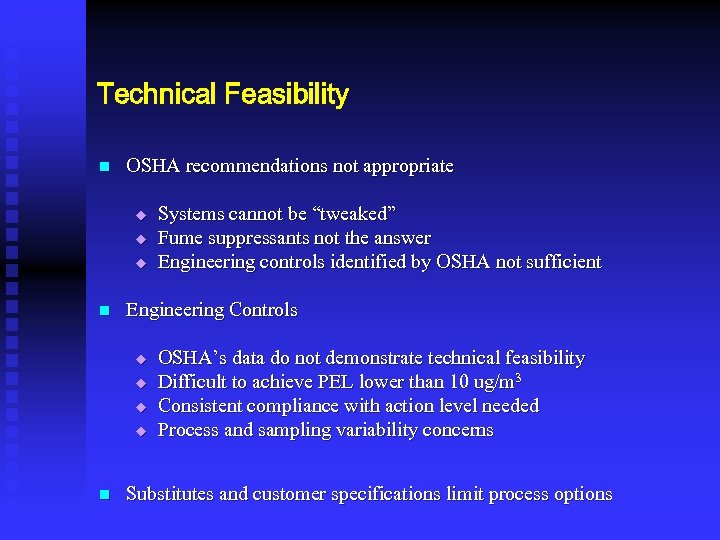 Technical Feasibility n OSHA recommendations not appropriate u u u n Engineering Controls u u n Systems cannot be “tweaked” Fume suppressants not the answer Engineering controls identified by OSHA not sufficient OSHA’s data do not demonstrate technical feasibility Difficult to achieve PEL lower than 10 ug/m 3 Consistent compliance with action level needed Process and sampling variability concerns Substitutes and customer specifications limit process options
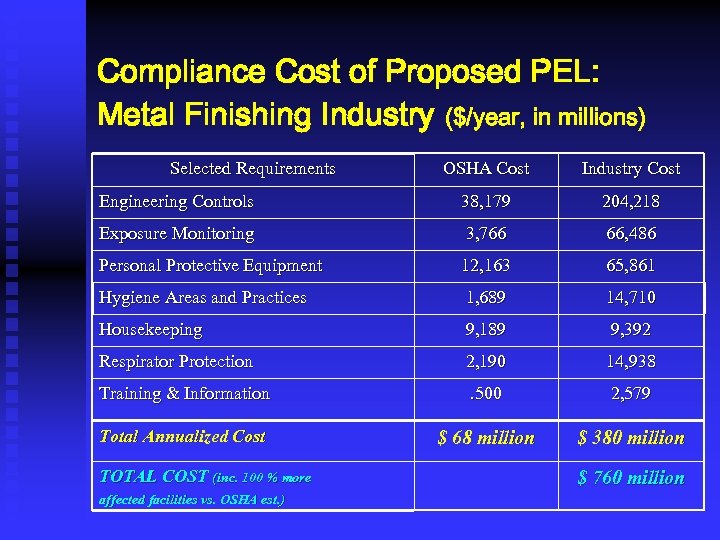 Compliance Cost of Proposed PEL: Metal Finishing Industry ($/year, in millions) Selected Requirements OSHA Cost Industry Cost Engineering Controls 38, 179 204, 218 Exposure Monitoring 3, 766 66, 486 Personal Protective Equipment 12, 163 65, 861 Hygiene Areas and Practices 1, 689 14, 710 Housekeeping 9, 189 9, 392 Respirator Protection 2, 190 14, 938 Training & Information . 500 2, 579 Total Annualized Cost $ 68 million $ 380 million TOTAL COST (inc. 100 % more affected facilities vs. OSHA est. ) $ 760 million
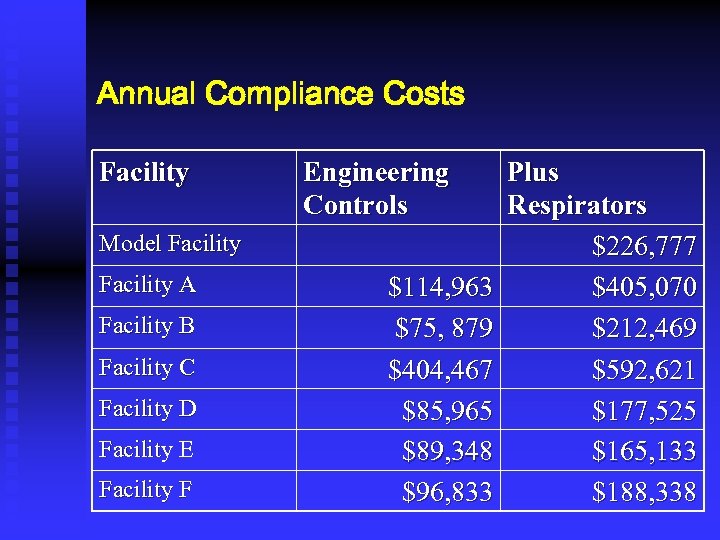 Annual Compliance Costs Facility Engineering Controls Model Facility A Facility B Facility C Facility D Facility E Facility F $114, 963 $75, 879 $404, 467 $85, 965 $89, 348 $96, 833 Plus Respirators $226, 777 $405, 070 $212, 469 $592, 621 $177, 525 $165, 133 $188, 338
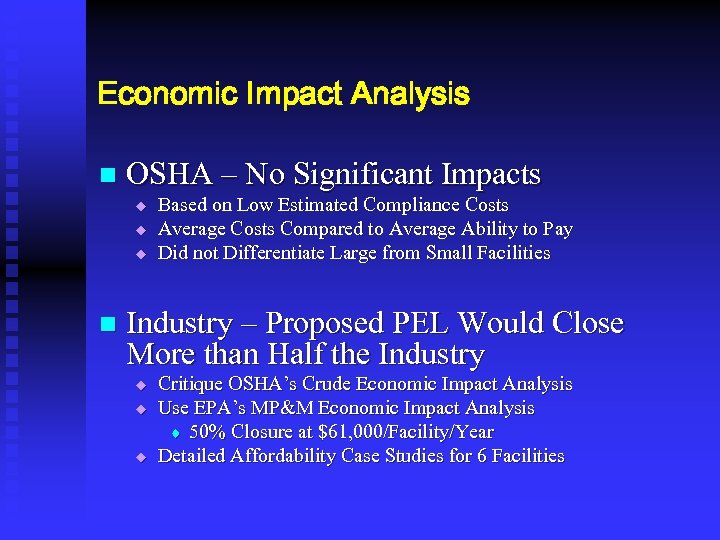 Economic Impact Analysis n OSHA – No Significant Impacts u u u n Based on Low Estimated Compliance Costs Average Costs Compared to Average Ability to Pay Did not Differentiate Large from Small Facilities Industry – Proposed PEL Would Close More than Half the Industry u u u Critique OSHA’s Crude Economic Impact Analysis Use EPA’s MP&M Economic Impact Analysis t 50% Closure at $61, 000/Facility/Year Detailed Affordability Case Studies for 6 Facilities
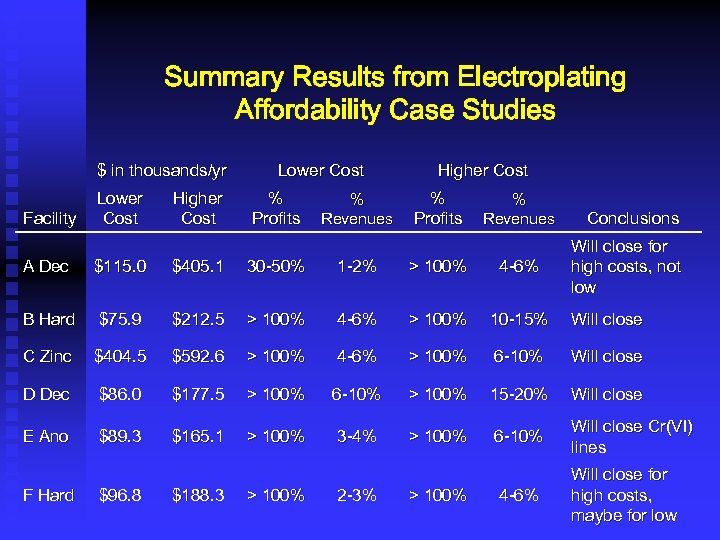 Summary Results from Electroplating Affordability Case Studies $ in thousands/yr Facility Lower Cost Higher Cost Lower Cost % Profits % Revenues Higher Cost % Profits % Revenues Conclusions Will close for high costs, not low A Dec $115. 0 $405. 1 30 -50% 1 -2% > 100% 4 -6% B Hard $75. 9 $212. 5 > 100% 4 -6% > 100% 10 -15% Will close C Zinc $404. 5 $592. 6 > 100% 4 -6% > 100% 6 -10% Will close D Dec $86. 0 $177. 5 > 100% 6 -10% > 100% 15 -20% Will close E Ano $89. 3 $165. 1 > 100% 3 -4% > 100% 6 -10% Will close Cr(VI) lines 4 -6% Will close for high costs, maybe for low F Hard $96. 8 $188. 3 > 100% 2 -3% > 100%
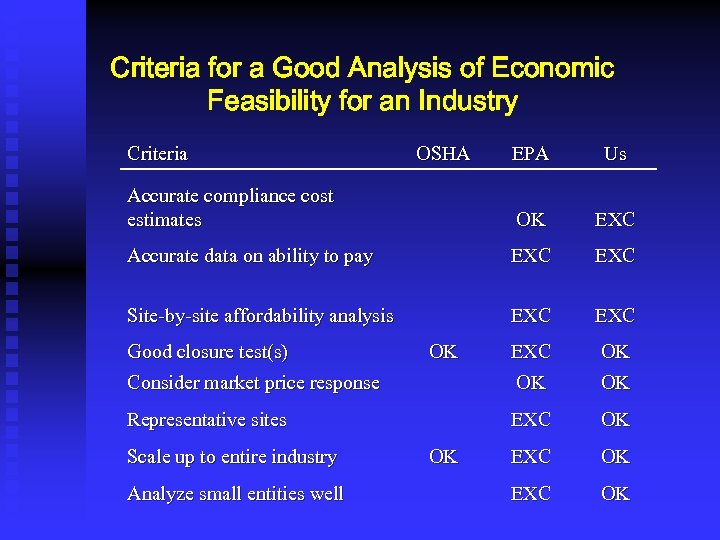 Criteria for a Good Analysis of Economic Feasibility for an Industry Criteria EPA Us Accurate compliance cost estimates OK EXC Accurate data on ability to pay EXC Site-by-site affordability analysis EXC EXC OK Consider market price response OK OK Representative sites EXC OK Good closure test(s) Scale up to entire industry Analyze small entities well OSHA OK OK
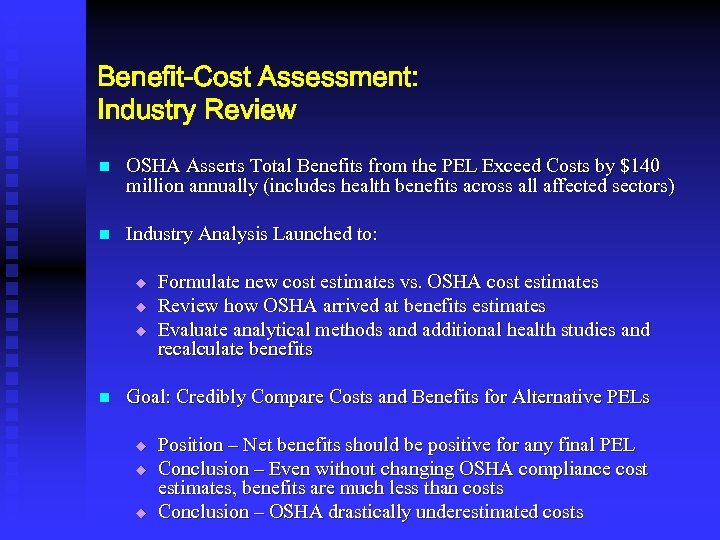 Benefit-Cost Assessment: Industry Review n OSHA Asserts Total Benefits from the PEL Exceed Costs by $140 million annually (includes health benefits across all affected sectors) n Industry Analysis Launched to: u u u n Formulate new cost estimates vs. OSHA cost estimates Review how OSHA arrived at benefits estimates Evaluate analytical methods and additional health studies and recalculate benefits Goal: Credibly Compare Costs and Benefits for Alternative PELs u u u Position – Net benefits should be positive for any final PEL Conclusion – Even without changing OSHA compliance cost estimates, benefits are much less than costs Conclusion – OSHA drastically underestimated costs
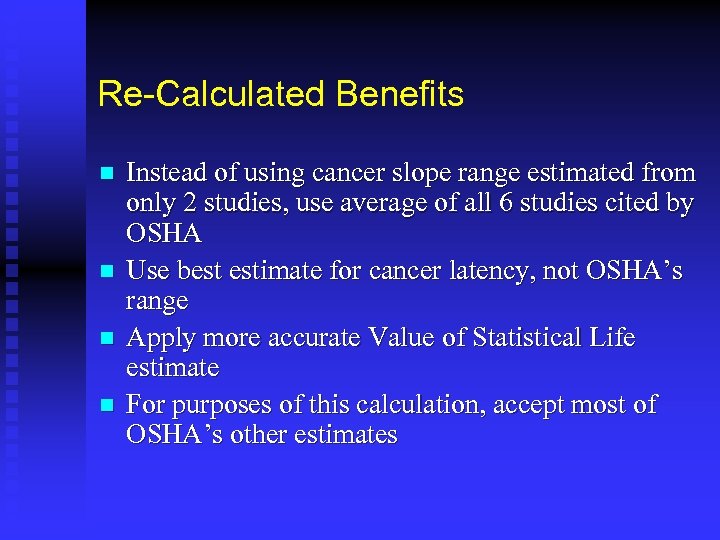 Re-Calculated Benefits n n Instead of using cancer slope range estimated from only 2 studies, use average of all 6 studies cited by OSHA Use best estimate for cancer latency, not OSHA’s range Apply more accurate Value of Statistical Life estimate For purposes of this calculation, accept most of OSHA’s other estimates
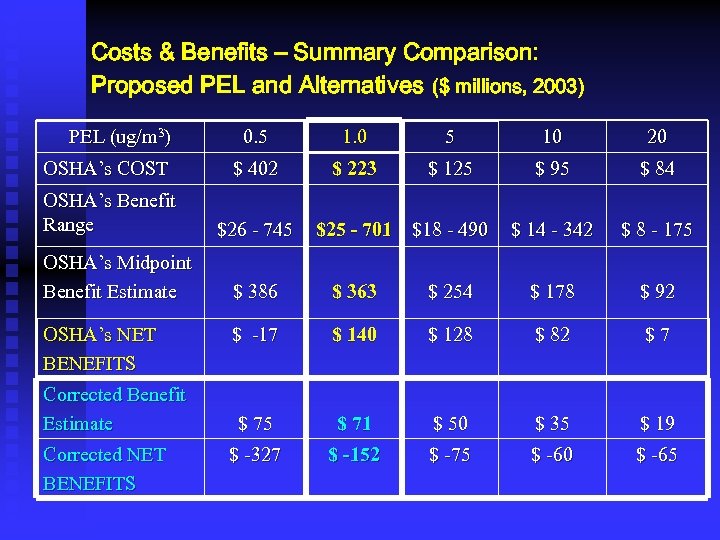 Costs & Benefits – Summary Comparison: Proposed PEL and Alternatives ($ millions, 2003) PEL (ug/m 3) 0. 5 1. 0 5 10 20 OSHA’s COST $ 402 $ 223 $ 125 $ 95 $ 84 OSHA’s Benefit Range $26 - 745 $ 14 - 342 $ 8 - 175 OSHA’s Midpoint Benefit Estimate OSHA’s NET BENEFITS Corrected Benefit Estimate Corrected NET BENEFITS $25 - 701 $18 - 490 $ 386 $ 363 $ 254 $ 178 $ 92 $ -17 $ 140 $ 128 $ 82 $7 $ 75 $ 71 $ 50 $ 35 $ 19 $ -327 $ -152 $ -75 $ -60 $ -65
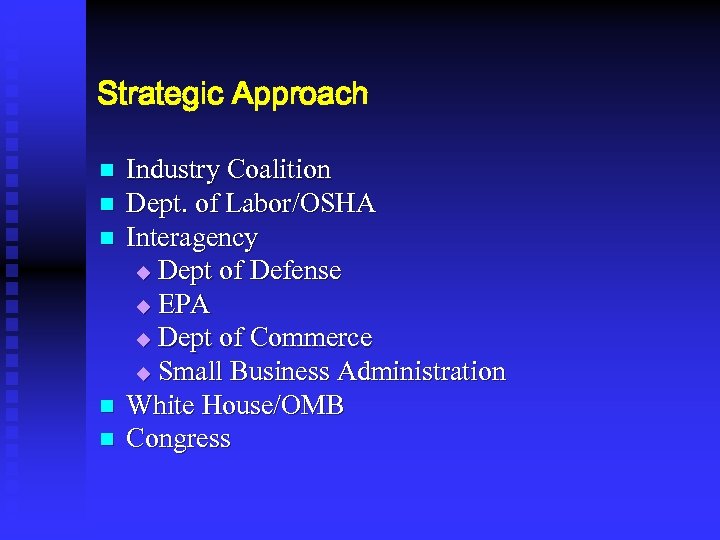 Strategic Approach n n n Industry Coalition Dept. of Labor/OSHA Interagency u Dept of Defense u EPA u Dept of Commerce u Small Business Administration White House/OMB Congress