 Скачать презентацию OS Support for Building Distributed Applications Multithreaded Programming
c3ecb9e21e7d2c179442e18e88642e27.ppt
- Количество слайдов: 49



OS Support for Building Distributed Applications: Multithreaded Programming using Java Threads Dr. Rajkumar Buyya Cloud Computing and Distributed Systems (CLOUDS) Laboratory School of Computing and Information Systems The University of Melbourne, Australia http: //www. buyya. com 1
Outline n n n n Introduction Thread Applications Defining Threads Java Threads and States Architecture of Multithreaded servers Threads Synchronization Summary 2
Introduction n n We discuss how Middleware is supported by the Operating System (OS) facilities at the nodes of a distributed system. The OS facilitates: n n Encapsulation and protection of resources inside servers; It supports invocation of mechanisms required to access those resources including concurrent access/processing. 3
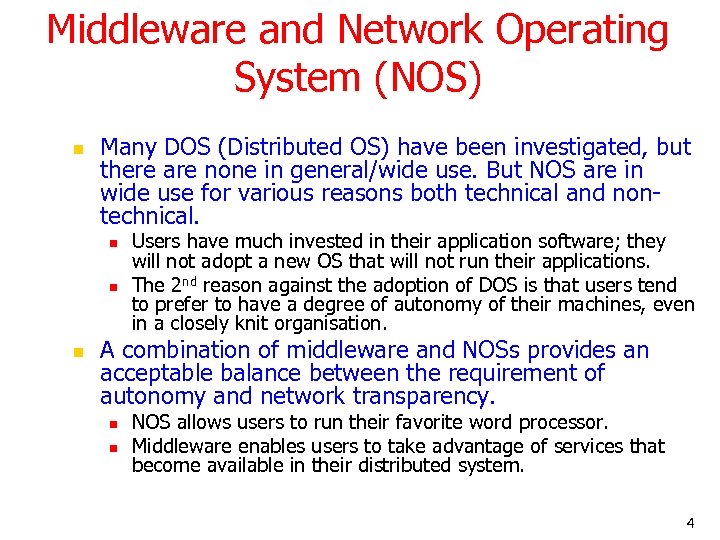
Middleware and Network Operating System (NOS) n Many DOS (Distributed OS) have been investigated, but there are none in general/wide use. But NOS are in wide use for various reasons both technical and nontechnical. n n n Users have much invested in their application software; they will not adopt a new OS that will not run their applications. The 2 nd reason against the adoption of DOS is that users tend to prefer to have a degree of autonomy of their machines, even in a closely knit organisation. A combination of middleware and NOSs provides an acceptable balance between the requirement of autonomy and network transparency. n n NOS allows users to run their favorite word processor. Middleware enables users to take advantage of services that become available in their distributed system. 4
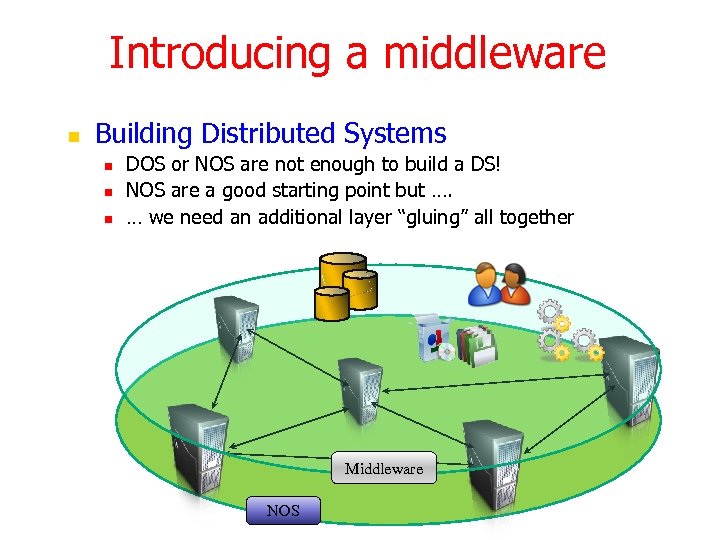
Introducing a middleware n Building Distributed Systems n n n DOS or NOS are not enough to build a DS! NOS are a good starting point but …. … we need an additional layer “gluing” all together Middleware NOS
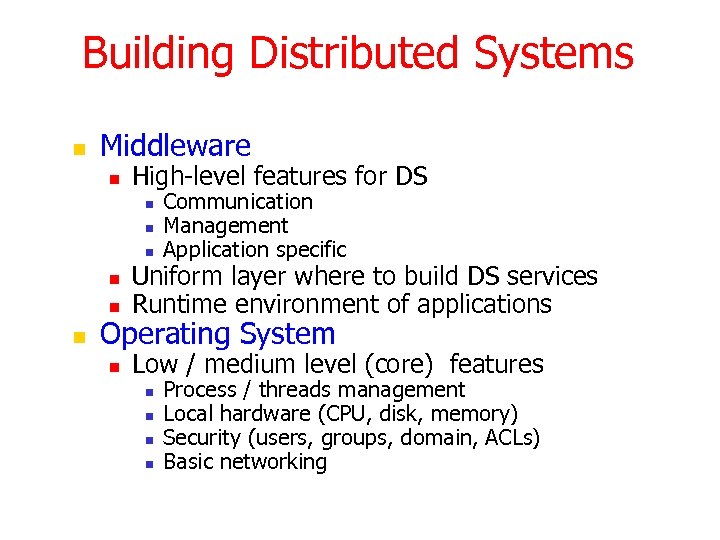
Building Distributed Systems n Middleware n High-level features for DS n n n Communication Management Application specific n Uniform layer where to build DS services Runtime environment of applications n Low / medium level (core) features n n Operating System n n Process / threads management Local hardware (CPU, disk, memory) Security (users, groups, domain, ACLs) Basic networking
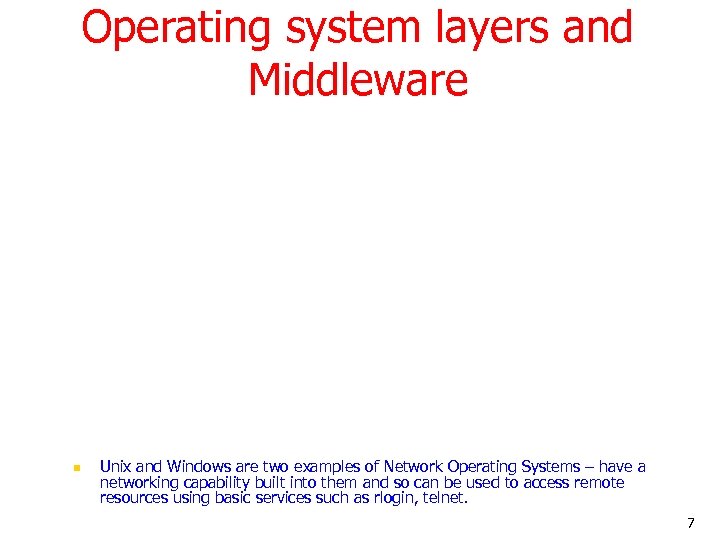
Operating system layers and Middleware n Unix and Windows are two examples of Network Operating Systems – have a networking capability built into them and so can be used to access remote resources using basic services such as rlogin, telnet. 7
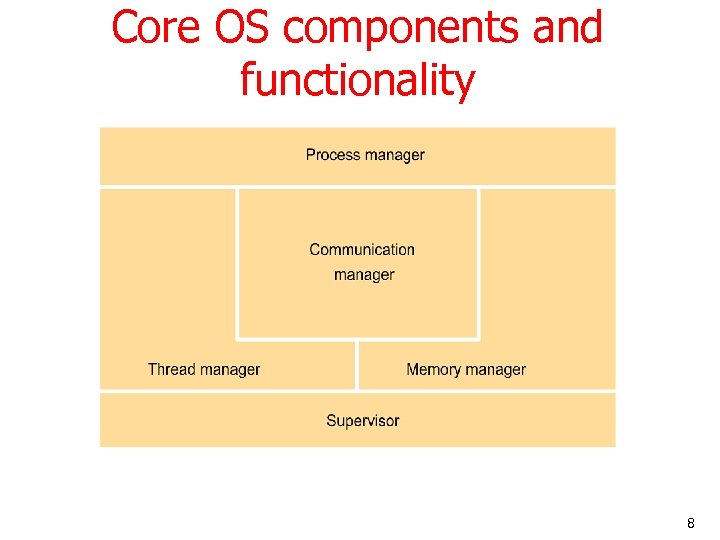
Core OS components and functionality 8
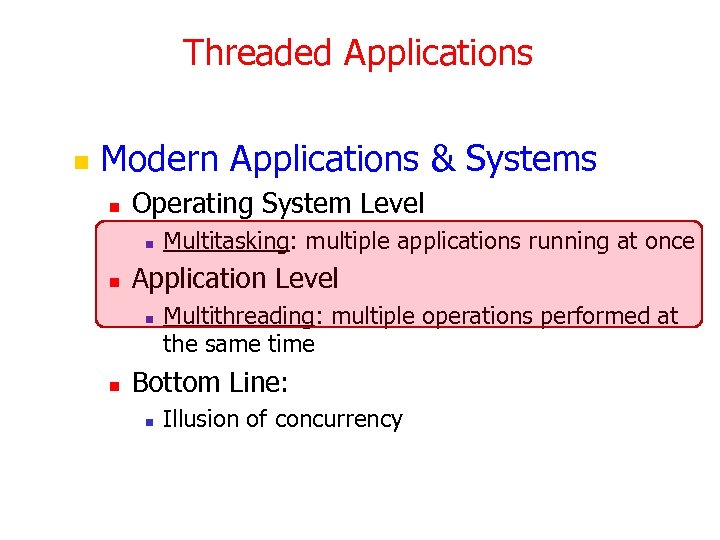
Threaded Applications n Modern Applications & Systems n Operating System Level n n Application Level n n Multitasking: multiple applications running at once Multithreading: multiple operations performed at the same time Bottom Line: n Illusion of concurrency
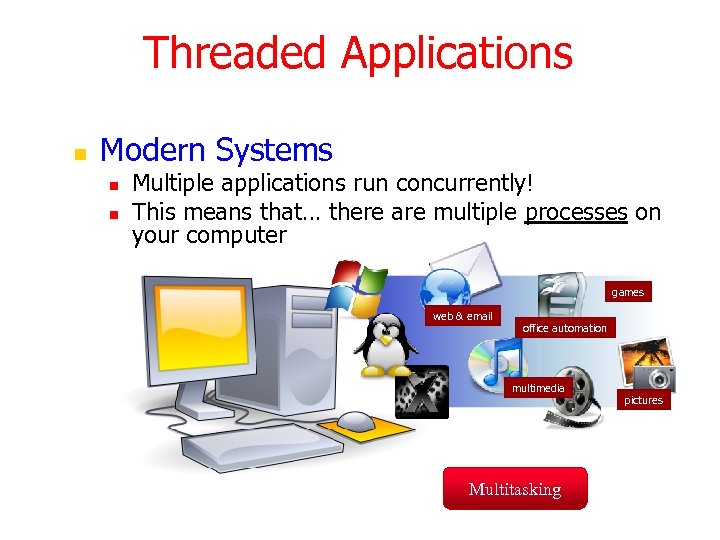
Threaded Applications n Modern Systems n n Multiple applications run concurrently! This means that… there are multiple processes on your computer games web & email office automation multimedia Multitasking pictures
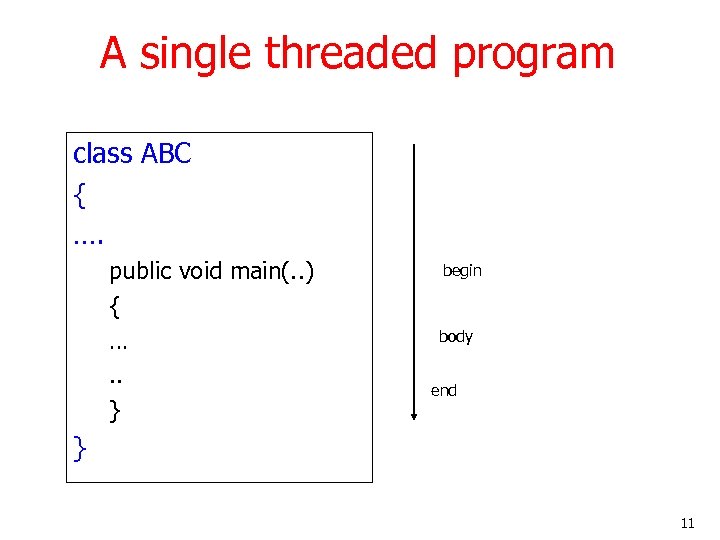
A single threaded program class ABC { …. public void main(. . ) { …. . } begin body end } 11
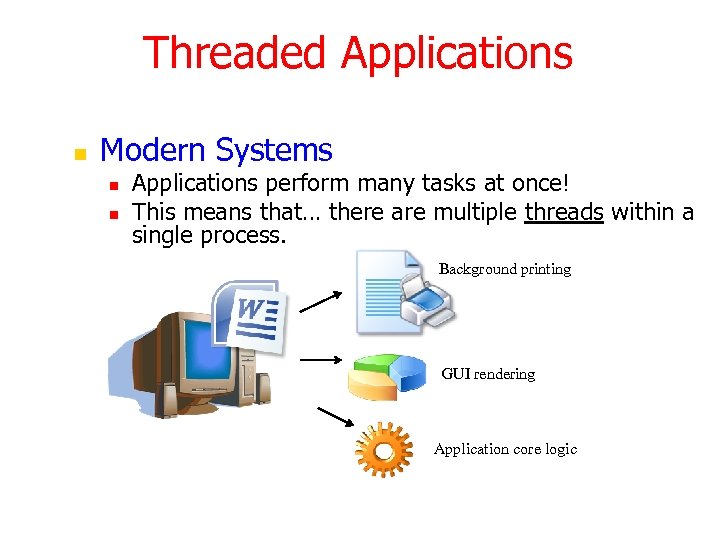
Threaded Applications n Modern Systems n n Applications perform many tasks at once! This means that… there are multiple threads within a single process. Background printing GUI rendering Application core logic
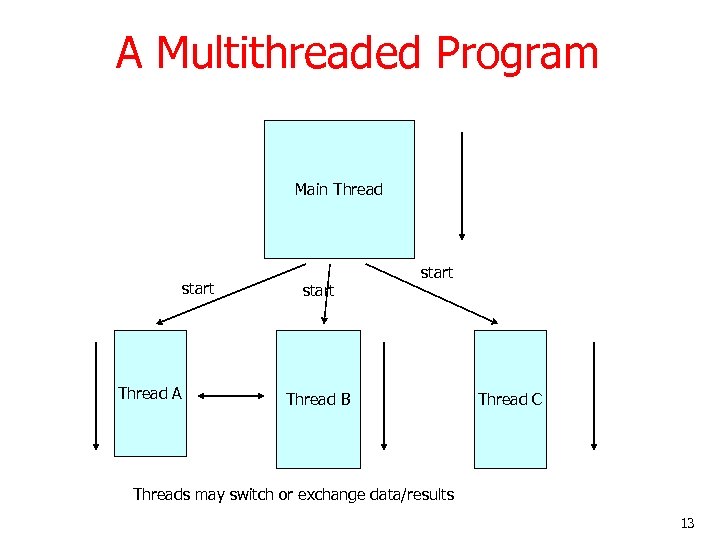
A Multithreaded Program Main Thread start Thread A start Thread B Thread C Threads may switch or exchange data/results 13
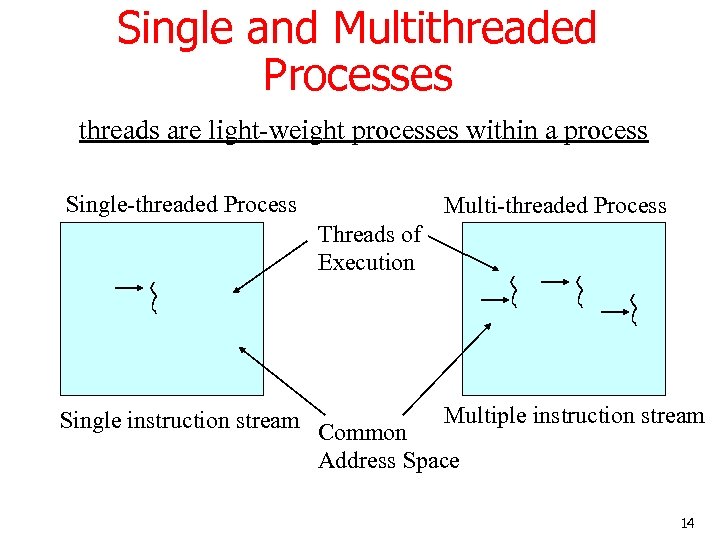
Single and Multithreaded Processes threads are light-weight processes within a process Single-threaded Process Multi-threaded Process Threads of Execution Multiple instruction stream Single instruction stream Common Address Space 14
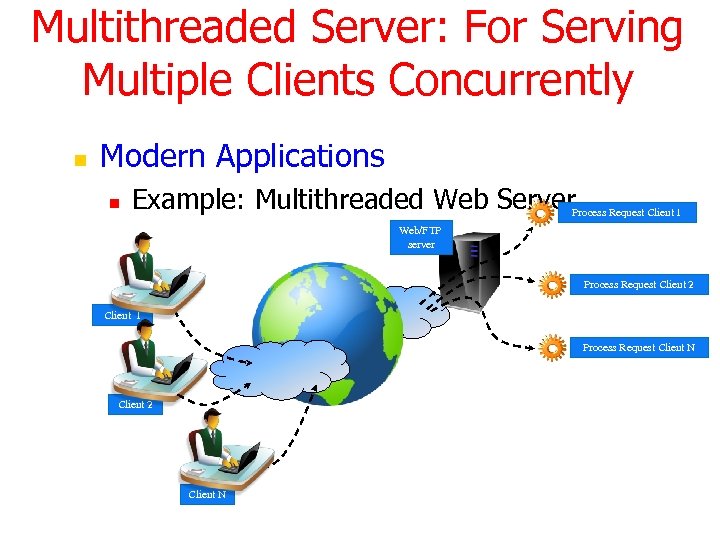
Multithreaded Server: For Serving Multiple Clients Concurrently n Modern Applications n Example: Multithreaded Web Server Process Request Client 1 Web/FTP server Process Request Client 2 Client 1 Process Request Client N Client 2 Client N
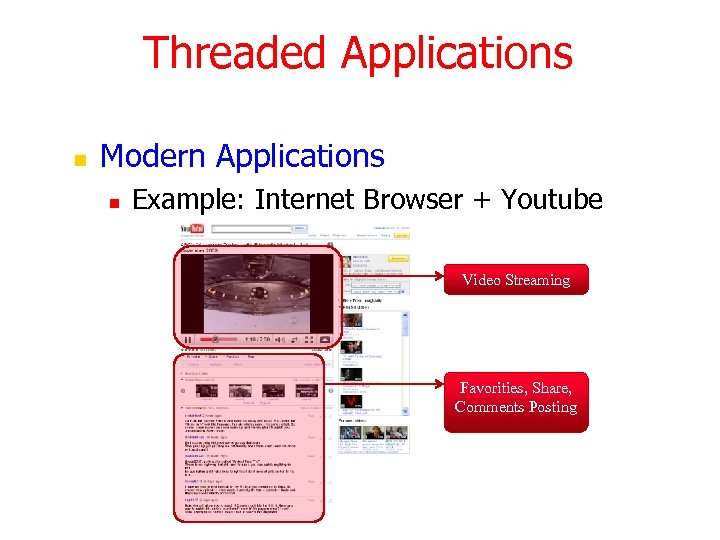
Threaded Applications n Modern Applications n Example: Internet Browser + Youtube Video Streaming Favorities, Share, Comments Posting
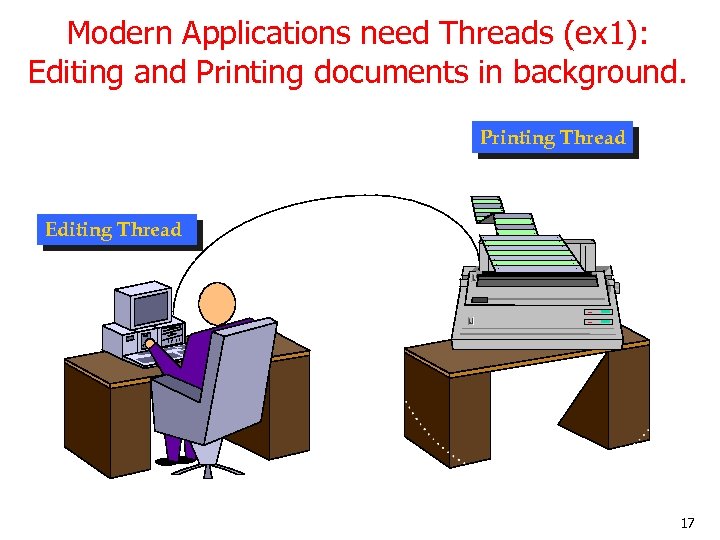
Modern Applications need Threads (ex 1): Editing and Printing documents in background. Printing Thread Editing Thread 17
![Multithreaded/Parallel File Copy reader() { - - - - lock(buff[i]); read(src, buff[i]); unlock(buff[i]); -](https://present5.com/presentation/c3ecb9e21e7d2c179442e18e88642e27/image-18.jpg "Multithreaded/Parallel File Copy reader() { - - - - lock(buff[i]); read(src, buff[i]); unlock(buff[i]); -")
Multithreaded/Parallel File Copy reader() { - - - - lock(buff[i]); read(src, buff[i]); unlock(buff[i]); - - - - } buff[0] buff[1] writer() { - - - - - lock(buff[i]); write(src, buff[i]); unlock(buff[i]); - - - - - } Cooperative Parallel Synchronized Threads 18
Defining Threads n Applications – Threads are used to perform: n n n Parallelism and concurrent execution of independent tasks / operations. Implementation of reactive user interfaces. Non blocking I/O operations. Asynchronous behavior. Timer and alarms implementation.
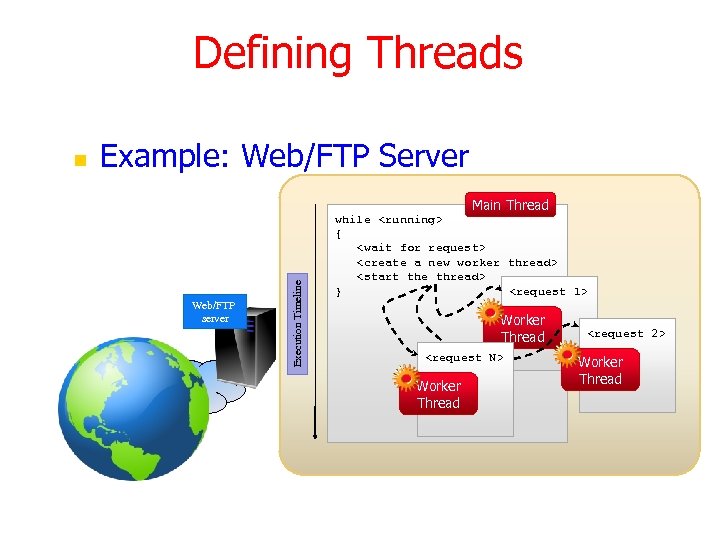
Defining Threads Example: Web/FTP Server Main Thread Web/FTP server Execution Timeline n while <running> { <wait for request> <create a new worker thread> <start the thread> <request 1> } Worker Thread <request N> Worker Thread <request 2> Worker Thread
Defining Threads n Summing Up n n A Thread is a piece of code that runs in concurrent with other threads. Each thread is a statically ordered sequence of instructions. Threads are used to express concurrency on both single and multiprocessors machines. Programming a task having multiple threads of control – Multithreading or Multithreaded Programming.
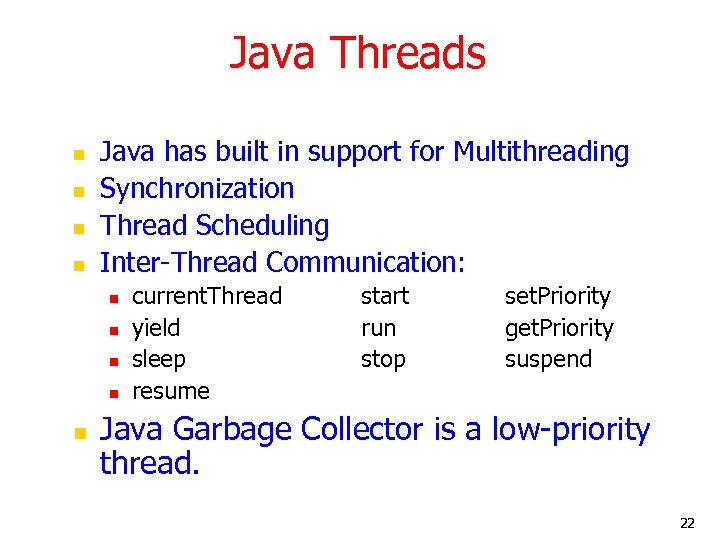
Java Threads n n Java has built in support for Multithreading Synchronization Thread Scheduling Inter-Thread Communication: n n n current. Thread yield sleep resume start run stop set. Priority get. Priority suspend Java Garbage Collector is a low-priority thread. 22
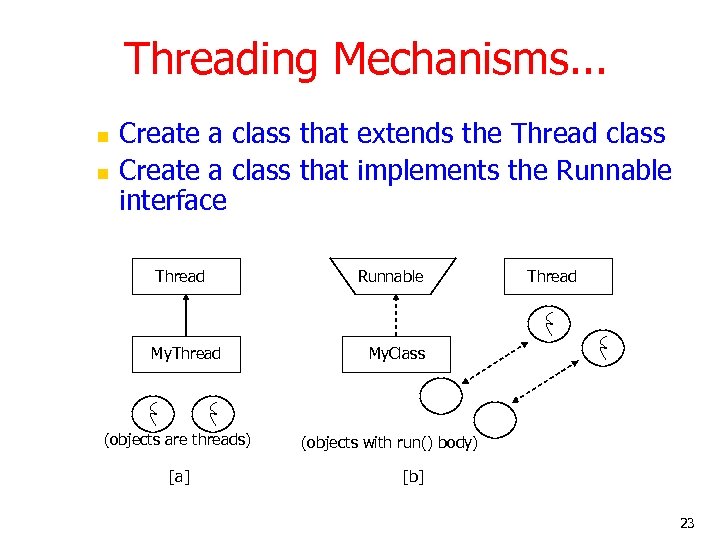
Threading Mechanisms. . . n n Create a class that extends the Thread class Create a class that implements the Runnable interface Thread My. Thread (objects are threads) [a] Runnable Thread My. Class (objects with run() body) [b] 23
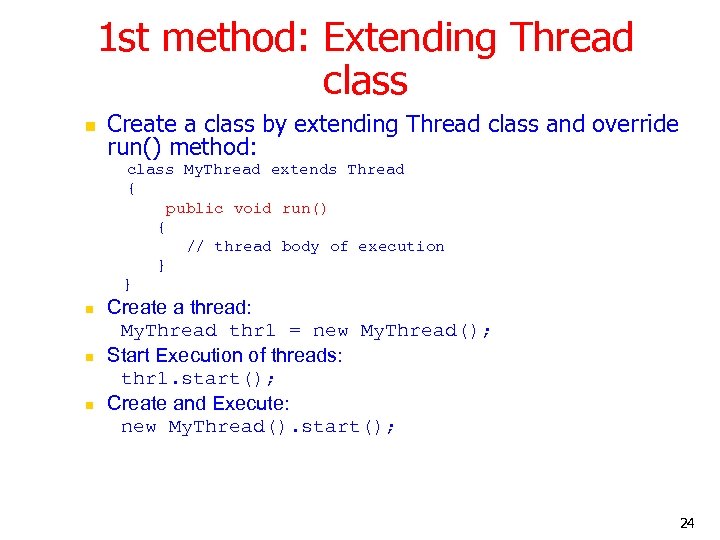
1 st method: Extending Thread class n Create a class by extending Thread class and override run() method: class My. Thread extends Thread { public void run() { // thread body of execution } } n n n Create a thread: My. Thread thr 1 = new My. Thread(); Start Execution of threads: thr 1. start(); Create and Execute: new My. Thread(). start(); 24
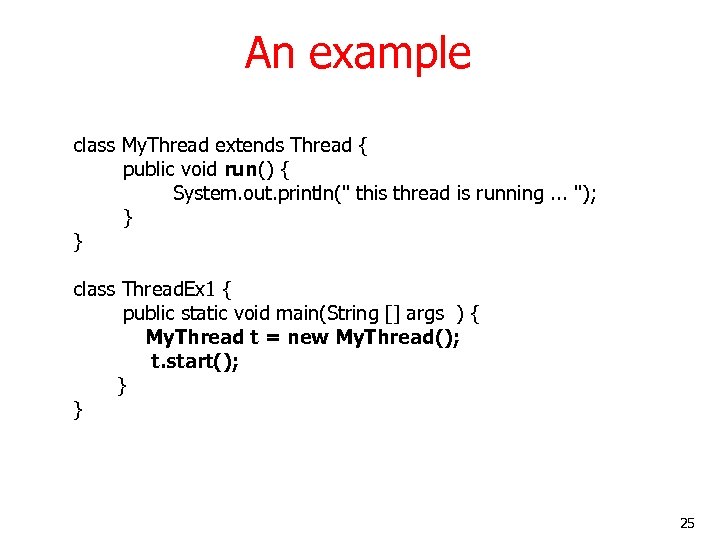
An example class My. Thread extends Thread { public void run() { System. out. println(" this thread is running. . . "); } } class Thread. Ex 1 { public static void main(String [] args ) { My. Thread t = new My. Thread(); t. start(); } } 25
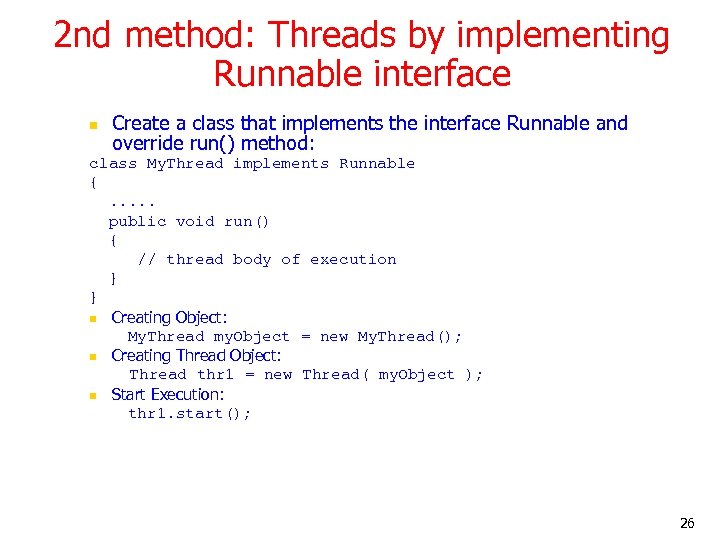
2 nd method: Threads by implementing Runnable interface n Create a class that implements the interface Runnable and override run() method: class My. Thread implements Runnable {. . . public void run() { // thread body of execution } } n Creating Object: My. Thread my. Object = new My. Thread(); n Creating Thread Object: Thread thr 1 = new Thread( my. Object ); n Start Execution: thr 1. start(); 26
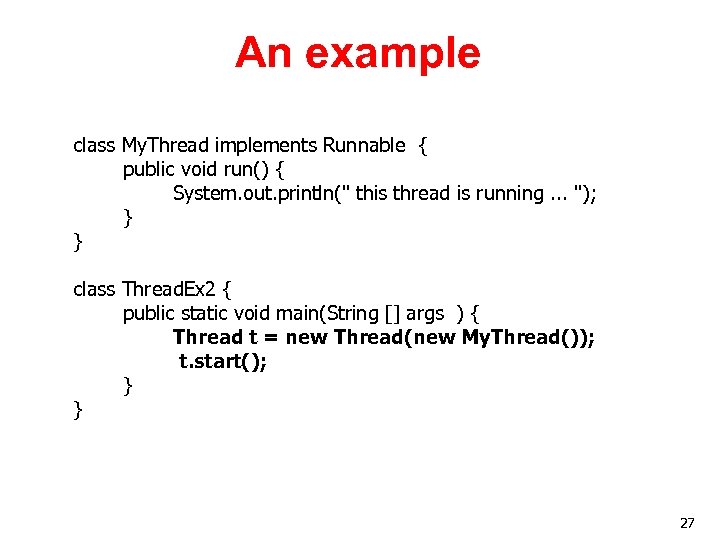
An example class My. Thread implements Runnable { public void run() { System. out. println(" this thread is running. . . "); } } class Thread. Ex 2 { public static void main(String [] args ) { Thread t = new Thread(new My. Thread()); t. start(); } } 27
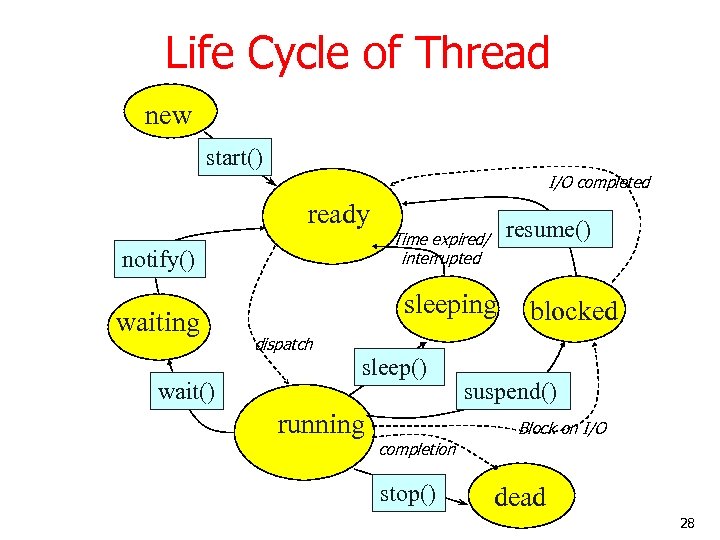
Life Cycle of Thread new start() I/O completed ready notify() waiting wait() resume() Time expired/ interrupted sleeping blocked dispatch sleep() running suspend() Block on I/O completion stop() dead 28
A Program with Three Java Threads n Write a program that creates 3 threads 29
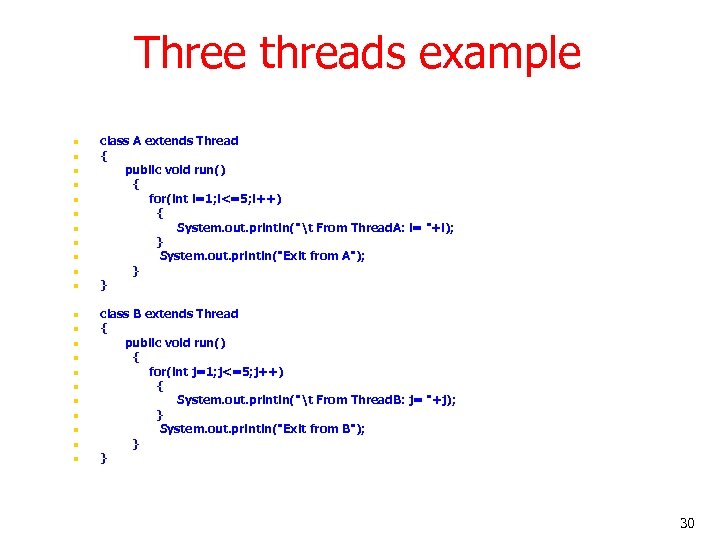
Three threads example n n n n n n class A extends Thread { public void run() { for(int i=1; i<=5; i++) { System. out. println("t From Thread. A: i= "+i); } System. out. println("Exit from A"); } } class B extends Thread { public void run() { for(int j=1; j<=5; j++) { System. out. println("t From Thread. B: j= "+j); } System. out. println("Exit from B"); } } 30
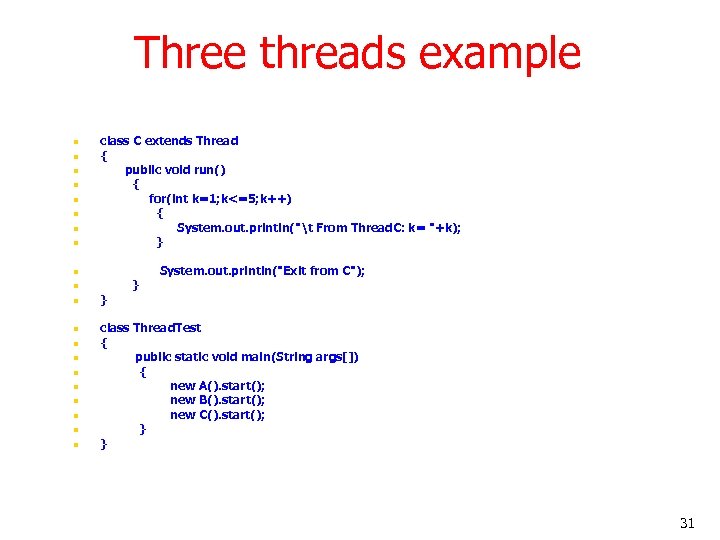
Three threads example n n n n class C extends Thread { public void run() { for(int k=1; k<=5; k++) { System. out. println("t From Thread. C: k= "+k); } n n n } } System. out. println("Exit from C"); class Thread. Test { public static void main(String args[]) { new A(). start(); new B(). start(); new C(). start(); } } 31
![Run 1 [raj@mundroo] threads [1: 76] java Thread. Test From Thread. A: i= 1](https://present5.com/presentation/c3ecb9e21e7d2c179442e18e88642e27/image-32.jpg "Run 1 [raj@mundroo] threads [1: 76] java Thread. Test From Thread. A: i= 1")
Run 1 [raj@mundroo] threads [1: 76] java Thread. Test From Thread. A: i= 1 From Thread. A: i= 2 From Thread. A: i= 3 From Thread. A: i= 4 From Thread. A: i= 5 Exit from A From Thread. C: k= 1 From Thread. C: k= 2 From Thread. C: k= 3 From Thread. C: k= 4 From Thread. C: k= 5 Exit from C From Thread. B: j= 1 From Thread. B: j= 2 From Thread. B: j= 3 From Thread. B: j= 4 From Thread. B: j= 5 Exit from B n 32
![Run 2 [raj@mundroo] threads [1: 77] java Thread. Test From Thread. A: i= 1](https://present5.com/presentation/c3ecb9e21e7d2c179442e18e88642e27/image-33.jpg "Run 2 [raj@mundroo] threads [1: 77] java Thread. Test From Thread. A: i= 1")
Run 2 [raj@mundroo] threads [1: 77] java Thread. Test From Thread. A: i= 1 From Thread. A: i= 2 From Thread. A: i= 3 From Thread. A: i= 4 From Thread. A: i= 5 From Thread. C: k= 1 From Thread. C: k= 2 From Thread. C: k= 3 From Thread. C: k= 4 From Thread. C: k= 5 Exit from C From Thread. B: j= 1 From Thread. B: j= 2 From Thread. B: j= 3 From Thread. B: j= 4 From Thread. B: j= 5 Exit from B Exit from A n 33
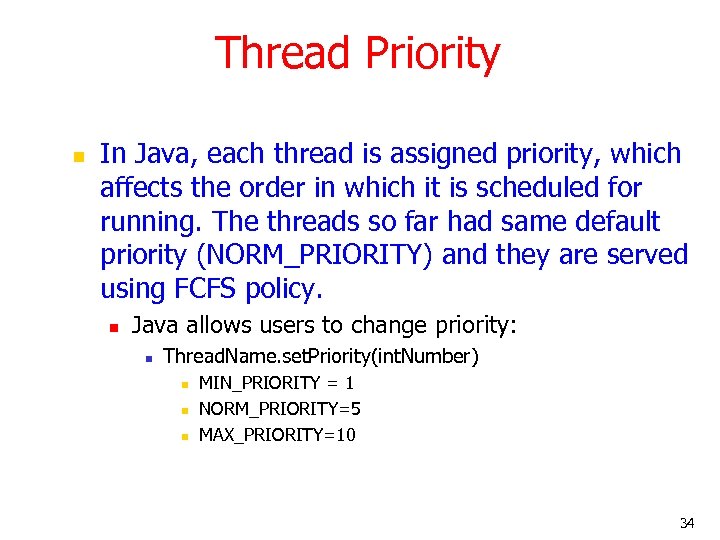
Thread Priority n In Java, each thread is assigned priority, which affects the order in which it is scheduled for running. The threads so far had same default priority (NORM_PRIORITY) and they are served using FCFS policy. n Java allows users to change priority: n Thread. Name. set. Priority(int. Number) n n n MIN_PRIORITY = 1 NORM_PRIORITY=5 MAX_PRIORITY=10 34
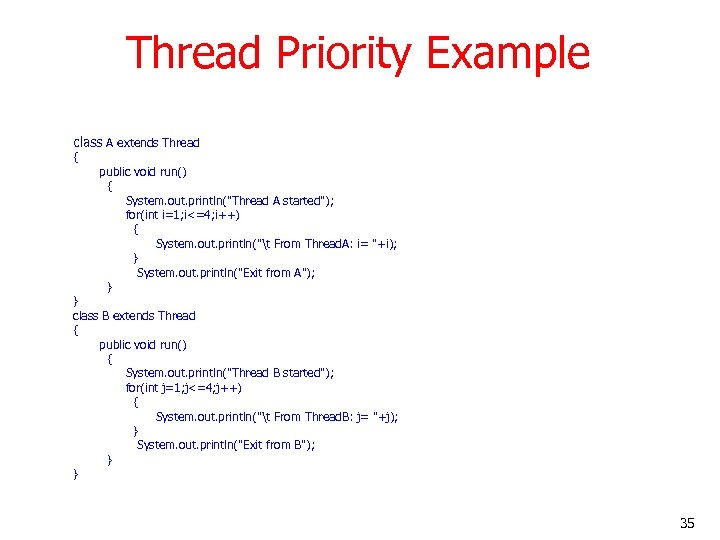
Thread Priority Example class A extends Thread { public void run() { System. out. println("Thread A started"); for(int i=1; i<=4; i++) { System. out. println("t From Thread. A: i= "+i); } System. out. println("Exit from A"); } } class B extends Thread { public void run() { System. out. println("Thread B started"); for(int j=1; j<=4; j++) { System. out. println("t From Thread. B: j= "+j); } System. out. println("Exit from B"); } } 35
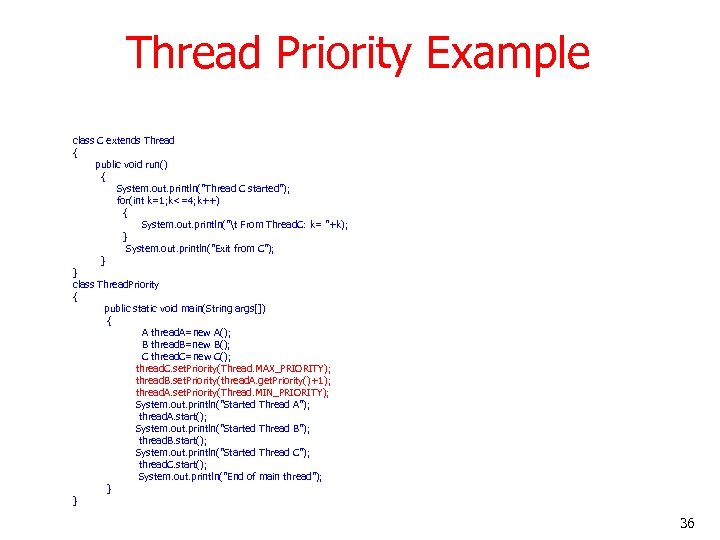
Thread Priority Example class C extends Thread { public void run() { System. out. println("Thread C started"); for(int k=1; k<=4; k++) { System. out. println("t From Thread. C: k= "+k); } System. out. println("Exit from C"); } } class Thread. Priority { public static void main(String args[]) { A thread. A=new A(); B thread. B=new B(); C thread. C=new C(); thread. C. set. Priority(Thread. MAX_PRIORITY); thread. B. set. Priority(thread. A. get. Priority()+1); thread. A. set. Priority(Thread. MIN_PRIORITY); System. out. println("Started Thread A"); thread. A. start(); System. out. println("Started Thread B"); thread. B. start(); System. out. println("Started Thread C"); thread. C. start(); System. out. println("End of main thread"); } } 36
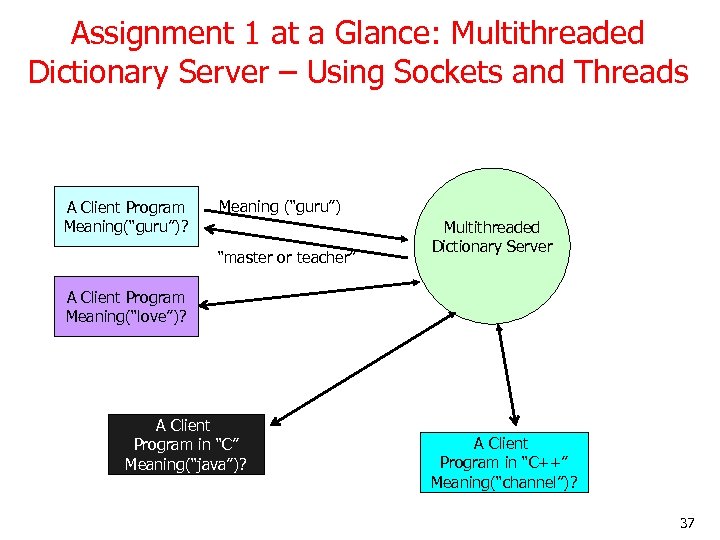
Assignment 1 at a Glance: Multithreaded Dictionary Server – Using Sockets and Threads A Client Program Meaning(“guru”)? Meaning (“guru”) “master or teacher” Multithreaded Dictionary Server A Client Program Meaning(“love”)? A Client Program in “C” Meaning(“java”)? A Client Program in “C++” Meaning(“channel”)? 37
Accessing Shared Resources n Applications access to shared resources need to be coordinated. n n n Printer (two person jobs cannot be printed at the same time) Simultaneous operations on your bank account. Can the following operations be done at the same time on the same account? n n n Deposit() Withdraw() Enquire() 39
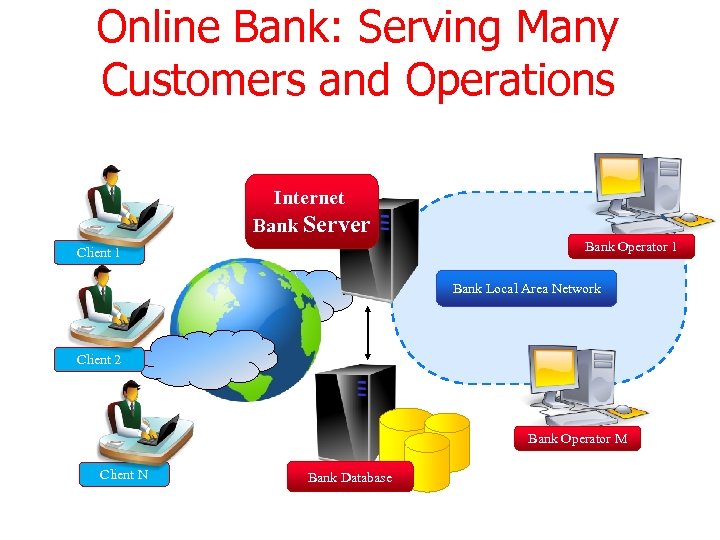
Online Bank: Serving Many Customers and Operations Internet Bank Server Bank Operator 1 Client 1 Bank Local Area Network Client 2 Bank Operator M Client N Bank Database
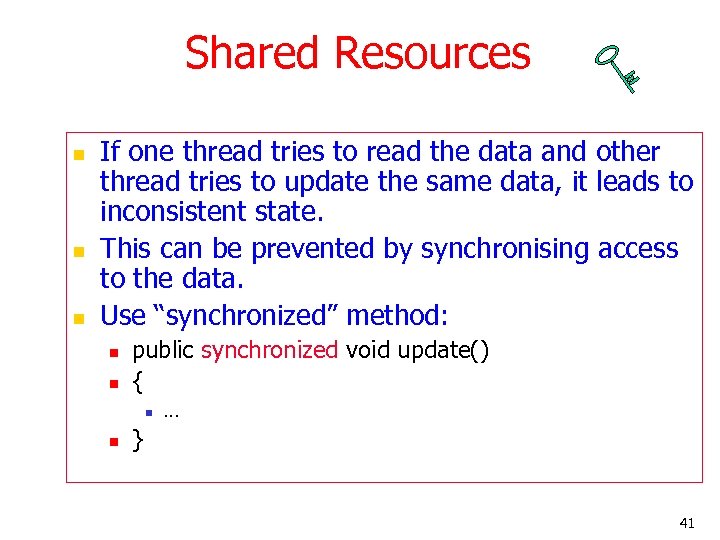
Shared Resources n n n If one thread tries to read the data and other thread tries to update the same data, it leads to inconsistent state. This can be prevented by synchronising access to the data. Use “synchronized” method: n n public synchronized void update() { n n … } 41
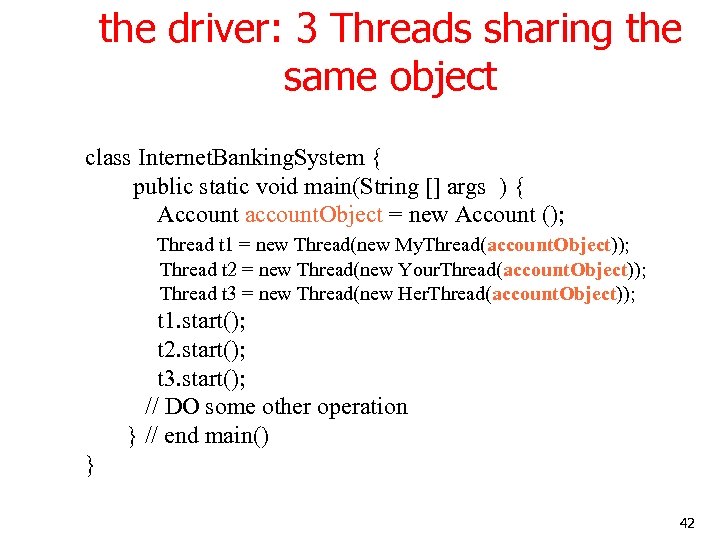
the driver: 3 Threads sharing the same object class Internet. Banking. System { public static void main(String [] args ) { Account account. Object = new Account (); Thread t 1 = new Thread(new My. Thread(account. Object)); Thread t 2 = new Thread(new Your. Thread(account. Object)); Thread t 3 = new Thread(new Her. Thread(account. Object)); t 1. start(); t 2. start(); t 3. start(); // DO some other operation } // end main() } 42
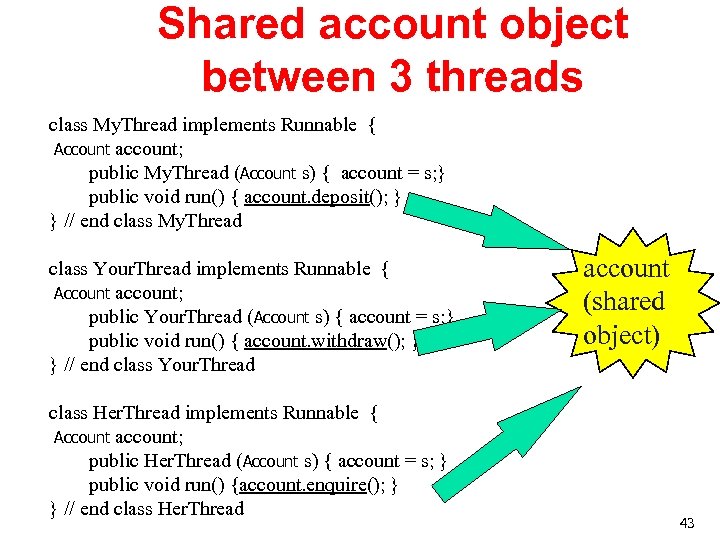
Shared account object between 3 threads class My. Thread implements Runnable { Account account; public My. Thread (Account s) { account = s; } public void run() { account. deposit(); } } // end class My. Thread class Your. Thread implements Runnable { Account account; public Your. Thread (Account s) { account = s; } public void run() { account. withdraw(); } } // end class Your. Thread class Her. Thread implements Runnable { Account account; public Her. Thread (Account s) { account = s; } public void run() {account. enquire(); } } // end class Her. Thread account (shared object) 43
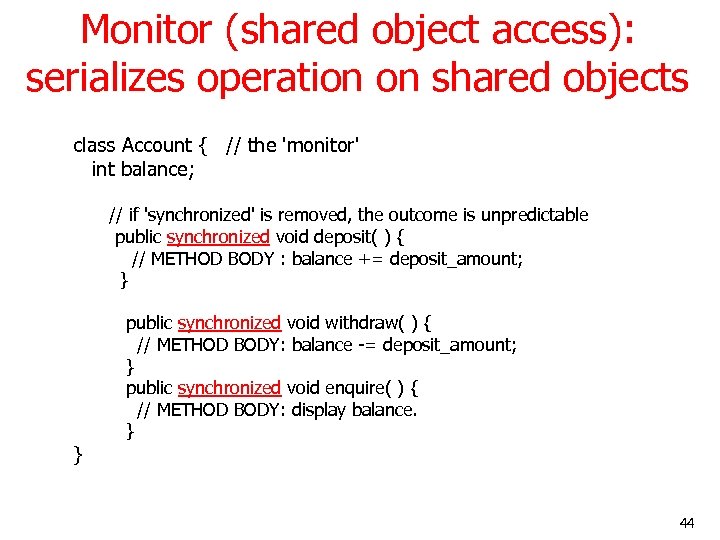
Monitor (shared object access): serializes operation on shared objects class Account { // the 'monitor' int balance; // if 'synchronized' is removed, the outcome is unpredictable public synchronized void deposit( ) { // METHOD BODY : balance += deposit_amount; } } public synchronized void withdraw( ) { // METHOD BODY: balance -= deposit_amount; } public synchronized void enquire( ) { // METHOD BODY: display balance. } 44
Architecture for Multithread Servers n n Multithreading enables servers to maximize their throughput, measured as the number of requests processed per second. Threads may need to treat requests with varying priorities: n n A corporate server could prioritize request processing according to class of customers. Architectures: n n Worker pool Thread-per-request Thread-per-connection Thread-per-object 45
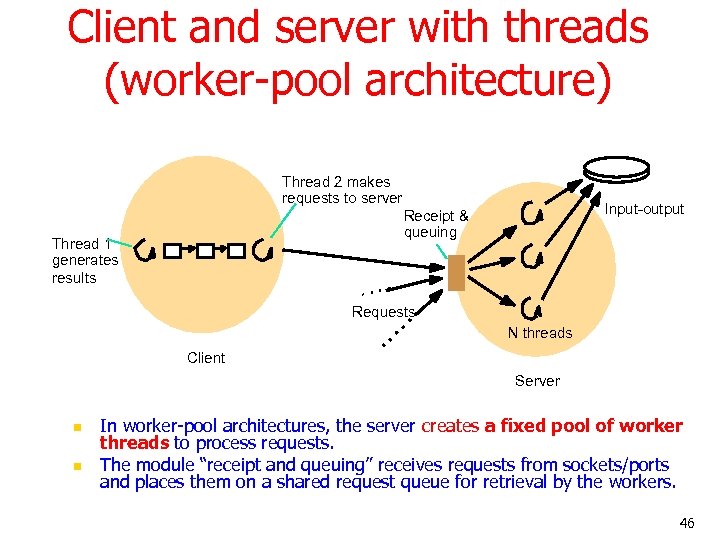
Client and server with threads (worker-pool architecture) Thread 2 makes requests to server Thread 1 generates results Input-output Receipt & queuing T 1 Requests N threads Client Server n n In worker-pool architectures, the server creates a fixed pool of worker threads to process requests. The module “receipt and queuing” receives requests from sockets/ports and places them on a shared request queue for retrieval by the workers. 46
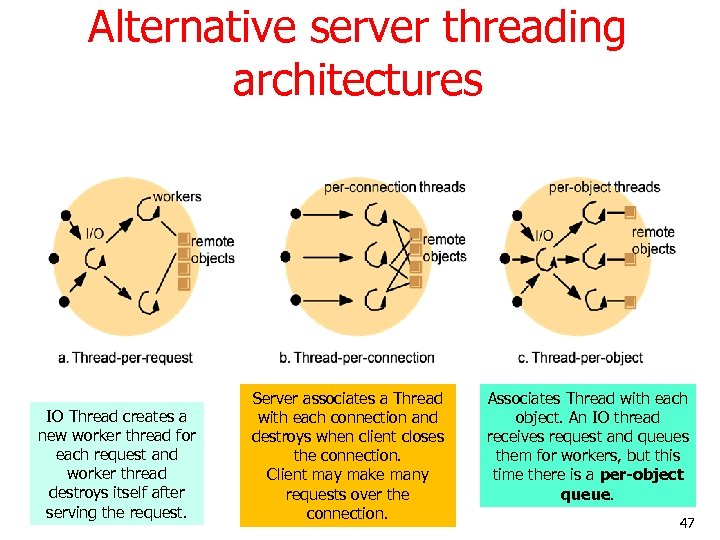
Alternative server threading architectures IO Thread creates a new worker thread for each request and worker thread destroys itself after serving the request. Server associates a Thread with each connection and destroys when client closes the connection. Client may make many requests over the connection. Associates Thread with each object. An IO thread receives request and queues them for workers, but this time there is a per-object queue. 47
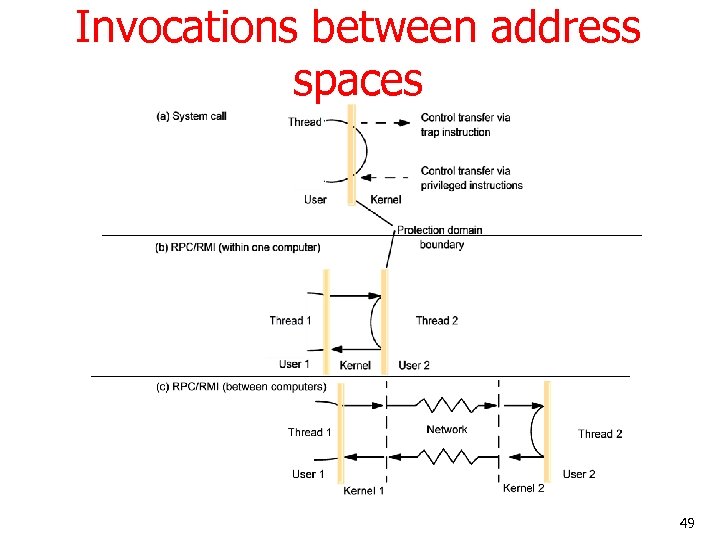
Invocations between address spaces 49
Summary n Operating system provides various types of facilities to support middleware for distributed system: n n Multithreading enables servers to maximize their throughput, measured as the number of requests processed per second. Threads support treating of requests with varying priorities. Various types of architectures can be used in concurrent processing: n n n encapsulation, protection, and concurrent access and management of node resources. Worker pool Thread-per-request Thread-per-connection Thread-per-object Threads need to be synchronized when accessing and manipulating shared resources. New OS designs provide flexibility in terms of separating mechanisms from policies. 52
References n CDK Book (Text Book) n n Chapter 7 – “Operating System Support” Chapter 14: Multithread Programming n R. Buyya, S. Selvi, X. Chu, “Object Oriented Programming with Java: Essentials and Applications”, Mc. Graw Hill, New Delhi, India, 2009. 53
Скачать презентацию OS Support for Building Distributed Applications Multithreaded Programming
c3ecb9e21e7d2c179442e18e88642e27.ppt