


 Скачать презентацию OS 352 4 17 08 I Administration A Final Exam
92bdcc42ed823fa70700aea5342a2de2.ppt
- Количество слайдов: 26
 OS 352 4/17/08 I. Administration. A. Final Exam (not cumulative): Monday, 4/28, Science Center 362, 11: 45 am-2: 45 pm B. Last class Thursday, 4/24, regular classroom – Course summary and article discussion (Combs & Hammonds), evals, +. 5 for attending C. Next class, Tues. , 4/22 at the Outdoor Lodge (near the Watertower) – Metrics, Systems. +. 5 for attending. D. Rosie the Riveter extra credit write-ups due Friday, 4/18 (email is fine). II. Workplace safety. III. International HRM
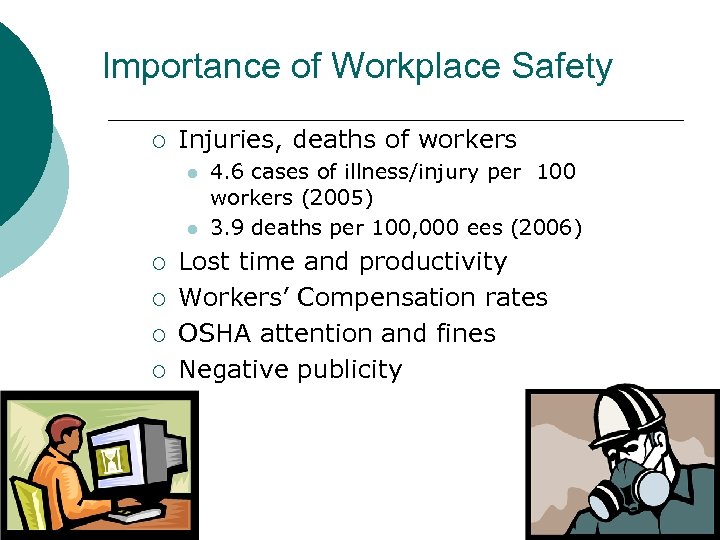 Importance of Workplace Safety ¡ Injuries, deaths of workers l l ¡ ¡ 4. 6 cases of illness/injury per 100 workers (2005) 3. 9 deaths per 100, 000 ees (2006) Lost time and productivity Workers’ Compensation rates OSHA attention and fines Negative publicity
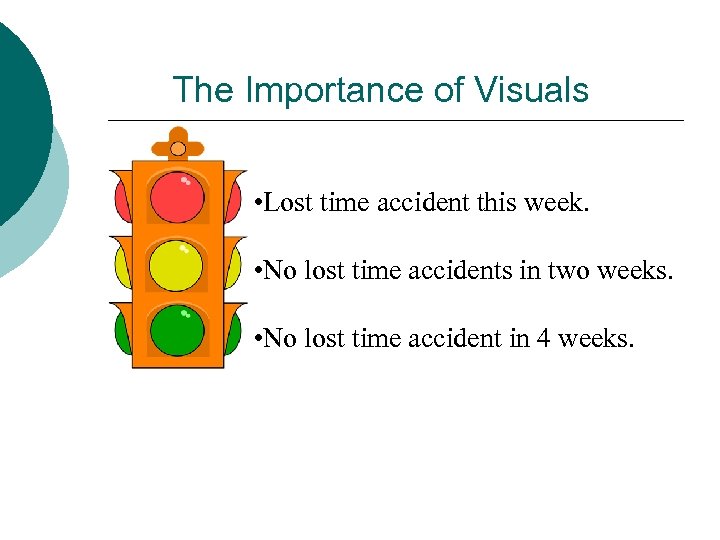 The Importance of Visuals • Lost time accident this week. • No lost time accidents in two weeks. • No lost time accident in 4 weeks.
 The Importance of Proper Incentives • Safety targets should be included in incentive bonus formulas. • Safety targets and improvements should be under the control of the workers. • Remove contextual factors that suppress the timely reporting of safety incidents.
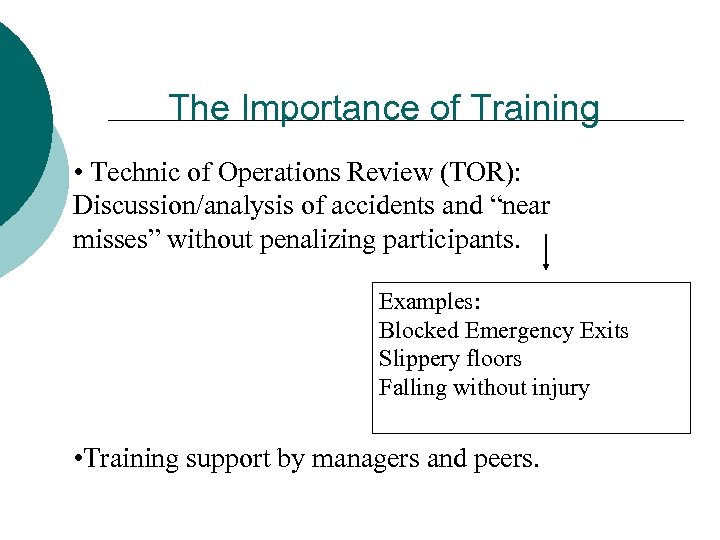 The Importance of Training • Technic of Operations Review (TOR): Discussion/analysis of accidents and “near misses” without penalizing participants. Examples: Blocked Emergency Exits Slippery floors Falling without injury • Training support by managers and peers.
 Accidents Waiting to Happen ¡ Smoking on the production floor. ¡ Drinking / drugs on the job. ¡ Lack of basic safety equipment. ¡ Lack of attention to ergonomics. ¡ Pranks
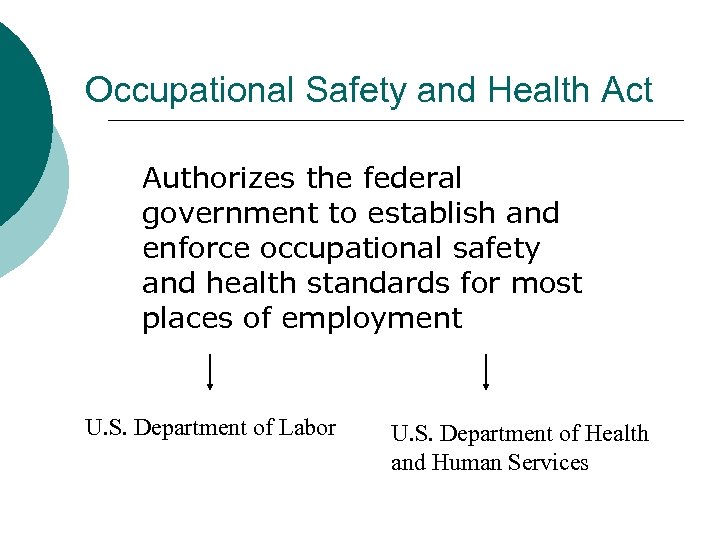 Occupational Safety and Health Act Authorizes the federal government to establish and enforce occupational safety and health standards for most places of employment U. S. Department of Labor U. S. Department of Health and Human Services
 Occupational Safety and Health Administration (OSHA) • Routine employer inspections • Investigations of deaths, injuries • Levies fines. • Up to $20, 000 for violations that result in the death of a worker • $1000 per violation for less serious violations • Employer education and assistance.
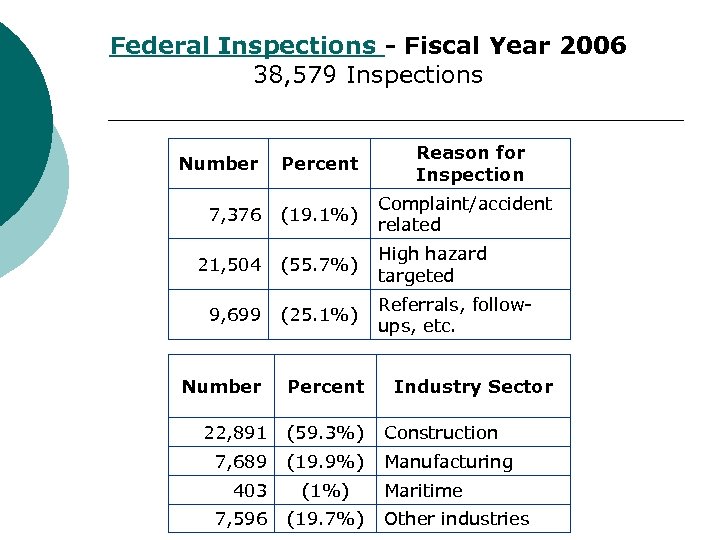 Federal Inspections - Fiscal Year 2006 38, 579 Inspections Number Percent Reason for Inspection 7, 376 (19. 1%) Complaint/accident related 21, 504 (55. 7%) High hazard targeted 9, 699 (25. 1%) Referrals, followups, etc. Number 22, 891 Percent (59. 3%) 7, 689 (19. 9%) 403 7, 596 (1%) (19. 7%) Industry Sector Construction Manufacturing Maritime Other industries
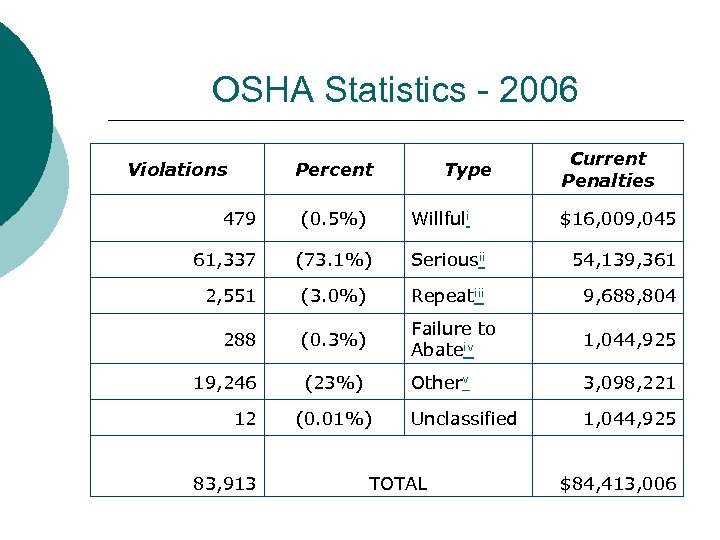 OSHA Statistics - 2006 Violations Percent Type 479 (0. 5%) 61, 337 (73. 1%) Seriousii 54, 139, 361 2, 551 (3. 0%) Repeatiii 9, 688, 804 288 (0. 3%) Failure to Abateiv 1, 044, 925 19, 246 (23%) Otherv 3, 098, 221 Unclassified 1, 044, 925 12 83, 913 Willfuli Current Penalties (0. 01%) TOTAL $16, 009, 045 $84, 413, 006
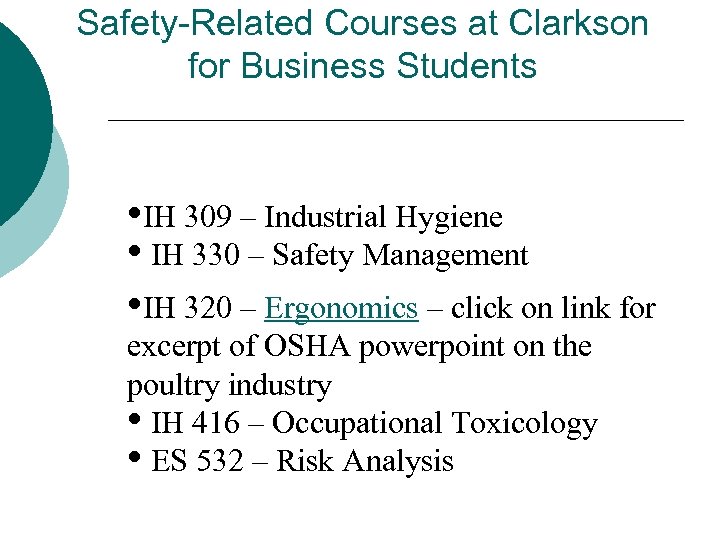 Safety-Related Courses at Clarkson for Business Students • IH 309 – Industrial Hygiene • IH 330 – Safety Management • IH 320 – Ergonomics – click on link for excerpt of OSHA powerpoint on the poultry industry • IH 416 – Occupational Toxicology • ES 532 – Risk Analysis
 Terms You Should Know ¡ Technic of Operations Review ¡ Occupational Safety and Health Administration (OSHA)
 You Should be Able To … ¡ Discuss why safety is important to the management of people in organizations. ¡ Know what OSHA does. ¡ Understand multiple ways that HR practices can help ensure a safe workplace.
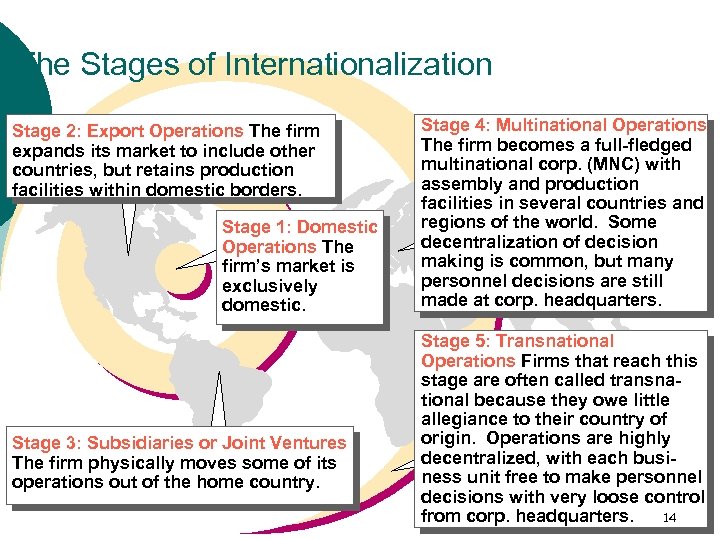 The Stages of Internationalization Stage 2: Export Operations The firm expands its market to include other countries, but retains production facilities within domestic borders. Stage 1: Domestic Operations The firm’s market is exclusively domestic. Stage 3: Subsidiaries or Joint Ventures The firm physically moves some of its operations out of the home country. Stage 4: Multinational Operations The firm becomes a full-fledged multinational corp. (MNC) with assembly and production facilities in several countries and regions of the world. Some decentralization of decision making is common, but many personnel decisions are still made at corp. headquarters. Stage 5: Transnational Operations Firms that reach this stage are often called transnational because they owe little allegiance to their country of origin. Operations are highly decentralized, with each business unit free to make personnel decisions with very loose control 14 from corp. headquarters.
 Culture A community’s set of shared assumptions about how the world works and what ideals are worth striving for. In brief … shared understandings.
 Hofstede’s Cultural Dimensions (text) 1) Individualism / Collectivism Strength of the relationship between the individual and other individuals in the society Collectivist countries: Mexico, Pakistan, Taiwan Individualistic countries: U. S. , U. K.
 Hofstede’s Cultural Dimensions (text) 2) Power Distance The way the culture deals with unequal distribution of power and defines the amount of inequality that is normal. High Power Distance Countries: Mexico, Japan Low Power Distance: U. S. , Denmark, Israel
 Hofstede’s Cultural Dimensions (text) 3) Uncertainty Avoidance Describes how cultures handle the fact that the future is unpredictable. High Uncertainty Avoidance Countries: Greece, Portugal Low Uncertainty Avoidance: Singapore, Jamaica
 Hofstede’s Cultural Dimensions (text) 4) Masculinity / Femininity Emphasis a culture places on practices or qualities that have traditionally been considered masculine or feminine. Masculine cultures: Germany, Japan Feminine cultures: Sweden, Norway
 Hofstede’s Cultural Dimensions (text) 5) Long-term/Short-term orientation Whether the focus of cultural values is on the future (long-term) or the past and present (short-term). Long-term orientation: Japan, China Short-term orientation: U. S. , Russia, West Africa
 Why International Assignments End in Failure • • Career Blockage • Many feel that the home office has forgotten them and that their career has been sidetracked Culture Shock • Many people who take international assignments cannot adjust to a different cultural environment Overemphasis on Technical Qualifications • The same traits that led to success at home can be disastrous in another country Family Problems • The inability or unwillingness of the expatriate’s spouse and children to adapt to life in another country is one of the most important reasons for failure 21
 Selecting Employees for International Assignments § § § Emphasize cultural sensitivity as a selection criteria Establish a selection board of expatriates Require previous international experience Explore the possibility of hiring foreign-born employees who can serve as “expatriates” at a future date Screen candidates’ spouses and families 22
 Training Employees for International Assignments ¡ ¡ ¡ 23
 Compensation ¡ ¡ ¡ Provide the expatriate with a disposable income that is equivalent to what he or she would receive at home. Provide and explicit “add-on” incentive for accepting an international assignment. Avoid having expatriates fill the same jobs held by locals or lower-ranking jobs. 24
 Virtual Expatriate Employee who manages an operation abroad without permanently relocating in another country.
 EEO in the International Context § § § U. S. companies are prohibited from basing employment decisions on employee characteristics such as race, sex, and age. This prohibition applies to international assignments, with the single exception that companies are not required to violate a host nation law. Foreign national employees of U. S. companies in their own country or in some other foreign country are not covered by U. S. employment law. Under the Immigration Control and Reform Act of 1986, people who are not U. S. citizens but who are living and have legal work status in the United States may not be discriminated against. 26