 Скачать презентацию ORKLA Long-term value creation 20 February 2003
11ff43cd02fc4c78a7daa1e105cbaebf.ppt
- Количество слайдов: 58



ORKLA Long-term value creation 20 February 2003
Agenda Performance and strategic direction Strong organisations Operational excellence Growth 2 w Performance (share, industry, portfolio) w Shareholder issues w Position for future value creation
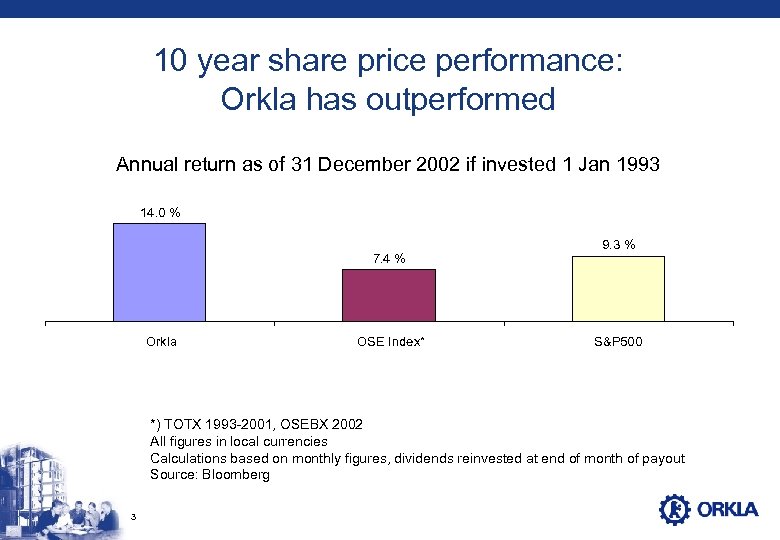
10 year share price performance: Orkla has outperformed Annual return as of 31 December 2002 if invested 1 Jan 1993 14. 0 % 7. 4 % Orkla OSE Index* 9. 3 % S&P 500 *) TOTX 1993 -2001, OSEBX 2002 All figures in local currencies Calculations based on monthly figures, dividends reinvested at end of month of payout Source: Bloomberg 3
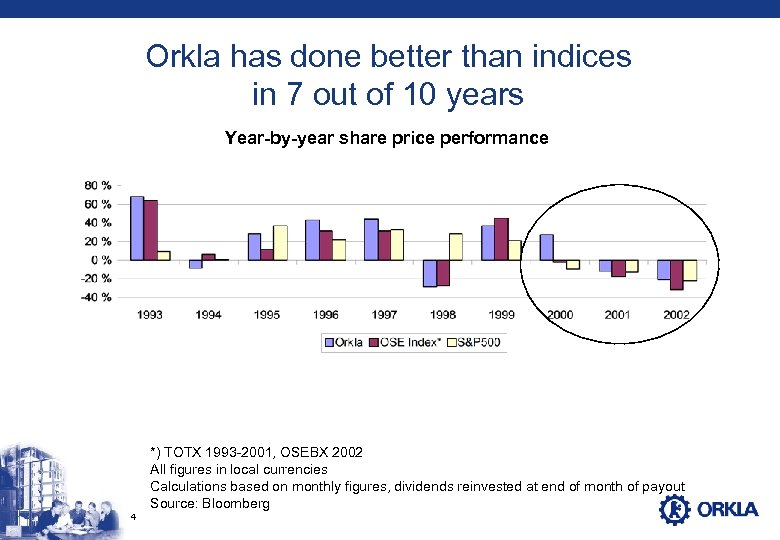
Orkla has done better than indices in 7 out of 10 years Year-by-year share price performance *) TOTX 1993 -2001, OSEBX 2002 All figures in local currencies Calculations based on monthly figures, dividends reinvested at end of month of payout Source: Bloomberg 4
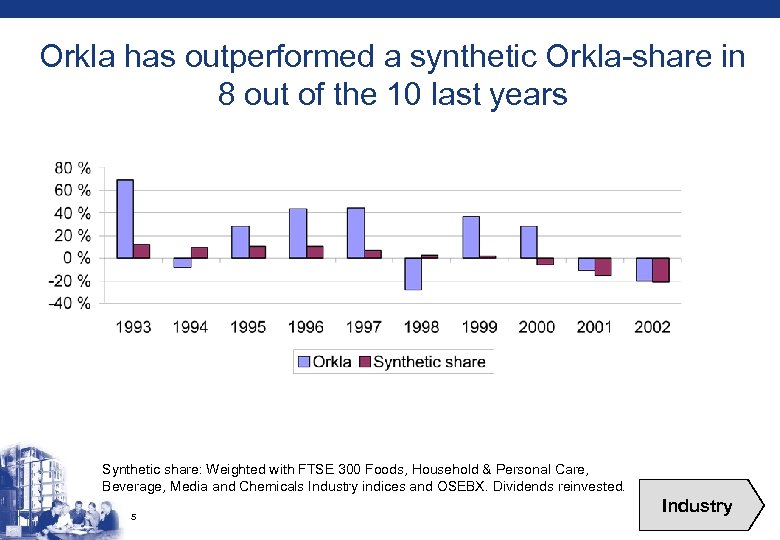
Orkla has outperformed a synthetic Orkla-share in 8 out of the 10 last years Synthetic share: Weighted with FTSE 300 Foods, Household & Personal Care, Beverage, Media and Chemicals Industry indices and OSEBX. Dividends reinvested. 5 Industry
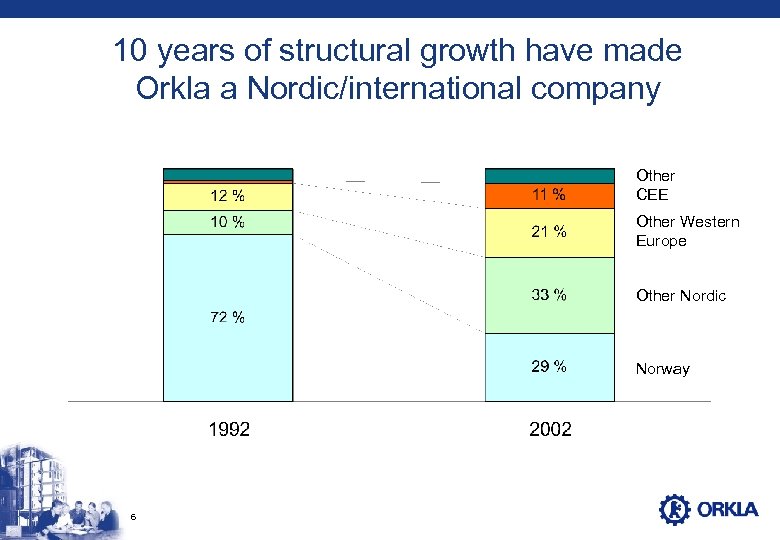
10 years of structural growth have made Orkla a Nordic/international company Other CEE Other Western Europe Other Nordic Norway 6
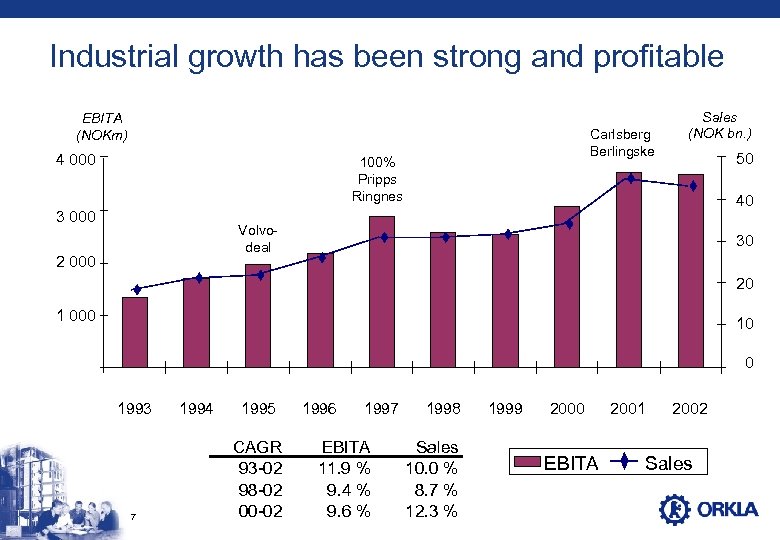
Industrial growth has been strong and profitable EBITA (NOKm) 4 000 Carlsberg Berlingske 100% Pripps Ringnes 3 000 Sales (NOK bn. ) 50 40 Volvodeal 2 000 30 20 1 000 10 0 1993 7 1994 1995 CAGR 93 -02 98 -02 00 -02 1996 1997 EBITA 11. 9 % 9. 4 % 9. 6 % 1998 Sales 10. 0 % 8. 7 % 12. 3 % 1999 2000 EBITA 2001 2002 Sales
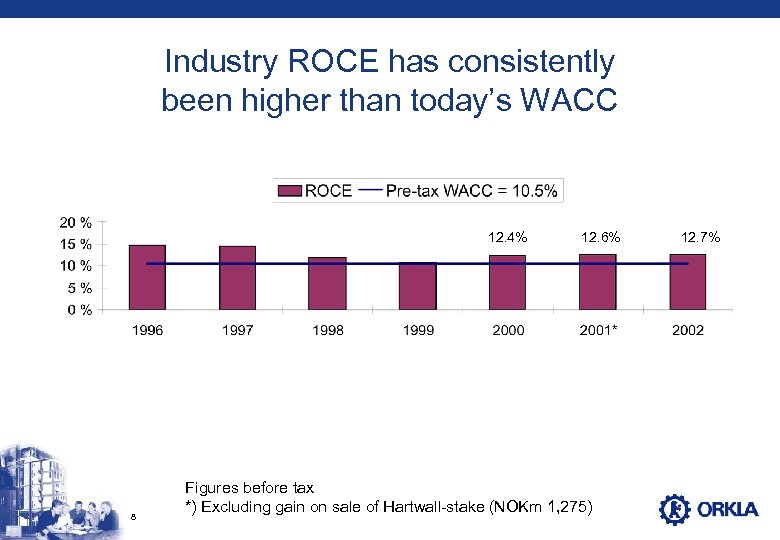
Industry ROCE has consistently been higher than today’s WACC 12. 4% 8 12. 6% Figures before tax *) Excluding gain on sale of Hartwall-stake (NOKm 1, 275) 12. 7%
Current industrial performance Most businesses are doing well, but we have some challenges: Performing satisfactorily w Nordic operations in Foods, Carlsberg Breweries and Brands w BBH w Chemicals Current challenges w Improve performance of underachievers Media in Denmark and Poland § Seafood operations in Poland § Beverages in Turkey § 9 Portfolio
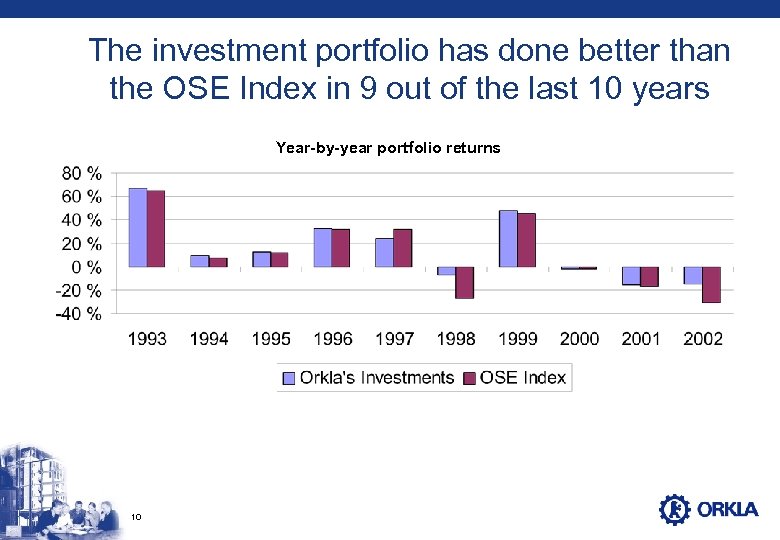
The investment portfolio has done better than the OSE Index in 9 out of the last 10 years Year-by-year portfolio returns 10
Summing up performance w The Orkla share has performed better than relevant indices, both in the short and long term w Industrial development is on average satisfactory, but has potential for improvements w Orkla has a strong platform for further growth and value creation § Most products hold leading market positions § Orkla has the expertise to exploit and improve these positions 11 Shareholder issues
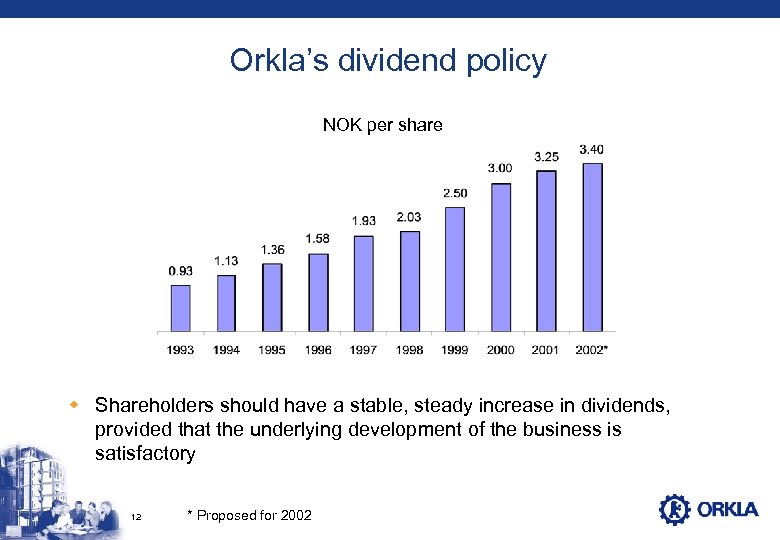
Orkla’s dividend policy NOK per share w Shareholders should have a stable, steady increase in dividends, provided that the underlying development of the business is satisfactory 12 * Proposed for 2002
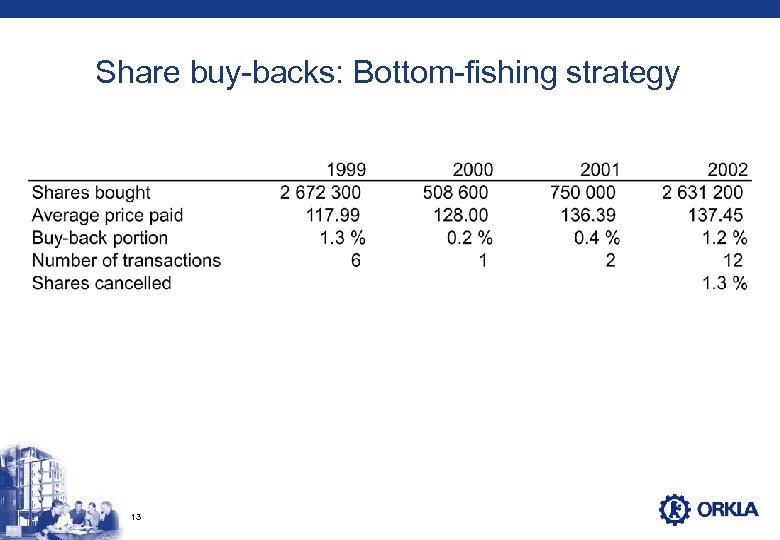
Share buy-backs: Bottom-fishing strategy 13
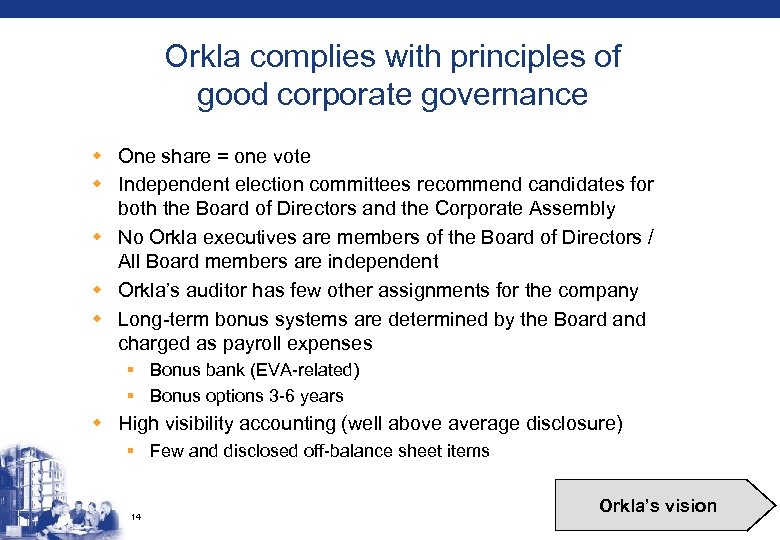
Orkla complies with principles of good corporate governance w One share = one vote w Independent election committees recommend candidates for both the Board of Directors and the Corporate Assembly w No Orkla executives are members of the Board of Directors / All Board members are independent w Orkla’s auditor has few other assignments for the company w Long-term bonus systems are determined by the Board and charged as payroll expenses § Bonus bank (EVA-related) § Bonus options 3 -6 years w High visibility accounting (well above average disclosure) § Few and disclosed off-balance sheet items 14 Orkla’s vision
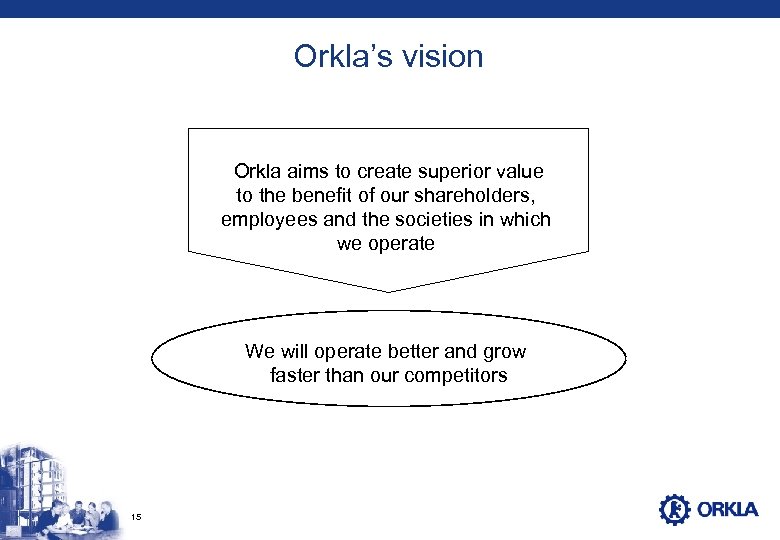
Orkla’s vision Orkla aims to create superior value to the benefit of our shareholders, employees and the societies in which we operate We will operate better and grow faster than our competitors 15
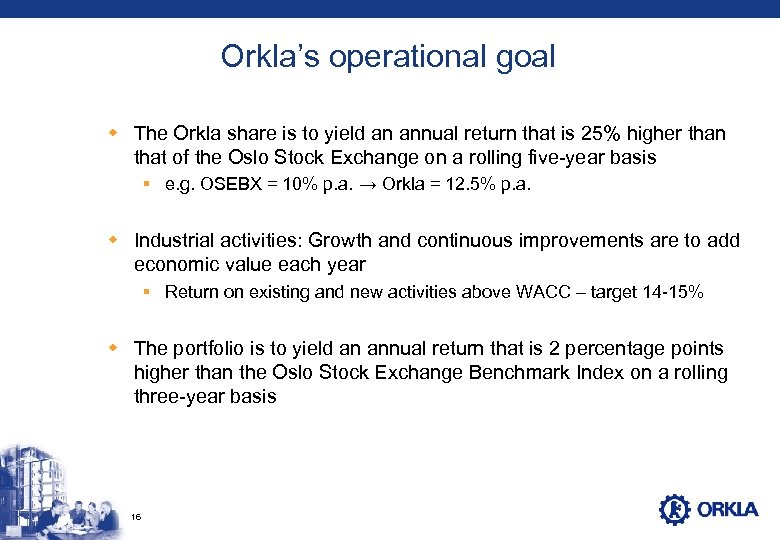
Orkla’s operational goal w The Orkla share is to yield an annual return that is 25% higher than that of the Oslo Stock Exchange on a rolling five-year basis § e. g. OSEBX = 10% p. a. → Orkla = 12. 5% p. a. w Industrial activities: Growth and continuous improvements are to add economic value each year § Return on existing and new activities above WACC – target 14 -15% w The portfolio is to yield an annual return that is 2 percentage points higher than the Oslo Stock Exchange Benchmark Index on a rolling three-year basis 16
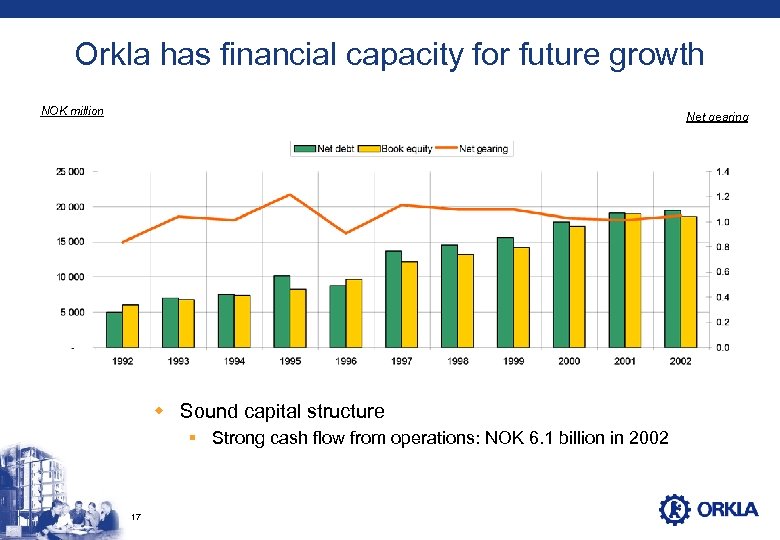
Orkla has financial capacity for future growth NOK million Net gearing w Sound capital structure § Strong cash flow from operations: NOK 6. 1 billion in 2002 17
Strategic Direction: Industrial growth Priorities w Branded Consumer Goods highest priority § Focus on growth and internationalisation w Continued specialisation and concentration for Chemicals § Longer term: Open to value-creating structural solutions w Limited allocation of new capital to the financial portfolio 18 Strategic issues by business area
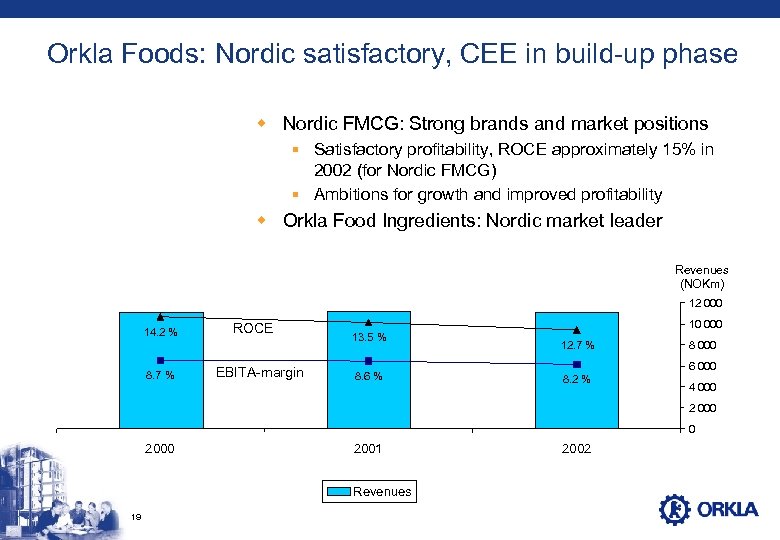
Orkla Foods: Nordic satisfactory, CEE in build-up phase w Nordic FMCG: Strong brands and market positions § Satisfactory profitability, ROCE approximately 15% in 2002 (for Nordic FMCG) § Ambitions for growth and improved profitability w Orkla Food Ingredients: Nordic market leader Revenues (NOKm) 12 000 14. 2 % 8. 7 % ROCE EBITA-margin 10 000 13. 5 % 8. 6 % 12. 7 % 8 000 6 000 8. 2 % 4 000 2 000 0 2001 Revenues 19 2002
Direction of development Nordic region w Consolidate and rationalise w Innovation and organic growth w Growth through acquisitions Central and Eastern Europe w Establish a solid and profitable platform w Consolidate present position w Further acquisitions w Will take time 20
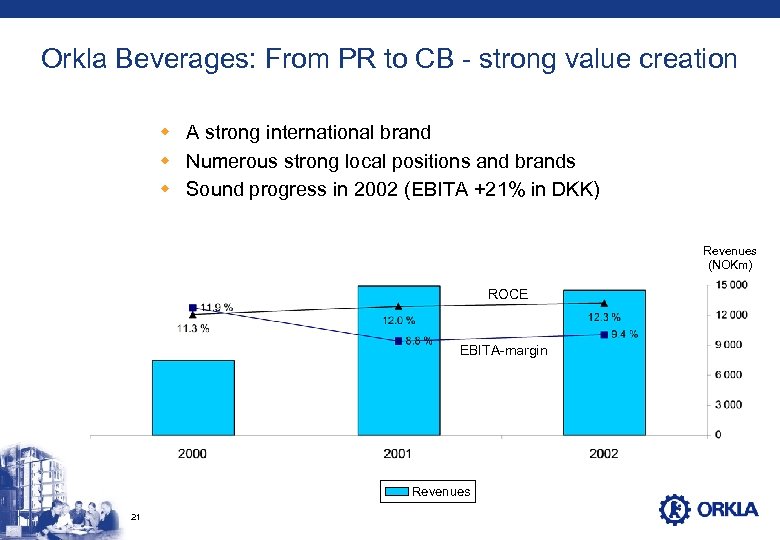
Orkla Beverages: From PR to CB - strong value creation w A strong international brand w Numerous strong local positions and brands w Sound progress in 2002 (EBITA +21% in DKK) Revenues (NOKm) ROCE EBITA-margin Revenues 21
Direction of development w Further develop “Carlsberg” as a global premium brand § Target: Annual growth of 8% (6% in 2002) w Rationalise and consolidate weaker positions w Continued growth at BBH, and growth/acquisitions in CEE w Participate in industry consolidation, but only if valuecreating 22
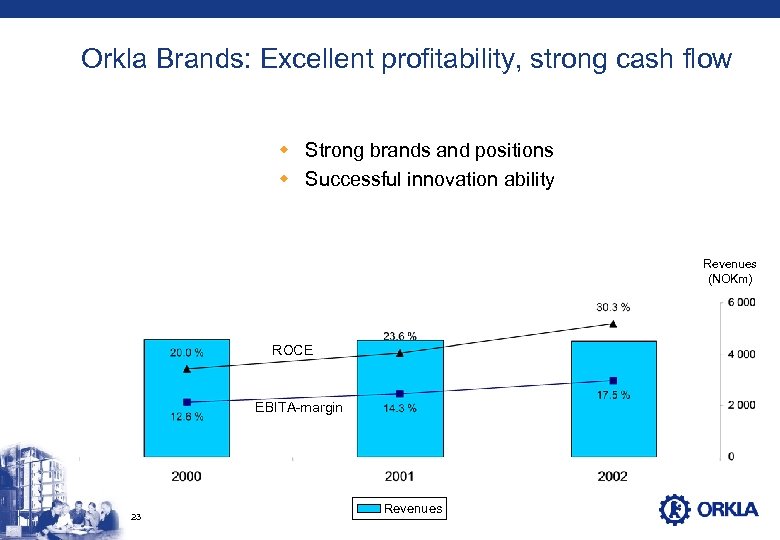
Orkla Brands: Excellent profitability, strong cash flow w Strong brands and positions w Successful innovation ability Revenues (NOKm) ROCE EBITA-margin 23 Revenues
Direction of development: More of the same w Maintain profitability and organic growth through innovation w Further develop Nordic platforms 24
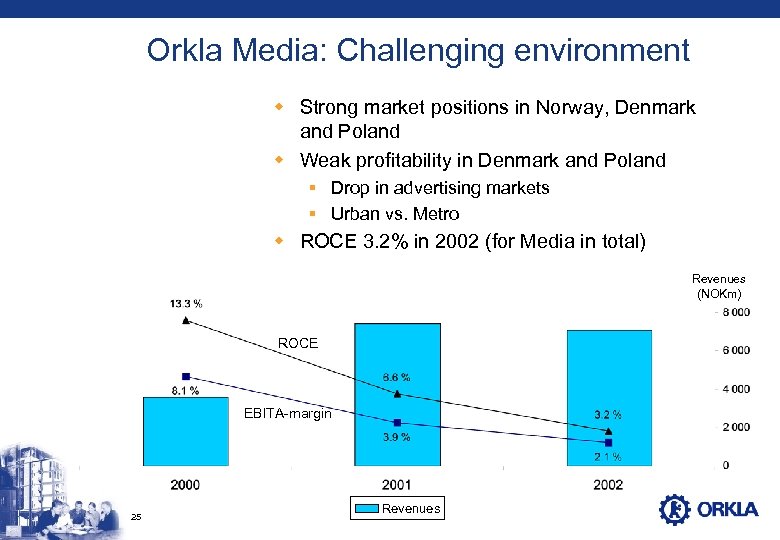
Orkla Media: Challenging environment w Strong market positions in Norway, Denmark and Poland w Weak profitability in Denmark and Poland § Drop in advertising markets § Urban vs. Metro w ROCE 3. 2% in 2002 (for Media in total) Revenues (NOKm) ROCE EBITA-margin 25 Revenues
Direction of development: Turnaround w Major task in coming years: Improve existing operations § Continued cost-cutting and consolidation § Co-operation with others when profitable w Target Berlingske: EBITA = DKK 200 -250 million in 2005/2006 w Product development 26
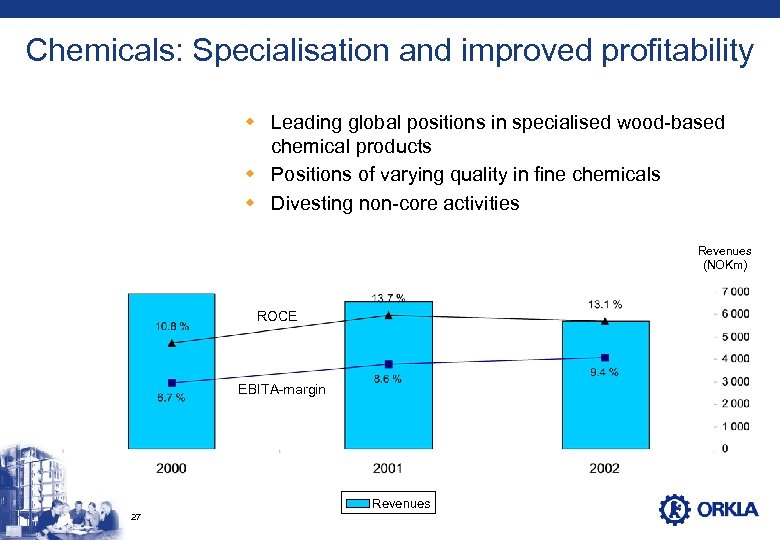
Chemicals: Specialisation and improved profitability w Leading global positions in specialised wood-based chemical products w Positions of varying quality in fine chemicals w Divesting non-core activities Revenues (NOKm) ROCE EBITA-margin Revenues 27
Direction of development: Dual track w Continued concentration on differentiated positions that can be further developed and specialised § Grow within wood-based chemicals w Divest positions where we are not - or cannot become market leaders and achieve satisfactory returns § Examples so far: § Power utilities § Ethanol-based products § Steel drums § Polymers § Paper pulp 28
Financial Investments: Better than benchmarks w Portfolio market value approx. NOK 12 billion § Plus real estate and forestry assets NOK 1. 5 billion w Long-term superior returns compared with indices w Synergies with Industry area w Own research with focus on identifying valuecreating companies rather than valuation only 29
Financial Investments: Direction of development w w w 30 Limited allocation of new capital to the portfolio Unbalanced portfolio Long-term perspective Nordic focus Increased degree of concentration Adds financial flexibility and strength
Orkla in 3 -5 years w A larger and more profitable company w More concentrated on branded consumer goods w Relatively smaller investment portfolio 31
Agenda Performance and strategic direction Strong organisations Operational excellence Growth 32 Building competitive advantage through w Commercial culture w Core competencies w Management development
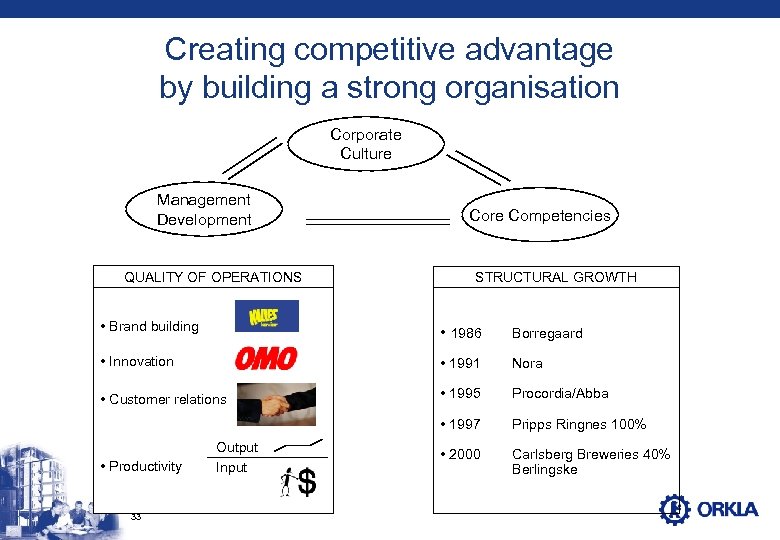
Creating competitive advantage by building a strong organisation Corporate Culture Management Development QUALITY OF OPERATIONS Core Competencies STRUCTURAL GROWTH • Brand building • 1986 Borregaard • Innovation • 1991 Nora • Customer relations • 1995 Procordia/Abba • 1997 Pripps Ringnes 100% • 2000 Carlsberg Breweries 40% Berlingske • Productivity 33 Output Input
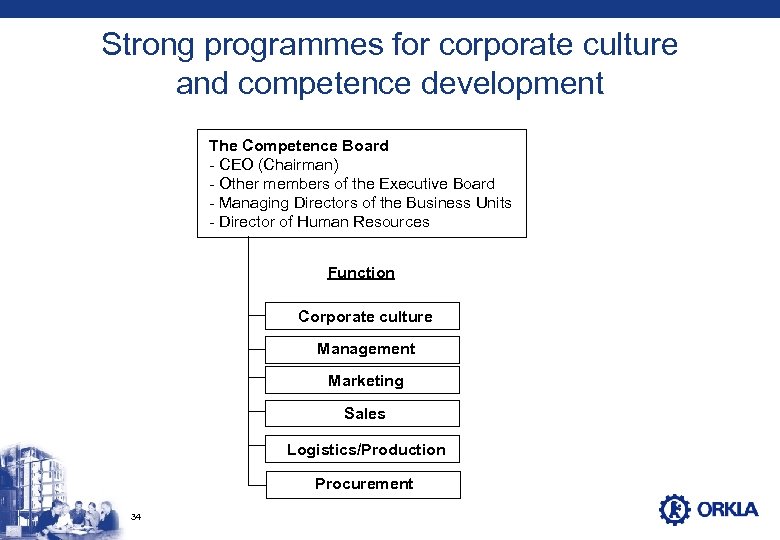
Strong programmes for corporate culture and competence development The Competence Board - CEO (Chairman) - Other members of the Executive Board - Managing Directors of the Business Units - Director of Human Resources Function Corporate culture Management Marketing Sales Logistics/Production Procurement 34
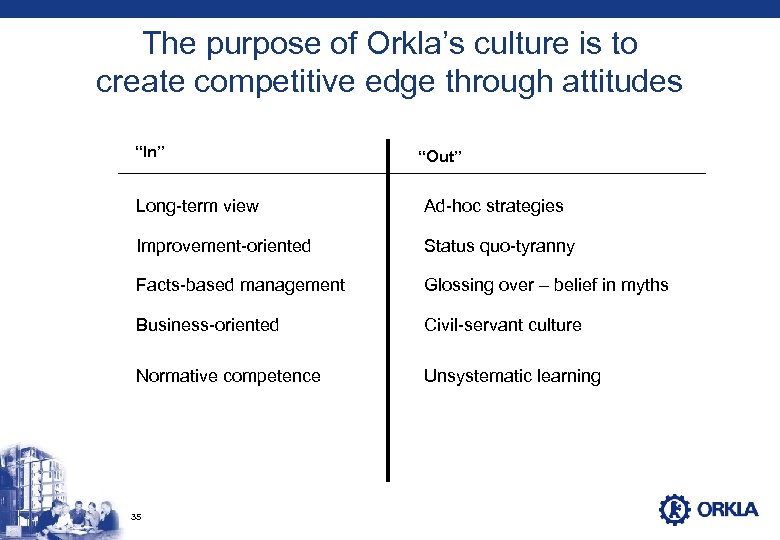
The purpose of Orkla’s culture is to create competitive edge through attitudes “In” “Out” Long-term view Ad-hoc strategies Improvement-oriented Status quo-tyranny Facts-based management Glossing over – belief in myths Business-oriented Civil-servant culture Normative competence Unsystematic learning 35
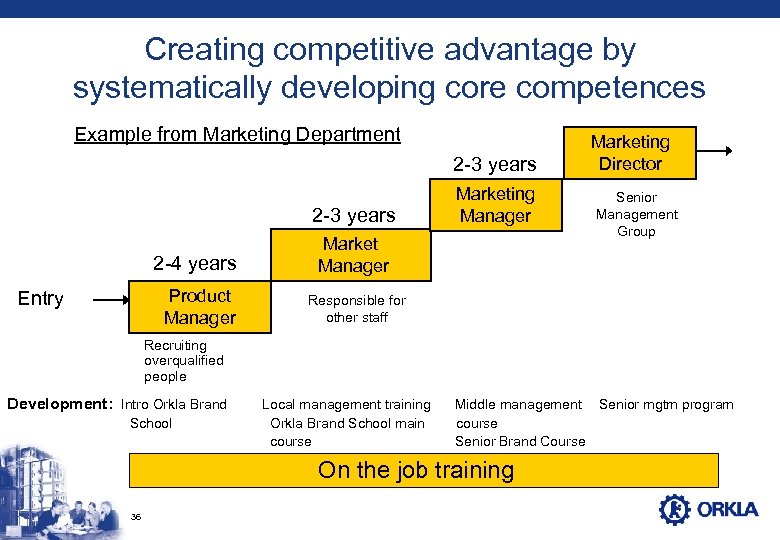
Creating competitive advantage by systematically developing core competences Example from Marketing Department 2 -3 years 2 -4 years Product Manager Entry Marketing Manager Marketing Director Senior Management Group Responsible for other staff Recruiting overqualified people Development: Intro Orkla Brand School Local management training Orkla Brand School main course Middle management Senior mgtm program course Senior Brand Course On the job training 36
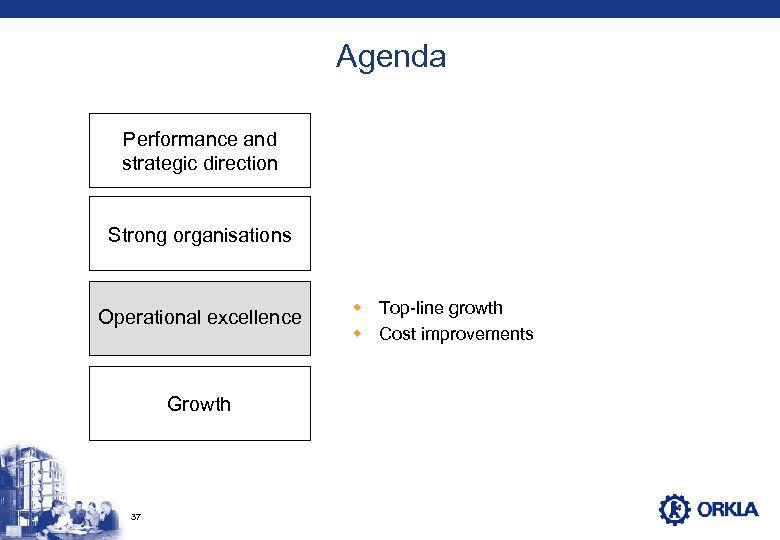
Agenda Performance and strategic direction Strong organisations Operational excellence Growth 37 w Top-line growth w Cost improvements
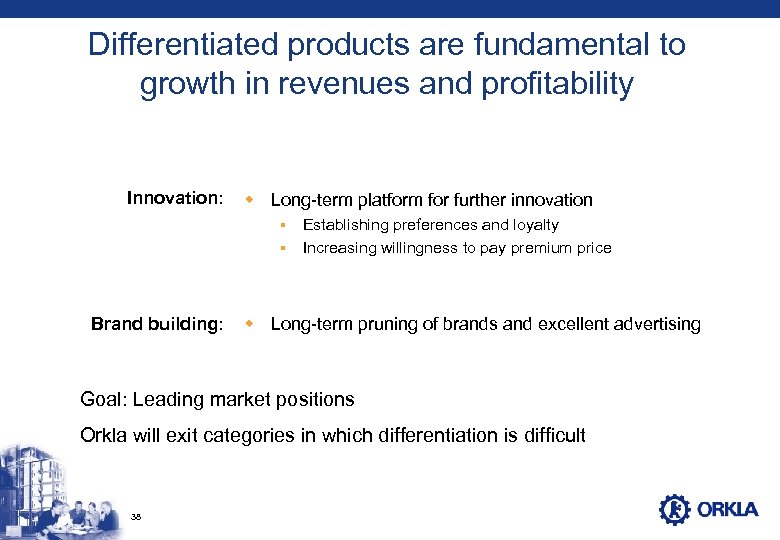
Differentiated products are fundamental to growth in revenues and profitability Innovation: w Long-term platform for further innovation Establishing preferences and loyalty § Increasing willingness to pay premium price § Brand building: w Long-term pruning of brands and excellent advertising Goal: Leading market positions Orkla will exit categories in which differentiation is difficult 38
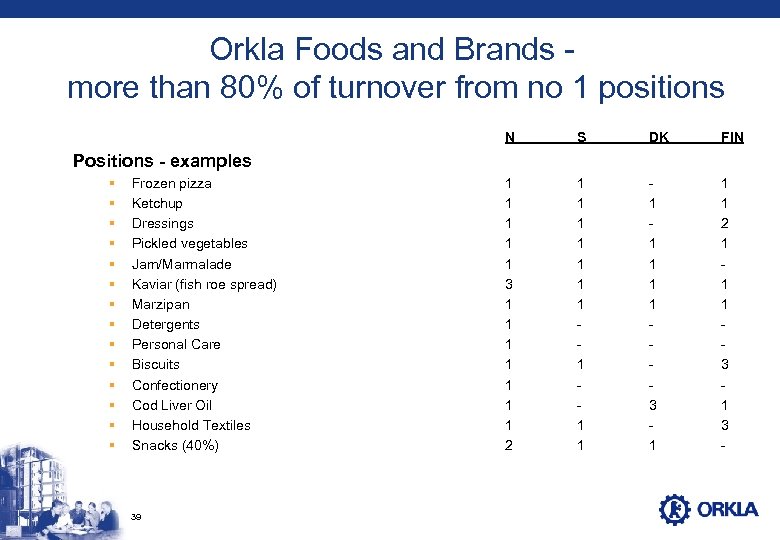
Orkla Foods and Brands more than 80% of turnover from no 1 positions N S DK FIN 1 1 1 3 1 1 1 1 2 1 1 1 1 3 1 1 1 2 1 1 1 3 - Positions - examples § § § § Frozen pizza Ketchup Dressings Pickled vegetables Jam/Marmalade Kaviar (fish roe spread) Marzipan Detergents Personal Care Biscuits Confectionery Cod Liver Oil Household Textiles Snacks (40%) 39
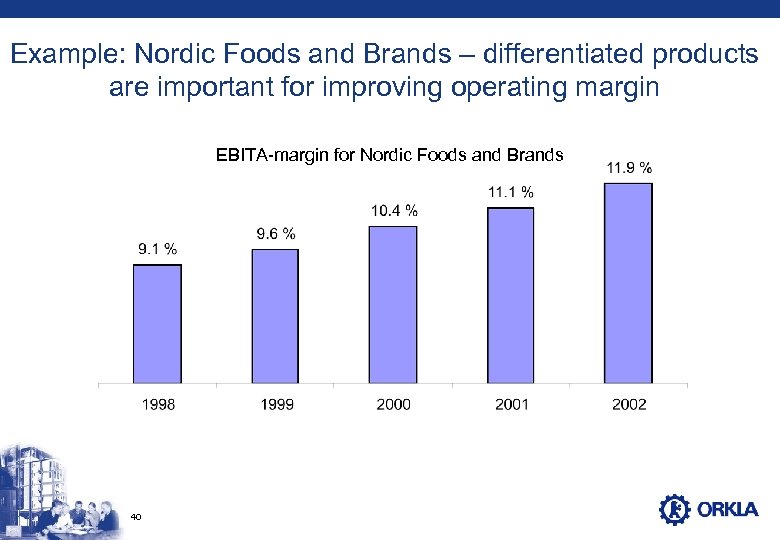
Example: Nordic Foods and Brands – differentiated products are important for improving operating margin EBITA-margin for Nordic Foods and Brands 40
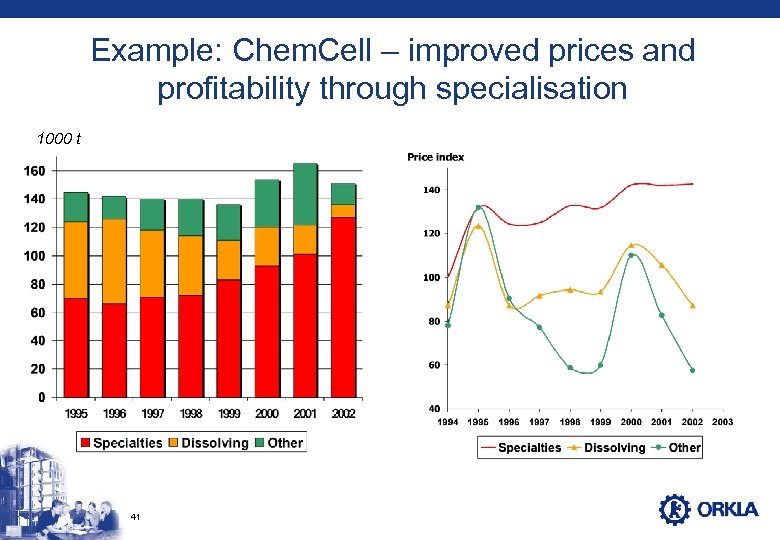
Example: Chem. Cell – improved prices and profitability through specialisation 1000 t 41
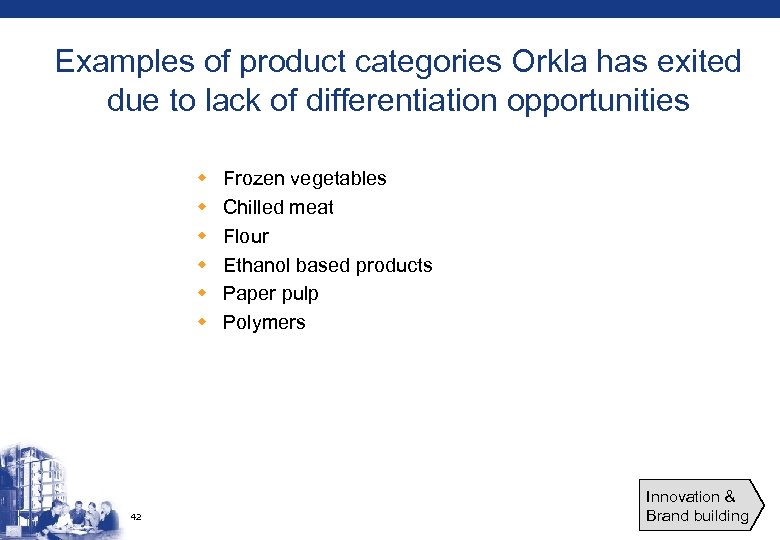
Examples of product categories Orkla has exited due to lack of differentiation opportunities w w w 42 Frozen vegetables Chilled meat Flour Ethanol based products Paper pulp Polymers Innovation & Brand building
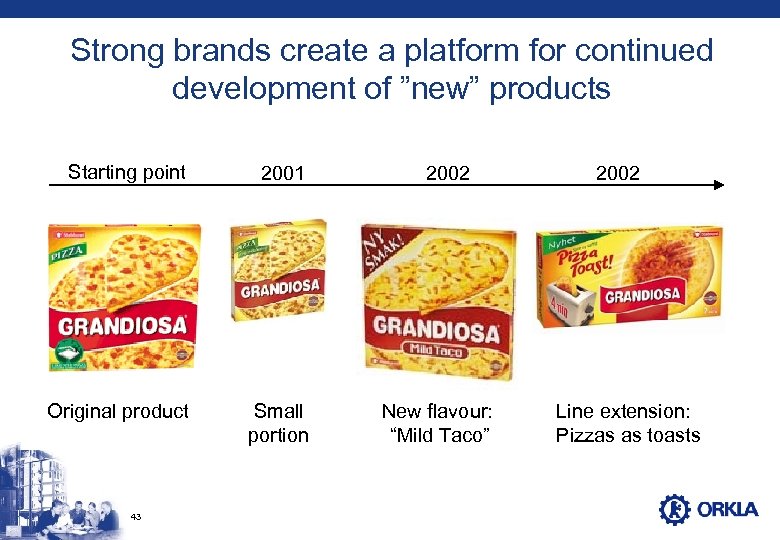
Strong brands create a platform for continued development of ”new” products Starting point 2001 Original product Small portion 43 2002 New flavour: “Mild Taco” 2002 Line extension: Pizzas as toasts
Good advertising is critical to the success of innovations w Focuses on the brand w Concentrates on the brand’s principal advantages; functional as well as emotional w Captures viewers’ attention w Has a simple message (understandable on first viewing) w Triggers a purchase - creates a desire to try the product w Is remembered - including which brand was being advertised 44
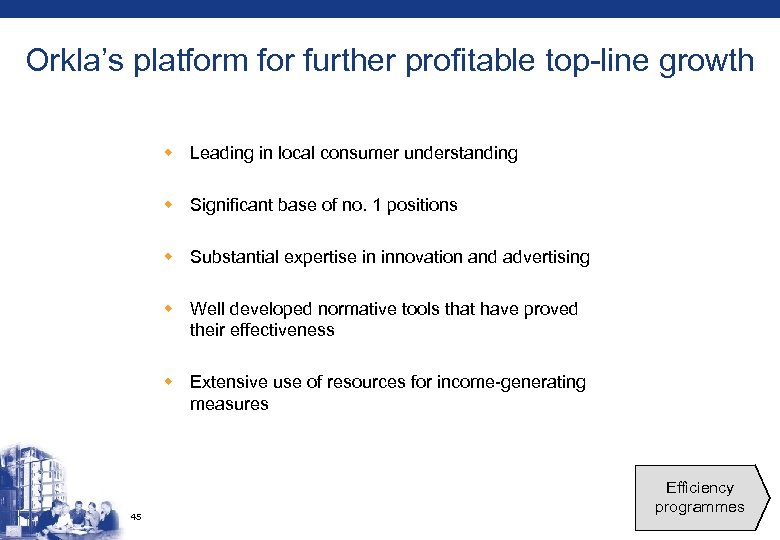
Orkla’s platform for further profitable top-line growth w Leading in local consumer understanding w Significant base of no. 1 positions w Substantial expertise in innovation and advertising w Well developed normative tools that have proved their effectiveness w Extensive use of resources for income-generating measures 45 Efficiency programmes
Orkla’s tool for continuous improvement of production efficiency: E 100 w The E 100 improvement programme initiated at Stabburet in 1994 w Further developed into a world class tool w Counteracts inflation pressure on existing products - creates a stable platform for growth through innovation Recognised as best practice within Orkla - now to be rolled out in rest of Group, starting with Orkla Foods 46
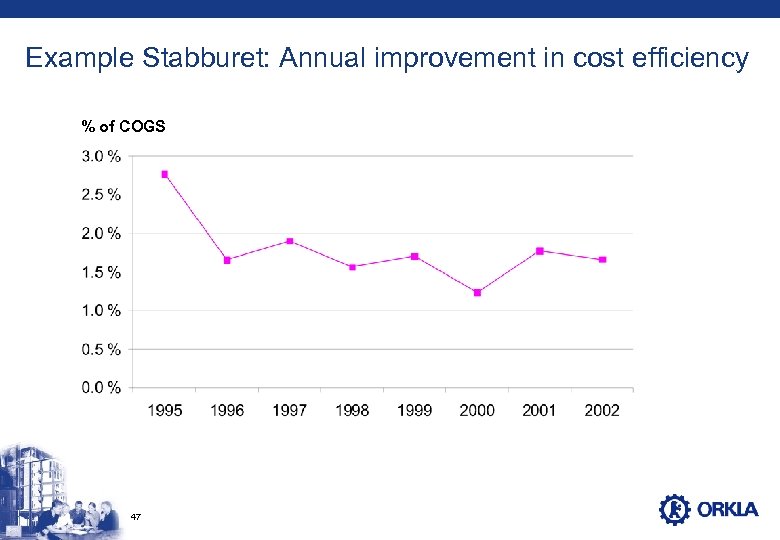
Example Stabburet: Annual improvement in cost efficiency % of COGS 47
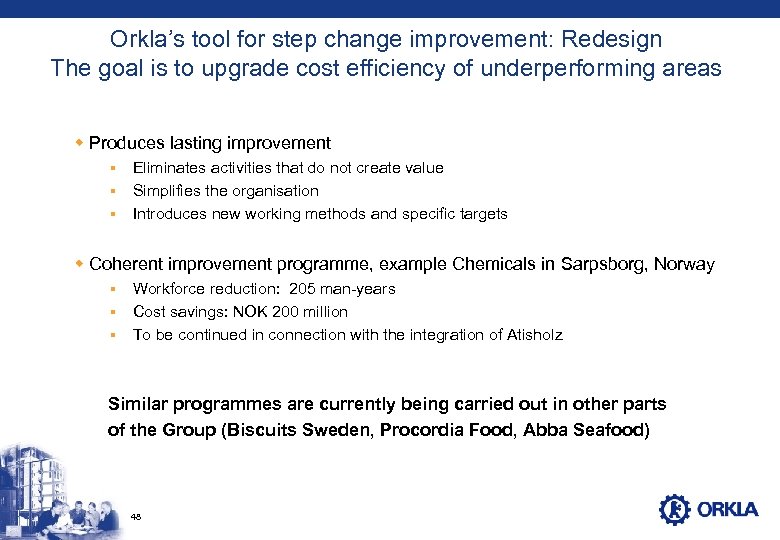
Orkla’s tool for step change improvement: Redesign The goal is to upgrade cost efficiency of underperforming areas w Produces lasting improvement Eliminates activities that do not create value § Simplifies the organisation § Introduces new working methods and specific targets § w Coherent improvement programme, example Chemicals in Sarpsborg, Norway Workforce reduction: 205 man-years § Cost savings: NOK 200 million § To be continued in connection with the integration of Atisholz § Similar programmes are currently being carried out in other parts of the Group (Biscuits Sweden, Procordia Food, Abba Seafood) 48
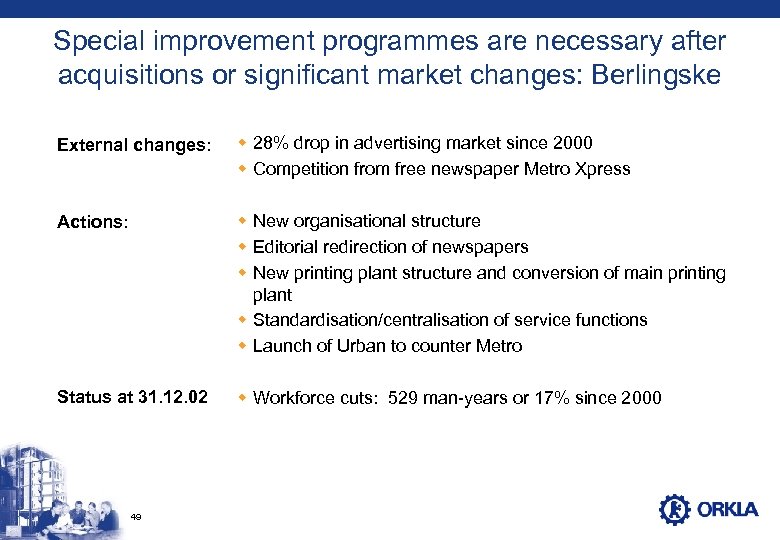
Special improvement programmes are necessary after acquisitions or significant market changes: Berlingske External changes: w 28% drop in advertising market since 2000 w Competition from free newspaper Metro Xpress Actions: w New organisational structure w Editorial redirection of newspapers w New printing plant structure and conversion of main printing plant w Standardisation/centralisation of service functions w Launch of Urban to counter Metro Status at 31. 12. 02 w Workforce cuts: 529 man-years or 17% since 2000 49
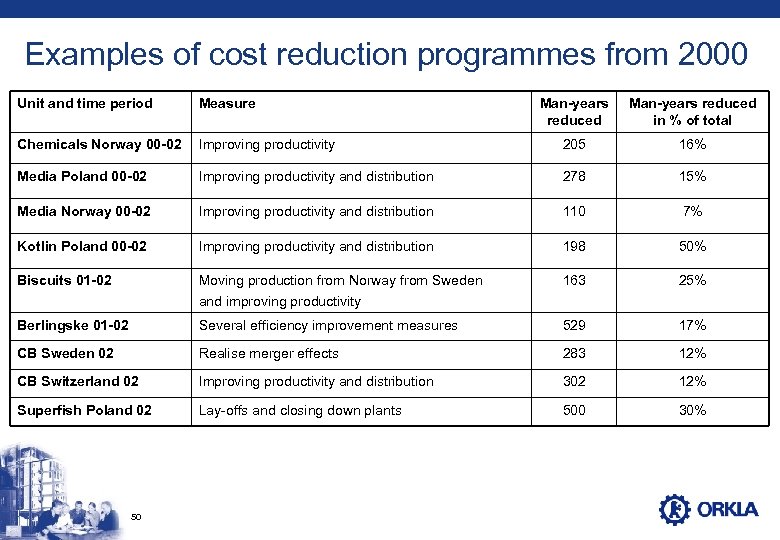
Examples of cost reduction programmes from 2000 Unit and time period Measure Man-years reduced in % of total Chemicals Norway 00 -02 Improving productivity 205 16% Media Poland 00 -02 Improving productivity and distribution 278 15% Media Norway 00 -02 Improving productivity and distribution 110 7% Kotlin Poland 00 -02 Improving productivity and distribution 198 50% Biscuits 01 -02 Moving production from Norway from Sweden and improving productivity 163 25% Berlingske 01 -02 Several efficiency improvement measures 529 17% CB Sweden 02 Realise merger effects 283 12% CB Switzerland 02 Improving productivity and distribution 302 12% Superfish Poland 02 Lay-offs and closing down plants 500 30% 50
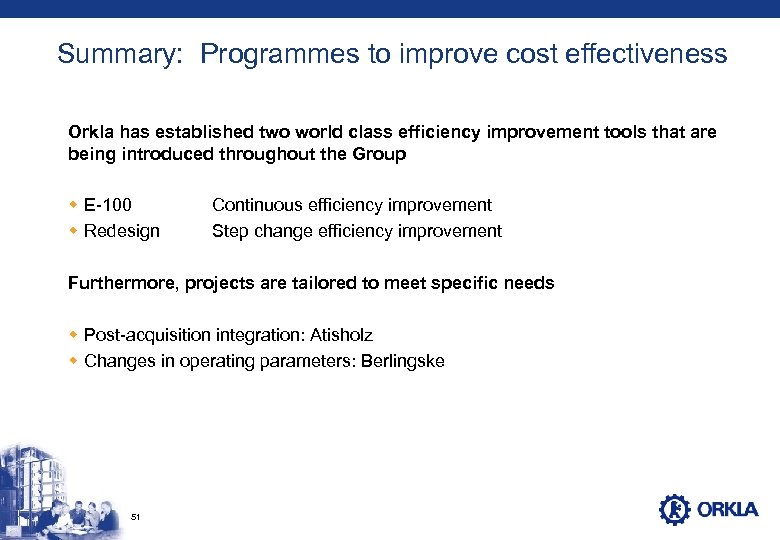
Summary: Programmes to improve cost effectiveness Orkla has established two world class efficiency improvement tools that are being introduced throughout the Group w E-100 w Redesign Continuous efficiency improvement Step change efficiency improvement Furthermore, projects are tailored to meet specific needs w Post-acquisition integration: Atisholz w Changes in operating parameters: Berlingske 51
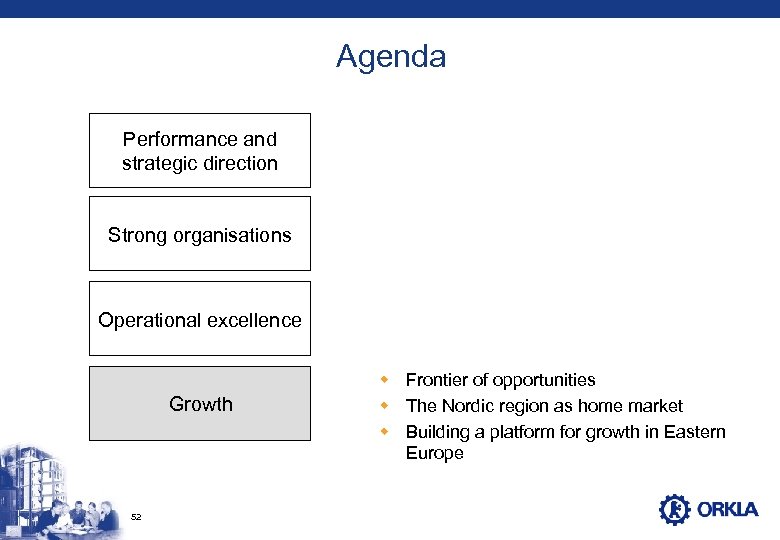
Agenda Performance and strategic direction Strong organisations Operational excellence Growth 52 w Frontier of opportunities w The Nordic region as home market w Building a platform for growth in Eastern Europe
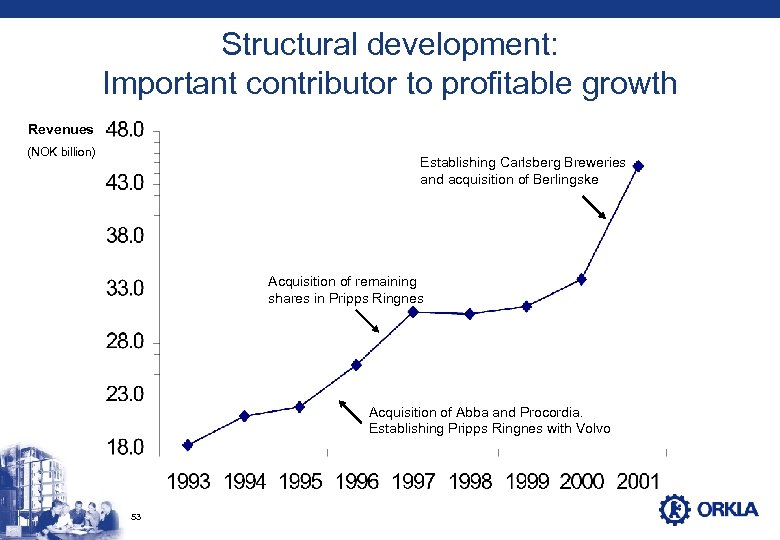
Structural development: Important contributor to profitable growth Revenues (NOK billion) Establishing Carlsberg Breweries and acquisition of Berlingske Acquisition of remaining shares in Pripps Ringnes Acquisition of Abba and Procordia. Establishing Pripps Ringnes with Volvo 53
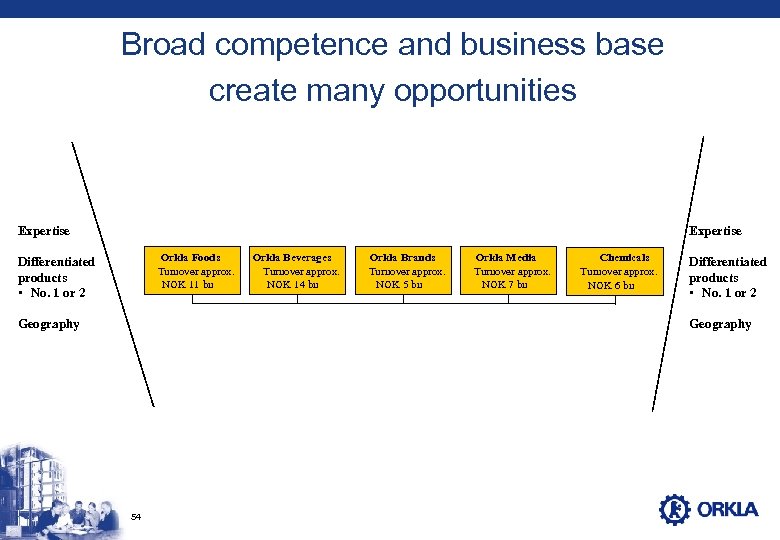
Broad competence and business base create many opportunities Expertise Orkla Foods Turnover approx. NOK 11 bn Differentiated products • No. 1 or 2 Geography Orkla Beverages Turnover approx. NOK 14 bn Orkla Brands Turnover approx. NOK 5 bn Orkla Media Turnover approx. NOK 7 bn Chemicals Turnover approx. NOK 6 bn Differentiated products • No. 1 or 2 Geography 54
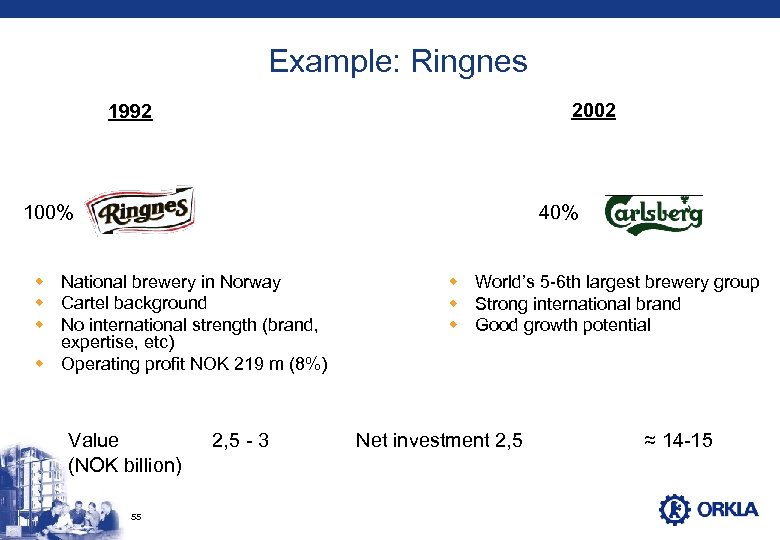
Example: Ringnes 2002 1992 100% 40% w National brewery in Norway w Cartel background w No international strength (brand, expertise, etc) w Operating profit NOK 219 m (8%) Value (NOK billion) 55 2, 5 - 3 w World’s 5 -6 th largest brewery group w Strong international brand w Good growth potential Net investment 2, 5 ≈ 14 -15
Orkla’s willingness to enter into joint ventures broadens the frontier of opportunities w In principle, we wish to own 100% of companies w We can accept JVs where this creates values that would not otherwise be realisable w JV are primarily financed with own funds, and shareholder agreements ensure that cash is not locked in But, w We will protect our cash flow and our reputation as an industrial company w Limited possibilities of creating large JVs which include entire business areas that are currently part of the Orkla Group 56
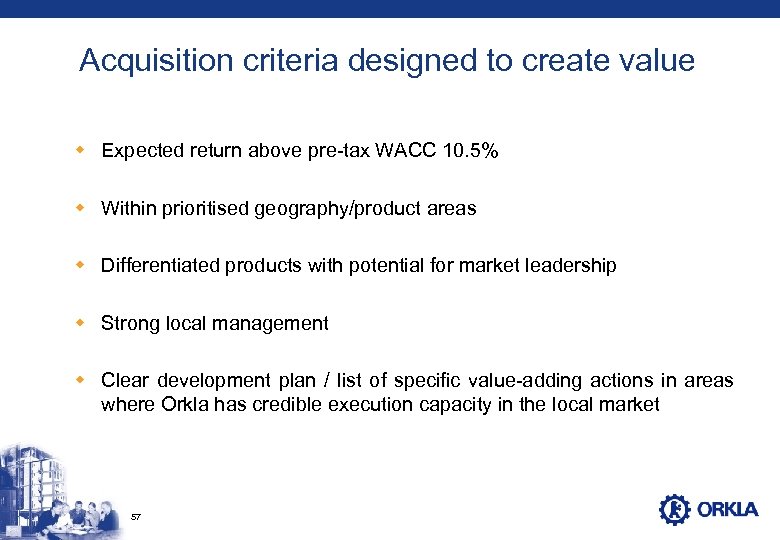
Acquisition criteria designed to create value w Expected return above pre-tax WACC 10. 5% w Within prioritised geography/product areas w Differentiated products with potential for market leadership w Strong local management w Clear development plan / list of specific value-adding actions in areas where Orkla has credible execution capacity in the local market 57
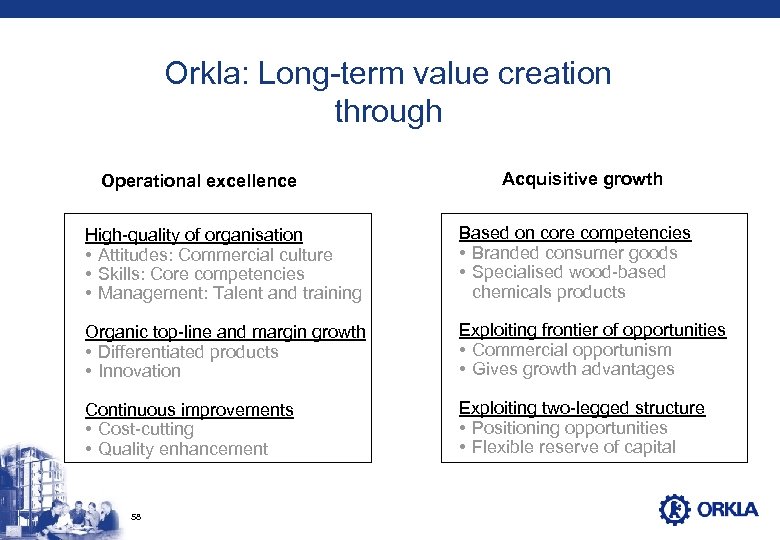
Orkla: Long-term value creation through Operational excellence Acquisitive growth High-quality of organisation • Attitudes: Commercial culture • Skills: Core competencies • Management: Talent and training Based on core competencies • Branded consumer goods • Specialised wood-based chemicals products Organic top-line and margin growth • Differentiated products • Innovation Exploiting frontier of opportunities • Commercial opportunism • Gives growth advantages Continuous improvements • Cost-cutting • Quality enhancement Exploiting two-legged structure • Positioning opportunities • Flexible reserve of capital 58
Скачать презентацию ORKLA Long-term value creation 20 February 2003
11ff43cd02fc4c78a7daa1e105cbaebf.ppt