 Скачать презентацию Origins of the Society of British Neurological Surgeons
111ba96c87d0b2e53062c1287def8c98.ppt
- Количество слайдов: 59



Origins of the Society of British Neurological Surgeons 1926 -1939 TT King Honorary Archivist 2006
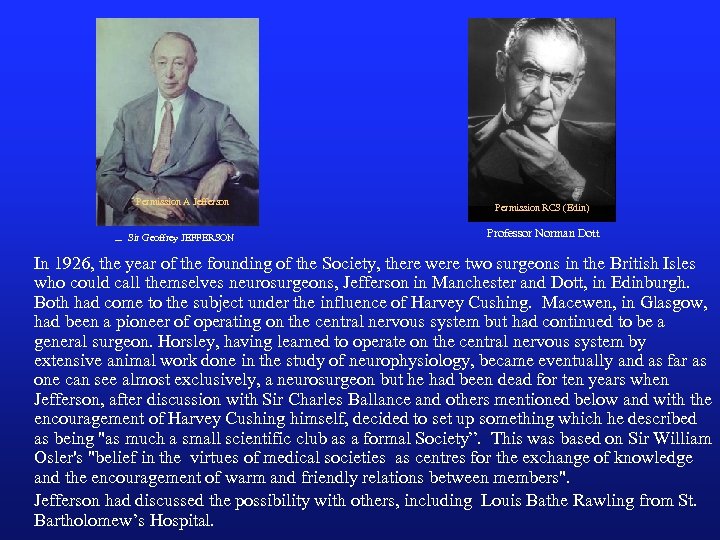
Permission A Jefferson Sir Geoffrey JEFFERSON Permission RCS (Edin) Professor Norman Dott In 1926, the year of the founding of the Society, there were two surgeons in the British Isles who could call themselves neurosurgeons, Jefferson in Manchester and Dott, in Edinburgh. Both had come to the subject under the influence of Harvey Cushing. Macewen, in Glasgow, had been a pioneer of operating on the central nervous system but had continued to be a general surgeon. Horsley, having learned to operate on the central nervous system by extensive animal work done in the study of neurophysiology, became eventually and as far as one can see almost exclusively, a neurosurgeon but he had been dead for ten years when Jefferson, after discussion with Sir Charles Ballance and others mentioned below and with the encouragement of Harvey Cushing himself, decided to set up something which he described as being "as much a small scientific club as a formal Society”. This was based on Sir William Osler's "belief in the virtues of medical societies as centres for the exchange of knowledge and the encouragement of warm and friendly relations between members". Jefferson had discussed the possibility with others, including Louis Bathe Rawling from St. Bartholomew’s Hospital.
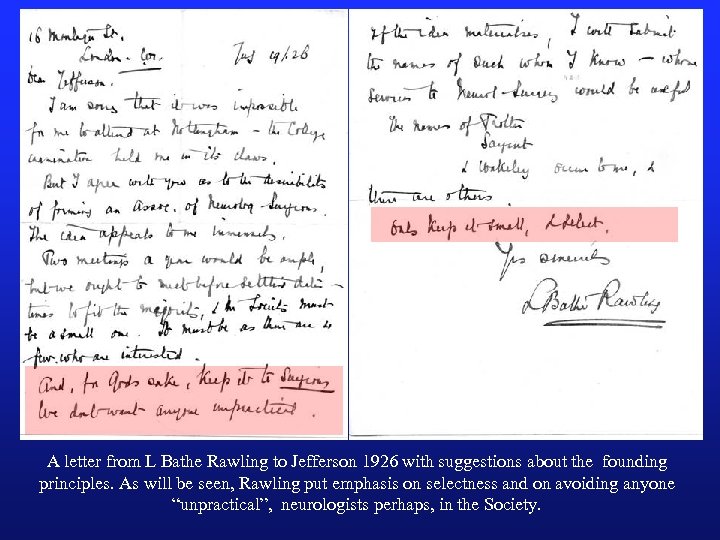
A letter from L Bathe Rawling to Jefferson 1926 with suggestions about the founding principles. As will be seen, Rawling put emphasis on selectness and on avoiding anyone “unpractical”, neurologists perhaps, in the Society.
Inaugural Dinner and Meeting: 2 nd and 3 rd December 1926 Sir Charles Ballance gave a dinner at the Athenaeum Club to inaugurate the Society. His son, Dr A W Ballance attended but took no further part in the Society. Norman Dott, from Edinburgh, did not come till the next day, but was elected a member. The others at the dinner were Ballance, Jefferson, Trotter, Bathe Rawling, Souttar, Learmonth, Bankart , Armour, Bromley, Broster, Mc. Connell and Sargent. With Young, who did not attend the meeting and Dott, these comprised the founding members. There were present, in addition, four distinguished scientists who, with the launching of the Society, were made Honorary Members: Sir David Ferrier, Sir Edward Sharpey-Schafer, Sir Arthur Keith and Professor (later Sir)Grafton Elliott Smith. Sir Charles Sherrington, who was not present, was also made an Honorary Member. Ballance was elected President (he relinquished this in 1927 to become Honorary President, a position which he held till his death in 1935 after which it disappeared). Jefferson became the first secretary, remaining in that post until 1952. Bromley was Treasurer and the Committee consisted of Trotter and Sargent.
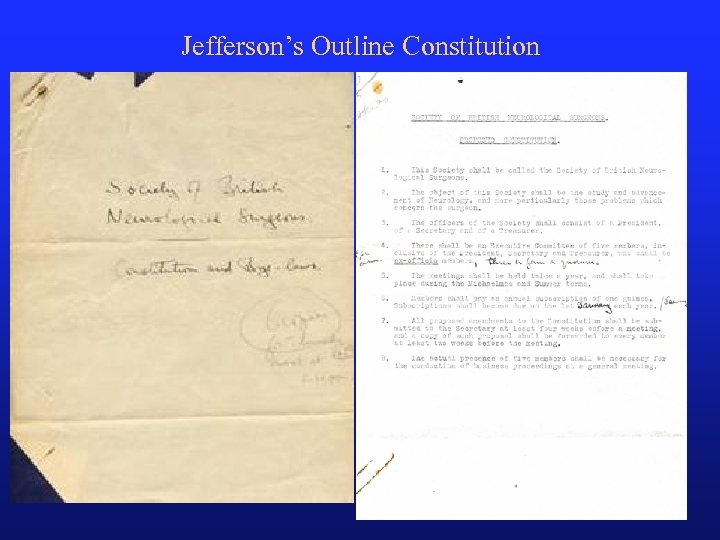
Jefferson’s Outline Constitution
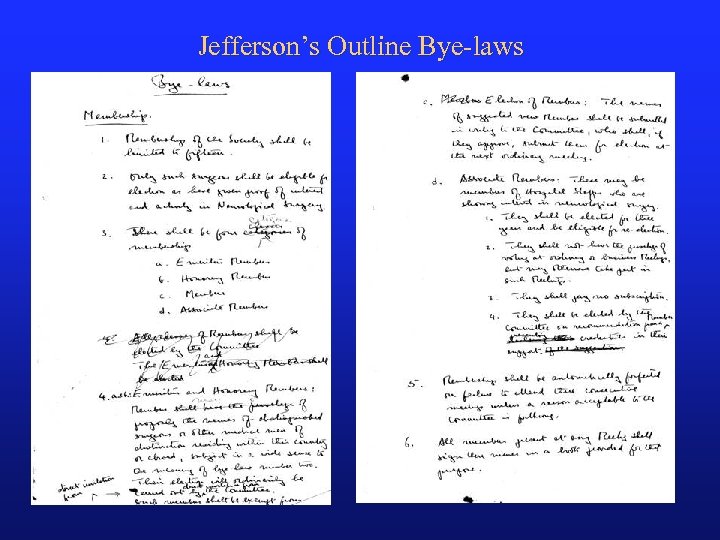
Jefferson’s Outline Bye-laws
Original Constitution and Bye-laws: 1926 The Constitution of the Society was based on that of two earlier organisations, the Society of Neurological Surgeons in the US, the only neurosurgical society whose founding preceded that of the British Society, and the British Orthopaedic Society whose first honorary secretary, Harry Platt, was a close friend of Jefferson's. There were to be two meetings a year, the number of members was to be restricted to 15 and the criterion for admission to membership was to be an interest in neurological surgery. The annual fee was one guinea ( about £ 40 in 2005) but this was raised to three guineas at the second meeting when a fee of one guinea was imposed on associate members. Three other categories of membership were to be honorary, emeritus and associate though the qualifications for the first two or the differences between them were not laid out. Failure to attend three successive meeting would result in ejection. In the archives, a loose sheet of proposals for a constitution , with Jefferson's annotations, mentions that the object of the meetings was primarily to visit the hospitals and laboratories of members in London or elsewhere and that, at intervals of not more than two years, the Society should visit a foreign neurosurgical clinic.
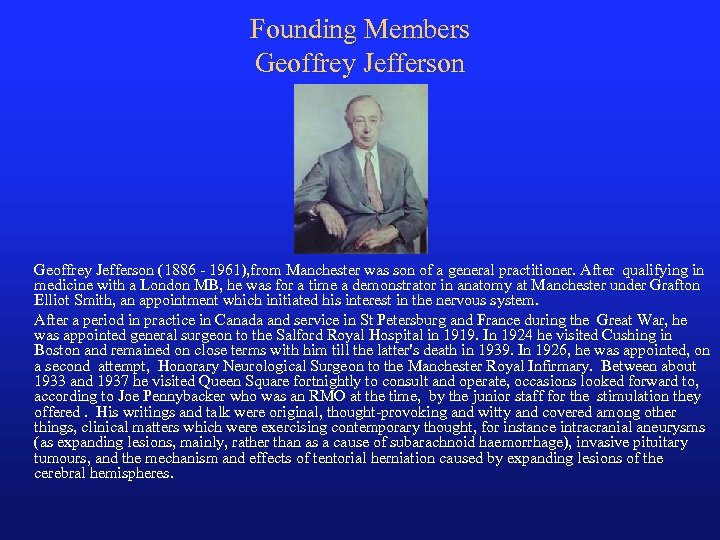
Founding Members Geoffrey Jefferson (1886 - 1961), from Manchester was son of a general practitioner. After qualifying in medicine with a London MB, he was for a time a demonstrator in anatomy at Manchester under Grafton Elliot Smith, an appointment which initiated his interest in the nervous system. After a period in practice in Canada and service in St Petersburg and France during the Great War, he was appointed general surgeon to the Salford Royal Hospital in 1919. In 1924 he visited Cushing in Boston and remained on close terms with him till the latter's death in 1939. In 1926, he was appointed, on a second attempt, Honorary Neurological Surgeon to the Manchester Royal Infirmary. Between about 1933 and 1937 he visited Queen Square fortnightly to consult and operate, occasions looked forward to, according to Joe Pennybacker who was an RMO at the time, by the junior staff for the stimulation they offered. His writings and talk were original, thought-provoking and witty and covered among other things, clinical matters which were exercising contemporary thought, for instance intracranial aneurysms (as expanding lesions, mainly, rather than as a cause of subarachnoid haemorrhage), invasive pituitary tumours, and the mechanism and effects of tentorial herniation caused by expanding lesions of the cerebral hemispheres.
Geoffrey Jefferson (Cont. ) He also wrote extensively on philosophical and physiological problems, such as consciousness and the development, in the nineteenth century, of the idea localisation of function in the brain, as well as historical biographies, all written in an unusually attractive style and showing deep knowledge extending well beyond medicine or purely neurological matters. He was twice President of the Society, during the first of which tenures, he was also Secretary, a post he held from the beginning of the Society until 1952. During the Second World War, he was consultant adviser to the ministries of Health and Pensions and had responsibility for organizing civilian neurosurgical facilities throughout the United Kingdom. After the introduction of the NHS in 1948, he was Advisor to the Ministry of Health on neurosurgery He was made a Fellow of the Royal Society in 1947 and knighted in 1950.
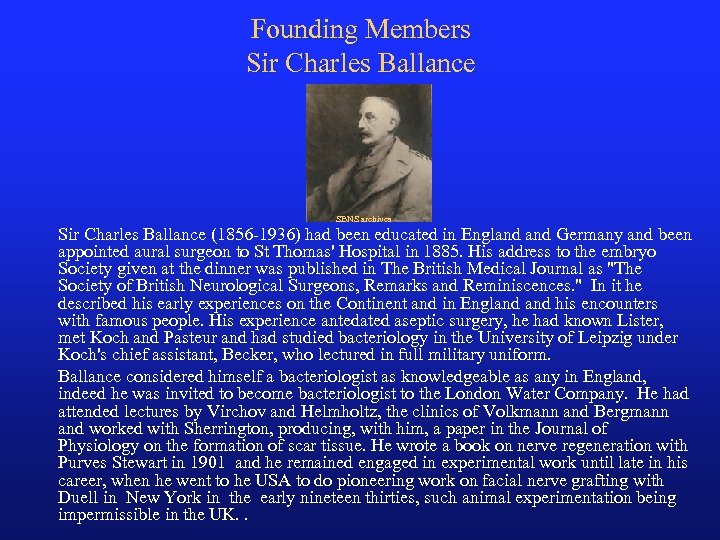
Founding Members Sir Charles Ballance SBNS archives Sir Charles Ballance (1856 -1936) had been educated in England Germany and been appointed aural surgeon to St Thomas' Hospital in 1885. His address to the embryo Society given at the dinner was published in The British Medical Journal as "The Society of British Neurological Surgeons, Remarks and Reminiscences. " In it he described his early experiences on the Continent and in England his encounters with famous people. His experience antedated aseptic surgery, he had known Lister, met Koch and Pasteur and had studied bacteriology in the University of Leipzig under Koch's chief assistant, Becker, who lectured in full military uniform. Ballance considered himself a bacteriologist as knowledgeable as any in England, indeed he was invited to become bacteriologist to the London Water Company. He had attended lectures by Virchov and Helmholtz, the clinics of Volkmann and Bergmann and worked with Sherrington, producing, with him, a paper in the Journal of Physiology on the formation of scar tissue. He wrote a book on nerve regeneration with Purves Stewart in 1901 and he remained engaged in experimental work until late in his career, when he went to he USA to do pioneering work on facial nerve grafting with Duell in New York in the early nineteen thirties, such animal experimentation being impermissible in the UK. .

Sir Charles Ballance (cont. ) He was, with Sir Victor Horsley, surgeon to the National Hospital, Queen Square. His book, Some Points on the Surgery of the Brain and its Membranes(1910) contains a report of what is often said to be one the earliest successful removals of an acoustic nerve tumour, though it seems likely the growth was, as Cushing thought, a meningioma arising near the porus. The postoperative picture of the patient suggests that the success was a qualified one.

Ballance’s Address to the Inaugural Meeting British Medical Journal Jan 8 th 1927

Founding Members Wilfred Trotter Permission of RCS Eng. Permission of RCS (E) Wilfred Trotter (1872 - 1939) was a surgeon at University College Hospital where he was influenced by Horsley, He was a person of wide accomplishments in surgery and beyond. He became interested in Freud's writings but thought they neglected the social side of man. He wrote two papers before the First World War on man as a social animal, living together with others and these was subsequently published as a book in 1916, The Instincts of the Herd in Peace and War. The publication of this was said to have been encouraged by the Government to help national morale. He identified three types of gregariousness, that of the beehive, the sheep flock and the wolf pack and put Britain in the first category and Germany in the last. With a colleague, he carried out a study of cutaneous sensation, amplifying the experiments of Henry Head which, together with his own, involving section of cutaneous nerves in the experimenters. He interpreted his own results as opposing Head's theory of protopathic and epicritic sensation. Described as being an exceptional surgical technician, he was concerned with the treatment of malignant disease, especially that of the head and neck and, in neurosurgery, intracranial aneurysms and subdural haematoma. He was married to the sister of Ernest Jones, Freud's English disciple and biographer, with whom he shared rooms and, like Jefferson after him, he was elected a Fellow of the Royal Society.

Founding Members Henry Souttar Permission RCS(E) of RCS Eng Henry Souttar (1875 - 1964) was surgeon to the London Hospital. He, too, had wide interests, having obtained a double first in mathematics at Oxford and been interested in engineering. He carried out what is reported as the first mitral valvotomy, was a skilled engineer and devised a hand-operated instrument for cutting a bone flap rapidly which is preserved in The Royal London Hospital Archives and Museum. It was subsequently taken up by W. James Gardner in the USA and modified by Hugh Trumble in Australia. Cairns, his junior surgical colleague at the London, in breaking away to set up a neurosurgical department in a London teaching hospital, felt he had offended him. He was knighted in 1949.

Founding Members Percy Sargent Permisson of Percy Sargent (1873 -1933), surgeon at St Thomas's and the National Hospital, had been a highly qualified and successful general surgeon and had little experience in neurosurgery before being appointed as assistant surgeon to the National Hospital, Queen Square. But he studied the methods of Horsley and evolved a technique of his own. He had a distinguished career in the Great War, being awarded a DSO for his work in a neurological centre in France where he had collaborated with Sir Gordon Holmes on the neurology of war wounds of the brain and, during this period, met Cushing who had two spells in France - 1915 and again in 1917 -18 when he was first with the British at Paschendaele and later with the American Expeditionary Force.
Percy Sargent (cont. ) He was, though, outside the Cushing tradition and according to Paul Bucy vocally critical of its slow and painstaking methods. He is said to have had a rapid and gentle technique but the description by Harvey Jackson, who worked with him, of his method of removing a meningioma with his finger and controlling bleeding by packing the cavity suggests a rough, general surgical style, outdated by Cushing, though the latter had been impressed with his operating on a compound head wound in France in 1915: “ a very careful, neat and expeditious performance. ” Pennybacker, in his unpublished memoirs, gives an indication of the resistance among the physicians at the National Hospital to Cushing’s establishment of a safe operative technique and the independence of neurosurgery in quoting F. M. R Walshe’s description of the former as "a triumph of technique over reason. "

Founding Members Louis Bathe Rawling Permission of St Bartholomew, s Hospital Louis Bathe Rawling (1871 -1940) was surgeon at St Bartholomew's Hospital and also The West End Hospital for Nervous Diseases, originally in Welbeck Street but later in Soho. He had written works on skull fractures and surface markings in anatomy, the latter still being regarded as useful in the nineteen fifties.
Founding Members A Blundell Bankart Permission of Br. Orth. Ass. Blundell Bankart (1879 - 1951), an orthopaedic surgeon, is remembered for his operation for habitual dislocation of the shoulder. He had, however, been influenced by Sherrington. He held appointments as surgeon to the Royal National Orthopaedic Hospital, The Belgrave Hospital for children and The Hospital for Epilepsy and Paralysis, Maida Vale, thus practising as an orthopaedic, paediatric and neurological surgeon, all at the same time. Later he was on the staff of the Middlesex Hospital. He became interested on manipulation as a means of treating the spine and other joints, writing a textbook on the subject. He resigned his membership of the Society in 1937.

Founding Members Donald Armour Permission of Donald Armour (1869 - 1933) was a Canadian and son of the Chief Justice of Ontario. He had moved to London to study medicine, worked with Horsley and been appointed to staff of the National Hospital. He had won the Jacksonian Prize for an essay on the diagnosis and treatment of diseases of the spinal cord. As a neurological surgeon it was said "he relied too much on complicated mechanical devices. " These implements seem to have been powered saws and the trephines. Pennybacker, who saw him do a subtemporal decompression in the thirties, comments that his technique was crude and involved much use of a chisel.

Founding Members Lennox Broster Permission RCP {Eng. ) Permission of RCS Eng. Lennox Broster (1889 - 1965), a South African and an Oxford Rugby Blue, had as his main interest the adrenal gland the adreno-genital syndrome. He was surgeon to Charing Cross Hospital. The only record in the Society minutes of his involvement in neurosurgery is that he performed a section of the sensory root of the Gasserian ganglion at the fifth Meeting of the Society at Charing Cross Hospital.

Founding Members Lancelot Bromley Permission of Guy’s Hosp. Lancelot Bromley (1885 -1945) had been elected to the staff of Guy's Hospital in 1920 "with charge of the neurological department. " He is described as "shy, modest, unassuming, known affectionately to his colleagues and pupils as ‘Daddy’”. He was Treasurer from 1926 until 1934.
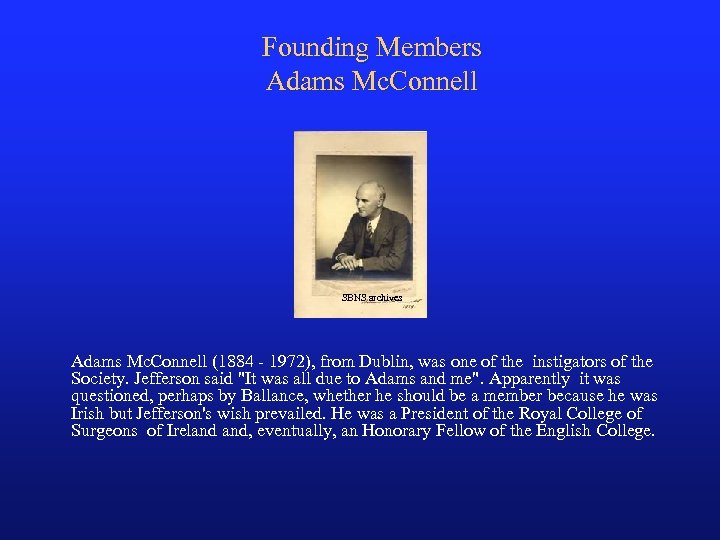
Founding Members Adams Mc. Connell SBNS archives Adams Mc. Connell (1884 - 1972), from Dublin, was one of the instigators of the Society. Jefferson said "It was all due to Adams and me". Apparently it was questioned, perhaps by Ballance, whether he should be a member because he was Irish but Jefferson's wish prevailed. He was a President of the Royal College of Surgeons of Ireland and, eventually, an Honorary Fellow of the English College.

Founding Members Norman Dott Permission of RCS (Edin. ) Norman Dott (1897 - 1973), who did not attend the dinner but was at the clinical meeting at the National Hospital next day, came from a family of Edinburgh art dealers and had originally intended a career in engineering. He had been appointed surgeon to the Deaconess and the Royal Hospital for Sick Children, Edinburgh, but had developed an interest in neurosurgery and spent a year, 1922 -23, with Cushing in Boston. He had no beds in the Edinburgh Royal infirmary to start with and took patients for surgery to a private hospital, returning them for postoperative care. He took, early, an interest in arteriography and was one of the first surgeons to carry out a direct operation on an intracranial aneurysm, the procedure being to wrap it with muscle. He was a gifted operator but took an optimistic view of results according to Pennybacker. He submitted himself who a cordotomy for the relief of chronic pain due to an old fracture of the hip, with the usual lack of success.

Founding Members Archibald Young Permission of RCPS Glasgow Archibald Young (1873 - 1939), Professor of Surgery at Glasgow, had been senior assistant to Sir William Macewen at Glasgow. Though he had been attached to the 4 th Scottish General Hospital during the first World War as a neurological expert, his main interest in the nervous system seems to have been in sympathectomy for Raynaud's disease, Hirschsprung's disease and even chronic arthritis though his belief in the ability of procedure to relieve pain was not shared by other surgeons. He submitted himself to periarterial sympathectomy for the treatment of chronic X-ray dermatitis of the hand with ulceration. The records of the Society suggest he did not play an important part in it up to his death in 1939

Founding Members James Learmonth Permission of RCS(Edin. James Learmonth (1895 - 1967) was, at the time of the first meeting, Assistant Professor of Surgery at the Western Infirmary, Glasgow. He had served as a officer in France during the Great War before completing his medical course. On a Rockefeller Fellowship he had been at the Mayo Clinic (1924 -25) with Alfred Adson, neurosurgeon, had married the director of social services there and was invited back to be on the staff where he was an Associate Professor of Neurosurgery between 1928 and 1932. He worked on the sympathetic nervous system and the innervation of the bladder while first at the Mayo Clinic and, on his return to Glasgow, wrote his thesis on spinal tumours.

James Learmonth (cont. ) He resigned from the Society at the second meeting at Manchester in 1927, presumably because of his impending departure to the Mayo Clinic but reappeared on his return. Subsequently he held the Regius Chair of Surgery in Aberdeen and then Edinburgh and was knighted after performing a sympathectomy on King George VI.

Hugh Cairns Permission of London Hosp. Archives Of these fourteen original members only three, Jefferson, Dott and Mc. Connell remained in neurosurgery, the others continuing in general surgery or another specialty. But the entry of younger, associate members in the ensuing years, Cairns for instance, who returned in September 1927 from a year with Cushing, gradually swelled the numbers of those practising as full-time neurological surgeons. Cairns ((1896 -1952), born in South Australia, had, in 1915, interrupted his 4 th year medical studies to serve in the Gallipoli campaign, returned to Australia to qualify in 1917 and win a Rhodes scholarship, and then went to France, where he served till the end of the war. Taking up his Scholarship at Oxford, he spent a year in Sherrington’s laboratory, did house jobs at Oxford, and then at the London Hospital, became First Assistant to Souttar and was placed on the staff as a general surgeon in 1926.
Hugh Cairns (cont. ) In 1927 he went to Boston on a Rockefeller Scholarship, working with Cushing for a year and returned to practise neurosurgery in London, overcoming considerable difficulties in setting up a specialist neurosurgical department at the London Hospital which attracted British, European and Commonwealth postgraduates. In 1937 he went to Oxford as the first Nuffield Professor of Surgery, under a scheme financed by Lord Nuffield, under Cairns’s influence, to establish a school of clinical medicine in the University. Cairns was a man of striking energy, organising powers and personality and wielded great influence, both professional and political. During the war he was in charge of military neurosurgery, established in St Hugh’s College, Oxford, a neurosurgical hospital, set up Mobile Neurosurgical Units which functioned in the Western Desert, Europe and Burma, with Florey, supervised the introduction of penicillin into the treatment of war wounds and following the studies of Holbourn, Denny-Brown and Ritchie Russell at Oxford on the mechanism of brain injury, was responsible for making crash helmets for motor-cycle dispatch riders compulsory. He died of a carcinoma of the colon at the early age of 56.
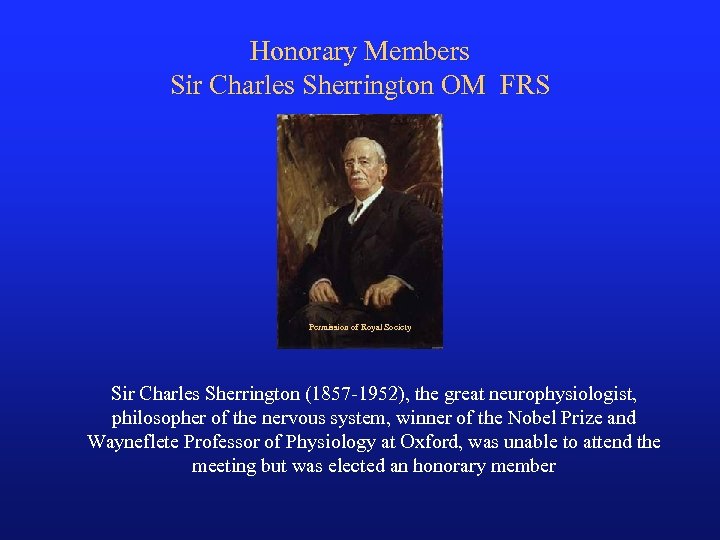
Honorary Members Sir Charles Sherrington OM FRS Permission of Royal Society Sir Charles Sherrington (1857 -1952), the great neurophysiologist, philosopher of the nervous system, winner of the Nobel Prize and Wayneflete Professor of Physiology at Oxford, was unable to attend the meeting but was elected an honorary member
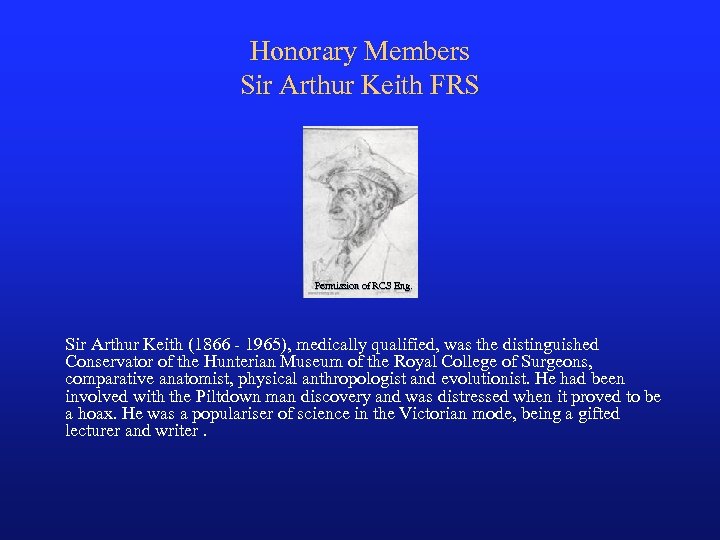
Honorary Members Sir Arthur Keith FRS Permission of RCS Eng. Sir Arthur Keith (1866 - 1965), medically qualified, was the distinguished Conservator of the Hunterian Museum of the Royal College of Surgeons, comparative anatomist, physical anthropologist and evolutionist. He had been involved with the Piltdown man discovery and was distressed when it proved to be a hoax. He was a populariser of science in the Victorian mode, being a gifted lecturer and writer.

Honorary Members Sir Edward Sharpey-Schafer FRS Permission Royal Society Permission of Royal Society Sir Edward Sharpey-Schafer (1850 - 1935) was Professor of Physiology at University College and, later, Edinburgh and the co-discoverer, with Oliver, of the pressor effect of adrenal extract in experimental animals, thus being one of the founders of endocrinology. He had done neurophysiological work on stimulation of the cerebral cortex with Horsley, who was working at the time in Sharpey-Schafer's laboratory in University College. Later he investigated the spinal cord and developed the prone method of applying artificial respiration after drowning which carried his name and was adopted by the Royal Life-Saving Society.
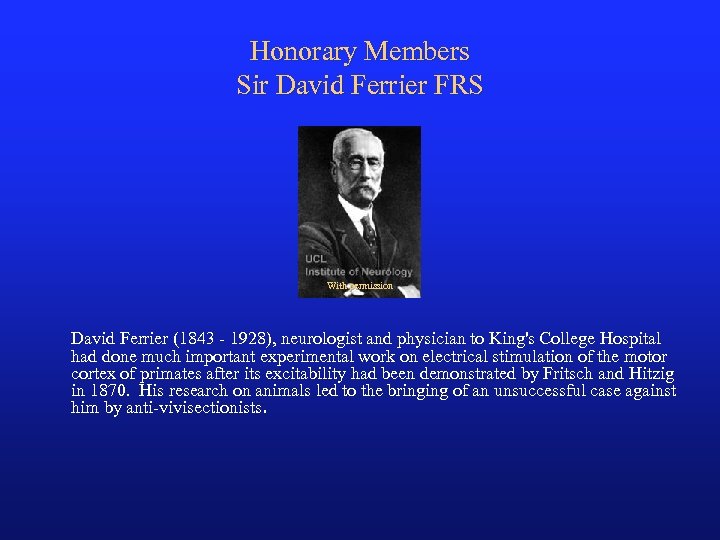
Honorary Members Sir David Ferrier FRS With permission David Ferrier (1843 - 1928), neurologist and physician to King's College Hospital had done much important experimental work on electrical stimulation of the motor cortex of primates after its excitability had been demonstrated by Fritsch and Hitzig in 1870. His research on animals led to the bringing of an unsuccessful case against him by anti-vivisectionists.
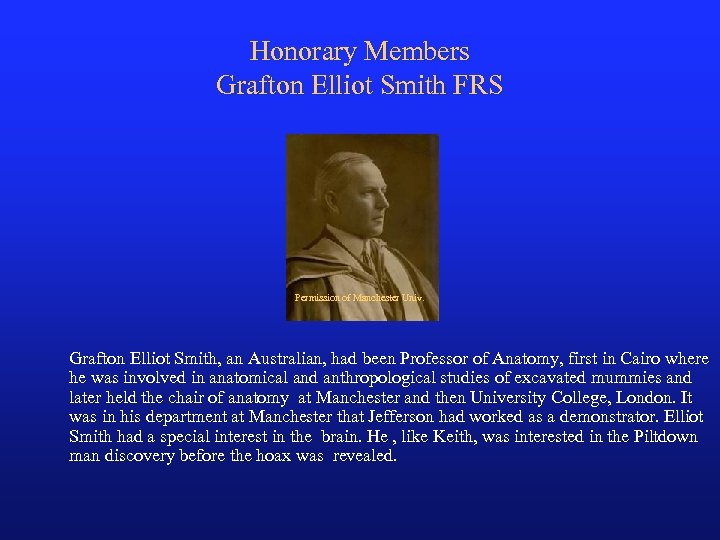
Honorary Members Grafton Elliot Smith FRS Permission of Manchester Univ. Grafton Elliot Smith, an Australian, had been Professor of Anatomy, first in Cairo where he was involved in anatomical and anthropological studies of excavated mummies and later held the chair of anatomy at Manchester and then University College, London. It was in his department at Manchester that Jefferson had worked as a demonstrator. Elliot Smith had a special interest in the brain. He , like Keith, was interested in the Piltdown man discovery before the hoax was revealed.
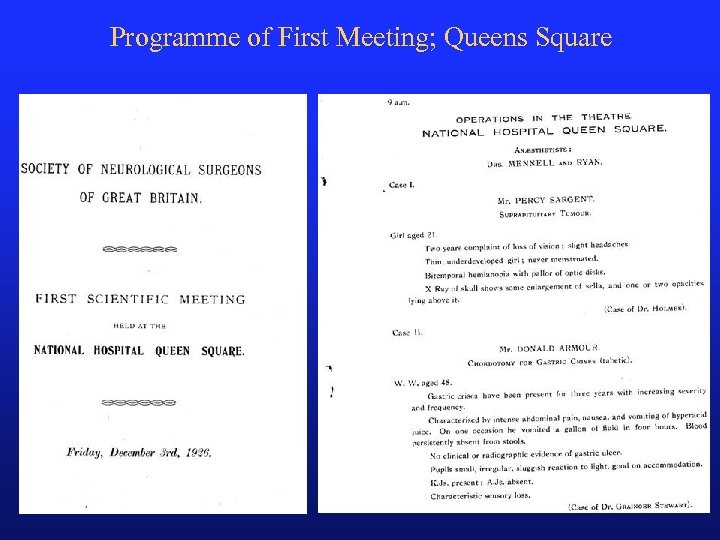
Programme of First Meeting; Queens Square
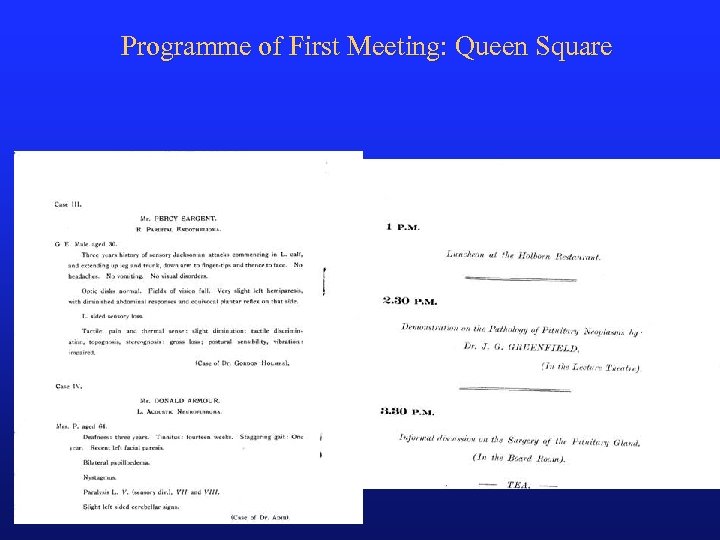
Programme of First Meeting: Queen Square
Programme of First Meeting: Queen Square The clinical or scientific meeting was held at the National Hospital, Queen Square on Friday, 2 nd December, 1926. Sargent partially removed a pituitary adamantinoma (craniopharyngioma) and carried out a negative exploration for what was expected to be a parietal endolthelioma. Armour carried out a cordotomy for tabetic gastric crises. The operation, which had been suggested to him by Godwin Greenfield, the great neuropathologist at the hospital, consisted of splitting the cord in the mid-line. The patient died next day and, in including the case in his Lettsomian Lecture, Armour remarked that he thought perhaps it had not been a good idea to carry out such a procedure in these circumstances. He also explored for an acoustic neurofibroma but found nothing though Jefferson's noted that a "wide exposure and a good view of the cerebello-pontine angle obtained. " In the afternoon Greenfield spoke on craniopharyngiomas, and Sargent, on his experiences with pituitary tumours. Afterwards, a humorous piece of verse, by "Lucio" appeared in the Manchester Guardian, headed by a quotation from Ballance's address.
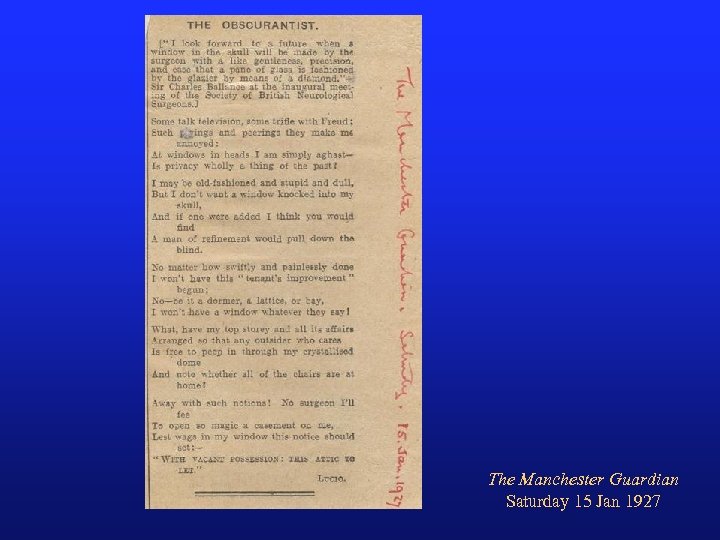
The Manchester Guardian Saturday 15 Jan 1927

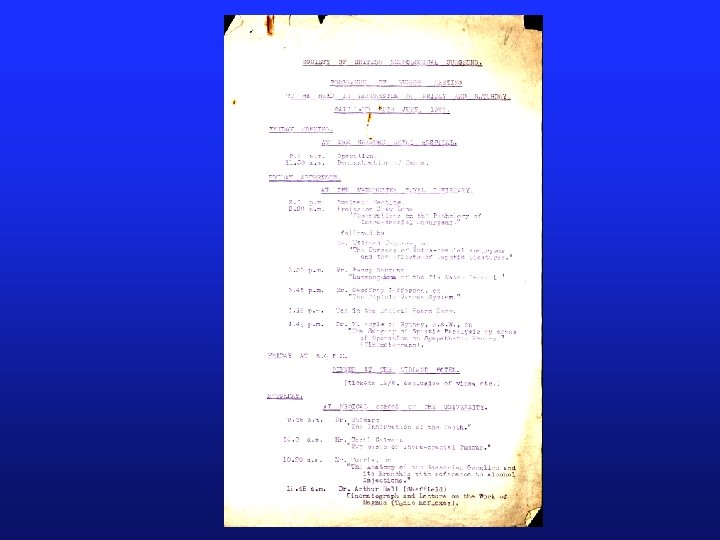
2 nd Meeting: Manchester Summer 1927 The second meeting was in Manchester on June 24 th and 25 th 1927, at the Salford Royal Hospital and the Manchester Royal Infirmary, though Jefferson, in a letter to Souttar, had said he thought it was too early to have it there. Cushing, himself, attended. SBNS Archives Harvey Cushing

2 nd Meeting: Manchester Summer 1927 This was important for being more extensive than the first and for being attended by Cushing, shortly after his delivery of the Macewen Lecture in Glasgow on olefactory groove meningiomas at which he first reported his experience with electrosurgery (diathermy). Jefferson carried out a section of the sensory root of the Gasserian ganglion, showed cases in the morning and in the afternoon there were papers on the pathology (Professor Shaw Dunn) and clinical aspects (Wilfred Trotter) of intracranial aneurysm. Royle, an orthopaedic surgeon from Sydney, spoke and showed a film about sympathectomy for spasticity, a procedure he and Hunter, Professor of Anatomy in Sydney, had advocated in 1924, and one that had aroused considerable interest, especially in the United States. Though it subsequently was shown to be ineffective for spasticity and based on a mistaken hypothesis, it directed attention in the operation of sympathectomy, for the authors observed the increased circulation in the limb after the operation which had previously been noted by Leriche in 1913. Cushing and Bankart took part in the discussion but there is no record of what was said. The guests attended a dinner at the Midland Hotel, the cost of which, without wine was twelve shillings and sixpence a head (twenty four pounds 43 pence in 2005).
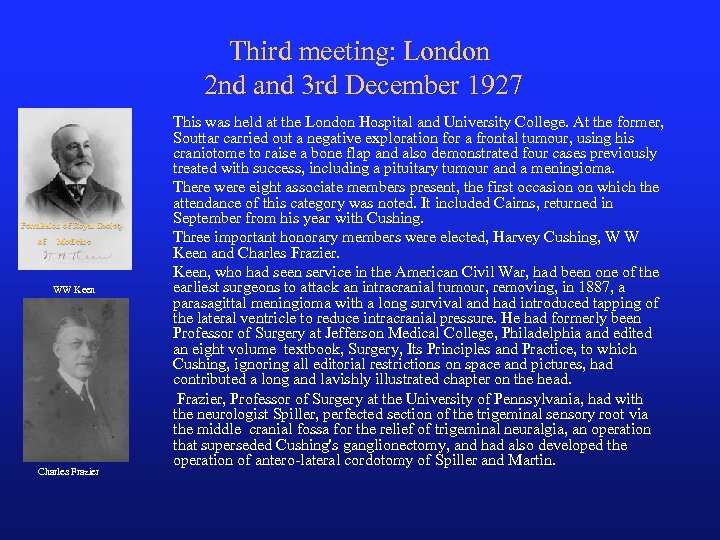
Third meeting: London 2 nd and 3 rd December 1927 Permission of Royal Society of Medicine WW Keen Charles Frazier This was held at the London Hospital and University College. At the former, Souttar carried out a negative exploration for a frontal tumour, using his craniotome to raise a bone flap and also demonstrated four cases previously treated with success, including a pituitary tumour and a meningioma. There were eight associate members present, the first occasion on which the attendance of this category was noted. It included Cairns, returned in September from his year with Cushing. Three important honorary members were elected, Harvey Cushing, W W Keen and Charles Frazier. Keen, who had seen service in the American Civil War, had been one of the earliest surgeons to attack an intracranial tumour, removing, in 1887, a parasagittal meningioma with a long survival and had introduced tapping of the lateral ventricle to reduce intracranial pressure. He had formerly been Professor of Surgery at Jefferson Medical College, Philadelphia and edited an eight volume textbook, Surgery, Its Principles and Practice, to which Cushing, ignoring all editorial restrictions on space and pictures, had contributed a long and lavishly illustrated chapter on the head. Frazier, Professor of Surgery at the University of Pennsylvania, had with the neurologist Spiller, perfected section of the trigeminal sensory root via the middle cranial fossa for the relief of trigeminal neuralgia, an operation that superseded Cushing's ganglionectomy, and had also developed the operation of antero-lateral cordotomy of Spiller and Martin.

Foreign and Overseas Members The Society elected foreign or Commonwealth members over the years and, by 1939, had accorded 21 neurosurgeons from outside Britain either Honorary or Corresponding Membership, including such distinguished figures as Olivecrona and Sjöqvist from Sweden, de Martel and Vincent from France, Foerster from Germany, Oljenick and de Vet from Holland, Busch from Denmark and Torkildsen from Norway.

Fourth Meeting: Edinburgh 8 th and 9 th June 1928 This meeting was arranged by Dott who carried out an operation at a private hospital. The procedure was excision of an orbital osteoma via a frontal craniotomy and went well. Sharpey-Schafer read a paper on the effect of a nerve section in his own hand, thus joining the company of Sir Henry Head and Trotter in exploiting the study of autosurgery. Professor Wilkie showed a young woman with an acoustic tumour in whom he had done a suboccipital decompression as a first stage, though it is not recorded whether the dura was opened. He asked for advice as to when he should operate again. Sargent suggested waiting twelve months

A Scientific Meeting Oxford: November 1929 In November 1929, the Society held its only meeting for the year at the Radcliffe Infirmary Oxford, where there was no neurosurgeon. Cases were shown, and Dott, two years after Moniz's first arteriogram, reported that he had carried out a carotid arteriogram, injecting two separate lots of 25% sodium iodide. Some of the material could be seen in the tumour on the second injection. Jefferson showed a ventriculogram in which dilatation of the third ventricle had led to a diagnosis of a cerebellar tumour. On the Saturday, a visit was paid to Sherrington's laboratory where various physiological preparations were shown by Sherrington, Denny-Brown, Eccles, John Fulton and others.
Foreign Meetings: Paris 1930 Jefferson had intended from the beginning that visits should be paid to foreign clinics but no arrangements were made for this until the winter meeting of 1928 when a suggestion was made of visiting Paris if Thierry de Martel would co-operate. The seventh meeting of the Society was eventually held in Paris in June 1930 and consisted of visits to the Clinics of de Martel, André Thomas and Clovis Vincent and to the Hôpital Salpêtrière. At Thomas' clinic a woman was shown who had suffered division of three main nerve trunks in upper arm. Petit-Dutaillis had inserted a 7 cm graft of a dog's sciatic nerve. Jefferson noted that "Some conduction was getting through. ” The case was reported in the Revue Neurologique. De Martel attacked an acoustic nerve tumour under local anaesthesia with the patient in the sitting position, using a special chair and his powered drill: "Condition fair only”. The operation at Vincent's clinic was an exploration of an intramedullary lipoma of the spinal cord under local anaesthetic with the patient again sitting in the de Martel chair. No normal cord could be found. Jefferson commented "Vincent was most unsympathetic to the patients screams of pain. I was disgusted". Subsequent foreign meetings were held in Amsterdam(1932), Paris (1933 and 1938) Stockholm(1935) and Berlin and Breslau (1937)
Early Operative Demonstrations Operative demonstrations were a feature of the early meetings but the results do not seem to have been very enlightening. In the first ten meetings, there were eighteen operations performed. Thirteen of these were craniotomies for supposed tumours, of which seven produced negative explorations, in one the finding was uncertain as judged by the entry in the minute book but sounds to have been negative, one was a first stage exploration only and four were positive in that a tumour was found. In only two was it removed and in one, the condition of the patient was unsatisfactory at the end of the procedure. Only in excision of a convexity meningioma by Mc. Connell in Dublin does it seem that a good immediate result was obtained. Of the other operative procedures, two were cranial nerve sections, one of the IXth and the other of the Vth, the latter an operation in which it was difficult, before the operating microscope was introduced, for anybody except the operator to see much. Two were spinal operations, one of which, by Vincent, seems to have been an unpleasant fiasco and the other, by Armour, resulted in death in the early postoperative period. Dott's removal of an orbital osteoma was a success. Though they became less frequent, there were odd examples over subsequent years.
Three meetings in 1935: Stockholm & London An extra meeting was held on 3 rd August 1935, making three for the year, the reason being the presence of a number of American neurosurgeons in London, attending the Second International Congress of Neurology. The usual summer meeting was held, this time in Stockholm. Eight members and associate members attended this meeting. Discussions on the first day were mainly on vascular lesions Sturge-Weber syndrome, aneurysms, A-V malformations and angioreticulomas. Olivecrona operated on both mornings, tapping a frontal cerebral cyst, removing a left parietal meningioma and a pituitary tumour, carrying out a subtotal removal of an acoustic nerve tumour and a frontal lobectomy for a glioma and clipping a trigeminal sensory root through the posterior fossa. Lysholm, the pioneer in neuroradiology, demonstrated ventriculograms of third and fourth ventricles, changes in the skull in meningiomas and the use of lipiodol in the ventricles. ( A year before, at the meeting at St Bartholomew's Hospital, Olivecrona had reported on “arterial encephalography by means of thorotrast", apparently the medium in use in Stockholm at the time, before its carcinogenic properties were appreciated. ) Jefferson remarks that "Dr Olivecrona was not only the perfect host but the most perfect diplomat possible. ” The speed and skill of Olivecrona's operating greatly impressed Jefferson who reported on it to Cushing. It clearly contrasted with previous experience of operative demonstrations.
Stockholm & London: 1935 (cont. ) In August of this year, the Second International Congress of Neurology took place in London and a joint meeting with the Society of Neurological Surgeons from the US and the recently founded Harvey Cushing Society was therefore arranged at the National Hospital, Queen Square. A striking group photograph of those attending exists. Cushing himself was not there but fourteen Americans, twenty members of the SBNS, nine honorary or corresponding members and about twenty five others attended, a total of around seventy. Jefferson gave an operative demonstration of sectioning the glossopharangeal nerve through the posterior fossa, Cairns showed cases and reports of the recent meetings of the three societies were given. The scientific programme appears to have been very crowded. The meeting closed at 7. 20 pm after eleven hours and those attending retired for dinner at Claridge's Hotel, a solemn photograph of which event exists. The third meeting for the year was at the London Hospital.
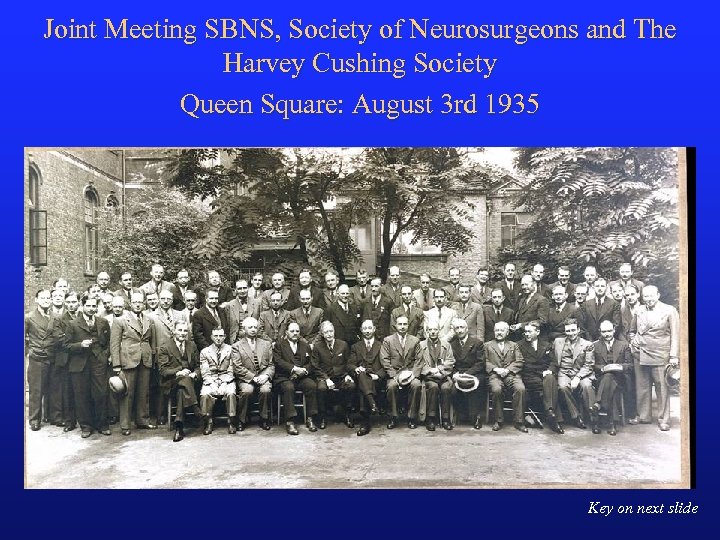
Joint Meeting SBNS, Society of Neurosurgeons and The Harvey Cushing Society Queen Square: August 3 rd 1935 Key on next slide
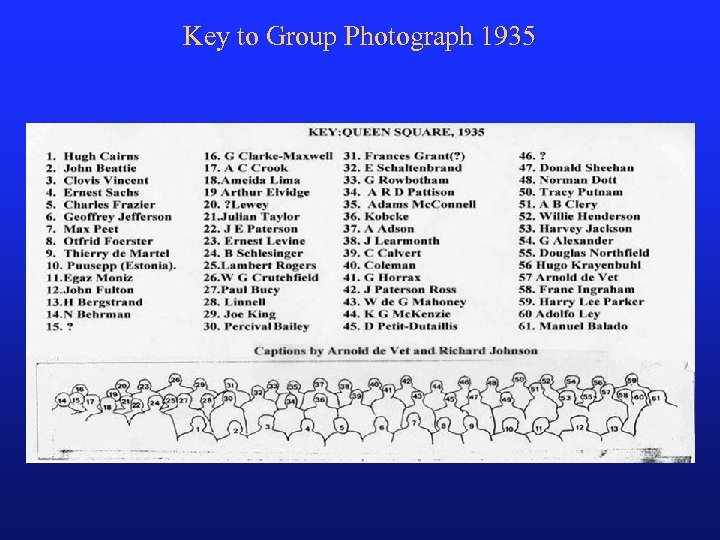
Key to Group Photograph 1935

Berlin: June 1937 In the summer of 1937 there was an extra meeting as the Society went to Berlin and Breslau. Tönnis, an honorary member of the Society since 1935, was the host in Berlin at the Kaiser Wilhelm Institute and Foerster, an honorary member since 1932, in Breslau. Joe Pennybacker, in his short history of the Society in its handbook, remembers the strident note of Nazi militarism that was evident in Berlin. In Berlin there were many soldiers about and much Nazi saluting. A visit to the Olympic Stadium from the previous year found it still bristling with Nazi flags. A military band played. Jefferson reported that the reception given by the Berlin Medical Society was the most impressive gathering that had ever appeared at any Society meeting. The list of speakers was certainly impressive, including as it did such important figures as Schaltenbrand, Bergstrand, Ringertz, Zülch, Spätz, Sjöqvuist, , Busch, Krayenbühl, Olivecrona, Lima, de Martel and Martin. Jefferson listed 39 names but this may be incomplete. He does not mention Pennybacker, dc Vet and Torkildsen, all of whom were there. Pennybacker appears in the photograph of Sauerbruch's demonstration and has left an account of the meeting. A paper by Löhr on arteriography of intracranial aneurysms appears to have made a notable impression. The German medical and surgical societies gave a dinner at the Bristol Hotel the cost of which the Society and its members reluctantly found themselves paying.
Berlin: June 1937 (cont. ) Pennybacker concluded that Tönnis, who spoke no English, must have been a good organiser since the meeting went so well. He thought he was pleasant enough but, though he had trained with Olivecrona, a rather rough surgeon. He was an honorary member of the Society but after the war he was thrown out because he had been a Nazi. Pennybacker was sympathetic to the younger German neurosurgeons who, he thought, were in a difficult position at the time as they could not continue with their work if they did not accept the political regime. According to Pennybacker Tönnis had been said to have been helpful to Martin, in Brussels, during the war, obtaining instruments for him and also "some of our men who were prisoners of war in Germany thought he had made beneficent efforts on their behalf. " He mentioned that Sauerbruch, the famous general surgeon who had devised, early, a method of performing open chest surgery by operating in a low-pressure chamber, also gave a demonstration of a oesophago-gastrectomy. Pennybacker thought this was rather rough too. After the war, Sauerbruch continued as an important surgical figure in East Berlin, in spite of progressive dementia which was for a time ignored because his prestige was important to the Government. Eventually he was dismissed amidst scandal. The political significance of what was going on in Germany, though manifestations of it were obvious, was not fully appreciated at the time by the British contingent according to Pennybacker but it was by the Continental members whom he observed anxiously and quietly discussing it.
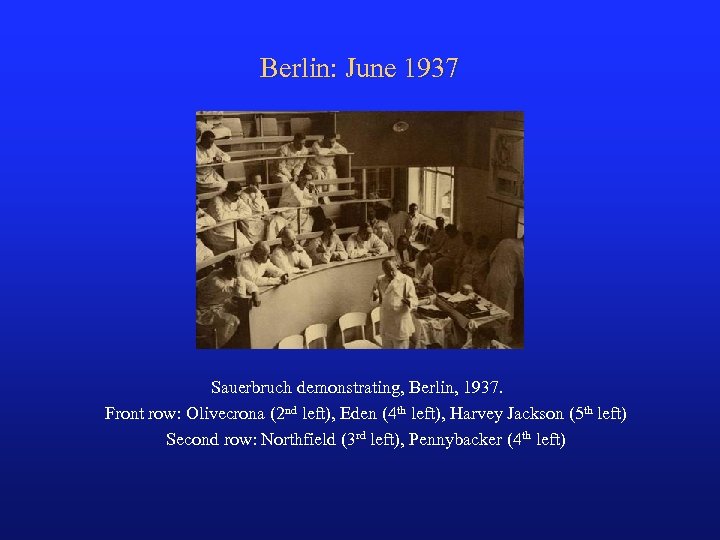
Berlin: June 1937 Sauerbruch demonstrating, Berlin, 1937. Front row: Olivecrona (2 nd left), Eden (4 th left), Harvey Jackson (5 th left) Second row: Northfield (3 rd left), Pennybacker (4 th left)

Breslau: June 1937 The second part of the meeting was held in Breslau where Naziism and its outward display were carried out with less verve than in Berlin.
Breslau: June 1937 (cont. ) Foerster was an old-fashioned gentleman, an Anglophile and a scientist. Pennvbacker thought he wasn't much of a surgeon but an excellent neurologist, neuropathologist and neuroanatomist. Ludwig Guttman, a Jew in Foerster's hospital, within two years fled to Oxford where Hugh Cairns found a position for him and George Riddoch, conceiving the idea of a spinal injuries unit at Stoke Mandeville, chose him to direct it.

Another Scientific Meeting: 1937 One in Paris: 1938 In December 1937, the Society's winter meeting was at the Strangeways Research Laboratory at Cambridge where E D (later Lord) Adrian was professor. The programme, on the first two days was formidable ( see next slide), but some relief was offered on the Saturday morning when Percival Bailey reviewed the classification of tumours of the glioma group which he and Cushing had developed and Dott and Levin presented the intracranial tuberculomas collected from members of the Society. In the summer of 1938, a further meeting was held in Paris at the Hôpital de la Pitié and the Salpêtrière. There were a number of visitors from the Continent present, including Tönnis, Schaltenbrand, Riechert and Zülch from Germany.

Programme, Strangeways Laboratory Cambridge: 1937
The Last Year Before the War: 1939 The last meeting before the outbreak of war was held on August 17 th, 18 th and 19 th August 1939 at Oxford. There was an unusually large attendance amounting to 32 members and associates, together with a number of visitors, including Francis Grant (Philadelphia), W. Mc. Craig (Mayo Clinic), William German (Yale) and Jason Mixter (Boston). The programme included a discussion on the treatment of penetrating head injuries of which Jefferson comments that he was the only one present who had experience in the first World War. In spite of the impending disaster, spirits were high and the sympathy of the Americans was heartening. The Third International Congress of Neurology in Copenhagen was held from August 21 st to 25 rd. It is hard to find any reports of the atmosphere at this event which must have been melancholy. The Lancet reported that the British contingent "was smaller than it would have been in more settled times" and added, facetiously, that it left two days early "for psychological rather than neurological reasons". The penultimate instructions in the Programme for the Oxford meeting were : "Those travelling to Copenhagen via Esjberg should catch the 1. 47 train from Oxford to London. For those travelling by air or via the Hook of Holland an excursion to Blenheim Palace on the afternoon of August 19 th has been arranged. ” War was declared just over a fortnight later.
Finis
Скачать презентацию Origins of the Society of British Neurological Surgeons
111ba96c87d0b2e53062c1287def8c98.ppt