


 Скачать презентацию Origins of the Constitution I Articles of Confederation
650fdcc639ad8f6d8a387dc9c945ba8c.ppt
- Количество слайдов: 25
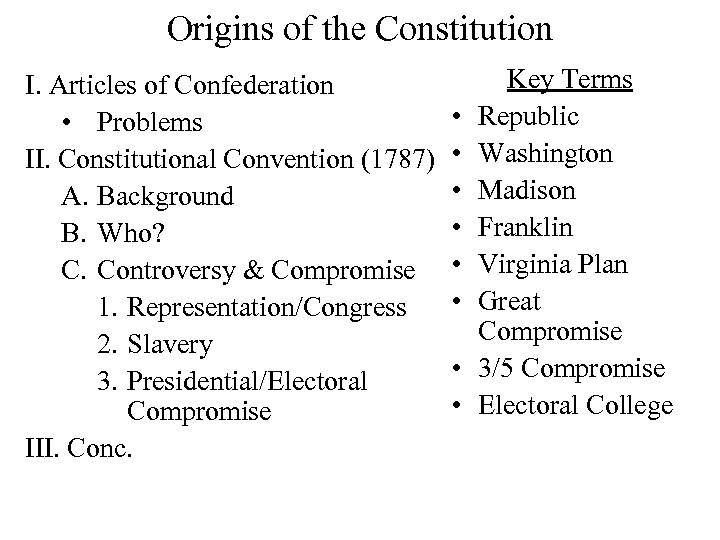
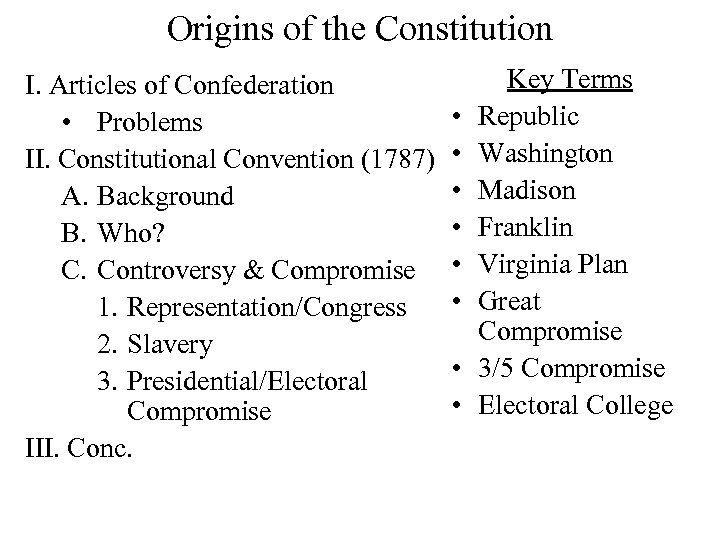 Origins of the Constitution I. Articles of Confederation • Problems II. Constitutional Convention (1787) A. Background B. Who? C. Controversy & Compromise 1. Representation/Congress 2. Slavery 3. Presidential/Electoral Compromise III. Conc. • • Key Terms Republic Washington Madison Franklin Virginia Plan Great Compromise 3/5 Compromise Electoral College
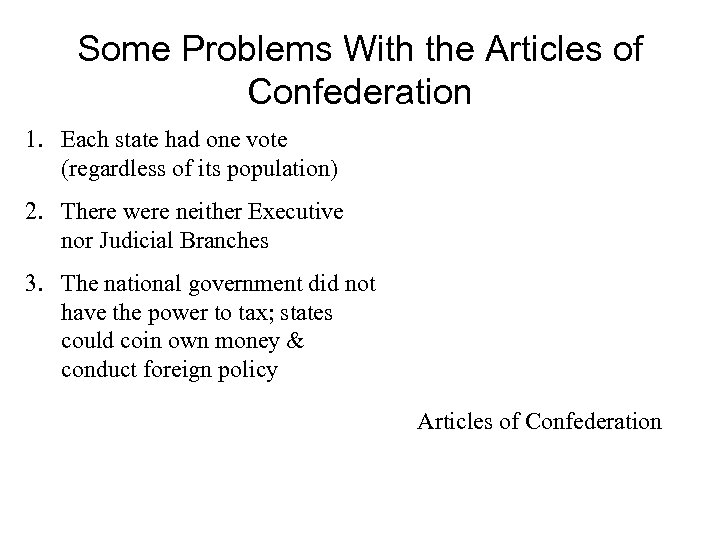 Some Problems With the Articles of Confederation 1. Each state had one vote (regardless of its population) 2. There were neither Executive nor Judicial Branches 3. The national government did not have the power to tax; states could coin own money & conduct foreign policy Articles of Confederation
 Where did they meet…? Philadelphia = Independence Hall
 One Philosophy Prevailed Republic • Eligible citizens elect representatives who make decisions & establish policies for them
 Who was at the Constitutional Convention? George Washington presided over the Convention as its chairman
 Who was at the Constitutional Convention? Ben Franklin James Madison
 Who was NOT at the Constitutional Convention? Thomas Jefferson was the US Ambassador to France
 Which individual had the greatest impact on the Constitution…? James Madison
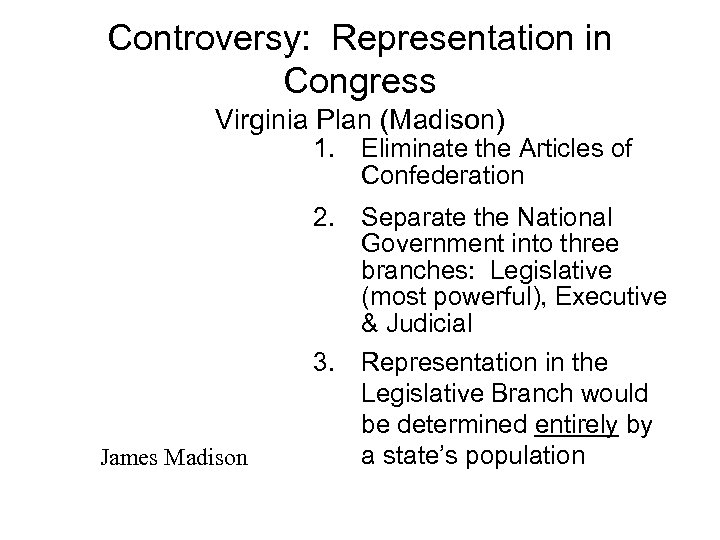 Controversy: Representation in Congress Virginia Plan (Madison) 1. Eliminate the Articles of Confederation James Madison 2. Separate the National Government into three branches: Legislative (most powerful), Executive & Judicial 3. Representation in the Legislative Branch would be determined entirely by a state’s population
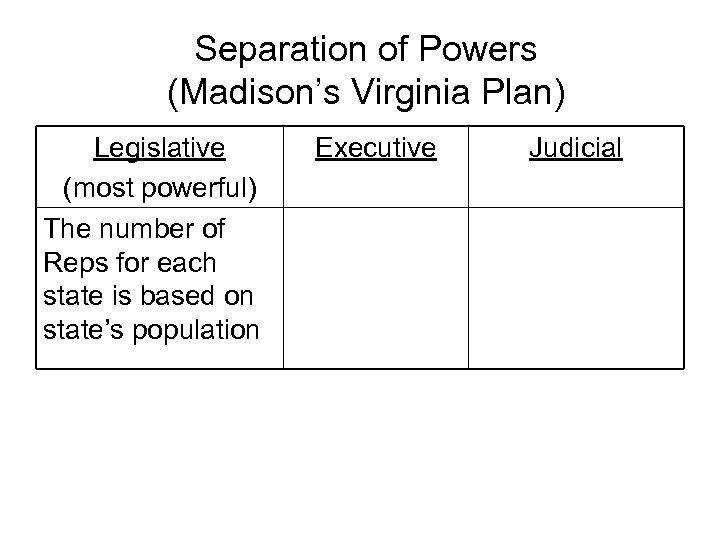 Separation of Powers (Madison’s Virginia Plan) Legislative (most powerful) The number of Reps for each state is based on state’s population Executive Judicial
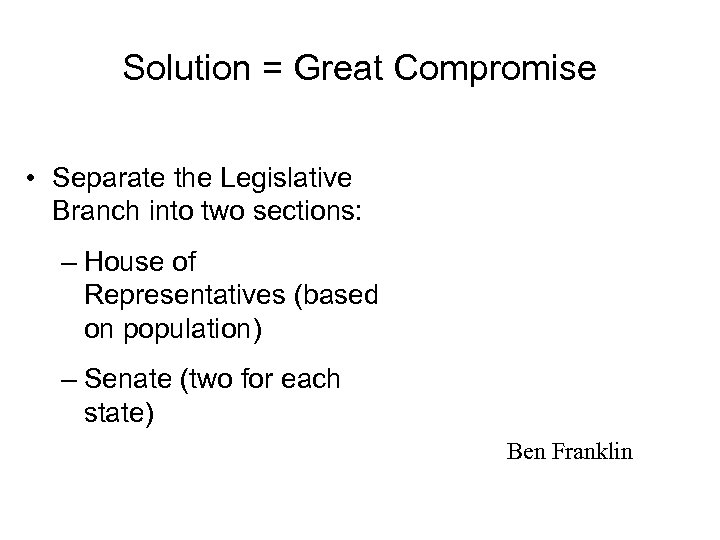 Solution = Great Compromise • Separate the Legislative Branch into two sections: – House of Representatives (based on population) – Senate (two for each state) Ben Franklin
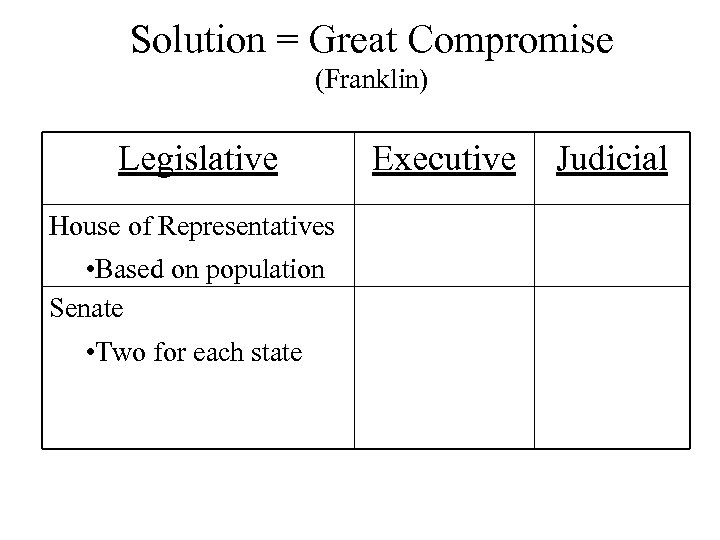 Solution = Great Compromise (Franklin) Legislative House of Representatives • Based on population Senate • Two for each state Executive Judicial
 Controversy: How to Count Slaves? Solution = 3/5 Compromise • One slave is equal to 3/5 of a person when determining a state’s population Torture Mask
 Controversy: Chief Executive Legislative Executive ? ? House of Representatives ? ? ? ? Senate Judicial
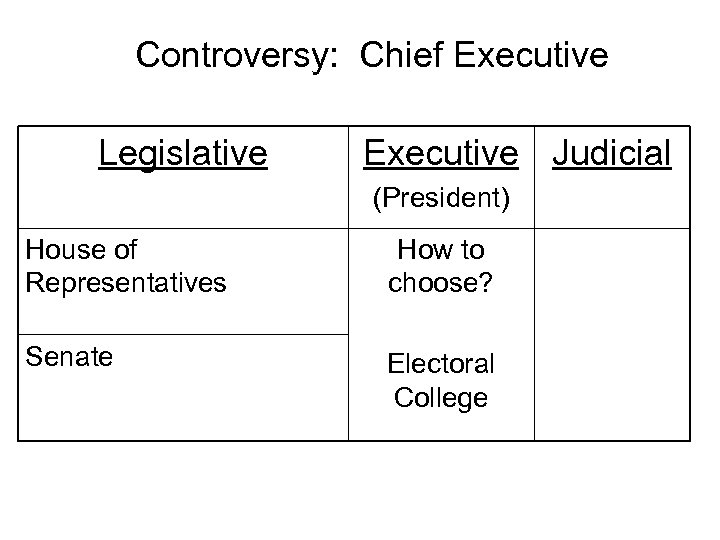 Controversy: Chief Executive Legislative Executive Judicial (President) House of Representatives How to choose? Senate Electoral College
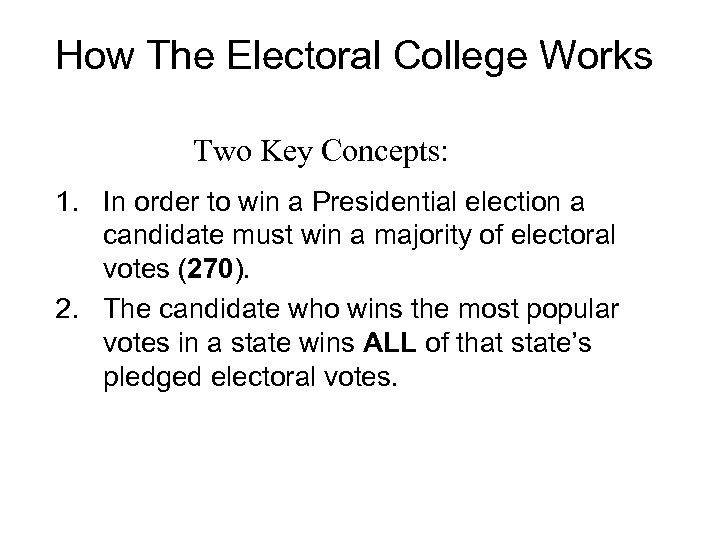 How The Electoral College Works Two Key Concepts: 1. In order to win a Presidential election a candidate must win a majority of electoral votes (270). 2. The candidate who wins the most popular votes in a state wins ALL of that state’s pledged electoral votes.
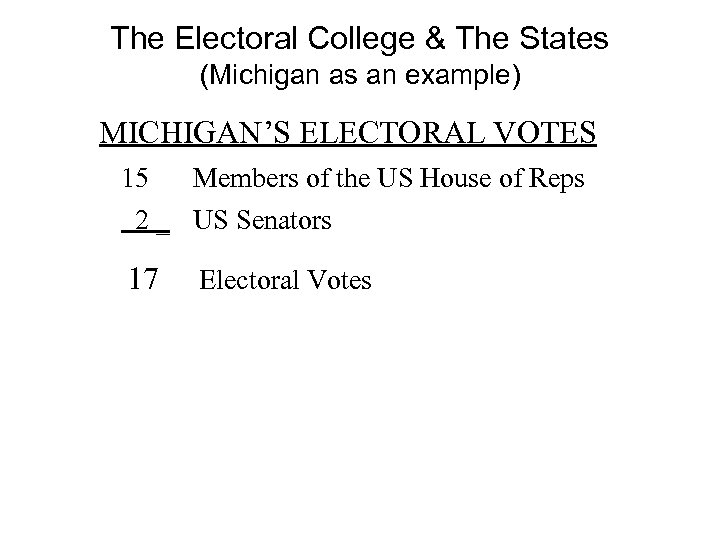 The Electoral College & The States (Michigan as an example) MICHIGAN’S ELECTORAL VOTES 15 Members of the US House of Reps 2 _ US Senators 17 Electoral Votes
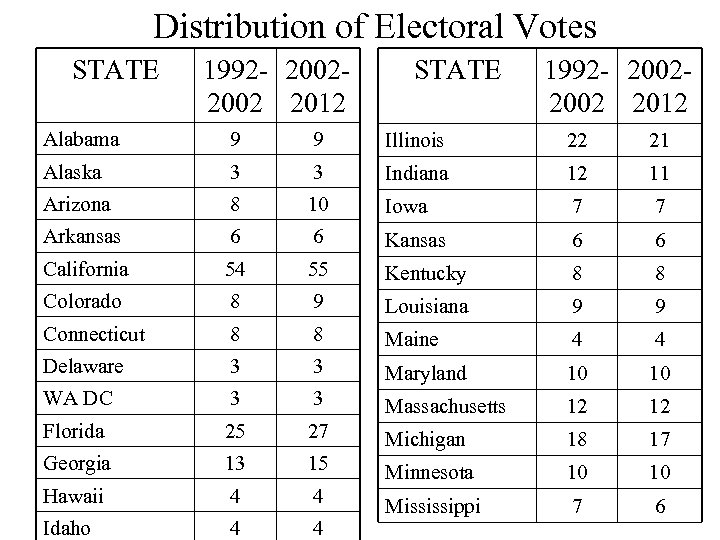 Distribution of Electoral Votes STATE 1992 - 20022002 2012 Alabama 9 9 Illinois 22 21 Alaska 3 3 Indiana 12 11 Arizona 8 10 Iowa 7 7 Arkansas 6 6 Kansas 6 6 California 54 55 Kentucky 8 8 Colorado 8 9 Louisiana 9 9 Connecticut 8 8 Maine 4 4 Delaware 3 3 Maryland 10 10 WA DC 3 3 Massachusetts 12 12 Florida 25 27 Michigan 18 17 Georgia 13 15 Minnesota 10 10 Hawaii 4 4 Idaho 4 4 Mississippi 7 6
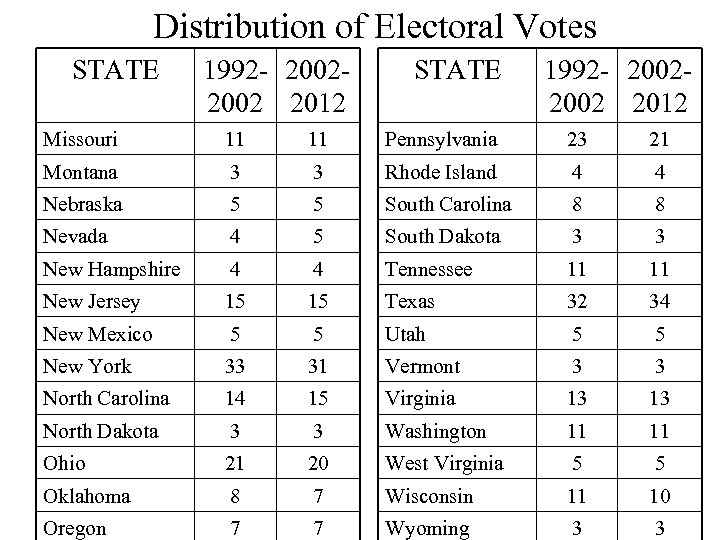 Distribution of Electoral Votes STATE 1992 - 20022002 2012 Missouri 11 11 Pennsylvania 23 21 Montana 3 3 Rhode Island 4 4 Nebraska 5 5 South Carolina 8 8 Nevada 4 5 South Dakota 3 3 New Hampshire 4 4 Tennessee 11 11 New Jersey 15 15 Texas 32 34 New Mexico 5 5 Utah 5 5 New York 33 31 Vermont 3 3 North Carolina 14 15 Virginia 13 13 North Dakota 3 3 Washington 11 11 Ohio 21 20 West Virginia 5 5 Oklahoma 8 7 Wisconsin 11 10 Oregon 7 7 Wyoming 3 3
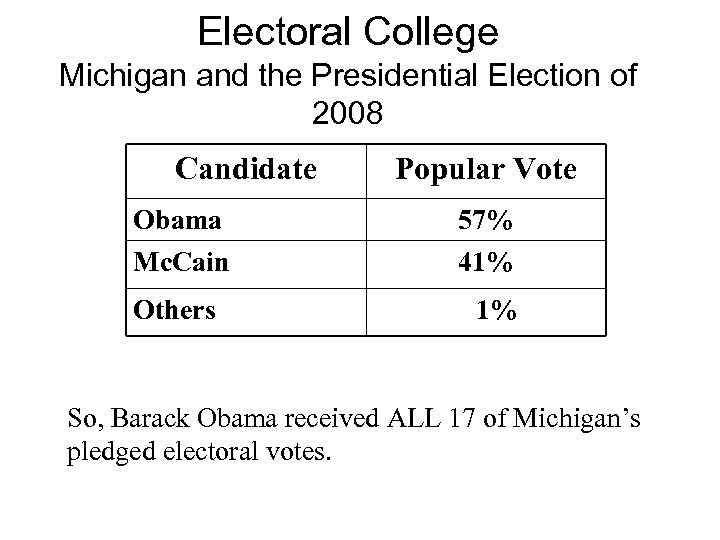 Electoral College Michigan and the Presidential Election of 2008 Candidate Obama Mc. Cain Others Popular Vote 57% 41% 1% So, Barack Obama received ALL 17 of Michigan’s pledged electoral votes.
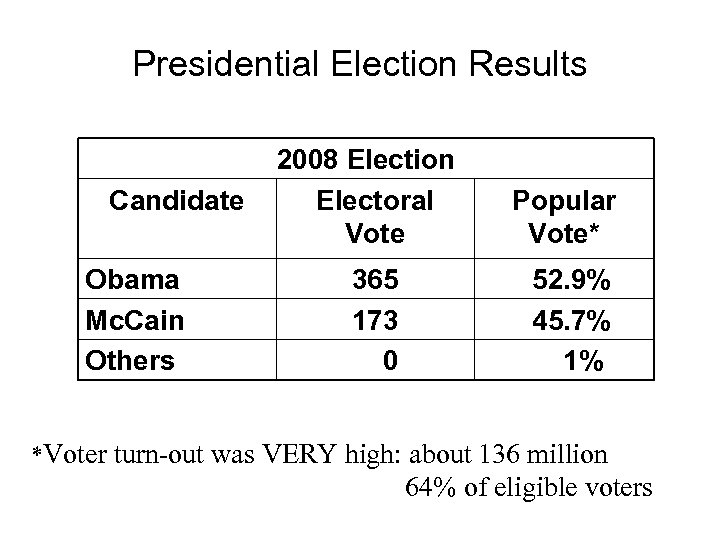 Presidential Election Results Candidate Obama Mc. Cain Others 2008 Election Electoral Vote 365 173 0 Popular Vote* 52. 9% 45. 7% 1% *Voter turn-out was VERY high: about 136 million 64% of eligible voters
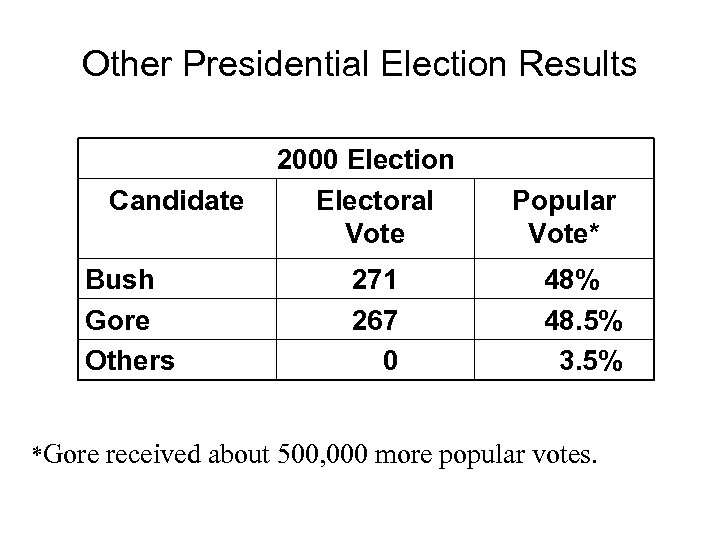 Other Presidential Election Results Candidate Bush Gore Others 2000 Election Electoral Vote 271 267 0 Popular Vote* 48% 48. 5% 3. 5% *Gore received about 500, 000 more popular votes.
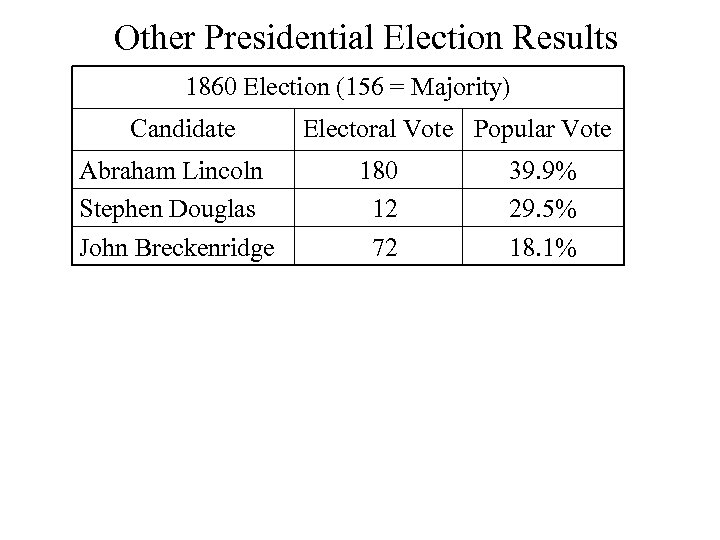 Other Presidential Election Results 1860 Election (156 = Majority) Candidate Abraham Lincoln Stephen Douglas John Breckenridge Electoral Vote Popular Vote 180 12 72 39. 9% 29. 5% 18. 1%
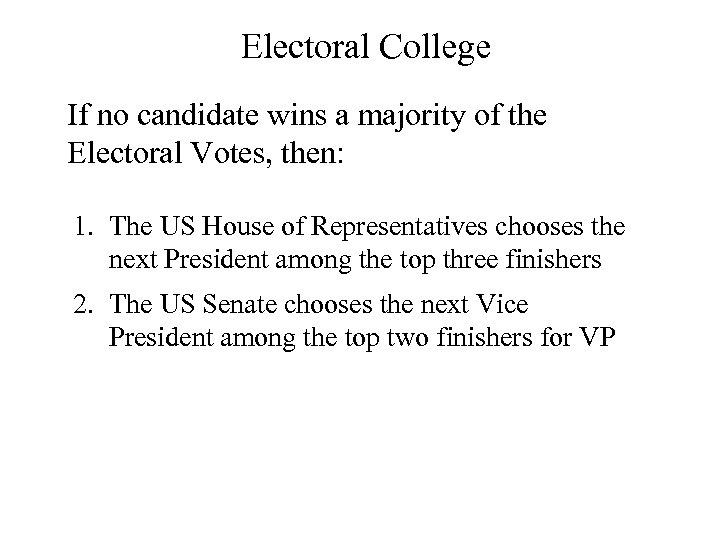 Electoral College If no candidate wins a majority of the Electoral Votes, then: 1. The US House of Representatives chooses the next President among the top three finishers 2. The US Senate chooses the next Vice President among the top two finishers for VP
 Origins of the Constitution I. Articles of Confederation • Problems II. Constitutional Convention (1787) A. Background B. Who? C. Controversy & Compromise 1. Representation/Congress 2. Slavery 3. Presidential/Electoral Compromise III. Conc. • • Key Terms Republic Washington Madison Franklin Virginia Plan Great Compromise 3/5 Compromise Electoral College