


 Скачать презентацию Organizing Cooperative Education What it is How to
d5f1840a180f4d845b04ba4893b805a9.ppt
- Количество слайдов: 100
 Organizing Cooperative Education What it is! How to do it!
 Work-Based Learning in Illinois • Work-based learning – academically and occupationally integrated learning activities and content needed to obtain and maintain employment in an occupational cluster
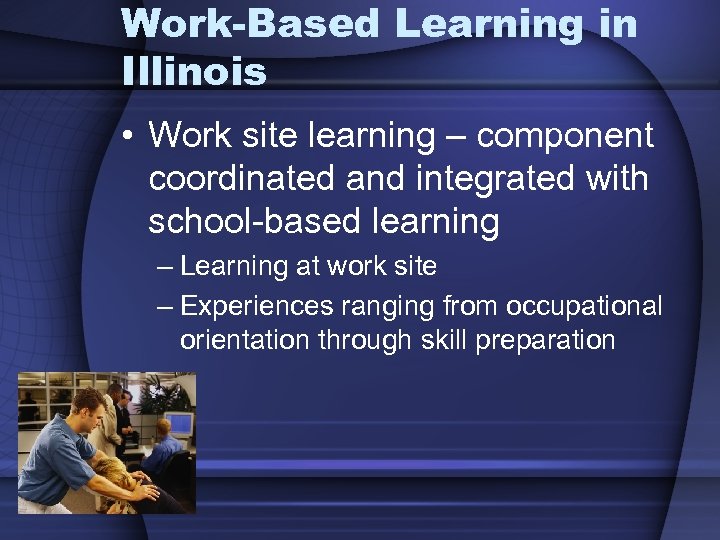 Work-Based Learning in Illinois • Work site learning – component coordinated and integrated with school-based learning – Learning at work site – Experiences ranging from occupational orientation through skill preparation
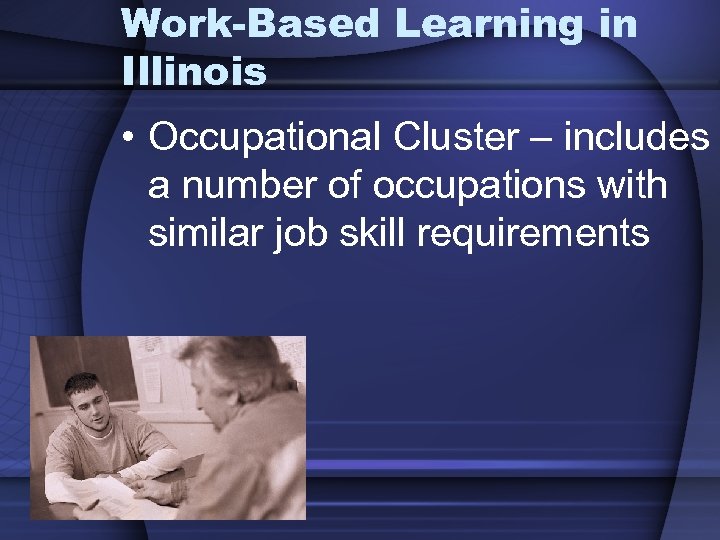 Work-Based Learning in Illinois • Occupational Cluster – includes a number of occupations with similar job skill requirements
 Cooperative Education Definition • Program of occupational education for persons who, through written cooperative agreements between school and employers, receive instruction, including required academic courses and related classroom instruction by alternation of study in school with a job in any occupational field • Experiences planned and supervised by school
 Cooperative Education Definition • Instructional method combining efforts and resources of employment community and LEA for purpose of providing students with learning experiences that lead to development of entry or intermediate level job skills (Illinois Handbook)
 Cooperative Education Characteristics • Prepare students for realities of work • Help them adjust and make transition from school to work • Planned career development program, designed at a minimum to produce entry-level competence
 Cooperative Education Characteristics • Opportunity for employers to assist in training – for themselves and for the occupational world • Method whereby instructors of in-school occupational courses can get feedback from potential employers of trainees
 Cooperative Education Characteristics • Logical approach for pre-employment program designed to break poverty cycle of some youth • Means of providing realistic opportunities to apply and test skills and knowledge learning in school
 Work-Based Career Education Plans • Cooperative Education—Used in agriculture; business, marketing, and management; FCS, health, and technology – – – Agricultural Cooperative Education (ACE) Cooperative Office Occupations (OO) Cooperative Marketing Occupations (MO) Health Occupations (HO) Home Economics and Related Occupations (HERO) – Industrial Cooperative Education (ICE)
 Work-Based Career Education Plans • Work Experience and Career Exploration Program (WECEP)—For 14 - and 15 -year-old at-risk students • Special Education Coop—Allows special education students to acquire marketable skills and knowledge in an occupation
 Work-Based Career Education Plans • Cooperative Work Training - Designed to give students work experience without specific career direction • Interrelated Cooperative Education - All career areas are included in same related class and are coordinated by one coordinator • Apprenticeship - Entry level employment training toward a career in cooperation with a labor union
 Work-Based Career Education Plans • Internships – Work experience required in professional degree programs; for post-secondary programs • Job shadowing – School-sponsored and supervised program in which students are placed with one or more employers for short period of time; secondary and post-secondary students
 Non-cooperative Work Programs • Work Observation – Observes different work for few weeks – Not paid – May or may not be tied to a class • Work Exploration – Briefly try out number of jobs • General Work Experience – No related class and limited school supervision
 Decision Regarding Type of Program • What occupational areas provide greatest opportunity for student employment in region? • What occupations seem to be of greatest interest to students? • What type of cooperative education will best serve agency students?
 Key Characteristics of Cooperative Plans • Refer to handout
 History of Cooperative Education • 1906 - Started at University of Cincinnati in engineering • 1909 - HS cooperative education program started in Fitchburg, Massachusetts, in cooperation with General Electric • 1910 – HS cooperative courses established in Cincinnati public schools
 History of Cooperative Education • 1911 – Experimental HS program established in York, Pennsylvania • 1912 – First retail cooperative training program in Boston HS • 1914 – Cooperative instruction established in Dayton Cooperative High School • 1915 – Programs established in ten New York City schools
 History of Cooperative Education • 1917 - Smith-Hughes Act – Provided $7 million for vocational education in agriculture, trades and industry, home economics, and teacher training • 1929 - George-Reed Act – Authorized an increase of $1 million annually for four years to expand voc ed in agriculture and home economics
 History of Cooperative Education • 1934 - George-Ellzey Act – Replaced previous legislation. – Authorized an appropriation of $3 million annually for three years for agriculture, home economics, and trades and industry • 1936 - George-Deen Act – Authorized, on a continuing basis, an annual appropriation of $14 million for the previous three occupations, but added distributive occupations (marketing)
 History of Cooperative Education • 1946 - George-Barden Act – Authorized larger appropriation ($29 million) for voc ed in agriculture, home economics, trades and industry, and distributive occupations • 1956 - George-Barden Amendments – Added practical nursing – Added fishery occupations
 History of Cooperative Education • 1958 - National Defense Education Act – Funded technical occupations necessary to national defense – Response to Sputnik I • 1962 - Manpower Development Training Act – Eased dislocated workers – Assisted economically disadvantaged
 History of Cooperative Education • 1963 - Vocational Education Act – Maintained, extended, and improved existing programs – Provided instruction so persons of all ages would have access to vocational training. – Added business education • 1968 – Vocational Education Amendments – Mandated programs for disadvantaged and handicapped – Provided consumer homemaking by contract
 History of Cooperative Education • 1973 - Comprehensive Employment Training Act – Replaced Manpower Development Training Act – Transferred decision making from DC to local and state governments • 1976 - Vocational Education Amendments – Extend, improve, and maintain existing programs – Develop new programs – Develop programs to overcome sex discrimination and stereotyping
 History of Cooperative Education • 1982 - Job Training Partnership Act – Establish programs to prepare youth and unskilled adults for entry into labor force – Afford job training to economically disadvantaged facing critical barriers to employment
 History of Cooperative Education • 1984 - Carl D. Perkins Vocational Education Act – Expanded and enlarged existing programs and programmatic opportunities – Economic goal – improve skills of labor force and prepare adults for job opportunities – Social goal – provide equal opportunities for adults in vocational education – Switched from expanding programs to improving programs and addressing at-risk populations
 History of Cooperative Education • 1990 - Carl D. Perkins Vocational and Applied Technology Education Act – Emphasized: • Integration of academic and vocational education • Articulation between segments of education • Closer linkages between school and work • Requires states to develop systems of performance measures and standards
 History of Cooperative Education • 1994 - School-to-Work Opportunities Act – Addressed national skills shortage – Emphasized preparing students with knowledge, skills, abilities and information about occupations and labor market to help make transition from school to employment – Elements included: collaborative partnerships, integrated curriculum, technological advances, adaptable workers, career guidance, work-based learning
 History of Cooperative Education • 1998 - Carl D. Perkins Vocational and Technical Education Act – Encourage career and technical education reform, innovation, and improvement – Tech prep was reauthorized – Strengthen academic, vocational, and technical skills – Provide students with strong experience in and understanding all aspects of an industry – Develop, expand, or improve use of technology – New accountability measures - performance
 History of Cooperative Education • Each year, the appropriation is in jeopardy and career and technical educators fight for their existence.
 Cooperative Education • Time for a question and answer break
 Cooperative Education • Shifting gears!!
 Some Purposes of CE • • Career orientation Work exploration Economic awareness Work adjustment and/or personal life adjustment Skill development Upgrading skills Skill application Job placement
 Advantages of Cooperative Education • For the Student – Provides closer integration of theory and practice – Increases student motivation – Develops responsibility and maturity – Provides closer association with adults – Establishes a base of occupational experience – Develops work skills that can’t be developed in school
 Advantages of Cooperative Education • For the Student (cont. ) – Augments financial resources – Improves job entry and advancement – Decreases number of early school leavers – Enables some students to stay in school – Offers organized plan of training in actual business settings – Eases transition from school to work – Offers career exploration – Provides awareness of civil and social responsibilities
 Advantages of Cooperative Education • For the Employer – Provides source for full-time employees – Benefits from tax dollars expended – Provides direct input into training programs – Could reduce employee turnover – Reduces costs of training – Improves image and prestige – Increases student buying power, thus sales base
 Advantages of Cooperative Education • For Labor – Enables labor to help guide program with representation on advisory committee – Helps assure labor market isn’t flooded – Offers pre-apprenticeship training – Opens opportunities for part-time and evening classes for apprentices and journey people
 Advantages of Cooperative Education • For the School – Increases working relationships with business community – Adds relevance to the on-going program – Provides facilities and equipment not in LEA – Improves placement of program completers – Helps to ensure program validity with regard to labor market demand – Develops partnerships between community and LEA – Expands the curriculum
 Advantages of Cooperative Education • For the Community – May keep graduates in home community – Involves community in meeting own training needs – Reduces community problems by reducing dropout rates – Produces more responsible citizens – Improves economic climate by increasing student buying power – Improves school-community relationships
 The Teacher-Coordinator • Effective teacher-coordinators – Are self-starters who plan their work – Organize time and manage resources to achieve objectives identified in planning process – Bring about action to achieve those objectives – Evaluate to determine if objectives are being achieved – Manage several diverse functions simultaneously
 The Teacher-Coordinator • Responsible for: – Planning, – Developing, – Implementing, – Operating, – Evaluating, and – Adjusting cooperative education plans – AND
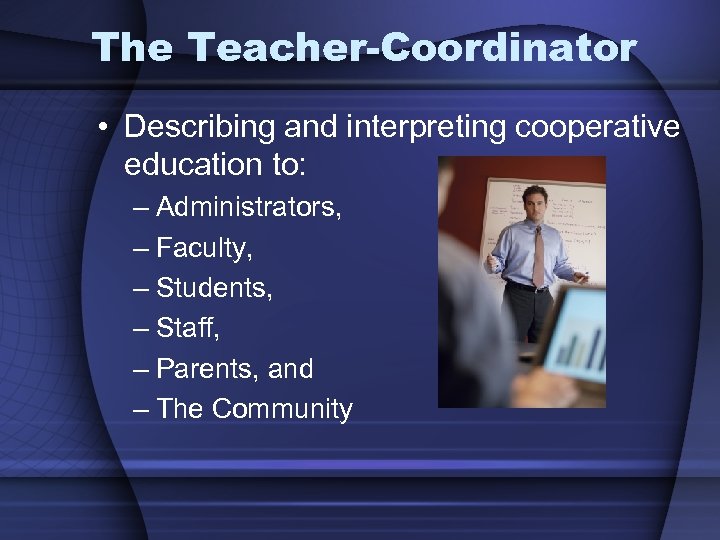 The Teacher-Coordinator • Describing and interpreting cooperative education to: – Administrators, – Faculty, – Students, – Staff, – Parents, and – The Community
 The Teacher-Coordinator • Administrative Duties – Conduct annual follow-up surveys of students – Conduct community surveys – Complete forms and reports – Organize and participate on advisory committees
 The Teacher-Coordinator • Coordination Activities – Locate training stations – Evaluate prospective training stations – Student placement – Visit training stations – Develop training plans – Assess student performance – Keep log of coordination activities – Prepare students for employment interviews
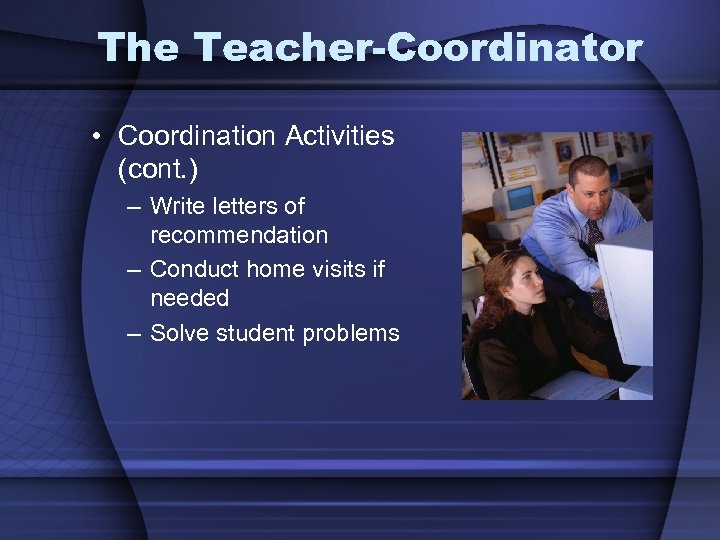 The Teacher-Coordinator • Coordination Activities (cont. ) – Write letters of recommendation – Conduct home visits if needed – Solve student problems
 The Teacher-Coordinator • Public Relations Activities – Inform civic and business groups about program – Implement a training sponsor program – Inform students about program – Develop and disseminate promotional materials – Prepare news releases – Conduct employer-employee activity – Complete annual reports on students
 Teacher-Coordinator Qualifications • Valid teaching certificate – 24 hours in area of specialization including a methods course • 2, 000 hours work experience in related occupation • Licensure, if required by law • Six semester hours of CE coursework
 Starting a New Program
 New Program Activities • Initial Planning – Timeline for planning will be about one year • Secure administrative approval • Determine needs and interest in program – Appoint steering committee – Ascertain student interest – Evaluate employer need, interest, and support – Identify employment trends • Review existing programs • Make a decision
 Planning a CE Program • Step I - Secure administrative approval to investigate need • Step II - Appoint steering/advisory committee • Step III - Determine needs and wants of students • Step IV - Determine employer needs, interests, and support • Step V - Determine labor market demands and trends • Step VI – Consider current programs in the region
 Step II: Advisory Committees • Types of Advisory Committees – General Advisory Committee • Concerned with total program – Craft Committee • Represents skill area – Task Committee • Appointed for specific purpose and for limited time period
 Purposes of Advisory Committees • Recommend advise • Help improve public relations • Help determine community needs • Assist coordinator in community • Explain program to public • Help evaluate program
 How to Kill an Advisory Committee • Choose members who have no real interest in program • Do not prepare members for their role • Let one or two people talk the meeting to death • Fail to ask them for advice and help • Fail to prepare an agenda • Fail to thank them for their work
 Advantages of an Advisory Committee • Link between school and community • Brings prestige to work education • Provides opportunity to determine real training needs of community • Keep your program up-to-date • Give support and advice
 Appointments to Advisory Committee • Should be made by administration (however, you will recommend members) • Members will come from: (you name them) – – – – Local Chamber Professional organizations Civic clubs Labor organizations Faculty Students or former students Community, business, or industry
 Activities of an Advisory Committee • Help locate training stations • Develop employment opportunities • Set criteria for student selection • Recommend instructional materials
 Activities of Advisory Committee • Set local training standards • Help relate instruction to community needs • Assist with training plans and agreements • Publicize program • Set evaluation criteria
 Policies for Advisory Committee • Profile of school and student body • Philosophy regarding Career and Technical Education • School policy regarding advisory committees • Outline of purpose and function of different types of advisory committees • Duties of advisory committee
 Policies for Advisory Committee • • Criteria and selection method for members Number and term of members Channels of communication Duties of chairperson Duties of school representatives Number of meetings (usually three) Handling of committee minutes
 Number of Members • Not more than 12, including ex-officio school members • Small committees typically meet more often and accomplish more work • Some members may serve on general and occupational advisory committees
 Duties of Members • Chairperson - Should be a community member who will work closely with coordinator to plan and who will conduct effective meetings • Vice-Chairperson - Should work closely with chair so that he/she can take over in absence of chair
 Duties of Members • Secretary - Usually furnished by school and is not a member of committee – Takes minutes and works with coordinator to disseminate minutes – Performs other duties to assist chair, vice chair, and coordinator
 Advisory Committee Meetings • Schedule meetings well in advance • Mail agenda at least two weeks before meeting—give details of meeting location, time, and other important information • Check meeting room and arrangements • Secure equipment and supplies needed • Prepare name cards or name tags
 Advisory Committee Meetings • Preparing an agenda – Make an agenda for the first advisory committee meeting that you will have to determine if a cooperative education program would be beneficial for LEA
 Advisory Committee Meetings • Preparing an agenda – Make an agenda for the second advisory committee meeting that you will have to follow up the first
 Regular Advisory Meetings • Prepare an agenda for a regular advisory committee meeting—this would be like one used after the program is up and running
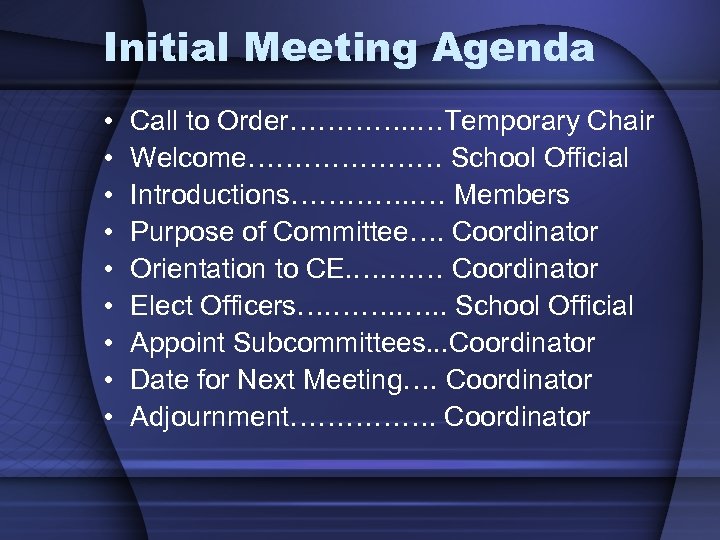 Initial Meeting Agenda • • • Call to Order…………. . …Temporary Chair Welcome………………… School Official Introductions…………. . … Members Purpose of Committee…. Coordinator Orientation to CE. …. …… Coordinator Elect Officers…. ……. . School Official Appoint Subcommittees. . . Coordinator Date for Next Meeting…. Coordinator Adjournment……………. Coordinator
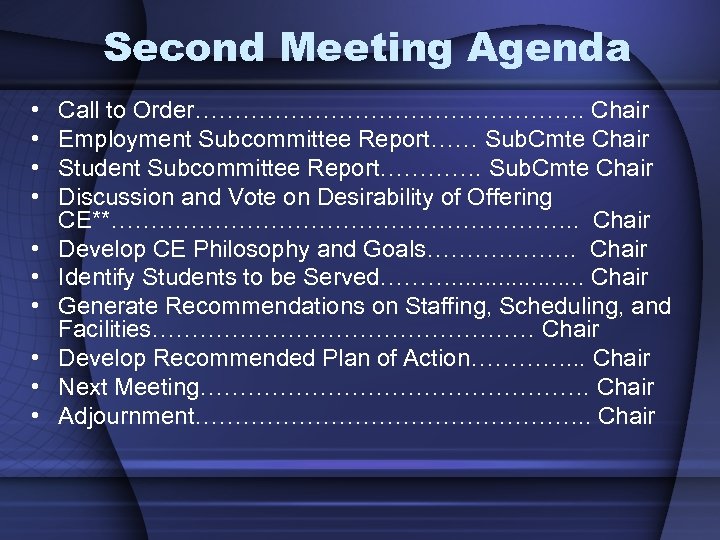 Second Meeting Agenda • • • Call to Order……………………. Chair Employment Subcommittee Report…… Sub. Cmte Chair Student Subcommittee Report…………. Sub. Cmte Chair Discussion and Vote on Desirability of Offering CE**…………………………. . Chair Develop CE Philosophy and Goals………………. Chair Identify Students to be Served………. . . . . Chair Generate Recommendations on Staffing, Scheduling, and Facilities…………………… Chair Develop Recommended Plan of Action…………. . . Chair Next Meeting……………………. Chair Adjournment……………………. . Chair
 Regular Meeting Agenda • • • Call to Order ………………… Chair Progress Report……………. . Coordinator Committee Reports ………… Chairs Next Meeting Dates ………. . Chair Assignment of Tasks ……. . Chair Adjournment ………………… Chair
 Problems Suited to Committee Action • How to proceed when an objective has been determined and the course of action must be decided • Areas of technical assistance where solutions are being sought • Areas where members have a professional or economic interest • Assignments which result in concrete results – public relations or evaluation
 Tips on Creating Activities • Give the group something to do • Recognize large committees do not function well • Don’t belittle ideas of business representatives • Have selected cooperative students meet with committee
 Activities for Committee • Speakers - Prepare list of resource people • Expansion – Suggest and arrange contacts for business people in which good training stations may be developed • Equipment & Instructional Materials – Locate new and unused equipment. Can also arrange to collect instructional materials from businesspeople – handbooks, manuals, trade journals, etc.
 Making the Committee Function • What are some suggestions that you might have to make your advisory committee an effective and functioning body?
 Changing Gears Again!!!
 Step III: Conducting a Student Needs Assessment
 Student Needs • Former Students (graduates and dropouts) – Occupations held – Periods of unemployment – Income level – Education/training attained after high school – Would they have participated in CE?
 Student Needs • Current Students – Career plans – Education plans – Occupational goals – Financial needs – Jobs currently held – Do current programs meet students’ needs?
 Student Needs • Future Students – What are they interested in studying? – What are their career goals? – What are their financial needs? – What are their favorite subjects? – How many are interested in work? – Where would they like to work? – How do parents/guardians feel about work education?
 Develop a Student Interest Survey (Sample on Web Site)
 Steps IV and V: Conducting a Community Survey • Community surveys are used to determine need and support in local community • A good survey instrument is: – No more than a couple of pages – Doesn’t take too long to complete – Logical and easily understood
 Basic Items on a Community Survey • Employment status of business: – Number of workers – Demographics of workers – Annual replacements – Recruitment sources – Employment needs in next five years
 Basic Items on a Community Survey • Employment opportunities in area – Number of employees currently needed – Number of employees needed in next five years – Wage and hour information – Union restrictions – Skills and requirements – Advancement opportunities
 Basic Items on a Community Survey • Placement opportunities for coop students – On-the-job training opportunities – Trainee requirements
 Develop a Community Survey (Sample on Web Site)

 Labor Market Demands & Trends • Secondary Sources – Illinois Occupational Information Coordinating Committee – Dept. of Commerce and Community Affairs – Dept. of Employment Security – Illinois Job Service – Illinois State Board of Education – Labor Unions – Chamber of Commerce
 Step VI: Consider Current Programs • Will the proposed program supplement, complement, or compete with other programs already offered in region? – Research should have determined need – Keep in mind decision should be based on student need and community resources
 Group Activity • Issues That May Arise
 Long Range Planning/Policy Setting • Gather background data from experts – State Board of Education – Consultants – National organizations – Research centers
 Long Range Planning/Policy Setting • Gather local information – Employment trends (more than just interest surveys) – State and local job service information – Job analysis surveys
 Long Range Planning/Policy Setting • Develop program goals/objectives – What the expectations are for the program – Utilize the data gathered previously
 Long Range Planning/Policy Setting • Identify resources – Sources of revenue and amounts – Sources of people power – Determine facilities available – Identify equipment needs
 Long Range Planning/Policy Setting • Develop a systematic plan – How do we get to where we want to go? – What activities are needed? – What policies need to be established? – How do we evaluate progress? – How do we change plans? – What are our deadlines?
 Long Range Planning/Policy Setting • Make assumptions about program – Enrollments – Community needs – Changing technology – Occupational growth – Special populations – Funding – Personnel
 Long Range Planning/Policy Setting • Plan time lines – Determine start and finish times for activities – Plot time lines on a chart • • 12 month chart Gantt chart Flow chart Activity chart
 Long Range Planning/Policy Setting • Resource planning chart – Used to plan for resources needed to operate program • Activities and procedures – Activities and action steps to accomplish objectives
 Program Planning Time-Line • An example of a program planning time-line can be found on the Web site. It is the timeline printed in the Illinois Handbook.
 Policy Statements • Policies guiding operation of program could include following types: – What to do if a student misses school but goes to work – Minimum and maximum number of hours to work (10 and 20) – Granting of credit – Consent to change jobs – What to do if a student is fired
 Policy Statements – Work requirements on holidays and when school is not in session – Reports to be filed by the teacher/coordinator – Travel reimbursement – Advisory committees – Assignment of grades – Training station visits – at least once a month – Coordinator contracts - extended – Required records of activities by T/C
 End of Power Point One