 Скачать презентацию Organized on behalf of President Chairman of
1caeb86f0a084f76df574d37db04c895.ppt
- Количество слайдов: 40



Organized on behalf of President & Chairman of the Board of the Saudi Commission for Tourism and Antiquities (SCTA), HRH Prince Sultan bin Salman Al Saud, By the Saudi Commission for Tourism and Antiquities Successful International & Regional Experiences in the Field of Statistics and Tourism Satellite Account (TSA) The TSA Significance and How to Use it in Measuring Tourism Development’s Economic and Social Impacts First Tourism Statistics Forum 09: 00 -09: 45 16 th, March 2015 Riyadh, Kingdom of Saudi Arabia Tadayuki (Tad) Hara Associate Dean of Finance and Administration, Rosen College of Hospitality Management, University of Central Florida, UNWTO Consultant, Special Advisor, UNWTO-Asia Pacific Regional Support Office,
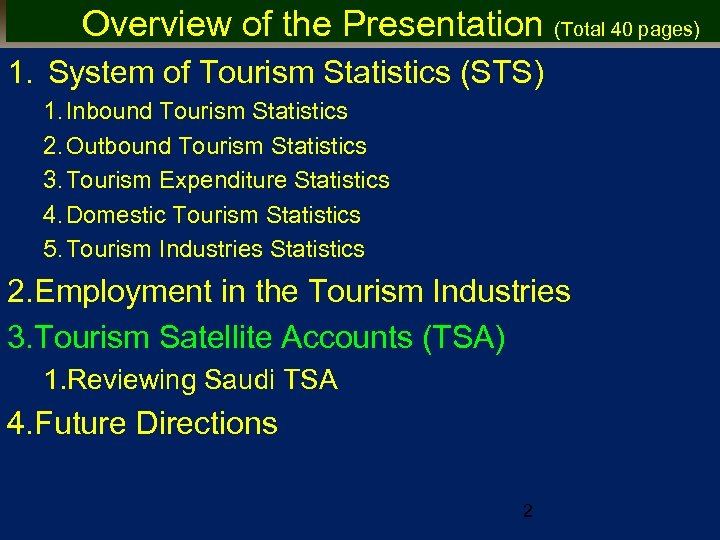
Overview of the Presentation (Total 40 pages) 1. System of Tourism Statistics (STS) 1. Inbound Tourism Statistics 2. Outbound Tourism Statistics 3. Tourism Expenditure Statistics 4. Domestic Tourism Statistics 5. Tourism Industries Statistics 2. Employment in the Tourism Industries 3. Tourism Satellite Accounts (TSA) 1. Reviewing Saudi TSA 4. Future Directions 2
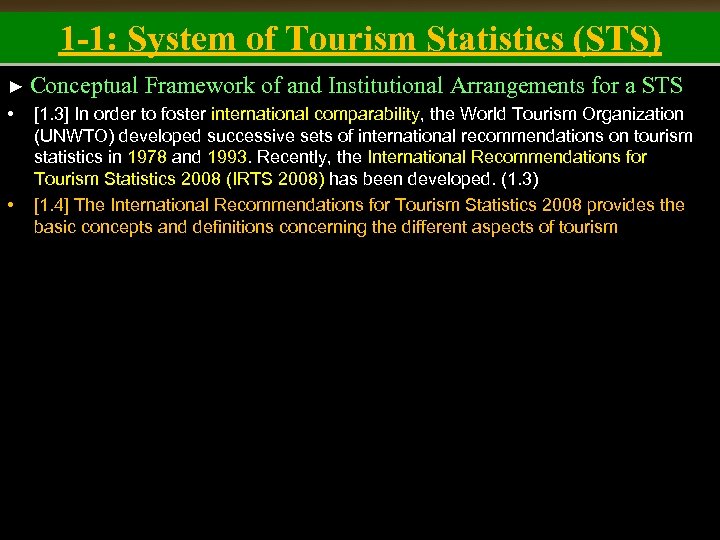
1 -1: System of Tourism Statistics (STS) ► Conceptual • • Framework of and Institutional Arrangements for a STS [1. 3] In order to foster international comparability, the World Tourism Organization (UNWTO) developed successive sets of international recommendations on tourism statistics in 1978 and 1993. Recently, the International Recommendations for Tourism Statistics 2008 (IRTS 2008) has been developed. (1. 3) [1. 4] The International Recommendations for Tourism Statistics 2008 provides the basic concepts and definitions concerning the different aspects of tourism 3
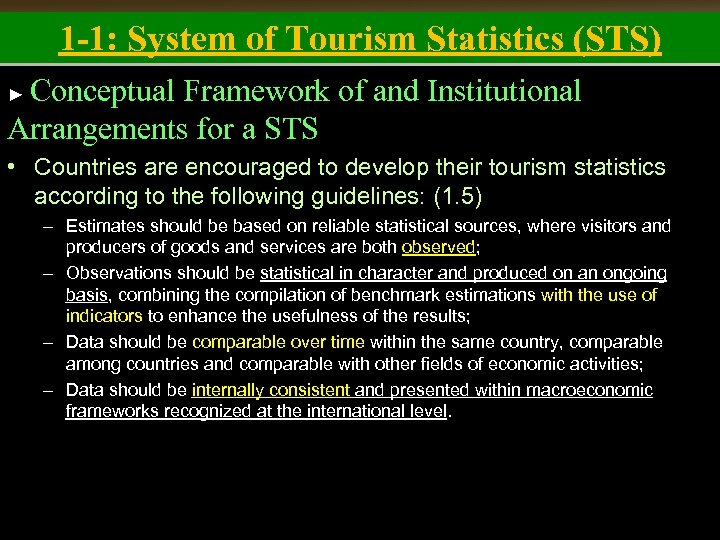
1 -1: System of Tourism Statistics (STS) Conceptual Framework of and Institutional Arrangements for a STS ► • Countries are encouraged to develop their tourism statistics according to the following guidelines: (1. 5) – Estimates should be based on reliable statistical sources, where visitors and producers of goods and services are both observed; – Observations should be statistical in character and produced on an ongoing basis, combining the compilation of benchmark estimations with the use of indicators to enhance the usefulness of the results; – Data should be comparable over time within the same country, comparable among countries and comparable with other fields of economic activities; – Data should be internally consistent and presented within macroeconomic frameworks recognized at the international level. 4
1 -1: System of Tourism Statistics (STS) ► Overviews of IRTS 2008 and UNWTO Compilation Guide of Tourism Statistics • The International Recommendations for Tourism Statistics 2008 Compilation Guide (adopted by UN Statistical Commission in its 45 th session, 4 -7 March 2014) is a companion document to the International Recommendations for Tourism Statistics (IRTS 2008). • The Compilation Guide is structured similarly to the IRTS 2008 and provides extensive explanations and country examples of typical compilation issues 5
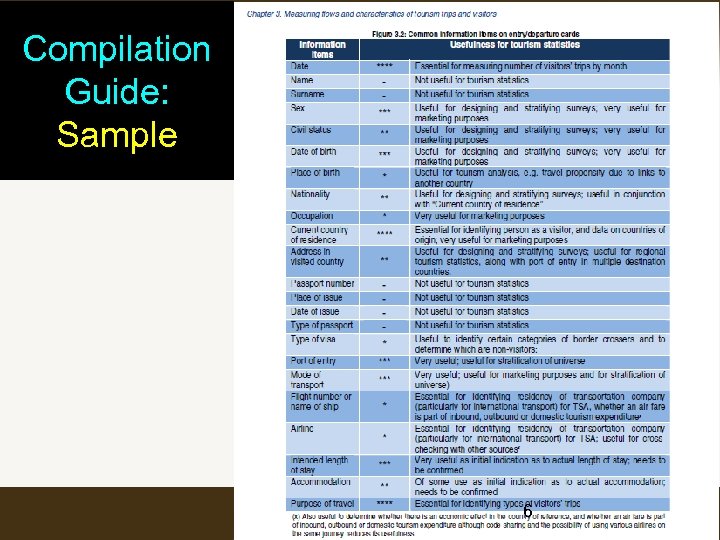
Compilation Guide: Sample 6
1 -1: System of Tourism Statistics (STS) ► Documenting National Systems of Tourism Statistics • The recommendations set out in IRTS 2008 for national STSs will facilitate international comparisons as well as integration within each country’s System of Tourism Statistics • In the meantime, some countries have to rely on approximate data, where it is the only tourism-related data available. Such data might include: • Balance of Payments data (from the travel and passenger transport items); • Inbound visitors from immigration authorities based on nationality (even though, for tourism purposes, information should be based on country of residence); • Data from hotel associations; • Data from transport companies; and • Data from commercial accommodation establishments. 7
1 -1: System of Tourism Statistics (STS) Importance of institutional arrangements in developing a System of Tourism Statistics (STS) • The proper environment for the development of a STS should be a proactive and synergetic Inter-Institutional Platform involving various categories of institutions: – Bodies that produce statistics and basic tourism information: • National Statistical Office (NSO) – as producers of basic statistics and compilers of National Accounts • National Tourism Administration (NTA) – as the entity responsible for public policy in tourism and for the coordination of public and private stakeholders • Central Bank (CB) - as they often compile the Balance of Payments • Immigration and Border protection authorities – as responsible for border procedures • associations of national tourism enterprises – as they are often providers of information as well as key users of tourism statistics 8
1 -2 Inbound Tourism Statistics ► Inbound Tourism Statistics and International Practices in Organizing and Conducting Border Surveys The measurement of inbound tourism has its peculiar challenges. – While some data relating to the visitor can be collected on arrival in the country, very little data can be collected on the visit, as this has not yet taken place. – Similarly, it is not satisfactory to collect the data during the visitor’s trip as this is not yet completed. This leads to the solution of collecting the data when the visitor is departing the country. 9
1 -2 Inbound Tourism Statistics ► Inbound Tourism Statistics and International Practices in Organizing and Conducting Border Surveys C. 1. 2. Complexity in the measurement of flows • Countries belonging to a zone within which controls for all movements have been abolished • Countries with special land border zones though with border controls usually in place in other non-land borders (air): • Movements of persons by land between two non-contiguous parts of the national territory: – Oman, the Russian Federation (Kaliningrad), Malaysia, the United States (Alaska), etc. 10
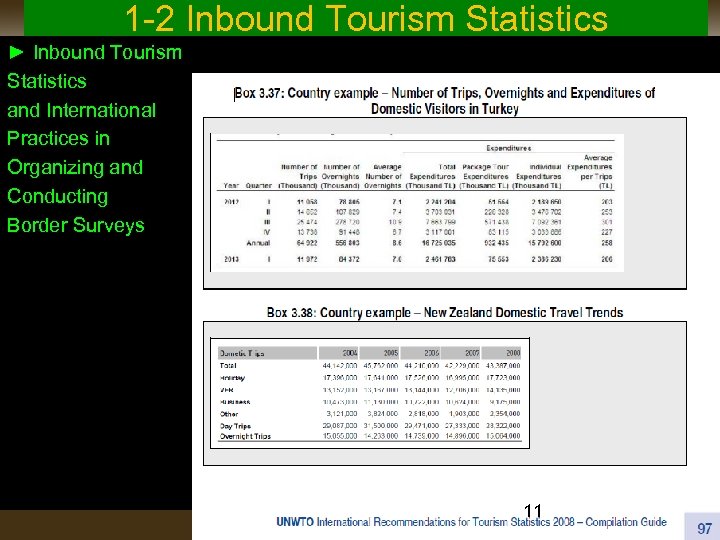
1 -2 Inbound Tourism Statistics ► Inbound Tourism Statistics and International Practices in Organizing and Conducting Border Surveys 11
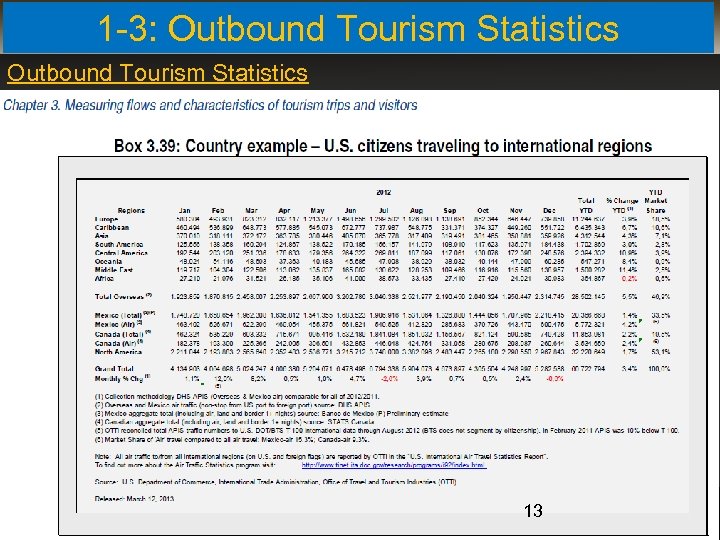
1 -3: Outbound Tourism Statistics • Outbound Tourism can be observed in two ways, by taking the same approach as for either inbound tourism (that is, at or near the border, see paragraph 3. 10), or domestic tourism (once the trip is concluded, using a household survey. In the first case, adjustments might be required, since the object of observation, an outbound visit, might be part of either an outbound or a domestic trip. (3. 141 IRTS CG) • If appropriate and feasible, countries could conduct observation procedures for outbound tourism both at the border and through household surveys, simultaneously, with the aim of comparing the results obtained in each case. 12
1 -3: Outbound Tourism Statistics 13
1 -4: Tourism Expenditure Statistics • Tourism statistics are especially useful for understanding the economic implications of visitors’ activities. Such measurements allow tourism analysis to be linked with other economic analysis, permitting the integration of tourism policy within a country’s general macroeconomic policy framework. (IRTS 4. 1) 14
1 -4: Tourism Expenditure Statistics • A growing number of countries have developed surveys to measure inbound tourism expenditure. The use of such instruments to also measure the “travel” item in the Balance of Payments has created increasing pressures for the alignment of tourism statistics with the Balance of Payments and International Investment Position Manual, Sixth Edition (BPM 6) and the Manual on Statistics of International Trade in Services (MSITS 2010). • In National Accounts, transactions of goods or services are to be recorded upon the transfer of ownership from seller to buyer in the case of goods, or upon service delivery by seller to buyer in the case of services – and not necessarily at the time of payment, which can occur beforehand (for instance, when a travel ticket is purchased in advance) or afterwards (when paying by credit card). For this reason, the terms “acquisition” and “payment” should not be used interchangeably: 15
1 -4: Tourism Expenditure Statistics ► Inbound and Outbound Tourism Expenditure Statistics • In general, visitors themselves can often easily identify where their expenditures were made and the country of residence of the sellers or providers. (4. 24. ) • For a few fields of expenditure, however, such determinations are less straightforward, and in particular for the following three – Transportation between origin and destination (mainly air, but also rail and water), – Package tours, and – Reservation services, imbedded in the purchase of some services. 16
1 -4: Tourism Expenditure Statistics ► Inbound and Outbound Tourism Expenditure Statistics • Classification of tourism expenditure – The IRTS 2008 thus recommends using a classification that allows visitors to group their expenditure according to purpose: the Classification of Individual Consumption by Purpose (COICOP). This classification is commonly used for the description of personal consumption in general statistics and household surveys, and has the primary advantage that it can be linked to the CPC (which, in turn, enables links to supply-side classifications). – The categories that are most commonly used and recommended in IRTS 2008 are: (4. 49) • • i. Package travel, package holidays and package tours ii. Accommodation iii. Food and drink iv. Local transport v. International transport vi. Recreation, culture and sporting activities vii. Shopping viii. Others 17
![1 -4: Tourism Expenditure Statistics ► Inbound and Outbound Tourism Expenditure Statistics [Advanced Topic]](https://present5.com/presentation/1caeb86f0a084f76df574d37db04c895/image-18.jpg "1 -4: Tourism Expenditure Statistics ► Inbound and Outbound Tourism Expenditure Statistics [Advanced Topic]")
1 -4: Tourism Expenditure Statistics ► Inbound and Outbound Tourism Expenditure Statistics [Advanced Topic] • Tourism expenditure classified in the National Accounts as intermediate consumption – SNA 2008 all purchases of goods and services by employees on business trips = should be classified as intermediate consumption – IRTS 2008 making no distinction between the macroeconomic concepts of “intermediate consumption” and “final consumption”, as long as the direct beneficiary of the expenditure is the visitor (IRTS 2008, 4. 5. ) • Regarding inbound and outbound tourism expenditure, and because some countries still do not compile tourism data, UNWTO uses data from the Balance of Payments rather than tourism data to support as much as possible international comparisons. However useful in this sense, Balance of Payments data should not be used in the overall tabulation of tourism statistics and should not be considered a substitute for tourism statistics. 18
1 -5: Domestic Tourism Statistics • Since the aim of this Compilation Guide is to help countries implement IRTS 2008 and develop a national STS, the data to be obtained should be classified with reference to the standard frameworks to serve national purposes but also ensure international comparability. • For the purposes of international comparability, UNWTO annually requests from member and non-member countries, and then disseminates in the Compendium of Tourism Statistics, the data set and indicators for domestic tourism. 19
1 -6: Tourism Industries Statistics (IRTS 2008) A. Introduction B. Accommodation Service Providers C. Providers of Food and Beverage Services D. Providers of Transportation Services E. Travel and Reservation Agencies F. Other Non-Tourism Industries F 1 Production and Trade of Handicrafts F 2 The Meetings Industry 20
1 -6: Tourism Industries Statistics (IRTS 2008) • Tourism is defined as an economic activity that is determined principally by demand (IRTS 2008, 1. 12. ). In describing and measuring tourism, however, supply (economic activity in response to demand) must also be considered, since without it, the economic effect of tourism could not be stated or described. Indeed, one of the major contributions of the IRTS 2008 is the fact that it describes tourism not only from the demand side (i. e. visitors) but also from the supply side (i. e. the industries that cater to visitors), thereby acknowledging tourism as an economic sector. (IRTS 6. 1) • Additionally, to properly integrate the analysis of tourism into that of the total economy, it must be ensured that what is measured on the supply side is consistent with what is measured on the demand side. – Such consistency enables comparison of data over time, as well as comparison with other countries’ data. 21
Session 6 16: 15 -18: 00 Session 6: Tourism Industries Statistics ► Measuring the Supply of Tourism Industries Presenter: UNWTO • Tourism statisticians should be aware of an issue that bears on the credibility of the tourism industries’ basic data and indicators (see “Tables of results”, paragraphs 6. 21 to 6. 23) and that National Tourism Administrations (NTAs), National Statistical Offices (NSOs) and other government agencies that publish tourism data should warn users about: only part of the output of each tourism industry is attributable to visitors’ consumption. This issue is explicitly identified and treated in the TSA by the use of “tourism shares” (or “tourism ratios”) within their total output (TSA: RMF 2008, 4. 50. and 4. 55. ). 22
1 -6: Tourism Industries Statistics (IRTS 2008) • Information on industries, their output, inputs, and employment is gathered mainly through surveys, which NSOs usually conduct on a yearly basis, covering all economic activities. The economic data thus collected is usually required for calculating the country’s National Accounts, for example calculating Gross Domestic Product, Gross Value Added, etc. (6. 12) • These surveys are currently well established and have a standardized format, based on the International Standard Industrial Classification of All Economic Activities (ISIC) categories (agriculture, mining, manufacture, etc. ). (6. 13) 23
2: Employment in the Tourism Industries ► Measuring Employment in the Tourism Industries Information on employment is very important in analysing any industry, but due to the increasing importance of tourism it is of particular interest in the case of tourism. • However, it should be recognized that the world of work in tourism is generally not well-known because reliable data on employment in the tourism industries are generally either not properly identified separately or are insufficiently compiled. For this reason, only a limited number of countries produce meaningful statistics on employment in the tourism industries. (7. 2) • IRTS 2008, Chapter 7 describes concepts, definitions, basic categories and indicators of employment in the tourism industries from a labour and industry statistics perspective rather than a national accounting perspective. 24
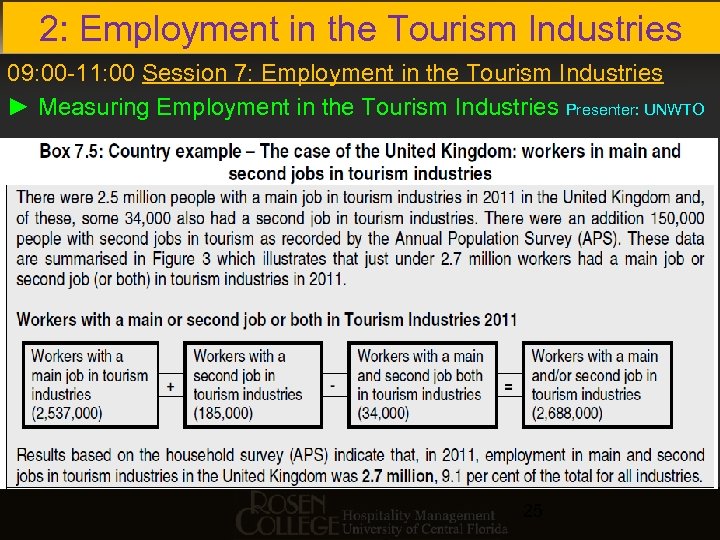
2: Employment in the Tourism Industries 09: 00 -11: 00 Session 7: Employment in the Tourism Industries ► Measuring Employment in the Tourism Industries Presenter: UNWTO 25
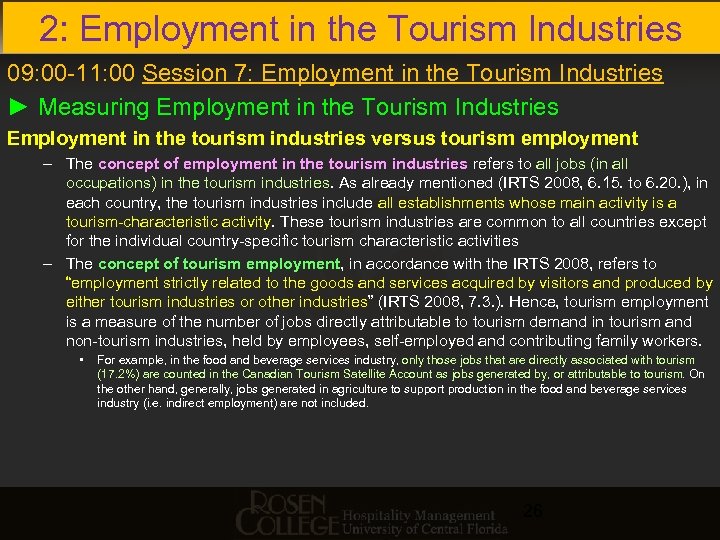
2: Employment in the Tourism Industries 09: 00 -11: 00 Session 7: Employment in the Tourism Industries ► Measuring Employment in the Tourism Industries Employment in the tourism industries versus tourism employment – The concept of employment in the tourism industries refers to all jobs (in all occupations) in the tourism industries. As already mentioned (IRTS 2008, 6. 15. to 6. 20. ), in each country, the tourism industries include all establishments whose main activity is a tourism-characteristic activity. These tourism industries are common to all countries except for the individual country-specific tourism characteristic activities – The concept of tourism employment, in accordance with the IRTS 2008, refers to “employment strictly related to the goods and services acquired by visitors and produced by either tourism industries or other industries” (IRTS 2008, 7. 3. ). Hence, tourism employment is a measure of the number of jobs directly attributable to tourism demand in tourism and non-tourism industries, held by employees, self-employed and contributing family workers. • For example, in the food and beverage services industry, only those jobs that are directly associated with tourism (17. 2%) are counted in the Canadian Tourism Satellite Account as jobs generated by, or attributable to tourism. On the other hand, generally, jobs generated in agriculture to support production in the food and beverage services industry (i. e. indirect employment) are not included. 26
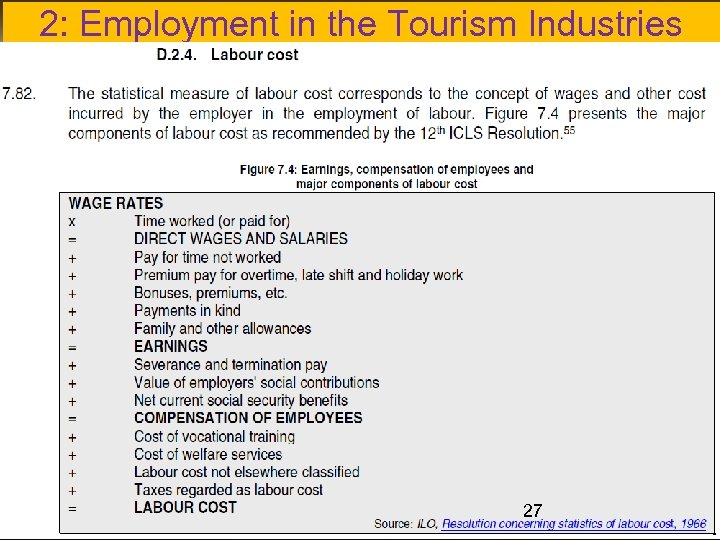
2: Employment in the Tourism Industries 09: 00 -11: 00 Session 7: Employment in the Tourism Industries ► Measuring Employment in the Tourism Industries Presenter: UNWTO 27
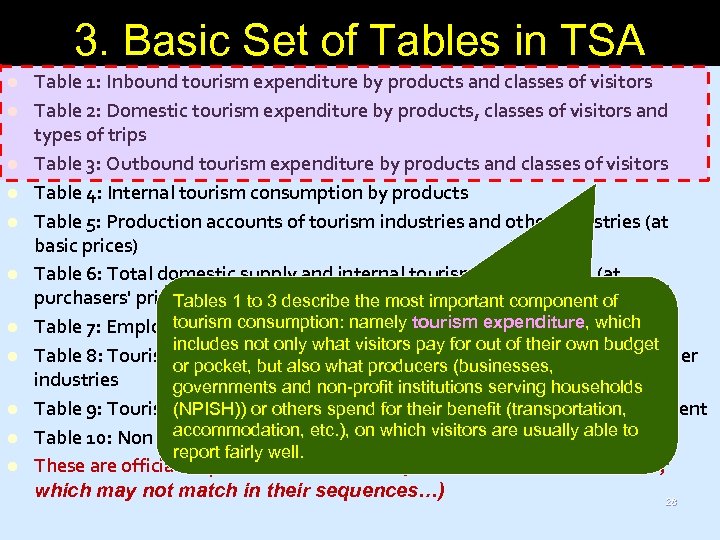
3. Basic Set of Tables in TSA l l l Table 1: Inbound tourism expenditure by products and classes of visitors Table 2: Domestic tourism expenditure by products, classes of visitors and types of trips Table 3: Outbound tourism expenditure by products and classes of visitors Table 4: Internal tourism consumption by products Table 5: Production accounts of tourism industries and other industries (at basic prices) Table 6: Total domestic supply and internal tourism consumption (at purchasers' prices) Tables 1 to 3 describe the most important component of tourism the tourism namely tourism expenditure, which Table 7: Employment inconsumption: industries includes not only what visitors pay for out of their own budget Table 8: Tourism gross fixed capital formation of (businesses, tourism industries and other or pocket, but also what producers industries governments and non-profit institutions serving households Table 9: Tourism collective consumptionfor their benefit (transportation, (NPISH)) or others spend by products and levels of government accommodation, etc. ), Table 10: Non monetary indicators on which visitors are usually able to report fairly well. These are official sequences of TSA tables! (What I cover is US version, which may not match in their sequences…) 28
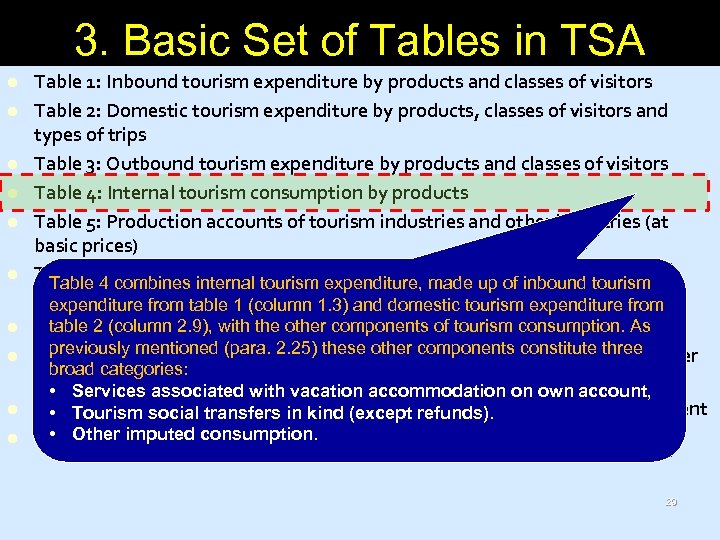
3. Basic Set of Tables in TSA l l l l l Table 1: Inbound tourism expenditure by products and classes of visitors Table 2: Domestic tourism expenditure by products, classes of visitors and types of trips Table 3: Outbound tourism expenditure by products and classes of visitors Table 4: Internal tourism consumption by products Table 5: Production accounts of tourism industries and other industries (at basic prices) Table 6: 4 Total domestic supply and internal tourism up of inbound tourism Table combines internal tourism expenditure, made consumption (at purchasers' prices)table 1 (column 1. 3) and domestic tourism expenditure from table 2 (column 2. 9), in the tourism industries Table 7: Employmentwith the other components of tourism consumption. As previously mentioned fixed capital formation of tourism industries and Table 8: Tourism gross(para. 2. 25) these other components constitute three other broad categories: industries • Services associated with vacation accommodation on own account, Table 9: Tourism collective consumption by products and levels of government • Tourism social transfers in kind (except refunds). • Other imputed consumption. Table 10: Non monetary indicators 29
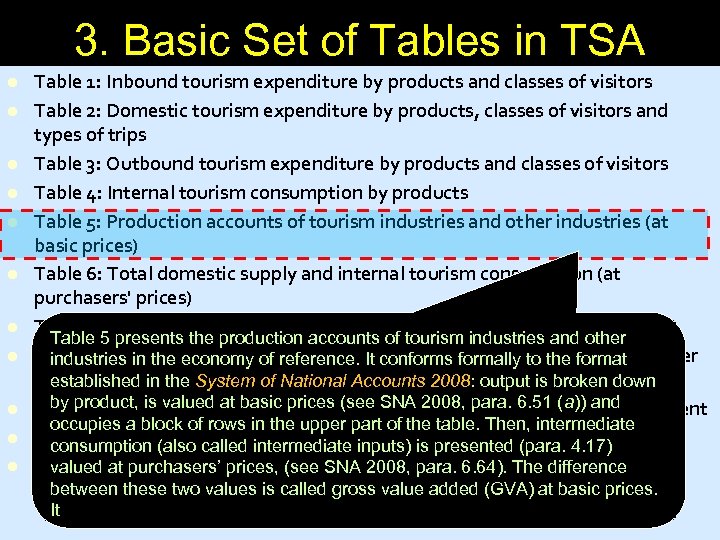
3. Basic Set of Tables in TSA l l l Table 1: Inbound tourism expenditure by products and classes of visitors Table 2: Domestic tourism expenditure by products, classes of visitors and types of trips Table 3: Outbound tourism expenditure by products and classes of visitors Table 4: Internal tourism consumption by products Table 5: Production accounts of tourism industries and other industries (at basic prices) Table 6: Total domestic supply and internal tourism consumption (at purchasers' prices) Table 7: Employment in the tourism industries Table 5 presents the production accounts of tourism industries and other Table 8: Tourism economy of reference. It conforms tourism industries and other industries in the gross fixed capital formation of formally to the format industries in the System of National Accounts 2008: output is broken down established by product, is valued at basic prices (see by products and levels of government Table 9: Tourism collective consumption. SNA 2008, para. 6. 51 (a)) and occupies a block of rows in the upper part of the table. Then, intermediate Table 10: Non (also calledindicators inputs) is presented (para. 4. 17) consumption monetary intermediate These are official sequences of TSA tables! (What 6. 64). The difference valued at purchasers’ prices, (see SNA 2008, para. I cover is US version, between these match in their sequences…) which may nottwo values is called gross value added (GVA) at basic prices. 30 It
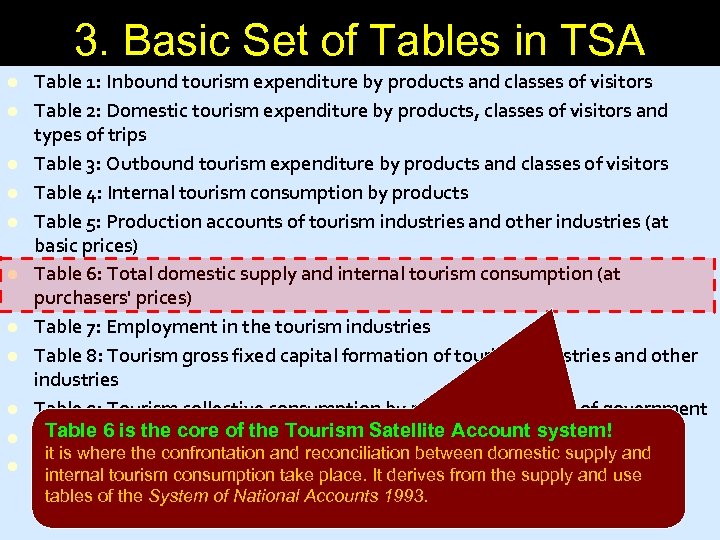
3. Basic Set of Tables in TSA l l l Table 1: Inbound tourism expenditure by products and classes of visitors Table 2: Domestic tourism expenditure by products, classes of visitors and types of trips Table 3: Outbound tourism expenditure by products and classes of visitors Table 4: Internal tourism consumption by products Table 5: Production accounts of tourism industries and other industries (at basic prices) Table 6: Total domestic supply and internal tourism consumption (at purchasers' prices) Table 7: Employment in the tourism industries Table 8: Tourism gross fixed capital formation of tourism industries and other industries Table 9: Tourism collective consumption by products and levels of government Table 6 is the core of the Tourism Satellite Account system! Table 10: Non monetary indicators it is where the confrontation and reconciliation between domestic supply and These are official sequences of TSA tables! (What I cover is US version, internal tourism consumption take place. It derives from the supply and use which may not match in their sequences…) tables of the System of National Accounts 1993. 31
TSA 2010 of the Kingdom of Saudi Arabia: Excellent Example of TSA presentation I have been teaching a course on SNA, TSA, tourism statistics (via I-O, SAM) and wrote a exploratory textbook during the last 11 years. In my limited experience and knowledge, this material is superior in many ways. Therefore, in my MOOC on TSA, I refer to this as one of a few great materials available for the rest of the world. I would like to show you what I mean. 32
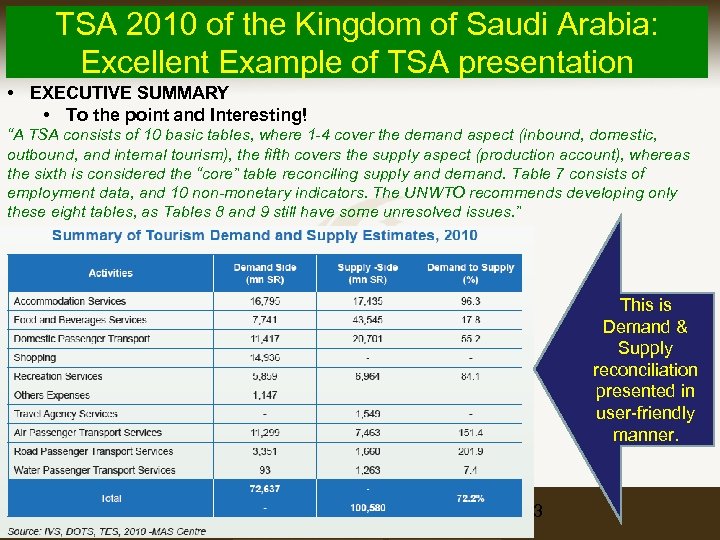
TSA 2010 of the Kingdom of Saudi Arabia: Excellent Example of TSA presentation • EXECUTIVE SUMMARY • To the point and Interesting! “A TSA consists of 10 basic tables, where 1 -4 cover the demand aspect (inbound, domestic, outbound, and internal tourism), the fifth covers the supply aspect (production account), whereas the sixth is considered the “core” table reconciling supply and demand. Table 7 consists of employment data, and 10 non-monetary indicators. The UNWTO recommends developing only these eight tables, as Tables 8 and 9 still have some unresolved issues. ” This is Demand & Supply reconciliation presented in user-friendly manner. 33
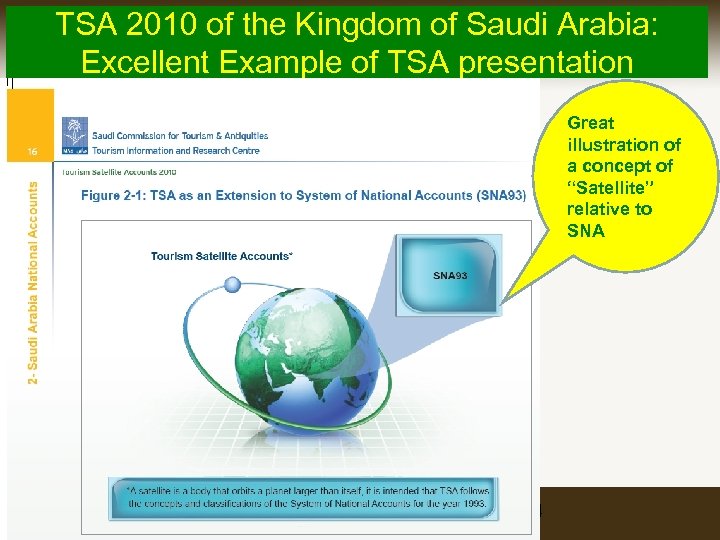
TSA 2010 of the Kingdom of Saudi Arabia: Excellent Example of TSA presentation Great illustration of a concept of “Satellite” relative to SNA 34
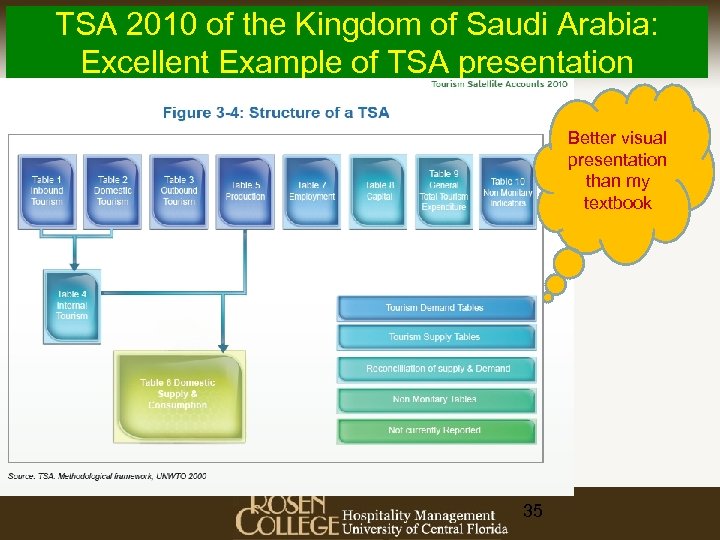
TSA 2010 of the Kingdom of Saudi Arabia: Excellent Example of TSA presentation Better visual presentation than my textbook 35
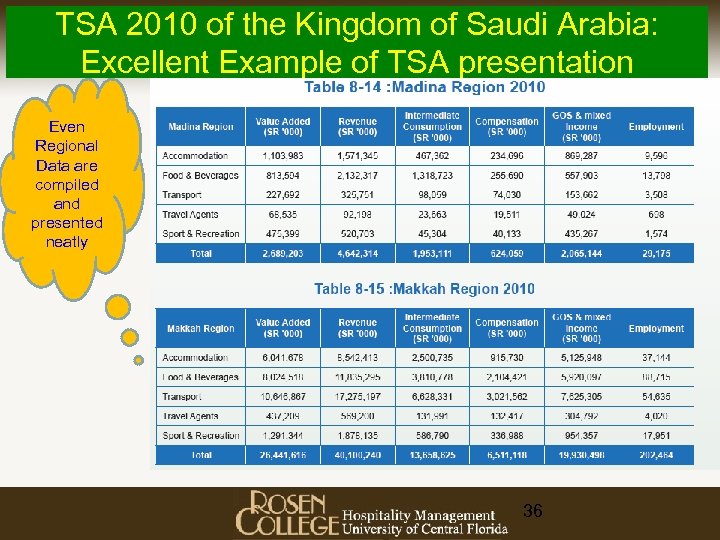
TSA 2010 of the Kingdom of Saudi Arabia: Excellent Example of TSA presentation Even Regional Data are compiled and presented neatly 36
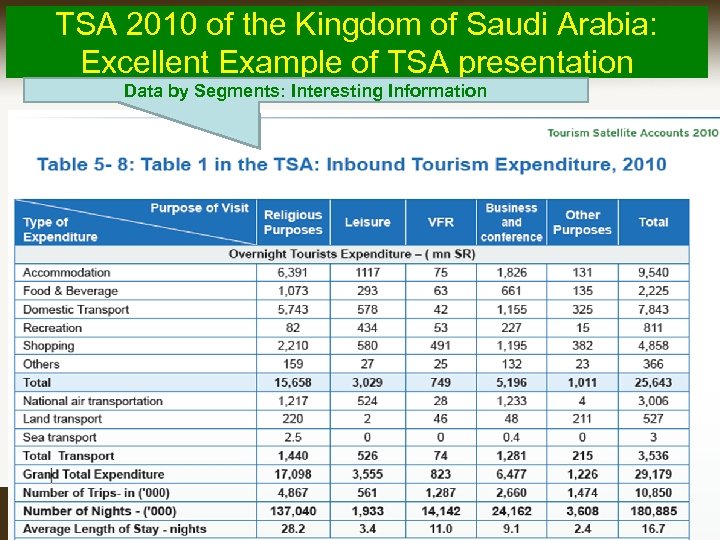
TSA 2010 of the Kingdom of Saudi Arabia: Excellent Example of TSA presentation Data by Segments: Interesting Information 37
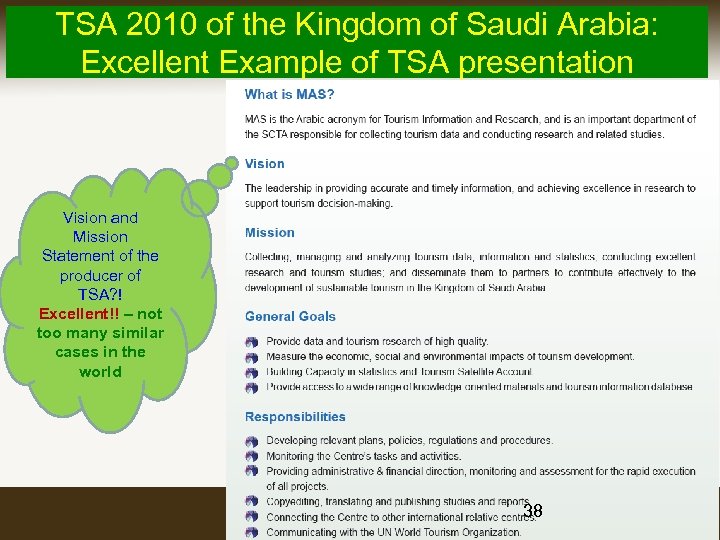
TSA 2010 of the Kingdom of Saudi Arabia: Excellent Example of TSA presentation Vision and Mission Statement of the producer of TSA? ! Excellent!! – not too many similar cases in the world 38
Future Directions • Knowledge on TSA and tourism statistics advance with “best practices”. – Case of Kingdom of Saudi Arabia is very useful, and great example of superior presentation. – Historically, cases from Europe, Canada, USA, NZ, Australia etc. , have been beacons, but KSA case can also lead several discussions • Regional Tourism Statistics • Accumulation of knowledge on TSA may help discussion on other satellite accounts such as CSA (Culture Satellite Accounts) within the United Nations’ framework. 39
! ﺷﻜﺮﺍ ﺟﺰﻳﻼ. ﻛﺎﻥ ﻣﻦ ﺩﻭﺍﻋﻲ ﺳﺮﻭﺭﻱ ﺃﻦ ﻳﻜﻮﻥ ﻟﻬﺎ ﺷﺮﻑ ﻗﻀﺎﺀ ﺍﻟﻮﻗﺖ ﻣﻌﻚ Thank you very much. It was a pleasure to have an honor of spending time with you, sirs! MOOC course on Economic Impact & TSA Now open – Starts on April 6, 2015. FREE to anybody in the world! (link below) https: //www. canvas. net/courses/tourism-industry-analysis-2 Thank you very much. Tad Hara tadayuki. hara@ucf. edu (e-mail) http: //hospitality. ucf. edu/person/dr-tadayuki-hara/ (web)
Скачать презентацию Organized on behalf of President Chairman of
1caeb86f0a084f76df574d37db04c895.ppt