 Скачать презентацию Organizational Overview Automation Federation Background
bd0004492fa6fca5ac64bb0b5f84b920.ppt
- Количество слайдов: 15



Organizational Overview
Automation Federation Background • • • A fragmented community of automation professional associations and societies – creating opposition and a struggle for resources Many small user groups and niche societies have formed in recent years – creating competition for time and money of individual members and interested companies Limited amount of automation industry leaders – dilutes the nature of healthy competition Formed to create an industry mechanism that would pull-together niche associations and societies engaged in manufacturing and process automation activities to: – Work collaboratively to meet the needs of the marketplace – Improve individual organization’s operating efficiencies – Enhance individual organization’s ability to diversify and grow – Better serve the end-user and customer through collective maximization 2
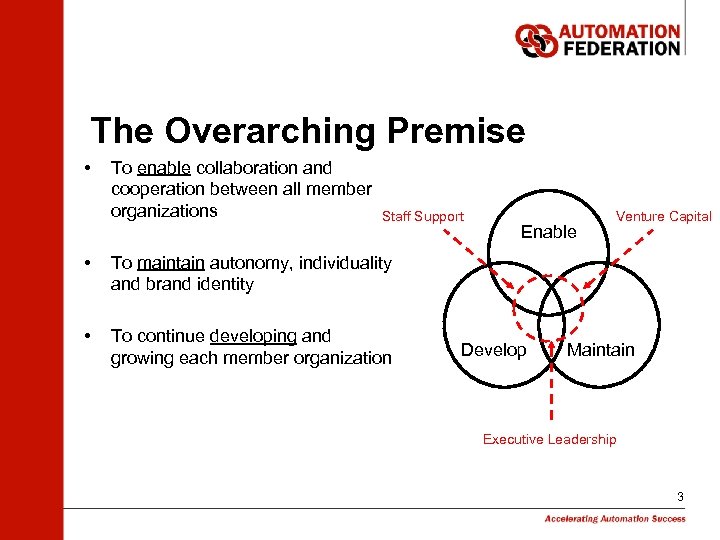
The Overarching Premise • To enable collaboration and cooperation between all member organizations Staff Support • To maintain autonomy, individuality and brand identity • To continue developing and growing each member organization Enable Venture Capital Develop Maintain Executive Leadership 3
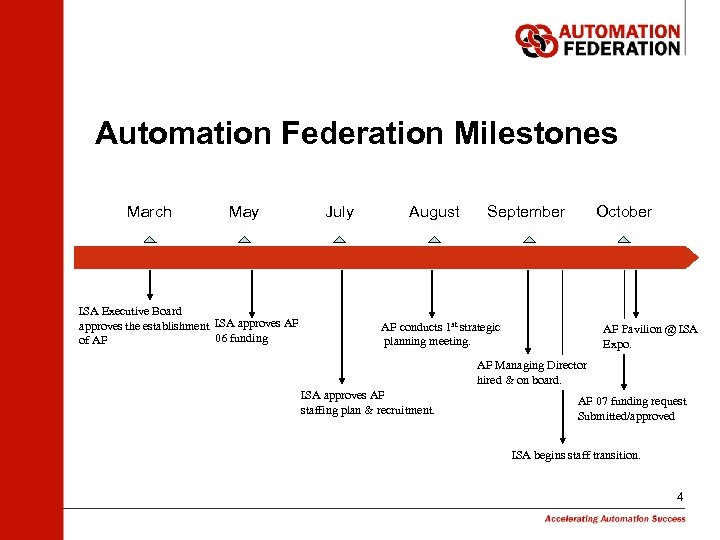
Automation Federation Milestones March May ISA Executive Board approves the establishment ISA approves AF 06 funding of AF July August September October AF conducts 1 st strategic planning meeting. AF Pavilion @ ISA Expo. AF Managing Director hired & on board. ISA approves AF staffing plan & recruitment. AF 07 funding request Submitted/approved ISA begins staff transition. 4
The Vision • To catalyze the alliance of organizations that together are the world wide recognized authority and source of knowledge regarding manufacturing (process, discrete, hybrid, continuous) automation and their associated operational technologies. 5
The Mission • Provide leadership and coordination of the world wide marketplace (member organizations and alliances) engaged in the advancement of science and engineering of automation, operational technologies and applications, and to serve as a one -stop-clearing house to address industry challenges and issues. 6
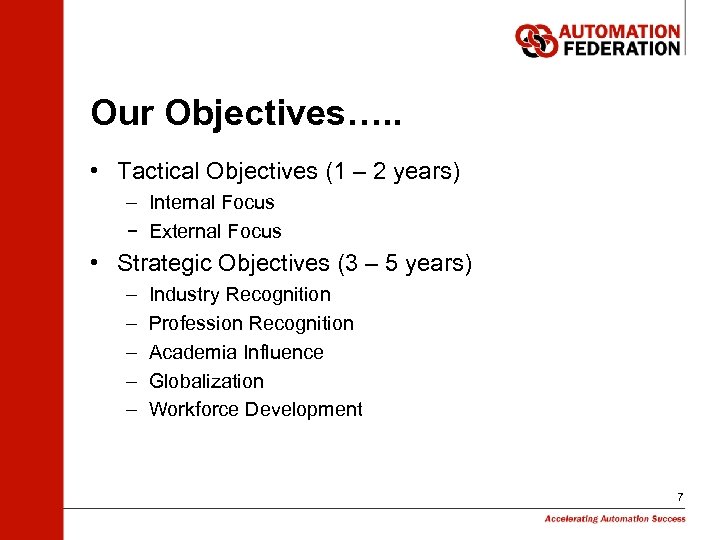
Our Objectives…. . • Tactical Objectives (1 – 2 years) – Internal Focus – External Focus • Strategic Objectives (3 – 5 years) – – – Industry Recognition Profession Recognition Academia Influence Globalization Workforce Development 7
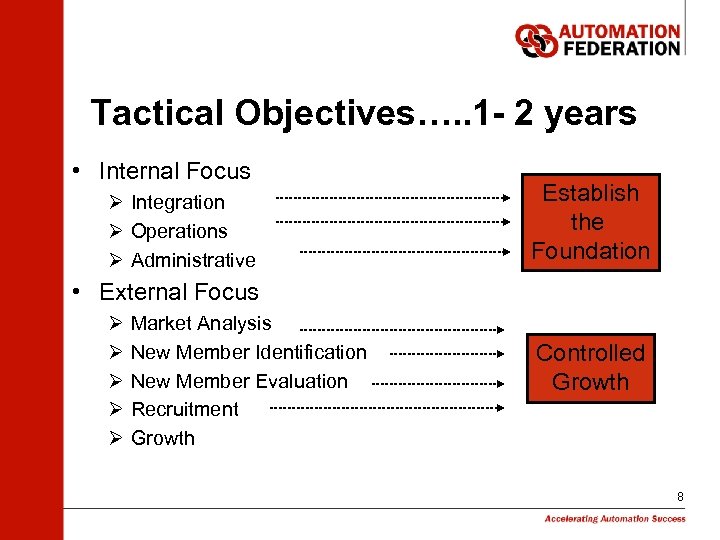
Tactical Objectives…. . 1 - 2 years • Internal Focus Ø Integration Ø Operations Ø Administrative Establish the Foundation • External Focus Ø Ø Ø Market Analysis New Member Identification New Member Evaluation Recruitment Growth Controlled Growth 8
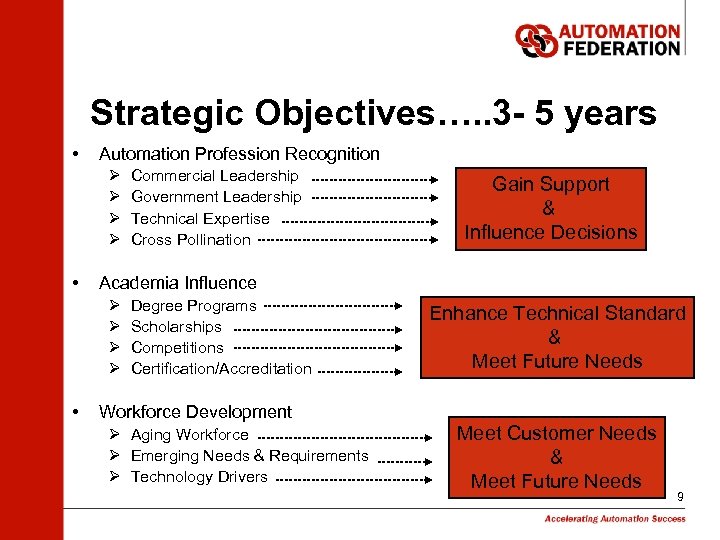
Strategic Objectives…. . 3 - 5 years • Automation Profession Recognition Ø Ø • Gain Support & Influence Decisions Academia Influence Ø Ø • Commercial Leadership Government Leadership Technical Expertise Cross Pollination Degree Programs Scholarships Competitions Certification/Accreditation Workforce Development Ø Aging Workforce Ø Emerging Needs & Requirements Ø Technology Drivers Enhance Technical Standard & Meet Future Needs Meet Customer Needs & Meet Future Needs 9
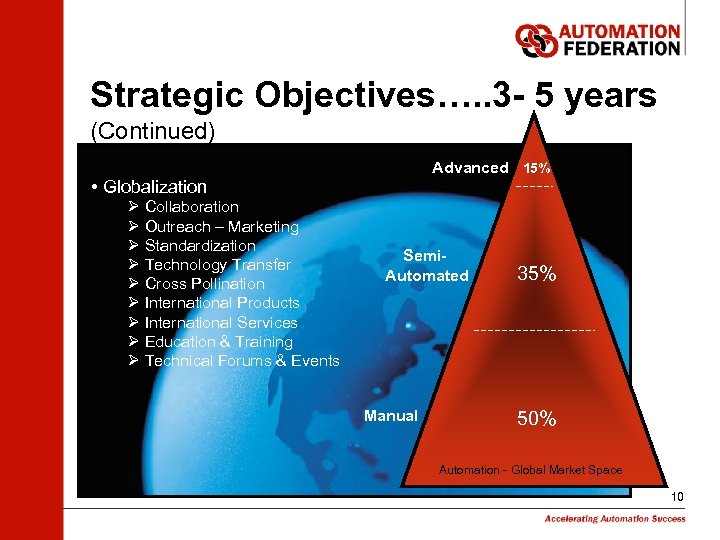
Strategic Objectives…. . 3 - 5 years (Continued) Advanced 15% • Globalization Ø Collaboration Ø Outreach – Marketing Ø Standardization Ø Technology Transfer Ø Cross Pollination Ø International Products Ø International Services Ø Education & Training Ø Technical Forums & Events Semi. Automated Manual 35% 50% Automation - Global Market Space 10
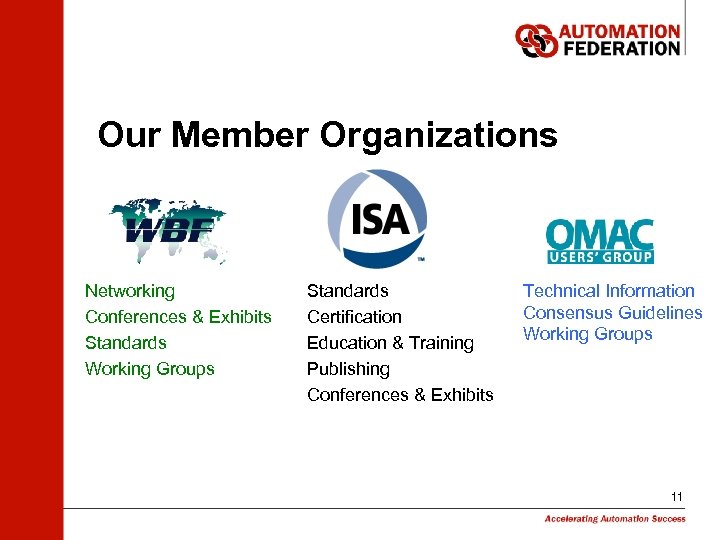
Our Member Organizations Networking Conferences & Exhibits Standards Working Groups Standards Certification Education & Training Publishing Conferences & Exhibits Technical Information Consensus Guidelines Working Groups 11
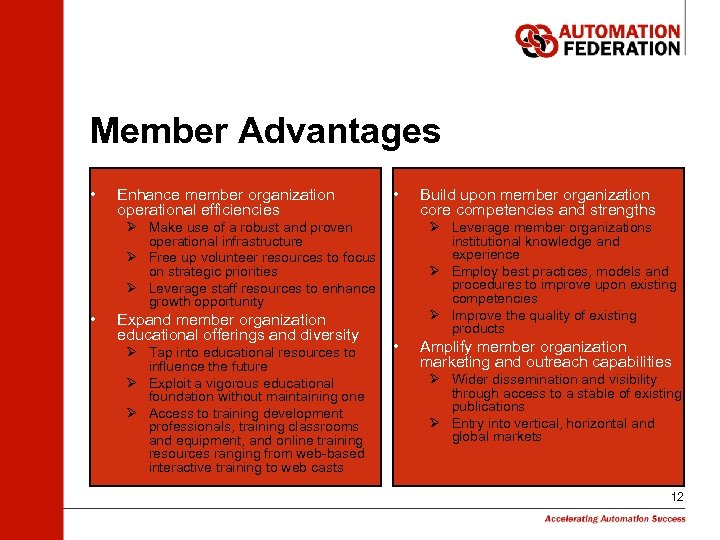
Member Advantages • Enhance member organization operational efficiencies • Ø Make use of a robust and proven operational infrastructure Ø Free up volunteer resources to focus on strategic priorities Ø Leverage staff resources to enhance growth opportunity • Expand member organization educational offerings and diversity Ø Tap into educational resources to influence the future Ø Exploit a vigorous educational foundation without maintaining one Ø Access to training development professionals, training classrooms and equipment, and online training resources ranging from web-based interactive training to web casts Build upon member organization core competencies and strengths Ø Leverage member organizations institutional knowledge and experience Ø Employ best practices, models and procedures to improve upon existing competencies Ø Improve the quality of existing products • Amplify member organization marketing and outreach capabilities Ø Wider dissemination and visibility through access to a stable of existing publications Ø Entry into vertical, horizontal and global markets 12
Member Advantage (continued) • Improve member organization networking capabilities Ø Collaborative technical conferences, workshops and symposia Ø Integration into member forums and Ø Develop and manage new initiatives • Develop standards and participate in working groups Ø Access to an ANSI-accredited standards development process Ø Leverage staff resources to grow and continue existing initiatives • Expand member organization publishing capability and functionality Ø Access to a proven book publishing program that publishes over 100 reference works with a distribution in excess of 20, 000 units annually around the world Ø Increased visibility through greater outreach Ø Leverage dedicated staff resources • Improve member organizational fiscal security Ø Access to new venture funding Ø Access to fiscal management tools and resources Ø Reciprocal agreements between member organizations • Careers & employment Ø Collaborative job postings & career fairs Ø Web based advertising and job posting 13
Industry Advantage • Collaborative Technical conferences, workshops and symposia Ø Cross pollination of technology and applications offer the best of solutions Ø Consolidation of events and forums Ø Developed to meet the needs of the customer • Collaborative Training and Education Ø Improve efficiencies, effectiveness, optimization and revenue through education, training and certification of the workforce Ø Implement cost effective training mechanism (virtual) • Standards Ø Access to an ANSI-accredited standards development process Ø Access to a greater selection of guidelines and best practices Ø Influence and implement change • Marketing and Business Development Ø Ø • Greater market exposure at collaborative forums Increased access to decision makers and industry knowledge Expansion of customer network Greater access to business intelligence Personnel Recruitment & Employment Ø Skill focused advertisements & recruitment Ø Skill focused career fairs 14
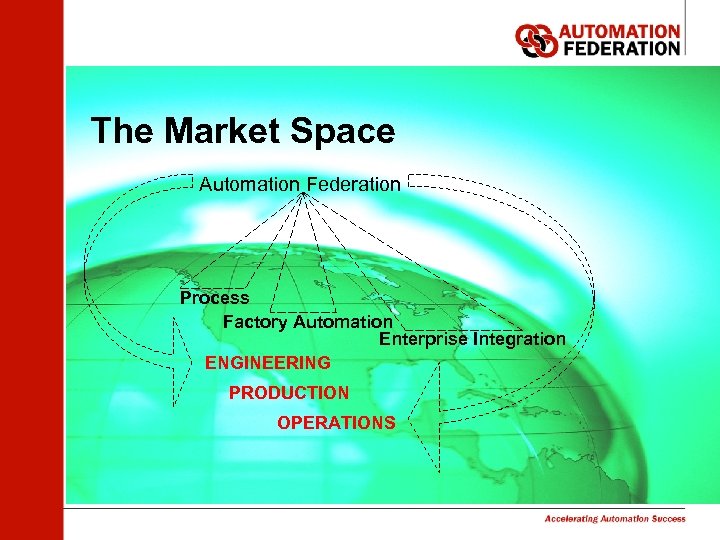
The Market Space Automation Federation Process Factory Automation Enterprise Integration ENGINEERING PRODUCTION OPERATIONS 15
Скачать презентацию Organizational Overview Automation Federation Background
bd0004492fa6fca5ac64bb0b5f84b920.ppt