


 Скачать презентацию Organizational Network Alignment Kent Myers Ph D Science
3084da7ffba583e5c334a847d86039be.ppt
- Количество слайдов: 27
 Organizational Network Alignment Kent Myers, Ph. D Science Applications International Corp.
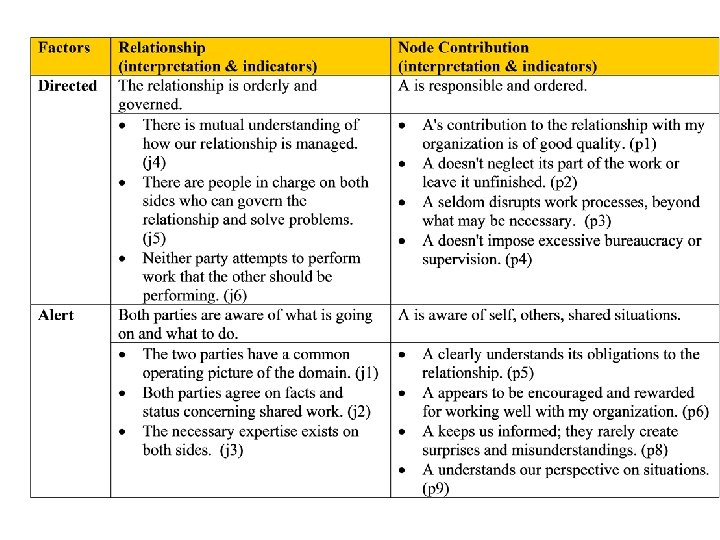
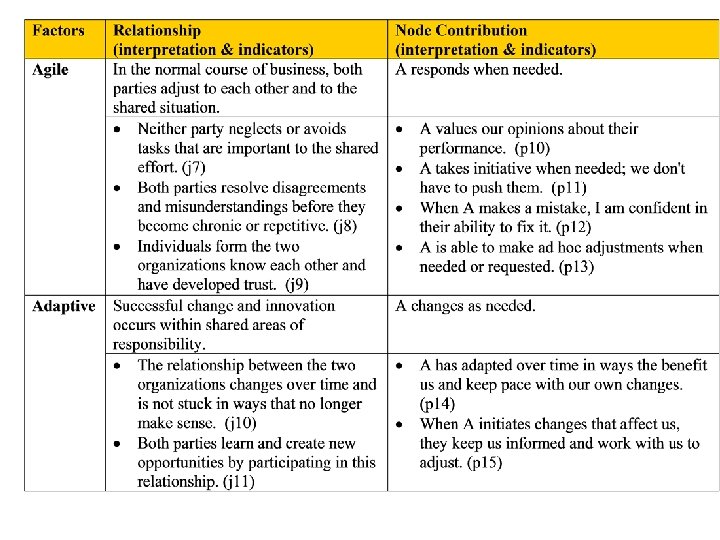
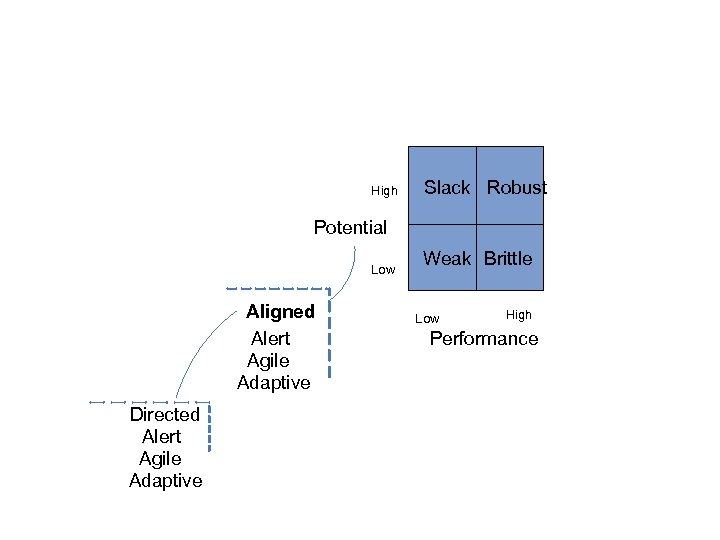 High Slack Robust Potential Low Aligned Alert Agile Adaptive Directed Alert Agile Adaptive Weak Brittle Low High Performance
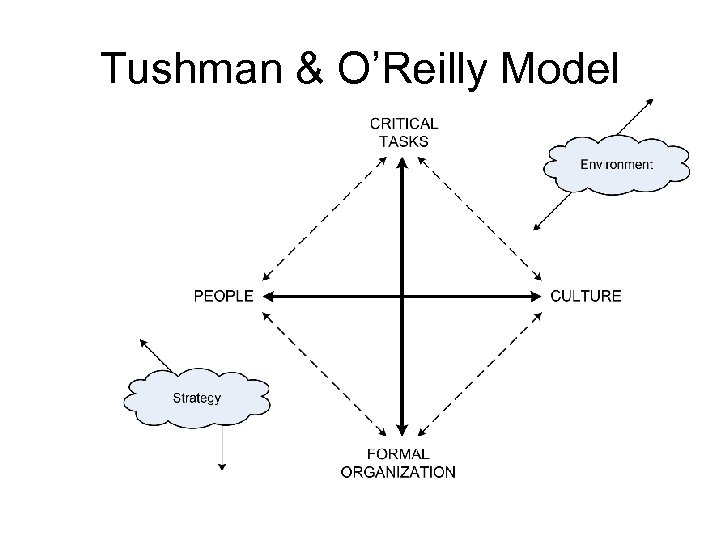
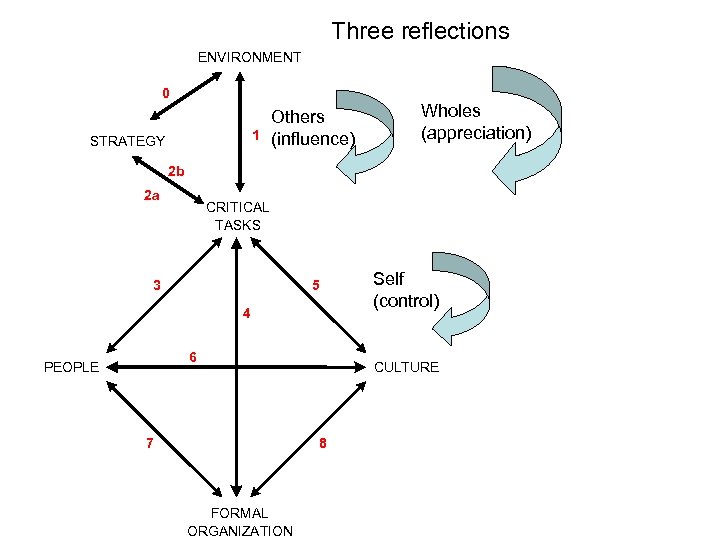 Three reflections ENVIRONMENT 0 1 STRATEGY Others (influence) Wholes (appreciation) 2 b 2 a CRITICAL TASKS 3 5 4 6 PEOPLE 7 CULTURE 8 FORMAL ORGANIZATION Self (control)
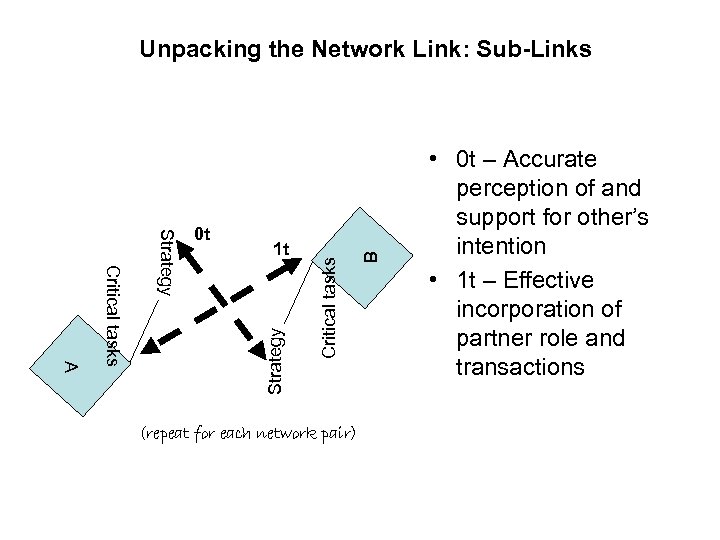 (repeat for each network pair) B 1 t Strategy A Critical tasks Strategy 0 t Critical tasks Unpacking the Network Link: Sub-Links • 0 t – Accurate perception of and support for other’s intention • 1 t – Effective incorporation of partner role and transactions
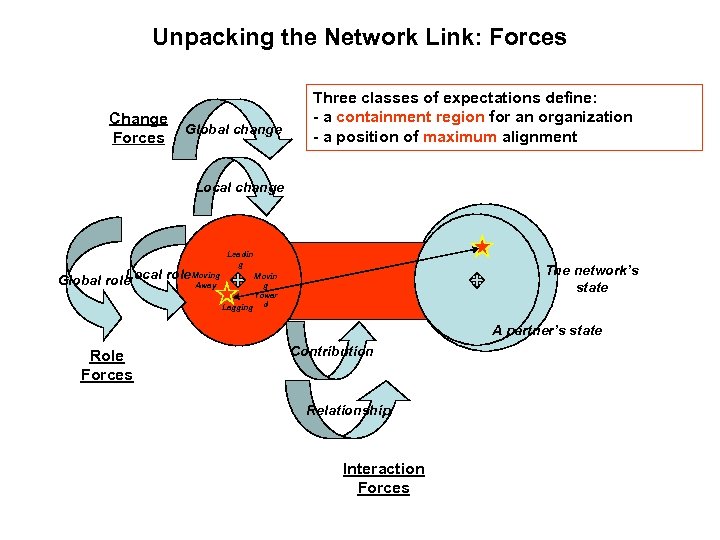 Unpacking the Network Link: Forces Change Forces Global change Three classes of expectations define: - a containment region for an organization - a position of maximum alignment Local change Local role Moving Global role Away Leadin g The network’s state Movin g Towar Lagging d A partner’s state Role Forces Contribution Relationship Interaction Forces
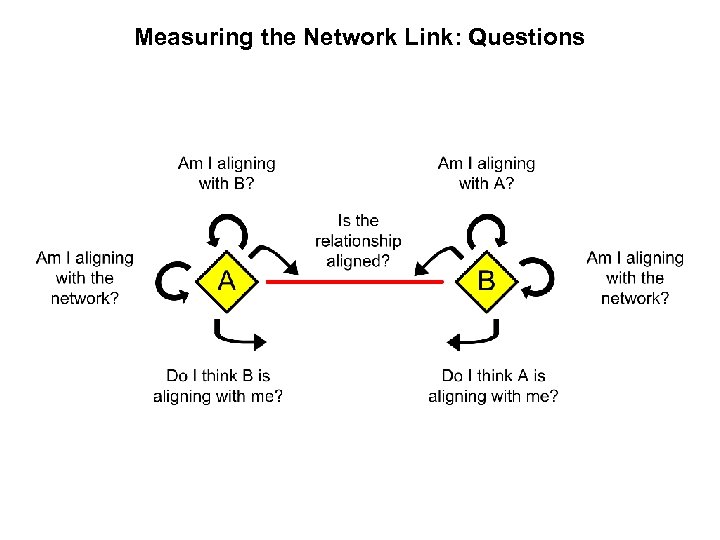 Measuring the Network Link: Questions
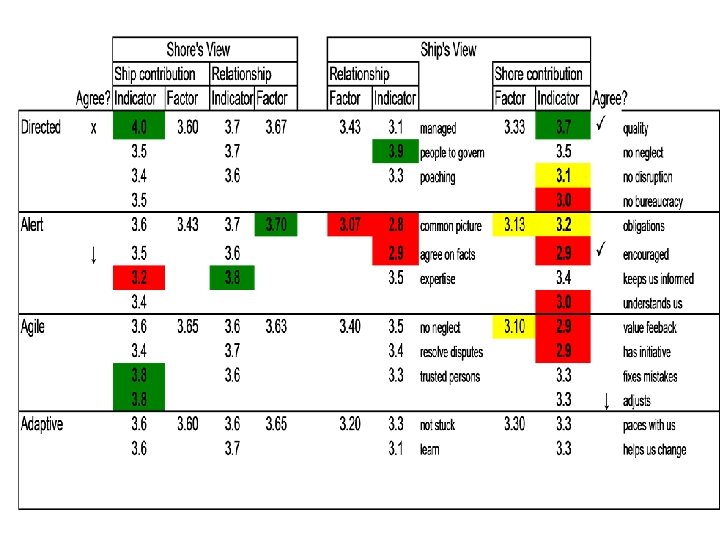
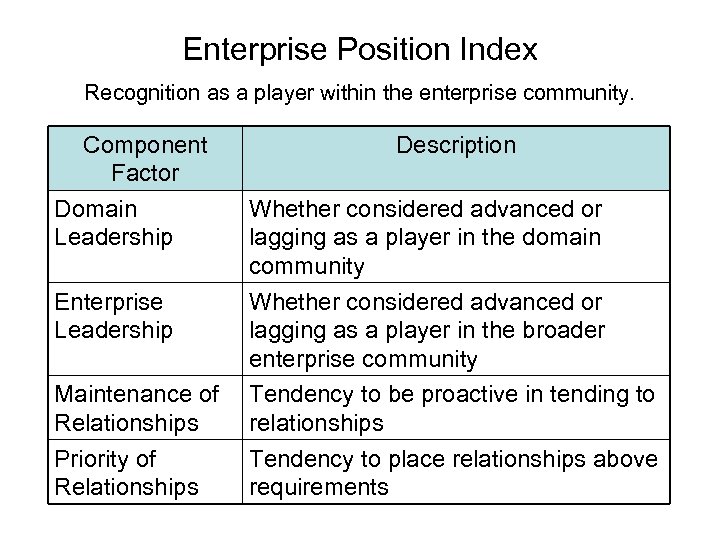
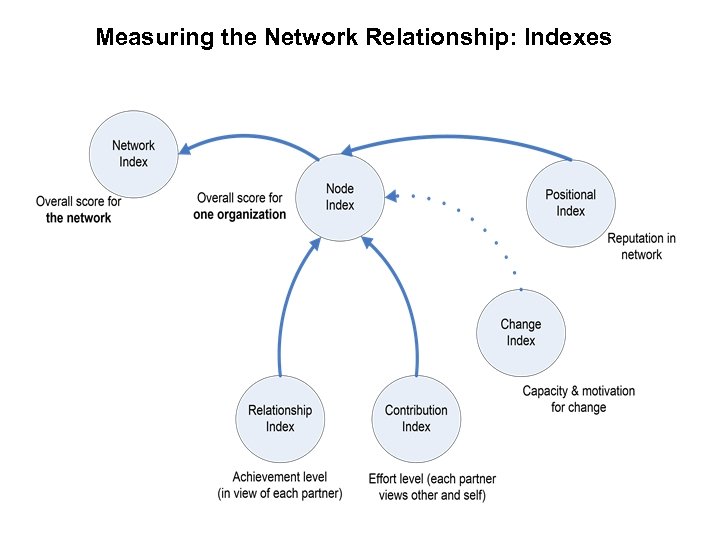 Measuring the Network Relationship: Indexes
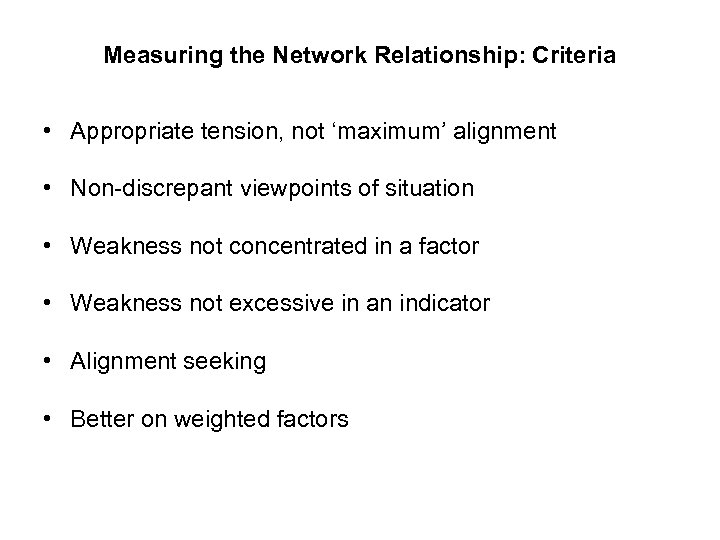 Measuring the Network Relationship: Criteria • Appropriate tension, not ‘maximum’ alignment • Non-discrepant viewpoints of situation • Weakness not concentrated in a factor • Weakness not excessive in an indicator • Alignment seeking • Better on weighted factors
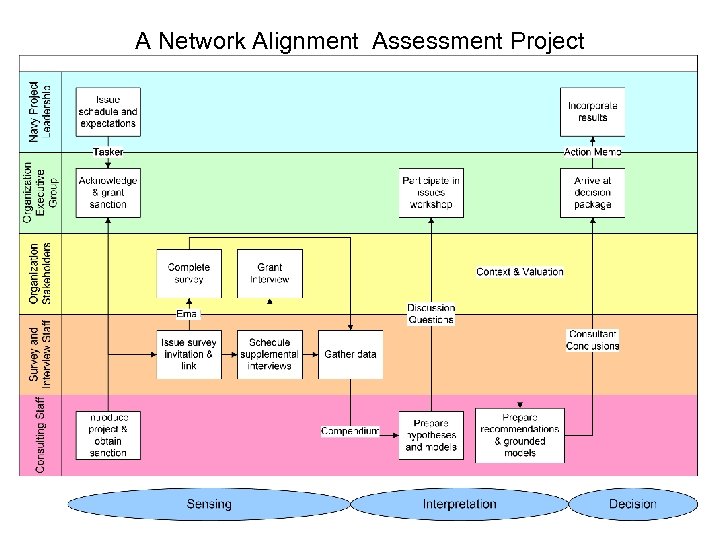 A Network Alignment Assessment Project
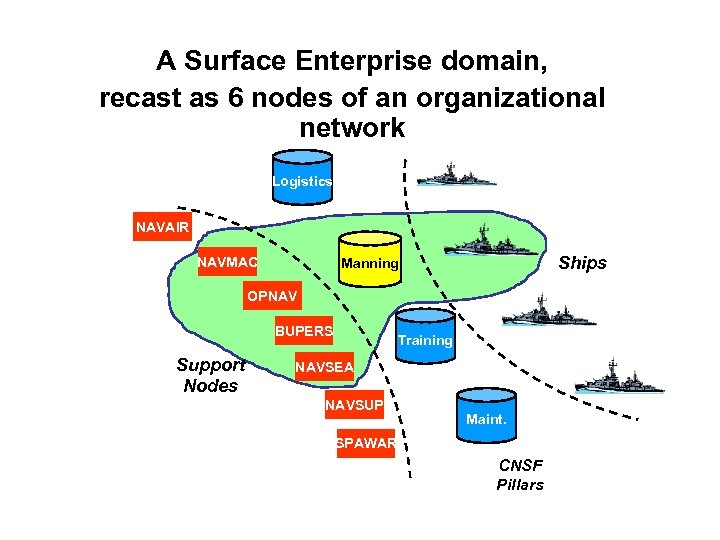 A Surface Enterprise domain, recast as 6 nodes of an organizational network Logistics NAVAIR NAVMAC Ships Manning OPNAV BUPERS Support Nodes Training NAVSEA NAVSUP Maint. SPAWAR CNSF Pillars
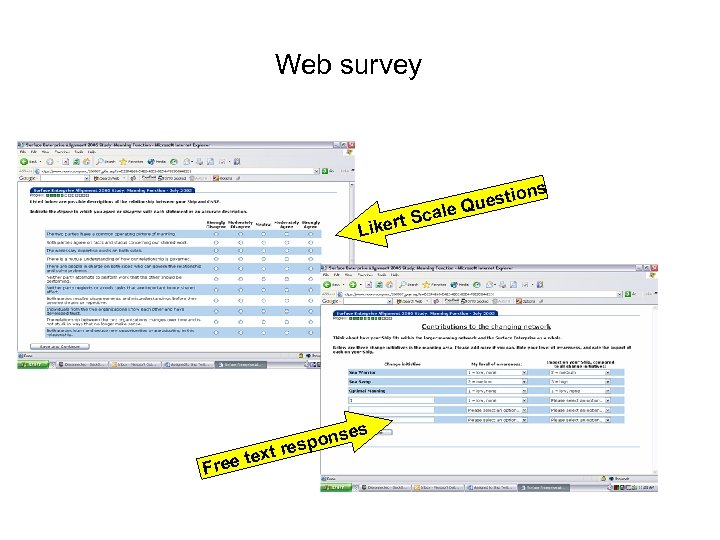 Web survey l a ert Sc Lik Free tex ses spon t re ns tio Ques e
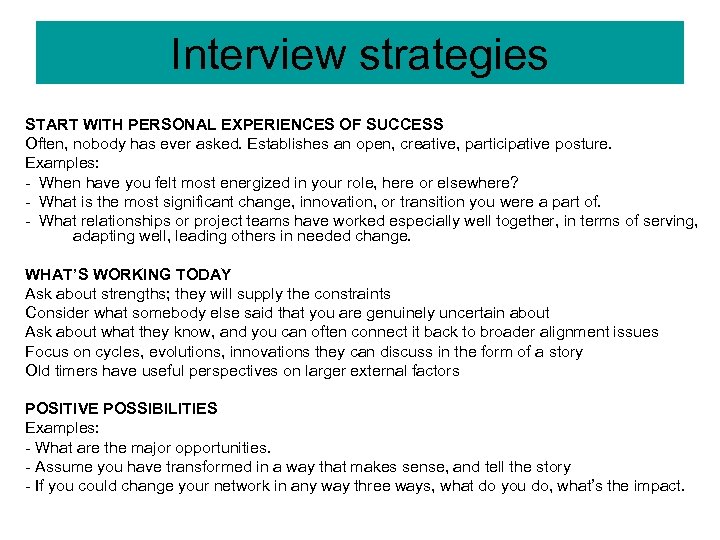 Interview strategies START WITH PERSONAL EXPERIENCES OF SUCCESS Often, nobody has ever asked. Establishes an open, creative, participative posture. Examples: - When have you felt most energized in your role, here or elsewhere? - What is the most significant change, innovation, or transition you were a part of. - What relationships or project teams have worked especially well together, in terms of serving, adapting well, leading others in needed change. WHAT’S WORKING TODAY Ask about strengths; they will supply the constraints Consider what somebody else said that you are genuinely uncertain about Ask about what they know, and you can often connect it back to broader alignment issues Focus on cycles, evolutions, innovations they can discuss in the form of a story Old timers have useful perspectives on larger external factors POSITIVE POSSIBILITIES Examples: - What are the major opportunities. - Assume you have transformed in a way that makes sense, and tell the story - If you could change your network in any way three ways, what do you do, what’s the impact.
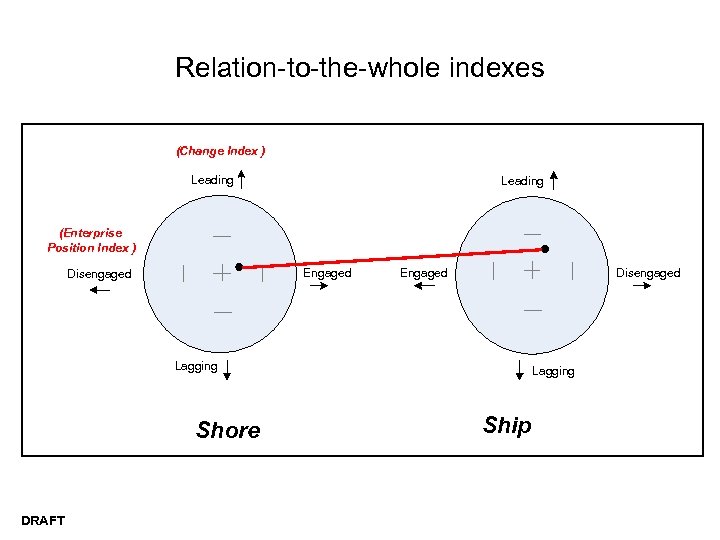 Relation-to-the-whole indexes (Change Index ) Leading (Enterprise Position Index ) Engaged Disengaged Lagging Shore DRAFT Lagging Ship
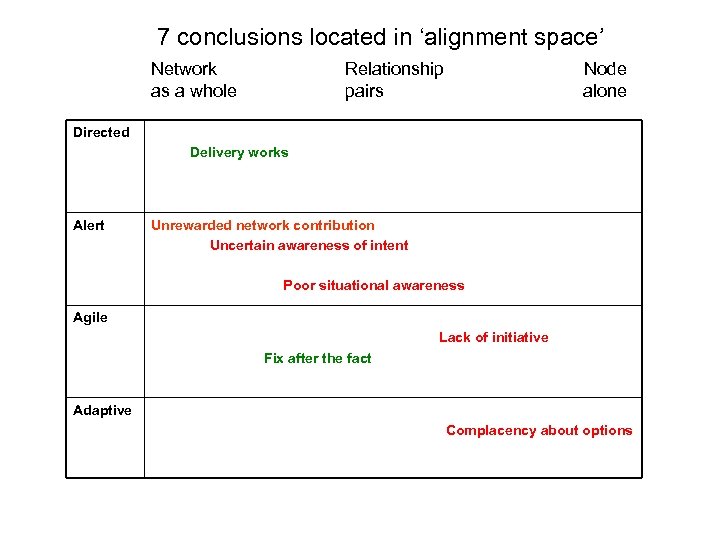 7 conclusions located in ‘alignment space’ Network as a whole Relationship pairs Node alone Directed Delivery works Alert Unrewarded network contribution Uncertain awareness of intent Poor situational awareness Agile Lack of initiative Fix after the fact Adaptive Complacency about options
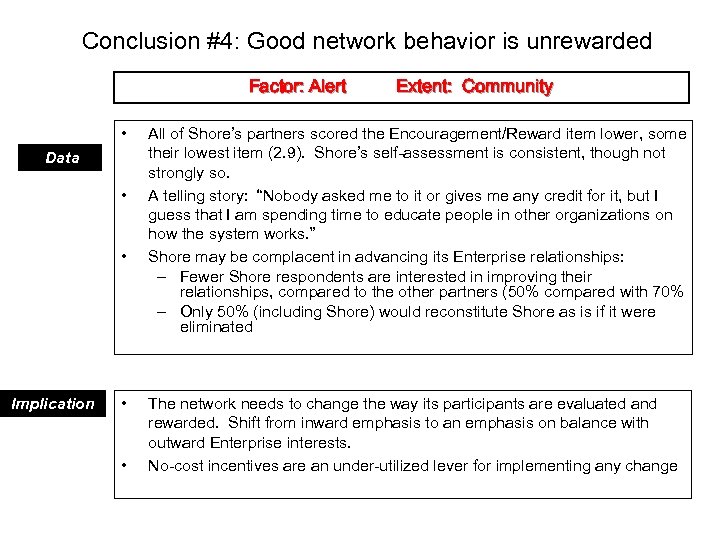 Conclusion #4: Good network behavior is unrewarded Factor: Alert • Data • • Implication s • • Extent: Community All of Shore’s partners scored the Encouragement/Reward item lower, some their lowest item (2. 9). Shore’s self-assessment is consistent, though not strongly so. A telling story: “Nobody asked me to it or gives me any credit for it, but I guess that I am spending time to educate people in other organizations on how the system works. ” Shore may be complacent in advancing its Enterprise relationships: – Fewer Shore respondents are interested in improving their relationships, compared to the other partners (50% compared with 70% – Only 50% (including Shore) would reconstitute Shore as is if it were eliminated The network needs to change the way its participants are evaluated and rewarded. Shift from inward emphasis to an emphasis on balance with outward Enterprise interests. No-cost incentives are an under-utilized lever for implementing any change
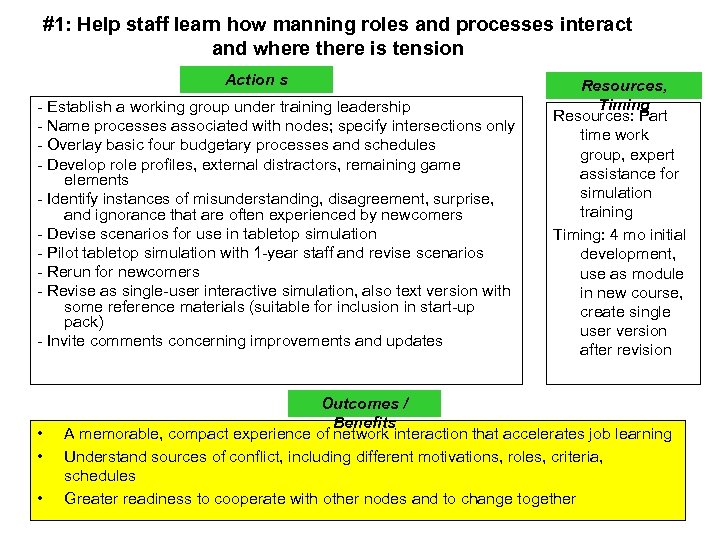 #1: Help staff learn how manning roles and processes interact and where there is tension Action s - Establish a working group under training leadership - Name processes associated with nodes; specify intersections only - Overlay basic four budgetary processes and schedules - Develop role profiles, external distractors, remaining game elements - Identify instances of misunderstanding, disagreement, surprise, and ignorance that are often experienced by newcomers - Devise scenarios for use in tabletop simulation - Pilot tabletop simulation with 1 -year staff and revise scenarios - Rerun for newcomers - Revise as single-user interactive simulation, also text version with some reference materials (suitable for inclusion in start-up pack) - Invite comments concerning improvements and updates • • • Resources, Timing Resources: Part time work group, expert assistance for simulation training Timing: 4 mo initial development, use as module in new course, create single user version after revision Outcomes / Benefits A memorable, compact experience of network interaction that accelerates job learning Understand sources of conflict, including different motivations, roles, criteria, schedules Greater readiness to cooperate with other nodes and to change together
 Some personal findings • The network perspective is a distinctively different -- and increasingly important -- way to look at organizations • Organizational potential is crucial, yet it is rarely isolated from performance or managed comprehensively • Government and military organizations may have thought about it early this time, but commercial organizations are on the move.
 back up
 Labovitz Model
 Tushman & O’Reilly Model
 Enterprise Position Index Recognition as a player within the enterprise community. Component Factor Domain Leadership Enterprise Leadership Maintenance of Relationships Priority of Relationships Description Whether considered advanced or lagging as a player in the domain community Whether considered advanced or lagging as a player in the broader enterprise community Tendency to be proactive in tending to relationships Tendency to place relationships above requirements
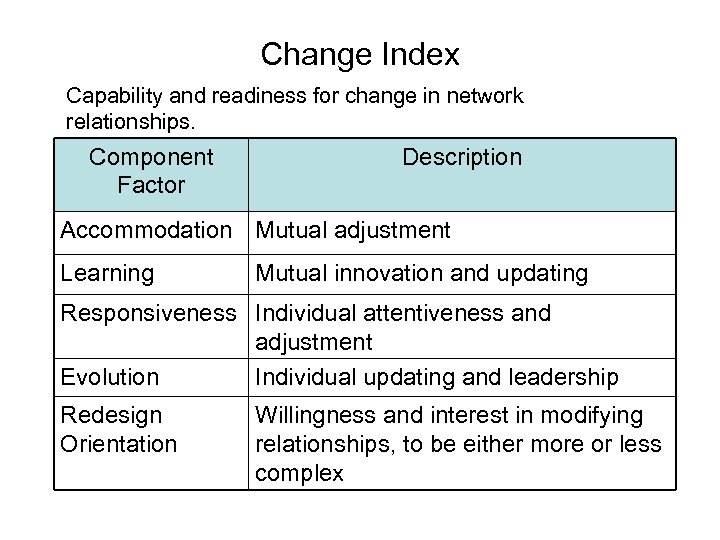 Change Index Capability and readiness for change in network relationships. Component Factor Description Accommodation Mutual adjustment Learning Mutual innovation and updating Responsiveness Individual attentiveness and adjustment Evolution Individual updating and leadership Redesign Orientation Willingness and interest in modifying relationships, to be either more or less complex
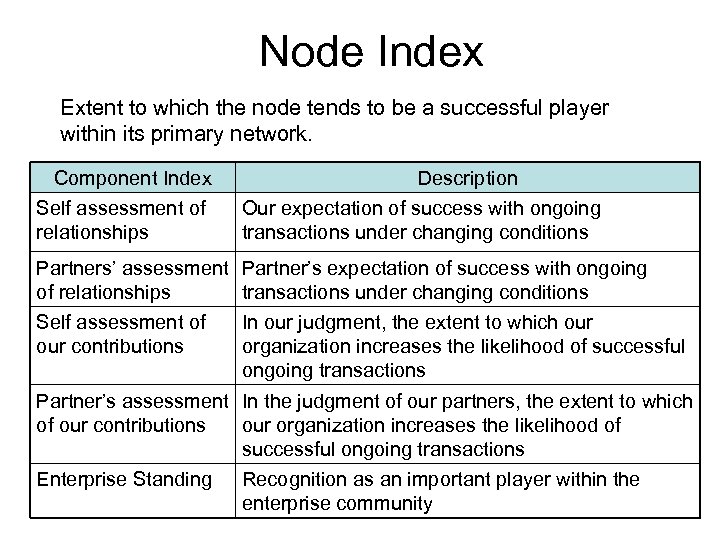 Node Index Extent to which the node tends to be a successful player within its primary network. Component Index Self assessment of relationships Description Our expectation of success with ongoing transactions under changing conditions Partners’ assessment Partner’s expectation of success with ongoing of relationships transactions under changing conditions Self assessment of our contributions In our judgment, the extent to which our organization increases the likelihood of successful ongoing transactions Partner’s assessment In the judgment of our partners, the extent to which of our contributions our organization increases the likelihood of successful ongoing transactions Enterprise Standing Recognition as an important player within the enterprise community
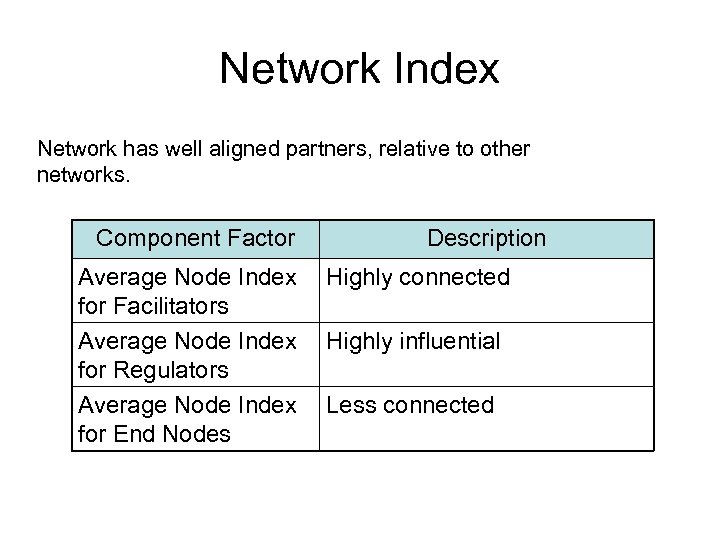 Network Index Network has well aligned partners, relative to other networks. Component Factor Average Node Index for Facilitators Average Node Index for Regulators Average Node Index for End Nodes Description Highly connected Highly influential Less connected