 Скачать презентацию Organizational Learning and Distributed Innovation Planning Edward Anderson
b2bad25b6c82153bfc25190211b10672.ppt
- Количество слайдов: 19



Organizational Learning and Distributed Innovation Planning Edward Anderson University of Texas Mc. Combs School www. Ed. Anderson. org Nitin Joglekar Boston University School of Management http: //people. bu. edu/joglekar/ INFORMS 2006
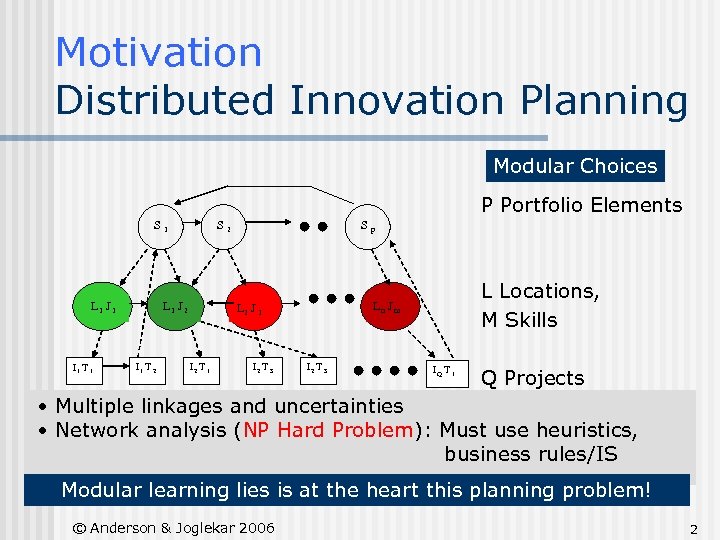
Motivation Distributed Innovation Planning Modular Choices P Portfolio Elements S 1 L 1 J 1 I 1 T 1 S 2 L 1 J 2 I 1 T 2 Sp I 2 T 1 I 2 T 3 L Locations, M Skills Ln J m L 2 J 1 I 2 T 3 IQ T 1 Q Projects • Multiple linkages and uncertainties • Network analysis (NP Hard Problem): Must use heuristics, business rules/IS Modular learning lies is at the heart this planning problem! © Anderson & Joglekar 2006 2
Distributed Innovation Literature n Sourcing Decisions n n n Chaos & Emergence Risks n n n Socio-political issues Hidden costs of coordination/vertical integration Adaptive behaviors (Brown & Eisenhardt) Modularity is touted as a solution (Baldwin & Clark, Sosa et al, Ethiraj & Levinthal) Organizational Learning n n n Explore or Exploit (March, Katila & Ahuja) Integration (Anderson & Parker) Ex-post selections (Sommer & Loch) © Anderson & Joglekar 2006 3
Research Questions n n n What implications does distributed product development have for organizational learning and vice-versa? How can the risk inherent in distributed product development be managed through modularization of capabilities? What risks does modularizing capabilities pose for organizational learning and distributed innovation? © Anderson & Joglekar 2006 4
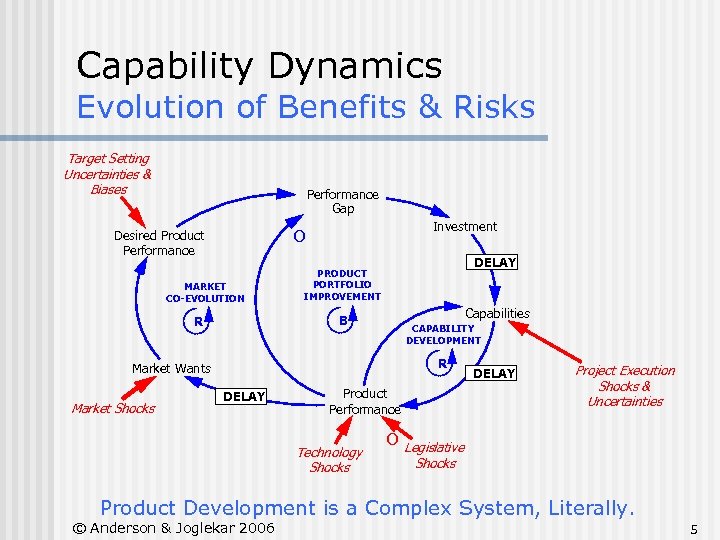
Capability Dynamics Evolution of Benefits & Risks Target Setting Uncertainties & Biases Performance Gap Investment O Desired Product Performance MARKET CO-EVOLUTION DELAY PRODUCT PORTFOLIO IMPROVEMENT Capabilities B R CAPABILITY DEVELOPMENT R Market Wants Market Shocks DELAY Product Performance Technology Shocks DELAY Project Execution Shocks & Uncertainties O Legislative Shocks Product Development is a Complex System, Literally. © Anderson & Joglekar 2006 5
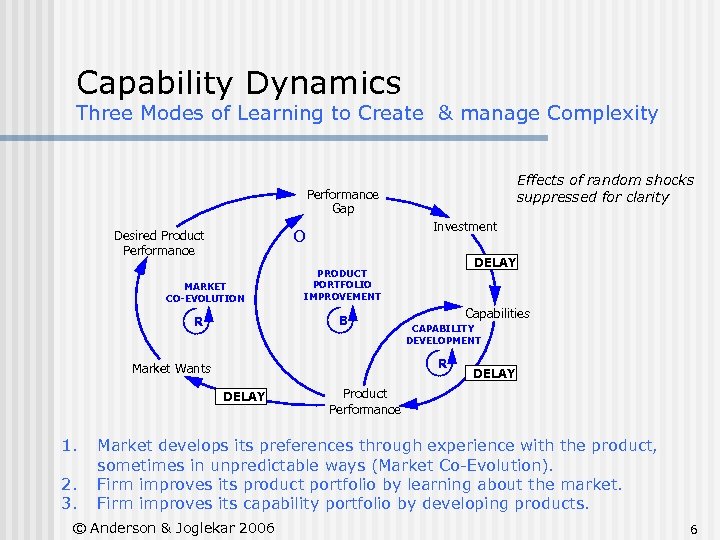
Capability Dynamics Three Modes of Learning to Create & manage Complexity Effects of random shocks suppressed for clarity Performance Gap Investment O Desired Product Performance MARKET CO-EVOLUTION B R DELAY 2. 3. Capabilities CAPABILITY DEVELOPMENT R Market Wants 1. DELAY PRODUCT PORTFOLIO IMPROVEMENT DELAY Product Performance Market develops its preferences through experience with the product, sometimes in unpredictable ways (Market Co-Evolution). Firm improves its product portfolio by learning about the market. Firm improves its capability portfolio by developing products. © Anderson & Joglekar 2006 6
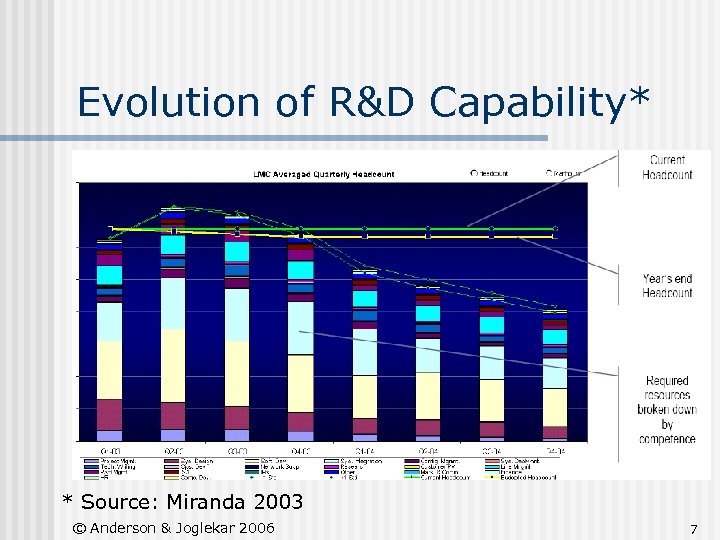
Evolution of R&D Capability* * Source: Miranda 2003 © Anderson & Joglekar 2006 7
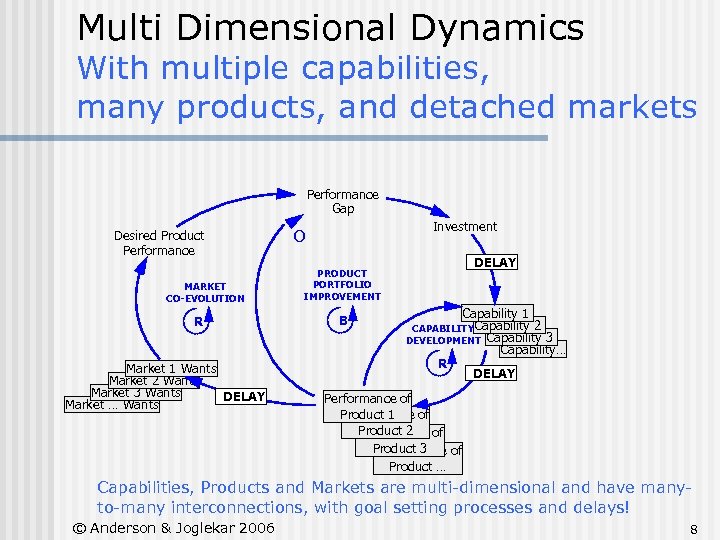
Multi Dimensional Dynamics With multiple capabilities, many products, and detached markets Performance Gap Desired Product Performance MARKET CO-EVOLUTION R Market 1 Wants Market 2 Wants Market 3 Wants DELAY Market … Wants Investment O DELAY PRODUCT PORTFOLIO IMPROVEMENT B Capability 1 CAPABILITYCapability 2 DEVELOPMENT Capability 3 Capability… R DELAY Performance of Product 1 Performance of Product 2 Performance of Product 3 Performance of Product … Capabilities, Products and Markets are multi-dimensional and have manyto-many interconnections, with goal setting processes and delays! © Anderson & Joglekar 2006 8
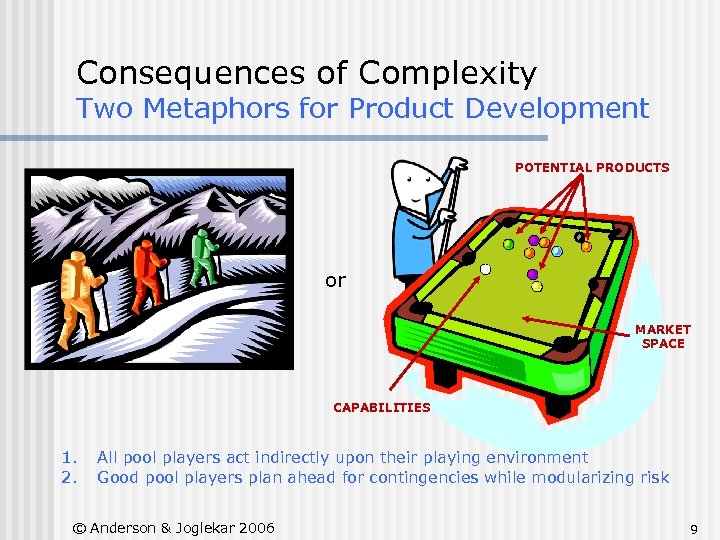
Consequences of Complexity Two Metaphors for Product Development POTENTIAL PRODUCTS or MARKET SPACE CAPABILITIES 1. 2. All pool players act indirectly upon their playing environment Good pool players plan ahead for contingencies while modularizing risk © Anderson & Joglekar 2006 9
Playing Pool within the Distributed Innovation Space? n n n Roadmap planning for product portfolios with contingencies (resources) with three modes of learning Invest in capabilities to support the portfolio using a real options approach Modularize your capabilities to support contingencies n Using the six modular operators* to deal with randomness, co-evolution, & tipping points * Split/exclude/substitute/augment/invert/port © Anderson & Joglekar 2006 10
Capability Interactions n Resources n n Separate projects require same capability; potential domino effect One capability dependent upon another • Complementarity if dependence is mutual n Communication n Interaction with other capabilities within projects (defined by architecture) • Overall product integration n Bundled or complementary products Piggybacking: Two projects utilizes the same capability to develop a common modular component Knowledge n Later projects require information (tacit knowledge, education, prior projects or diffusion) from capabilities developed during earlier projects © Anderson & Joglekar 2006 11
Capability Modularization Strategems n Time and resource buffering n n n Modular, uniform architecture & common business processes n n Encapsulates capability Provides “plug and play” personnel from each capability Enables off-the-shelf components Fungible skill-sets n n n By e. g. sacrificial functionality Isolate inter-capability risks (e. g. Intel’s operations strategy) Substitute capabilities Fungible capabilities (perhaps through cross-training) “A, B, C” Capability Map n n Insourcing, partial insourcing/in-house experts, complete outsourcing (Linked to real options approach) Utilize in combination with a ring-of-defense personnel strategy © Anderson & Joglekar 2006 12
Risks to Organizational Learning n Capabilities are tacit knowledge n n n Common architecture and business processes promote “core rigidities” n n Vulnerable to turnover Requires intra and inter-capability knowledge diffusion Tendency to ignore scouting except by integrative personnel and executives, reducing absorptive capacity Excessive overhead for mature industries n Starves investment in current capabilities © Anderson & Joglekar 2006 13
Recap n Product development is a complex system amenable to scenario planning using a real-options approach n n Capability planning is a high leverage activity n n n Modular risk management Risks to organizational learning Managerial Implications n n n Complexity created and managed by three learning loops: capability, product portfolio, and market In non-mature industries, use of scenario planning, with three modes of learning, to determine a long-term capability strategy is key Modularizing capability risk must be seen as a necessary hedge to enable long-term viability Research Implications n n Examine capability modularity in a manner analogous to study of component modularity Formal specification and testing of three modes of learning © Anderson & Joglekar 2006 14
Questions? We welcome your feedback … n joglekar@bu. edu n www. Ed. Anderson. org © Anderson & Joglekar 2006 15
Backup Slides
How Do We Play Pool with Distributed Innovation n n Product development is not predictable, but may be amenable to scenario planning Hence, you can plan for developing capabilities using a real-options approach, but you may need to these recombine these capabilities quickly. n n Suggests a decentralized, modular architecture for capabilities, whose carriers of tacit knowledge are people. n n This is only reinforced by the need to launch multiple test product probes to promote product learning to match market’s evolution of tastes (of course these coevolve, so you do get a Red Queen effect) One way to do this is to modularize your capabilities (by encapsulating business units with standard business processes), then capabilities (i. e. people) can be inserted and removed as necessary from a product’s development. Of course each product’s organization will need to be modularized as well. Also recommends test products, both to probe the shape of market demand also to provide development of capabilities. Created by splitting, inversion, and porting through encapsulation. Advantages: speed of reaction to market, allows augmentation, substitution, exclusion, Disadvantages: Opportunism and other bad behavior, overhead from encapsulation (learning standard business processes), and threats to organizational learning. How does this modular organization of technical capabilities diminish or create risk, and what threats do these make to organizational learning? © Anderson & Joglekar 2006 17
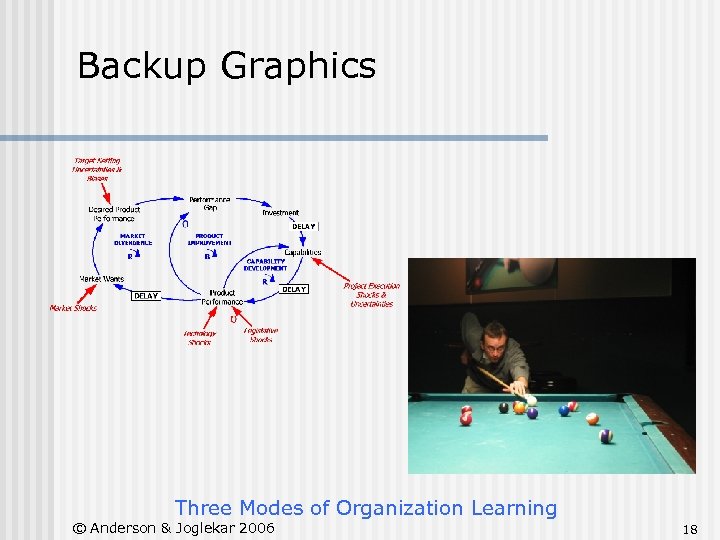
Backup Graphics Three Modes of Organization Learning © Anderson & Joglekar 2006 18
Marginally shuffled Nutshell Argument (NRJ) n Market, product, and capability learning create a complex system n n Some researchers assume that the planning landscape is given, and call for scenario planning (with ex-post selectionism and learning) with provisions for contingencies, both foreseen and unforseen (unk-unks) We argue that the landscape is not entirely random because there are basins of attraction. Furthermore, there is feedback between the market, your products, and your capabilities, so you may be able to shape your future (cars with safety features) in a modular manner. But tipping points all over, and even these modular actions are unpredictable. n Research Questions: How does one modularize capability risk? And, what are the downsides to modularizing capability risk for organizational learning, esp. innovation? • Carriers of tacit knowledge (capabilities) are people • Interactions between capabilities • Potential remedies n Hypotheses: • Three modes of learning for managing this risk! • Best dealt with by roadmap to develop capabilities through product introductions (which also improve market learning). © Anderson & Joglekar 2006 19
Скачать презентацию Organizational Learning and Distributed Innovation Planning Edward Anderson
b2bad25b6c82153bfc25190211b10672.ppt