


 Скачать презентацию Organizational Effectiveness The Role of Technology May 9
0b17da160841b84418b5a268004d4c7c.ppt
- Количество слайдов: 7
 Organizational Effectiveness The Role of Technology May 9, 2007 Don Blake, Senior Technologist
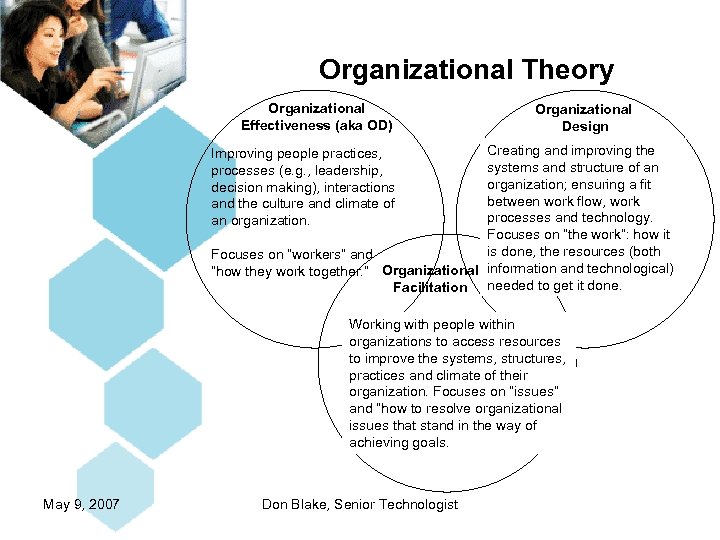 Organizational Theory Organizational Effectiveness (aka OD) Organizational Design Creating and improving the systems and structure of an organization; ensuring a fit between work flow, work processes and technology. Focuses on “the work”: how it is done, the resources (both Focuses on “workers” and “how they work together. ” Organizational information and technological) Facilitation needed to get it done. Improving people practices, processes (e. g. , leadership, decision making), interactions and the culture and climate of an organization. Working with people within organizations to access resources to improve the systems, structures, practices and climate of their organization. Focuses on “issues” and “how to resolve organizational issues that stand in the way of achieving goals. May 9, 2007 Don Blake, Senior Technologist
 Collaborative technology is a core enabler of the change process. Three widely recognized applications of technology in OD: • Quantitative, data-based assessment tools, such as employee surveys and 360 -degree feedback • Communications and teamwork, including document management and information sharing • Management and employee development, including online training. May 9, 2007 Don Blake, Senior Technologist
 OD approaches that embrace technology as an integrated component of the strategic change process itself can: • Enable whole system participation. Ideas, opinions and issues from all stakeholder groups can be shared and considered in a collective forum virtually and in connection with face-to-face meetings. • Rapidly align dispersed stakeholders. Creating alignment between stakeholders who are located across the country or the globe can take months or years. • Accelerate organizational readiness. Inviting the whole system to participate in the change process enhances communication, fosters buy-in and establishes a level of readiness for change that traditional communications plans cannot easily achieve. May 9, 2007 Don Blake, Senior Technologist
 OD approaches that embrace technology as an integrated component of the strategic change process itself can: • Produce higher quality strategies and plans. Through obtaining direct input from both a horizontal and vertical slice of the organization, as well as partners, customers, and other stakeholder groups, more robust ideas and work products can be produced. • Foster collaborative learning and knowledge sharing. By linking together stakeholders that would not otherwise connect and communicate, it becomes possible to harness learning and knowledge in ways that surface and diffuse best practices, which leads to a greater capacity for innovation and organizational agility. May 9, 2007 Don Blake, Senior Technologist
 Collaborative technology has become a core enabler of the change process. The WROE program models (not mandates) uses of existing technologies to which it has access in an effort to support: • Quantitative, data-based assessments (Survey Monkey). • Communications and teamwork, including document management, information sharing and team building. (Blogging and Social Networking) May 9, 2007 Don Blake, Senior Technologist
 The Road Ahead: Module 3 and Beyond Key Discussion Points (obtained from Online Survey): OD uses knowledge and techniques from the behavioral sciences to improve performance through trust, open confrontation of problems, empowerment and participation of staff, the design of meaningful work, cooperation between groups, and the full use of human potential. May 9, 2007 1. Access to which technology tools --Difference between Blogging and Social Networking --Association support 2. Comfort level of WROE participants --Time --Security issues 3. Buy-in to virtual participation --Obvious, clear value to WROE program (ME) Don Blake, Senior Technologist