


 Скачать презентацию Organization Theory Strategy Implementation Process Steven E Phelan
00ac0efc5e3c84093f0b8158a2ea7b6d.ppt
- Количество слайдов: 47
 Organization Theory: Strategy Implementation Process Steven E. Phelan June, 2006 Bureaucracy Scale & Scope Economics of Organization
 Who am I? Associate Professor of Strategic Management at UNLV, formerly at UT Dallas I have taught MBA students in 5 countries: Australia, Hong Kong, Singapore, Italy, and US. Taught EMBA students at UT Dallas and UT Austin Practitioner background: l l l Telecom Australia Ansett Airlines Bridges Management Group (worked on credit cards, loyalty schemes, distribution strategy, new product development, and acquisitions)
 What is this course about? Organization Theory l l l Lots of academic textbooks Large membership in AOM (2000+) Dry as dust Strategy Implementation l l No textbook since 1980 s We know a plan is no good unless it is implemented – kind of important then The chosen path… l Cover the interesting parts from OT and explore something useful in strategy implementation (Strategy Execution & Change Management).
 Goals To be able to view organizational life through different lenses To develop a critical appreciation of organizational discourse To have an understanding of the major issues in strategy execution and change management To have acquired skills in changing organizations To gain an appreciation of some of the issues in strategy implementation
 Assessment Class Participation (30%) Personal Diary (35%) Change Agent Interview (35%)
 Teaching Philosophy I am not into one-way transmissions of information I favor a collaborative learning environment: We learn from each other We learn from the problems and issues we identify and how we solve them I see myself as a coach or mentor guiding the learning experience Thus, the ultimate responsibility for learning is with you l l l Read the materials Come to class prepared to discuss relevant aspects of your organizational life (or lives) PLEASE interrupt, discuss, question, argue, debate, clarify
 Overview of Today One Right Way Metaphor in organizations Organizations as machines Perrow on Bureaucracy Chandler on Scale and Scope Paths of Glory DVD – Video Case Study Contingency theory Morgan Ch. 3 Phelan on Economics of Organization
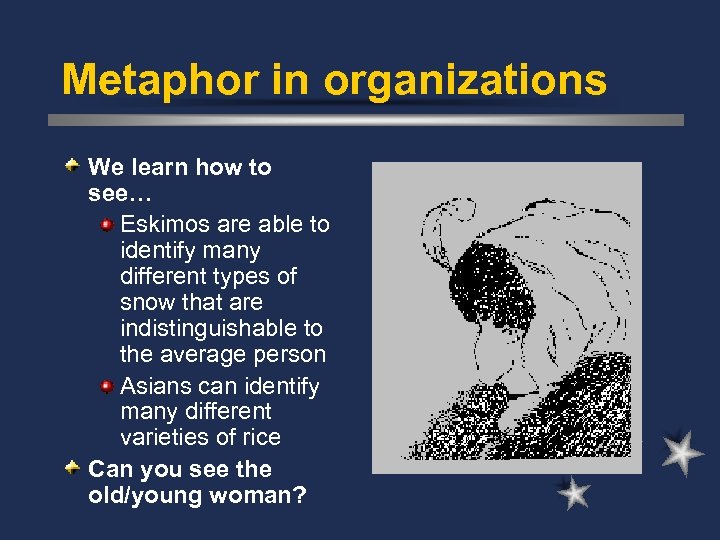 Metaphor in organizations We learn how to see… Eskimos are able to identify many different types of snow that are indistinguishable to the average person Asians can identify many different varieties of rice Can you see the old/young woman?
 Morgan on Metaphor What, then, is truth if different people learn to see the same thing in different ways? Is there value in teaching people to see their organizations in different ways? “If you only have a hammer, does every problem become a nail? ” “The test of a first-rate intelligence is the ability to hold two opposed ideas in mind at the same time and still retain the ability to function” -- F. Scott Fitzgerald “It is easy to teach anybody a new fact…but it needs light from heaven to enable a teacher to break the old framework in which the student has been accustomed to seeing” -- Arthur Koestler
 Developing multiple interpretations “At Foxboro, a technical advance was desperately needed for survival in the company’s early days. Late one evening, a scientist rushed into the president’s office with a working prototype. Dumbfounded at the elegance of the solution and bemused about how to reward it, the president bent forward in his chair, rummaged through most of the drawers in his desk, found something, leaned over the desk to the scientist, and said, “Here!” In his hand was a banana, the only reward he could immediately put his hands on. From that point on, the small ‘gold banana’ pin has been the highest accolade for scientific achievement at Foxboro. ” Can you develop 3 different angles or viewpoints on this story?
 Viewing your organization as if you were from a foreign land… On first joining… What struck you as being novel, strange, or different about the way things happened compared to your expectations or what you had become used to elsewhere?
 Organizations as Machines
 Organization as machine Pre-determined goals and objectives A rational structure of jobs and activities Its blueprint becomes an organizational chart People are hired to operate the machine and behave in a predetermined way When an organization is seen as a machine it is expected to operate in a routinized, efficient, reliable, and predictable way
 Max Weber The bureaucratic form routinizes the process of administration exactly as the machine routinizes production. Bureaucracies provide: Precision, speed, clarity, regularity, reliability, and efficiency Through: A fixed division of tasks, hierarchical supervision, and detailed rules and regulations
 Purging Particularism According to Perrow, one of the major benefits of bureaucracy is purging particularism (incl. nepotism and favoritism) Loyalty to the king was once everything, incompetence counted for little Tenure was a early invention that provided freedom from unjust authority, separating the office from the person further controlled it. However, nepotism is still a big problem in a lot of countries – e. g. Italy, Mexico, China Why is it so bad? Because there is often little relationship between the social criteria for hiring or promoting people and the characteristics that affect performance in the organization It may even hurt performance (lower morale, motivation etc. )
 Perrow on corruption Corruption (or enlightened self-interest) is also a likely to accompany favoritism Perrow argues corruption is good for the individual and sometimes even good for the organization l l “one of the best ways to seize or retain control [of an organization] is to surround oneself with loyal people” It doesn’t hurt to have a sympathetic friend in government Bureaucracy limits corruption: l l “since official goals are proclaimed, unofficial, unpublicized, and unlegitimated uses can be held up to scrutiny when they are found, and action can be taken. ” “The hidden uses of organizations, always present, can be exposed and addressed”
 Hierarchy Downside to hierarchy: Lack of motivation - ‘not my problem’ Fear of passing bad news or suggesting changes Buck passing Delays and sluggishness Dictatorial/ignorant decisions by superiors Stifling of independence and creativity
 The Upside Perrow argues that: A lack of coordination between departments The failure to exercise authority or be decisive, and A lack of accountability are, in fact, much worse problems than the problems identified on the previous slide Do you agree?
 Strengths of the machine metaphor For Morgan, mechanistic approaches work well when: There is a straightforward task to perform The environment is stable and predictable (to enable efficient division of labor) When one produces the same product time and again When efficiency and precision are at a premium When the human parts are compliant and behave as they have been designed For Perrow: Bureaucracies limit particularism and self-interest, and promote coordination
 Limitations of the machine metaphor Bureaucracies have difficulty adapting to change They are designed to achieve predetermined goals not innovation It takes time to get an efficient division of labor through detailed job analysis
 Moreover… Mechanistic approaches result in mindless and unquestioning bureaucracy Problems can be ignored Communication can be ineffective Paralysis and inaction can lead to backlogs Senior managers can become remote Specialization creates myopia and NIH syndrome Employees know what is expected of them but also what is not expected of them Initiative is discouraged
 Chandler on Scale & Scope Large plants produce products at a much lower cost than small plants (scale) Large plants can make a variety of products from the same raw materials (scope) A constant flow of supply and demand is needed for full capacity utilization The railroad, telegraph, and steamship made this possible Professional managers were needed to coordinate production and distribution (I. e. sales & marketing) Significant first mover advantages
 Modern scale and scope Does Chandler’s argument apply in the Internet age? Think: l l Microsoft/Intel Amazon Google/Yahoo Ebay What are the lessons for: l l l Startups? Followers? Leaders? How can scale/scope advantages be lost?
 Paths of Glory DVD What are the strengths and weaknesses of army bureaucracy in the movie (use Perrow)? What evidence of particularism is there? Should/could the organization be redesigned? How would you change the incentive system?
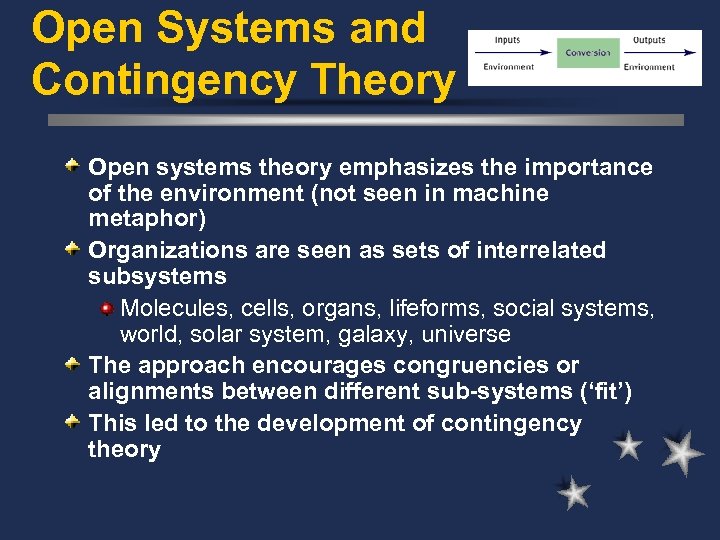 Open Systems and Contingency Theory Open systems theory emphasizes the importance of the environment (not seen in machine metaphor) Organizations are seen as sets of interrelated subsystems Molecules, cells, organs, lifeforms, social systems, world, solar system, galaxy, universe The approach encourages congruencies or alignments between different sub-systems (‘fit’) This led to the development of contingency theory
 Contingency theory There is no best way of organizing. The appropriate form depends on the kind of task or environment – many species of organizations Management’s job is achieving alignment or fit Fit applies not only to the org-env but also between sub-systems in an organization
 First distinction Mechanistic vs organic (Burns and Stalker) Changing technology or market conditions pose new problems and challenges that require open and flexible styles of organization and management Lawrence and Lorsch showed that styles of organization might need to vary between organizational subunits e. g. R&D departments need to be organized differently from production departments) How is this different from an ideal bureaucracy?
 Typologies This research led to the development of typologies of organizations: Miles and Snow l Prospectors, analyzers, defenders Mintzberg l Machine bureaucracy, divisionalized form, professional bureaucracy, simple structure, adhocracy BCG l Cash cows, dogs, stars, question marks Porter l Cost leadership, differentiation, focus
 Other developments Organization development The belief that we can diagnose the environment and thus improve internal and external fit Expert Systems Burton and Obel even developed an expert system to choose the right structure for an organization
 Strengths of the Organismic Metaphor Organizations must always pay close attention to their external environments Achieving congruence with the environment becomes a key managerial task What are the implications for strategy implementation?
 Limitations of the Organismic Metaphor Organizations are not organisms Environments are not concrete Actual vs perceived vs enacted Metaphor overstates degree of functional unity and cohesion in most organizations and top management’s ability to choose subsystem settings Can lead to social Darwinism and other ideological traps i. e. the best performing organizations are the fittest and thus the ‘best’ No guarantee the best today will be the best tomorrow
 Ecoomics of Organization Why do firms exist? OR why is all production not undertaken by one giant firm? Subset of wider question Why do we see a diversity of economic arrangements? Spot contracts, joint ventures, firms, strategic alliances, franchises etc. Payoff for managers Should help in determining the vertical boundaries of the firm = corporate strategy Should help in deciding when to start a new business – when you can beat the market
 The Basics Adam Smith The wealth of society grows when we allow people to specialize in activities in which they have a comparative advantage and then exchange their surplus with other specialists Harold Demsetz A firm is any individual or group that produces for exchange rather than personal consumption The alternative to the firm is therefore NOT the market but the household Firms exist only because of gains from specialization But, ‘the division of labor is limited by the extent of the market’ Firm vs. market decisions are really MY firm vs. YOUR firm decisions
 Coordination economy require the Most products in today’s input of a multitude of specialists First, an entrepreneur must perceive a need for a product or service Then, identify the inputs required to produce the product or service Then, assemble the inputs – make or buy (rent or own) This problem of coordination is to make the right combination of make and buy decisions to maximize producer surplus or profit Think of the inputs required to get just one product to market – start small…a pencil
 Cooperation Naturally, the specialists providing the inputs will try to maximize their own gains from exchange The problem of cooperation is ensuring that the specialists (or agents) do what they are paid to do (i. e. that they don’t shirk or act opportunistically) This is usually achieved through a combination of incentives and supervision (monitoring). The problems of coordination and cooperation arise because of information costs In a world with perfect knowledge/information these problems would not exist. Why?
 Efficiency An organization is efficient when it has no better way of organizing itself i. e. all opportunities for gain or profit are exhausted Decisions are efficient with respect to information and transaction costs as well as coordination and cooperation costs Is it efficient to sell wine for $5 per bottle in Las Vegas and the same wine for $10 per bottle in Henderson?
 Efficiency Tautology If I could have made a better decision then I would have But I didn’t so the actual observed outcome must be the most efficient case. Decisions can be efficient ex ante but appear inefficient ex post. Regret is irrelevant if it is too costly to change a decision. So, if we commonly observe firms, joint ventures, strategic alliances, and market exchanges then they must all be efficient in some circumstances. The task is to figure out when and why.
 Ronald Coase (1937) Firms exist because there are costs to using the market Transaction costs are the costs of: Searching for sellers of inputs and buyers of outputs, and negotiating and enforcing contracts between them when found Long term contracts lower these transaction costs but require more flexibility for unforeseen developments, hence employment contracts usually allow employers to direct employees (specialists) to any reasonable task All transactions do not occur in one firm: The number, dispersion, and dissimilarity of transactions increases coordination (administrative) costs What about cooperation costs?
 Applications What is the effect on firms of: Railroads/telegraph/telephone Internet Government corruption Single European market
 Alchian and Demsetz (1972) Firms are a fiction There is no difference between an employment contract and a market contract Firms are just a particularly dense ‘network of contracts’ Team production provides opportunities for shirking (agency costs) Someone must monitor the shirkers but who monitors the monitor? Solution: Give monitor rights to residual income --> provides strong incentive to monitor well
 Holdup (another transaction cost) Relying on a single supplier creates an incentive for opportunism in the form of hold-up E. g. If I make you the exclusive supplier of a critical part then I expose myself to your demands Firms integrate to avoid the threat of hold-up or the costs of avoiding it (e. g. litigation, distrust) Integration is efficient if the transaction costs of hold-up exceed governance costs In theory, hold-up should be very rare because potential victims will integrate before being held up.
 Property Rights Why is the firm defined by ownership of physical assets? Grossman, Hart, and Moore (1986, 1990) say it is because asset ownership grants residual rights of income and control Owners can freely allocate assets to new uses AND control access to assets (=power) They also keep any income from new uses Thus, assets with real options should be owned Note, human capital cannot be owned so doctors and lawyers tend to form partnerships. Why?
 Summary: Reasons to Make To avoid ex ante transaction costs Searching, negotiating, re-negotiating, and enforcing contracts To avoid ex post transaction costs Holdup and costs of avoiding holdup To gain upside from ownership advantage Ability to re-deploy or sell resources To gain management by fiat (authority)
 Reasons to Buy Specialization (Smith) Market specialists have greater economies of scale and scope Information (Hayek) Market prices signal profit opportunities Market prices tell us how consumers value various offerings Market prices also convey information on supply and demand conditions All difficult to duplicate in companies
 Incentives Markets provide high powered incentives Pay for performance Firms must be efficient and innovative to survive (But measures must be affordable and relevant) Firms often use low powered incentives (wages) Creates shirking and agency costs (costs of monitoring) and influence costs Lack of internal competition generates inertia
 Other reasons Business models may be dissimilar Concept of dominant logic External suppliers may have unique capabilities For instance, if Intel is the only company capable of producing a certain microprocessor Using outsiders reduces risk and increases flexibility Suppliers can be changed Risk and lack of flexibility are also costs of doing business
 Final Thoughts Alternative forms of organization exist Strategic alliances, joint ventures, keiretsu, clanbased organization, franchises According to efficiency principle, the fact that these forms persist points to their relative efficiency All make/buy decisions are a balance of Technical efficiency and agency efficiency Transaction costs and governance (administrative) costs There is no such thing as a costless organization